⏱ 20 min read
Distributed systems rarely fail because we forgot how to serialize JSON. They fail because we confuse the thing that happened in the business with the machinery that carries news of that thing across a hostile landscape of brokers, retries, schema evolution, and partial outages.
That confusion is expensive.
An enterprise says, “Customer address changed.” The platform says, “Here is a Kafka record with headers, correlation IDs, content type, partition key, trace context, tenant marker, schema version, security classification, and maybe a dead-letter reason if things go badly.” Both are true. Only one belongs to the domain. The other belongs to the road. event-driven architecture patterns
The message envelope pattern exists because roads matter. And because good architects know the difference between cargo and container.
In event-driven architecture, especially in Kafka-heavy microservice estates, the envelope is the structure that wraps a domain message with metadata needed for transport, routing, observability, security, compatibility, and operations. Used well, it creates a clean separation between domain semantics and integration concerns. Used badly, it becomes a junk drawer where every team stuffs random headers and accidental coupling.
This article is about using envelopes properly: not as an excuse for more abstraction, but as a disciplined way to preserve meaning while surviving scale.
Context
Most enterprises do not start with pure event-driven design. They start with applications. Then they add integration. Then they add queues. Then Kafka. Then audit requirements. Then multi-region failover. Then legal retention. Then someone asks why two services disagree on whether an order was cancelled.
By that point, messages are no longer simple payloads. They are artifacts crossing organizational, technical, and temporal boundaries.
In a small system, a message body may be enough:
But in a real enterprise landscape, that body is only part of the story. Consumers need to know:
- what type of event this is
- which schema version it conforms to
- when it happened versus when it was published
- who originated it
- which tenant or region it belongs to
- how to correlate it to a business process
- whether it contains sensitive data
- whether it is a command, event, notification, or integration fact
- what to do if the payload cannot be parsed anymore three years from now
This is where the envelope enters. It is not ornamentation. It is survival gear.
The deeper reason is domain-driven design. In DDD terms, a domain event should express a meaningful business fact inside a bounded context: PolicyIssued, PaymentCaptured, ClaimRegistered. The transport substrate should not pollute that language. A premium calculation service should not need to care whether the event came through Kafka headers, AMQP properties, or an S3-backed replay pipeline. Domain meaning must remain stable even when infrastructure changes under it.
That is the architectural heart of the pattern.
Problem
Without a clear envelope pattern, event-driven systems drift into one of two ugly shapes.
The first is the naked payload. Teams put only business fields in the message body and rely on broker-specific metadata, tribal knowledge, and consumer guesswork for everything else. It feels lean. It also falls apart once you need versioning, tracing, replay, compliance, or cross-platform integration.
The second is the payload swamp. Everything gets shoved into the body: domain data, transport metadata, retry counters, topic names, technical flags, routing hints, and internal implementation details. The event stops being a business fact and becomes a serialized pile of anxiety.
Both shapes damage the architecture.
A naked payload creates ambiguity. A swamp payload creates coupling.
In enterprises, the real cost shows up later:
- consumers break because schema evolution was informal
- audit teams cannot reconstruct event lineage
- multi-tenant data leaks because context was carried inconsistently
- reconciliation jobs need brittle custom logic because timestamps mean different things in different services
- platform teams cannot standardize observability because every producer invents its own metadata conventions
- downstream bounded contexts consume internal details and become dependent on upstream implementation
If you are doing event sourcing, integration events, CDC feeds, or asynchronous workflow orchestration, this gets worse. You are not just moving data. You are preserving meaning over time. Meaning decays quickly when wrapped in improvisation.
Forces
The message envelope pattern exists because several forces pull in different directions.
1. Domain purity versus operational reality
DDD tells us to model the business language clearly. Operations tells us every message must be traceable, replayable, observable, and governable. These are both valid demands. The envelope is the compromise that keeps them from contaminating each other.
2. Loose coupling versus standardization
Teams want autonomy. Platform teams want consistency. If each team invents headers and metadata ad hoc, consumers inherit chaos. If the platform mandates an overengineered canonical envelope for every use case, teams work around it. The right pattern standardizes the essentials and leaves the domain payload alone.
3. Broker independence versus practical use of Kafka features
Kafka headers are useful. So are partition keys and record timestamps. But making your event model depend entirely on Kafka mechanics makes migration harder. The envelope should allow pragmatic use of Kafka without fusing domain semantics to Kafka internals.
4. Evolution over time
Schemas evolve. Meanings evolve more carefully. A version number alone is not enough. Consumers need to understand event type lineage, backward compatibility policy, and potentially transform older envelopes during replay or migration.
5. Replay and reconciliation
In real enterprises, reconciliation is not a corner case. It is routine. Systems miss events. Consumers lag. external APIs fail. Data must be repaired. An envelope can carry the metadata needed to compare source truth, replay windows, deduplicate processing, and explain discrepancies.
6. Security and governance
Classification labels, tenant markers, legal retention indicators, and provenance are not domain concepts, but they matter. The envelope gives them a home that does not poison the business language.
Solution
The solution is straightforward in principle and surprisingly easy to get wrong in execution:
Separate the message into two parts:
- Payload — the domain fact or command, expressed in domain language
- Envelope — the metadata required to move, process, observe, secure, and evolve that payload
A typical conceptual envelope looks like this:

That diagram hides a hard truth: deciding what belongs in the envelope is architecture, not formatting.
My rule is blunt:
> If a field changes the meaning of the business event, it belongs in the payload.
> If it explains how the event should be processed, traced, governed, routed, or evolved, it belongs in the envelope.
For example:
orderStatus = SHIPPEDbelongs in payloadeventType = OrderShippedbelongs in envelopecustomerTier = GOLDbelongs in payload if it is part of business meaningschemaVersion = 3belongs in envelopetenantIdis often envelope metadata, unless tenancy itself is part of the domain modeloccurredAtoften belongs in envelope, but if the business meaning depends on a domain-effective date, that date belongs in payload too
That last point matters. Enterprises often confuse business time with integration time. They are not the same. A claim may be registered at 9:03, validated at 9:10, and published at 9:12 after a retry. If settlement logic uses registration time, that timestamp is domain data, not transport metadata.
Good envelope design respects time as a first-class architectural concern.
Canonical envelope fields
Not every system needs every field, but mature estates usually converge on a core set:
messageIdeventTypeormessageTypeschemaVersionsourceoccurredAtpublishedAtcorrelationIdcausationIdtenantIdpartitionKeyor aggregate key referencetraceContextsecurityClassificationidempotencyKeywhere needed
Do not add fields because they feel useful. Add them because they resolve a recurring operational or semantic problem.
Envelope in headers or body?
This is the classic question. The answer is: both are viable, but choose deliberately.
- Broker headers are efficient for routing, tracing, and middleware concerns.
- Envelope in the message body is more portable, more replay-friendly, and easier to persist consistently outside the broker.
In Kafka-centric enterprises, a common compromise works well:
- critical metadata for platform tooling in Kafka headers
- durable business-relevant integration metadata also represented in a structured envelope body
Yes, this duplicates some values. That is acceptable when it avoids broker lock-in and improves replay and audit.
The architecture is not a purity contest. It is a bet on future maintenance.
Architecture
A practical envelope architecture in a Kafka and microservices environment usually includes four layers of concern: microservices architecture diagrams
- Producer domain model
- Envelope assembly
- Broker transport
- Consumer interpretation
The producer emits a domain event from inside its bounded context. An integration layer maps that event into an envelope, enriching it with metadata from infrastructure or process context. Kafka transports it. Consumers first interpret the envelope, then deserialize and process the payload according to event type and version.
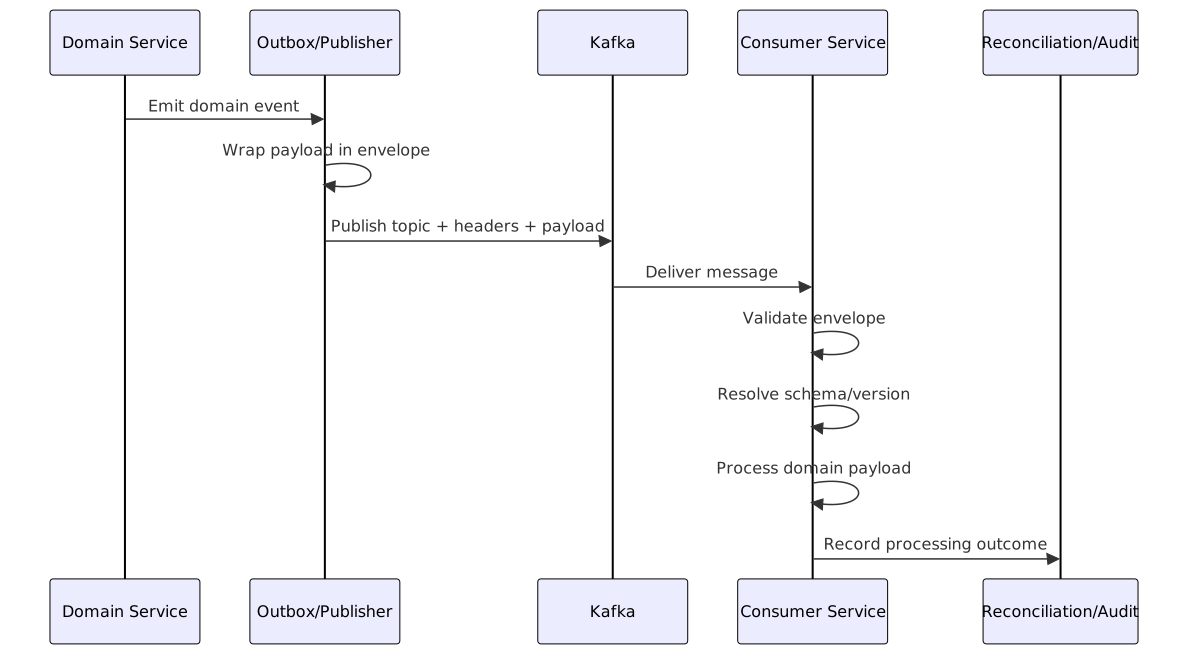
The outbox connection
In serious systems, the envelope pattern pairs naturally with the transactional outbox. The service commits domain state and stores the event plus envelope metadata in the same transaction. A publisher later sends it to Kafka.
This matters because an envelope often carries provenance: message ID, aggregate ID, occurred-at time, source context, and sequence hints. Those should be generated close to the transaction that produced the business fact, not reconstructed later from logs and hope.
Bounded contexts and semantic translation
DDD changes how we should think about envelopes. The envelope is not a license to create a global canonical business model. That way lies enterprise integration theater.
Each bounded context should own its payload semantics. The envelope standardizes technical metadata, not business language. If Sales says OrderBooked and Fulfillment says OrderReleased, do not force both into a fake universal noun because the messaging platform wants one “enterprise schema.” Translate at context boundaries.
That translation may include envelope-level changes too. A public integration event may keep the same payload concept but alter metadata classification, source identity, visibility, or schema lineage. The envelope becomes part of the anti-corruption layer.
Ordering, partitioning, and aggregate identity
Kafka brings a practical concern: ordering only exists within a partition. If event processing depends on aggregate order, the envelope or headers must consistently carry the partitioning key. Usually that key is a stable business identifier such as orderId, accountId, or policyId.
Be careful here. The partition key is not just performance tuning. It encodes processing assumptions. If one team partitions by customer and another by order for related events, downstream reconciliation becomes painful and apparent ordering guarantees become fiction.
Versioning strategy
Versioning belongs in both schema governance and semantic governance. EA governance checklist
A payload can often evolve with additive changes. An event’s meaning should evolve far more cautiously. If the semantics change materially, publish a new event type rather than quietly bumping a version. CustomerAddressChanged is not the same as CustomerContactPreferencesUpdated, even if both touch the same aggregate.
The envelope should therefore support:
- event type identity
- schema version
- source identity
- optional deprecation metadata in governance tooling
Version numbers are cheap. Semantic discipline is not.
Migration Strategy
Most organizations do not wake up one morning and replace all events with a neat envelope pattern. They inherit a patchwork. Migration must be progressive, survivable, and measurable.
That means strangler migration, not big-bang reform.
Step 1: classify current message shapes
Inventory existing topics, queues, and event types:
- payload-only messages
- payloads with embedded technical metadata
- broker-header-heavy messages
- CDC events from databases
- commands disguised as events
- event names that are really CRUD notifications
You cannot migrate what you have not named.
Step 2: define the minimum viable envelope
Resist the temptation to design the “perfect enterprise envelope.” Start with a small mandatory set:
- message ID
- type
- version
- source
- occurred-at
- correlation ID
Then add optional metadata for tenancy, security, and tracing based on actual needs. Migration succeeds when producers can adopt the pattern incrementally.
Step 3: introduce envelope adapters
For legacy publishers, add an adapter layer that wraps existing payloads before publication or at egress gateways. For legacy consumers, build dual-read capability so they can understand both old and new forms during transition.
Step 4: publish compatibility rules
The hardest migration problem is not code. It is ambiguity. Teams need clear rules:
- which envelope fields are mandatory
- what timestamps mean
- how event type naming works
- where schema version is stored
- whether headers and body must be kept in sync
- how idempotency is achieved
Without this, every “standard” decays into folklore.
Step 5: support replay and reconciliation from day one
Migration breaks trust unless consumers can prove the new path preserves business truth. That means replay tools, audit comparison, and reconciliation reports. If you change message shape but cannot reconcile old and new event histories, the business will rightly refuse the rollout.
Step 6: retire old formats topic by topic
Use topic gateways, schema registry rules, consumer cutover metrics, and dead-letter tracking to phase out old shapes gradually.
Here is a typical strangler path:
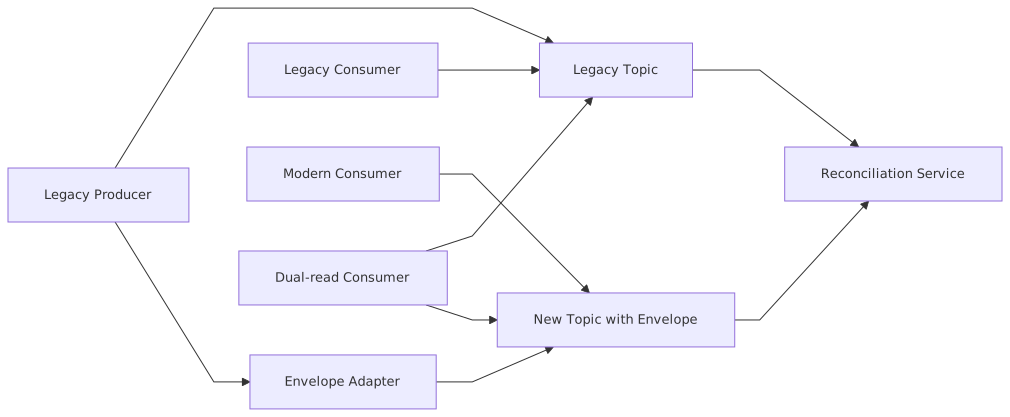
This is not glamorous work. It is enterprise architecture in its natural habitat: reducing risk while changing the rails under a moving train.
Reconciliation during migration
Reconciliation deserves more attention than it usually gets.
When message structure changes, three things commonly drift:
- event counts
- event timing
- event interpretation
A reconciliation service or process should compare:
- source transaction records versus published envelope records
- old topic versus new topic counts by business key and time window
- consumer state derived from legacy versus enveloped events
If a migrated payment stream shows 99.8% parity, that is not success. It is 0.2% of financial truth missing in action.
Good reconciliation design uses the envelope to help:
messageIdfor uniquenesssourcefor provenanceoccurredAtandpublishedAtfor timing analysiscorrelationIdfor process-level grouping- optional sequence numbers for aggregates where strict lineage matters
Enterprise Example
Consider a global insurer modernizing claims processing.
The company has:
- a 20-year-old policy administration platform
- a claims platform split into microservices
- Kafka as the event backbone
- regional data residency rules
- nightly reconciliation with finance
- multiple downstream consumers for fraud, customer communications, analytics, and reinsurance
Originally, claim-related events were inconsistent. Some services published payload-only JSON. Others relied on Kafka headers for event type and tenant. CDC streams from the core policy database emitted raw table-change events. Fraud consumed one shape. Analytics consumed another. Replays were a nightmare because historic metadata was incomplete.
The turning point came after a production incident. Claims in one region were processed twice after a consumer failover. The payload had no stable message identity, the topic headers were not preserved in the replay archive, and downstream systems could not distinguish redelivery from genuine duplicate business events. Settlement reconciliation took three days.
The architecture team introduced a message envelope standard for integration events:
messageIdeventTypeschemaVersionsourceSystemregiontenantIdoccurredAtpublishedAtcorrelationIdcausationIdclassification- payload
The payload remained domain-specific:
ClaimRegisteredClaimCoverageValidatedClaimPaymentAuthorized
Notably, they did not build a universal “InsuranceBusinessEvent” schema. Claims, policy, and payments each kept their bounded-context language. The envelope standardized transport and governance, not domain semantics.
They also introduced:
- transactional outbox in new microservices
- CDC-to-envelope adapters for legacy platforms
- schema registry policies
- a replay service that read archived enveloped events
- reconciliation jobs comparing claim IDs, payment IDs, and envelope message lineage
The result was not perfection. It was control.
Operational teams could trace a claim payment across services. Regional retention policies could be enforced using envelope classification. Fraud could subscribe to domain events without understanding legacy source quirks. Finance reconciliation improved because occurredAt and publishedAt were explicitly separated, exposing latency versus true business timing.
The biggest win, though, was social: teams finally had a common language for discussing message design. And in enterprises, shared language is often more valuable than shared tooling.
Operational Considerations
Envelope patterns look elegant on whiteboards and become real in operations.
Observability
A message envelope should support tracing across asynchronous boundaries. Correlation and causation IDs are the practical backbone of this. If your tracing stops at the HTTP gateway and vanishes in Kafka, you do not have distributed observability. You have expensive guessing.
Dead-letter and retry handling
Do not mutate the original payload to store retry metadata. That belongs outside the domain fact. Retry counts, dead-letter reasons, and last failure timestamps can live in headers, side stores, or operational wrappers around the original envelope.
The original event should remain immutable.
Schema management
A schema registry helps, but it does not save poor semantics. Register payload schemas, validate compatibility, and keep envelope structure stable. Frequent envelope changes are a red flag; they indicate your platform concerns are not settled.
Security and privacy
Classification metadata in the envelope can drive policy enforcement:
- encryption requirements
- redaction on replay
- routing restrictions by region
- retention windows
But never assume metadata alone protects sensitive payloads. Governance labels are signs on the door, not locks. ArchiMate for governance
Storage and replay
If replay matters, archive the full durable message representation, including enough envelope metadata to reconstruct processing decisions. Broker-only metadata often disappears in external archives. This is why many enterprises keep a structured envelope in the body even when duplicating key fields in Kafka headers.
Idempotency
At-least-once delivery is normal in Kafka ecosystems. Consumers need stable identifiers. The envelope is the right place for message identity and idempotency support. But remember: idempotency is not free. It requires storage, time windows, and a clear definition of what “same message” actually means.
Tradeoffs
The envelope pattern is useful because the world is messy. It also introduces its own mess.
Benefits
- clearer separation of domain and infrastructure concerns
- better observability and governance
- easier replay, audit, and reconciliation
- improved compatibility management
- reduced broker lock-in
- stronger operational consistency across teams
Costs
- additional payload size
- more design decisions upfront
- governance overhead
- risk of overstandardization
- possible duplication between headers and body
- need for tooling and libraries
The biggest tradeoff is subtle: envelopes make integration cleaner, but they can tempt architects into centralization. A standard envelope is good. A centrally mandated universal domain schema is usually bad.
The line matters.
Failure Modes
Patterns do not fail in theory. They fail in implementation.
1. The envelope becomes a dumping ground
Teams put every field imaginable into metadata. Soon nobody knows what is authoritative. If both payload and envelope contain business state, your architecture is already drifting.
2. Event type names become technical instead of semantic
Names like customer-service-event-v4 are a sign of surrender. Event types should communicate domain meaning, not repository structure.
3. Envelope standards are too rigid
If onboarding a new producer requires six committees and thirty mandatory metadata fields, teams will bypass the standard and publish side-channel topics.
4. Replay loses metadata parity
If the archive keeps payloads but drops headers, or vice versa, replay results differ from original processing. This is a common and painful enterprise failure mode.
5. Timestamps are semantically confused
occurredAt, processedAt, publishedAt, and business effective dates get mixed. Reconciliation then becomes guesswork disguised as SQL.
6. Consumers couple to producer internals
A producer leaks implementation details in metadata, and consumers start depending on them. You now have distributed temporal coupling with better formatting.
7. Migration creates dual truth
Legacy and enveloped topics coexist too long without reconciliation discipline. Different consumers trust different streams. The platform gains structure while the business loses confidence.
When Not To Use
Not every message needs a formal envelope.
Do not use a heavyweight envelope pattern when:
- communication is strictly internal within a small, stable module
- the broker and consumers are tightly controlled and ephemeral
- throughput is so extreme that every byte matters and metadata can safely remain in broker-native structures
- the event is temporary telemetry rather than business integration
- the system is simple enough that added abstraction would outweigh value
In other words, do not put a shipping container around a paper note passed across one desk.
Also be wary in low-maturity teams. If people are still arguing about what an event is, adding an elaborate envelope can institutionalize confusion instead of solving it. Sometimes the right move is first to clarify event taxonomy—domain event, command, notification, CDC fact—before standardizing wrappers.
Related Patterns
The envelope pattern rarely stands alone. It works best with a small ecosystem of supporting patterns.
Transactional Outbox
Ensures state change and event publication stay consistent. Essential when envelope metadata should reflect the same transaction as the business fact.
Schema Registry
Manages payload and compatibility rules. Useful, but not a substitute for semantic discipline.
Anti-Corruption Layer
Translates external events into the local bounded context. Often maps both payload semantics and envelope metadata.
Event Versioning
Supports additive change and explicit semantic evolution. Best handled through event type governance plus schema compatibility.
Idempotent Consumer
Uses message identity and processing records to handle redelivery safely.
Dead Letter Queue / Topic
Captures processing failures without mutating original events.
CDC Adapter
Wraps raw database changes into a more meaningful integration envelope when legacy platforms cannot emit proper domain events directly.
These patterns together create a platform that can evolve without erasing business meaning.
Summary
The message envelope pattern is one of those ideas that seems mundane until you have lived without it.
It is not glamorous. It does not promise magical decoupling. It will not rescue a weak domain model. But in event-driven enterprise systems, especially those built on Kafka and microservices, it does something more important: it keeps business meaning separate from the mechanics of transport.
That separation pays off in versioning, tracing, replay, reconciliation, migration, and governance. It supports domain-driven design by protecting payload semantics inside bounded contexts while giving the platform a consistent place for operational metadata. It makes strangler migration feasible because old and new message shapes can coexist under a shared integration contract. It gives operations a handle. It gives architecture a seam.
Used badly, it becomes a bureaucratic wrapper around confusion. Used well, it is a quiet piece of structural integrity.
And that is often what real architecture looks like. Not novelty. Not fashion. Just a sound container, carrying valuable cargo across rough ground without letting the road rewrite the message.
Frequently Asked Questions
What is enterprise architecture?
Enterprise architecture aligns strategy, business processes, applications, and technology in a coherent model. It enables impact analysis, portfolio rationalisation, governance, and transformation planning across the organisation.
How does ArchiMate support architecture practice?
ArchiMate provides a standard language connecting strategy, business operations, applications, and technology. It enables traceability from strategic goals through capabilities and services to infrastructure — making architecture decisions explicit and reviewable.
What tools support enterprise architecture modeling?
The main tools are Sparx Enterprise Architect (ArchiMate, UML, BPMN, SysML), Archi (free, ArchiMate-only), and BiZZdesign. Sparx EA is the most feature-rich, supporting concurrent repositories, automation, scripting, and Jira integration.