⏱ 19 min read
Event streams have a bad habit of pretending to be immortal.
At the beginning, that illusion is useful. A new event-driven system arrives with all the energy of a clean whiteboard. Teams publish domain events, Kafka topics multiply, dashboards light up, and everyone talks about replay as if infinite history were a birthright. “We’ll just retain everything.” It sounds modern. It sounds prudent. It also sounds suspiciously like someone else will deal with the bill later. event-driven architecture patterns
Later always comes.
What starts as a crisp event backbone becomes an expensive sedimentary layer of facts, near-facts, duplicate facts, poison messages, schema variants, and compliance-sensitive records. Some topics are genuinely business history. Some are operational chatter wearing business clothes. Some must be retained for audit, some only for troubleshooting, and some should have been deleted months ago. Yet many enterprises keep all of it in hot storage because no one wants to touch the one thing every service quietly depends on: the stream.
This is where event stream archival stops being a storage problem and becomes an architecture problem.
Done badly, archival is a blunt instrument: dump old Kafka segments somewhere cheap and hope nobody asks to replay them. Done well, it is a deliberate design around domain semantics, recovery objectives, legal retention, replay boundaries, and the simple truth that not every event deserves the same lifespan. The stream is not just infrastructure. It is part of the business memory. And business memory has to be curated, not merely hoarded.
This article takes a strong view: event stream archival should be designed as a first-class capability in event-driven systems, especially in microservice estates built around Kafka or similar platforms. It belongs in enterprise architecture, not as a postscript from the platform team. If you treat archival as a technical afterthought, you will either lose business meaning or keep paying premium prices to preserve noise. microservices architecture diagrams
Context
Event-driven systems promise decoupling, temporal flexibility, and durable business history. In practice, they create a layered landscape:
- Hot streams used for real-time processing
- Consumer-owned materialized views for queries and workflows
- Analytical sinks feeding data lakes, warehouses, and reporting
- Audit and compliance stores preserving legally relevant history
- Disaster recovery mechanisms that rely on selected replay paths
Kafka often sits in the middle of this universe. It is durable, operationally familiar, and built for throughput. So enterprises naturally lean on it as the system’s memory. But Kafka is not a philosophy of record retention. It is a log platform with retention, compaction, and replication semantics. Those are powerful primitives, not finished answers.
The architectural mistake is subtle. Teams conflate three different ideas:
- Event as domain fact
- Event as integration contract
- Event as infrastructure artifact
Those are not the same thing.
A PaymentCaptured event may be a domain fact. The enriched variant with tracing headers, retry counters, and downstream correlation IDs is partly an integration artifact. The compacted topic storing only the latest account state projection is not domain history at all. If you archive all three with the same policy, you create cost and ambiguity. If you delete all three with the same policy, you create risk.
Domain-driven design helps here because it asks the right question first: what does this event mean in the business, and in which bounded context does that meaning hold? Archival policy without domain semantics is just file management with more brokers.
Problem
As event-driven estates grow, four pressures collide.
First, cost. Long retention on high-volume topics drives storage growth, replication overhead, network cost, backup complexity, and operational drag. Tiered storage helps, but it does not remove the need to decide what history deserves to remain immediately replayable.
Second, compliance and governance. Some events must be retained for years. Others contain personal data that should not survive beyond policy windows. “Keep everything” can violate the law as easily as “delete aggressively.”
Third, replay expectations. Teams love the phrase “we can always replay.” Usually they mean “we hope replay works for the subset of events with valid schemas, available reference data, compatible consumers, and no broken side effects.” Full replay across years of event evolution is often fiction.
Fourth, domain ambiguity. Enterprises publish events that mix business facts with technical noise. When archival is driven purely by topic names or platform defaults, business-critical streams get treated the same as transient telemetry.
The result is a familiar mess: hot Kafka clusters acting as cold archives, no clear distinction between source-of-truth events and derivative events, uncertain replay guarantees, brittle recovery runbooks, and executives learning too late that the company’s “immutable history” is neither complete nor affordable.
Forces
A good archival architecture has to balance forces that pull in different directions.
Preserve business meaning
An order lifecycle event may have long-term audit value. A retry notification likely does not. Archival policy must reflect domain semantics, not just bytes on disk.
Keep hot platforms hot
Kafka is excellent at streaming workloads. It becomes less excellent when asked to be the eternal resting place of every topic ever created. Retention is architecture, not housekeeping.
Support selective replay
Replaying history is valuable, but replay has boundaries. Some consumers are replay-safe. Others trigger external side effects and must never be re-run blindly. Archival should distinguish rebuildable history from non-replayable integration trails.
Respect bounded contexts
The same event name can mean different things in different contexts. Customer data in CRM, billing, fraud, and support does not share identical retention rules. One enterprise noun is not one retention policy.
Enable reconciliation
Archival is not just about storing old events. It is about being able to answer later: did the archive capture what the business believes happened? Without reconciliation, archive integrity is theater.
Manage schema evolution
Older events age badly. Schemas change, enumerations drift, defaults disappear, references lose meaning, and deserializers become archeology projects. If archives are meant to remain usable, you need a strategy for schema versioning, envelope preservation, or canonical transformation.
Minimize coupling
If every consumer depends on the archive format, your archive becomes the new monolith. Archive storage should preserve optionality, not create a second runtime dependency graph.
Solution
The pragmatic solution is to separate event history into explicit archival tiers, each driven by semantics and replay intent.
At minimum, I recommend thinking in four categories:
- Hot operational streams
Recent events retained in Kafka for real-time consumers, short-term replay, and operational recovery.
- Warm replayable archive
Selected streams copied to lower-cost storage in an append-only format suitable for controlled replay or rebuild of downstream projections.
- Cold audit archive
Long-retained, immutable records for compliance, legal hold, and forensic access. This may be queryable, but it is not optimized for broad replay.
- Disposable or derivative streams
Topics with transient value only. These should expire aggressively and often should not be archived at all.
This sounds obvious. It rarely happens because teams avoid making semantic distinctions. They want one retention story. There isn’t one.
A sound archival design generally includes:
- Event classification by domain value and retention class
- Archive pipeline decoupled from core consumers
- Immutable envelope preservation where provenance matters
- Canonical transformation where long-term usability matters more than exact broker representation
- Replay gateway instead of direct ad hoc consumption from archive
- Reconciliation controls to verify archive completeness
- Strangler migration path so existing topics and consumers are not broken in one large move
The key architectural move is this: archive intent should be explicit at event publication or topic registration time, not inferred years later by a storage admin.
Architecture
A typical enterprise architecture for event stream archival in a Kafka-centered landscape looks like this:
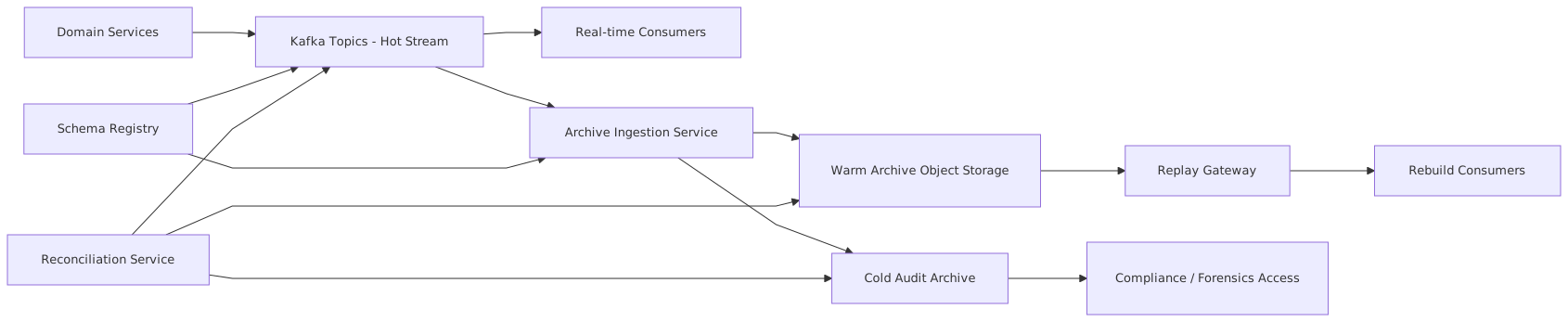
There are a few important choices embedded in this picture.
Archive ingestion is a product, not a connector afterthought
You can use Kafka Connect, tiered storage, object sinks, or custom pipelines. The tool matters less than the stance. The archive path should preserve ordering guarantees where required, partition lineage where meaningful, provenance metadata, schema references, and retention classification. A blind export job is not enough.
Hot stream and archive have different responsibilities
The hot stream exists for current operations and local recovery windows. The archive exists for long-term retention, selective replay, audit, or analytics handoff. If you make Kafka responsible for all four forever, you avoid architecture for a while and pay for it continuously.
Replay should go through a gateway
Do not let every team pull arbitrary historical files and pump them into production topics.
That road leads to duplicate processing, broken contracts, and accidental side effects.
A replay gateway should enforce:
- authorized replay windows
- stream eligibility
- target environment controls
- idempotency expectations
- rate limits
- semantic transformations when older contracts no longer match current consumers
Replay is surgery, not jogging.
Canonical archive vs raw broker archive
There is a tradeoff here. Preserving the raw Kafka record, including key, value, headers, partition, offset, timestamp, and schema id, gives you forensic fidelity. Transforming into a canonical event archive gives you long-term readability and cross-platform usefulness.
In large enterprises, the right answer is often both:
- raw immutable capture for forensic correctness
- canonical business archive for retention, query, and controlled replay
Yes, it duplicates data. No, that is not automatically wasteful. It is a deliberate split between evidence and utility.
Domain semantics shape archive classes
Here is the decision model I like:
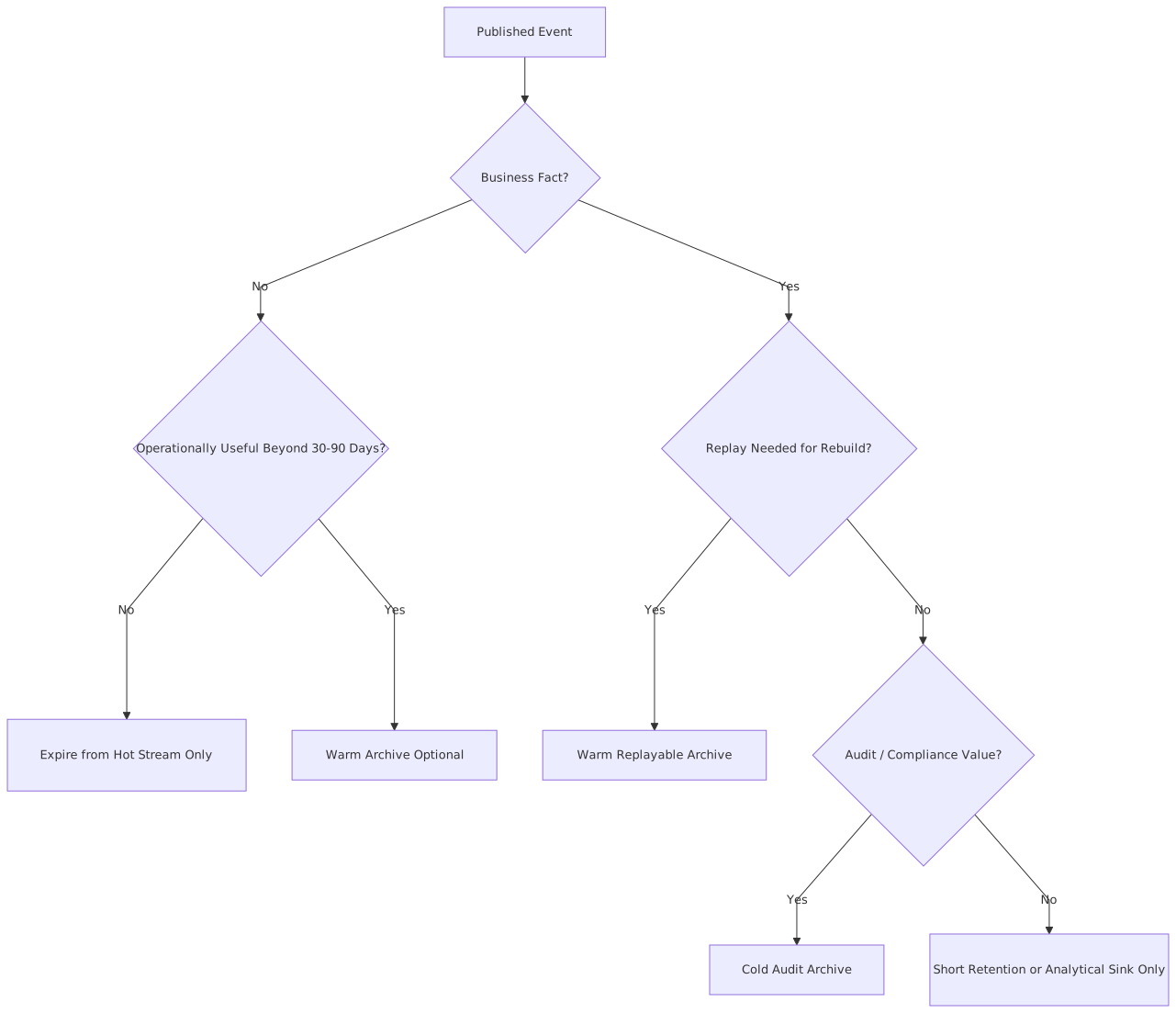
This is simple enough to use and opinionated enough to stop the endless “archive everything just in case” reflex.
Domain semantics discussion
This is where architecture earns its keep.
In domain-driven design, events are not merely messages. They are statements that something meaningful happened within a bounded context. The word meaningful is doing the heavy lifting.
Take a retail bank.
AccountOpenedis a domain fact with regulatory and operational significance.AddressValidatedmay be a useful process event but not the canonical record of customer identity.DailyBalanceProjectionUpdatedis a derived event and usually not worthy of long-term archival.FraudScoreCalculatedmay be highly sensitive, model-dependent, and governed under entirely different retention rules.
If all four land in Kafka, the platform sees records. The business sees profoundly different obligations.
This is why archival policy should be attached to event types or streams through a domain catalog:
- bounded context owner
- business definition
- data classification
- legal retention class
- replayability status
- rebuild dependencies
- PII sensitivity
- deletion constraints
- reconciliation rules
Without this catalog, archival becomes a political negotiation every quarter.
A practical rule: archive domain facts and legally relevant decision events; be ruthless with derivative and operational noise.
Migration Strategy
Most enterprises cannot redesign event archival from scratch. They inherit topics with inconsistent retention, unclear ownership, and consumers that assume Kafka is infinite. So the migration has to be progressive. This is classic strangler fig territory: surround the old, prove the new, shift traffic carefully.
Step 1: classify streams before moving data
Do not begin with technology. Begin with a stream inventory:
- topic purpose
- producer owner
- consumer criticality
- retention today
- replay frequency
- compliance relevance
- schema history
- business event or derivative event
Expect surprises. In one large enterprise, half the “business event” topics turned out to be projection update feeds. That discovery alone cut archival scope dramatically.
Step 2: introduce archive ingestion in parallel
Attach archive ingestion to selected topics without changing existing consumers. Prove you can capture events reliably, preserve provenance, and reconcile counts by partition and time window.
Step 3: reconcile relentlessly
Before any retention changes, run parallel validation:
- message counts by topic/partition/window
- checksums or hash totals
- schema compatibility checks
- late arrival detection
- missing segment detection
- sample replay validation into non-production rebuild environments
If you cannot reconcile, you do not have an archive. You have optimism.
Step 4: shorten hot retention gradually
Once confidence is established, reduce Kafka retention for streams whose long-term storage now lives elsewhere. Do this in stages. Watch lagging consumers, operational incidents, and support workflows. Hidden dependencies often emerge only when old data disappears from the broker.
Step 5: route replay through governed services
Replace direct “consume from beginning” habits with replay requests and controlled rebuild paths. This is as much organizational change as technical change.
Step 6: retire ad hoc retention exceptions
Large organizations accumulate special cases. Review them. Some are real. Many are fossilized fear.
A migration view helps:
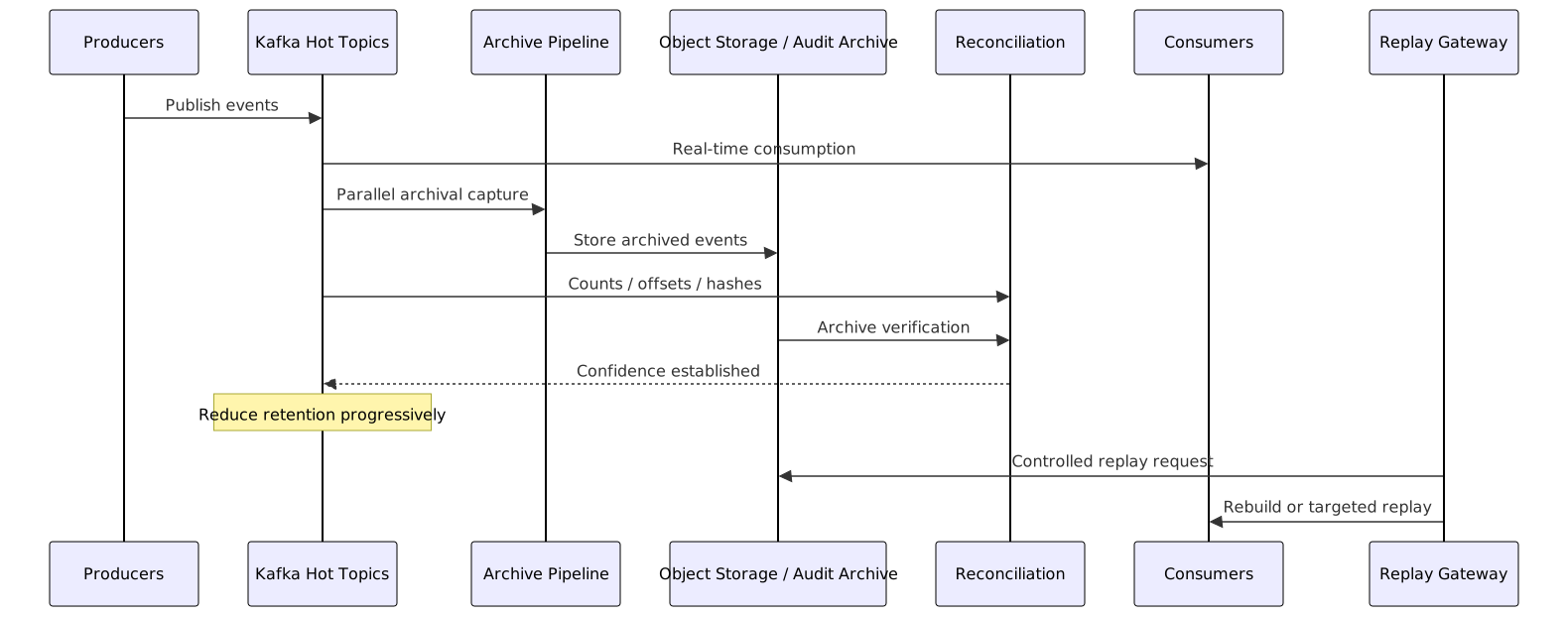
The point is not speed. The point is asymmetry of risk. It takes one bad archival cutover to poison trust for years.
Reconciliation discussion
Reconciliation deserves its own section because many archival programs skip it and then discover gaps during an audit or outage.
There are three reconciliation questions:
- Completeness — Did every eligible event make it to the archive?
- Integrity — Was it stored without mutation where mutation is not allowed?
- Usability — Can archived events still be interpreted and, where intended, replayed?
Completeness is usually validated with topic-partition-window counts, offset continuity, and watermark tracking. Integrity may rely on content hashes, immutable object versioning, signed manifests, or write-once controls. Usability requires schema preservation, event envelope versioning, and periodic replay drills.
The important part is periodic.
Archival systems fail quietly. A sink connector pauses. A permissions policy changes. A schema registry entry goes missing. An object lifecycle rule expires the wrong bucket prefix. Nobody notices because production still runs. Then six months later, someone needs to replay or produce evidence for regulators. Silence follows.
Good enterprises run archive reconciliation as an operational discipline, not a project task.
Enterprise Example
Consider a global insurer running more than 200 microservices across policy administration, claims, billing, fraud, and customer service. Kafka is the event backbone. Over five years, topic count grew into the hundreds, with retention stretching from 7 days to “effectively forever.” Costs climbed, and more importantly, nobody could answer a basic question: which streams represented business record versus integration exhaust?
The insurer’s claims domain exposed the problem vividly.
Events included:
ClaimRegisteredClaimDocumentAttachedClaimAssessmentRequestedClaimAssessmentCompletedClaimReserveUpdatedClaimProjectionRefreshedNotificationDispatchRetried
The business and compliance teams cared deeply about claim registration, assessment completion, reserve changes, and selected document metadata. They did not need to preserve every projection refresh or retry event for seven years.
The architecture team introduced a domain event catalog aligned to bounded contexts. Each event type was tagged with:
- record class
- retention period
- replay eligibility
- PII classification
- legal hold applicability
They then built an archive ingestion capability using Kafka Connect for raw capture to object storage and a separate canonical archive service that normalized selected domain facts into a stable event envelope. Raw capture preserved exact broker evidence. Canonical storage supported controlled replay and forensic queries.
Migration was gradual. Claims topics were onboarded first because they had obvious audit value and manageable event volumes. Reconciliation compared Kafka offsets and archive manifests daily. After three months of clean runs, hot Kafka retention for key claims topics dropped from 365 days to 30 days. Projection and retry topics were cut even further.
The most valuable outcome was not storage reduction, though that was substantial. It was operational clarity. When a claims reserve projection became corrupted after a deployment, the team did not replay the universe. They requested a replay for the ClaimReserveUpdated archive class over a bounded date range into a rebuild pipeline, regenerated the projection store, and left non-replayable notification topics alone.
That is mature event architecture: not heroic, just precise.
Operational Considerations
Archival dies in operations long before it dies in slides.
Security and data classification
Archives often hold the most sensitive long-lived data in the estate. Encrypt at rest, control access tightly, segregate compliance archives, and be explicit about whether tokenization or field-level encryption is preserved in archived payloads.
Lifecycle management
Warm and cold archives need their own lifecycle rules. Retention should be automated, policy-driven, and reviewable. If legal hold exists, it must override deletion safely.
Schema and metadata retention
Archiving payloads without schema references is like preserving books after burning the alphabet. Keep schema history, registry exports, envelope definitions, and transformation logic where canonicalization is used.
Replay drills
Run replay tests. Not once. Routinely. Prove selected archives can rebuild selected consumers. A replay path never exercised is a fantasy.
Observability
Track:
- archival lag
- failed writes
- reconciliation gaps
- replay request volume
- archive read latency
- storage growth by retention class
- schema decode failures
- archive object integrity failures
Partitioning and ordering
If order matters within an aggregate, the archive must preserve enough lineage to reconstruct that order. Kafka offset order is partition-local, not global. Architects forget this at exactly the wrong moment.
Idempotency
Replays create duplicates from the perspective of downstream consumers unless consumers are designed for replay. The replay gateway should insist on idempotency declarations or rebuild-only targets.
Tradeoffs
There is no free lunch here, only better bills.
Raw versus canonical archive
- Raw preserves truth as emitted, excellent for audit, harder for long-term usability.
- Canonical improves readability and controlled replay, but introduces transformation risk and governance overhead.
Most serious enterprises need both for different reasons.
Centralized archive platform versus domain-owned archival
- Centralized gives consistency, governance, lower platform duplication.
- Domain-owned gives semantic precision and local accountability.
The sweet spot is usually centralized platform capability with domain-defined classification and retention policy.
Archive everything versus selective archival
- Archive everything reduces decision burden, increases cost and ambiguity.
- Selective archival requires discipline and cataloging, but produces a system people can reason about.
I favor selectivity. Architecture is partly the art of deciding what not to preserve in expensive forms.
Replayable archive versus audit-only archive
Making archives replayable is more useful and more expensive. If you do not genuinely need replay, do not pay the complexity tax. But if business recovery depends on rebuilding state from history, an audit-only archive is insufficient.
Failure Modes
This is the part people skip, usually because it is impolite. It is also the part that saves careers.
Treating Kafka retention as archival strategy
This works until cost, compliance, or recovery expectations collide. Then you discover your “archive” is a production broker setting.
Archiving derivative streams as if they were source facts
You end up preserving stale projections and mistaking them for business history. Rebuilds become inconsistent because the archive stores the answer, not the evidence.
Losing schema interpretability
Payloads remain, meaning disappears. Future replay becomes impossible because no one can decode old versions correctly.
No reconciliation
Gaps accumulate silently. The archive is incomplete, but everyone assumes it is fine because the sink job says “running.”
Uncontrolled replay into live systems
This creates duplicate side effects, customer confusion, billing errors, and support escalations. Replays should be bounded, governed, and often targeted at rebuild pipelines rather than original production topics.
Archiving sensitive data without deletion semantics
You satisfy retention and violate privacy. Enterprises do this more often than they admit.
Cross-context semantic collapse
A central archive team flattens events into generic enterprise nouns, stripping bounded-context meaning. The archive becomes easy to store and hard to trust.
When Not To Use
Event stream archival is not mandatory for every event-driven system.
Do not over-engineer this pattern when:
- event volumes are modest and long Kafka retention is operationally acceptable
- events are mostly transient integration signals with no audit or replay value
- the true system of record is transactional storage, and streams are disposable notifications
- compliance requires record retention elsewhere, making event archival redundant
- your organization lacks even basic event ownership and schema discipline
In some systems, a compacted topic plus database audit tables is enough. In others, data lake ingestion already provides the necessary retention for selected facts. Architectural maturity includes knowing when not to build another platform.
The anti-pattern is building an elaborate archival subsystem because “event-driven systems should have one.” Should is dangerous language.
Related Patterns
Event stream archival sits near several other patterns, but they are not interchangeable.
Event sourcing
Event sourcing stores domain events as the primary source of truth for aggregates. Archival may support event-sourced systems, but most Kafka estates are not event-sourced in the strict sense.
Outbox pattern
The outbox pattern ensures reliable publication from transactional systems. It says little about long-term archival policy, though outbox records can feed archive classification.
CQRS and materialized views
Archived replayable events are often used to rebuild read models. That does not mean every read-model update event should itself be archived.
Data lake ingestion
A data lake can act as a cold archive, but analytical storage alone is usually insufficient for governed replay, provenance, and audit-grade completeness.
Tiered storage
Tiered Kafka storage reduces hot-cluster pressure. Useful, yes. Complete archival architecture, no.
Summary
Event stream archival is one of those topics that exposes whether an enterprise really understands its event-driven system or is merely operating one.
The stream is not sacred because it is a stream. It is valuable when it captures business meaning, operational leverage, and trustworthy history. Archival should preserve that value without forcing real-time infrastructure to become a museum basement.
The right approach is semantic and deliberate:
- classify events by business meaning
- separate hot retention from long-term archival
- distinguish replayable history from audit evidence
- preserve schema and provenance
- reconcile continuously
- migrate progressively using a strangler approach
- govern replay like a production capability, not a debugging trick
If you remember one line, make it this: not every event deserves eternity, but the ones that do deserve better than an old Kafka retention setting.
That is the architecture choice. Not how to keep data forever. How to keep meaning long enough, cheaply enough, and safely enough that the business can still trust its own memory.
Frequently Asked Questions
What is enterprise architecture?
Enterprise architecture aligns strategy, business processes, applications, and technology in a coherent model. It enables impact analysis, portfolio rationalisation, governance, and transformation planning across the organisation.
How does ArchiMate support architecture practice?
ArchiMate provides a standard language connecting strategy, business operations, applications, and technology. It enables traceability from strategic goals through capabilities and services to infrastructure — making architecture decisions explicit and reviewable.
What tools support enterprise architecture modeling?
The main tools are Sparx Enterprise Architect (ArchiMate, UML, BPMN, SysML), Archi (free, ArchiMate-only), and BiZZdesign. Sparx EA is the most feature-rich, supporting concurrent repositories, automation, scripting, and Jira integration.