⏱ 20 min read
There is a particular kind of optimism that shows up early in event-driven programs. A few teams adopt Kafka, publish domain events, wire up consumers, and suddenly everything feels modern. The architecture diagrams look clean. Producers are decoupled. Consumers move at their own pace. People start saying things like “the event stream is the source of truth,” often with the calm certainty of someone who has not yet been paged at 2 a.m.
Then the organization grows up.
More teams arrive. More services need the same business facts. Finance wants a reliable feed of order activity. Customer support needs the latest lifecycle state. Fraud wants every state transition. Analytics wants history. Operations wants replay. Somebody notices five teams are producing near-identical “order” events, all with slightly different semantics, identifiers, and timestamps. Another team “helpfully” creates a giant shared topic with every event about everything. Now half the enterprise depends on it, nobody fully owns it, and schema changes feel like touching exposed wiring in a wet basement.
This is where shared event streams become interesting. And dangerous.
A shared event stream is not merely a Kafka topic that many consumers read. It is an intentional architectural boundary: a stream of business-significant facts, curated so multiple bounded contexts can depend on it without collapsing into one giant distributed monolith. Done well, it becomes a stable public language for the enterprise. Done badly, it becomes integration debt with better branding.
The distinction matters. A stream is cheap. Shared semantics are expensive.
This article looks at when and how to use shared event streams in event-driven architecture, especially in microservices environments using Kafka or similar platforms. We will walk through domain-driven design implications, migration strategy, reconciliation, operational realities, tradeoffs, and the failure modes that appear in real enterprises long after the conference slides are over. event-driven architecture patterns
Context
In most enterprises, shared event streams emerge from pressure, not theory.
A retailer modernizing order management wants to reduce point-to-point integrations. An insurer wants policy lifecycle changes available to underwriting, claims, billing, and customer channels. A bank wants a common stream of payment status changes consumed by fraud, ledgers, notifications, and reporting. In each case, many downstream capabilities need the same business events, but they do not need the producer’s internal model, database schema, or APIs.
So teams reach for an event backbone, often Kafka. This makes sense. Kafka is particularly good at high-throughput durable logs, consumer independence, replay, partitioned scaling, and long-lived streams. It solves the transport problem extremely well. But transport is the easy part. Architecture starts when multiple domains depend on the meaning of what travels across it.
A shared stream sits at the intersection of three concerns:
- Domain semantics: what does an event mean in the business?
- Integration contract: what can downstream consumers rely on?
- Operational durability: how does the stream behave under replay, lag, schema evolution, duplicates, or partial outages?
A team that treats a shared stream as simply a technical pub/sub channel usually ends up with semantic drift. One that treats it as a carefully governed enterprise API, with domain language and ownership, can create a durable integration asset.
Shared streams are attractive because they promise reuse. Reuse is seductive. It is also where architecture gets sloppy. If every integration concern is poured into one shared stream, then “shared” stops meaning “commonly useful” and starts meaning “everybody is trapped together.”
Problem
The core problem is simple to state:
How do multiple services and domains consume the same evolving business facts without coupling themselves to one producer’s internals or creating a brittle enterprise-wide dependency?
That sounds like a standard messaging problem. It is not. It is a semantics problem disguised as infrastructure.
Consider order processing. Sales, fulfillment, payments, customer service, and analytics all care about order lifecycle events. But they care in different ways.
- Fulfillment needs events that imply physical work.
- Payments needs monetary intent and settlement state.
- Customer service needs a coherent customer-visible lifecycle.
- Analytics needs a historical trail, including corrections.
- Finance may need an auditable sequence with strict reconciliation.
If the stream simply mirrors the order service’s database updates, nobody gets what they need. If the stream includes everything anyone might need, it becomes bloated, unstable, and impossible to evolve cleanly. If each team creates its own event flavor, integration entropy wins.
A shared event stream must therefore solve several tensions at once:
- Shared enough to be useful.
- Stable enough to be depended on.
- Specific enough to be meaningful.
- Decoupled enough not to leak internal models.
- Governed enough to evolve.
- Operable enough to survive reality.
That is harder than creating a topic and publishing JSON.
Forces
Architects should be blunt about the forces involved, because these tensions do not disappear with better tooling.
1. Domain language versus implementation detail
A good shared stream carries business facts, not CRUD exhaust. “OrderPlaced” or “PaymentAuthorized” are domain-significant. “OrderRowUpdated” is a confession that no modeling happened.
Domain-driven design is useful here because it asks a disciplined question: what event belongs to the bounded context, and what meaning is safe to publish outside it? Shared streams should express an upstream context’s published language, not its accidental data model.
2. Consumer diversity
Different consumers want the same facts for different reasons. This encourages stream reuse, but also tempts upstream teams to enrich events with every imaginable field. That path leads to canonical enterprise sludge: huge events, weak semantics, and change paralysis.
3. Independent evolution
Producers and consumers must evolve without lockstep coordination. That requires schema compatibility, versioning strategy, and careful stewardship of field meaning. Backward compatibility is not enough if semantic compatibility is broken.
4. Replay and time
A shared stream is often replayable. This is one of its superpowers. It is also where hidden assumptions die. Consumers that accidentally depend on wall-clock arrival order, current reference data, or mutable side effects tend to fail during reprocessing.
5. Governance versus speed
Enterprise architects often over-correct. They see semantic inconsistency and respond with central control. A review board appears. Every field needs approval. Teams slow down and create side channels. The architecture remains “governed” and the business routes around it.
6. Data ownership
A shared stream can blur ownership. If ten services depend on the stream, who owns its quality? The answer must remain crisp: the producing bounded context owns the published facts; platform teams own transport and guardrails; consumers own interpretation within their contexts.
7. Consistency and reconciliation
Shared streams are usually asynchronous. This means consumers can lag, miss transient dependencies, or process duplicates. Reconciliation is not an edge concern. It is a first-class design obligation.
Solution
The right pattern is not “put everything on a shared topic.” The right pattern is:
Publish a domain-owned shared event stream for a cohesive business capability, with explicit semantics, durable contracts, and consumer independence.
That means a few things in practice.
First, the stream should align to a bounded context or a coherent subdomain. Shared event streams work best when they represent a stable business narrative: orders, payments, shipments, policies, claims, invoices, customer identity lifecycle. They work poorly when they represent vague cross-cutting categories like “all business events” or “customer-related things.”
Second, the stream should be composed of published domain events or carefully designed integration events. These are not necessarily identical to internal domain events. Internal events may be noisy, too granular, or too coupled to implementation. A shared stream is a public language. Public language deserves curation.
Third, downstream consumers should treat the stream as a feed of facts, not commands. If consumers begin to rely on producer-specific side effects or expect workflow orchestration by event accident, coupling returns through the side door.
Fourth, the stream should support replay, schema evolution, idempotent consumption, and reconciliation. If you cannot recover consumers from the stream or reconcile discrepancies, you do not have a strategic shared stream. You have optimistic messaging.
Here is the basic shape.
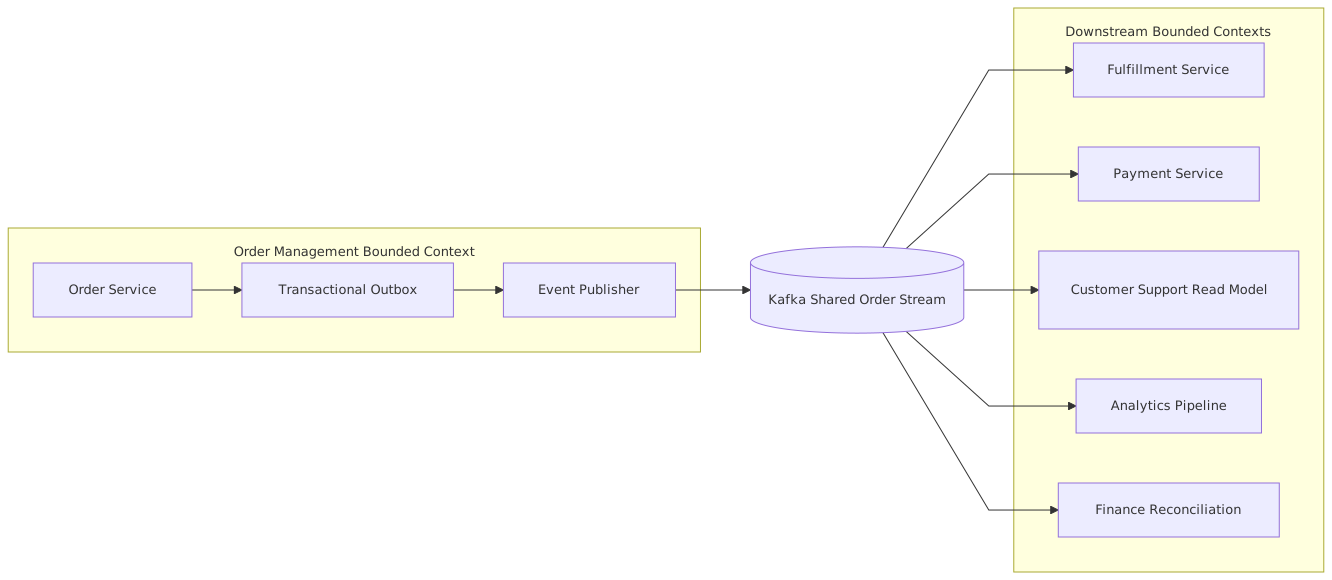
This looks deceptively simple. The hard part is deciding what belongs on that stream and what does not.
Architecture
A sound architecture for shared event streams usually has five layers of discipline.
1. Bounded context ownership
One bounded context owns the stream’s semantics. This is not optional. Shared does not mean ownerless. For example, the Order Management context owns the meaning of OrderPlaced, OrderConfirmed, OrderCancelled, and perhaps OrderLineAdjusted if those are externally relevant.
That ownership gives consumers confidence that the stream reflects authoritative business facts from the source domain. It also creates a place where schema decisions and semantic clarifications live.
2. Published language, not internal chatter
Domain-driven design gives us a useful distinction: internal model versus published language. Many teams skip this and leak internals straight onto Kafka. They emit table-shaped events with field names that make perfect sense to ORM mappings and no sense to business readers.
A shared stream should prefer events such as:
OrderPlacedOrderPricedOrderPaymentAuthorizedOrderReleasedForFulfillmentOrderCancelled
These communicate business transitions. They are not snapshots of every row change. They should include stable identifiers, timestamps with clear meaning, causation or correlation metadata where useful, and enough business context for downstream autonomy.
There is a tradeoff here. Domain events are elegant, but downstream consumers sometimes need state-oriented data. In practice, many enterprises use a hybrid approach:
- Event stream for state transitions and facts.
- Compacted projection topic or query API for current state lookups.
Do not force one stream to serve every purpose.
3. Delivery guarantees and transaction boundaries
If your service updates a database and publishes an event separately, you have created a failure mode with a timer attached. The common mitigation is the transactional outbox pattern: commit business state and pending event in the same local transaction, then publish asynchronously.
This matters more with shared streams because downstream blast radius is large. A missed event is no longer one broken integration; it can become a dozen inconsistent read models and operational incidents.
4. Partitioning and ordering strategy
Kafka gives ordering within a partition, not across a topic. Architects who ignore this eventually rediscover it through production bugs.
Partition by the domain aggregate or another key that matches the stream’s consistency needs. For order lifecycle, orderId is the obvious choice. This preserves per-order ordering for consumers. It does not preserve global order, and that is fine unless your domain mistakenly relies on it.
5. Consumer isolation
Downstream services should each maintain their own storage and interpretation. The shared stream is not a distributed shared database. Consumers derive local read models, trigger local workflows, or build local analytics structures. They do not reach back into the producer’s assumptions.
Here is a more detailed view.
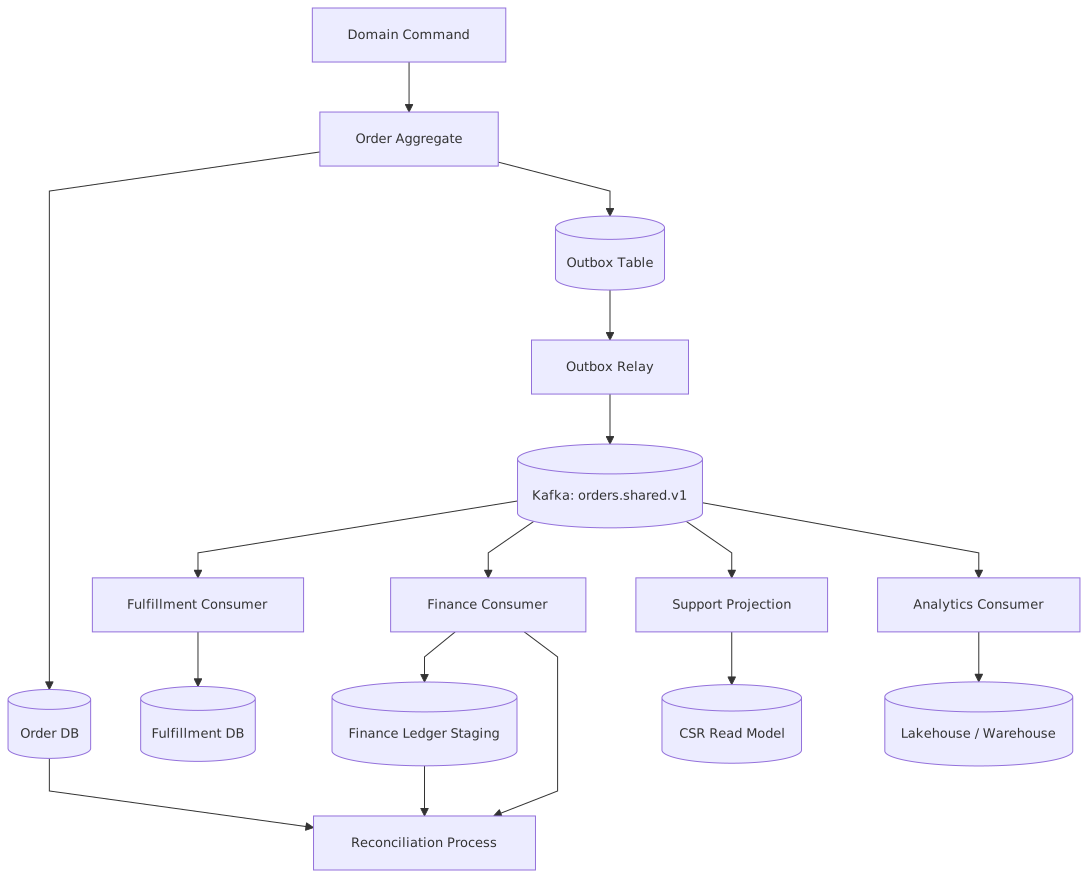
That reconciliation process is not decorative. It is how grown-up event-driven systems remain trustworthy.
Migration Strategy
Most enterprises do not get to design shared event streams on a blank page. They inherit APIs, ETL jobs, cron-based exports, point-to-point integration, database replication, and the occasional spreadsheet. Migration is therefore as important as target architecture.
The migration strategy that works in real life is usually a progressive strangler.
Start by identifying a business capability where many downstream consumers already need the same facts and where semantics can be stabilized. Orders, payments, shipments, claims, or invoices are common candidates.
Then proceed in stages.
Stage 1: Observe and extract
Do not begin by forcing all consumers onto a new stream. Begin by instrumenting the source system with a transactional outbox and publishing a curated stream in parallel with existing integrations. Existing APIs and batch feeds continue to run.
The goal here is not immediate cutover. The goal is to validate semantics, event completeness, schema choices, and partitioning strategy.
Stage 2: Build early consumers as projections
Pick one or two downstream consumers with relatively low coordination risk and clear value. Customer support read models and analytics pipelines are common first consumers. They are useful, visible, and tolerant of eventual consistency if designed properly.
These consumers create feedback. Missing fields appear. Event ambiguities surface. Sequence assumptions become obvious.
Stage 3: Reconciliation and dual-run
Before migrating critical operational consumers, run dual paths. Compare the state derived from the shared stream with the state produced by legacy integration or direct query. This is where reconciliation becomes a migration tool, not just an operational afterthought.
For example:
- Compare order totals by day between legacy export and event-derived finance staging.
- Compare shipment release counts between existing service calls and event-driven fulfillment intake.
- Compare customer-visible status transitions between support UI reads and event-derived read model.
If the numbers diverge, do not argue from architecture principles. Investigate. The business only trusts what reconciles.
Stage 4: Strangle consumer by consumer
Move consumers incrementally. Each migration removes one direct integration path and increases confidence in the stream. Maintain clear decommission milestones so “temporary parallel mode” does not become permanent complexity.
Stage 5: Introduce compaction, snapshots, or reference feeds where needed
Some consumers will not thrive on event transitions alone. This is normal. Add supporting patterns deliberately: compacted current-state topics, periodic snapshots, CDC-fed reference streams, or query APIs. The stream should not be stretched into solving every read problem.
Here is a typical migration path.
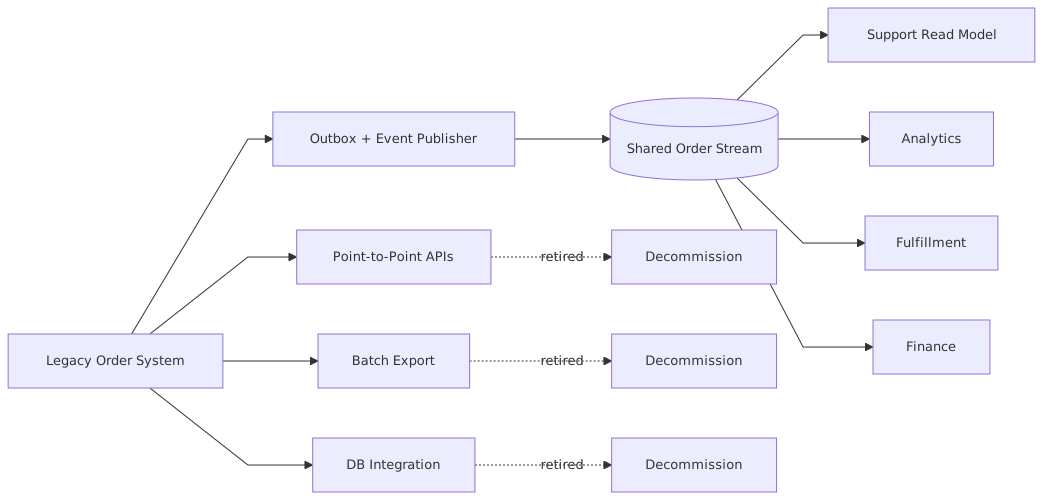
This is the strangler pattern applied to integration architecture. The old world is not switched off all at once. It is outcompeted. integration architecture guide
Enterprise Example
Consider a global retailer modernizing order processing across e-commerce, stores, and marketplaces.
Historically, the retailer had a central order management platform. Customer support queried it directly. Fulfillment received near-real-time service calls. Finance relied on nightly exports. Analytics ingested database snapshots. Fraud consumed a custom JMS feed. Every integration was justified in isolation. Collectively, they formed a thicket.
The modernization program introduced microservices and Kafka. The first naive proposal was predictable: “Let every service publish order events.” That would have created six partial truths with no authoritative stream. Instead, the architecture team established a shared orders stream owned by the Order Management bounded context.
They made several opinionated choices:
- Only externally meaningful order lifecycle events were published.
- Internal pricing recalculation chatter was kept private.
- Events used stable order, customer, and channel identifiers.
- Financially relevant events included explicit monetary semantics and currency.
- Per-order ordering was preserved via partition key on
orderId. - Schema contracts were managed with compatibility checks.
- A support read model and analytics pipeline were the first consumers.
- Finance migrated only after a three-month reconciliation period.
- Legacy nightly exports remained until event-derived totals matched within agreed thresholds.
What happened?
The good news: support gained faster, more coherent order views. Analytics got replayable history. New marketplace services integrated much faster by consuming the shared stream rather than negotiating bespoke APIs.
The bad news: hidden semantic disagreements surfaced immediately. “Order confirmed” meant one thing in e-commerce and another in store pickup. Cancellation reasons were not standardized. Price-adjustment events had unclear customer-visible meaning. These were not Kafka problems. They were domain problems that the stream made impossible to ignore.
That is one of the underappreciated virtues of shared event streams: they force semantic honesty. A messy domain can survive inside a monolith for years. Publish it to the enterprise and the ambiguity becomes expensive.
Eventually, the retailer split some concerns. A shared order lifecycle stream remained. Inventory reservation events lived in a different bounded context. Customer notifications consumed both but maintained their own customer-facing status model. This was the right outcome. Shared streams unified what should be common and separated what should not.
Operational Considerations
The operational burden of shared streams is where many elegant whiteboard designs become ordinary production systems with extraordinary edge cases.
Schema evolution
Use schema management with explicit compatibility rules. Avro, Protobuf, or JSON Schema can all work if governed properly. The tool is less important than the discipline.
The critical point: field compatibility is not semantic compatibility. Changing an enum value meaning, altering timestamp interpretation, or changing whether an amount is gross versus net can break consumers without breaking schema validation.
Document semantics like you would for a public API. Because that is what this is.
Idempotency
Consumers will see duplicates. They will retry. They will occasionally reprocess after rebalance or recovery. Design handlers to be idempotent using event IDs, aggregate version checks, or consumer-side deduplication records.
Hope is not a deduplication strategy.
Replay safety
A replayable shared stream is useful only if consumers can replay safely. Avoid consumers whose processing logic sends uncontrolled external side effects on historical replay. Separate projection building from side-effecting workflows where possible.
Retention and recovery
Retention policy is a business decision disguised as a broker setting. If finance needs 90 days of replayable source events for recovery, seven-day retention is not “lean”; it is negligence. For longer horizons, archive streams to object storage and support rehydrate paths.
Monitoring and lag
Monitor:
- Consumer lag
- Dead-letter volumes
- Publish failures from outbox relay
- Schema validation errors
- Partition skew
- Reconciliation drift
- End-to-end event freshness
Lag alone is not enough. A consumer can be caught up and still wrong.
Reconciliation
Reconciliation deserves its own section because it is often under-designed.
In shared-stream architectures, reconciliation is how you prove the event fabric still reflects business truth. It can be periodic or continuous. It compares independently derived records or aggregates across systems and identifies divergence.
Examples:
- Count and value of orders placed versus finance intake
- Number of orders released for fulfillment versus warehouse staging
- Latest customer-visible order state versus support read model
- Payment authorization totals versus payment provider acknowledgments
Reconciliation exists because distributed systems fail in partial, boring, expensive ways: missed events, poison messages, consumer bugs, schema misunderstandings, compensating updates processed out of order. The stream gives you history; reconciliation gives you confidence.
Tradeoffs
Shared event streams are powerful, but they are not free.
Benefits
- Reduce point-to-point integration sprawl
- Enable independent consumers and replay
- Improve time-to-integrate for new services
- Create durable business event history
- Support polyglot downstream models
- Decouple producers from synchronous consumer availability
Costs
- Significant semantic design effort
- Ongoing contract governance
- Operational complexity in brokers and consumers
- Need for reconciliation and observability
- Risk of over-centralized streams becoming enterprise bottlenecks
- Harder debugging across asynchronous boundaries
The biggest tradeoff is this: you trade direct coupling for semantic discipline and operational rigor. That is usually a good trade at scale, but only if you are willing to pay the bill.
Failure Modes
Shared event streams fail in characteristic ways. Architects should recognize them early.
1. The “shared everything” stream
A giant enterprise topic with dozens of event types and no coherent bounded context. It begins as convenience and ends as a junk drawer. Ownership is muddy. Schemas are unstable. Every change sparks broad fear.
2. Database-change masquerading as domain event
CDC or table-change feeds are useful, but they are not automatically a published domain language. If consumers rely directly on internal row mutations, the producer loses freedom to evolve.
3. Canonical model overreach
A central team defines a universal enterprise event schema that allegedly works for all domains. It usually flattens nuance and pushes local complexity into extension fields. Better to have several well-designed domain streams than one abstracted monstrosity.
4. Workflow by coincidence
Teams start relying on observed event sequences as an implicit orchestrator. No explicit process model exists, but everyone assumes “after X, Y will happen.” Then retries, timing changes, or new branches arrive and the choreography becomes brittle.
5. Ignoring reconciliation
The first months look fine. Then one consumer misses messages during a deployment bug. Another mishandles a new enum value. Three weeks later finance totals do not match. Without reconciliation, you discover drift only when the business does.
6. Semantic versioning theater
Teams add version numbers but do not manage meaning. The schema registry is green; the enterprise is red.
When Not To Use
Shared event streams are not a universal answer.
Do not use them when:
- The domain semantics are not stable enough to publish.
- Only one consumer exists and no broader reuse is likely.
- The integration is fundamentally request/response and requires immediate consistency.
- The organization lacks operational maturity for asynchronous systems.
- Teams are not prepared to own schemas and semantic contracts.
- Consumers need tailored views so different that a shared stream would become either bloated or meaningless.
- Data sensitivity or regulatory constraints demand more tightly controlled access patterns than broad stream consumption can safely support.
There are also cases where a simple API is better. If a consumer needs current reference data occasionally, an API or data product may be more appropriate than a durable stream. Architects should not build event machinery to avoid a straightforward service contract.
A useful rule: use shared event streams for shared business facts over time, not for every integration impulse.
Related Patterns
Shared event streams sit alongside several related patterns.
Event-carried state transfer
Useful when consumers need enough data in the event to avoid calling back upstream. Often paired with shared streams, but should be used carefully to avoid bloated payloads.
Transactional outbox
Essential for reliable publication from state-changing services.
Change Data Capture
Useful for migration and some integration scenarios, especially where systems cannot yet publish domain events. But CDC is not a substitute for published domain semantics.
CQRS projections
Consumers frequently build local read models from shared streams. This is one of the strongest use cases.
Event sourcing
Related, but distinct. A shared stream is not automatically an event-sourced aggregate history. Event sourcing is a persistence model; shared event streams are an integration pattern. Sometimes they coexist. Often they should remain separate.
Sagas or process managers
When business workflows span services, explicit coordination patterns are safer than assuming order from shared event sequences alone.
Data mesh and data products
Shared event streams can act as operational data products if ownership and semantics are clear. But not every shared stream should be treated as an analytics-grade product by default.
Summary
Shared event streams are one of the most useful and most abused tools in event-driven architecture.
At their best, they turn fragmented enterprise integration into something coherent: a durable stream of business facts, owned by a bounded context, consumed independently by many services, replayable, governable, and meaningful. They reduce brittle point-to-point coupling and create a shared language that new systems can join quickly.
At their worst, they become ownerless pipes full of leaky internals, wishful semantics, and hidden coupling. The technology still works. The architecture does not.
The winning move is to treat a shared stream as a published domain contract, not a broker convenience. Design around domain-driven boundaries. Curate events that express business meaning. Use transactional outbox for reliability. Partition for the ordering you actually need. Build idempotent consumers. Reconcile relentlessly. Migrate with a progressive strangler rather than a heroic cutover.
And remember the uncomfortable truth: Kafka can move bytes beautifully, but it cannot rescue muddy domain thinking. A shared stream is only as good as the language it carries.
That is the real architecture.
Frequently Asked Questions
What is enterprise architecture?
Enterprise architecture aligns strategy, business processes, applications, and technology in a coherent model. It enables impact analysis, portfolio rationalisation, governance, and transformation planning across the organisation.
How does ArchiMate support architecture practice?
ArchiMate provides a standard language connecting strategy, business operations, applications, and technology. It enables traceability from strategic goals through capabilities and services to infrastructure — making architecture decisions explicit and reviewable.
What tools support enterprise architecture modeling?
The main tools are Sparx Enterprise Architect (ArchiMate, UML, BPMN, SysML), Archi (free, ArchiMate-only), and BiZZdesign. Sparx EA is the most feature-rich, supporting concurrent repositories, automation, scripting, and Jira integration.