⏱ 23 min read
ArchiMate for Digital Transformation Programs: A Practical Enterprise Architecture Guide
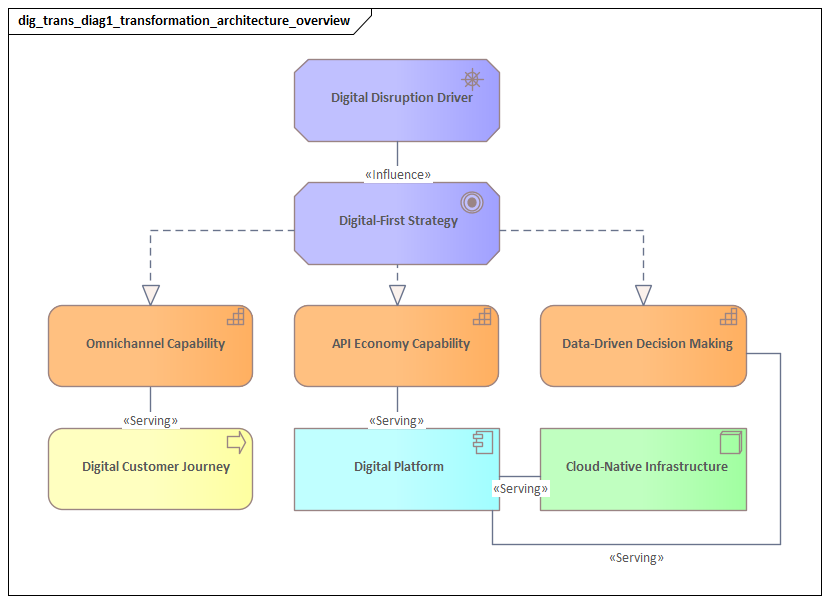
Learn how ArchiMate supports digital transformation programs by aligning business, application, and technology architecture. Explore practical modeling approaches, stakeholder communication, and roadmap planning. ArchiMate tutorial for enterprise architects
ArchiMate, digital transformation, enterprise architecture, ArchiMate modeling, transformation roadmap, business architecture, application architecture, technology architecture, capability mapping, stakeholder communication, architecture governance, IT strategy, operating model, change management ArchiMate layers explained
Introduction
Digital transformation programs are difficult not because they introduce new technology, but because they require coordinated change across strategy, operating model, processes, applications, data, platforms, governance, and delivery. Each stakeholder group sees that change through a different lens. Executives look for outcomes, risk reduction, and return on investment. Business leaders focus on capabilities, services, and customer experience. Architects examine dependencies, transition states, and design trade-offs. Delivery teams worry about scope, sequencing, and implementation risk. When those perspectives are managed through separate documents and disconnected diagrams, transformation becomes harder to steer and even harder to execute.
ArchiMate is valuable in that environment because it provides a shared architectural language for linking those perspectives. It allows architects to show how strategic goals relate to business capabilities, how those capabilities are supported by applications and technology services, and how implementation initiatives move the enterprise from the current state toward a target state. Its strength is not simply that it spans multiple layers of architecture. The real advantage is that it makes the relationships between those layers explicit. ArchiMate relationship types
That focus on relationships matters in transformation work. A decision that appears local—launching a new digital channel, consolidating an application, modernizing identity and access management, or migrating a platform—often has consequences well beyond the immediate team. Process ownership, data quality, integration patterns, security controls, support models, and funding assumptions can all be affected. ArchiMate helps expose those dependencies early, so architecture informs prioritization, roadmap design, and impact analysis rather than serving as documentation after the fact. ArchiMate modeling best practices
It is also well suited to the staged nature of enterprise change. Large programs rarely move in a single step from legacy to target architecture. They pass through transition states in which old and new capabilities coexist, temporary duplication is accepted, and benefits are delivered incrementally. ArchiMate supports that reality by allowing architects to model plateaus, gaps, and work packages in a way both business and technical stakeholders can follow.
Used well, ArchiMate is selective rather than exhaustive. The aim is not to model the whole enterprise in full detail. The aim is to create the smallest set of connected views needed to answer the important questions: which capabilities are being improved, which applications support them, what constraints shape the roadmap, and which initiatives need to happen first. In that role, ArchiMate becomes a decision-support tool embedded in planning and governance.
This article explains how to position ArchiMate within the broader enterprise architecture toolset, which concepts matter most in transformation, how to model current, target, and transition states, and how to use the language to support governance, stakeholder alignment, and value realization.
Why ArchiMate Matters in Digital Transformation Programs
The central challenge in digital transformation is not representing isolated systems. It is coordinating change across multiple domains and across different time horizons. ArchiMate matters because it gives architects a disciplined way to describe that coordination in one coherent modeling language.
Transformation programs usually combine several kinds of change at once: customer and employee experience redesign, capability uplift, process simplification, application modernization, data enablement, platform evolution, and governance reform. Those changes rarely move at the same speed. Strategy may shift quarterly. Product teams may release continuously. Platform teams often work to multi-year roadmaps. Regulatory obligations can impose fixed constraints. Without a shared architectural structure, each area tends to create its own planning artifacts, and the links between them become harder to see.
ArchiMate helps by making dependencies explicit. A new digital service may rely on identity management, shared customer data, integration capabilities, security controls, and revised support processes. Consider a retail bank introducing digital account opening. What begins as a channel initiative quickly touches customer verification, consent management, fraud screening, call-center authentication, and core banking integration. If those dependencies are scattered across business cases, project plans, and technical designs, leaders struggle to understand the full implications of the decision. ArchiMate brings them together in a form that supports enterprise-level reasoning.
This becomes even more important because digital transformation is rarely just a modernization exercise. Many organizations are trying to retire legacy systems, standardize platforms, improve service delivery, and redesign customer journeys at the same time. Some of the issues are technical, but many are structural or organizational. A fragmented customer experience may stem less from software limitations than from unclear business ownership or duplicated capabilities across operating units. By separating business, application, technology, and implementation concerns while still linking them, ArchiMate helps prevent programs from treating every problem as a technology problem.
The language is also useful because it works at the right level of abstraction for enterprise decision-making. Program leaders need to know which capabilities are affected, which services depend on which platforms, and which initiatives are prerequisites for others. They usually do not need workflow-level process detail or software design models. ArchiMate sits in that middle ground: concrete enough to guide investment and sequencing, abstract enough to remain stable across delivery cycles.
Just as important, ArchiMate creates continuity. Digital transformation programs often run for years, outlast leadership changes, and involve a mix of internal and external stakeholders. Slide decks and narrative documents are useful for communication, but they rarely endure as a shared decision reference. A maintained architectural model provides a more stable basis for roadmap updates, governance decisions, and benefit tracking.
For that reason, ArchiMate is best understood as a way to manage transformation complexity through traceability. It helps show how strategic intent connects to capabilities, how capabilities depend on applications and platforms, and how implementation work is expected to deliver outcomes. The next sections build on that idea by positioning ArchiMate within the broader architecture toolset and identifying the concepts most useful for transformation planning.
Positioning ArchiMate Within the Enterprise Architecture Toolset
ArchiMate should not be treated as a complete architecture method. It is a modeling language, and it becomes most effective when used within a broader enterprise architecture operating model. That distinction matters in digital transformation programs, where success depends not only on good models but also on governance, portfolio management, planning, risk control, and delivery discipline.
Upstream, organizations use strategy frameworks, operating model definitions, business cases, capability maps, and value stream analysis to explain why change is needed. Downstream, delivery teams use process models, domain models, API contracts, infrastructure designs, backlogs, and runbooks to define how solutions will be built and operated. ArchiMate sits between those worlds. It translates strategic direction into structured architectural views that can guide programs and portfolios without replacing specialist methods.
This makes clear what ArchiMate should and should not be used for. It is well suited to expressing relationships among goals, outcomes, capabilities, services, applications, data objects, technology services, and implementation initiatives. It is less suited to detailed workflow design, detailed software design, or low-level infrastructure engineering. BPMN may still be the better choice for process optimization, UML for software structure, and cloud deployment artifacts for engineering design. ArchiMate’s value lies in integrating those perspectives, not forcing every concern into a single notation.
Within an enterprise architecture repository, ArchiMate often becomes the language of traceability. Many organizations already maintain inventories of applications, capabilities, standards, projects, and platforms. On their own, those inventories offer limited decision value. ArchiMate relationships turn them into usable architecture knowledge. Rather than simply recording that a system exists, the enterprise can see which business services it supports, which data it uses, which technology services it depends on, and which work packages are changing it.
There is a governance benefit as well. Architecture reviews often become inconsistent because every project presents change in its own format. If the architecture function defines a small set of standard viewpoints—capability impact, application dependency, transition state, implementation roadmap—review boards can compare initiatives more consistently. For instance, when a healthcare provider proposes a new patient messaging tool, the board can assess it against the existing communication platform, consent-management service, and target integration pattern rather than reviewing the proposal as an isolated purchase. The point is not to require every project to produce a large formal model. The point is to support recurring decisions with recurring viewpoints.
A practical way to position ArchiMate is to treat it as the enterprise-level translation layer between strategic planning and delivery execution:
- Strategy and portfolio tools define intent and funding.
- ArchiMate models define structural relationships and change implications.
- Delivery artifacts define implementation detail.
Used this way, ArchiMate supports consistency without imposing rigidity. Specialist teams can continue using their preferred methods, while the architecture function maintains a shared view of enterprise change. That shared view becomes the foundation for the concepts and viewpoints described in the next section.
Core ArchiMate Concepts for Transformation Planning and Communication
Architects do not need the full ArchiMate specification in every transformation model. What they need is a practical subset of concepts that supports planning, communication, and governance. The most useful concepts are the ones that answer four questions: why change is happening, what in the enterprise must change, what enables that change, and how it will be delivered over time.
Motivation concepts
At the motivation level, the key concepts are drivers, goals, outcomes, requirements, and constraints. These matter because transformation often begins with broad ambitions that different stakeholders interpret in different ways. Statements such as “improve customer centricity” or “become data-driven” are too vague to guide investment on their own. They need to be tied to concrete outcomes such as reduced onboarding time, faster service resolution, higher straight-through processing, or improved digital adoption.
Motivation concepts provide that traceability. They allow architects to show why a capability uplift or platform investment exists and what requirement or constraint is shaping it. This is especially useful in funding and governance discussions, where stakeholders need to see whether a proposed initiative has a credible link to business outcomes.
Business concepts
At the business layer, the most useful concepts are capabilities, value streams, business processes, business services, and products. For transformation planning, capabilities are often the most stable anchor because they describe what the enterprise must be able to do, regardless of how teams, processes, or systems are reorganized.
That stability makes capabilities a strong organizing structure for roadmaps. They allow architects to assess application and platform change in business terms rather than treating modernization as an end in itself. Value streams and business processes then show where those capabilities are exercised and where change is felt by customers, employees, or partners. Business services and products help describe what the enterprise actually delivers.
Application and data concepts
At the application level, the most useful concepts are application components, application services, and data objects. These make it easier to see how business capabilities are enabled and where current-state constraints exist. A capability uplift may require a new application service, better access to master data, or the retirement of a duplicated legacy component.
These concepts are especially important in transformation programs that have to balance rapid delivery with estate simplification. A good model should make it clear whether a proposed initiative strengthens reusable services or simply introduces another isolated solution. In a logistics company, for example, shipment tracking, route planning, and warehouse systems may all publish operational events through a shared streaming platform rather than building new point-to-point integrations for each team. That distinction is architectural, not merely technical.
Technology concepts
At the technology level, technology services, nodes, and related infrastructure elements show what platform capabilities support the application landscape and where foundational constraints exist. This layer is most useful when connected to business and application concerns rather than treated as a stand-alone infrastructure diagram. Its value lies in showing whether the platform can actually support the intended application and service model.
Implementation and migration concepts
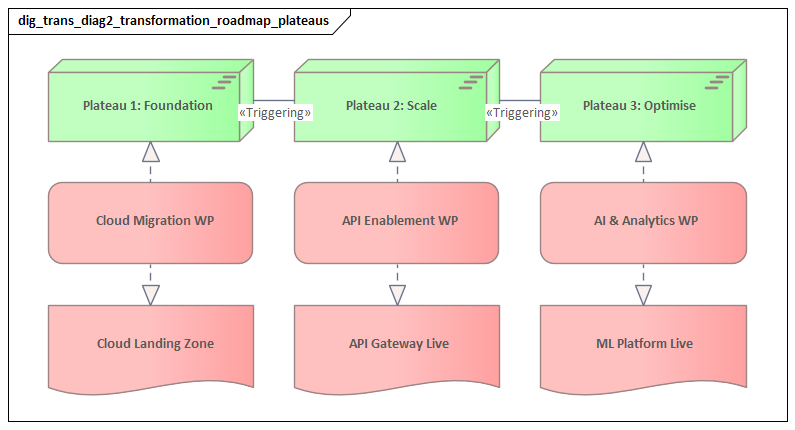
For roadmap planning, the most important concepts are work packages, deliverables, plateaus, and gaps. These are what make ArchiMate especially practical in digital transformation. A plateau represents a meaningful state of the enterprise at a point in time. A gap captures what is missing between states. A work package links that gap to an implementation effort.
This allows architects to move beyond static target-state thinking and describe transformation as a staged journey. Instead of showing only the destination, they can show what the enterprise will look like at each transition point and what work is needed to reach the next state.
Relationships
The analytical value of ArchiMate often lies less in the elements themselves than in the relationships between them. Relationships such as realization, serving, access, composition, assignment, and influence make it possible to answer practical questions:
- Which capabilities support a target outcome?
- Which applications realize a business service?
- Which data objects are accessed by a process?
- Which constraints influence a design choice?
- Which work packages deliver a capability increment?
Discipline matters here. Too many elements and relationships make models harder to use. The goal is to show the few relationships that clarify a decision.
These concepts provide the foundation for the next step: using ArchiMate to model current state, target state, and transition architectures in a coherent way.
Using ArchiMate to Model Current State, Target State, and Transition Architectures
One of ArchiMate’s strongest contributions to digital transformation is its ability to represent change over time without splitting the architecture into unrelated documents. Architects can model current state, target state, and transition architectures as connected views of the same enterprise.
Modeling the current state
The current state should not be an exhaustive inventory. Its purpose is to explain the conditions that materially affect transformation decisions. In practice, that usually means identifying:
- the capabilities currently in place,
- the business services and processes they support,
- the applications and data objects involved,
- the technology services they depend on,
- and the constraints or risks that limit change.
The key question is not “What do we have?” but “What in the current environment explains cost, delay, duplication, risk, or dependency?” A useful current-state model reveals where legacy platforms anchor critical business services, where data is fragmented, where multiple teams depend on a shared component, and where governance or ownership is unclear.
Modeling the target state
The target state serves a different purpose. It should represent the intended operating model and enabling architecture at a level stable enough to guide investment and governance. It is not simply a tidier version of the current state. It should make deliberate design choices visible.
Examples include:
- moving from fragmented channels to shared digital services,
- consolidating duplicated applications into common platform capabilities,
- shifting from point-to-point integration toward reusable API or event patterns,
- clarifying business service ownership,
- or establishing shared data products and governance structures.
A good target-state model highlights the capabilities, services, applications, information structures, and platform components expected to persist beyond individual projects. It should answer a simple question: what kind of enterprise are we trying to become?
Modeling transition architectures
In large programs, the greatest value often lies in the transition architectures between current and target states. Most enterprises cannot move directly to the target because of funding cycles, operational resilience concerns, contractual commitments, or organizational readiness. Transformation usually advances through intermediate states where old and new coexist.
ArchiMate’s implementation and migration concepts are particularly useful here. Plateaus can represent meaningful transition states, such as:
- legacy and digital channels operating in parallel,
- a partially consolidated application estate,
- a new data platform serving only selected domains,
- shared identity services introduced before broader customer journey redesign,
- or an event-streaming platform introduced first for operational use while batch integration remains in place for finance reporting.
A public-sector example is common: an agency may introduce a new citizen portal while the case-management platform remains unchanged for another year. During that plateau, digital submissions are captured through the new channel, but staff still work cases in the legacy back-office system. The transition architecture makes that temporary operating model visible and governable.
Gaps then describe what is still missing between one plateau and the next, and work packages show what implementation effort is intended to close those gaps.
Why transition modeling matters
Transition architectures help answer the practical questions executives and program leaders ask repeatedly:
- Which capabilities become available in the first phase?
- What dependencies must be resolved before a legacy platform can be retired?
- Where will duplication exist temporarily?
- Which transition state carries the highest operational risk?
- When do expected benefits become achievable?
Without this intermediate view, target architecture can become aspirational but operationally unhelpful. Transition modeling grounds the roadmap in enterprise reality.
Maintaining coherence across states
To keep the three states useful, architects should follow a few simple disciplines:
- Use the same core concepts across views.
This makes comparison possible.
- Model only decision-relevant detail.
Too much detail quickly reduces usability.
- Make deltas explicit.
Stakeholders should be able to see what changes between states and why.
- Link state changes to work packages and outcomes.
A transition state is most useful when stakeholders can see both what it enables and what work creates it.
When current, target, and transition architectures are linked coherently, governance becomes stronger. Change requests can be assessed against their effect on capabilities, services, dependencies, and roadmap assumptions. That same coherence also allows ArchiMate to connect strategy, business, application, technology, and implementation layers in practice.
Applying ArchiMate Across Strategy, Business, Application, Technology, and Implementation Layers
The previous section focused on how ArchiMate models change over time. Just as important is its ability to connect change across architecture layers. This is where the language becomes especially valuable in digital transformation, because enterprise decisions rarely stay confined to one layer.
Strategy layer
At the strategy level, the focus is intent: what the organization is trying to achieve and which capabilities or courses of action it is investing in. ArchiMate helps translate strategic themes into a form that can guide architecture. A strategy centered on customer self-service, platform standardization, or ecosystem integration can be linked to the capability increments required to make it real.
This matters because many initiatives sound strategic but have no clear architectural path to value. A strategy-layer view should therefore connect goals and outcomes to the capabilities and resources expected to deliver them.
Business layer
At the business layer, the question becomes how strategy changes the operating model. Using the business concepts introduced earlier, architects can show how capabilities, value streams, business services, processes, and products are affected.
This is often where transformation either gains traction or stalls. A technically sound platform may still fail to deliver value if business service ownership remains fragmented or process accountability is unclear. Business-layer modeling helps distinguish between real operating model change and simple automation of existing fragmentation.
Application layer
At the application layer, the focus shifts to enablement and simplification. Architects use application components, services, and data objects to show which systems support which business services, where duplication exists, and where modernization or retirement is needed.
This layer is particularly important in programs trying to move quickly without creating additional complexity. A telecom provider, for example, may discover that online sales, field service, and billing all maintain separate customer-contact data. The issue is not just duplicated data stores; it is a fragmented application landscape that undermines a supposedly unified customer experience. An ArchiMate view makes that dependency visible in business terms.
Technology layer
The technology layer provides the operational foundation for the transformation. Its value is not in showing infrastructure for its own sake, but in showing how platform services and environments support application behavior and constrain delivery options.
A target application model may assume elastic scaling, managed integration, stronger observability, or standardized deployment pipelines. Those assumptions are only credible if the technology layer can support them consistently. Modeling that connection helps expose foundational work that is often underrepresented in business cases. The same applies to technology lifecycle governance: a target-state view may depend on retiring an end-of-support integration broker or database version before a broader platform standard can be enforced.
Implementation and migration layer
The implementation and migration layer connects cross-layer design to executable change. Work packages, deliverables, events, and plateaus make it possible to show that a release or program milestone depends not only on application delivery, but also on process change, data migration, platform readiness, and governance actions.
This improves planning realism. It also helps prevent a common failure mode in transformation programs: assuming business outcomes will follow automatically from technical deployment.
Working across layers without overmodeling
Applying ArchiMate across layers does not mean creating one enormous integrated diagram. In practice, that usually makes communication worse. The better approach is to maintain a shared underlying model and derive targeted viewpoints for specific decisions. For example:
- a steering committee may need a goal-to-capability-to-investment view,
- a design authority may need business-to-application traceability,
- a transformation office may need plateau-to-work-package dependency views,
- and risk stakeholders may need a service-to-platform impact view.
The principle is straightforward: preserve traceability in the model, but present only the level of detail the audience needs. That same principle also underpins effective governance and value realization.
Governance, Stakeholder Alignment, and Value Realization with ArchiMate
Digital transformation requires sustained decision-making across many initiatives, not just a well-designed target state. That is why ArchiMate delivers the most value when it is embedded in governance and stakeholder communication rather than treated only as repository documentation.
Supporting governance
Architecture governance in transformation programs must do more than approve solution designs. It has to help the organization make consistent decisions about standards, priorities, sequencing, risk, and exceptions. ArchiMate supports that by providing decision traceability.
When an initiative proposes a new platform component, a process redesign, or an exception to a standard, the architecture team should be able to show:
- which capability it supports,
- which business outcomes it is expected to influence,
- which services and applications it affects,
- what constraints apply,
- and which other work packages depend on it.
This shifts governance from isolated technical review to enterprise-level reasoning. Review forums can assess whether a proposal is coherent with the intended transformation path and whether its consequences are understood. For example, an architecture board may approve an identity exception for a partner portal in the short term, but only if the model shows a defined transition to the enterprise identity platform and no conflict with the target access-control pattern.
Improving stakeholder alignment
Stakeholder groups in transformation programs work with different vocabularies and different success measures. Executives care about value and confidence. Business leaders focus on service performance and operating model change. Delivery teams care about scope and dependencies. Risk and compliance teams focus on control. They do not need identical diagrams, but they do need a shared reference point.
ArchiMate allows one underlying model to support multiple viewpoints. That is one of its most practical strengths. The architecture function can tailor communication for each audience while preserving consistency of meaning. This reduces the familiar problem of different stakeholder groups working from different versions of reality.
Strengthening accountability for benefits
Benefits in transformation programs are often declared early and then become difficult to track once delivery begins. ArchiMate helps by linking outcomes to capabilities, business services, applications, and work packages. This does not guarantee value realization, but it makes the benefit logic testable.
If a capability uplift is delayed, a legacy retirement is removed from scope, or a key platform dependency slips, the model can show which outcomes are now at risk. That creates a stronger basis for revisiting business-case assumptions and adjusting the roadmap.
Governing at portfolio level
Transformation programs often consist of many individually justified projects that collectively create duplication, fragmented data ownership, or inconsistent platform use. ArchiMate helps at the portfolio level by making shared services, common capabilities, cross-program dependencies, and lifecycle risks visible.
That visibility allows governance bodies to intervene where reuse should be enforced, where work should be consolidated, or where sequencing should change. It also supports technology lifecycle governance. A board can see, for example, that extending a legacy middleware product by two years affects three programs, delays target integration patterns, and increases operational risk. The purpose is not central control for its own sake. It is to ensure that separate investments contribute to a coherent enterprise result.
Using models as living governance assets
A mature architecture practice uses ArchiMate throughout the life of the program, not only at approval points. Models can support:
- quarterly planning,
- roadmap reviews,
- change control,
- risk assessments,
- benefit realization reviews,
- and architecture compliance discussions.
Used this way, the model becomes part of the operating rhythm of transformation. It helps keep alignment between what the enterprise intends to change, what it funds, and what it actually implements.
Conclusion
ArchiMate is most useful in digital transformation when it improves the quality of enterprise decisions. Its value does not come from producing more diagrams. It comes from making structural relationships visible: how goals connect to capabilities, how capabilities depend on applications and platforms, how change unfolds through transition states, and how implementation work is expected to deliver outcomes.
In practice, the strongest use of ArchiMate is selective and traceable. Architects should model the minimum set of concepts and relationships needed to support planning, governance, and communication. That usually means connecting motivation, business, application, technology, and implementation concerns through a small number of purposeful viewpoints rather than trying to model everything.
This approach also gives transformation programs something they often lack: continuity. Over time, models can preserve architectural memory about design choices, dependencies, sequencing logic, and unfinished transition states. That continuity supports stronger governance, clearer stakeholder alignment, and more credible benefit realization.
For enterprise architects, the implication is straightforward. Use ArchiMate as a connective language within the broader architecture toolset. Anchor models in capabilities and outcomes. Keep current, target, and transition states coherent. Derive audience-specific viewpoints from a shared model. Embed those views in the routines that govern delivery.
Used in that way, ArchiMate becomes more than a notation standard. It becomes a practical instrument for steering digital transformation with greater coherence, accountability, and confidence.
Frequently Asked Questions
How does ArchiMate support digital transformation planning?
ArchiMate supports transformation by modeling baseline architecture, target architecture, and transition plateaus. Implementation and Migration diagrams show work packages, migration events, and the sequencing of changes needed to move from current to future state.
What is a transition architecture in ArchiMate?
A transition architecture in ArchiMate represents an intermediate state between baseline and target. It describes the architecture at a specific milestone in the transformation journey, helping teams plan incremental delivery and manage dependencies across parallel workstreams.
How do you create an implementation roadmap in ArchiMate?
An implementation roadmap in ArchiMate is created using the Implementation and Migration layer, modeled with Work Packages (groups of work), Implementation Events (milestones or triggers), and Plateaus (stable architecture states). Gap Analysis diagrams show what must change between each plateau.