⏱ 19 min read
Most enterprise architecture in EU institutions fails for a very boring reason: it is too polite.
Too polite to challenge fragmented governance. Too polite to call out duplicated platforms. Too polite to say that “alignment” without decision rights is just a meeting calendar. And too polite to admit that many architecture deliverables are beautifully formatted, politically safe, and operationally irrelevant. TOGAF roadmap template
That sounds harsh. Good. It should.
Because the problem is not that EU institutions lack architecture. They have plenty of architecture. Principles, target states, capability maps, review boards, reference patterns, strategy decks. The problem is that much of it sits above the real gravity of delivery: procurement constraints, legal obligations, multilingual citizen services, identity federation, legacy data silos, cross-border interoperability, and the permanent tension between sovereignty and standardisation.
If you are doing enterprise architecture for EU institutions, your job is not to produce a cleaner PowerPoint version of complexity. Your job is to make complexity governable.
That means making hard choices. What must be standardised? What can be federated? Where do we allow local optimisation? Which platforms become institutional capabilities, not project assets? Where do we enforce identity, eventing, integration, cloud controls, data classification, and lifecycle management? And where do we stop pretending that every agency or directorate should be “free to choose” technologies that everyone else will eventually have to support?
This article is opinionated on purpose. Enterprise architecture in the EU public sector needs less decorative abstraction and more operational backbone.
What enterprise architecture for EU institutions actually means
Let’s keep the simple explanation early.
Enterprise architecture for EU institutions is the discipline of designing how business processes, information, applications, technology, security, and governance fit together across large public organisations that are politically complex, highly regulated, and deeply interconnected. ArchiMate for governance
That sounds generic. Here is the practical version.
In an EU institution, enterprise architecture is about deciding things like:
- how identity and access management works across internal staff, external partners, contractors, and citizens
- how systems exchange data across institutions, agencies, and member states
- when to use cloud services and under what controls
- how to modernise legacy applications without breaking legal obligations or operational continuity
- how to design shared platforms so every new programme does not reinvent case management, document handling, integration, analytics, or workflow
- how to make policy intent survive contact with implementation reality
In other words, enterprise architecture is not an IT drawing exercise. It is institutional design through technology decisions.
And EU institutions make this harder than most enterprises.
A bank may be complicated, but at least it usually has a single executive chain, a clearer commercial model, and stronger direct control over technology standards. An EU institution works across legal mandates, multi-country stakeholders, funding cycles, procurement law, political scrutiny, language diversity, and organisational fragmentation. The architecture challenge is not just technical scale. It is governance scale. EA governance checklist
That is why imported private-sector architecture methods often fail here. They assume cleaner authority than actually exists.
The central tension: standardise enough to scale, federate enough to survive
This is the first architectural truth in EU institutions: full centralisation is fantasy, but uncontrolled federation is sabotage.
You need both.
Too much central control and delivery teams route around architecture. They buy niche SaaS tools, create side databases, and build tactical APIs that become permanent. Too much federation and you end up with seven identity stores, twelve integration styles, duplicated document repositories, and five “strategic” cloud landing zones that all violate policy in slightly different ways.
The real work is designing the boundary between common platforms and local autonomy.
That boundary should be explicit, not cultural.
A useful mental model is this:
- Institution-wide mandatory capabilities: IAM, audit logging, network/security baselines, integration standards, data classification, observability, key management, API governance
- Shared optional capabilities: workflow engines, analytics tooling, case management patterns, event streaming platforms, content services
- Domain-owned capabilities: policy-specific applications, local process orchestration, specialised data models, mission systems
- Exception path: formal process for justified deviations with expiry dates, risk acceptance, and migration obligations
Architects often get this wrong because they confuse “reference architecture” with “operating model.” A reference architecture says what good looks like. An operating model decides who can choose, who must comply, who funds shared services, and who pays when fragmentation creates cost.
Without the operating model, architecture is just advice.
Why EU institutions need stronger enterprise architecture than most organisations
A lot of people assume public-sector architecture should be lighter because delivery is slower and constraints are higher. I think the opposite. EU institutions need stronger architecture because the cost of inconsistency is structural.
Consider what these institutions deal with:
- cross-border data exchange
- shared policy execution with local autonomy
- long-lived records and legal traceability
- multilingual digital services
- external stakeholder ecosystems
- identity trust across organisational boundaries
- mixed hosting models
- procurement-driven solution landscapes
- constant auditability
That combination creates systemic risk.
If one team picks an IAM approach that does not federate well, it is not a local inconvenience. It becomes a barrier to partner onboarding, staff mobility, delegated administration, and audit consistency. If one programme chooses point-to-point integrations instead of event-driven patterns or managed APIs, future interoperability costs multiply. If cloud adoption happens project by project without a common control plane, security and compliance become forensic exercises.
So yes, enterprise architecture in EU institutions must be more pragmatic. But it also has to be more forceful.
Not bureaucratic. Forceful.
There is a difference.
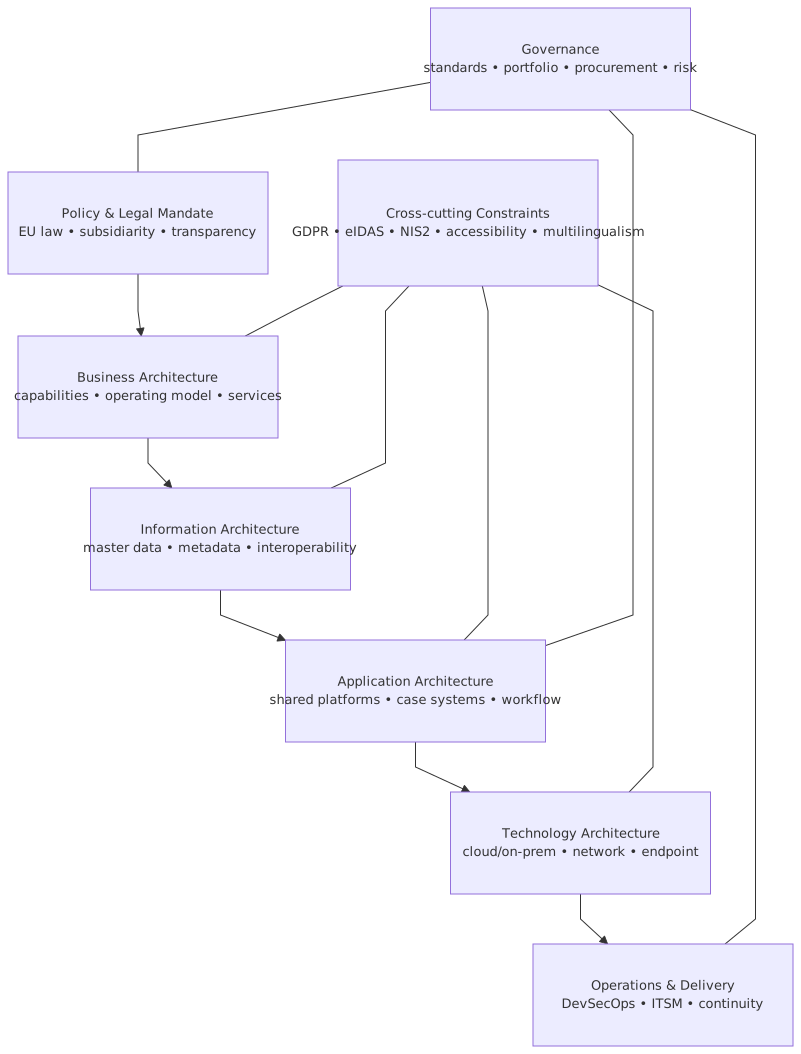
The architecture layers that matter in practice
A lot of architecture content spends too much time defining layers and not enough time making them useful. Still, the layers matter if you treat them as decision domains.
1. Business architecture
This is where many institutions underinvest. Not because they do not model business processes, but because they stop at process diagrams and never define institutional capabilities clearly enough.
Capabilities matter because they survive organisational reshuffles better than org charts.
For example:
- grants management
- compliance monitoring
- case handling
- stakeholder engagement
- policy reporting
- inspection planning
- identity verification
- records retention
When these capabilities are understood properly, you can decide what should be shared and what should stay domain-specific.
2. Information architecture
This is not just data modelling. It is deciding what information has institutional value, what is authoritative, what is sensitive, what must be retained, and how data moves across boundaries.
EU institutions often struggle here because every programme believes its data model is special. Sometimes it is. Usually it is only partly special.
The architect’s job is to separate:
- truly domain-unique data
- common reference data
- shared master data
- reporting data
- event data
- archival/legal records
If you do not do this, integration becomes a swamp.
3. Application architecture
This is where duplication hides in plain sight.
Every institution eventually discovers it has multiple tools doing some variation of:
- document management
- workflow
- CRM-like stakeholder tracking
- portal delivery
- reporting
- forms processing
- notifications
- identity administration
Application architecture should expose this duplication and force decisions. Not every problem needs a shared platform. But every repeated problem should trigger the question.
4. Technology architecture
This includes hosting, network, cloud platforms, middleware, observability, endpoint patterns, messaging, and resilience.
The common mistake here is going too deep on products too early. Product choices matter, but first define the technical guardrails:
- approved hosting patterns
- cloud account/subscription model
- encryption and key management approach
- API gateway standards
- event streaming standards
- logging and monitoring baseline
- backup and recovery patterns
- workload segmentation
5. Security architecture
In EU institutions this cannot be bolted on. It must shape architecture from the start, especially around IAM, data access, auditability, and trust boundaries.
Security architecture is not the department that says no. It is the discipline that makes institutional trust technically enforceable.
The IAM problem is always bigger than people think
If you ask me where enterprise architecture for EU institutions most often proves whether it is real or performative, I would say identity and access management.
Everyone says IAM is strategic. Then they treat it like a late integration task.
Bad move.
IAM is not just login. In institutional environments it determines:
- who can access what across organisational boundaries
- how roles are defined and governed
- how external experts, contractors, and partner organisations are onboarded
- how delegated administration works
- how auditability is maintained
- how separation of duties is enforced
- how citizen and staff identity models coexist
This gets even more complex when you have internal directories, HR systems, external federation, privileged access requirements, and application-specific role models all interacting badly.
A mature enterprise architecture approach to IAM in EU institutions should define:
A contrarian point: many institutions chase sophisticated fine-grained access models too early. They want perfect attribute-based access control before they have clean authoritative identity data or consistent role ownership. That is architecture vanity. Start with reliable identity lifecycle, federation, and role governance. Fancy policy engines do not fix broken governance. architecture decision record template
Kafka, event-driven architecture, and the false romance of “real time”
Let’s talk about Kafka, because it keeps showing up in modernization programmes, and often for the wrong reasons.
Kafka can be excellent in institutional architecture. It supports decoupling, event distribution, scalable integration, and stream-based processing. It can reduce brittle point-to-point interfaces and create a more resilient information flow across domains.
But many teams adopt Kafka because they are bored with APIs.
That is not a strategy.
In EU institutions, event-driven architecture is useful when:
- multiple systems need to react to business events
- data propagation across domains should be asynchronous
- audit/event trails have operational value
- analytics or monitoring benefit from streams
- integration complexity is growing beyond manageable synchronous patterns
Examples:
- a case status changes and downstream reporting, notifications, and archival workflows react
- identity lifecycle events trigger application provisioning
- document ingestion events launch classification and review pipelines
- grant approval events feed finance, publication, and oversight systems
Where architects go wrong:
- They introduce Kafka without event ownership.
- They publish database-shaped events instead of business events.
- They skip schema governance.
- They treat the platform as integration magic.
- They create another central team bottleneck.
A real architecture stance is this: Kafka is not your architecture. It is a platform capability inside your architecture.
If you do not define event domains, producer accountability, retention rules, schema versioning, replay boundaries, and data sensitivity handling, Kafka just accelerates chaos.
And one more unpopular opinion: not everything should be event-driven. Synchronous APIs remain the correct choice for many transactional interactions, especially where immediate response, validation, or user-facing confirmation matters. Architects who push eventing everywhere usually leave operations to deal with the mess.
Cloud in EU institutions: stop arguing ideology, start designing control
Cloud debates in EU institutions are often strangely theological.
One camp acts as if cloud is obviously the only modern answer. Another camp treats it as a sovereignty threat by default. Both positions are lazy.
Cloud is not a religion. It is an operating model choice.
The right question is not “cloud or not?” It is:
- which workloads
- under which controls
- with what exit assumptions
- using what landing zone and security baseline
- with what data classification restrictions
- and with what financial governance
In real enterprise architecture work, cloud for EU institutions usually means some combination of:
- private cloud or sovereign hosting for sensitive workloads
- public cloud for scalable digital services, analytics, or platform services
- hybrid integration for legacy systems that cannot move soon
- common landing zones with institutional guardrails
- standard patterns for network segmentation, secrets, observability, and deployment
Architects make two opposite mistakes here.
Mistake one: cloud exceptionalism
This is when cloud teams claim every old governance rule is obsolete. Suddenly teams want direct self-service, rapid experimentation, no shared standards, and product selection by project. That usually ends in duplicated environments, weak tagging, poor cost visibility, and inconsistent security controls.
Mistake two: on-prem thinking in cloud clothing
This is when institutions move workloads to cloud but preserve every old operational habit. Manual provisioning, ticket-based networking, no automation, no policy-as-code, no platform engineering, no standard deployment templates. So they get the cost profile of cloud with the agility of a filing cabinet.
A good enterprise architecture position is blunt:
- standardise the landing zone
- standardise identity integration
- standardise logging and policy controls
- standardise network/security baselines
- allow workload variation above that line
- and force teams to justify deviations in business terms, not technical preference
A real example: what a bank can teach EU institutions
Here is a concrete example from banking, because banks and EU institutions actually share more architectural problems than people admit: regulation, auditability, complex identity, legacy systems, and high cost of operational failure. ArchiMate in TOGAF ADM
A large European bank I worked with had grown through mergers. Predictably, it had multiple customer platforms, fragmented IAM, a crowded middleware estate, and teams building APIs as if naming conventions were architecture. Every programme said it was unique. None of the platforms wanted to give up control.
The turning point was not a new diagram. It was a platform-based architecture decision package with governance attached.
The bank did five important things:
- Established IAM as a central institutional capability
Authoritative identity sources were defined. Federation patterns were standardised. Application onboarding to central IAM stopped being optional.
- Introduced Kafka for bounded use cases, not as a replacement religion
Customer lifecycle events, fraud signals, and operational events were published with schema governance and domain ownership. They did not force every integration onto Kafka.
- Created a cloud landing zone with strict controls
Teams could deploy quickly, but only within approved patterns for identity, network, logging, encryption, and tagging.
- Rationalised duplicate workflow and document services
Not by ripping everything out, but by identifying strategic platforms and putting all new development on those rails.
- Made architecture decisions financially visible
If a programme wanted an exception, it had to carry the lifecycle cost, integration impact, and operational support burden.
The result was not perfection. It was better: fewer duplicate platforms, faster onboarding, cleaner audit evidence, better resilience, and more honest governance.
The EU institution lesson is obvious. Large public institutions should stop assuming they are “too special” for platform discipline. They are special in mandate, not in the laws of complexity.
What this looks like in real architecture work
This is where many articles become abstract. Let’s not do that.
If you are an enterprise architect in an EU institution, your week probably includes things like:
- reviewing a programme business case that includes hidden platform duplication
- advising on whether a new partner portal should use central IAM or local accounts
- challenging a project that wants bespoke integration because the shared API platform feels “slow”
- defining target-state principles for cloud workload placement
- mediating between security, operations, legal, procurement, and delivery teams
- deciding whether a case management need is truly unique or just politically framed that way
- evaluating whether Kafka is justified for a domain event stream or whether an API and batch export would be simpler
- identifying where data ownership is unclear and therefore architecture risk is high
- translating strategic goals into enforceable architectural constraints
Real architecture work is less “inventing” and more “forcing clarity.”
You do not win by producing the most complete metamodel. You win when:
- shared services are actually adopted
- exceptions are visible and temporary
- delivery teams know the approved patterns
- security and audit teams trust the design
- operations can support what gets deployed
- the institution can evolve without re-arguing first principles every quarter
That means architects need a few habits.
1. Get close to delivery
If you only operate at steering committee altitude, you will miss where architecture really fails: onboarding friction, unclear standards, bad templates, weak IAM integration, poor data contracts, and platform teams that are harder to work with than external vendors.
2. Make standards usable
A 90-page reference architecture that no delivery team can apply is just ceremonial architecture. Give teams patterns, decision trees, sample blueprints, reusable modules, and clear exception processes.
3. Follow the money
Duplication survives because it is locally convenient and centrally invisible. Architects who ignore funding models are basically drawing around the real problem.
4. Design for institutional turnover
Leaders change. Programmes end. Vendors rotate. Political priorities shift. Architecture has to survive this. That means explicit ownership, durable standards, and operational handover models.
Common mistakes enterprise architects make in EU institutions
Let’s be direct.
Mistake 1: confusing consensus with architecture
If every architectural decision is negotiated until nobody objects, you are not architecting. You are averaging.
Mistake 2: producing target states with no migration path
A target architecture without sequencing, dependencies, and transition states is fantasy. Institutions run legacy for long periods. Plan accordingly.
Mistake 3: underestimating IAM and data governance
Teams love talking about APIs, cloud, and AI. Meanwhile, access models and data ownership remain muddy. That is how programmes fail in slow motion.
Mistake 4: allowing projects to become platform owners by accident
One project builds a useful component. Then three others depend on it. Suddenly a project-funded asset becomes a critical institutional platform with no proper product owner, funding, or lifecycle model.
Mistake 5: overengineering interoperability
Not every integration needs canonical perfection. Sometimes a simple API contract is enough. Architects who try to solve all semantic variation centrally often create paralysis.
Mistake 6: treating procurement as an afterthought
In EU institutions, procurement shapes architecture. If your architecture assumes flexibility that contracts do not allow, your architecture is fiction.
Mistake 7: failing to define exception governance
Standards without an exception process become theatre. But exceptions without expiry become architecture decay.
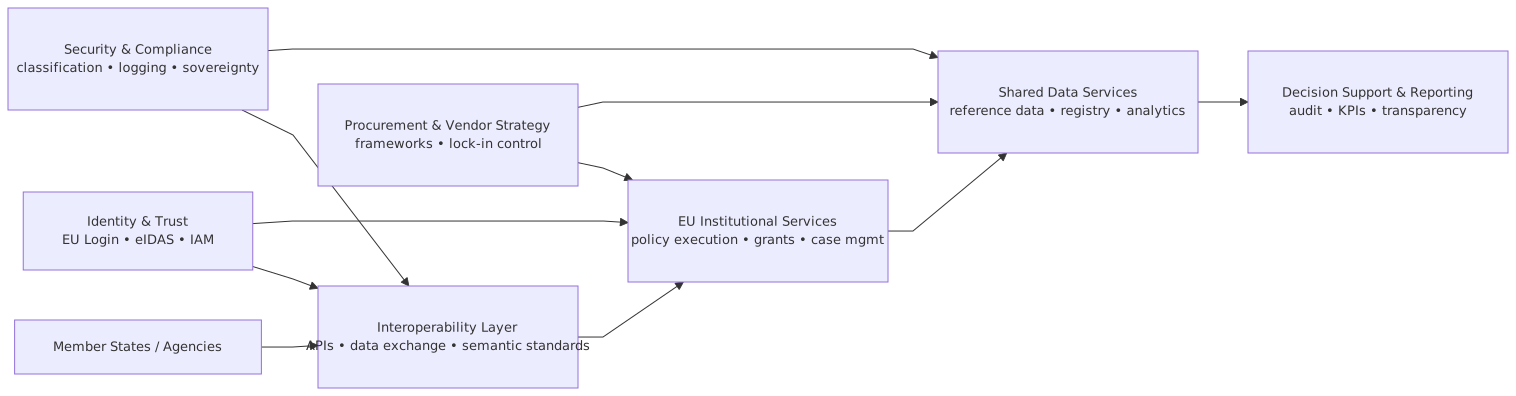
A practical architecture operating model for EU institutions
If I had to recommend one workable model, it would look like this:
This model works only if there is actual authority behind it. Not just forums. Authority.
And yes, that means some projects will be told no. Good. They should be.
Contrarian thoughts that need saying
A few opinions that will annoy some people.
Not every institution needs a massive EA repository before it needs architectural discipline.
Tooling helps. But weak decision-making with a better repository is still weak decision-making.
“Business-led” architecture is often used as a shield against technical accountability.
Of course architecture must serve business goals. But if nobody is willing to confront poor technical choices early, business outcomes suffer later and more expensively.
Interoperability is not achieved by standards documents alone.
It is achieved by common platforms, enforced contracts, funded governance, and operational ownership.
Agility is not the right of every team to choose its own stack.
In institutions, real agility comes from standard platforms that reduce repeated decisions.
Legacy is not the enemy. Unmanaged legacy is.
Some legacy systems are stable, understood, and worth containing rather than replacing immediately. Architects should stop pretending every old system deserves a transformation programme.
Final thought
Enterprise architecture for EU institutions is not about creating a perfect target state. It is about creating a durable decision system for a politically complex, operationally constrained, highly regulated environment.
That requires architects who are comfortable being useful before being elegant.
You need enough abstraction to see the institution, enough technical depth to challenge bad designs, enough governance sense to make standards stick, and enough realism to work with procurement, legacy, and organisational fragmentation instead of pretending they are side issues.
If that sounds less glamorous than architecture frameworks often promise, good. Real architecture is not glamorous. It is consequential.
And in EU institutions, consequential beats elegant every time.
FAQ
1. What is the biggest enterprise architecture priority for EU institutions?
Usually IAM and governance around shared capabilities. If identity, access, and institutional standards are weak, every other domain becomes harder: cloud, integration, audit, external collaboration, and digital services.
2. Should EU institutions adopt cloud-first strategies?
Not blindly. A cloud-first slogan is weaker than a workload-placement strategy with clear controls. Some workloads fit public cloud well, some require private or sovereign hosting, and many will remain hybrid for years.
3. Is Kafka a good fit for EU institutions?
Yes, when used for clear event-driven use cases with domain ownership, schema governance, and operational maturity. No, if used as a fashionable replacement for all APIs and integration patterns.
4. What is the most common mistake architects make in public institutions?
Designing target architectures that ignore delivery mechanics: funding, procurement, platform ownership, migration sequencing, and exception governance. The result looks coherent on paper and fails in practice.
5. How can enterprise architects make standards actually adopted?
By making them usable. Provide patterns, templates, reusable services, onboarding paths, and fast decision processes. Teams adopt standards when standards reduce effort, not when they come with more slides.
Frequently Asked Questions
What is enterprise architecture?
Enterprise architecture is a discipline that aligns an organisation's strategy, business processes, information systems, and technology. Using frameworks like TOGAF and modeling languages like ArchiMate, it provides a structured view of how the enterprise operates and how it needs to change.
How does ArchiMate support enterprise architecture practice?
ArchiMate provides a standard modeling language that connects strategy, business operations, applications, data, and technology in one coherent model. It enables traceability from strategic goals through business capabilities and application services to the technology platforms that support them.
What tools are used for enterprise architecture modeling?
The main tools are Sparx Enterprise Architect (ArchiMate, UML, BPMN, SysML), Archi (free, ArchiMate-only), and BiZZdesign Enterprise Studio. Sparx EA is the most feature-rich option, supporting concurrent repositories, automation, scripting, and integration with delivery tools like Jira and Azure DevOps.