⏱ 20 min read
Most enterprise architecture teams talk about models as if the hard part is drawing the boxes.
It isn’t.
The hard part is agreeing on what the boxes mean.
That’s where architecture efforts quietly fail. Not because the diagrams are ugly. Not because the repository is outdated. And not even because the framework was bad. They fail because five architects, twelve analysts, and three platform teams all use the same words for different things. “Application” means product to one person, deployable to another, SaaS contract to procurement, and a Kubernetes namespace to the cloud team. Then everyone wonders why the repository became a graveyard.
So let’s say it plainly:
A metamodel is the definition of the kinds of things you are allowed to model, plus the relationships between them.
That’s the simple explanation.
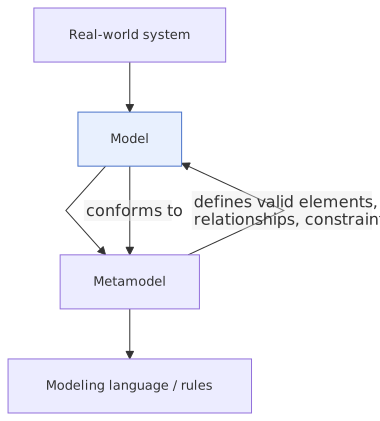
If a model is the map, the metamodel is the legend and grammar of the map. It tells you what counts as an application, a capability, a data object, an event, an interface, a policy, a control, and how those things can connect. Without it, architecture is just PowerPoint with ambition.
And yes, this sounds abstract. It also happens to be one of the most practical concepts in enterprise architecture.
Because the moment you need to answer real questions—Which systems process customer identity? What breaks if Kafka cluster A fails? Which cloud workloads support payments? Which IAM roles violate segregation of duties?—you need consistency. Not artistic consistency. Semantic consistency.
That’s what a metamodel gives you.
The Simple Explanation First
Here’s the shortest useful version:
A metamodel is a model of your modeling language.
It defines:
- what types of architecture elements exist
- what attributes they have
- how they relate to each other
- what rules apply
Example:
Your metamodel might say:
- A Business Capability is realized by one or more Applications
- An Application runs on a Technology Platform
- An Application owns or consumes Data Objects
- An API is exposed by an Application
- An Event Stream in Kafka is produced by one Service and consumed by many Services
- An Identity Provider authenticates Users
- An IAM Role grants access to Cloud Resources
That’s a metamodel. Not the actual inventory of your bank’s systems. The shape of how that inventory is represented.
Then your actual architecture model would contain instances like:
- Capability: Retail Payments
- Application: Payment Hub
- Platform: AWS EKS
- Event Stream:
payment-authorized - Identity Provider: Azure AD
- IAM Role:
payments-prod-readonly
The metamodel says what kinds of things those are and what connections are legal and meaningful.
If that sounds almost too simple, good. It should.
Architects often make metamodels sound like mystical theory because they’re trying to hide the fact that they made them too complicated.
Why Architects Need a Metamodel at All
Here’s the contrarian view: a lot of architecture teams should do less modeling, not more.
But if you are going to model enterprise architecture seriously, then a metamodel is non-negotiable.
Why? Because architecture without a metamodel produces three predictable disasters:
- Everyone models differently
- You cannot query anything reliably
- Traceability becomes fiction
Let’s make that concrete.
Imagine a bank trying to map customer onboarding across channels. One team models “Customer Onboarding” as a business process. Another models it as a capability. Another models “Onboarding Platform” as the same thing. Security models identity proofing as a control. The IAM team tracks it as a policy domain. Data architecture tracks KYC status as a data entity. Integration architecture tracks onboarding events in Kafka. Cloud architecture tracks the workloads in Azure.
All of those may be valid views. But without a metamodel, none of them line up.
You end up with architecture that looks broad but cannot answer basic questions like:
- Which applications support onboarding?
- Which data stores hold KYC documents?
- Which Kafka topics carry onboarding events?
- Which IAM roles can access those systems?
- Which cloud resources host those workloads?
- Which controls apply to regulated customer data?
That’s the difference between diagrams and architecture.
A metamodel is how you move from “nice picture” to “operating system for decision-making.”
The Big Misunderstanding: A Metamodel Is Not a Tool Feature
A lot of people first encounter metamodels through architecture tools. Sparx, LeanIX, Bizzdesign, HOPEX, Ardoq, whatever. The tool asks you to define object types and relationships, and suddenly there’s a metamodel. Sparx EA performance optimization
Then people start thinking the metamodel is just “how the tool is configured.”
No.
The tool implements it. The tool does not define the purpose of it.
A metamodel is fundamentally a governance choice about meaning.
That matters because many architecture teams inherit a tool vendor’s default metamodel and assume the job is done. Usually it isn’t. Vendor defaults are broad, generic, and safe. Enterprises are specific, political, messy, and inconsistent. You need a metamodel that reflects how your organization makes decisions.
If your bank needs to track event-driven dependencies via Kafka because operational resilience is a board-level concern, then “application integrates with application” is too vague. You may need explicit concepts like:
- Event Producer
- Event Consumer
- Kafka Topic
- Schema
- Integration Pattern
- Data Classification
- Recovery Objective
That’s not academic overengineering. That’s architecture serving the business.
But here’s the warning: lots of teams swing too far and create a metamodel with 140 object types because they finally discovered they can.
That’s not maturity either. That’s taxonomy cosplay.
What a Metamodel Actually Contains
A useful metamodel usually defines four things.
That’s it. That’s the practical core.
You do not need to turn this into a philosophical opera.
1. Element Types
These are your nouns.
Examples from enterprise architecture:
- Business Capability
- Business Process
- Application
- Service
- API
- Data Object
- Event Stream
- Kafka Topic
- Technology Component
- Cloud Account
- IAM Role
- Identity Provider
- Control
- Vendor
The trick is not making this list too short or too long.
Too short and everything becomes “application” or “component,” which tells you nothing.
Too long and nobody knows the difference between “digital service,” “application service,” “system service,” “platform service,” and “shared technical service.” I’ve seen metamodels where the architects themselves couldn’t explain the distinctions consistently. That’s a bad sign.
2. Attributes
These are the properties of each element.
For an Application, you might want:
- name
- owner
- lifecycle state
- criticality
- deployment model
- cloud provider
- resilience tier
- data classification handled
For a Kafka Topic:
- producer team
- consumer teams
- retention period
- schema registry reference
- message classification
- replay policy
For an IAM Role:
- account or subscription
- privilege level
- human or machine usage
- owner
- review date
- linked policy set
Attributes are where architecture becomes operationally useful. If your repository cannot tell you which applications are Tier 1 and process customer-identifiable information, the repository is decorative.
3. Relationships
This is where the real value sits.
A metamodel doesn’t just define objects. It defines meaningful connections.
Examples:
- Business Capability is supported by Application
- Application runs on Cloud Platform
- Application publishes to Kafka Topic
- Kafka Topic is consumed by Service
- Application uses Identity Provider
- IAM Role grants access to Cloud Resource
- Data Object is stored in Database
- Control applies to Application
Without relationship discipline, architecture repositories become a junk drawer full of disconnected inventory records.
4. Constraints and Rules
This is the part many teams skip, and it’s a mistake.
A metamodel should also define what must be true.
For example:
- Every production application must map to at least one business capability
- Every critical application must have a disaster recovery tier
- Every Kafka topic must have an owner and data classification
- Every cloud workload must map to a cost center and support team
- Every privileged IAM role must have a quarterly review date
Now your metamodel is not just descriptive. It’s governing quality.
The Difference Between a Model and a Metamodel
People confuse these constantly, so let’s make it blunt.
Think of it this way:
- The model is your enterprise architecture content.
- The metamodel is the schema behind that content.
If you come from data architecture, this should feel familiar. A database table stores rows; the schema defines what kind of rows can exist. Same idea, though metamodels often include richer semantics and relationship rules.
And if you come from software engineering, it’s also familiar. A class definition shapes what objects can exist. Again, same basic pattern.
This is why architects who dismiss metamodels as “too abstract” are usually just avoiding discipline.
How This Applies in Real Architecture Work
Now the important part: real work, not theory.
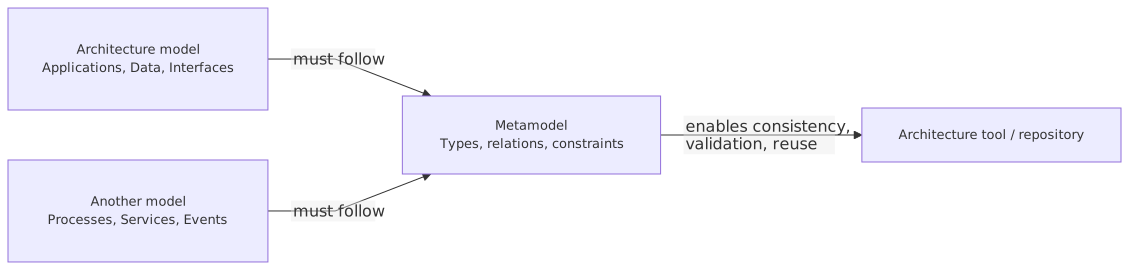
A metamodel matters because enterprise architecture is supposed to answer real questions under pressure. During an audit. During a merger. During a cloud migration. During a resilience review. During a cyber incident. During cost reduction. During a regulator visit.
In those moments, nobody cares that your capability map uses lovely colors. ArchiMate capability map
They care whether the architecture can tell the truth quickly.
Example 1: Banking and Kafka Dependency Mapping
Let’s say you’re in a retail bank. Your payments domain has moved toward event-driven architecture. Core systems publish events to Kafka: payment initiated, payment authorized, fraud flagged, settlement completed. Different services consume these events for ledger updates, notifications, fraud analytics, customer timeline, reconciliation.
If your metamodel only has “application integrates with application,” you are blind.
You can’t represent:
- which service produces which event
- which Kafka topic carries regulated data
- which downstream consumers depend on a topic
- where schema ownership sits
- what breaks if a topic or cluster is unavailable
A better metamodel would include explicit concepts like:
- Application
- Service
- Kafka Cluster
- Kafka Topic
- Event Schema
- Producer
- Consumer
- Data Classification
- Resilience Tier
Now you can answer things like:
- Which critical banking services depend on Kafka cluster PROD-EU-1?
- Which topics contain payment reference data?
- Which consumers would be impacted by a schema change?
- Which event flows cross cloud boundaries?
That is architecture delivering operational value.
Example 2: IAM in a Cloud Estate
Another common mess: identity and access management in cloud environments.
A company says, “We need better visibility into IAM.” Fine. Then architecture creates a generic metamodel with User, Role, Application, Platform.
Too vague. Useless in practice.
What you usually need is something closer to:
- Identity Provider
- User
- Service Principal
- IAM Role
- Policy
- Cloud Account / Subscription
- Resource Group / Project
- Cloud Resource
- Application
- Privilege Level
- Access Review
Now you can model:
- Azure AD authenticates users
- Service principal X assumes IAM role Y
- Role Y grants access to S3 bucket Z
- Bucket Z stores customer statements
- Statement service uses bucket Z
- Statements support Retail Servicing capability
That gives you traceability from business service to technical access control.
Without that structure, your security architects and platform engineers will maintain separate spreadsheets forever, and your “enterprise view” will be fiction.
Example 3: Cloud Migration Planning
Suppose the bank is moving 200 applications from on-prem to cloud.
Leadership asks:
- Which workloads are easy to rehost?
- Which depend on on-prem IAM?
- Which consume or publish to Kafka?
- Which process regulated data in a restricted geography?
- Which applications support critical capabilities and need active-active resilience?
If your metamodel has only Business Capability, Application, and Server, good luck.
A practical cloud migration metamodel might add:
- Deployment Environment
- Hosting Platform
- Region
- Data Residency Constraint
- Identity Dependency
- Integration Dependency
- Recovery Pattern
- Technology Obsolescence
Now migration planning becomes analysable instead of political theater.
And yes, that sentence was intentional. Many migration programs pretend to be architecture-led while actually being driven by whoever shouts loudest in steering committees.
A good metamodel reduces shouting.
Not completely. Let’s not get silly.
Common Mistakes Architects Make With Metamodels
This is where strong opinions are deserved.
1. They Start With Framework Purity Instead of Decision Needs
This is probably the most common mistake.
Architects begin by asking, “What does TOGAF say?” or “What does ArchiMate support?” Wrong starting point. ArchiMate layers explained
The better question is:
What decisions do we need the architecture to support?
If your key decisions are around resilience, IAM risk, cloud cost, and event-driven dependencies, then your metamodel should support those. Frameworks can help. They should not dictate.
Framework-first architecture often looks neat and does very little.
2. They Create a Metamodel That’s Too Generic
Everything becomes:
- business object
- application component
- technology component
- interface
This feels elegant. It is also mostly useless for enterprise analysis.
If Kafka topics matter, model Kafka topics.
If IAM roles matter, model IAM roles.
If cloud accounts matter, model cloud accounts.
Generic metamodels are often a symptom of architects trying to avoid commitment.
3. They Create a Metamodel That’s Too Detailed
The opposite problem.
Suddenly there are 17 kinds of service and 11 kinds of data entity. Nobody knows which one to use. Adoption dies. Data quality collapses.
A metamodel should be as simple as possible, but not simpler. Yes, that old line still applies.
The acid test is easy: can a normal architect or analyst classify most things correctly without a two-hour debate?
If not, the metamodel is too clever.
4. They Ignore Ownership and Lifecycle
A repository full of object types and relationships but no ownership model is doomed.
Every meaningful element should have:
- accountable owner
- update responsibility
- review cadence
- lifecycle state
Otherwise your architecture becomes stale almost immediately.
And once the business sees stale architecture once, trust drops hard.
5. They Don’t Define Relationship Meaning Clearly
“Depends on” is the laziest relationship in architecture.
Depends on how?
- hosts?
- authenticates?
- publishes event to?
- consumes from?
- stores data in?
- governed by?
- monitored by?
Ambiguous relationships make analysis unreliable. Better to have fewer, clearer relationships than dozens of vague ones.
6. They Treat the Metamodel as Finished
It never is.
A metamodel is a product, not a monument.
As your architecture concerns evolve—cloud native platforms, zero trust IAM, event streaming, AI services, regulatory traceability—your metamodel should evolve too.
Not every week. That becomes chaos. But pretending the first version is final is naive.
A Real Enterprise Example: Banking, Kafka, IAM, and Cloud
Let’s walk through a realistic scenario.
A mid-sized bank is modernizing its customer servicing and payments landscape.
The Situation
The bank has:
- legacy core banking on-prem
- digital channels in Azure
- analytics workloads in AWS
- Kafka used as the enterprise event backbone
- centralized identity in Azure AD / Entra ID
- multiple IAM models across cloud platforms
- growing regulatory pressure around operational resilience and access governance
Leadership asks enterprise architecture for a clear view of:
- which services support critical customer journeys
- where customer identity is used
- how payments events flow
- which cloud resources are in scope for resilience testing
- which privileged roles have access to regulated workloads
What Happens Without a Metamodel
Each team provides its own view.
- Business architecture gives a capability map
- Application architecture gives an application inventory
- Integration architects show event flow diagrams
- Security architects show IAM role mappings
- Cloud architects show landing zones and subscriptions
All valid. None integrated.
So when the COO asks, “If Kafka payments cluster EU-PROD fails, what customer services are impacted?” the room goes quiet.
Not because the information does not exist. Because it exists in incompatible structures.
What the Metamodel Looks Like
The bank defines a practical metamodel with these key elements:
- Business Capability
- Customer Journey
- Application
- Service
- API
- Kafka Cluster
- Kafka Topic
- Event Schema
- Data Object
- Identity Provider
- IAM Role
- Cloud Subscription / Account
- Cloud Resource
- Control
- Support Team
And relationships such as:
- Customer Journey is enabled by Capability
- Capability is supported by Application
- Application contains Service
- Service publishes to Kafka Topic
- Service consumes Kafka Topic
- Kafka Topic runs on Kafka Cluster
- Application uses Identity Provider
- IAM Role grants access to Cloud Resource
- Application runs on Cloud Resource
- Control applies to Application
- Support Team owns Application / Kafka Topic / IAM Role
What the Bank Can Now Answer
With this structure in place, architecture can answer real questions:
- Which customer journeys rely on the Payment Authorization service?
- Which applications consume the
payment-authorizedtopic? - Which topics on EU-PROD carry personal data?
- Which services depend on Entra ID for authentication?
- Which privileged IAM roles can access storage containing customer statements?
- Which critical applications in Azure lack mapped resilience controls?
- Which support teams would be paged if a specific Kafka cluster failed?
That is not “nice documentation.” That is architectural intelligence.
The Hidden Benefit
The biggest win usually isn’t the diagrams. It’s decision quality.
The bank can now prioritize:
- resilience investment based on actual dependency concentration
- IAM cleanup based on access paths to critical workloads
- migration sequencing based on real integration dependencies
- control assurance based on application and data criticality
This is where metamodels earn their keep. They reduce ambiguity at the exact point where ambiguity gets expensive.
How to Create a Useful Metamodel Without Overcomplicating It
Here’s a practical approach I’ve used and seen work.
Step 1: Start With the Questions You Need to Answer
Not theory. Questions.
For example:
- Which applications support this capability?
- Which systems process customer identity?
- Which Kafka topics are critical to payments?
- Which IAM roles grant privileged access to production?
- Which cloud workloads host regulated data?
Write 20–30 such questions. Your metamodel should exist to answer them.
Step 2: Identify the Minimum Necessary Element Types
Pull the nouns from those questions.
Maybe you need:
- Capability
- Application
- Service
- Kafka Topic
- IAM Role
- Cloud Resource
- Data Object
- Control
Maybe you don’t need Process, Product, Value Stream, Contract, and Interface Contract on day one. That’s okay. Start with what matters.
Step 3: Define Relationship Semantics Carefully
Be precise.
Instead of a generic “related to,” use:
- supports
- runs on
- publishes to
- consumes
- authenticates via
- grants access to
- stores
- governed by
These are analysable.
Step 4: Add Only Attributes That Drive Decisions
If no one will ever use an attribute, don’t include it.
Useful attributes are things like:
- owner
- lifecycle
- criticality
- data classification
- region
- resilience tier
- environment
- review date
Useless attributes are often things somebody thought “might be interesting later.” That way lies repository obesity.
Step 5: Define Governance Rules
Decide what is mandatory.
Example:
- Every production application must have owner, criticality, and support team
- Every Kafka topic must have producer, data classification, and environment
- Every IAM role must have owner, privilege level, and review date
Without mandatory fields, quality decays fast.
Step 6: Pilot in One Domain
Don’t launch enterprise-wide first.
Pilot in a domain with real urgency—payments, customer identity, cloud platform, fraud, whatever. Learn what works. Then extend.
This is another place architects get it wrong. They design for universal perfection, then die in rollout.
A Contrarian Thought: Sometimes You Don’t Need a Bigger Metamodel. You Need Fewer Ambitions.
Enterprise architects love scope. That’s one of our flaws.
We say we want traceability from strategy to capability to process to application to API to event to data to control to infrastructure to cost to risk. And yes, in theory, that sounds glorious.
In practice, most organizations cannot maintain that level of model integrity across all domains.
So here’s the unpopular but useful position:
A smaller metamodel that is actually used is far better than a grand metamodel nobody trusts.
If your teams can reliably maintain:
- capabilities
- applications
- services
- Kafka topics
- IAM roles
- cloud resources
- controls
then start there. Don’t force ten more layers of abstraction because some framework slide suggested end-to-end purity.
Architecture value comes from decision support, not conceptual completeness.
That doesn’t mean be simplistic. It means be honest about organizational capacity.
A metamodel should fit the maturity of the enterprise, while nudging it upward. Not fantasy-leap ten levels ahead.
How to Explain a Metamodel to Non-Architects
You will need this, because if you can’t explain it simply, stakeholders will assume it’s architecture jargon.
Try this:
> “A metamodel is the agreed structure for how we describe the enterprise. It defines what kinds of things we track—like applications, APIs, Kafka topics, IAM roles, and cloud resources—and how they connect. That consistency lets us answer impact, risk, and change questions quickly.”
That usually lands.
For engineers, I often say:
> “Think of it as the schema for enterprise architecture data.”
For executives:
> “It’s the standard behind the architecture inventory, so we can trust cross-domain analysis.”
For skeptical delivery teams:
> “It stops six teams from using the same term six different ways.”
That last one usually gets a laugh because it’s true.
Final Thought
A metamodel is not glamorous. It won’t impress anyone in a steering committee on its own. It’s not the shiny part of architecture.
But it is one of the few things that separates architecture as a discipline from architecture as a drawing habit.
If you want enterprise architecture to do real work—to support cloud migration, Kafka dependency analysis, IAM governance, resilience planning, banking controls, and cross-domain decision-making—then you need a metamodel. ARB governance with Sparx EA
Not an enormous one. Not a framework museum. Not a vendor default worshipped as doctrine.
A practical one.
Clear types. Clear relationships. Clear rules. Built around real decisions.
That’s it.
The irony is that once you have a good metamodel, people stop talking about it. Which is exactly what should happen. It fades into the background and makes the architecture usable.
And honestly, that’s the best outcome most architecture work can hope for.
FAQ
1. What is a metamodel in simple terms?
A metamodel is the structure behind your architecture model. It defines what kinds of things you can represent—applications, capabilities, Kafka topics, IAM roles, cloud resources—and how they relate. It’s basically the schema and rules for architecture data.
2. Why is a metamodel important in enterprise architecture?
Because without one, teams use inconsistent definitions and relationships. That makes impact analysis, risk assessment, migration planning, and governance unreliable. A metamodel gives you consistency, which is what makes architecture useful beyond diagrams. EA governance checklist
3. Is a metamodel the same as a framework like TOGAF or ArchiMate?
No. A framework provides concepts, methods, or notation. A metamodel defines the specific element types, attributes, relationships, and rules your organization uses in its architecture repository. Frameworks can inform it, but they are not the same thing.
4. How detailed should a metamodel be?
Only as detailed as needed to support real decisions. If Kafka, IAM, and cloud dependencies matter, model them explicitly. But don’t create dozens of overly subtle object types nobody can apply consistently. Practical beats perfect.
5. Can you build a metamodel incrementally?
Yes, and you probably should. Start with a domain that has urgent business value—like payments, IAM, or cloud migration. Define the minimum useful structure, test it, then expand. Trying to design the ultimate enterprise metamodel upfront is usually a mistake.
- A model describes a system.
- A metamodel describes how models are allowed to be built.
- For architects, it provides a shared structure: what element types exist, how they relate, and what rules apply.
- This helps with consistency, governance, validation, and tool interoperability.
Frequently Asked Questions
What is enterprise architecture?
Enterprise architecture is a discipline that aligns an organisation's strategy, business processes, information systems, and technology. Using frameworks like TOGAF and modeling languages like ArchiMate, it provides a structured view of how the enterprise operates and how it needs to change.
How does ArchiMate support enterprise architecture practice?
ArchiMate provides a standard modeling language that connects strategy, business operations, applications, data, and technology in one coherent model. It enables traceability from strategic goals through business capabilities and application services to the technology platforms that support them.
What tools are used for enterprise architecture modeling?
The main tools are Sparx Enterprise Architect (ArchiMate, UML, BPMN, SysML), Archi (free, ArchiMate-only), and BiZZdesign Enterprise Studio. Sparx EA is the most feature-rich option, supporting concurrent repositories, automation, scripting, and integration with delivery tools like Jira and Azure DevOps.