⏱ 19 min read
Most architecture confusion does not come from technology. It comes from people using the same words to mean different things and then acting surprised when delivery goes sideways.
“Model” and “metamodel” are classic examples. I’ve seen enterprise architects, solution architects, platform teams, and governance leads sit in the same room, all saying “we need a better model,” while one person means a capability map, another means a data schema, another means an ArchiMate view, and someone from engineering just means a Terraform module. Then six weeks later everybody wonders why the architecture repository is full of diagrams nobody trusts.
So let’s be blunt: if you don’t understand the difference between a model and a metamodel, your architecture practice will eventually become a slide factory. Pretty pictures, weak decisions.
This article explains the difference clearly, then goes deeper into how it actually matters in enterprise architecture work—especially in messy, real environments with banks, Kafka platforms, IAM sprawl, and cloud migration politics.
The simple explanation first
Here’s the short version, early and clear.
- A model is a representation of something in the real world.
- A metamodel is the definition of how those models are allowed to be structured.
That’s it. That’s the core idea.
If you want a plain-English analogy:
- A model is a sentence.
- A metamodel is grammar.
Or:
- A model is a building.
- A metamodel is the building code plus the blueprint conventions.
Or, in enterprise architecture terms:
- A model might show that Customer Identity Service publishes events to Kafka, which are consumed by Fraud Detection, and access is controlled through IAM roles in the cloud.
- A metamodel defines that you are allowed to have elements like Application, Data Object, Event Stream, Role, Policy, Cloud Resource, and relationships like publishes, consumes, depends on, accesses, owns, and governed by.
The model is the thing you create.
The metamodel is the rulebook for what kinds of things can appear in that creation.
That simple distinction matters more than many architects admit. EA governance checklist
Why architects get this wrong
Because architecture has a bad habit of pretending all abstraction is useful.
It isn’t.
A lot of teams jump too quickly into “meta” thinking because it sounds sophisticated. They start debating ontology, repository structure, taxonomy alignment, and canonical viewpoints before they can answer basic questions like:
- Which systems handle customer onboarding?
- Where does privileged access get approved?
- Which Kafka topics carry regulated data?
- Which applications still depend on the mainframe?
- Which cloud workloads violate identity policy?
That’s backwards.
You do not start with a metamodel because it feels elegant. You start with the decisions you need to support. Then you define just enough metamodel to make your models consistent and useful.
That’s a strong opinion, yes. But it comes from experience. The enterprise architecture teams that obsess over metamodel design too early often produce repositories that are internally consistent and externally irrelevant.
What is a model, really?
A model is a purposeful simplification of reality.
That word “purposeful” matters. A model is not just a description. It is a description shaped for a reason.
In architecture work, models help people:
- understand a landscape
- analyze dependencies
- evaluate risk
- compare options
- govern standards
- communicate decisions
- plan change
A model is never the whole truth. It is a selected truth.
For example, in a bank you might create:
- a business capability model showing Payments, Lending, Fraud, Customer Servicing
- an application model showing which systems support those capabilities
- a data flow model showing how customer and transaction data move
- a security model showing IAM roles, trust boundaries, and privileged access
- a cloud deployment model showing workloads across AWS accounts and Azure subscriptions
- an event-driven integration model showing Kafka topics, producers, consumers, schemas, and ownership
Each of those is a model because each represents part of reality for a purpose.
A model is useful when it helps answer a question.
That should be obvious. Yet many architecture teams create models that answer no serious question at all. They’re comprehensive, color-coded, and totally disposable.
What is a metamodel, really?
A metamodel defines the language and structure used to create models.
It says things like:
- what element types exist
- what attributes those elements have
- what relationships are valid
- what constraints apply
- what viewpoints are supported
- what semantics should be consistent across models
A metamodel is not the architecture itself. It is the schema behind the architecture descriptions.
Think about a repository tool used by enterprise architects. If it allows entities such as:
- Business Capability
- Business Process
- Application
- Service
- Data Entity
- Event Topic
- IAM Role
- Cloud Account
- API
- Team
- Control
- Risk
…and relationships like:
- supports
- owns
- consumes
- publishes
- stores
- authenticates with
- deployed in
- governed by
- depends on
…that structure is the metamodel.
The actual entries—say, “Retail Payments Platform,” “Customer Profile Topic,” “Privileged Access Role,” “AWS Production Account,” “Fraud Analytics Service”—and the links between them form the models.
So a metamodel is one layer up. Not more important. Just one layer up.
That distinction matters because many enterprise architecture arguments are actually arguments about the metamodel disguised as arguments about the model.
Example:
- “Why can’t I link a Kafka topic directly to a business capability?”
- “Why do we classify IAM roles as technology objects instead of logical services?”
- “Why does the repository force every application to have a lifecycle state?”
- “Why can’t a cloud landing zone be modeled as both a platform and a governance boundary?”
Those are metamodel questions.
The key difference in one table
Here’s the cleanest way to frame it.
That last row is important. Models fail by being wrong. Metamodels fail by making useful modeling difficult.
And honestly, the second failure is often worse.
Why this matters in real enterprise architecture work
In theory, this is a neat conceptual distinction. In practice, it affects whether your architecture team can do its job.

1. It determines whether architecture scales beyond a few smart people
When architecture knowledge lives in the heads of a few senior people, things can still function—for a while. But once the organization gets larger, regulated, cloud-heavy, and event-driven, informal understanding breaks down.
You need consistency.
Not because consistency is beautiful. Because inconsistency destroys traceability.
If one architect models Kafka as infrastructure, another as middleware, another as an integration service, and another doesn’t model topics at all, then good luck answering:
- which critical business flows depend on Kafka?
- which topics carry PII?
- which IAM policies grant producer access?
- which cloud accounts host regulated workloads?
- which teams own recovery obligations?
Without a metamodel, every model becomes a one-off artifact. That’s not architecture at scale. That’s artisanal diagramming.
2. It affects governance quality
Governance is where weak metamodels get exposed fast.
Suppose your review board wants to assess whether new cloud solutions align with identity and access standards. If your metamodel does not clearly distinguish:
- human identities
- machine identities
- roles
- policies
- entitlements
- trust relationships
- privileged access paths
…then your models will blur everything together under vague labels like “authentication” or “security layer.”
That means governance becomes subjective. And subjective governance is where standards go to die. ARB governance with Sparx EA
3. It shapes automation potential
A mature architecture practice should support some level of automation:
- repository validation
- impact analysis
- control mapping
- lifecycle reporting
- data lineage checks
- application rationalization
- cloud policy alignment
You can’t automate much if your metamodel is fuzzy.
For example, if your repository explicitly models:
- Application
- Topic
- Data Classification
- IAM Role
- Cloud Account
- Control Requirement
…and valid relationships among them, then you can query things like:
- Show all applications consuming confidential Kafka topics without approved machine identity controls.
- Show all cloud workloads in production accounts lacking mapped business owners.
- Show all IAM roles with access to customer data stores but no linked control owner.
That’s useful architecture. Not glamorous, but useful.
A real enterprise example: bank modernization with Kafka, IAM, and cloud
Let’s make this concrete.
Imagine a mid-sized retail bank modernizing its customer onboarding and fraud detection landscape.
The situation
The bank has:
- legacy onboarding on a core banking platform
- a new cloud-native customer identity service
- Kafka used for real-time event streaming
- centralized IAM, but with inconsistent service account practices
- fraud analytics consuming customer and transaction events
- workloads split across on-prem and AWS
- regulatory pressure around customer data, access control, and auditability
The architecture team is asked to answer:
- Which systems participate in onboarding?
- Where is customer identity data created and propagated?
- Which Kafka topics carry sensitive data?
- Which applications and services can publish or consume those topics?
- How is access controlled?
- What breaks if the IAM service changes?
- Which workloads can move fully to cloud?
The model
A useful model for this scenario might include:
- Business Process: Customer Onboarding
- Application Services: Identity Verification, Customer Profile, Fraud Scoring
- Applications: IAM Platform, Onboarding Portal, Fraud Engine, Core Banking Adapter
- Event Topics:
customer-identity-created,kyc-status-updated,fraud-alert-raised - Data Objects: Customer Profile, KYC Status, Risk Score
- IAM Roles: producer role, consumer role, support admin role
- Cloud Resources: AWS account, EKS cluster, managed Kafka, secrets vault
- Relationships:
- Onboarding Portal uses Identity Verification Service
- Identity Service publishes customer-identity-created
- Fraud Engine consumes customer-identity-created
- Core Banking Adapter consumes KYC updates
- Producer role authorizes publish to topic
- Consumer role authorizes read from topic
- Fraud Engine deployed in AWS production account
- Customer Profile classified as confidential
That model helps answer actual questions.
The metamodel behind it
Now step back. Why is that model coherent at all?
Because the metamodel defines things such as:
- Application can expose Application Service
- Application Service can publish or consume Event Topic
- Event Topic can carry Data Object
- Data Object has a Classification
- IAM Role can authorize access to Application Service, Topic, or Resource
- Application can be deployed to Cloud Resource
- Business Process can be supported by Application Service
- Team owns Application and Topic
- Control governs Data Object or Access Relationship
Without those rules, every architect would model the same landscape differently. One would connect teams directly to topics. Another would connect roles to applications but not services. Another would treat topics as data objects. Another would model AWS accounts as applications because “they provide services.”
Sounds silly? It happens all the time.
What went wrong in the real world
In one banking environment I saw, the architecture repository had dozens of diagrams showing Kafka. But there was no stable metamodel for event assets.
Some architects modeled:
- Kafka cluster as technology component
- topic as interface
- event as data entity
- producer as application
Others modeled:
- topic as application service
- event stream as integration flow
- schema as data object
- ACL as note on the diagram
The result:
- no reliable inventory of sensitive topics
- no clean mapping from IAM entitlements to event access
- no consistent ownership model
- impossible impact analysis when the platform team proposed topic naming changes
- endless manual review for audits
That is exactly where model/metamodel confusion becomes operational pain.
Common mistakes architects make
Let’s get into the traps. These are not academic mistakes. These are the things that quietly degrade an architecture function.
Mistake 1: Treating the metamodel as an ivory-tower exercise
Some architects love the metamodel because it gives them control. They can define the official language, taxonomy, and relationship rules. Fine. But if that language is too abstract, too pure, or too detached from delivery reality, nobody will use it properly.
A metamodel should serve architecture work, not the ego of the architecture team.
If engineers cannot map their world to your metamodel, your repository becomes fiction.
Mistake 2: Not having a metamodel at all
The opposite problem is just as common. Teams claim to be “pragmatic” and avoid formal metamodel thinking altogether.
That sounds agile. It usually becomes chaos.
If every model uses different object types and different relationship meanings, then architecture knowledge cannot accumulate. It remains a collection of disconnected artifacts.
Pragmatism without structure is just drift.
Mistake 3: Confusing notation with metamodel
This one is subtle.
Architects often think that because they use ArchiMate, UML, BPMN, C4, or some cloud diagramming standard, the metamodel problem is solved. ArchiMate modeling guide
No. Not quite.
Those notations come with metamodels or implicit structural rules, yes. But your enterprise still needs its own modeling conventions and extensions.
For example:
- Where do Kafka topics fit?
- How do you represent IAM policies?
- Is a cloud account a location, a resource boundary, or an organizational unit?
- How do you distinguish platform service from business-facing service?
- How do you model machine identity versus human identity?
Standard notation helps. It does not eliminate the need for enterprise-specific metamodel choices.
Mistake 4: Overloading models with too many concerns
Architects often try to make one model do everything:
- business capability mapping
- deployment topology
- security controls
- data lineage
- ownership
- lifecycle
- cost
- resilience
That usually creates unreadable diagrams and confused stakeholders.
The metamodel should support multiple related models, not force all concerns into one monster picture.
A good architecture practice has a coherent metamodel and several focused models.
Mistake 5: Ignoring semantics
This is the big one.
The problem is not just whether an object exists in the metamodel. The problem is whether its meaning is stable.
Take “service.” In many enterprises, “service” can mean:
- a business service
- an application service
- a microservice
- a platform service
- an ITSM catalog service
- an API
- a support offering
If your metamodel uses “service” loosely, your models become misleading. And misleading models are worse than missing models.
Architects sometimes act as if ambiguity is acceptable because “people understand context.” No, they don’t. Not at enterprise scale.
Mistake 6: Building a metamodel that cannot evolve
This is a contrarian point: many metamodels are too rigid because architects are afraid of losing control.
But enterprises change. Fast.
Five years ago, many architecture repositories did not model:
- event streams as first-class assets
- machine identities in detail
- policy-as-code artifacts
- cloud landing zones
- platform products
- data products
If your metamodel cannot evolve, your architecture practice becomes outdated while still looking formal. That’s a dangerous combination.
A practical way to think about it
Here’s the approach I recommend.
Start with decision use cases
Before defining or changing a metamodel, ask:
- What decisions do we need to support?
- What questions do leaders, engineers, risk teams, and operations keep asking?
- What traceability do we need for compliance, resilience, and change planning?
Examples:
- Which applications use a shared IAM service?
- Which Kafka topics contain regulated data?
- Which cloud workloads lack clear ownership?
- Which business capabilities depend on legacy systems?
- Which integrations are point-to-point versus event-driven?
Those questions drive what your metamodel must represent.
Define the minimum viable metamodel
Do not model the universe.
Define only the concepts and relationships needed to answer important questions consistently.
For a modern enterprise, that often includes at least:
- business capability
- business process
- application
- application service
- data object
- interface or API
- event topic/stream
- team/owner
- environment
- cloud resource/account
- identity/role/policy
- control/risk
- lifecycle state
Not because it looks nice. Because real architecture work needs it.
Separate core from extension
This is where mature teams do better.
Have:
- a core metamodel used broadly across the enterprise
- domain extensions for specific concerns like IAM, Kafka, cloud infrastructure, data governance, or integration
That gives you consistency without forcing every architect to use the same granularity everywhere.
For example:
- Core says Application supports Capability.
- Integration extension says Application publishes Topic.
- Security extension says Role authorizes access to Topic.
- Cloud extension says Application deployed in Account/Cluster.
- Data extension says Topic carries Data Object with Classification.
That’s a lot more practical than trying to cram everything into one universal abstraction.
The banking, Kafka, IAM, cloud angle in practice
Let’s tie the examples together more directly.
In banking
Banks live on traceability. Regulators don’t care that your diagrams look modern. They care whether you can explain:
- where critical data flows
- who has access
- what controls apply
- what happens when a component fails
- who owns remediation
A model helps tell that story for a specific case. A metamodel makes sure the story is told consistently across hundreds of cases.
In Kafka environments
Kafka introduces a common modeling problem: people focus on the platform and neglect the information architecture around it.
They model clusters and brokers. Fine. But the enterprise questions are usually about:
- topics
- schemas
- ownership
- data sensitivity
- producer/consumer dependencies
- retention and recovery
- access control
If your metamodel doesn’t represent those well, your Kafka architecture becomes operationally opaque.
In IAM
IAM is where weak modeling goes from annoying to risky.
If your metamodel treats access as just a generic relationship with no distinction between:
- authentication
- authorization
- role assignment
- trust delegation
- machine credentials
- human privileged access
…then your models cannot support serious security architecture.
And this matters in cloud especially, where IAM is not a side concern. It is the control plane.
In cloud
Cloud architecture forces precision.
An AWS account is not just a “node.” It may also be:
- a billing boundary
- a security boundary
- an operational boundary
- a policy boundary
- a deployment target
A metamodel has to decide how to represent that cleanly enough for governance and impact analysis. Otherwise your cloud models become decorative.
A useful mental test
Here’s a practical test I use.
If someone shows you an architecture artifact, ask two questions:
- What real thing or situation is this describing?
If they can answer, you’re looking at a model.
- What rules determined what kinds of things could appear here and how they relate?
If they can answer, you’re looking at the metamodel behind it.
If they cannot answer either question, you are probably looking at a consultant diagram.
A bit harsh, maybe. But not wrong.
Another table: what good looks like vs bad
The contrarian view: metamodels are sometimes overrated
Let me be fair.
Metamodels are important, but they are also sometimes overvalued by architecture teams trying to prove they are rigorous.
A weak model built from a perfect metamodel is still weak.
And in some cases, a rough model created quickly for a decision workshop is more valuable than a pristine repository artifact nobody reads.
So yes, use metamodel discipline. But don’t worship it.
Architecture exists to improve decisions, not to maintain conceptual purity.
I’ve seen senior architects spend months refining repository semantics while the organization made major cloud and identity decisions using PowerPoint and tribal knowledge. That is failure dressed as method.
The right balance is:
- enough metamodel to create consistency
- enough modeling to support decisions
- not so much of either that the practice collapses under its own weight
That balance is harder than people think.
Final takeaway
If you remember only one thing, remember this:
A model describes the enterprise. A metamodel describes how you describe the enterprise.
The model is the map.
The metamodel is the legend, rules, and grammar behind the map.
You need both. But not in equal measure at all times.
In real architecture work:
- the model helps answer immediate questions
- the metamodel makes those answers repeatable, scalable, and governable
Get the model wrong, and you make bad decisions.
Get the metamodel wrong, and you make good modeling almost impossible.
And if you’re working in banking, Kafka-heavy integration, IAM modernization, or cloud transformation, this distinction is not academic. It determines whether your architecture practice can support audit, security, resilience, and change at enterprise scale.
My advice? Be practical. Be explicit. Be consistent. And stop calling every diagram a model if nobody knows what language it’s written in.
FAQ
1. What is the simplest difference between a model and a metamodel?
A model is a representation of something real, like an application landscape or Kafka event flow. A metamodel defines the types of elements and relationships allowed in that representation.
2. Do enterprise architects always need a formal metamodel?
Not always formally documented in a heavyweight way, but yes, they need some agreed modeling structure. Without it, architecture artifacts become inconsistent and hard to reuse or govern.
3. Is ArchiMate itself a metamodel?
Yes, in part. ArchiMate includes a metamodel that defines concepts and relationships. But enterprises often need to tailor or extend it for practical concerns like IAM roles, Kafka topics, cloud accounts, or internal governance objects.
4. Why does this matter so much in cloud and IAM architecture?
Because cloud and IAM depend on precise relationships: who can access what, under which policy, in which account, through which identity path. If your metamodel is vague, your models cannot support governance, security reviews, or impact analysis.
5. Can a good architect work without thinking about metamodels?
For small, one-off diagrams, maybe. For enterprise-scale architecture, not really. At some point, if you want consistency, traceability, and useful repositories, you are doing metamodel thinking whether you admit it or not. ArchiMate in TOGAF ADM
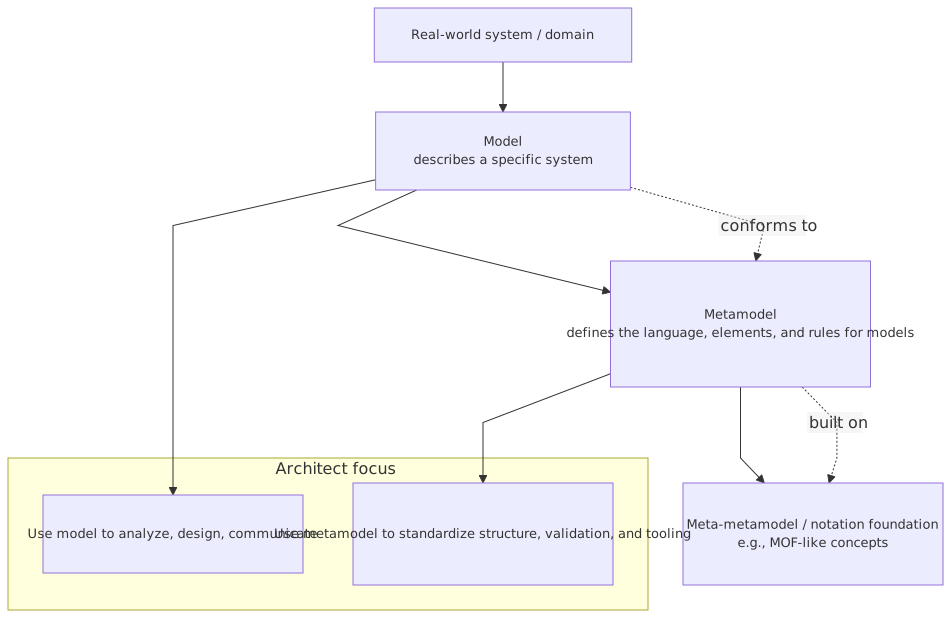
1) Layered view: model vs metamodel
2) Dependency and usage flow
Frequently Asked Questions
What is enterprise architecture?
Enterprise architecture is a discipline that aligns an organisation's strategy, business processes, information systems, and technology. Using frameworks like TOGAF and modeling languages like ArchiMate, it provides a structured view of how the enterprise operates and how it needs to change.
How does ArchiMate support enterprise architecture practice?
ArchiMate provides a standard modeling language that connects strategy, business operations, applications, data, and technology in one coherent model. It enables traceability from strategic goals through business capabilities and application services to the technology platforms that support them.
What tools are used for enterprise architecture modeling?
The main tools are Sparx Enterprise Architect (ArchiMate, UML, BPMN, SysML), Archi (free, ArchiMate-only), and BiZZdesign Enterprise Studio. Sparx EA is the most feature-rich option, supporting concurrent repositories, automation, scripting, and integration with delivery tools like Jira and Azure DevOps.