⏱ 19 min read
Most enterprise architecture is still theater.
That sounds harsh, but let’s be honest. In a lot of companies, architecture exists as PowerPoint, Visio, wiki pages, and governance committees that produce decisions nobody can operationalize. We call it “target state,” “capability mapping,” or “reference architecture,” then wonder why delivery teams ignore it. The reason is simple: if architecture cannot be tested, queried, automated, and enforced, it eventually becomes decoration.
That is why executable enterprise architecture matters.
And yes, I mean executable in a serious sense, not just “better documentation.” I mean an architecture discipline where the metamodel is not a static taxonomy hidden in an EA repository, but a living system that can drive controls, generate views, validate change, trigger workflows, and connect directly to delivery and operations. A metamodel-driven enterprise architecture should not just describe the enterprise. It should influence it in near real time.
This is where the future is going. Frankly, it has to.
The simple version first
If you’re looking for the quick explanation:
Executable enterprise architecture means your architecture model is structured enough that software can use it.
Not just humans. Software.
Instead of saying:
- “Application A uses customer data”
- “Kafka is our integration backbone”
- “IAM is centralized”
- “Workloads should run in approved cloud zones”
…you define those things in a metamodel with relationships, constraints, ownership, lifecycle states, and policies. Then tools can do useful work with it:
- detect policy violations
- identify impact of change
- validate architecture decisions
- generate compliance evidence
- support migration planning
- connect to CI/CD, cloud inventory, IAM platforms, and event streams
That’s the practical idea.
A metamodel is just the model of your architecture model. It defines the types of things that exist and how they relate:
- business capability
- process
- domain
- application
- service
- API
- event
- data object
- IAM role
- cloud account
- control
- owner
- risk
- technology product
Most architecture teams already have some version of this in their heads. The problem is that it usually stays vague, inconsistent, and trapped in slides. Executable architecture turns that into something machine-consumable and operational.
Now let’s go deeper, because this is where it gets interesting.
Why traditional enterprise architecture keeps failing
The old pattern is familiar.
Architecture teams create standards, principles, reference diagrams, roadmaps, and review boards. Delivery teams build systems under pressure. Security adds controls late. Operations discovers reality after deployment. Audit arrives six months later and asks why no one can prove who approved what.
Then everyone acts surprised.
The issue is not that architects are doing useless work. The issue is that the output format is wrong. We still produce architecture as narrative artifacts, while the enterprise runs as software-defined infrastructure, event-driven systems, identity graphs, APIs, cloud policies, and automated pipelines.
That mismatch is fatal.
If your cloud landing zone is enforced by policy-as-code, but your enterprise architecture standards live in PDF documents, then the real architecture is not in the architecture repository. It is in Terraform, IAM policies, Kafka ACLs, Kubernetes manifests, service mesh rules, and CI pipelines.
That’s the uncomfortable truth many architecture teams still resist.
And here’s the contrarian part:
EA teams do not lose relevance because agile or DevOps “don’t value architecture.” They lose relevance because they keep publishing architecture in non-executable forms.
That’s on us.
Metamodel-driven systems are not new. But most organizations never took them seriously enough
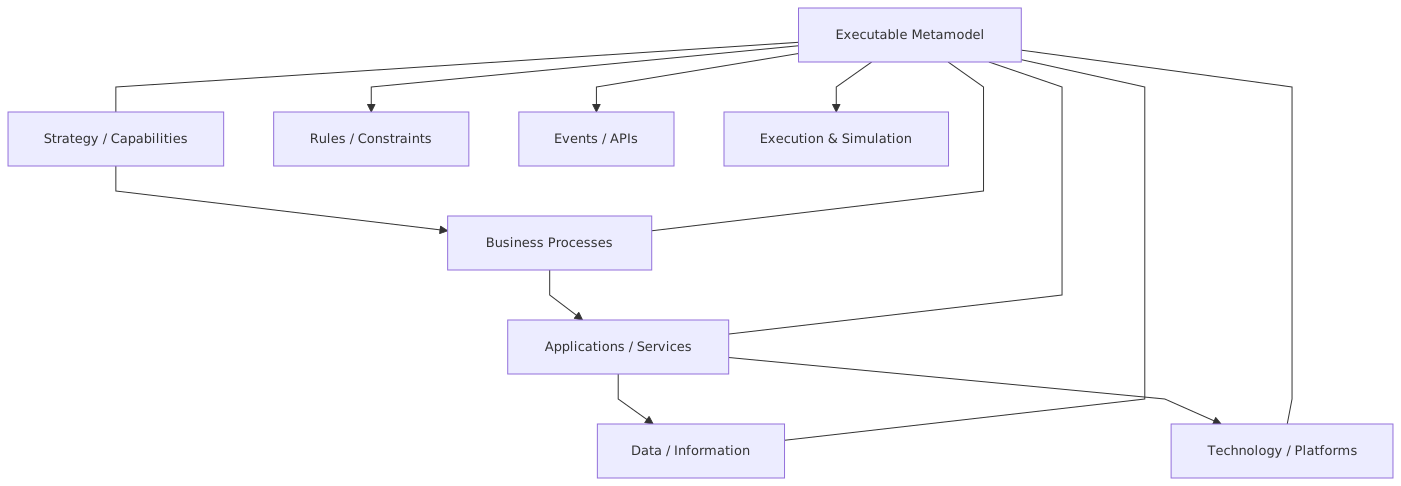
There’s a tendency to talk about metamodels as if they are abstract academic constructs. They are not. In every serious enterprise, whether people admit it or not, there is already an implicit metamodel. TOGAF roadmap template
For example, in a bank, people already understand that:
- a business capability is realized by processes
- processes use applications
- applications expose APIs and publish events
- applications store or process data entities
- data entities have classifications
- applications authenticate via IAM patterns
- workloads run in cloud environments with network and security zones
- controls apply differently depending on criticality and regulation
That is a metamodel. It just happens to be undocumented, inconsistent, and tribal.
The future is not inventing metamodels. The future is making them explicit, governed, extensible, and executable.
That means:
- defining architecture concepts clearly
- mapping them to real systems and delivery artifacts
- connecting them to operational sources of truth
- expressing constraints and rules in machine-readable ways
- using the model to drive action, not just reporting
This is the shift.
What “executable” really means in enterprise architecture
Let’s be precise, because this term gets abused.
Executable architecture does not mean the whole enterprise can be generated from a model. That old fantasy has wasted enough time already. Full model-driven utopia usually collapses under complexity, local variation, and the reality that engineers don’t want generated junk they cannot maintain.
Executable architecture means something more practical and more valuable:
1. The architecture model can be queried
You can ask:
- Which banking applications process PCI data and publish Kafka events?
- Which systems rely on a deprecated IAM protocol?
- Which cloud workloads violate the approved network segregation pattern?
- What capabilities are affected if this customer master service changes?
2. The model can be validated
You can assert rules such as:
- critical applications must have a named business owner and technical owner
- all externally exposed APIs must use centralized IAM
- Kafka topics carrying customer data must have classification and retention metadata
- regulated workloads must run only in approved cloud regions
3. The model can trigger workflows
For example:
- introducing a new data domain requires data governance review
- creating a new internet-facing service requires security architecture assessment
- changing authentication patterns triggers IAM review
- onboarding a new Kafka topic with restricted data triggers schema and access review
4. The model can synchronize with reality
Not perfectly, but enough to matter:
- cloud inventory imports deployed workloads
- IAM systems import identities, roles, and trust relationships
- Kafka platforms import clusters, topics, consumers, ACLs
- CMDB, CI/CD, and repo metadata enrich application and ownership records
5. The model can produce decisions and evidence
This is a big one. Architecture should help answer:
- Are we compliant?
- What is the blast radius?
- Where are policy exceptions?
- Which systems block modernization?
- What is the migration path?
That is executable architecture in the real world.
Why metamodel-driven EA matters now more than ten years ago
Ten years ago, many organizations could get away with looser architecture because change moved slower. Today, the enterprise is too dynamic.
You have:
- multi-cloud sprawl
- event-driven integration
- decentralized product teams
- zero-trust IAM models
- regulatory pressure
- AI workloads entering the estate
- platform engineering standardizing delivery
- constant restructuring of systems and domains
In this environment, static architecture repositories decay almost immediately.
The only way architecture stays useful is if it becomes part of the digital operating model. Not adjacent to it. Part of it.
That means the metamodel becomes the connective tissue across business, engineering, security, data, and operations.
And no, this does not mean architects need to become software engineers in disguise. But they do need to think like system designers, not like librarians.
A practical metamodel for modern enterprise architecture
Let’s make this concrete. A useful metamodel is not enormous. In fact, one of the common mistakes is trying to model the universe on day one.

Start with a core set of concepts that reflect real architectural decisions.
This is enough to become dangerous in a good way.
Notice what is missing: huge theoretical taxonomies that nobody uses. Good metamodels are opinionated. They focus on the concepts that support decisions.
That’s another contrarian point:
If your metamodel cannot answer a real governance, engineering, or risk question, it is too abstract.
How this applies in real architecture work
This is where many articles become fluffy, so let’s stay practical.
An executable metamodel changes the day-to-day work of architects in at least six ways.
1. Architecture reviews become evidence-based
Instead of asking teams to fill in giant review templates, you pull known facts from the model:
- application owner
- data classification
- IAM pattern
- deployment location
- integration style
- current standards compliance
- known dependencies
The review becomes about genuine design choices, not clerical data collection.
2. Impact analysis becomes faster and less political
When a bank wants to retire an on-prem identity store, architects can identify:
- which applications still depend on it
- which APIs use old auth methods
- which customer journeys are affected
- which cloud services have trust integrations tied to it
That is much better than sending emails and hoping people reply.
3. Standards become enforceable
If the standard says all event integrations must use approved Kafka clusters with registered schemas and defined ownership, that should be checkable. Not aspirational.
4. Roadmaps become grounded in dependency reality
Transformation plans often fail because they ignore hidden coupling. A metamodel-driven view exposes:
- shared databases
- undocumented batch feeds
- IAM dependencies
- topic consumers nobody remembered
- cloud account entanglements
5. Architects can partner with platform teams
This is a huge shift. The architecture function becomes useful when it feeds platform automation:
- environment provisioning based on workload classification
- IAM templates based on system type
- Kafka topic provisioning with policy defaults
- cloud guardrails applied based on architecture metadata
6. Governance gets lighter, not heavier
This surprises people. Executable architecture can reduce bureaucracy because fewer things require manual review. If the model and policy checks are good, many standard cases can flow automatically.
That is the real prize.
A real enterprise example: banking, Kafka, IAM, and cloud
Let’s use a realistic example.
Imagine a retail bank modernizing its customer servicing platforms. Over fifteen years, it accumulated:
- legacy core banking systems
- multiple customer databases
- a mix of ESB and point-to-point integrations
- several identity platforms after mergers
- workloads spread across on-prem and cloud
- a strategic move toward Kafka for event-driven integration
- pressure to improve auditability and reduce architecture review bottlenecks
Very normal. Very messy.
The initial state
The bank’s architecture repository contained:
- application catalog entries with poor ownership data
- reference diagrams for target-state event architecture
- IAM standards in PDF form
- cloud standards in Confluence
- separate data lineage tooling
- infrastructure inventory in cloud-native tools
- Kafka metadata managed by platform engineers
- architecture decisions captured inconsistently
What happened in practice?
- teams created Kafka topics without clear data classification
- some customer events carried sensitive fields without proper review
- application teams used inconsistent IAM approaches for internal and external APIs
- cloud deployments drifted away from approved landing zone assumptions
- architecture review boards spent too much time rediscovering basic facts
- impact analysis for regulatory change took weeks
The change
The bank did not attempt a giant “single repository of everything” program. Smart move.
Instead, it defined a practical metamodel around:
- business capability
- application/service
- API/event
- data entity/classification
- IAM pattern
- cloud deployment zone
- ownership
- risk/control
- standards compliance state
Then it connected this model to real sources:
- Kafka cluster metadata for topics, producers, consumers
- IAM platform metadata for applications, roles, trust relationships
- cloud inventory for deployed workloads and environments
- CI/CD metadata for deployment ownership
- data governance metadata for customer and payment data classifications
What became executable
The bank implemented rules such as:
- any Kafka topic containing restricted customer data must have a registered owner, schema, retention policy, and approved access pattern
- all customer-facing APIs must use centralized IAM with approved token validation patterns
- Tier 1 applications cannot deploy into non-compliant cloud accounts
- applications processing regulated data must map to a business owner and control set
- deprecated IAM mechanisms automatically trigger architecture remediation flags
What improved
This is where metamodel-driven architecture earns its keep.
When the bank planned to consolidate IAM platforms, architects could instantly identify:
- all applications using the legacy provider
- which customer journeys would be affected
- where Kafka consumers validated identity claims downstream
- which cloud workloads relied on old trust relationships
- what remediation patterns were needed by application type
When audit asked for evidence that customer data events were governed properly, the architecture team did not scramble through documents. They produced traceable views across:
- event topics
- data classifications
- application ownership
- control mappings
- exception records
That is not glamorous. It is just competent architecture. But competent architecture at enterprise scale is rare enough to be powerful.
Common mistakes architects make with executable EA
Now let’s talk about where this goes wrong, because it often does.
Mistake 1: Building a metamodel that is too big
Architects love completeness. Completeness is a trap.
If you start by modeling every business concept, every infrastructure component, every dependency type, and every governance artifact, you will create a museum. Nobody will maintain it. ArchiMate for governance
Start with the decisions you need to support. Expand only when there is a clear use case.
Mistake 2: Treating the repository as the source of truth for everything
It should not be.
An executable architecture model should federate truth, not pretend to own all of it. Cloud reality belongs in cloud control planes. Kafka topic details belong in platform metadata. IAM relationships belong in IAM systems. The architecture model should reference, reconcile, enrich, and govern.
Architects who try to centralize all truth usually create stale truth.
Mistake 3: Confusing notation with value
I’ve seen teams spend months debating whether an “application service” should be distinct from a “business service” while no one can answer which systems still use basic auth.
This is classic architecture vanity. The point is not semantic purity. The point is operational usefulness.
Mistake 4: Ignoring delivery metadata
If your model has no connection to repos, pipelines, deployment units, and teams, it will stay abstract. Modern architecture lives close to delivery.
Mistake 5: Separating architecture from security and platform engineering
This is one of the biggest organizational anti-patterns.
Executable architecture only works when enterprise architects, security architects, data architects, and platform teams agree on core concepts and control points. If everyone builds separate models, you get duplicated governance and inconsistent policy. EA governance checklist
Mistake 6: Thinking automation removes the need for judgment
It does not.
Executable architecture is not a replacement for architects. It removes repetitive checking so architects can focus on trade-offs, exceptions, and transformation design. If everything is reduced to a rule engine, you will automate mediocrity.
Mistake 7: Failing to model exceptions properly
Real enterprises run on exceptions. That is not cynicism. It is reality.
If your metamodel cannot represent waivers, time-bound exceptions, compensating controls, and decision rationale, your governance will become dishonest. People will route around it. architecture decision record template
The uncomfortable truth about architecture tools
Let me be blunt: buying an enterprise architecture tool does not mean you are doing executable architecture.
A lot of EA platforms promise “single pane of glass” goodness, but most organizations use them as expensive filing cabinets. Pretty dashboards. Weak operational integration. Manual updates. Low trust.
The tool is not the transformation.
The real work is:
- defining a useful metamodel
- choosing authoritative data sources
- agreeing on ownership
- integrating with delivery and operations
- defining rules that matter
- making outputs useful for real decisions
If the tool helps, great. If not, a combination of graph storage, metadata services, policy engines, and reporting layers may do a better job. This is another contrarian view that annoys vendors but happens to be true.
Architecture capability is not purchased. It is designed.
What a good target state looks like
A credible target state for executable enterprise architecture has a few characteristics.
Architecture metadata is federated
Not one giant monolith. Connected domains of metadata with clear ownership.
The metamodel is opinionated and minimal
Enough structure to support decisions. Not a philosophical encyclopedia.
Runtime and delivery signals feed the model
Cloud assets, IAM configurations, Kafka metadata, pipeline metadata, and service inventories are regularly synchronized.
Policies are machine-readable where possible
Examples:
- allowed IAM patterns by application type
- required controls by data classification
- deployment constraints by workload criticality
- event governance rules by data sensitivity
Human review exists for non-standard cases
Architecture remains a judgment discipline, especially for transformation and exceptions.
Outputs are embedded in work
Architecture views show up in:
- project intake
- change approval
- security review
- migration planning
- audit response
- platform provisioning
- portfolio rationalization
That is what “toward executable” should mean. Not perfection. Direction.
Where AI fits, and where people are overselling it
Since everything now has to mention AI, here is the honest view.
AI can help architecture in metamodel-driven environments by:
- classifying systems from documentation and code metadata
- suggesting missing relationships
- summarizing impact of change
- detecting anomalies or policy drift
- generating draft architecture views and decision records
Useful? Yes.
Transformational on its own? No.
If your metamodel is weak, your metadata is stale, and your governance is inconsistent, AI will mostly generate confident nonsense faster. The foundation still matters.
The exciting part is not “AI does architecture.” It is that a structured architecture model gives AI something real to reason over. That is much more interesting.
A practical adoption path
If you are a chief architect or EA lead, do not launch a three-year repository transformation program. Those usually die under their own ambition.
Do this instead.
Phase 1: Pick two or three high-value use cases
For example:
- IAM modernization impact analysis
- Kafka event governance for sensitive data
- cloud deployment compliance by workload tier
Phase 2: Define the minimum metamodel
Only include concepts needed for those use cases.
Phase 3: Connect to real sources
Import from:
- IAM platform
- Kafka platform
- cloud inventory
- application/service catalog
- data classification sources
Phase 4: Define a handful of rules
Not fifty. Five to ten meaningful checks.
Phase 5: Use outputs in actual governance
Make architecture review, audit response, or migration planning consume the model.
Phase 6: Expand carefully
Once people trust it, extend the metamodel and automation.
That trust point matters. Executable architecture fails when teams see it as another central function inventing metadata burdens with no visible payoff.
Show payoff early.
Strong opinion: the future architect is part model designer, part policy designer, part systems thinker
The traditional image of the enterprise architect as a standards guardian with broad conceptual knowledge is not enough anymore.
The future architect needs to be comfortable with:
- metamodel design
- graph thinking
- policy expression
- metadata ownership
- integration with operational systems
- platform collaboration
- exception design
- traceability across business and technical layers
Not necessarily hands-on coding every day. But definitely more rigorous than “drawing boxes and facilitating workshops.”
And honestly, that is a good thing. Enterprise architecture has spent too long defending its relevance through vocabulary. It needs to earn relevance through execution.
Final thought
Executable enterprise architecture is not some shiny new methodology. It is the overdue correction to a long-running failure mode.
For years, architecture has tried to govern software-defined enterprises using static artifacts. That was never going to scale. Not in cloud. Not with Kafka-driven integration. Not with fragmented IAM estates. Not under regulatory pressure. Not when delivery moves continuously.
The metamodel is the key, but only if we stop treating it as a taxonomy exercise and start treating it as an operational design asset.
That is the future: architecture models that can be queried, validated, synchronized, and acted on. Not perfect digital twins. Not model-driven fantasy. Just architecture that finally participates in how the enterprise actually runs.
And if that sounds obvious, good. It should be obvious. The strange thing is how long our profession tolerated the alternative.
FAQ
1. What is executable enterprise architecture in simple terms?
It is enterprise architecture where the model is structured enough for software to use, not just people. That means the architecture can support validation, automation, impact analysis, governance, and evidence generation.
2. Is this just another name for CMDB or application portfolio management?
No. A CMDB usually focuses on configuration items and infrastructure relationships. Application portfolio management focuses on lifecycle and cost. Executable EA connects business, application, data, security, technology, and governance concepts in a way that supports architecture decisions and policy enforcement.
3. Do we need a dedicated enterprise architecture tool to do this?
Not necessarily. Some EA tools can help, but the important part is the metamodel, the integrations, and the governance design. Many organizations will need a combination of EA tooling, graph or metadata platforms, policy engines, and source-system integrations.
4. How does this help with Kafka, IAM, and cloud specifically?
It helps by making relationships explicit and usable. You can map applications to Kafka topics, data classifications, IAM patterns, cloud deployment zones, and controls. That allows you to detect risk, assess change impact, enforce standards, and support audit much faster.
5. What is the biggest mistake to avoid when starting?
Trying to model everything. Start with a few high-value use cases, define a minimal metamodel, connect to real operational sources, and prove value quickly. If you begin with an all-encompassing architecture encyclopedia, you will create overhead instead of capability.
Frequently Asked Questions
What is enterprise architecture?
Enterprise architecture is a discipline that aligns an organisation's strategy, business processes, information systems, and technology. Using frameworks like TOGAF and modeling languages like ArchiMate, it provides a structured view of how the enterprise operates and how it needs to change.
How does ArchiMate support enterprise architecture practice?
ArchiMate provides a standard modeling language that connects strategy, business operations, applications, data, and technology in one coherent model. It enables traceability from strategic goals through business capabilities and application services to the technology platforms that support them.
What tools are used for enterprise architecture modeling?
The main tools are Sparx Enterprise Architect (ArchiMate, UML, BPMN, SysML), Archi (free, ArchiMate-only), and BiZZdesign Enterprise Studio. Sparx EA is the most feature-rich option, supporting concurrent repositories, automation, scripting, and integration with delivery tools like Jira and Azure DevOps.