Introduction: Why Modeling Is Non-Negotiable in Pharma
In the pharmaceutical industry, the stakes are high: complex products, global regulation, data integrity, and patient safety. Modeling is not a luxury — it’s a necessity. Unified Modeling Language (UML) is one of the foundational tools used to define, analyze, and standardize information flows across regulatory, clinical, and manufacturing domains. ArchiMate modeling guide
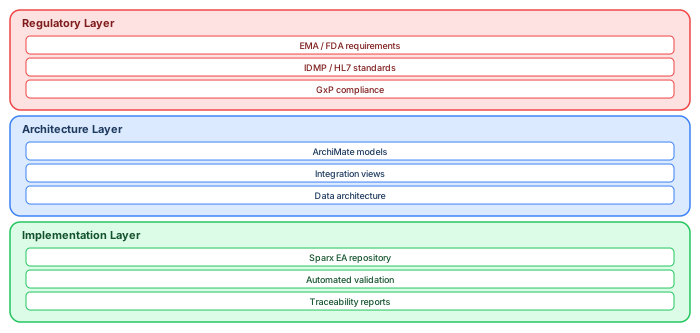
One of the clearest examples of UML’s application in pharma is its use in supporting IDMP (Identification of Medicinal Products) — a set of ISO standards that require global harmonization of how medicines are described. IDMP uses formal ontologies to define medicinal products, substances, and packaging — and at the heart of those ontologies is structured UML modeling.
What Is IDMP?
IDMP stands for Identification of Medicinal Products , a suite of five ISO standards:
- ISO 11615 – Medicinal product information
- ISO 11616 – Pharmaceutical product information
- ISO 11238 – Substances
- ISO 11239 – Pharmaceutical dose forms, units of presentation, routes of administration, and packaging
- ISO 11240 – Units of measurement
The goal is global interoperability — regulators (like EMA, FDA, PMDA) need to share structured, machine-readable data about products across jurisdictions. Ontologies are needed to describe and validate this complex domain. But those ontologies don’t just appear — they’re modeled first.
Why UML Before Ontology?
Ontologies express knowledge using logical formalisms (OWL, RDF, etc.), but they must be built on a solid structural foundation. That’s where UML comes in:
- 📘 UML defines concepts, attributes, relationships — the skeleton of any ontology
- 🔁 UML enables versioning and validation of models before publishing as formal ontology
- 🔍 UML class diagrams provide a readable, visual map for domain experts, analysts, and regulators
- ⚙️ Tools like Sparx EA export UML models to OWL/RDF or XML for transformation into semantic models
Example: UML Model for IDMP Substance
Let’s look at how UML is used to define the “Substance” domain in IDMP:
-
Substance
is a class with attributes like
Substance ID,Name,Structure, andSource - Substance may be Manufactured or Natural
-
Substance
links to
Reference InformationandControlled Vocabularyclasses
This UML model forms the basis of:
- Regulatory forms and submissions (SPOR / EMA)
- Data exchange standards (HL7 FHIR, ISO XML)
- Ontology definitions (OWL classes, restrictions)
Diagram Snapshot (Conceptual)
+----------------+       +------------------+
|   Substance    |<>-----|  SubstanceType   |
+----------------+       +------------------+
| - ID           |       | - TypeCode       |
| - Name         |       +------------------+
| - Structure    |
+----------------+
Without UML Modeling, Progress Stalls
Why is modeling mandatory?
- ❌ Without UML, no standard vocabulary or structure
- ❌ No validation or simulation of relationships
- ❌ Impossible to auto-generate schemas or APIs
- ❌ Regulatory submissions become manual and inconsistent
- ❌ Ontology teams struggle to align with business experts
UML bridges the world of structured modeling and semantic representation. It's the prerequisite for traceability, automation, and validation .
Client Example: UML-Driven IDMP Implementation
We supported a multinational pharma firm in designing their IDMP data platform. The core design artifact? UML models for:
- Substances, Products, and Authorizations
- Dosage forms and units of presentation
- Controlled vocabularies and code lists
We used Sparx EA to model these domains, apply business rules (using OCL and stereotypes), and export structured definitions for ontology builders. The result: Sparx EA best practices
- ✅ 100% traceable data from design to implementation
- ✅ Schema reuse across EMA and FDA requirements
- ✅ Faster onboarding for new regulatory standards
Conclusion: UML Is the Foundation of Semantic Pharma
In pharma, data is a product. That product must be modeled, validated, and exchanged globally. UML isn’t optional — it’s the foundation. From IDMP ontologies to regulatory data lakes, modeling brings order to biological and chemical complexity.
Before you can build the ontology, define the structure. That’s UML’s job — and why it’s more critical than ever.
If you’d like hands-on training tailored to your team — Sparx Enterprise Architect, BPMN, SysML or the Archi tool — or modelling coaching in ArchiMate and TOGAF-aligned governance, you can reach us via our contact page.
Frequently Asked Questions
What is enterprise architecture?
Enterprise architecture is a discipline that aligns an organisation's strategy, business operations, information systems, and technology infrastructure. It provides a structured framework for understanding how an enterprise works today, where it needs to go, and how to manage the transition.
How is ArchiMate used in enterprise architecture practice?
ArchiMate is used as the standard modeling language in enterprise architecture practice. It enables architects to create consistent, layered models covering business capabilities, application services, data flows, and technology infrastructure — all traceable from strategic goals to implementation.
What tools are used for enterprise architecture modeling?
Common enterprise architecture modeling tools include Sparx Enterprise Architect (Sparx EA), Archi, BiZZdesign Enterprise Studio, LeanIX, and Orbus iServer. Sparx EA is widely used for its ArchiMate, UML, BPMN and SysML support combined with powerful automation and scripting capabilities.