⏱ 20 min read
Most enterprise architecture is still decorative.
That sounds harsh, but let’s not pretend otherwise. In too many organizations, EA is a collection of diagrams, capability maps, standards PDFs, and review boards that produce more PowerPoint than operational change. Architects describe the enterprise. They rarely shape it in a way that can be tested, automated, or executed. And then we wonder why delivery teams ignore us. ArchiMate capability map
If enterprise architecture cannot increasingly become executable—or at least machine-interpretable—it will keep losing relevance to platform engineering, cloud governance, security engineering, and product teams who are already solving architecture problems in code.
That is the core issue.
A simple explanation first: what “executable enterprise architecture” means
Executable enterprise architecture means architecture models are not just for humans to read. They are structured enough that tools, policies, pipelines, and platforms can act on them.
Not fully. Not magically. But materially.
In practical terms, it means your architecture is expressed through a metamodel that defines things like:
- business capabilities
- applications
- data domains
- events
- APIs
- IAM roles and policies
- cloud resources
- compliance controls
- lifecycle states
- ownership
- dependencies
- rules
And those elements are linked in ways that software can validate and use.
So instead of saying:
- “Customer onboarding depends on identity verification”
- “Only PCI-approved services may handle card data”
- “Kafka topics carrying PII must use encryption and retention limits”
- “Production workloads must use managed identities, not long-lived secrets”
…you encode those relationships and constraints in a metamodel and supporting rules. Then architecture becomes something closer to an operating system for change, not a slide deck about change.
That’s the short version. It matters because enterprise complexity has outgrown diagram-only architecture.
Why this matters now
For years, enterprise architecture got away with abstraction because implementation moved slower. That era is over.
Cloud platforms provision infrastructure in minutes. Kafka estates span dozens or hundreds of event streams. IAM policies change weekly. Teams deploy continuously. Regulatory evidence is expected on demand, not quarterly. The enterprise is not a static structure anymore; it is a dynamic system under constant modification.
And dynamic systems cannot be governed effectively with static artifacts.
This is where the metamodel comes in. If your metamodel is weak, your architecture practice remains weak. Because your metamodel determines what the enterprise can be represented as, what can be reasoned about, what can be validated, and ultimately what can be automated.
That’s the part many architects still underplay. They talk about repositories, standards, and viewpoints. Fine. But the real leverage is in the semantics. What are the objects? What are the relationships? What constraints are meaningful? What state changes are permitted? What evidence can be derived?
That is metamodel work. And frankly, it is more important than another polished “future state” diagram.
The uncomfortable truth: most EA metamodels are not built for execution
Most enterprise architecture metamodels were designed for classification, not action.
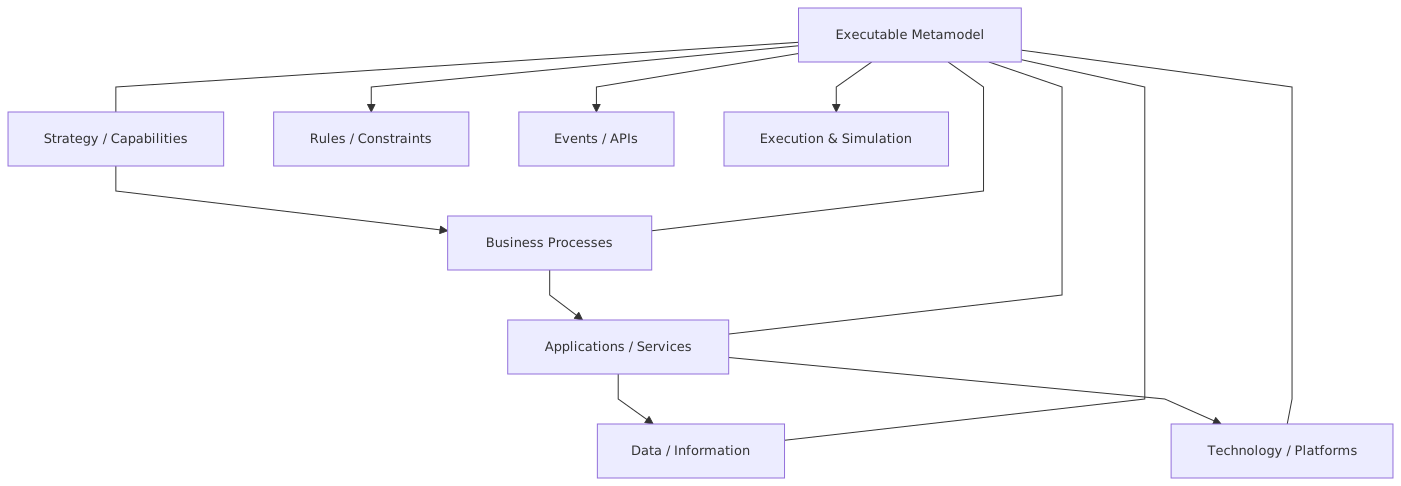
They are good at inventory:
- applications
- processes
- technologies
- interfaces
- capabilities
They are much worse at expressing:
- runtime policy
- ownership accountability
- deployment intent
- identity trust boundaries
- event contracts
- data sensitivity propagation
- compliance obligations
- control inheritance
- environment-specific constraints
- machine-verifiable standards
That gap is why so much architecture becomes disconnected from engineering reality.
A metamodel that says “Application uses Technology Component” is not wrong. It’s just weak. It tells me almost nothing useful for modern governance or delivery. ARB governance with Sparx EA
I need to know things like:
- Does this application publish or consume Kafka events?
- What data classification is present in those topics?
- Which IAM model is used between workloads?
- Is the workload running in a regulated cloud landing zone?
- Which controls are inherited from the platform and which are implemented by the team?
- Is the API internet-facing?
- Is customer consent required for this data flow?
- What recovery tier is mandated by the business service it supports?
- Which business capability owns the policy decision, versus the technical implementation?
That is architecture. Not because it is detailed, but because it is operationally meaningful.
Executable architecture starts with a different metamodel mindset
If you want executable enterprise architecture, stop treating the metamodel as a taxonomy exercise. Treat it as a control surface.
That means your metamodel should support at least five things:
- Representation of real enterprise entities
- Explicit relationships with operational meaning
- Constraints and rules
- Lifecycle and state
- Bindings to implementation artifacts
If one of those is missing, execution gets fuzzy fast.
1. Representation of real enterprise entities
This sounds obvious, but architects often model abstractions that are too generic to be useful.
For example:
- “Application Component”
- “Data Object”
- “Technology Service”
These are fine as base classes. But on their own, they are too vague for modern enterprise decisions.
You need more precise enterprise entities such as:
- business service
- customer journey step
- event stream
- Kafka topic
- API product
- data domain
- identity provider
- service principal / workload identity
- cloud account / subscription / project
- control objective
- regulatory obligation
- platform product
- deployment environment
- trust boundary
Some architects resist this because they fear “tool-specific” or “implementation-level” modeling. I think that fear is overdone. If your enterprise materially depends on Kafka, cloud IAM, and platform controls, then pretending those are beneath EA is just laziness dressed up as abstraction.
2. Explicit relationships with operational meaning
A good executable metamodel does not just connect things. It says what the connection means.
Not “Application related to Data Object.”
More like:
- business service consumes API product
- application publishes event stream
- Kafka topic contains data classification
- workload identity is trusted by resource policy
- cloud workload is deployed in landing zone
- control objective is satisfied by platform guardrail
- data product is owned by domain team
- application inherits resilience tier from business service
- customer process requires strong authentication
- IAM role grants privileged action on resource class
Those relationships can drive review automation, policy checks, and impact analysis. Without relationship precision, execution is impossible.
3. Constraints and rules
This is where architecture stops being descriptive and starts being useful.
Examples:
- Any Kafka topic containing PCI data must enforce encryption at rest, private network access, and a retention maximum of X days.
- Any workload handling customer PII must use federated IAM, not static credentials.
- Any application supporting payments must align to resilience tier 1 and active-active deployment patterns.
- Any externally exposed API must have an owning product manager, threat model, and approved authentication pattern.
- Any system consuming identity events must not derive authorization directly from unaudited profile attributes.
These are architecture rules. They are not low-level implementation details. They are enterprise intent expressed in a form that can be checked.
4. Lifecycle and state
Most architecture repositories are bad at time.
They show what exists, but not whether something is proposed, approved, deprecated, in pilot, or under exception. They also fail to model transitions. Yet in real architecture work, transition is half the job.
An executable metamodel should support states like:
- proposed
- approved
- active
- restricted
- deprecated
- sunset planned
- exception granted
And it should support stateful governance questions: EA governance checklist
- Can a deprecated IAM pattern still be used in new systems? No.
- Can a restricted cloud service be deployed in regulated workloads? Only with exception.
- Can a Kafka topic schema change break consumers? Only under approved compatibility mode.
- Can an API remain active without an owner? It should not.
Without lifecycle semantics, your architecture repository becomes a museum.
5. Bindings to implementation artifacts
This is where architects either get serious or retreat into theory.
If your architecture model cannot link to:
- cloud accounts/subscriptions/projects
- Terraform modules
- CI/CD policies
- Kafka clusters and topics
- IAM groups, roles, and policies
- API gateway configurations
- CMDB or service catalog records
- data catalog entries
- control evidence sources
…then “executable” remains a slogan.
No, this does not mean the EA tool becomes the source of truth for everything. That would be a terrible design. The point is linkage, not centralization. The metamodel should provide the semantic map across sources of truth.
That distinction matters.
What this looks like in real architecture work
Let’s make this concrete.
In real enterprise architecture work, executable architecture changes the architect’s role from reviewer of documents to designer of decision systems.
Instead of manually asking every team the same questions, you define the architecture objects, rules, and evidence paths so that many decisions become pre-validated, or at least easier to assess.
Example: banking, Kafka, IAM, and cloud
Consider a retail bank modernizing customer servicing. They are moving from a monolithic core-adjacent servicing platform to domain-aligned services in the cloud. Kafka is the event backbone. IAM is federated through a central identity platform. Some workloads sit in a regulated cloud landing zone; others remain on-prem.
A traditional EA approach might produce:
- target-state diagrams
- capability maps
- integration principles
- reference architectures
- a few standards documents
Useful, yes. But insufficient.
An executable EA approach would model things like this:
Now imagine a change proposal: the bank wants to publish customer KYC status changes to Kafka so downstream fraud, onboarding, and CRM services can react in near real time.
In a normal architecture review, the team brings a diagram. The architect asks good questions. The team goes away. Maybe there are action items. Maybe not. The result depends heavily on who is in the room.
In an executable architecture model, the proposal can be checked against enterprise rules:
- KYC status is sensitive customer data.
- Topics carrying this classification must be in regulated Kafka clusters only.
- Cross-region replication may be prohibited.
- Consumers must be registered owners, not anonymous integrations.
- IAM access must be via workload identities mapped to approved service accounts.
- Retention must be limited.
- Schema changes require compatibility guarantees because multiple downstream consumers exist.
- Customer-facing decisions derived from KYC events require audit traceability.
Now architecture review becomes sharper. Less theater. More signal.
The architect still matters—maybe more than before—but now the value is in resolving exceptions, shaping trade-offs, and refining the model, not reciting generic principles.
The metamodel implications most teams underestimate
Here is where the topic gets more serious. “Toward executable EA” is not just about adding metadata fields to your repository. It changes what your metamodel must be capable of.

Implication 1: You need first-class policy objects
Many metamodels treat standards and policies as attached documents. That is not enough.
Policies need to become first-class architectural objects with:
- scope
- applicability conditions
- mandatory vs advisory status
- control mappings
- exception process
- evidence source
- enforcement point
For example:
- “All production cloud workloads must use centralized IAM federation”
- Applies to: production workloads in cloud
- Mandatory: yes
- Control mapping: identity and access control standard
- Evidence source: cloud IAM config scan
- Enforcement point: CI/CD policy and cloud guardrail
- Exception: requires CISO sign-off
Once policy is modeled this way, architecture can operate at scale.
Implication 2: Relationships need cardinality and direction that mean something
This sounds academic. It isn’t.
If one business service is supported by multiple applications, and one application publishes multiple events, and one Kafka topic is consumed by many applications, then impact analysis depends on relationship precision.
When a topic schema changes, which business services are at risk?
When an IAM provider changes trust configuration, which production workloads break?
When a cloud landing zone control changes, which regulated services are affected?
You cannot answer these reliably with fuzzy relationships.
Implication 3: Inheritance matters more than many architects think
Inheritance is where executable models get leverage.
Examples:
- An application inherits data handling obligations from the data classifications it processes.
- A workload inherits regional restrictions from the landing zone it runs in.
- A service inherits resilience expectations from the business process it supports.
- A Kafka topic inherits encryption and audit requirements from the classification of the payload.
- A team inherits certain control implementations from the platform product, reducing local burden.
Without inheritance, every review becomes manual re-evaluation. With inheritance, architecture scales.
Implication 4: Exceptions must be modeled, not buried in email
Real enterprises run on exceptions. Anyone who says otherwise has never worked in a bank.
The mistake is treating exceptions as governance failure. They are not. Hidden exceptions are failure. Modeled exceptions are reality management. architecture decision record template
Your metamodel should support:
- exception type
- rationale
- compensating controls
- approver
- expiry date
- affected assets
- review cadence
If a legacy payment service still uses a non-preferred IAM pattern because of a vendor limitation, that should not live in someone’s inbox. It should be visible, bounded, and linked to risk.
Implication 5: Ownership must be explicit and multi-layered
“Owner” is one of the most abused words in architecture.
There is no single owner for most enterprise elements. There are usually several:
- business owner
- technical owner
- data owner
- platform owner
- control owner
- exception approver
If you collapse these into one field, your metamodel becomes politically neat and operationally useless.
Common mistakes architects make
Let’s be blunt. A lot of architects sabotage executable architecture without realizing it.
Mistake 1: Staying too abstract for too long
Some architects think naming Kafka topics, IAM trust models, or cloud landing zones is “solution architecture.” That is outdated thinking.
If these things materially shape enterprise risk, agility, and operating cost, they belong in the enterprise model. Not every implementation detail does. But these do.
Mistake 2: Building a metamodel for completeness instead of decisions
Architects love completeness. It feels rigorous. But a complete model that supports no important decisions is just expensive taxonomy.
Start with decisions:
- Which cloud patterns are allowed for regulated workloads?
- Which event streams can carry sensitive data?
- Which IAM models are permitted for machine-to-machine access?
- Which systems are impacted by policy changes?
- Which controls are inherited vs locally implemented?
Then shape the metamodel accordingly.
Mistake 3: Treating the repository as the source of truth for everything
This is a classic overreach. EA tools should not become a bad CMDB, a bad cloud inventory, a bad data catalog, and a bad IAM dashboard all at once.
Use federated truth. Link to operational systems. Model semantics centrally, not every raw fact.
Mistake 4: Ignoring lifecycle and transition architecture
Architects often model target state as if migration is an administrative detail. It isn’t. Transition is where risk lives. TOGAF roadmap template
In banking especially, old and new coexist for years. Your metamodel must represent that coexistence:
- dual-run states
- temporary integration patterns
- exception windows
- phased control uplift
- deprecation milestones
Mistake 5: Confusing governance with review meetings
Governance is not a calendar invite.
If your architecture governance depends mostly on humans remembering to ask the right questions in review boards, it will fail under scale. Some human review is necessary. But the baseline should be encoded in the model, rules, and delivery controls.
Mistake 6: Under-modeling identity
This one is huge.
Many enterprise models still treat identity as a side concern—maybe a box labeled “IAM service.” That is nowhere near enough. Identity is the control plane of the modern enterprise.
You need to model:
- human identities
- workload identities
- trust relationships
- authentication patterns
- authorization domains
- privileged access boundaries
- federation dependencies
- identity event flows
If you do not, your architecture model misses one of the most consequential parts of modern operating reality.
A real enterprise example
A few years ago, I worked with a large bank that had a familiar problem: every domain wanted event-driven integration, but no one could answer simple questions consistently.
- Which Kafka topics contained regulated customer data?
- Which consumers were approved?
- Which services still used static credentials instead of federated IAM?
- Which cloud workloads were in approved regulated landing zones?
- Which controls were inherited from the platform versus implemented by teams?
- Which business services would be impacted if a topic contract changed?
The organization had architecture artifacts everywhere. Capability maps, application inventories, security standards, cloud principles, data policies. Smart people had produced all of it. But the pieces were disconnected.
The bank’s first instinct was to buy a better repository tool. Wrong instinct. The problem was not tooling first. It was metamodel weakness.
We redesigned the model around executable concerns:
- event streams and Kafka topics were first-class
- data classification attached to payloads and propagated obligations
- IAM patterns were modeled explicitly
- cloud landing zones were represented as policy-bearing structures, not just hosting locations
- ownership was split across business, technical, and control dimensions
- policies became structured objects with applicability and evidence links
- exceptions were modeled with expiry and compensating controls
Then we linked the model to actual sources:
- Kafka topic metadata
- cloud account inventories
- IAM configuration sources
- API gateway registrations
- data catalog classifications
- CI/CD policy outcomes
Did this create a magical self-governing enterprise? Of course not. Let’s be serious.
But it did create some very practical outcomes:
- Architecture reviews got faster because half the baseline questions were already answerable.
- Security found unapproved static credentials in production-integrated services.
- Data governance finally had visibility into which event streams carried PII.
- Teams could see inherited controls, which reduced duplicate implementation effort.
- Change impact analysis became credible enough to use in planning.
The biggest shift, though, was cultural. Architecture stopped being seen mainly as a documentation function. It became part of the delivery system.
That is the threshold worth crossing.
Contrarian view: not everything should be executable
Now the pushback.
There is a bad version of this idea where people try to formalize all architecture into rigid machine logic. That usually ends in bureaucracy with YAML.
Not every architectural judgment can or should be encoded. Trade-offs involving customer experience, strategic differentiation, organizational maturity, or ambiguous risk often require human reasoning. And some architecture is intentionally exploratory.
So no, I am not arguing for a fully automated enterprise architect. That fantasy is usually sold by people who have not had to govern a messy estate with legacy systems, vendor packages, political constraints, and regulatory nuance.
What I am arguing is this:
- the repeatable parts should be modeled
- the policy-driven parts should be machine-interpretable
- the evidence-heavy parts should be linked to operational reality
- the exception-heavy parts should be explicit
- the human parts should be focused where judgment actually matters
That is a much more sensible ambition.
How to start without boiling the ocean
If you are trying to move toward executable EA, do not start by redesigning your entire enterprise metamodel in one giant initiative. That is how architecture teams disappear into abstraction for 18 months.
Start with one pressure point where architecture, engineering, and risk all care.
Good candidates:
- cloud landing zone governance
- Kafka/event governance
- IAM modernization
- API exposure controls
- regulated data handling
Then do the following.
Step 1: Identify the decisions that need to scale
Pick 5–10 decisions that are currently manual, inconsistent, or slow.
For example:
- Can this workload deploy to the regulated landing zone?
- Can this Kafka topic carry PII?
- Can this service use client secrets?
- Is this API allowed to be internet-facing?
- Which controls are inherited from platform?
Step 2: Model only the entities and relationships needed for those decisions
Do not model everything. Model enough.
Step 3: Define policy objects and applicability logic
This is where architecture gets executable.
Step 4: Link to real evidence sources
If the answer depends on cloud config, Kafka metadata, IAM setup, or API gateway registration, connect to those sources.
Step 5: Make exceptions visible
Again: visible exceptions are manageable. Invisible ones are what auditors eventually discover for you.
Step 6: Use the model in actual governance
Not in theory. In real reviews, portfolio decisions, migration planning, and control attestations.
What good looks like
A mature executable EA practice does not mean every architecture artifact is generated from code. That’s a childish benchmark.
Good looks like this:
- architecture objects align to real enterprise operating concerns
- relationships support impact analysis and policy applicability
- policies are structured and testable
- lifecycle and exceptions are explicit
- implementation bindings exist to operational systems
- architects spend less time collecting facts and more time resolving trade-offs
- delivery teams see architecture as useful because it reduces ambiguity
- governance becomes more continuous and less ceremonial
That is a better future for EA than endless debates about notation purity.
Final thought
The metamodel is not a background technicality. It is the architecture of the architecture function.
If your metamodel cannot represent events, identity, policy, inheritance, evidence, lifecycle, and exceptions in a meaningful way, then your enterprise architecture will remain mostly descriptive. Maybe elegant. Maybe comprehensive. But still descriptive.
And in a world of cloud automation, Kafka-driven integration, zero-trust IAM, and relentless regulatory scrutiny, descriptive architecture is not enough.
Enterprise architecture needs to become more executable—not because machines are replacing architects, but because enterprises have become too dynamic for architecture to remain a static narrative.
The real question is not whether executable EA is desirable.
It is whether your current metamodel is honest about the enterprise you actually run.
FAQ
1. What is executable enterprise architecture in plain English?
It means your architecture is structured so tools and processes can use it, not just people reading diagrams. Policies, relationships, ownership, and constraints are modeled clearly enough to support validation, automation, and impact analysis.
2. Does executable EA mean we need to model everything in code?
No. That is the wrong goal. You model the repeatable, policy-driven, and evidence-heavy parts in machine-interpretable ways. Human judgment still matters for ambiguity, strategy, and trade-offs.
3. How is this different from a CMDB or architecture repository?
A CMDB tracks configuration items. A repository stores architecture artifacts. Executable EA goes further by defining semantic relationships, policy applicability, lifecycle, inheritance, and links to evidence sources so architecture can influence and validate change.
4. Why are Kafka and IAM so important in this discussion?
Because they expose where traditional EA models are too shallow. Kafka introduces event contracts, topic governance, retention, and consumer accountability. IAM introduces trust, authorization boundaries, workload identity, and control-plane risk. If your metamodel cannot represent those well, it is not ready for modern enterprise reality.
5. Where should an enterprise start?
Start where pain is already obvious—cloud governance, IAM modernization, event governance, or regulated data handling. Pick a small set of recurring decisions, model the minimum needed entities and rules, connect to real evidence sources, and use it in live governance. That is how executable architecture becomes real.
Frequently Asked Questions
What is enterprise architecture?
Enterprise architecture is a discipline that aligns an organisation's strategy, business processes, information systems, and technology. Using frameworks like TOGAF and modeling languages like ArchiMate, it provides a structured view of how the enterprise operates and how it needs to change.
How does ArchiMate support enterprise architecture practice?
ArchiMate provides a standard modeling language that connects strategy, business operations, applications, data, and technology in one coherent model. It enables traceability from strategic goals through business capabilities and application services to the technology platforms that support them.
What tools are used for enterprise architecture modeling?
The main tools are Sparx Enterprise Architect (ArchiMate, UML, BPMN, SysML), Archi (free, ArchiMate-only), and BiZZdesign Enterprise Studio. Sparx EA is the most feature-rich option, supporting concurrent repositories, automation, scripting, and integration with delivery tools like Jira and Azure DevOps.