⏱ 23 min read
Introduction
If you want the quick answer: the four-layer architecture of UML is a way to separate language definition from models, and models from runtime reality. M3 defines the language used to define modeling languages. M2 defines UML itself. M1 is where your actual system models live. M0 is the real-world or running instances those models describe.
That sounds abstract because, frankly, it often gets explained in an abstract way. And that is exactly why many architects either ignore it or misuse it.
My opinion: that’s a mistake.
Not because every enterprise architect needs to become a metamodeling purist. Most don’t. But because the M3–M0 stack gives you a disciplined way to answer a question that turns up in almost every serious architecture effort:
What is the thing, what is the definition of the thing, and what language are we even using to describe it?
When you’re working across business capability models, application portfolios, domain models, event schemas, IAM structures, cloud landing zones, and platform standards, that distinction matters a lot. Without it, teams mix runtime facts with design intent, and mix modeling rules with implementation constraints. Once that happens, architecture turns muddy fast.
So this article is not a textbook tour of OMG terminology. It’s a practical walkthrough of the four layers, why they still matter in enterprise architecture, and where people get tripped up—especially in large organizations where UML is only one of several modeling lenses in use. UML modeling best practices
Core explanation
The simple mental model
The four layers can be understood like this:
That’s the clean version. Let’s unpack it in a way that matters for architecture work.
M3: the meta-metamodel layer
At M3, you define the constructs used to define metamodels. In the UML ecosystem, this is usually MOF—the Meta-Object Facility.
I’ll be honest: many enterprise architects can go years without needing to say “MOF” out loud. That’s fine. But the reason M3 exists is important. It gives a formal foundation for defining modeling languages in a consistent way.
Think of M3 as the grammar for creating grammars.
You are usually not designing at M3 in day-to-day architecture. If you are, you’re probably building tooling, extending modeling platforms, or working in a standards-heavy environment. Still, M3 matters because it explains why UML is not just a bag of diagram shapes. UML has a formal definition underneath it. That formal definition is what allows tools, profiles, constraints, and model transformations to exist with some rigor. UML for microservices
The contrarian view here: most architecture teams do not need to care deeply about M3, but they absolutely benefit from knowing that M2 is not arbitrary. UML is not Visio with fancier boxes. Or at least, it shouldn’t be.
M2: the metamodel layer
This is where UML itself lives.
At M2, you have definitions like Class, Association, Component, Node, Interface, Artifact, Use Case, and so on. These are not your business entities or your applications. They are the types of modeling elements available to express those things.
If someone says, “A UML class can have attributes and operations,” they are talking at M2. They are describing the modeling language.
This distinction sounds subtle until you see how often it gets blurred. In architecture reviews, I’ve seen people argue about whether a “Customer” on a diagram should be a Class, an Actor, a Business Role, or a Bounded Context. That is not a runtime discussion. That is an M2/M1 boundary discussion. You’re deciding which modeling construct is appropriate for the thing you want to express.
This is where UML profiles and stereotypes also come into play. If you create stereotypes like <, <, <, or <, you’re extending UML at the metamodel usage level. Strictly speaking, you are applying extension mechanisms defined at M2 to make M1 models more useful for your enterprise.
And this is where enterprise architecture often gets more interesting than pure UML theory. Most organizations don’t use “vanilla UML.” They use UML plus conventions, profiles, naming rules, architecture principles, and tool-specific semantics. In practice, your M2 layer is often “UML as adapted by your enterprise.”
That’s not bad. It’s necessary.
M1: the model layer
This is the layer most architects actually work in.
At M1, you create models of a particular system, domain, platform, or change initiative. This is where you draw:
- a payments platform with services, APIs, topics, and databases
- an IAM model with roles, entitlements, trust boundaries, and identity providers
- a cloud deployment model with VPCs, subnets, clusters, gateways, and observability components
- a domain model for customer onboarding, fraud checks, account lifecycle, and KYC evidence
If you model a CustomerService, AccountService, and FraudScreeningEngine, and show that CustomerService publishes a CustomerCreated event to Kafka, that is M1. You are using UML constructs to represent a specific architecture.
Likewise, if you create a deployment diagram showing an API gateway in AWS, workloads on EKS, Kafka on Confluent Cloud, and IAM federation with Azure AD or Okta, that is M1. It is a model of your environment or target state.
This is where the four-layer architecture becomes practical. M1 is where architecture decisions become visible and reviewable.
M0: the instance layer
M0 is the actual thing in the world.
Not the model. Not the class. The instance.
Examples:
- the running
customer-servicecontainer in production - the actual Kafka topic
customer.created.v1 - a specific event message with customer ID
C12345 - a real IAM role assigned to a real support engineer
- a concrete EC2 instance, pod, database schema, or API request
- a specific customer account opened at 09:14 UTC and flagged by fraud rules
If M1 says “CustomerService publishes CustomerCreated events,” then M0 is the actual stream of those events moving through Kafka right now.
This is the layer architects often underplay, even though the business lives here. Production incidents happen here. Compliance failures happen here. Latency happens here. Data leaks happen here.
And this leads to a second contrarian insight: many architecture models fail not because the diagrams are wrong, but because they stop at M1 and never connect meaningfully to M0 evidence. A model that cannot be related to operational reality becomes decorative very quickly.
Understanding the relationships between layers
The key relationships are:
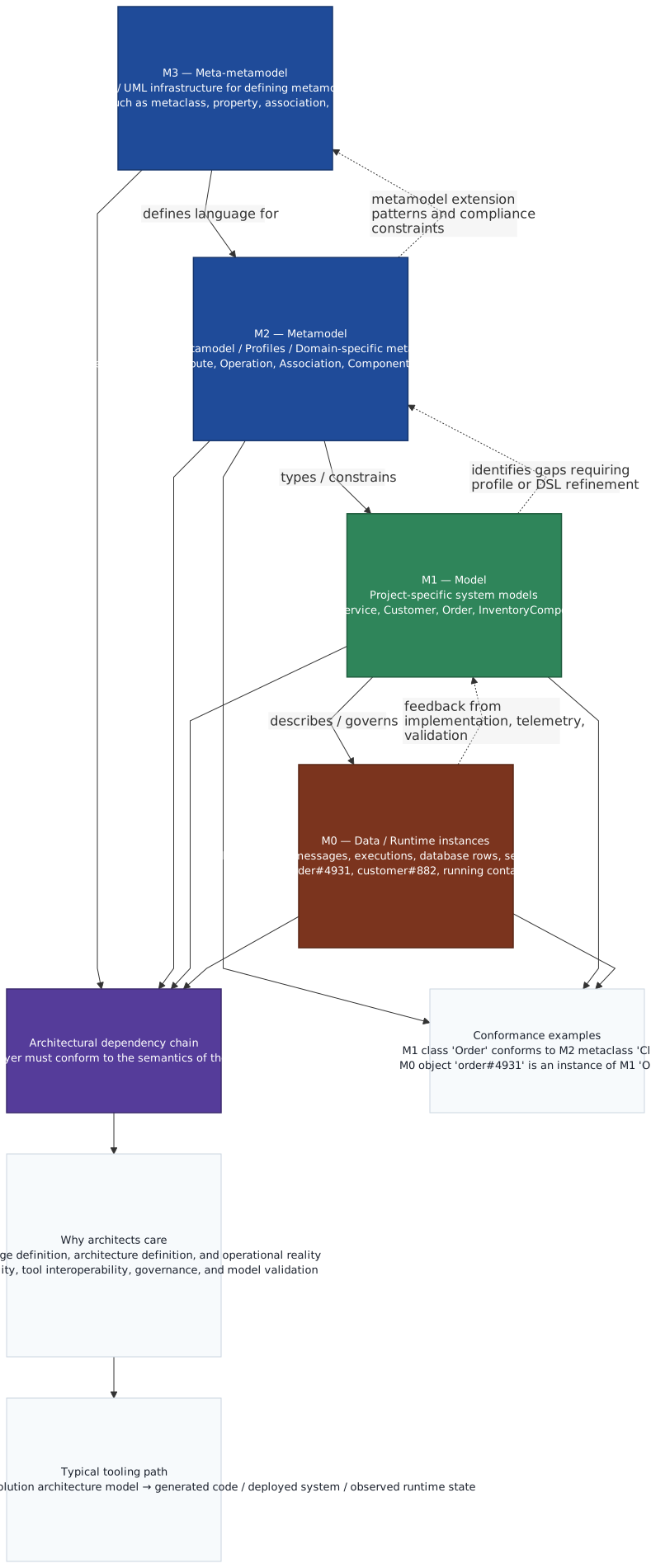
- An M2 element defines the type of an M1 element.
- An M1 element describes the structure or behavior of M0 instances.
- M3 defines the constructs used to define M2.
A UML Class at M2 is the concept of “Class.”
A Customer class in your domain model at M1 is an instance of that UML Class concept.
An actual customer record or object at runtime at M0 is an instance of the Customer model element.
That chain matters.
Here’s a more enterprise-flavored example.
This layering helps you avoid category errors.
For instance, “Kafka topic retention is 7 days” is usually an M0 or environment-specific configuration fact, unless you deliberately model it as an M1 property of your target architecture. “A Topic is a kind of messaging construct” is more like M1 semantics expressed using an M2 extension. “A stereotype can have tagged values” belongs to M2. Very different conversations.
That distinction is not academic. It affects ownership, governance, and tooling. ARB governance with Sparx EA
Why architects get confused by this
Because enterprise architecture is messy, and the clean UML stack gets mixed with at least five other realities:
- Tooling bends the concepts.
Modeling tools often let users create elements with weak semantics. A box becomes whatever the team says it is.
- Architecture repositories blur model and inventory.
CMDB data, cloud asset inventories, and logical architecture models get merged into one giant “repository,” which confuses M1 and M0.
- Teams use multiple notations at once.
UML, ArchiMate, C4, BPMN, ERD, OpenAPI, AsyncAPI, Terraform, and cloud-native diagrams all overlap.
- Runtime platforms are highly dynamic.
In Kubernetes or serverless environments, M0 changes constantly. Static M1 diagrams go stale fast.
- People model for different reasons.
Some want design precision. Others want stakeholder communication. Others want governance evidence. Those are not the same thing. EA governance checklist
So yes, the four-layer architecture is conceptually neat, but in enterprise practice it only helps if you use it as a thinking tool, not as a purity test.
That matters. A lot.
How this applies in real architecture work
1. Separating architecture intent from runtime inventory
One of the most useful applications of the M1/M0 distinction is separating target architecture from what happens to exist today.
Say you’re modernizing a bank’s customer onboarding platform.
Your M1 model might define:
- onboarding domain services
- event contracts
- IAM trust boundaries
- data ownership rules
- deployment zones
- resilience patterns
- encryption and key management expectations
Your M0 reality might show:
- three legacy apps still writing directly to the customer table
- Kafka topics with inconsistent naming
- IAM roles with wildcard permissions
- a shadow SFTP feed still used by operations
- a production data export job no one documented
If you don’t keep M1 and M0 distinct, architecture becomes a passive mirror of chaos. That’s not architecture. That’s diagrammed entropy.
Good architecture work often means saying: this is the model we intend to govern toward, and this is the runtime deviation we must either remediate or consciously accept.
That is a very practical use of the UML layer idea.
2. Clarifying what standards actually standardize
Enterprise standards often fail because they try to standardize everything at once.
For example, an organization says, “All integration must use event-driven architecture with Kafka.” Fine. But what exactly is being standardized?
- At M2-ish enterprise convention level: perhaps the allowed stereotypes, naming conventions, and mandatory metadata for event models.
- At M1: the actual application interaction models, event schemas, topic ownership, and retry patterns.
- At M0: the deployed clusters, ACLs, retention settings, partition counts, and consumer lag thresholds.
These are different concerns.
If you standardize only M0, you get brittle operational controls without design consistency.
If you standardize only M1, teams can produce elegant diagrams and still deploy insecure or unscalable implementations.
If you blur M2 and M1, your “standard” becomes a pile of examples with no real modeling discipline.
A mature architecture function knows which layer it is governing at any given moment.
3. Improving model-driven automation
This is where the stack becomes more than theory.
Suppose your enterprise uses a UML profile to mark service components with stereotypes like:
<> <> <> <> <>
That is M2-guided modeling applied at M1.
Now imagine those tagged values drive:
- security review checklists
- IAM policy templates
- Kafka topic provisioning workflows
- cloud network segmentation rules
- data classification controls
That creates a path from M1 to M0 automation.
This is one of the few places where UML layering still feels surprisingly modern. Not sexy, maybe. But useful. If your models are structured well enough, they can influence implementation and governance instead of just decorating PowerPoint. architecture decision record template
4. Aligning domain models with runtime observability
Architects often complain that observability is too implementation-focused. Operations teams complain that architecture models are too abstract. Both are right.
The M1/M0 distinction helps bridge the gap.
For example:
- M1 says the
PaymentOrchestratorinvokesFraudCheckServiceand emitsPaymentApprovedorPaymentRejected. - M0 telemetry should let you observe actual request paths, retries, event emissions, and failure rates for those interactions.
If the M1 model cannot be traced to logs, traces, metrics, topic flows, and IAM actions in M0, your model has weak operational value.
In cloud-native architecture, traceability from model to runtime is becoming less optional. Not because UML says so, but because distributed systems punish wishful thinking.
Common mistakes architects make
Mistake 1: Treating diagrams as reality
This is the classic one.
A deployment diagram says there are three trust zones and all service-to-service traffic goes through the mesh. In reality, one batch process bypasses the mesh, two Lambda functions use direct credentials, and a vendor integration still tunnels through a firewall exception from 2019.
The model is M1. Reality is M0. They are not automatically the same.
Senior architects know this. But even experienced teams drift into “the diagram says” thinking. Usually because diagrams are easier to govern than runtime.
My rule of thumb: if an architecture decision matters for resilience, security, compliance, or cost, ask what evidence exists at M0.
Mistake 2: Over-customizing UML until no one can read it
Yes, profiles and stereotypes are useful. No, that does not mean every enterprise should invent a private modeling language that requires a two-week induction course.
I’ve seen organizations create stereotypes for every platform nuance:
<, <, <, and so on. At some point the model stops clarifying and starts performing bureaucracy.
A good enterprise modeling convention should make important distinctions visible without turning diagrams into legal contracts.
This is one of those places where restraint is underrated.
Mistake 3: Mixing logical, physical, and operational concerns in one model
A single diagram that shows business capabilities, application services, Kafka topics, Kubernetes namespaces, IAM roles, and incident escalation teams is usually not “holistic.” It’s just overloaded.
The four-layer architecture doesn’t solve viewpoint management by itself, but it does remind you that not all elements belong in the same semantic conversation.
Keep models purposeful.
- Logical service decomposition: one view
- Event interaction model: another
- Physical deployment: another
- Runtime asset inventory: probably not UML at all
Architects who try to force everything into one canonical model usually create confusion faster than alignment.
Mistake 4: Confusing type definitions with enterprise decisions
A UML Component is a generic modeling construct. Your enterprise definition of a “deployable service” is not the same thing.
Likewise, a UML Class does not settle whether a domain concept should be represented as a master data entity, a cache projection, or an event payload contract.
This sounds obvious. Yet teams routinely use UML labels as if they answer architecture questions by themselves.
They don’t.
UML gives you expressive structure. It does not replace judgment.
Mistake 5: Ignoring M0 because it feels “too operational”
This one is common in architecture teams that still see operations as someone else’s concern.
In modern enterprises, especially in cloud and platform-heavy environments, architecture that ignores runtime behavior is incomplete. If your model says a service is “highly available,” but M0 shows all consumers depend on a single Kafka cluster in one region with weak failover testing, your architecture claim is hollow.
I’m not saying architects need to become SREs. I am saying they can no longer hide behind static abstractions.
Real example from enterprise context
Let’s take a realistic scenario: a retail bank modernizing its customer and payments platform.
The situation
The bank has:
- a legacy core banking platform
- a CRM system
- a digital onboarding app
- a payments hub
- a fraud engine
- Kafka as the strategic event backbone
- hybrid cloud deployment across on-prem and AWS
- federated IAM using Azure AD with privileged access controls in AWS
The target architecture aims to reduce batch coupling, improve customer data consistency, and support near-real-time fraud detection.
M2 in this context
The architecture team uses UML with an enterprise profile. They define stereotypes such as:
<> <> <> <> <> <>
These are not runtime objects. They are modeling conventions layered onto UML to make enterprise concerns visible.
This is effectively M2 usage tailored for the bank.
M1 in this context
The team creates models showing:
CustomerProfileServiceas a<> CoreBankingPlatformas a<> customer.profile.updated.v1as an<> FraudAssessmentServiceconsuming customer and payment eventsPII Vaultas a<> - IAM trust boundaries between internal services, admin roles, and third-party providers
They also model sequence flows:
- onboarding app submits customer application
- customer profile service validates and persists profile
- event is published to Kafka
- fraud assessment consumes event
- payment eligibility flags are updated
- downstream systems subscribe
This is all M1. It is a model of the bank’s intended architecture.
M0 in this context
Then reality shows up.
In production:
- the onboarding app still writes synchronously to the CRM for one compliance attribute
- the Kafka topic has eight consumers, including two undocumented downstream analytics jobs
- one fraud consumer uses a stale schema version
- a support IAM role has broader access than the model intended
- the PII Vault replication lag occasionally exceeds SLA
- a nightly reconciliation batch still corrects customer state because event ordering isn’t fully trusted
That is M0. Messy, specific, and very normal.
Why the layer distinction helps
Without the four-layer mindset, the team tends to argue in circles:
- “But the architecture says event-driven.”
- “Yes, but production still depends on synchronous CRM writes.”
- “Then the diagram is wrong.”
- “No, the implementation is transitional.”
- “Then what is the approved state?”
The M1/M0 separation lets the team say something much more useful:
- M1 target: customer profile is mastered in
CustomerProfileService; CRM becomes downstream consumer only. - M0 current: CRM remains a partial synchronous dependency for compliance fields.
- Gap: target-state deviation requiring remediation, exception approval, or revised design.
That is a grown-up architecture conversation.
A practical trade-off the bank faces
The team wants strict event-driven decoupling. Good goal. But fraud decisions for high-risk payments need low-latency certainty. Kafka is excellent for propagation, not always ideal for synchronous decision points.
So they make a trade-off:
- customer profile changes propagate asynchronously through Kafka
- high-risk payment authorization still invokes fraud scoring synchronously via API
- fraud outcomes are also emitted as events for downstream consumers
Purists may dislike the hybrid approach. I think it’s the right call. Enterprises often over-romanticize asynchronous everything. Sometimes synchronous interaction is the honest design, especially where user flow, regulatory timing, or risk controls demand it.
Again, the layering helps.
- M1 captures both interaction styles intentionally
- M0 validates whether latency and resilience actually hold up
Another trade-off: IAM model simplicity vs operational control
The bank initially models a neat IAM structure:
- application roles
- admin roles
- break-glass roles
- least-privilege boundaries by environment
Very clean at M1.
At M0, however, support teams need temporary elevated access during incidents, and vendor-managed services complicate role assumptions across accounts. The architecture team can either preserve the elegant model and ignore reality, or update the model to include approved elevation patterns, just-in-time access, audit requirements, and exception pathways.
The second option is better. Less pretty, more truthful.
That’s a recurring lesson with M1 and M0: architecture should not become a cosmetic layer over operational improvisation.
A more grounded way to think about M3 to M0
Here’s the version I use in practice:
That framing keeps the theory anchored.
And if I’m being blunt, that’s what most teams need. Not a seminar on metamodel ontology. Just enough precision to avoid confusion.
Where UML layering still earns its keep
A lot of architects have moved toward lighter notations like C4, cloud-native reference diagrams, or architecture decision records. Fair enough. I use those too. UML is not the center of the universe anymore.
But the layered thinking behind UML still earns its keep in a few places:
Enterprise-wide modeling consistency
When multiple teams model domains, services, integrations, and controls, M2-level conventions prevent semantic drift. If one team’s “service” means deployable runtime and another team’s “service” means business capability wrapper, comparisons become useless.
Regulated environments
Banks, insurers, healthcare firms, and public sector organizations often need traceability from policy to design to implementation. The M1/M0 separation is extremely helpful there.
Tool-supported governance
If models feed repositories, review workflows, provisioning templates, or conformance checks, you need explicit semantics. Informal boxes and arrows don’t scale well.
Complex platform ecosystems
In hybrid cloud, event-driven, identity-heavy environments, architecture spans logical design and runtime control planes. The four-layer view helps keep those concerns related but not confused.
A few opinions worth stating plainly
First: most UML problems in enterprises are not UML problems. They are clarity problems. Teams don’t agree on what they are modeling, why they are modeling it, or what decisions the model is supposed to support.
Second: the M3 layer is overemphasized in theory and underemphasized in tooling discussions. Most architects don’t need to dwell there, but platform and repository teams absolutely should if they want model integrity.
Third: M1 without M0 feedback is architecture theater. Maybe useful theater. Still theater.
And one more. Slightly contrarian: a simpler model that maps well to runtime is often more valuable than a semantically perfect model no one maintains. Precision matters, but stale precision is not a virtue.
Final thoughts
From M3 to M0, the four-layer architecture of UML is really about one discipline: keeping definition, design, and reality distinct enough that you can reason clearly.
- M3 gives formal grounding.
- M2 gives the modeling language.
- M1 gives the architecture model.
- M0 gives the actual running world.
In enterprise architecture, the real payoff is not memorizing the layers. It’s using them to avoid category mistakes, improve governance, and connect architecture intent to operational truth.
That’s the part that matters.
When you’re modeling a banking platform, a Kafka-based integration landscape, an IAM trust model, or a cloud deployment architecture, ask four simple questions:
- What language am I using to express this?
- What modeling constructs am I relying on?
- What is the intended system design?
- What actually exists at runtime?
If those answers are clear, the architecture conversation gets sharper. Trade-offs become more visible. Exceptions become easier to govern. And diagrams start doing real work instead of just looking official.
That’s why the M3-to-M0 stack is still worth understanding. Not because UML is sacred. It isn’t. But because enterprises are full of blurred abstractions, and this is one of the few frameworks that helps separate them cleanly.
FAQ
FAQ
1) What do M3, M2, M1, and M0 mean in UML?
They are the four abstraction layers of UML.
- M3: the meta-metamodel layer
- M2: the metamodel layer
- M1: the model layer
- M0: the real-world instance layer
A simple way to remember it: language of languages → language → model → actual objects/data.
2) What is at the M3 layer?
M3 defines the structure used to create metamodels. In UML, this role is typically played by MOF (Meta-Object Facility). It provides the basic concepts used to define UML itself.
3) What belongs to the M2 layer?
M2 contains the UML metamodel—the definitions of elements like Class, Attribute, Association, Use Case, and more. This is the layer that defines what UML notation means.
4) What is an example of the M1 and M0 layers?
At M1, you create a UML model, such as a class diagram with Customer, Order, and Product.
At M0, you have actual runtime or real-world instances, such as Customer = Alice and Order = #1045.
5) Why is the four-layer architecture useful?
It helps separate definition, modeling, and real instances. This makes UML easier to standardize, extend, and use consistently across tools and projects.
Diagram 1 — Four-Layer UML Architecture (M3 → M0)
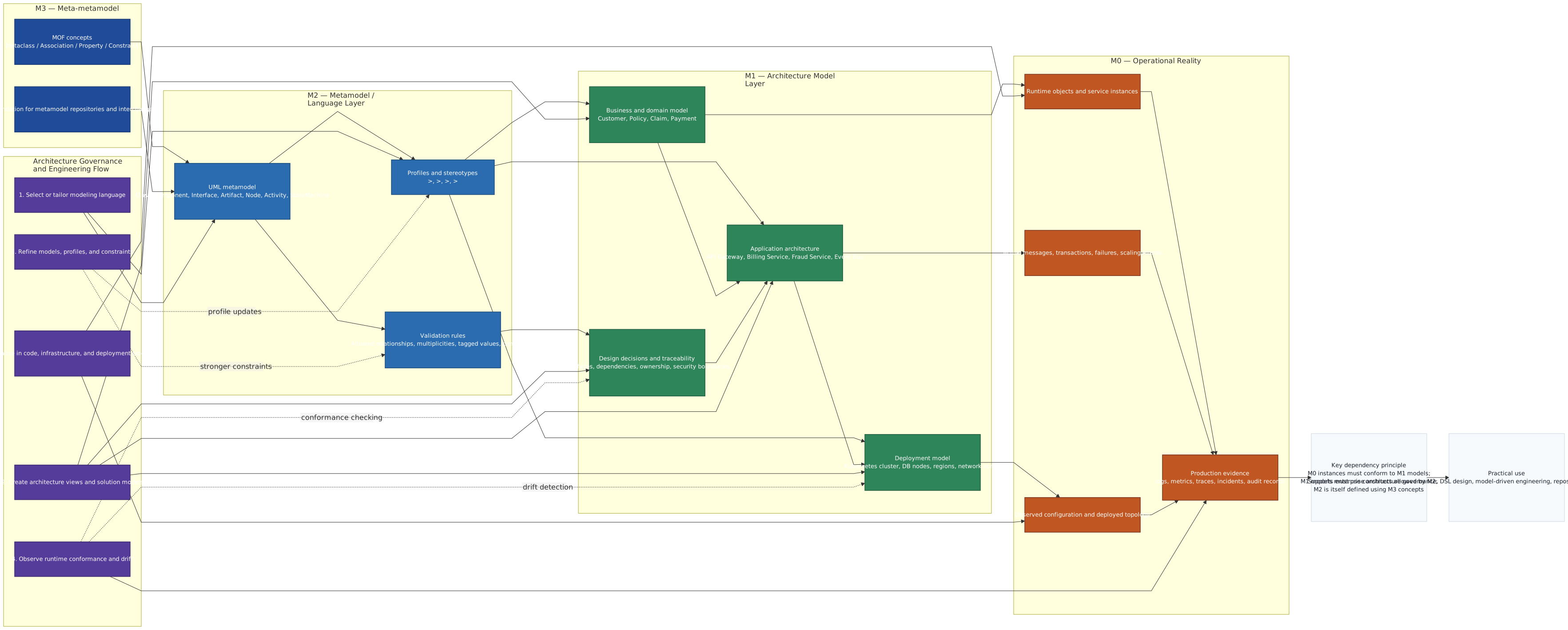
Diagram 2 — How Real Architecture Work Traverses the UML Layers
Frequently Asked Questions
What is enterprise architecture?
Enterprise architecture is a discipline that aligns an organisation's strategy, business processes, information systems, and technology. Using frameworks like TOGAF and modeling languages like ArchiMate, it provides a structured view of how the enterprise operates and how it needs to change.
How does ArchiMate support enterprise architecture practice?
ArchiMate provides a standard modeling language that connects strategy, business operations, applications, data, and technology in one coherent model. It enables traceability from strategic goals through business capabilities and application services to the technology platforms that support them.
What tools are used for enterprise architecture modeling?
The main tools are Sparx Enterprise Architect (ArchiMate, UML, BPMN, SysML), Archi (free, ArchiMate-only), and BiZZdesign Enterprise Studio. Sparx EA is the most feature-rich option, supporting concurrent repositories, automation, scripting, and integration with delivery tools like Jira and Azure DevOps.