⏱ 19 min read
Most enterprise architecture diagrams lie.
Not always maliciously. Usually politely. A team opens a modeling tool, drags a few boxes around, labels one “Customer,” another “Order,” another “Identity Service,” and suddenly everyone pretends the picture means something precise. It rarely does. The worst part is that people then use these vague diagrams to make expensive decisions about software boundaries, integration patterns, ownership, security, and cloud deployment.
Here’s the blunt version: if you use UML without understanding its metamodel, you’re often producing decorative ambiguity. And if you practice Domain-Driven Design without understanding modeling discipline, you’re just renaming services after business nouns and calling it strategy. UML modeling best practices
That’s the tension this article is about.
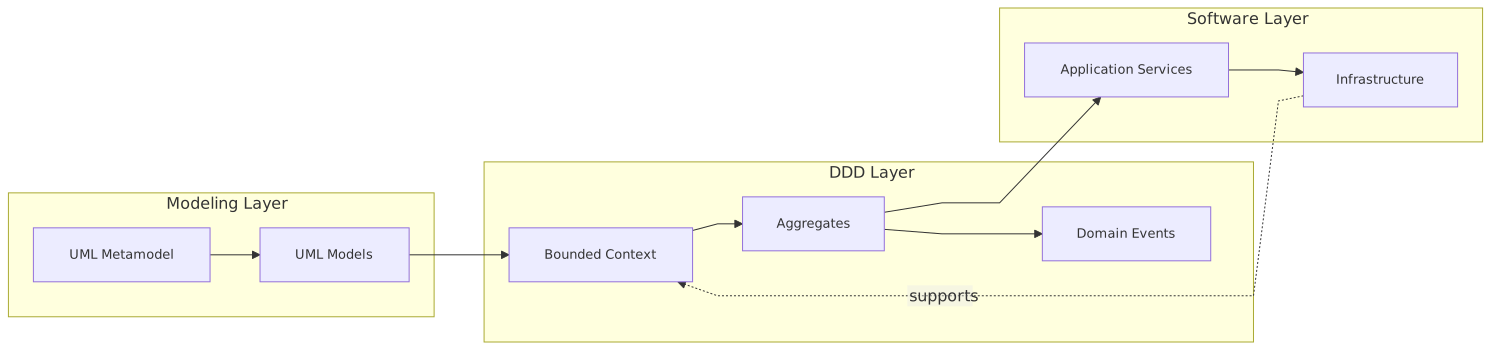
UML metamodel and DDD are not the same thing. They come from different traditions. UML gives you a language for describing models and model elements with formal structure. DDD gives you a way to shape software around business meaning, boundaries, and change. In real enterprise architecture work, the two can complement each other very well. But only if you stop treating UML as a drawing standard and DDD as a microservices branding exercise. UML for microservices
My opinion: architects should care less about notation purity and more about semantic precision. But semantic precision does matter. A lot. Especially in banking, IAM, event-driven systems, and cloud platforms where one bad boundary can create five years of operational pain.
So let’s make this practical.
The simple explanation first
If you need the short SEO-friendly answer early, here it is:
- UML metamodel is the formal definition of what UML elements are and how they relate.
It defines things like what a Class is, what an Association is, what a Component is, and what rules connect them.
- Domain-Driven Design (DDD) is an approach to software design that focuses on modeling the business domain, using ubiquitous language, bounded contexts, aggregates, domain events, and explicit context boundaries.
- Why they matter together:
DDD tells you what business boundaries and concepts matter.
UML metamodel helps you express those concepts consistently and precisely in architecture artifacts.
In other words: DDD gives meaning, UML gives structure.
That’s the nice clean answer. Real life is messier.
Why architects get this wrong
There are two common failure modes.
1. The UML-heavy architect
This person produces immaculate diagrams with stereotypes, packages, dependencies, components, and deployment nodes. It all looks serious. But the model says almost nothing useful about business meaning. “Customer Service” talks to “Account Service” via “Event Bus.” Fine. What is a customer in this enterprise? Is a party the same as a customer? Does IAM own identity or just authentication? Where does regulatory responsibility live? The UML model can be formally valid and still strategically useless.
2. The DDD-heavy architect
This person knows all the vocabulary: aggregates, anti-corruption layer, bounded context, domain events. Sounds smart in workshops. But when it comes time to formalize architecture, the model collapses into hand-wavy sketches. Interfaces are vague. Ownership is unclear. Runtime topology is ignored. Identity boundaries are mixed with customer data boundaries. Kafka topics become accidental APIs. The DDD language is there, but the architecture isn’t controlled.
Both camps miss the point. Enterprises need meaningful models that are also structurally disciplined.
That’s where the UML metamodel matters more than most architects admit.
What the UML metamodel actually is, in plain English
A metamodel is a model of the modeling language itself.

That sounds abstract, but it’s not that mystical. Think of it this way:
- Your architecture diagram is a model
- UML defines the types of things you can put in that model
- The UML metamodel defines those types and their legal relationships
So when you say something is a Class, Component, Interface, Artifact, Node, Package, or Association, you’re not just drawing shapes. You’re making claims that have formal meaning.
That formal meaning matters because enterprise architecture is full of category errors. Architects constantly confuse:
- logical component with deployable unit
- business capability with application service
- domain entity with database table
- identity with customer
- event stream with system boundary
The UML metamodel won’t magically solve those mistakes. But it does force discipline if you use it properly. It makes you ask: what kind of thing is this, really?
That question is underrated.
What DDD actually brings to architecture
DDD is often reduced to tactical patterns. Aggregates. Repositories. Value objects. Fine, those matter. But for enterprise architecture, the strategic side is more important:
- Bounded contexts
- Ubiquitous language
- Context mapping
- Separation of domain responsibilities
- Explicit translation across boundaries
This is where DDD becomes architecture, not just code design.
In a large bank, for example, the word “account” can mean:
- a retail current account
- a general ledger account
- a digital identity account
- a broker account
- a service account in IAM
- a cloud account for infrastructure billing
If your enterprise model uses one neat box called “Account,” congratulations, you’ve just built confusion into the foundation.
DDD says: stop pretending one word means one thing everywhere. Define bounded contexts. Let terms differ where the business differs. Translation is not failure. Translation is architecture.
This is also where UML diagrams often become dangerous. UML encourages generic structural modeling. DDD insists on semantic boundaries. If you use UML naively, you flatten distinctions that should remain explicit.
Contrarian thought: many enterprise architecture repositories would be more useful if half the “canonical data model” content was deleted and replaced with bounded context maps.
UML metamodel and DDD are complementary, not competing
Here’s the practical synthesis:
- Use DDD to decide what concepts and boundaries deserve first-class attention
- Use UML metamodel discipline to decide how to represent them clearly and consistently
For example:
- A bounded context may be modeled as a UML Package, Component, or subsystem-like grouping depending on purpose
- A domain service might be represented as a Component or Interface, not as a random box
- An aggregate might be modeled as a conceptual Class cluster or package-level construct, but not confused with a database schema
- A context map may use dependencies and relationships with stereotypes to show upstream/downstream, conformist, anti-corruption layer, published language, and so on
- A domain event can be represented as a message type, event class, or information object associated with an event channel
The exact notation matters less than consistency and explicit semantics. This is where I get opinionated: I would rather see a simple UML profile used consistently for DDD concepts than a “creative” workshop mural that nobody can operationalize.
Architects love freedom. Models need constraints.
The real architecture value: making boundaries visible before they become outages
In real architecture work, this combination matters because systems fail at boundaries.
Not usually inside a well-written service. They fail:
- between identity and customer domains
- between event contracts and consuming teams
- between cloud platform ownership and application ownership
- between product model and ledger model
- between IAM assertions and downstream authorization semantics
DDD helps you discover those boundaries. UML metamodel discipline helps you document them in a form that teams can reason about, govern, and implement.
If you don’t do both, architecture becomes either:
- a strategy deck with no engineering teeth, or
- a model repository with no business truth
Neither is enough.
A useful mapping: DDD concepts to UML-ish representation
Below is a practical mapping. Not the only one. But useful.
That table alone would save some architecture teams months of confusion.
The banking example: where this gets real fast
Let’s use a realistic enterprise scenario.
Imagine a bank modernizing customer onboarding and account opening across channels:
- mobile app
- branch systems
- partner channels
- fraud systems
- core banking
- IAM platform
- Kafka-based event backbone
- cloud-hosted onboarding services
At first glance, the architecture looks simple:
- Customer submits application
- Identity is verified
- KYC and AML checks run
- Account is opened
- Credentials are provisioned
- Events are published
That’s exactly the kind of process where sloppy modeling creates long-term damage.
The first big mistake: confusing Customer, Party, Identity, and User
These are not the same thing.
- Customer domain owns business relationship with the bank
- Party domain may represent legal persons and organizations in a broader enterprise data model
- IAM domain owns digital identity credentials, authentication, and maybe some profile attributes
- Channel/User context may represent session actors and interaction preferences
If one architect creates a UML class called Customer and uses it across all those contexts, the model is already broken.
DDD says these are likely different bounded contexts with overlapping but non-identical concepts. UML metamodel discipline says don’t pretend they’re one element reused everywhere just because the label looks convenient.
In practice, I would model:
- separate bounded contexts for Customer Management, Identity and Access Management, Onboarding, Core Account Origination, Fraud Decisioning
- explicit dependencies between them
- translation points where language changes
- event contracts that reflect source context semantics, not enterprise wishful thinking
The second big mistake: treating Kafka as the architecture
This happens all the time. Teams say they are “event-driven,” and then what they really mean is “we have Kafka.”
Kafka is not the domain model. Kafka is a transport and streaming platform. The topic name is not the bounded context. The schema registry is not ubiquitous language. And an event stream does not erase ownership.
A better architecture view would show:
- Onboarding Context emits
ApplicationSubmitted - Fraud Context emits
ScreeningDecisionMade - Customer Context emits
CustomerEstablished - Account Origination Context emits
DepositAccountOpened - IAM Context emits
DigitalIdentityProvisioned
Those are domain events. They may be carried over Kafka topics. But the topics should be implementation details in one view, not the primary source of meaning in every view.
This sounds obvious. Yet I’ve seen enterprises where topic taxonomies replaced domain architecture entirely. It ends badly. Topic sprawl, duplicate semantics, incompatible payloads, and consumers depending on accidental fields. Very modern mess.
The third big mistake: using cloud boundaries as domain boundaries
A team deploys services into separate AWS accounts or Azure subscriptions and starts calling that “domain separation.” No. That’s an operational boundary. It may support domain boundaries, but it does not define them.
In our banking example:
- IAM might run in a tightly controlled security landing zone
- onboarding services in a digital platform account
- Kafka in a shared event platform
- fraud decisioning partly SaaS, partly internal
- core account opening still on-prem or private cloud
Those are deployment realities. Important ones. But DDD boundaries should not be reverse-engineered from cloud tenancy. UML helps here because deployment diagrams and component/domain views are different views of the same architecture. They should relate, not collapse into each other.
How I’d model this in real enterprise architecture work
Not in theory. In actual architecture practice.
I would create a small set of linked views, each with a purpose.
1. Context map view
Purpose: show bounded contexts, ownership, and translation relationships.
This is where I’d show:
- Onboarding
- Customer Management
- IAM
- Fraud Decisioning
- Account Origination
- Notification
- Ledger / Core Banking
And I would stereotype relationships:
- upstream/downstream
- published language
- anti-corruption layer
- conformist where unavoidable
- customer/supplier if there is productized ownership
This view is strategic. It answers: where does meaning change?
2. Domain concept view per bounded context
Purpose: show major concepts and language inside a context.
For example in IAM:
- DigitalIdentity
- Credential
- AuthenticationMethod
- ConsentArtifact
- AccessPolicy
- IdentityProofReference
In Customer Management:
- Customer
- RelationshipStatus
- ContactPoint
- RiskProfile
- CustomerSegment
Notice I would not force these into one merged enterprise class model. That’s where many architecture efforts go wrong. Shared understanding does not require one universal object model.
3. Event and integration view
Purpose: show domain events, APIs, and asynchronous flows.
This is where Kafka appears, but in the right place:
- event producers
- event consumers
- event types
- ownership of schemas
- durability and replay expectations
- criticality and regulatory retention concerns
In banking, this matters because replaying CustomerEstablished may be fine, but replaying AccessGranted or FundsReserved has very different risk implications. Event architecture is not just plumbing.
4. Deployment and trust boundary view
Purpose: show cloud accounts, clusters, IAM trust zones, network controls, and runtime placement.
This is where:
- production Kubernetes clusters
- managed Kafka
- IAM tenant
- HSM-backed key services
- PCI zones
- regional data residency boundaries
all become visible.
This view should connect to domain ownership, but not replace it.
That set of views is enough for executive conversation, engineering planning, and governance. Not perfect. But useful, which matters more. ARB governance with Sparx EA
Common mistakes architects make with UML metamodel and DDD
Let’s be honest. These are everywhere.
Mistake 1: Equating bounded context with microservice
A bounded context is a semantic boundary. A microservice is a deployment and runtime design choice. Sometimes they align. Sometimes one context contains several services. Sometimes one service temporarily spans multiple contexts during transition. Don’t make the mapping dogmatic.
Mistake 2: Treating UML classes as code classes
In architecture, a class diagram can represent conceptual domain structure, not implementation classes. If your architects and developers can’t tell the difference, your modeling practice is immature.
Mistake 3: Building a fake canonical model
Enterprises love canonical data models because they look neat in PowerPoint. In practice, they often erase necessary distinctions. Canonical models are useful only in narrow integration cases. As enterprise truth, they usually become semantic debt.
Mistake 4: Making every integration an anti-corruption layer
No, Karen, your JSON mapper is not automatically an anti-corruption layer. An ACL protects a model from foreign semantics. Sometimes you just have a protocol adapter. Use the term properly.
Mistake 5: Forgetting power and ownership in context maps
Not all dependencies are equal. Some teams dictate schemas. Some consume passively. Some own shared identity assertions. Some are trapped by vendor platforms. Context maps should show influence, not just connectivity.
Mistake 6: Modeling Kafka topics instead of business events
Topic names are not architecture strategy. They are implementation assets. Start from business events and ownership.
Mistake 7: Mixing IAM identity with customer profile
This one is especially dangerous. IAM should not quietly become the source of truth for customer domain data just because login exists there. Authentication identity, authorization attributes, and customer relationship data have different governance and lifecycle concerns. EA governance checklist
Mistake 8: Ignoring time and change
A model isn’t just a snapshot. Domains evolve. Event versions evolve. Regulatory meaning evolves. If your architecture repository has no way to express change over time, it will become museumware.
Contrarian view: most enterprise UML usage is too broad, and most DDD usage is too narrow
Here’s the opinion some people won’t like.
UML is often used too broadly
Organizations try to model everything in UML: business process, application inventory, deployment, information models, code design, governance taxonomy. The result is bloated and unloved. UML should be used selectively where precision helps.
DDD is often used too narrowly
Teams keep DDD inside software delivery and never let it influence enterprise architecture, operating model, data governance, or IAM design. That’s a waste. DDD is one of the few approaches that actually respects the fact that different parts of an enterprise mean different things by the same word.
If I had to choose, I’d rather have:
- a lightweight but disciplined UML approach
- plus strong DDD-based context thinking
than a giant “enterprise meta-model” nobody trusts.
Yes, I know enterprise repository vendors hate that sentence.
IAM is where this discipline pays off immediately
IAM is one of the most misunderstood domains in enterprise architecture because it intersects with almost everything:
- workforce identities
- customer identities
- service identities
- cloud roles
- authorization policies
- consent
- entitlements
- audit
Architects often collapse these into one abstract “identity” model. That’s not simplification. That’s semantic malpractice.
Using DDD:
- Workforce IAM is a different bounded context from Customer IAM
- Cloud platform IAM is another context again
- Application authorization may belong partly to application domains, not centrally to IAM
- Consent may belong in customer interaction or privacy domains, not purely IAM
Using UML metamodel discipline:
- model these as distinct components/packages/contexts
- show interface contracts and event relationships
- map trust boundaries separately from business semantics
- avoid one giant “Identity” class pretending to solve everything
In a bank, this matters because a customer login identifier, a core banking CIF, a fraud subject reference, and a cloud service principal are all identity-related but not the same thing. If your architecture artifacts don’t reflect that, your controls and integrations will drift into nonsense.
Where cloud architecture fits in
Cloud makes modeling both easier and more dangerous.
Easier because modern platforms expose clear deployable units, managed services, identity mechanisms, event backbones, and policy boundaries.
More dangerous because teams start believing platform structure is business structure.
A few practical principles:
- Use DDD to define domain boundaries first
- Use UML views to connect those boundaries to cloud constructs
- Do not infer domain ownership from Kubernetes namespaces or AWS accounts
- Do not put shared platform services in the middle of every domain diagram as if they own the business
- Represent trust boundaries explicitly
For example:
- Kafka platform team owns the event infrastructure
- Domain teams own event semantics and contracts
- IAM team owns authentication platform and core identity controls
- Product domains own business authorization decisions where appropriate
- Cloud platform team owns landing zones and baseline policies
That allocation is architectural. And it should be visible in the model.
A practical modeling pattern that works
If you want a method that works without turning architecture into a notation seminar, use this sequence:
- Identify business capabilities and pain points
- Discover bounded contexts using DDD language
- Define key domain concepts per context
- Map context relationships and translation needs
- Add integration patterns: sync API, async event, batch, file, whatever reality demands
- Then map runtime/deployment views in cloud and platform terms
- Finally add governance metadata: owner, SLA, data classification, regulatory scope
Notice what comes last: governance metadata. Important, yes. But too many enterprise teams start there and never recover.
The model should answer:
- who owns this meaning?
- who depends on it?
- what is the translation cost?
- what is the runtime path?
- what trust boundaries exist?
- what changes often?
- what must remain stable?
That’s architecture.
Final thought: precision beats prettiness
The point of combining UML metamodel discipline with DDD is not to create more diagrams. God knows enterprises don’t need more diagrams.
The point is to make architecture artifacts trustworthy enough to support real decisions:
- where to split systems
- where to keep things together
- where Kafka helps and where it just hides coupling
- where IAM should own policy and where it should not
- how cloud deployment reflects, but does not define, domain boundaries
- how banking concepts differ across onboarding, customer, account, fraud, and identity domains
If your model cannot survive those conversations, it’s decoration.
And yes, this means architects need to be more opinionated. Not louder. More precise.
A bounded context is not a vibe.
A component is not any box you draw.
A topic is not a domain.
Identity is not customer.
And a model that smooths over those distinctions is not enterprise architecture. It’s enterprise theater.
FAQ
1. Is UML still relevant for modern enterprise architecture, or is it outdated?
Yes, still relevant. But selectively. UML is useful when you need precision in structure, relationships, interfaces, and deployment views. It becomes outdated only when people use it as a heavyweight documentation ritual. The metamodel is valuable because it forces clarity about what kind of thing you are modeling.
2. Do I need UML to do Domain-Driven Design well?
No. DDD does not require UML. You can practice DDD with event storming, context maps, and plain-language diagrams. But in larger enterprises, UML-style discipline helps turn DDD insights into reusable architecture artifacts. Especially when multiple teams, governance bodies, and delivery programs need a shared structure.
3. How do bounded contexts relate to Kafka topics?
They are not the same. A bounded context defines semantic ownership and language. Kafka topics are transport channels for events or streams. One context may publish many event types across topics. Multiple topics may support one context. Start with context ownership and event meaning, then design Kafka topology.
4. Should IAM be its own bounded context?
Usually yes, but not as one giant context for all identity concerns. Workforce IAM, customer IAM, service identity, authorization policy, and consent often have different semantics and ownership. Treating all of them as one domain creates confusion and weak controls.
5. What is the biggest mistake enterprise architects make here?
Trying to unify everything too early. They create one canonical model, one shared vocabulary, one giant architecture diagram. Real enterprises are plural. Different domains need different models. Good architecture makes those differences explicit and manageable, instead of hiding them under tidy labels.
Frequently Asked Questions
What is a UML metamodel?
A UML metamodel is a model that defines UML itself — it specifies what element types exist (Class, Interface, Association, etc.), what relationships are valid between them, and what constraints apply. It uses the Meta Object Facility (MOF) standard, meaning UML is defined using the same modeling concepts it uses to define other systems.
Why does the UML metamodel matter for enterprise architects?
The UML metamodel determines what is and isn't expressible in UML models. Understanding it helps architects choose the right diagram types, apply constraints correctly, use UML profiles to extend the language for specific domains, and validate that models are internally consistent.
How does the UML metamodel relate to Sparx EA?
Sparx EA implements the UML metamodel — every element type, relationship type, and constraint in Sparx EA corresponds to a metamodel definition. Architects can extend it through UML profiles and MDG Technologies, adding domain-specific stereotypes and tagged values while staying within the formal metamodel structure.