⏱ 18 min read
Distributed systems rarely fail with a bang. They fail like old buildings settle: first a hairline crack, then a door that doesn’t quite close, then a floor that feels wrong under your feet. Domain events without versioning behave the same way. Everything looks fine while teams move fast, product managers celebrate delivery, and Kafka topics hum along like a healthy bloodstream. Then one service adds a field. Another renames one. A third decides that “customer” was always really “account holder.” Nothing explodes on day one. That is precisely the danger. event-driven architecture patterns
The breakage is slow, social, and architectural.
Event-driven systems are often sold as freedom machines. Publish facts, let consumers decide, decouple producers from downstream needs. There is truth in that. But there is also a trap. Once an event leaves a bounded context, it becomes part of a contract surface whether you intended that or not. Teams who treat events as internal DTOs with a broker attached eventually discover they have built a distributed integration API with no discipline around schema evolution. And those systems age badly.
This article is about that aging process, and how to stop it. Not with ceremony for ceremony’s sake, but with a practical architecture for schema evolution topology: versioned domain events, explicit migration paths, reconciliation mechanisms, and a gradual strangler approach that does not require rewriting your platform in a fit of architectural guilt.
Context
Let’s start with the thing many teams miss: a domain event is not merely data that happened to be emitted. It is a statement in the language of the business.
“OrderPlaced” is not the same thing as order_status = NEW.
“PaymentCaptured” is not the same thing as a row update in a payments table.
“CustomerRelocated” is not the same thing as changing an address field.
Domain-driven design matters here because domain events are part of the ubiquitous language. They are the exported semantics of a bounded context. When an Order context emits OrderShipped, it is telling the rest of the enterprise something business-meaningful has occurred. If the shape or meaning of that message drifts casually, consumers do not just break technically. They begin to misunderstand the domain itself.
That is why schema evolution is not merely a serialization problem. Avro, Protobuf, JSON Schema, a schema registry, backward compatibility rules — these help, but they do not solve semantic drift. A field can remain syntactically compatible while becoming semantically poisonous. Add statusReason, change time zone assumptions, reinterpret money units, split one concept into two — and the schema checker may smile while your business logic rots.
In Kafka-heavy estates, this gets amplified. Topics live for years. New services replay old events. Data platforms ingest the same streams for analytics, compliance, and machine learning. The number of consumers is often unknown to the producing team. “We only changed one field” is the event-driven equivalent of “it worked on my machine.” enterprise architecture with ArchiMate
Problem
Without versioning, domain events become accidental shared classes spread across teams and time.
At first, there is convenience. Teams serialize JSON directly from internal models. Maybe there is a topic called orders.events. Maybe every event has a type property and a blob of payload. It feels lightweight. Nobody wants the overhead of version numbers, schema governance, or event catalogs when there are features to ship.
Then evolution starts.
A shipping team needs richer address metadata, so addressLine1 and addressLine2 become a nested structure. A finance team introduces a new notion of settlement, so PaymentCompleted is now split into PaymentAuthorized and PaymentCaptured. A CRM migration changes customer identity semantics from local integer IDs to global UUIDs. None of these changes are unreasonable. In fact, they are signs that the domain is growing up.
The problem is not change. The problem is unmanaged change in a topology of long-lived consumers.
Here is where systems break slowly:
- Existing consumers silently ignore fields they needed but never knew about.
- Replayers fail because old messages no longer map to current code.
- Analytics pipelines stitch incompatible generations of event meaning into the same warehouse table.
- Teams fork custom translation logic in every consuming service.
- “Temporary” compatibility shims become permanent architecture.
- Incident response becomes archaeology.
And worst of all, the organization loses trust in events. Teams fall back to synchronous APIs, dual writes, or direct database access because “the stream is unreliable.” That is not a technology failure. It is a contract failure.
Forces
Several forces pull against a clean solution.
Decoupling versus contract stability
Teams adopt event-driven architecture to reduce coupling. Ironically, the less visible the coupling, the more dangerous it becomes. A topic with fifteen consumers is coupled, whether the producer acknowledges it or not.
Domain evolution versus consumer survivability
A bounded context must evolve in its own language. You should not freeze your domain because one downstream service cannot keep up. But consumers also need survivable contracts. Good architecture accepts both truths.
Replayability versus current semantics
Kafka encourages replay. That is a strength. But replay only works if historical events remain interpretable. If your current consumer logic cannot understand prior generations of events, replay becomes fantasy.
Producer agility versus enterprise governance
Central governance can prevent chaos. It can also suffocate delivery. Too little governance, and every event becomes bespoke. Too much, and teams hide changes outside the approved path. EA governance checklist
Technical compatibility versus semantic compatibility
A nullable field addition may be technically backward compatible. If downstream pricing logic assumes non-null meaning, it is not operationally compatible. Schema rules catch syntax. Architecture must catch meaning.
Cost of migration versus cost of entropy
Versioning has overhead. Registries, adapters, translation layers, deprecation policies, test matrices — none of it is free. But entropy is expensive too, just billed later and with interest.
Solution
The practical answer is simple to describe and harder to institutionalize: treat domain events as versioned domain contracts, evolve them intentionally, and isolate consumers from raw producer churn through a schema evolution topology.
Three principles matter.
1. Version the event contract, not just the serializer
Every externally consumed domain event should carry explicit version identity. This might be in the schema subject, event type, metadata envelope, or topic naming convention. The exact mechanism is less important than clarity.
Good:
OrderPlaced v1OrderPlaced v2- envelope with
eventTypeandeventVersion
Bad:
- “same event, slightly different payload”
- hidden semantic changes under a stable name
Versioning is not an admission of failure. It is an acknowledgment that language evolves.
2. Separate domain events from integration events when necessary
A bounded context should emit events in its own language. But not every internal domain event should be published as-is to the enterprise. Sometimes you need an anti-corruption layer or translation stream that turns rich internal semantics into stable external integration events.
That distinction saves systems. Internal events can evolve faster. External events can be curated, versioned, and documented with stronger compatibility rules.
3. Build an evolution path, not a one-time fix
Versioning is useless if migration strategy is absent. Consumers must be able to:
- read multiple event versions,
- upcast old events where semantics permit,
- route incompatible cases to reconciliation,
- gradually move to new streams or schemas.
This is where schema evolution topology comes in. Evolution is not just “new schema in registry.” It is the network of producers, translators, consumers, replay pipelines, dead-letter handling, and reconciliation jobs that let the estate change safely.
Architecture
A robust event architecture usually has five elements:
- Stable event envelope
- Schema registry and compatibility policy
- Version-aware producers
- Upcasters or translators
- Consumer isolation with reconciliation
The envelope should be boring and durable: event id, type, version, occurred-at timestamp, aggregate id, correlation id, causation id, producer context. Boring is good. Innovation belongs in the payload, not the metadata.

Notice the translator. Many enterprises resist this because it feels like extra plumbing. It is extra plumbing. It is also cheaper than forcing every consumer to understand every historical producer quirk.
A healthy topology often looks like this:
- Producers publish versioned events from bounded contexts.
- A schema registry enforces baseline backward or full compatibility where appropriate.
- Translation services convert older versions to canonical forms when semantics allow.
- Consumers subscribe either to raw domain streams or to canonical integration streams depending on their needs.
- Reconciliation processes compare eventual state when translation cannot guarantee exactness.
This is not dogma. It is containment.
Domain semantics first
Suppose CustomerMoved used to mean any address change. Later the business distinguishes billing address, shipping address, and legal domicile. Do not pretend this is still one event with a few extra optional fields. That is semantic change, not mere schema change. Introduce new event types or versions that name the new reality.
The best event architectures are honest about the business.
Topic strategy
Kafka raises a recurring design question: version in-topic or by-topic?
You can:
- keep one topic and carry event version in metadata, or
- publish to separate versioned topics such as
customer.events.v1andcustomer.events.v2.
There is no universal answer. A single topic preserves ordering and simplifies discovery but makes consumer logic more complex. Separate topics isolate generations but can fragment topology and complicate replay.
My bias: keep domain streams stable by topic where possible, version in the event contract, and introduce translation topics when semantics diverge materially. Topic proliferation is an architectural tax. Don’t pay it casually.
Upcasting
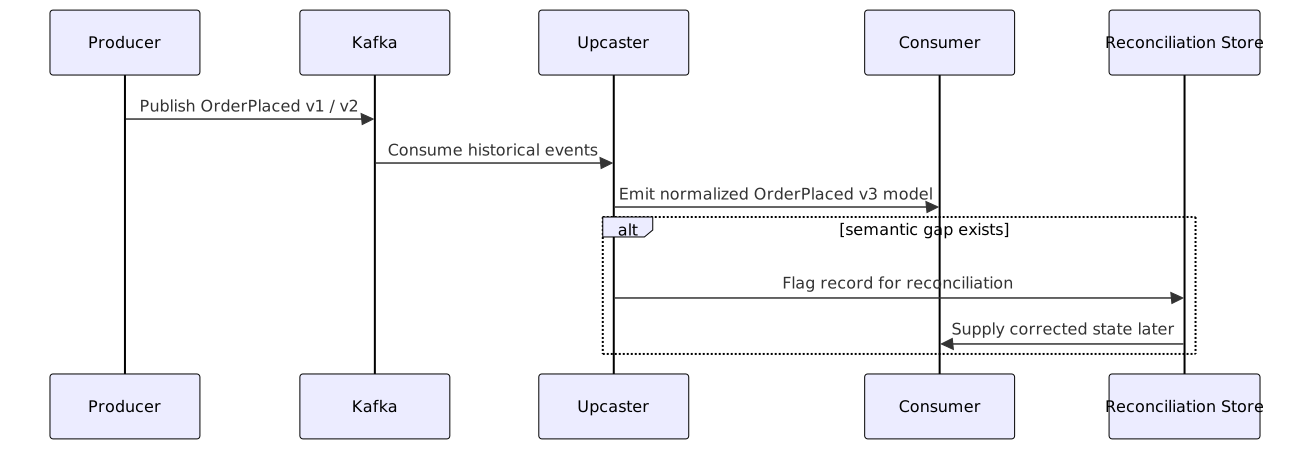
Upcasting is the process of transforming older event versions into a newer in-memory model for consumers. It is useful, but teams overestimate its power. Upcasting works for additive or structurally transformable changes. It does not magically invent lost business meaning.
If discountCode was absent in v1, perhaps defaulting to null is fine.
If v1 collapsed multiple payment states into one boolean paid, you cannot truthfully upcast into a rich settlement lifecycle without external knowledge.
That is when reconciliation enters.
Migration Strategy
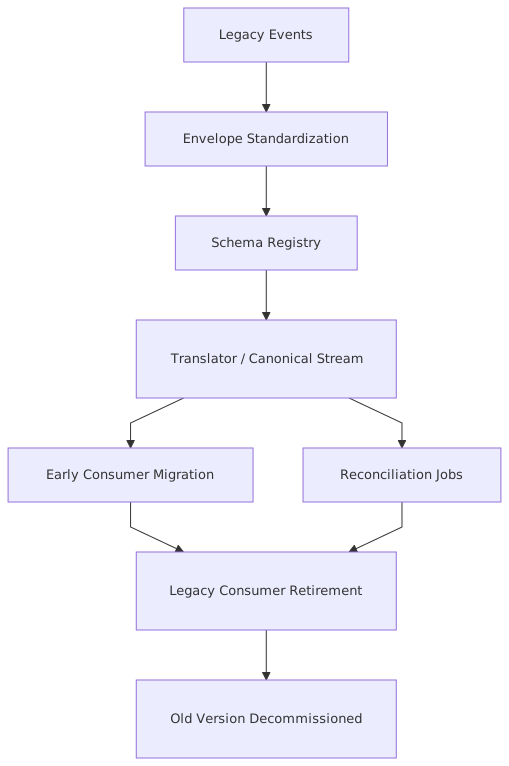
This is where architecture earns its keep. Most enterprises do not get to stop the world and redesign event contracts cleanly. They have live traffic, brittle consumers, compliance retention, and release trains that move at different speeds. So the migration must be progressive.
The strangler pattern is the right mental model.
Start by wrapping the old mess, not replacing it all at once.
Step 1: Inventory event consumers
You cannot evolve what you cannot see. Build a catalog of:
- topics,
- event types,
- known consumers,
- schema versions in use,
- replay dependencies,
- business criticality.
In large organizations, this alone is revealing. There are always ghost consumers. Some are in production analytics jobs nobody owns. Some are partner exports. Some are abandoned but still subscribed.
Step 2: Introduce a stable event envelope
Even if payloads remain messy, standardize metadata. This gives you traceability, de-duplication support, and routing capability.
Step 3: Register schemas and compatibility rules
For each externally relevant event type, move from “payload by convention” to explicit schema management. Backward compatibility is the usual starting point, but use full compatibility where replay and bidirectional reading matter.
Step 4: Add translation or upcasting layer
Do not force all consumers to migrate instantly. Introduce a translator service or stream processor that can consume legacy versions and emit canonical events.
Step 5: Migrate consumers gradually
Critical consumers move first. Low-value and batch consumers can follow. During transition, some consumers may read both legacy and canonical streams. This sounds ugly because it is. Transitional architectures are ugly. The point is to make the ugliness temporary and visible.
Step 6: Reconcile
For events that cannot be translated losslessly, compare downstream projections with source-of-truth state. Use reconciliation jobs to repair missed or misinterpreted outcomes. This is particularly important for finance, inventory, and compliance-sensitive domains.
Step 7: Deprecate old versions with dates, not wishes
Every version needs:
- introduction date,
- support window,
- migration guidance,
- retirement criteria.
“Deprecated” without a kill date is just a bedtime story.
Progressive strangler in practice
A common pattern is to leave legacy producers untouched initially. Capture their events, normalize them in transit, and migrate consumers to normalized streams. Once most consumers are off the raw stream, modernize producers to emit the new contract directly. Then retire the translator for that producer path.
This sequence matters. If you demand producer rewrites first, the migration stalls because every producer team has other priorities. If you normalize at the edge, the platform team can create momentum without waiting for a perfect world.
Enterprise Example
Consider a global retailer with separate domains for Orders, Fulfillment, Payments, Pricing, and Customer. Kafka is the backbone. Over six years, OrderSubmitted became the universal “something happened to an order” event. It carried dozens of fields, many optional, with semantics varying by channel.
The web channel populated customerId.
The store channel used loyaltyId.
Marketplace orders used a partner reference.
Some events included tax-inclusive totals; others did not.
Currency rounding rules changed by region over time.
Cancellation reasons were free text in one market and coded values in another.
Technically, the JSON remained parseable. Operationally, it was chaos.
Finance built a settlement service that consumed OrderSubmitted.
Fulfillment used it to reserve stock.
Analytics used it to drive revenue dashboards.
Customer service replayed it to rebuild case histories.
Then the retailer launched split shipments and partial captures. Suddenly one order could map to several fulfillment and payment lifecycles. The old event shape no longer represented reality. The system did not crash immediately. It drifted. Inventory held too much stock for some orders. Finance had reconciliation breaks. Dashboards disagreed with the ledger.
The fix was not “add more fields.”
The retailer introduced explicit events:
OrderPlaced v2OrderLineAllocated v1ShipmentDispatched v1PaymentAuthorized v1PaymentCaptured v1OrderCancelled v2
An event translation service consumed legacy OrderSubmitted and emitted canonical integration events where possible. Where not possible, it wrote unresolved records into a reconciliation queue. Finance and inventory projections were rebuilt from canonical streams, with nightly reconciliation against source systems.
A separate anti-corruption layer translated Customer semantics. Legacy local customer identifiers were mapped to a global party model before enterprise consumption. This mattered because “customer” had become three different concepts depending on channel.
The migration took nine months. Nobody enjoyed it. But afterward:
- replay worked,
- settlement discrepancies dropped sharply,
- teams could evolve domains independently,
- analytics stopped inventing truth out of mixed generations of meaning.
That is what good event versioning buys: not elegance, but survivability.
Operational Considerations
Versioned events are an operational discipline as much as a design discipline.
Observability
You need metrics by event type and version:
- publish counts,
- consumer lag,
- deserialization failures,
- translation failures,
- reconciliation backlog,
- dead-letter volume.
If you cannot see version distribution, you cannot know when it is safe to retire an old one.
Contract testing
Schema compatibility checks are necessary and insufficient. Add consumer-driven or provider contract tests for business-critical consumers. Better yet, maintain replay test suites with historical event samples across versions.
Historical fixtures are gold. Guard them.
Idempotency
Migration often causes duplicate delivery paths. Consumers reading translated streams and raw streams, replays overlapping live traffic, reconciliation issuing corrective commands — all of this increases duplication risk. Idempotent handling keyed by stable event ids is non-negotiable.
Ordering
Version transitions can create subtle ordering bugs. A translated v1 event may arrive after a native v2 event for the same aggregate due to processing lag. Consumers need clear rules: event-time ordering, partition strategy, or aggregate sequence numbers where feasible.
Dead-letter and quarantine
Not all events should fail the pipeline the same way. Poison messages with malformed schema can go to dead-letter topics. Semantically ambiguous events often deserve a quarantine stream and business review, especially in regulated domains.
Governance model
Do not centralize every event approval in an architecture review board. That leads to shadow integration. Instead, establish lightweight standards:
- naming,
- envelope,
- versioning policy,
- compatibility levels,
- deprecation process,
- ownership metadata.
Give teams guardrails, not bureaucracy theater.
Tradeoffs
There is no free lunch here.
What you gain
- safer schema evolution
- replayable event histories
- clearer domain boundaries
- lower accidental coupling
- easier consumer migration
- better enterprise data quality
What you pay
- more upfront design
- translation/upcasting components
- schema governance overhead
- longer test matrices
- temporary duplication during migration
- organizational friction over ownership
The key tradeoff is simple: do you want to pay in explicit architecture now, or in implicit chaos later? Enterprises often choose the latter because the invoice is deferred. Then they act surprised when the bill arrives in the middle of a transformation program.
Another tradeoff: strict versioning can tempt teams into overproducing versions for trivial changes. That way lies noise. Not every additive field deserves a new major event generation. The art is distinguishing structural evolution from semantic change.
Failure Modes
Even teams that embrace versioning can get this wrong.
Versioning only the schema, not the meaning
If OrderCompleted used to mean “customer checked out” and now means “cash settled,” a version bump alone won’t save consumers who still interpret the old business moment.
Canonical model overreach
Some enterprises build a giant canonical event model to unify everything. This often becomes a graveyard of lowest-common-denominator semantics. Use canonical integration events sparingly, mostly at enterprise boundaries where they reduce complexity. Inside domains, preserve local language.
Consumer-by-consumer custom translation
If every consuming service writes bespoke migration logic, you have not solved the problem. You have redistributed it.
Infinite backward compatibility
Supporting every version forever is not architecture. It is hoarding. Old versions need retirement plans.
No reconciliation path
If you assume all old events can be perfectly translated, you will eventually discover a business scenario where that is false. Design for unresolved cases.
Topic explosion
Version-per-topic-per-team-per-environment turns Kafka into a filing cabinet nobody can navigate. Version with discipline.
When Not To Use
There are cases where this level of rigor is unnecessary.
Do not build a full schema evolution topology if:
- events are strictly internal to one service and never replayed externally,
- the system is small, short-lived, or experimental,
- consumers are few, known, and deployed in lockstep,
- the event stream is not part of enterprise integration or compliance history.
In these scenarios, lightweight versioning and simple backward-compatible schemas may be enough.
Also, do not force domain events onto problems that are really CRUD integration. If another system just needs the current customer record, a well-designed API or change data capture feed might be more appropriate than turning every field update into a theatrically named business event.
Not every change deserves a chorus.
Related Patterns
Several related patterns complement this approach.
Event sourcing
If you use event sourcing, versioning is even more important because events are the source of truth, not just integration artifacts. Upcasting becomes common, but the semantic cautions still apply.
Anti-corruption layer
Essential when translating between legacy and modern bounded contexts. Particularly useful when consumer language should not inherit producer ambiguity.
Outbox pattern
Helps ensure reliable event publication from transactional systems, especially during migration when dual writes are tempting.
Change data capture
Useful for legacy strangling, but CDC records are not domain events. Treat them as raw facts requiring translation before broad consumption.
CQRS projections
Projection rebuilds make replay quality visible. If you cannot rebuild projections from your event history, your event contract strategy is weaker than you think.
Consumer-driven contracts
Helpful for identifying downstream expectations, though they should not become veto power over healthy domain evolution.
Summary
Domain events without versioning do not usually shatter. They sag. And slow architectural decay is dangerous because organizations normalize it. Teams add adapters, special cases, side spreadsheets, “one-off” replay scripts. Eventually the event backbone becomes a rumor everyone works around.
The remedy is not heroics. It is disciplined design.
Treat domain events as business-language contracts. Version them explicitly. Distinguish structural compatibility from semantic compatibility. Use schema registries, yes, but do not confuse tooling with architecture. Introduce translators and upcasters where they genuinely help. Add reconciliation where they cannot. Migrate progressively with a strangler approach. Retire old versions on purpose.
Most of all, respect bounded contexts. A domain event is a message from one part of the business to another. If that message changes, say so clearly. Systems can survive change. What they do not survive well is ambiguity at scale.
Versioning is not bureaucracy. It is honesty for long-lived systems.
Frequently Asked Questions
What is enterprise architecture?
Enterprise architecture aligns strategy, business processes, applications, and technology in a coherent model. It enables impact analysis, portfolio rationalisation, governance, and transformation planning across the organisation.
How does ArchiMate support architecture practice?
ArchiMate provides a standard language connecting strategy, business operations, applications, and technology. It enables traceability from strategic goals through capabilities and services to infrastructure — making architecture decisions explicit and reviewable.
What tools support enterprise architecture modeling?
The main tools are Sparx Enterprise Architect (ArchiMate, UML, BPMN, SysML), Archi (free, ArchiMate-only), and BiZZdesign. Sparx EA is the most feature-rich, supporting concurrent repositories, automation, scripting, and Jira integration.