⏱ 19 min read
There is a moment in every large enterprise when everyone is using the same words and meaning different things.
It usually starts innocently. Sales says “customer” and means the legal account buying the product. Support says “customer” and means the person opening tickets. Billing says “customer” and means the entity that receives invoices. Marketing says “customer” and means a segment in a campaign tool. Data says “customer” and means whatever survived the ETL pipeline last night. Nobody is lying. Nobody is careless. But the language has started to drift, and once that happens, architecture begins to rot from the inside.
This is one of the least glamorous and most expensive problems in enterprise systems. Not because the code stops compiling. It often compiles just fine. The APIs still return JSON. Kafka topics still flow. Dashboards still glow green. The trouble is deeper: the system no longer agrees with itself about reality. event-driven architecture patterns
That is the heart of domain language drift in Domain-Driven Design. DDD is often sold through its attractive ideas—ubiquitous language, bounded contexts, aggregates, domain events. But the hard truth is that language does not stay put. Businesses change. Regulations arrive. acquisitions happen. teams split. products converge. And the once-clear domain model becomes a river delta of local interpretations. If architecture does not make that drift visible and manageable, the enterprise pays in reconciliation work, integration fragility, and very expensive misunderstandings.
A good architect knows this is not a naming problem. It is a semantics problem. And semantics, unlike names, cannot be patched with a global search and replace.
Context
Domain-Driven Design begins with a healthy ambition: build software around the language of the business. The famous promise is the ubiquitous language, shared by domain experts and engineers, embedded in code, models, conversations, and contracts. It is one of the best ideas in software architecture because it attacks the root of enterprise complexity: ambiguity.
But in real organizations, there is no single business language. There are dialects. Sometimes there are rival languages that happen to use the same words.
A multinational insurer may have one “policy” in underwriting, another in claims, and a third in finance. A retailer may talk about “orders” in e-commerce, “shipments” in logistics, and “fulfillment requests” in warehouse systems, while executives insist these are all “the same thing.” They are not. They overlap, influence one another, and occasionally reconcile—but they are not identical.
This is why bounded contexts matter. They give us permission to say the quiet part out loud: different parts of the business have different models for good reasons. The trouble starts when the enterprise accepts that idea in theory but ignores it in integration. Shared databases, generic canonical models, over-eager master data programs, and event streams with vague semantics flatten distinctions that should stay explicit.
Language drift appears when the meaning of a domain term changes across time, across teams, or across system boundaries without a corresponding architectural response. The drift is usually gradual. A field called status acquires six meanings. An event named CustomerUpdated becomes a bucket for everything no one can classify. An API response is extended “just this once” until no consumer can tell which fields are authoritative.
Eventually the enterprise is running not on shared understanding, but on folklore.
Problem
The visible symptom of language drift is confusion. The real damage is structural.
Once terms stop lining up with domain semantics, five things happen.
First, integration becomes translation by guesswork. Teams map one model to another with hand-coded assumptions, tribal knowledge, and a lot of comments that begin with “actually.” Every integration starts looking small and ends up brittle.
Second, reconciliation becomes a permanent operational function. Reports disagree. invoices mismatch. customer records split and merge unpredictably. entire teams spend their days comparing records across systems, trying to determine which version of reality is currently winning.
Third, event-driven architectures magnify the problem. Kafka is excellent at moving facts quickly. It is equally good at moving ambiguity quickly. If a topic contains events whose names are stable but whose semantics are drifting, then the enterprise has built a high-speed semantics distribution network.
Fourth, governance reacts in the wrong place. Instead of clarifying boundaries and meaning, organizations try to control syntax: naming conventions, schema review boards, enterprise canonical data models. These can be useful, but they do not solve semantic conflict. They often just freeze it into shared infrastructure.
Fifth, strategic change slows down. Mergers, product launches, regionalization, channel expansion—these all depend on careful domain alignment. Language drift makes every change look larger because nobody trusts where meanings begin and end.
The uncomfortable truth is this: when language drifts, architecture stops being an enabler and becomes a translator of accumulated misunderstanding.
Forces
This problem persists because strong forces push in both directions.
On one side, the business wants local optimization. Teams need models tailored to their workflow. Billing needs invoice cycles and tax identities. support needs contacts and entitlements. logistics needs addresses and delivery constraints. these are not cosmetic differences; they are operational necessities.
On the other side, the enterprise wants consistency. Finance wants consolidated reporting. Compliance wants traceability. Customer experience wants one face to the user. Data teams want integrated analytics. Executives want “a single source of truth,” a phrase that has inspired more architecture mistakes than almost any other.
There are also temporal forces. Meanings change over time. A startup’s “customer” may begin as an individual user and later become an enterprise account hierarchy with subsidiaries, contracts, and delegated administrators. The language that once worked no longer fits. Legacy systems preserve old semantics long after the business has moved on.
Mergers and acquisitions make this worse. When two companies integrate, they do not just bring systems together; they bring competing ontologies. One firm’s “account” is another’s “party.” One platform distinguishes quote, order, and subscription; another collapses them into a sales agreement. The architecture challenge is not plumbing. It is meaning.
And then there is technology itself. Microservices encourage local autonomy. That is good. But autonomy without explicit semantic boundaries turns into accidental divergence. Kafka encourages event publication. Also good. But event publication without semantic stewardship creates streams of plausible nonsense. microservices architecture diagrams
Every enterprise lives in this tension: local truth versus enterprise coherence. The right architecture does not eliminate the tension. It manages it.
Solution
The solution is not to force a single vocabulary across the company. That path leads to thin abstractions and thick confusion.
The right move is to treat domain semantics as a first-class architectural concern. In DDD terms, that means bounded contexts are not just design artifacts. They are semantic safety barriers.
Within each bounded context, language should be sharp, specific, and optimized for the domain’s work. Across bounded contexts, translation should be explicit. Not hidden in convenience APIs. Not buried inside shared tables. Explicit, governed, versioned, and observable.
A useful rule is this: shared words do not imply shared meaning. Architects should assume semantic divergence until proven otherwise.
The practical pattern looks like this:
- identify business terms that are overloaded or unstable
- define their meaning within each bounded context
- model relationships between those meanings
- publish events and APIs in context-specific language
- translate at boundaries using anti-corruption layers
- reconcile where business truth genuinely spans contexts
- version semantics, not just schemas
This is where many teams hesitate. They fear that explicit translation means duplication. It does. Good. Duplication of models across contexts is often cheaper than accidental coupling through fake sameness.
The key is not to eliminate drift altogether. That is impossible. The key is to contain it, detect it, and make it negotiable.
Architecture
The architecture for handling domain language drift is less about one pattern than a combination of them: bounded contexts, context maps, anti-corruption layers, event contracts, and reconciliation services where needed.
The first step is to expose the semantic landscape.
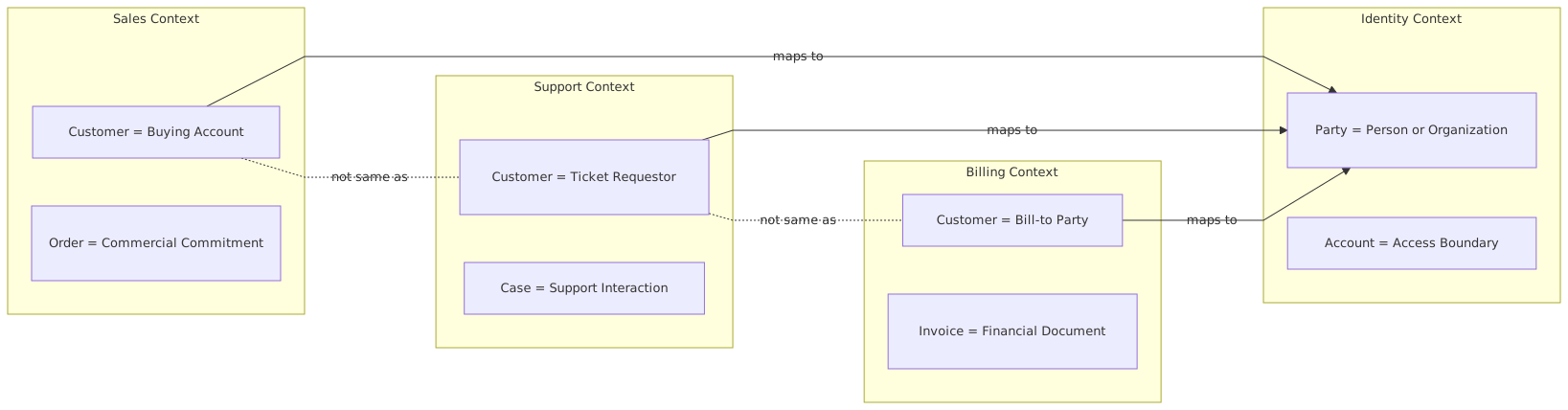
That diagram captures the point most enterprises miss. “Customer” is not a master entity floating above the company. It is a context-dependent projection of more fundamental concepts such as party, account, contract, contact, or legal entity. If you do not separate those, every integration becomes a semantic coin toss.
In practice, the architecture often needs a small number of foundational contexts. Identity or Party is a common one. Product Catalog is another. These are not universal truths, but they can serve as stable reference contexts if the business semantics justify them. The trick is not to let these become dumping grounds for everything vaguely shared.
Events must also be modeled by context. This is where Kafka earns its keep—if used with discipline. A billing service should publish InvoiceIssued with billing semantics. A CRM service should publish CustomerProfileUpdated with CRM semantics. Do not publish CustomerChanged and expect downstream consumers to read your mind.
A healthier event architecture looks like this:
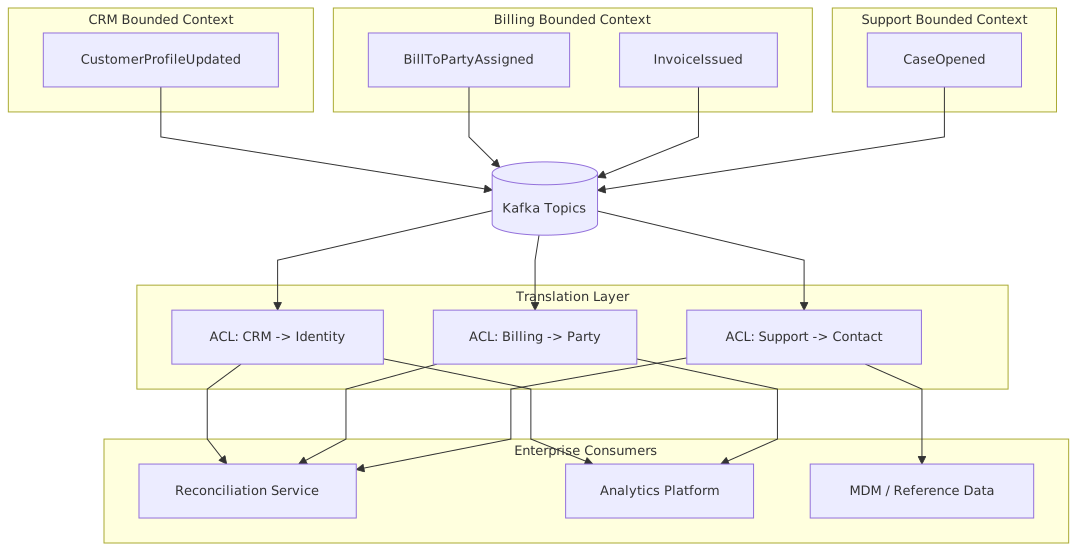
Notice what is happening here. Kafka is not the semantic integration layer. It is the transport. The meaning is preserved by context-specific events and explicit translation. Too many enterprises skip that middle layer and then wonder why every consumer bakes in its own mapping logic. That is not event-driven architecture. That is distributed ambiguity.
Reconciliation as a first-class concern
Some truths span contexts and cannot be resolved by one model dominating the others. Revenue recognition may depend on order semantics, billing semantics, and fulfillment semantics. Customer exposure may depend on legal entity, account hierarchy, and support entitlements. In these cases, reconciliation is not an ugly workaround. It is part of the domain.
A reconciliation service should have a clear mandate:
- compare state across contexts
- identify semantic mismatches
- apply deterministic matching rules where possible
- surface unresolved conflicts for human workflow
- maintain traceability of source-of-truth by attribute and context
This matters because “source of truth” is almost never singular. Truth is usually partitioned. Billing is authoritative for invoice totals. CRM is authoritative for marketing preferences. Identity may be authoritative for legal party identifiers. Reconciliation exists because enterprise reality is federated.
Migration Strategy
Language drift is rarely solved in one grand redesign. The estate is too large, the dependencies too messy, the politics too human. This is where progressive strangler migration is the adult move.
Start by finding the terms causing the most semantic damage. Usually these are nouns everybody uses and nobody defines: customer, account, order, policy, product, contract, asset, case. Do not begin with a broad enterprise taxonomy exercise. Begin where integration pain is highest and ambiguity is expensive.
Then map the current semantics:
- which systems use the term
- what they mean by it
- which attributes are authoritative
- what events or APIs expose it
- where mismatches cause operational issues
Create a context map before changing code. The map is not bureaucracy. It is a weapon against magical thinking.
Once the map exists, introduce boundary translation around the most problematic legacy system. This is the strangler move: do not rip out the old model; isolate it. Add an anti-corruption layer that translates legacy semantics into explicit bounded-context language. Let new services consume the translated model, not the legacy terminology directly.
A typical migration looks like this:
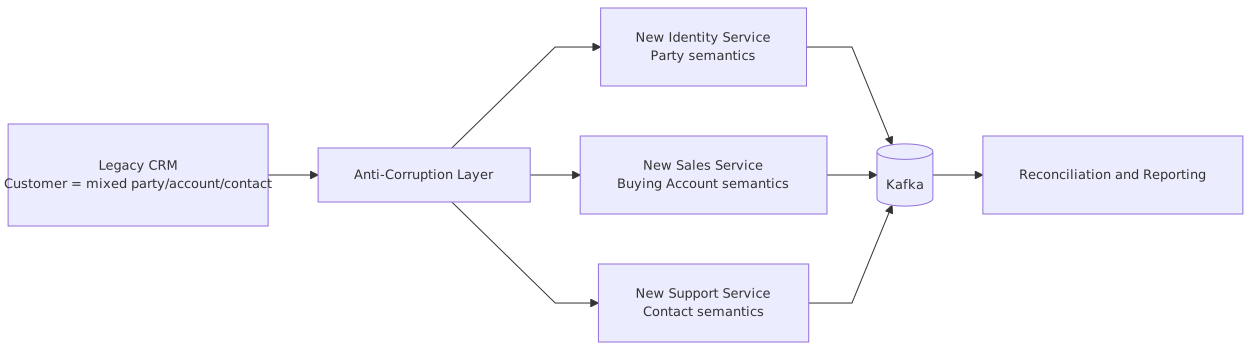
This is not glamorous architecture. It is deliberate surgery. The old system keeps operating while the enterprise starts speaking more precisely around it.
Progressive migration steps
- Name the semantic fracture.
Document where one term is carrying multiple meanings.
- Isolate the most harmful boundary.
Usually a shared database table or a generic API.
- Introduce an anti-corruption layer.
Translate inbound and outbound concepts explicitly.
- Publish precise events.
Replace vague topic contracts with context-specific ones.
- Stand up reconciliation.
Accept temporary dual representations and compare them.
- Migrate consumers one by one.
This is where strangler patterns pay off. Consumers move to the translated model progressively.
- Retire semantic debt.
Remove old contracts only after downstream dependencies are gone and data lineage is proven.
The migration will create temporary duplication. Good. Semantic clarity is worth some duplication. Shared confusion is not a cost saving.
Enterprise Example
Consider a global telecom provider operating across mobile, broadband, and enterprise networking. Through acquisition, it ended up with five major customer-facing platforms: consumer CRM, enterprise sales, billing, field service, and support. Every one of them had a customer_id. None of them meant the same thing.
In consumer CRM, the customer was a household account. In enterprise sales, it was a legal organization with subsidiaries. In billing, it was a bill-to account, often split by region or product line. In support, the customer was the authenticated caller or admin contact opening a case. In field service, the customer was tied to a service location.
Executives wanted omnichannel service and a 360-degree customer view. The first attempt followed a familiar enterprise pattern: build a canonical customer model in the integration layer and synchronize all systems to it. The result was exactly what experienced architects would predict. Endless mapping arguments. bloated schemas. low trust. every exception became a new field. “Canonical” ended up meaning “nobody’s native language.”
The second approach was better and more DDD-informed.
The architecture team identified four bounded contexts with sharp semantics: Party Identity, Sales Account, Billing Account, and Service Contact. They stopped trying to make one object represent all of them. Instead, they established explicit relationships:
- a Party could be a person or organization
- a Sales Account represented a commercial relationship
- a Billing Account represented a financial responsibility boundary
- a Service Contact represented an individual authorized for support interactions
They then used Kafka to distribute context-specific events. BillingAccountCreated did not pretend to be a customer event. ServiceContactAuthorized did not update sales systems directly. An anti-corruption layer around the old CRM translated its overloaded customer model into the new context language.
Reconciliation became central. For example, when an enterprise contract was amended, the system had to reconcile changes across sales account hierarchies, billing setup, and support entitlements. Not every mismatch could be solved automatically. Some needed workflow and human adjudication. That was accepted as domain reality rather than hidden as a technical inconvenience.
The payoff was not immediate simplicity. In fact, the architecture looked more complex on paper. But operationally, things improved:
- customer onboarding errors dropped because account and party semantics were no longer mixed
- support entitlement issues fell because contacts and accounts were separated
- data lineage improved for regulatory audit
- analytics gained higher-quality dimensions because the event streams became semantically trustworthy
Most importantly, the company stopped arguing about whether the systems were “in sync” and started asking the better question: “which context should own this decision?”
That is mature architecture.
Operational Considerations
Handling language drift is not just a design exercise. It changes operations.
Contract governance
Schema registries help, but schema validation is not semantic governance. A field can remain syntactically valid while its business meaning quietly shifts. Enterprises need lightweight semantic reviews for event and API changes. Not a bureaucratic tribunal. A practical checkpoint: what does this term mean here, who owns it, and what consumers assume about it. EA governance checklist
Observability for semantic flows
Traditional observability watches latency, errors, throughput. That is necessary and insufficient. You also need observability for translation and reconciliation:
- event version adoption
- mapping failures by context pair
- duplicate identity match rates
- unresolved reconciliation cases
- drift indicators, such as rising null/default usage in translated attributes
A healthy architecture can tell you not just that messages are flowing, but that meaning is holding.
Data lineage and traceability
When auditors ask why a number on a customer statement differs from a CRM view, “integration lag” is not a serious answer. Reconciliation services should preserve provenance: which context supplied which value, under which rule, at what time. This is especially important in regulated industries such as banking, insurance, telecom, and healthcare.
Human workflow
Not all semantic conflicts can be automated away. Some require case management. If a legal entity merge conflicts with billing hierarchy and support authorization, the right answer may involve human review. Good enterprise architecture makes that workflow explicit rather than burying it in exception queues.
Platform fit
Kafka is useful here because it supports asynchronous distribution, replay, and decoupled consumers. But it raises the bar for semantic discipline. Topic naming, event ownership, schema evolution, and retention policy all matter. If you publish domain events without clear bounded context ownership, replay simply replays confusion more efficiently.
Tradeoffs
There is no free lunch here. Explicit semantic architecture buys clarity at the cost of more moving parts.
The biggest tradeoff is local translation versus shared standardization. Translation preserves domain fit but adds integration machinery. Shared standardization reduces visible duplication but risks flattening important distinctions. My bias is clear: prefer translation where semantics genuinely differ. Premature standardization is one of the classic enterprise blunders.
Another tradeoff is speed versus precision. Teams often want to expose a quick generic API or topic because deadlines are real. Sometimes that is acceptable as a tactical move. The danger is that tactical vagueness tends to become strategic infrastructure. Temporary ambiguity ages badly.
There is also a cognitive tradeoff. Bounded contexts and context-specific events ask more of teams. They must understand where their language begins and ends. That requires stronger product thinking and better architecture literacy. Some organizations are not there yet.
Finally, reconciliation introduces operational overhead. It means admitting that the enterprise has plural truths that need coordination. Executives often resist this because they want elegance. But federated truth with explicit reconciliation is usually more honest than fake singular truth with hidden exceptions.
Failure Modes
Most initiatives in this area do not fail because DDD is wrong. They fail because enterprises implement the vocabulary of DDD without accepting its implications.
The canonical model trap
This is the most common failure. The organization creates an enterprise-wide object—Customer, Order, Product—and insists every system conform. The model becomes huge, vague, and weakly owned. It solves superficial alignment while preserving semantic conflict underneath.
Shared event mush
Teams publish generic events like EntityUpdated, CustomerChanged, or StatusModified. Consumers reverse-engineer meaning from payload fields and internal conventions. Over time, each consumer interprets the event differently. Kafka becomes a rumor mill.
Boundary collapse
A platform team, with good intentions, centralizes “common services” too early. Identity, customer profile, account management, entitlement, preferences, and contacts all get merged into one service because they look adjacent. The result is a distributed monolith wrapped around semantic confusion.
ACLs that leak
An anti-corruption layer is supposed to protect a bounded context from foreign models. In practice, teams often let legacy field names and semantics seep through because translating properly feels slower. Once that happens, the new model is contaminated and the migration stalls.
Reconciliation denial
Some architects treat reconciliation as failure and try to design it away. That is a category error. In large enterprises, reconciliation is often a core business capability. Ignoring it just pushes the work into spreadsheets and operations teams.
When Not To Use
Not every system needs this much semantic ceremony.
If you are building a small product with one team, one clear domain, and modest integration needs, then heavy bounded context mapping may be overkill. A straightforward shared language can work perfectly well when the social and technical distance is small.
If the business process is simple and the terms are stable, introducing multiple context models may create needless abstraction. A local CRUD application for equipment tracking probably does not need a grand semantic architecture.
Likewise, if your organization lacks the discipline to maintain explicit contracts, event ownership, and translation rules, then a partially adopted DDD approach can be worse than a simpler monolith. Bounded contexts drawn in diagrams but ignored in code are just decorative architecture.
And if latency-sensitive, tightly coupled transactional workflows absolutely require a single authoritative model inside one consistency boundary, forcing artificial context separation may hurt more than help. DDD is not a religion. It is a lens.
Use this approach when semantic divergence is real, costly, and organizationally persistent. Do not use it as an excuse to over-engineer a small system.
Related Patterns
Several patterns sit naturally alongside this approach.
Bounded Context is the foundation. Without it, language drift is invisible.
Context Map makes relationships between models explicit: upstream, downstream, conformist, anti-corruption, partnership. This is often the most useful artifact in migration planning.
Anti-Corruption Layer is the workhorse for progressive strangler migration. It lets new models emerge without inheriting legacy confusion.
Event Storming is valuable for surfacing domain semantics and discovering where terms diverge across workflows.
Master Data Management can help for identifiers and reference attributes, but only if it respects bounded contexts. MDM is not a magic solvent for semantic differences.
Data Mesh intersects here too. Data products need explicit business semantics and trustworthy ownership. If operational domains are drifting in language, analytical domains will inherit the mess unless semantic contracts are made clear.
Saga and process orchestration become relevant when reconciliation spans long-running workflows across contexts.
Summary
Domain language drift is what happens when the business changes, the systems diverge, and the architecture pretends words still mean what they used to.
In Domain-Driven Design, the answer is not to invent a universal dictionary and force everyone into it. The answer is to respect bounded contexts, make semantics explicit, translate at boundaries, and treat reconciliation as a legitimate enterprise capability.
This is especially important in microservices and Kafka-based ecosystems. Distributed systems do not merely distribute computation. They distribute meaning. If that meaning is vague, drift accelerates. If that meaning is explicit, versioned, and context-owned, the architecture stays sane even as the business evolves.
The memorable line here is simple: the worst integration bug is not a broken message. It is a perfectly delivered misunderstanding.
Good enterprise architecture exists to prevent exactly that.
Frequently Asked Questions
What is enterprise architecture?
Enterprise architecture aligns strategy, business processes, applications, and technology in a coherent model. It enables impact analysis, portfolio rationalisation, governance, and transformation planning across the organisation.
How does ArchiMate support architecture practice?
ArchiMate provides a standard language connecting strategy, business operations, applications, and technology. It enables traceability from strategic goals through capabilities and services to infrastructure — making architecture decisions explicit and reviewable.
What tools support enterprise architecture modeling?
The main tools are Sparx Enterprise Architect (ArchiMate, UML, BPMN, SysML), Archi (free, ArchiMate-only), and BiZZdesign. Sparx EA is the most feature-rich, supporting concurrent repositories, automation, scripting, and Jira integration.