⏱ 20 min read
Most large systems do not fail because teams forgot a pattern. They fail because they forgot the language of the business.
That sounds dramatic, but it is the quiet tragedy of enterprise software. A company starts with a sensible system. Then integration demands pile up: one more partner feed, one more ERP connector, one more event stream, one more “temporary” transformation. Before long, the software no longer speaks in terms of policies, claims, shipments, premiums, orders, or settlements. It speaks in CSV columns, topic names, payload versions, and field mappings. The business becomes a rumor hiding behind integration code.
This is exactly where the distinction between integration layer and domain layer matters in Domain-Driven Design. Not as a textbook separation. As survival.
The integration layer is where your system shakes hands with the outside world. It deals with protocols, schemas, APIs, queues, file drops, partner quirks, authentication, retries, and translation. The domain layer is where the business makes decisions. It carries the model, the invariants, the language, the policies, and the behavior that actually matters to the enterprise. One is about interoperability. The other is about meaning.
Confuse the two, and you get a codebase that is easy to connect but impossible to change. Separate them well, and you get a system that can evolve while the enterprise around it keeps moving.
This article is about that boundary: where it belongs, why it matters, how to migrate toward it, and when the effort is not worth it.
Context
In modern enterprise architecture, systems rarely live alone. A domain service sits between upstream channels and downstream systems: web apps, mobile apps, brokers, partner APIs, Kafka topics, CRM platforms, finance systems, document services, fraud engines, identity providers, and reporting pipelines. Every one of those boundaries exerts pressure on the software. event-driven architecture patterns
That pressure creates two very different kinds of work.
The first kind is integration work:
- receive a payload from a REST endpoint
- consume an event from Kafka
- parse a flat file from a third party
- call a payment gateway
- map a legacy code table
- transform a SOAP response
- handle transport-level retries
- enforce idempotency at the boundary
- reconcile with another system after partial failure
The second kind is domain work:
- determine whether a policy is eligible for renewal
- calculate settlement based on contractual rules
- decide whether a shipment can be released
- reserve inventory against an order line
- validate whether a claim enters manual review
- apply pricing rules with business exceptions
These are not the same activity. They should not live in the same mental model. Yet many systems mix them until the difference disappears.
In Domain-Driven Design, this matters because the domain model should reflect the ubiquitous language of the business. That language is not “message version 4.2” or “partner status code PEND-RVW.” Those are integration concerns. Useful ones, necessary ones, but not domain semantics.
A good architecture lets external data arrive in whatever ugly shape the world produces, then translates it into clean domain concepts before the business logic begins. It also lets domain decisions leave the system in business terms, then adapt them for external consumers. That is the real role of the integration layer: a membrane, not a brain.
Problem
Most enterprise systems start by underestimating integration complexity and overestimating the stability of external interfaces.
At first, a service receives a simple request, maps it to an object, and performs some logic. Then another partner arrives with a slightly different schema. Then Kafka is introduced for asynchronous propagation. Then a legacy core platform must remain the system of record for six years longer than anyone hoped. Then audit needs every incoming payload retained. Then one downstream service can accept only a subset of states. Then reconciliation jobs appear because distributed transactions are gone and somebody still needs the books to balance.
What often happens next is predictable: business decisions drift into adapters, consumers, controllers, orchestrators, and mappers. Domain objects start carrying transport fields. Events mirror database tables. Kafka topic contracts become the de facto source of business truth. Teams begin saying things like “the domain status is whatever the outbound API allows.”
That sentence should make an architect nervous.
Because once the domain is shaped by integration constraints, every external change becomes a business change. A partner adds a field and suddenly core classes must move. A transport format changes and tests for business rules break. A downstream timeout now contaminates application flow. Semantic drift sets in. The model loses integrity.
The system still works. That is the dangerous part. It works while getting steadily harder to reason about.
Forces
This boundary is hard because strong forces pull in both directions.
1. Delivery pressure favors collapse
Putting everything into one service class is faster in the short term. A consumer reads Kafka, deserializes JSON, applies business logic, calls another API, updates the database, publishes an event. One place. One deployment. One team. Job done.
Until versioning starts.
2. External systems are messy
Partners use inconsistent identifiers. Legacy systems expose procedural interfaces instead of business concepts. Different applications mean different things by “customer,” “order,” or “settled.” Integration often requires anti-corruption work, code conversion, enrichment, and temporal alignment.
This mess is real. Pretending it doesn’t exist by pushing it into the domain model is not simplification. It is contamination.
3. Domain semantics need protection
A domain model works only when it preserves meaning. If an Order aggregate starts carrying transport artifacts like sourceSystemCode, rawStatus, partnerSequenceNumber, and retryToken because “we need them somewhere,” then it is no longer modeling the business. It is acting as a cargo container.
4. Distributed systems create reconciliation needs
In a monolith with one database, it is tempting to hide integration concerns. In a microservices and Kafka landscape, there is no hiding. Partial failure is normal. Consumers lag. duplicate messages happen. downstream acknowledgements are delayed. Reconciliation becomes a first-class concern. microservices architecture diagrams
This tends to push architects toward heavy workflow layers. Sometimes rightly. Sometimes not.
5. Teams often own technical slices, not bounded contexts
The organization itself can blur layers. One team owns APIs, another owns messaging, another owns master data, another owns “business logic.” If the architecture mirrors those silos blindly, semantics fracture across system boundaries.
Conway always collects his debt.
Solution
The simplest useful rule is this:
**The integration layer translates, coordinates, and protects boundaries.
The domain layer decides.**
That is the line.
The integration layer should:
- accept inbound requests, messages, files, and callbacks
- validate transport shape and basic contract correctness
- map external schemas into domain commands or domain queries
- call external systems through gateways or adapters
- publish outward-facing events or responses
- manage technical concerns such as retry, timeout, dead-lettering, correlation IDs, idempotency keys, protocol details, and schema evolution
- support reconciliation flows when state between systems diverges
The domain layer should:
- express business concepts and behavior
- enforce invariants
- own aggregate state transitions
- evaluate policies and rules
- emit domain events meaningful to the business
- remain independent of transport and vendor technology
- preserve ubiquitous language
That sounds clean because it is. But the devil is in semantics.
If a Kafka message says account_status = P3, the integration layer should not leak P3 into the domain. It should translate it into something meaningful, perhaps AccountUnderManualReview, if that is what the business means. If the meaning is ambiguous, that ambiguity is itself an integration concern to handle explicitly.
Likewise, if the domain emits ClaimApproved, the integration layer may need to fan this out as:
- a Kafka event for analytics
- a REST callback to a partner
- a batch entry for finance
- an update into a legacy mainframe queue
The domain should not know or care.
This is classic DDD thinking with practical enterprise edges. The domain model is not a universal schema hub. It is the heart of a bounded context. The integration layer is the translator at the border crossing.
Architecture
A useful way to think about the architecture is as a set of concentric responsibilities, not just technical tiers.
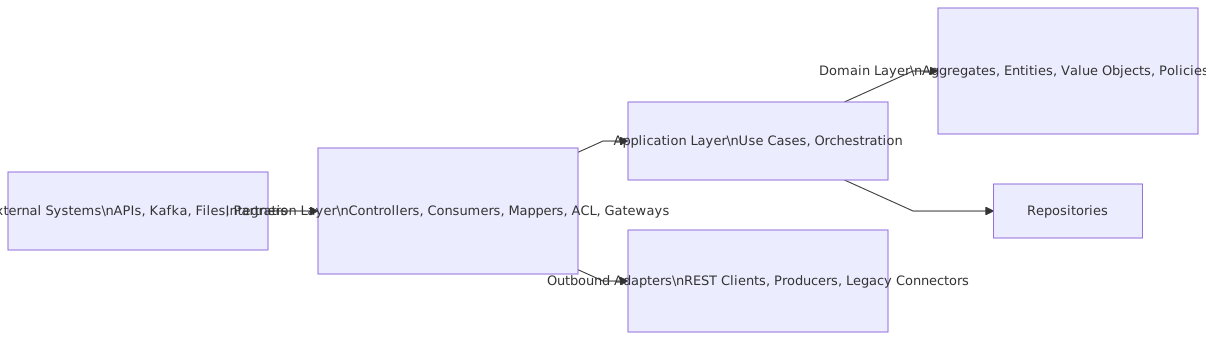
The application layer sits between integration and domain in many implementations, and that is healthy. It coordinates use cases, manages transactions where possible, invokes domain behavior, and handles workflow without becoming a dumping ground for business rules.
Here is the key distinction:
- Integration layer: “How do I get data in and out safely?”
- Application layer: “How do I execute this use case?”
- Domain layer: “What is the correct business decision?”
That separation becomes especially important in event-driven systems.
Kafka and domain semantics
Kafka is often introduced as if it were a domain architecture. It is not. Kafka is transport and temporal decoupling. Very useful transport. Very dangerous model.
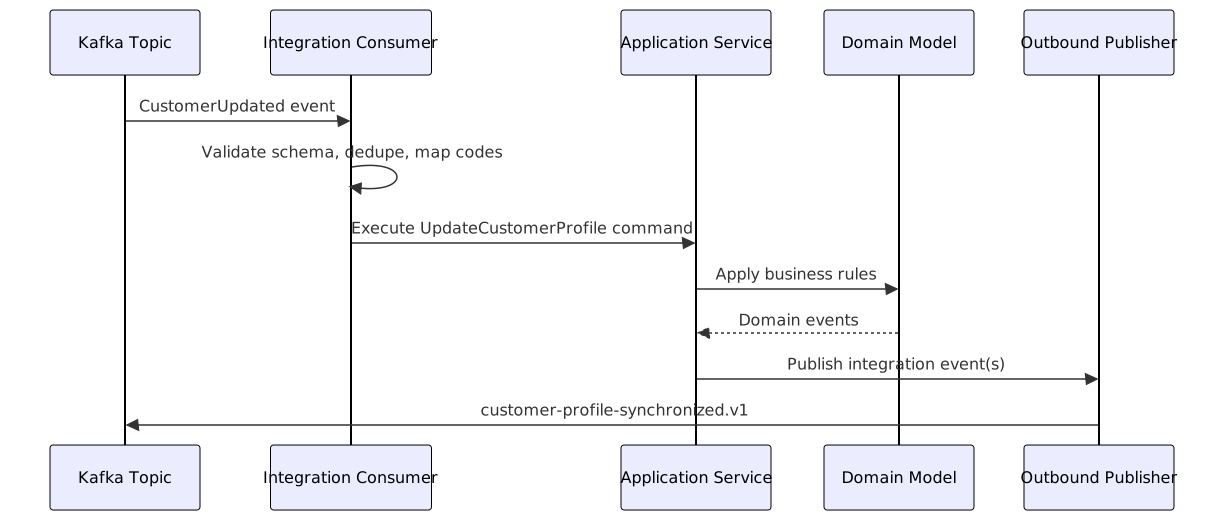
A team publishes “domain events,” but what appears on the wire is often a compromise between reporting needs, operational convenience, and historical accidents. The result is a hybrid artifact that is neither a clean integration event nor a pure domain event.
A better approach is to distinguish:
- domain events inside the bounded context
- integration events published for other systems
A domain event might be InvoiceIssued.
An integration event might be billing.invoice-issued.v2 with partition keys, metadata, event IDs, timestamps, tenant references, and flattened fields required by consumers.
Related, but not identical.
Anti-Corruption Layer belongs in integration territory
When integrating with legacy platforms or foreign bounded contexts, the Anti-Corruption Layer is not optional if semantics differ materially. It protects your model from inherited nonsense.
That nonsense can be subtle:
- one system’s “active” includes suspended accounts
- another system’s “shipped” means dispatched, not delivered
- a policy effective date in one platform is local time, in another UTC midnight
- customer identity may be a person in one domain and a party relationship in another
If you skip semantic translation, you do not save effort. You defer it into every business rule forever.
Reconciliation is architecture, not housekeeping
In distributed enterprise systems, the integration layer often must support reconciliation:
- compare intended vs observed state across systems
- detect missed outbound events
- replay commands safely
- recover after downstream unavailability
- identify poison messages or semantic mismatches
- compensate where full consistency is impossible
This is not domain behavior in the core sense. It is an operational and integration responsibility in support of domain correctness.
That said, reconciliation frequently needs domain-aware comparison. “Different payload” is not enough. The real question is whether business state diverged in a meaningful way. That usually means integration tooling informed by domain semantics.
Migration Strategy
Nobody gets to design this cleanly from day one in a large enterprise. You inherit APIs that return XML wrapped in mystery. You inherit services where controllers call repositories directly. You inherit Kafka topics that everyone depends on and nobody fully understands.
So the right strategy is almost always progressive strangler migration.
Do not announce a heroic rewrite. That is architecture as theatre.
Start by identifying where integration concerns and domain concerns are currently tangled. Typical hotspots:
- controllers or consumers with business branching logic
- mapping layers that alter domain decisions
- outbound API clients called directly from aggregates or entities
- services where transport DTOs are passed deep into business logic
- Kafka schemas used as internal domain types
- retry logic embedded inside business methods
- direct dependencies on legacy code tables inside domain objects
Then peel them apart incrementally.
Step 1: Create explicit boundary types
Introduce:
- inbound DTOs or event contracts
- domain commands
- domain value objects
- outbound integration events
This sounds pedestrian. It is transformative. Naming the boundaries makes semantic drift visible.
Step 2: Move translation outward
Take every code conversion, protocol adjustment, partner-specific rule, and schema adaptation you can find, and move it into integration mappers or anti-corruption components.
If the business really does care about a partner-specific concept, model it explicitly in domain language. If not, keep it out.
Step 3: Pull decision logic inward
When an adapter says:
- “if status is X and amount > Y, approve”
- “if customer segment is gold and source is portal, skip review”
that belongs in domain policy, specification, or aggregate behavior.
Integration layer asks the domain what to do. It should not improvise business judgments.
Step 4: Introduce event publication through an application boundary
Do not let random classes publish Kafka messages. Publish through an application or messaging abstraction that can distinguish domain events from integration events, apply outbox patterns, and control versioning.
Step 5: Add reconciliation capabilities early
Once you separate the layers, inconsistencies become more visible. Good. Now provide:
- outbox or transactional message log
- replay support
- dead-letter handling
- audit trails linking inbound messages to domain actions
- periodic state comparison jobs where needed
Step 6: Strangle legacy interfaces one edge at a time
Route one inbound API, one topic consumer, one partner integration, or one business capability through the new boundary model at a time. Keep legacy internals behind a facade if needed. Replace surfaces gradually.
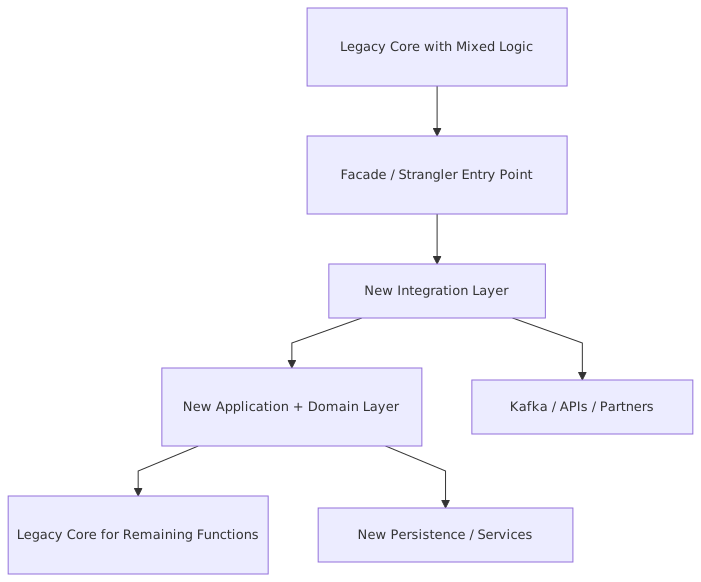
The point of a strangler is not elegance. It is risk management. Large enterprises need migration routes that preserve continuity while improving semantics.
Enterprise Example
Consider a global insurance company modernizing its claims platform.
The legacy core system handled claim intake, adjudication, reserves, and payment initiation. Over 20 years, it accumulated partner integrations for brokers, repair networks, medical reviewers, payment processors, fraud vendors, and regulatory reporting. Later, Kafka was added to stream claim updates into downstream analytics and customer channels.
What looked like “claim processing” had become three different things:
- ingesting claims from many channels
- deciding claim outcomes
- synchronizing claim state with a web of external systems
The architecture mixed them all.
The inbound API payloads were passed almost directly into service classes. Status codes from repair partners appeared in claim entities. Fraud review logic depended on transport-specific fields. Kafka messages mirrored database rows because reporting wanted “everything.” Reconciliation happened through spreadsheets during incidents.
The modernization effort did not start with microservices. It started with language.
The team defined a claims bounded context with a proper domain model:
ClaimCoverageDecisionReserveAssessmentSettlementManualReviewClaimApprovalPolicy
Then they built an explicit integration layer around it:
- REST controllers and Kafka consumers for inbound intake
- anti-corruption mappers for partner claim formats
- gateway clients for payment, fraud, and document services
- outbound integration event publishers for claim lifecycle notifications
- reconciliation jobs to compare internal settlement state with payment confirmations
A repair network might send a status like APPROVED_PENDING_PARTS. That was not allowed inside the domain model. Integration translated it into domain-relevant facts:
- estimate approved
- repair blocked by parts availability
- payment not yet eligible
Those facts then informed business decisions.
Kafka became cleaner too. Internal domain events like SettlementAuthorized were produced by domain logic. The integration layer transformed them into outward contracts for claims notifications, finance feeds, and analytics topics, each versioned separately.
The biggest gain was not technical purity. It was controlled change.
When a new regional regulator required extra reporting fields, the team changed outbound integration mapping without rewriting claim decision logic. When a fraud vendor was replaced, only one gateway and its translation rules changed. When reconciliation found payment confirmations missing after a downstream outage, the system replayed integration commands based on durable outbox records instead of manual case triage.
That is what layer separation buys you in the enterprise: not beauty, but survivable complexity.
Operational Considerations
Architects often discuss layers as if they stop at code structure. They do not. The integration layer has a strong operational footprint.
Observability
You need end-to-end traceability from:
- inbound request or event
- domain command execution
- state change
- outbound event or API call
- downstream acknowledgement or failure
Correlation IDs, message IDs, idempotency keys, aggregate identifiers, and causation metadata matter. Without them, reconciliation turns into forensic archaeology.
Idempotency
The integration layer should usually own duplicate protection at boundaries:
- repeated REST submissions
- duplicate Kafka deliveries
- replayed files
- partner retries after timeout
The domain still needs safe behavior under repeated commands, but technical deduplication should not leak everywhere.
Schema evolution
Kafka and APIs evolve. The domain should not twitch every time a payload version changes. Use versioned contracts and transformation components in the integration layer. If a semantic change occurs, then yes, domain changes may be required. But shape-only changes should be absorbed at the boundary.
Backpressure and failure isolation
An overloaded downstream system should not collapse your domain processing model. Use queues, circuit breakers, retry policies, dead-letter topics, and asynchronous publication patterns where sensible. Keep transport turbulence from becoming business chaos.
Audit and compliance
Many enterprises need to retain source payloads, decision reasons, and outbound transmission evidence. This usually crosses layers:
- raw payload retention in integration
- business decision rationale in domain or application
- transmission logs in outbound adapters
Design these deliberately. Compliance retrofits are expensive.
Reconciliation operating model
Reconciliation is not just a batch job. It needs ownership, thresholds, and action paths:
- what constitutes divergence?
- when is replay safe?
- when is compensation required?
- who resolves semantic mismatches?
- how are stale records escalated?
If nobody owns this, incidents become political before they become technical.
Tradeoffs
There is no free lunch here.
Benefit: stronger domain integrity
Cost: more mapping and more types
A separated architecture introduces DTOs, commands, events, mappers, policies, gateways, and anti-corruption logic. People will complain about boilerplate. Sometimes they are right. But boilerplate is cheaper than semantic rot.
Benefit: easier change isolation
Cost: up-front design effort
When external interfaces churn, a clean integration layer pays off. But if the system is tiny and stable, the extra structure may be unnecessary.
Benefit: better bounded context protection
Cost: possible latency and indirection
Event-driven boundaries, outbox publication, translation steps, and orchestration add hops. That can affect performance and complicate debugging if done carelessly.
Benefit: more resilient migration path
Cost: dual-running and temporary duplication
During strangler migration, you may maintain old and new paths, duplicate events, run side-by-side reconciliation, and tolerate temporary inconsistency. That is operationally noisy but often safer than a cutover.
Benefit: cleaner ownership
Cost: organizational discipline required
If teams do not respect the separation, the architecture degrades quickly. A clean model can still be bypassed by one urgent integration project.
Architecture is a socio-technical system. The code only tells half the story.
Failure Modes
This pattern fails in recognizable ways.
1. The integration layer becomes a second domain
Adapters start containing “just a little” business logic. Soon every partner has custom decisions. The real behavior is scattered across mappings and consumers.
Symptom: two incoming channels trigger different outcomes for what should be the same business case.
2. The domain layer becomes an anemic schema wrapper
Teams overreact and move all behavior into application services while keeping the domain model as passive data classes. This preserves the layering diagram while losing DDD’s core benefit.
Symptom: all invariants enforced procedurally outside aggregates.
3. Integration events are treated as canonical domain truth
Kafka topic schemas become the unofficial enterprise data model. Internal concepts are then contorted to match consumer expectations.
Symptom: changing an event field requires “business approval” even when domain meaning is unchanged.
4. Reconciliation is ignored until production incidents
Without replay, comparison, and audit support, partial failure creates silent divergence.
Symptom: support teams discover mismatched states days later through customer complaints.
5. Anti-corruption layer is skipped because “mapping is overhead”
Legacy semantics bleed directly into the domain model.
Symptom: business objects carry legacy code values nobody can explain.
6. Over-separation slows delivery without real semantic gain
Not every CRUD integration needs rich domain modeling.
Symptom: endless abstractions around simple reference data sync.
When Not To Use
You should not build a heavily separated integration and domain architecture for every system.
Do not lean hard into this approach when:
- the problem is straightforward CRUD with minimal business rules
- the service mainly proxies data between systems
- there is no meaningful bounded context or ubiquitous language
- the lifespan is short and integration volatility is low
- a reporting or ETL pipeline is the real need
- the team lacks the discipline to maintain semantic boundaries
In these cases, simpler layered application design may be enough. A thin service with adapters and straightforward transaction scripts can be entirely appropriate.
DDD is most useful where the business is complicated, the language matters, and change is frequent. If the core challenge is data movement rather than decision-making, do not pretend otherwise.
There is nothing noble about over-architecting a pass-through service.
Related Patterns
Several patterns sit naturally around this distinction.
Anti-Corruption Layer
Essential when integrating with legacy or foreign models. Protects domain semantics.
Hexagonal Architecture / Ports and Adapters
A useful structural style for isolating domain logic from external concerns. The integration layer often implements adapters against ports.
Application Service
Coordinates use cases, transactions, and orchestration without owning core business decisions.
Outbox Pattern
Critical for reliable publication of integration events alongside domain state changes.
Saga / Process Manager
Useful when long-running workflows span services and no single domain transaction exists. But be careful: sagas are often used to compensate for poor domain boundaries.
Transaction Script
A valid alternative for simple domains. Not every service needs aggregates and rich domain objects.
Strangler Fig Pattern
The sensible migration strategy for disentangling mixed legacy layers incrementally.
Summary
The integration layer and the domain layer serve different masters.
The integration layer serves the reality of the enterprise landscape: protocols, schemas, retries, Kafka topics, partner contracts, legacy systems, and reconciliation after things go wrong. It is where translation happens. It is where boundaries are defended.
The domain layer serves the business itself: meaning, rules, policies, invariants, and decisions. It is where the software speaks the language of the organization rather than the language of transport.
That separation is not ceremony. It is how you stop external mess from rewriting your business model.
In Domain-Driven Design, the domain should not know about payload quirks, vendor codes, or Kafka partition strategy. And integration components should not decide who gets paid, what qualifies for approval, or whether a policy can be renewed. One layer moves information. The other determines truth.
For enterprises modernizing through progressive strangler migration, this distinction becomes even more valuable. It allows you to wrap old systems, translate foreign semantics, introduce Kafka and microservices without surrendering the model, and build reconciliation capabilities that keep distributed reality honest.
If the domain is trivial, keep it simple. If the business is complex and the integration landscape is chaotic, draw the line clearly and defend it.
Because when integration logic starts pretending to be the business, the business eventually pays the bill.
Frequently Asked Questions
What is enterprise architecture?
Enterprise architecture aligns strategy, business processes, applications, and technology in a coherent model. It enables impact analysis, portfolio rationalisation, governance, and transformation planning across the organisation.
How does ArchiMate support architecture practice?
ArchiMate provides a standard language connecting strategy, business operations, applications, and technology. It enables traceability from strategic goals through capabilities and services to infrastructure — making architecture decisions explicit and reviewable.
What tools support enterprise architecture modeling?
The main tools are Sparx Enterprise Architect (ArchiMate, UML, BPMN, SysML), Archi (free, ArchiMate-only), and BiZZdesign. Sparx EA is the most feature-rich, supporting concurrent repositories, automation, scripting, and Jira integration.