⏱ 20 min read
Most enterprise systems don’t fail because the database is slow or Kafka is misconfigured. They fail because the business meaning got smeared across too many tables, services, and “helpful” integrations. A sales order is half in ERP, half in a fulfillment service, and the most important rule in the business lives in a stored procedure nobody admits to owning. Then one day someone asks a simple question — “Can this order still be canceled?” — and five teams argue for an hour.
That is the real job of aggregates in Domain-Driven Design: not to make UML prettier, not to satisfy a textbook definition, but to draw a hard line around business consistency. An aggregate is a promise. Inside the boundary, invariants hold now, in the same transaction. Outside the boundary, the world is negotiated with, informed later, reconciled if needed, and occasionally forgiven.
This is where many teams go wrong. They treat aggregates as object graphs to be loaded whole, or as mini-databases to contain everything related to a concept. That’s backward. Aggregate design is really transaction design in domain clothing. If you want a practical rule, here it is: an aggregate boundary is the edge of immediate consistency.
And that matters even more in modern enterprise architecture. Once you have microservices, event streams, Kafka topics, external SaaS platforms, and regional deployment constraints, transaction scope stops being a local implementation detail. It becomes an architectural decision with operational consequences. Choose the wrong boundary and you get deadlocks, chatty services, brittle sagas, endless retries, and support teams learning the art of “manual reconciliation” at 2 a.m.
So let’s be concrete. This article looks at aggregates through the lens that actually matters in production: domain semantics, transaction scope, failure modes, migration strategy, and operational tradeoffs. We’ll use enterprise examples, including Kafka and progressive strangler migration, because aggregate boundaries are rarely born in greenfield bliss. More often, they are carved out of legacy sediment. event-driven architecture patterns
Context
Domain-Driven Design gave us a useful way to think about complex business systems: build software around the domain model, align code with language used by domain experts, and create bounded contexts where concepts mean one thing instead of ten. Aggregates sit in the tactical part of that toolkit, but they only make sense when tied back to strategic design.
An aggregate is not just a cluster of entities and value objects. It is a consistency boundary within a bounded context. The aggregate root is the gatekeeper. All changes that must uphold a business invariant together go through that root and happen atomically.
That’s the elegant definition. In the enterprise, the practical version is sharper:
- If two pieces of state must change together or not at all, they probably belong in the same aggregate.
- If they can diverge briefly and be reconciled later, they probably do not.
- If consistency across them requires locking half the system, your model is lying to you.
This is not merely a coding concern. It shapes:
- repository design
- database schema behavior
- event publication patterns
- API granularity
- service ownership
- Kafka topic contracts
- retry and reconciliation flows
- observability and support processes
The aggregate boundary diagram becomes, in effect, a map of where the business insists on certainty and where it tolerates delay.
Problem
Enterprise systems accumulate accidental transactions.
A legacy monolith often starts with broad ACID transactions because it is easy. One service call updates the customer, order, credit reserve, shipment request, tax calculation, and notification status in one procedural flow. At first it feels safe. Later it becomes a trap. Every change requires touching more records. More workflows need longer locks. The data model turns into a knot where every operation drags three unrelated concerns behind it.
Then the organization decides to move to microservices. The old transaction gets cut apart by network boundaries. What used to be one commit becomes six API calls and three Kafka events. The team discovers, painfully, that they never understood which things truly needed immediate consistency and which only looked convenient together in the old code. microservices architecture diagrams
This is why aggregate design becomes urgent during modernization. It forces the question the monolith avoided: what must be true immediately, and what may become true eventually?
Consider an order management domain:
- An
Orderhas line items, totals, and a lifecycle status. - A
CustomerCreditcapability decides whether sufficient credit exists. InventoryAllocationreserves stock.Shipmentarranges fulfillment.InvoiceandPaymentsit downstream.
The naive model puts all of this “under order” because it feels related. But relation is not the same as transactional unity. If every credit decision, stock reservation, and shipment update is inside the same aggregate or same transaction, you are effectively asking the business to freeze whenever any adjacent concern is uncertain. That is not domain rigor. That is architecture by fear.
Forces
Aggregate boundaries are pulled by competing forces. Ignore these tensions and you either build a brittle system or a meaningless model.
Business invariants
This is the first and most important force. What rules must never be violated, even for a millisecond?
Examples:
- An order total must equal the sum of its line items.
- A customer cannot have two active primary addresses in the same bounded context.
- An account cannot be debited below its allowed overdraft limit.
- A booking cannot assign the same seat twice.
These rules often justify a single aggregate.
But other rules sound absolute while actually being negotiable:
- “Inventory must always be correct.”
- “Credit must always match current orders.”
- “Customer data must be synchronized everywhere.”
In real enterprises, these are usually not single-transaction invariants. They are operational goals achieved through asynchronous messaging, compensations, and reconciliation.
Throughput and contention
Large aggregates create hot spots. If every change to a customer, preference, loyalty balance, communication consent, support flag, and risk profile goes through one aggregate root, you’ve built a lock magnet.
High-write domains need small transactional surfaces.
Read convenience versus write integrity
Teams often enlarge aggregates to simplify reads. That is the wrong optimization. Reads can be solved with projections, views, search indexes, caches, and denormalized read models. Aggregates should be designed for correct writes.
A useful maxim: optimize aggregate boundaries for invariant protection, not screen rendering.
Team ownership and bounded contexts
If different teams own different capabilities, a single aggregate spanning them is a governance fantasy. Shared transactions across services are not collaboration; they are entanglement with a Slack channel. EA governance checklist
Failure tolerance
Can the business tolerate temporary inconsistency? If yes, use events and reconciliation. If no, keep the state inside the same aggregate or at least the same local transaction.
Legacy constraints
Existing tables, batch jobs, vendor products, and integration platforms matter. The purest aggregate model in the world is useless if the migration path requires a two-year freeze and a miracle.
Solution
The solution is to define aggregates around true transactional invariants and to keep the boundary smaller than your first instinct.
Within an aggregate:
- enforce business rules synchronously
- modify state atomically
- expose behavior, not data mutation
- reference internals directly
- version for optimistic concurrency where appropriate
Across aggregates:
- communicate by identity and domain events
- avoid distributed transactions
- expect delay, duplication, and reorder
- reconcile divergences
- design explicit process flows, often with sagas or process managers
Here is the mental model that usually works well in practice:

The line between Commit Local Transaction and Other Aggregates / Services React Eventually is the architectural seam. Everything before that line is immediate business truth. Everything after it is coordinated truth.
Domain semantics first
A strong aggregate model starts with language. Not table structure. Not REST resources. Not protobuf schemas. Language.
Ask domain experts questions like:
- What can change independently?
- What business rules must be checked at the same moment?
- What is the natural unit of decision?
- When something fails halfway, what does the business expect us to preserve?
- What gets corrected later by reconciliation today?
That last question is gold. Enterprises already reveal their true transactional model through their operations. If finance runs a nightly mismatch report between billing and payments, those two things are not one aggregate. The business has already accepted eventual consistency, whether engineering has formalized it or not.
Keep references by identity
A classic DDD guideline remains sound: one aggregate should reference another by identity, not by direct object graph. That prevents accidental multi-aggregate modification inside one transaction and discourages giant memory structures pretending to be a domain model.
Use domain events as the bridge
When an aggregate changes and others care, emit a domain event. In distributed architectures, persist it with the same local transaction using the outbox pattern, then publish to Kafka or another broker.
This allows one aggregate to remain transactional without pretending the entire estate is.
Architecture
Let’s ground this in a common enterprise decomposition.
Suppose we have these domain concepts:
- Order
- Credit Account
- Inventory Reservation
- Shipment
A healthy model often looks like this:
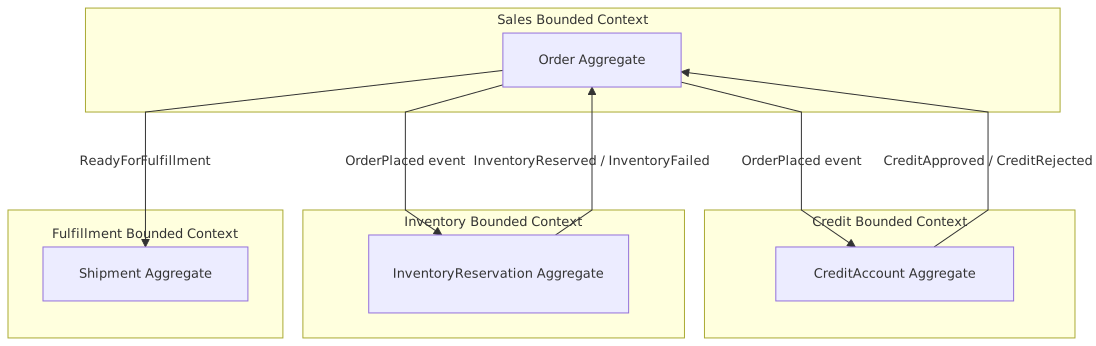
Here the Order aggregate owns rules such as:
- line item validity
- lifecycle transitions
- cancellation policy at order level
- total calculation
- whether confirmation can be issued once prerequisites are met
The CreditAccount aggregate owns:
- exposure calculation
- reservation or authorization rules
- overdraft or limit policies
The InventoryReservation aggregate owns:
- stock reservation constraints
- expiration of reservations
- warehouse-specific policies
The Shipment aggregate owns:
- fulfillment creation
- dispatch rules
- carrier booking lifecycle
This is not splitting hairs. It’s splitting responsibility where the business already has different clocks, owners, and failure handling.
Aggregate boundary diagram
A more detailed aggregate boundary diagram for Order might look like this:
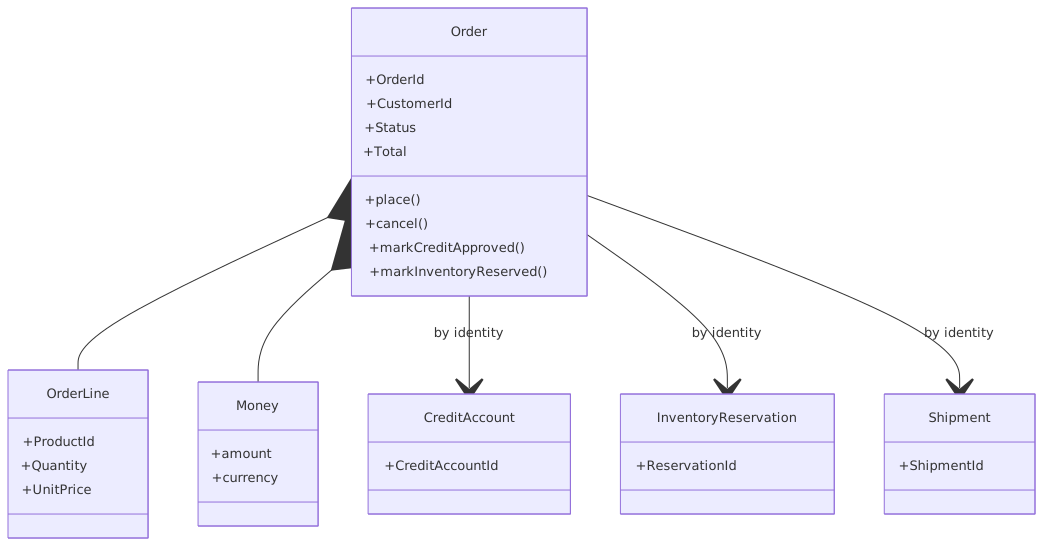
The point of this diagram is not notation purity. It’s to show what lives inside the Order transaction and what does not. OrderLine is internal; CreditAccount is external. That distinction is the difference between a fast, coherent write model and a distributed transaction hiding in code review.
Kafka and event-driven coordination
Kafka is often where aggregate thinking becomes operationally real.
When an Order is placed:
- The command hits the
Orderaggregate. - The aggregate validates local invariants.
- The local transaction commits the new order state and an outbox event.
- The outbox publisher sends
OrderPlacedto Kafka. - Credit and inventory services consume the event and act on their own aggregates.
- They publish outcome events.
- The order service consumes those outcomes and transitions the order.
This architecture accepts temporary uncertainty. The order may sit in PendingApproval until credit and stock are confirmed. That is not a weakness. It is an explicit representation of business reality.
What matters is making states meaningful. “Pending” is not a technical waiting room; it is a domain state with semantics, SLAs, and support procedures.
Migration Strategy
This is where architecture earns its salary. Most organizations are not designing aggregates in a pristine new platform. They are extracting them from a monolith, an ERP-heavy estate, or a distributed mess that already half-broke consistency.
The right migration strategy is usually progressive strangler, not heroic rewrite.
Step 1: Discover actual transactional seams
Look for:
- current rollback boundaries
- nightly reconciliation reports
- manual support steps
- hot tables and lock contention
- domains with clear team ownership
- integrations already using messages or batch handoff
These clues tell you where the business already tolerates eventual consistency and where it does not.
Step 2: Isolate a candidate aggregate behind a façade
Wrap legacy order behavior behind an API or application service. Do not immediately break storage apart. First establish a clear domain entry point.
Step 3: Introduce domain events via outbox
Even inside the monolith, write business events to an outbox table. Publish to Kafka. This creates the language of coordination before the services are split.
Step 4: Externalize one adjacent capability
A common first move is inventory reservation or credit check, because these are naturally separate decision domains. The legacy order transaction now stops at local order persistence and emits an event. The externalized service reacts asynchronously.
Step 5: Add reconciliation before you think you need it
This is the adult move. During migration there will be duplicate events, missed updates, partial cutovers, stale reads, and rollback asymmetry. Build reconciliation jobs and discrepancy dashboards early.
For example:
- orders pending credit longer than SLA
- inventory reserved with no corresponding order confirmation
- shipment created for canceled orders
- outbox records not published
- events received that reference unknown aggregate versions
Step 6: Shrink the old transaction
Once confidence grows, remove cross-domain updates from the monolith transaction. Leave only the true aggregate state inside.
A strangler migration often looks like this:

This pattern is valuable because it turns migration into a series of truth-revealing steps. Each extraction asks: did this really need to be in the same transaction? Often the answer is no.
Reconciliation is not a workaround
Architects sometimes talk about reconciliation as if it were embarrassment made executable. That’s a mistake. In enterprise systems, reconciliation is a first-class control mechanism. Accounting knows this. Operations knows this. Logistics knows this. Software teams are often the last to admit it.
If aggregate boundaries are chosen well, reconciliation becomes focused and manageable. If boundaries are chosen badly, reconciliation becomes a permanent substitute for design.
Enterprise Example
Let’s take a real enterprise-style case: a global manufacturer selling configurable equipment through multiple regional channels.
The company had a legacy order management platform backed by Oracle. An order transaction did everything:
- validate configuration
- calculate pricing
- reserve customer credit
- allocate inventory from regional warehouses
- create fulfillment requests
- trigger invoice pre-generation
- send confirmation emails
It was one giant transaction in spirit, though in reality half the steps involved side tables, packaged procedures, and integrations pretending to be synchronous. Under load, lock contention was ugly. During quarterly peaks, support teams saw phantom failures where order status and warehouse allocations disagreed. The business response was a daily “order integrity report” handled manually.
That report was the giveaway. The system already operated with eventual consistency. It simply lacked the architecture to admit it.
Redesign
The architecture team reframed the model into bounded contexts:
- Sales:
Orderaggregate - Finance:
CreditExposureaggregate - Supply:
InventoryReservationaggregate - Fulfillment:
ShipmentRequestaggregate
The Order aggregate kept these invariants local:
- a valid order configuration
- line totals and order totals
- legal state transitions
- cancellation rules before fulfillment threshold
- readiness for confirmation once prerequisites are satisfied
Credit, inventory, and shipment became separate transactional concerns. Kafka carried domain events between contexts.
Why this worked
Because the business semantics were different.
A customer service rep placing an order needs immediate certainty that the order itself is valid and accepted. They do not need a single cross-system transaction proving that warehouse slotting in Singapore and regional credit exposure in Germany committed in the same millisecond. What they need is a meaningful order state: Accepted, PendingCredit, PendingInventory, Confirmed, Rejected, PartiallyAllocated, and so on.
Once the model reflected that truth, several things improved:
- order writes became faster and more isolated
- lock contention fell dramatically
- failed credit checks no longer poisoned the order transaction
- inventory exceptions were visible as domain states, not technical errors
- support had explicit workflows for reconciliation and recovery
What they learned the hard way
The first cut still made the Order aggregate too large. They included promotional entitlement usage, sales territory assignment, and customer communication preference snapshots inside the same transaction because “they affect the order.” True enough, but not in the same way.
This caused version conflicts and unnecessary retries during high-volume imports. Eventually those concerns were moved out:
- promotion accounting became a separate aggregate with compensating adjustment
- territory assignment became an asynchronous enrichment process
- communication preferences were read from a projection at command time, not stored as transactional internals
That’s the practical lesson: many things influence a decision without belonging in the same aggregate.
Operational Considerations
Aggregate design has consequences in production. Ignore them and your nice domain model becomes a support burden.
Optimistic concurrency
Most aggregates should use optimistic concurrency via version checks. This works well when boundaries are small and conflicts are meaningful. If conflicts are constant, the aggregate may be too coarse or the workload may require command serialization.
Idempotency
In Kafka-driven flows, consumers must be idempotent. Domain events will be retried. Some will arrive twice. A service that reserves stock twice because the event was replayed is not event-driven; it is operationally reckless.
Outbox and delivery guarantees
If domain events matter, publish through an outbox tied to the same local transaction as aggregate changes. Without that, you will eventually face the classic split-brain moment: database committed, event lost.
State machine visibility
Asynchronous coordination requires visible state transitions. A support team must be able to answer:
- why is this order pending?
- which prerequisite is missing?
- what event was last processed?
- is this stuck or merely waiting?
- what compensations have been attempted?
If your domain model exposes only “success” and “failure,” operations will invent a spreadsheet to fill the gap.
Reprocessing and replay
Kafka makes replay easy in theory and dangerous in practice. Event contracts, aggregate versioning, and consumer idempotency must support safe replay. Otherwise backfills become archaeology with production access.
Timeouts and SLA-driven behavior
Pending states need deadlines. If credit approval does not arrive within 15 minutes, should the order expire, escalate, or proceed with risk? These are domain questions masquerading as technical settings.
Tradeoffs
Good architecture is made of tradeoffs, not commandments.
Small aggregates
Benefits
- lower contention
- clearer invariants
- easier scaling
- cleaner service boundaries
Costs
- more asynchronous flows
- more domain events
- more pending states
- more reconciliation logic
Larger aggregates
Benefits
- simpler local reasoning
- fewer coordination workflows
- stronger immediate consistency
Costs
- contention hot spots
- harder horizontal scale
- larger object graphs
- accidental coupling of unrelated change
Event-driven coordination
Benefits
- decoupled services
- resilient temporal boundaries
- natural fit for Kafka and microservices
Costs
- duplicate handling
- eventual consistency
- harder debugging
- more explicit operational design
The right answer is not “always small” or “always eventual.” The right answer is to spend immediate consistency where the business truly needs it and nowhere else.
Failure Modes
Aggregate mistakes produce very recognizable failure modes.
1. The giant aggregate
Everything related is shoved into one root. Writes conflict constantly. Teams cache around the problem. Read models leak into command logic. Performance tuning becomes a full-time hobby.
2. The anemic aggregate boundary
The aggregate is so tiny it protects no meaningful invariant. Important rules are enforced in application services, workflows, or UI validation. The model looks clean but business truth is scattered.
3. Distributed transaction by stealth
A command handler updates one aggregate, calls another service synchronously, waits on a third, then commits. It works in test and creates unpredictable partial failure in production.
4. Event optimism without reconciliation
Teams embrace eventual consistency but never build discrepancy detection. Missing events, consumer bugs, and poison messages accumulate silently until finance notices.
5. Read-model-driven boundaries
Aggregates are designed around page composition or API payload shape. This often leads to oversized roots and false transactional coupling.
6. Semantic drift across bounded contexts
“Order confirmed” means one thing in sales and another in fulfillment. Events become ambiguous and compensations become dangerous. This is not a messaging problem; it is a language problem.
When Not To Use
DDD aggregates are powerful, but they are not mandatory everywhere.
Do not force aggregate-rich modeling when:
- the domain is simple CRUD with weak business rules
- the system is mostly reporting or data movement
- a vendor package already owns the transactional semantics
- the cost of eventual consistency is unacceptable and the system must remain centralized
- the organization lacks stable domain ownership and will only create service sprawl
Also, don’t turn every microservice into a DDD sermon. Some capabilities are integration wrappers, policy engines, or data products. They may benefit from bounded context thinking without a heavy aggregate model.
And not every table cluster in a monolith deserves rebirth as an aggregate. Sometimes the honest answer is: leave it alone, put a façade over it, and spend architecture effort where business volatility and complexity justify it.
Related Patterns
Aggregates live well with several adjacent patterns.
Bounded Context
The strategic container in which terms and rules have coherent meaning. Aggregate boundaries make sense only inside a bounded context.
Saga / Process Manager
Useful when multiple aggregates or services participate in a long-running business process. Sagas coordinate; they do not replace aggregate invariants.
Outbox Pattern
Essential when publishing domain events from local transactions to Kafka or another broker.
CQRS
Helpful when read concerns tempt you to enlarge aggregates. Separate write integrity from read optimization.
Anti-Corruption Layer
Critical during migration from legacy systems whose data model and transaction semantics do not match the target domain model.
Event Sourcing
Sometimes paired with aggregates, but not required. Event sourcing preserves state changes as an event stream. It sharpens aggregate design but adds operational and cognitive load. Use it when auditability, temporal queries, or behavioral replay justify the cost.
Summary
Aggregates are where domain-driven design stops being theory and starts setting the rules of engagement for your architecture. They answer a brutally practical question: what must be true together, right now?
Everything inside that answer belongs in one transaction. Everything outside it needs another mechanism: events, sagas, retries, reconciliation, support workflows, and clear domain states.
That is why aggregate design is really about transaction scope. The boundary is not drawn by object relationships or API convenience. It is drawn by business semantics and failure tolerance.
In enterprise modernization, this becomes even more important. As you move from monolith to microservices, from direct database updates to Kafka-driven integration, and from hidden procedural consistency to explicit asynchronous coordination, aggregate boundaries become the seams of the new system. They determine where you keep certainty and where you manage uncertainty.
A good aggregate is small enough to be fast, strong enough to protect real invariants, and honest enough to admit that the rest of the enterprise catches up later.
That honesty is architecture. And in large organizations, honesty scales better than heroics.
Frequently Asked Questions
What is enterprise architecture?
Enterprise architecture aligns strategy, business processes, applications, and technology in a coherent model. It enables impact analysis, portfolio rationalisation, governance, and transformation planning across the organisation.
How does ArchiMate support architecture practice?
ArchiMate provides a standard language connecting strategy, business operations, applications, and technology. It enables traceability from strategic goals through capabilities and services to infrastructure — making architecture decisions explicit and reviewable.
What tools support enterprise architecture modeling?
The main tools are Sparx Enterprise Architect (ArchiMate, UML, BPMN, SysML), Archi (free, ArchiMate-only), and BiZZdesign. Sparx EA is the most feature-rich, supporting concurrent repositories, automation, scripting, and Jira integration.