⏱ 20 min read
Large enterprises rarely fail because they lack systems. They fail because too many systems believe they are in charge.
That is the real disease.
A customer changes their legal name in one application, their shipping preferences in another, and their billing profile in a third. By lunch, three teams each think they own “customer.” By the end of the quarter, nobody can explain why invoices are wrong, why the CRM disagrees with fulfillment, or why the data lake has four versions of truth and none of them survive an audit. This is not a technology problem in the narrow sense. It is a semantic problem wearing infrastructure clothes.
Domain-driven design gives us a better lens. Not “where does the data live?” but “which domain capability has the authority to decide?” That question sounds simple. In most enterprises, it is explosive.
Domain capability ownership is one of the most practical ideas in modern architecture, and one of the most routinely misunderstood. People hear “ownership” and think repository, database, or service boundary. That is too small. Ownership is about decision rights over business meaning. It determines which bounded context is allowed to define states, validate rules, emit business facts, and resolve disputes when other parts of the estate disagree.
Get this right and your architecture gains clarity, autonomy, and changeability. Get it wrong and you build a distributed argument.
This article looks at domain capability ownership through a DDD lens, with a particular focus on enterprise reality: legacy platforms, Kafka-based integration, microservices, reconciliation, progressive strangler migration, and the ugly tradeoffs that show up after the slide deck has gone home. event-driven architecture patterns
Context
In a healthy domain model, capabilities are not arbitrary system functions. They are business abilities with language, rules, and consequences. “Price a policy.” “Authorize a payment.” “Allocate inventory.” “Issue a refund.” “Maintain party identity.” Each one has semantics. Each one lives inside a bounded context where terms mean something precise.
That precision matters more than most architecture diagrams admit.
Take “customer.” In marketing, it may mean a prospect with segmentation attributes. In billing, it may mean the legal party liable for payment. In fulfillment, it may mean the ship-to recipient. In fraud, it may mean a risk-scored identity cluster. These are not inconsistent views of the same thing. They are different domain concepts wearing the same label. Once you see that, a lot of enterprise integration pain becomes obvious.
Domain capability ownership is the practice of assigning authoritative responsibility for a business capability to a specific bounded context and team. Not ownership of all related data. Not ownership of every copy of a record. Ownership of the rules and decisions that define what is valid, complete, and binding in that capability.
This shifts architecture away from the old central-master mindset. In classic enterprise estates, one platform was declared the “system of record,” often by procurement or political gravity. In DDD, authority is more granular. A domain may own party verification, another credit exposure, another contract lifecycle, another stock availability. Different contexts can each be authoritative for different aspects of the same business entity.
That is the key move. Ownership follows capability, not noun.
Problem
Most enterprises inherited a tangle of ownership assumptions:
- ERPs own product, except the commerce platform also owns product content.
- CRM owns customer, except onboarding owns identity proofing.
- Order management owns order status, except warehouse management updates fulfillment states.
- Finance owns invoices, except subscription platforms calculate charges.
- MDM claims global authority, except local operational systems still make real decisions.
The result is a familiar architecture smell: duplicated business rules, contradictory updates, endless synchronization, and “temporary” reconciliation jobs that become mission-critical.
What makes this especially dangerous is that systems often agree structurally while disagreeing semantically. Fields line up. APIs compile. Messages flow. But one system’s ActiveCustomer is another system’s “account with at least one settled invoice in the last 12 months,” while a third uses “registered party with accepted terms.” The integration works technically while failing conceptually.
Once microservices enter the estate, the confusion can get worse. Teams split monoliths into services but keep old ownership ambiguity. They produce distributed CRUD instead of bounded contexts. Kafka topics appear. Events proliferate. Everyone subscribes to everyone else. Yet nobody can answer the critical question: when two systems disagree, who wins, and why?
That is where ownership matters. Without explicit capability ownership, event-driven architecture becomes event-driven gossip.
Forces
Several forces pull against clean ownership boundaries.
1. Shared business nouns create false unity
Enterprises organize around nouns because nouns look stable. Customer. Product. Order. Employee. But capabilities are where rules live, and the same noun behaves differently across contexts. If architects force one “enterprise customer model” into every workflow, they flatten semantics and create brittle integration.
2. Legacy systems already encode authority
Old core systems may be ugly, but they are often ugly in business-critical places. The mainframe that everyone wants to retire may still be the only place where contract cancellation rules are fully encoded. Declaring a new microservice the owner without migrating those decisions is architecture by wishful thinking. microservices architecture diagrams
3. Reporting and compliance want consistency
Audit, finance, and regulators do not care about bounded context theory. They care that numbers tie out. This creates pressure for centralization. But central reporting needs consistent facts, not necessarily centralized transactional ownership. That distinction is essential.
4. Teams want autonomy, but operations want predictability
A team owning a capability should evolve independently. Yet production support needs traceability, failure handling, and reconciliation across the whole estate. Ownership without operational discipline becomes fragmentation.
5. Eventual consistency is acceptable until it is not
Architects casually say “eventual consistency” as if time heals all wounds. It does not. Some delays are harmless; some create legal exposure, customer harm, or financial leakage. Ownership decisions must be tied to consistency requirements at the process level.
6. Mergers and regional variation distort the model
Large enterprises rarely have one clean domain model. They have acquisitions, country variants, and product-line exceptions. Capability ownership has to survive organizational reality, not just greenfield diagrams.
Solution
The practical solution is to assign authoritative ownership at the domain capability level, then design data distribution, APIs, and events around that authority.
This means each important business capability gets answers to four blunt questions:
- Which bounded context owns the business rules?
- Which system is authoritative for state transitions in that capability?
- Which events represent facts emitted by that owner?
- How do dependent contexts project, cache, enrich, and reconcile that information without redefining ownership?
Ownership is therefore not a storage strategy. It is a semantic contract.
A domain capability owner should control:
- the canonical business rules for the capability
- validation and invariants
- legal and operational state transitions
- publication of domain events
- dispute resolution when downstream copies disagree
Other contexts may hold replicas, read models, and local interpretations needed for their own workflows. That is normal. In fact it is often necessary. But they should not silently seize decision rights that belong elsewhere.
A useful test is this: if a regulator, auditor, or operations lead asks, “Why did this business state change?” one team and one bounded context should be able to answer without negotiation.
Ownership map over entity map
Many enterprises begin by drawing entity ownership. That is too crude. Better to draw an ownership map of capabilities:
- Party Identity Verification owned by Onboarding
- Credit Limit Assessment owned by Risk
- Contract Activation owned by Policy Administration
- Shipment Allocation owned by Fulfillment
- Invoice Generation owned by Billing
- Payment Settlement owned by Treasury
Now you can tolerate multiple “customer” records because authority is sliced by domain semantics. This is far healthier than forcing one giant golden record to do every job.
Architecture
A good ownership architecture usually combines bounded contexts, API contracts, event streams, and deliberate read-model duplication. It is less tidy than centralization, but much more honest.
Core pattern
- The owning bounded context executes commands and enforces invariants.
- It persists authoritative state for its capability.
- It emits domain events representing completed business facts.
- Downstream contexts subscribe and maintain local projections tailored to their own models.
- Reconciliation processes detect drift where business critical.
- Cross-context workflows use sagas/process managers where no single context can own the entire transaction.
Here is a simple ownership view.
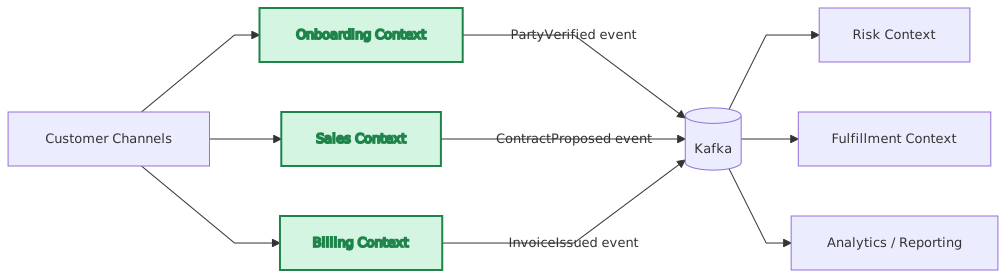
This diagram matters for what it does not show. There is no universal “customer owner” in the middle. There are capability owners. Different contexts emit facts for different business concerns.
Domain semantics first
If you skip semantic design, ownership decomposes into technical tribalism.
For example:
- Party may be the legal or natural person.
- Account may be the commercial relationship.
- Customer may be a role played by a party in a sales context.
- Bill-to may be an invoicing role.
- Subscriber may be a contract participant.
- Recipient may be a fulfillment endpoint.
Those are different concepts, not data subsets. A context map should make that explicit. Otherwise you get accidental overlap and duplicate authority.
Event design and Kafka
Kafka is useful here, but only if events are treated as domain facts, not table-change confetti.
Good ownership-aligned events say things like:
PartyVerifiedCreditLimitApprovedContractActivatedInventoryAllocatedInvoiceIssuedPaymentSettled
Poor events say:
CustomerUpdatedOrderChangedRecordSynced
The first set communicates business meaning. The second pushes ambiguity downstream.
Kafka enables decoupled propagation, replay, and auditability of business facts. It also supports progressive migration: legacy systems and new services can coexist by publishing and consuming the same streams. But Kafka does not solve ownership ambiguity. It amplifies whatever semantics you put into it.
Command vs event boundaries
The command to change a business state should go to the owning capability. The event announcing that the state changed can be consumed broadly.
That distinction is often violated. Teams directly write into another service’s database “for speed,” or expose broad update APIs allowing foreign contexts to mutate owned state. This creates covert shared ownership. Once that happens, no amount of event choreography will restore clarity.
Reconciliation architecture
In real enterprises, downstream projections drift. Messages arrive late. Consumers fail. Legacy jobs overwrite values. Duplicate commands sneak in. Therefore ownership must be backed by reconciliation.
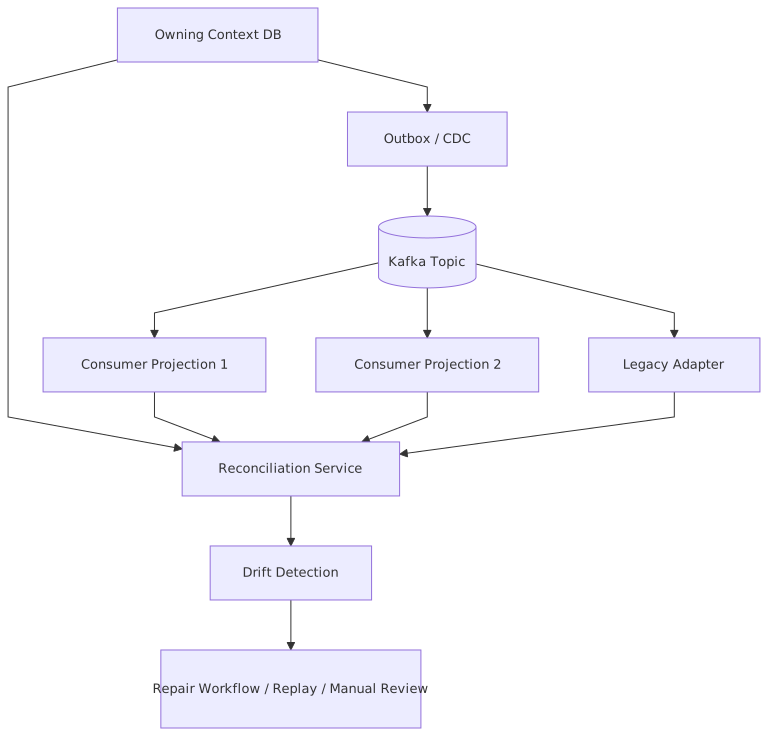
Reconciliation is not an admission of failure. It is the cost of running distributed systems in a non-fiction enterprise.
The trick is to reconcile against ownership. You do not ask every system to vote. You compare projections to the authoritative source or authoritative event log for that capability, then repair based on defined precedence.
Migration Strategy
Ownership architecture is rarely introduced on a blank page. It must be migrated into an existing estate where authority is entangled. This is where many architecture efforts become performative. They rename systems without moving decisions.
The right approach is a progressive strangler migration.
Step 1: Identify capabilities and current authority
Do not start with application inventory. Start with business decisions. What capabilities actually matter? For each one, document:
- current rule owner
- current data sources
- inbound change paths
- downstream consumers
- critical reports and controls
- existing reconciliation points
- regulatory/audit dependencies
You will usually discover hidden authority in batch jobs, stored procedures, and manual operations. Those are not edge cases. They are part of the real system.
Step 2: Separate read dependence from write authority
Many systems that “own” something merely read it, enrich it, or cache it. Untangle who truly decides. This often reduces apparent complexity.
A classic migration move is to freeze writes in non-owning systems while still letting them retain local copies for performance and process continuity.
Step 3: Introduce anti-corruption and event publication
If the current owner is legacy, wrap it. Publish meaningful events from the legacy source using CDC, outbox, or adapter services. Normalize semantics at the boundary, not deep inside every consumer.
This is often where Kafka first enters the picture. Not because event streaming is fashionable, but because it creates a controlled seam between old authority and new consumers.
Step 4: Move one decision at a time, not one entity at a time
This is the crucial DDD move.
Do not say, “We are moving Customer to the new platform.” That sentence is almost always nonsense.
Say instead:
- “Identity verification will now be owned by the Onboarding service.”
- “Credit eligibility will now be owned by the Risk service.”
- “Billing profile state transitions will now be owned by Billing.”
Each migrated capability needs command routing, event publication, historical backfill if required, and operational controls.
Step 5: Run dual-read and reconciliation before cutover
During migration, downstream systems may compare old and new authority outputs. This is especially important where calculations, eligibility, or state machines are involved.
Reconciliation should be explicit:
- compare decisions
- measure divergence
- categorize acceptable differences
- investigate semantic gaps
- only then cut over the write path
Step 6: Decommission hidden write paths
The hardest part of migration is not standing up the new owner. It is killing old ways of changing state. Admin screens, support scripts, batch corrections, ETL backwrites, “temporary” SQL updates — these are where ownership goes to die.
A capability is not truly migrated until unauthorized state mutation paths are shut down.
Here is a typical strangler path.
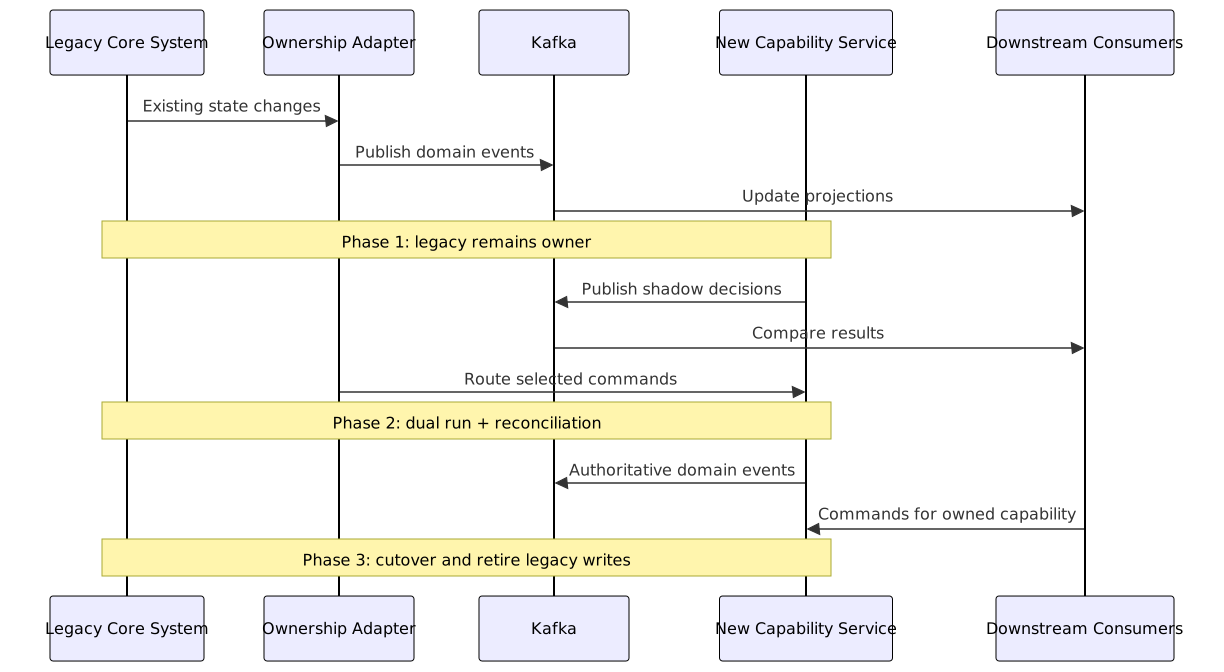
That is migration in the real world: asymmetric, staged, and heavy on evidence.
Enterprise Example
Consider a multinational insurer modernizing policy administration across 14 countries.
At the start, the enterprise had:
- a central CRM claiming ownership of customer
- a policy core system owning policies and endorsements
- a billing platform calculating invoices
- a claims platform maintaining claimant identities
- a regional MDM hub synchronizing party records
- nightly ETL jobs pushing updates everywhere
Every platform had a Customer table. None agreed.
The architecture team first tried a common canonical customer model. It failed. Why? Because “customer” meant:
- prospect in sales
- policyholder in policy administration
- payer in billing
- claimant in claims
- party under sanctions screening in compliance
One noun. Five meanings. The project spent nine months standardizing columns while the business kept asking who could legally change a policyholder’s name after policy issuance.
The redesign used domain capability ownership instead.
Ownership decisions
- Party identity verification was assigned to the Onboarding context.
- Policyholder role assignment and policy lifecycle state stayed with Policy Administration.
- Billing account responsibility and invoice generation belonged to Billing.
- Claims claimant registration and case-specific contact details belonged to Claims.
- Sanctions and compliance screening status belonged to Compliance.
The CRM no longer “owned customer.” It owned sales interaction history. That was a politically difficult but architecturally necessary decision.
Integration model
Kafka became the event backbone:
- Onboarding emitted
PartyVerifiedandPartyIdentityCorrected - Policy Administration emitted
PolicyActivated,PolicyholderAssigned,PolicyEndorsed - Billing emitted
InvoiceIssued,PaymentReceived,AccountDelinquent - Claims emitted
ClaimOpened,ClaimantRegistered - Compliance emitted
PartyScreeningStatusChanged
Downstream systems built local read models. The data lake consumed all domain events for reporting. MDM shifted from “global transaction owner” to “cross-reference and survivorship support” for selected reference attributes.
Reconciliation
Reconciliation was critical in two places:
- Policyholder identity across policy and billing
- Delinquency state consumed by collections and customer service
The team implemented daily drift checks plus event replay tooling. A small operations squad handled unresolved semantic mismatches. This looked expensive on paper. In practice it was far cheaper than endless customer disputes and audit findings.
Outcome
The enterprise did not eliminate duplication. It made duplication intentional.
Teams could change internal models independently. Policy Administration no longer waited for CRM schema committees. Billing stopped accepting direct customer profile writes from regional systems. Claims could maintain claim-local contact detail without pretending to own the legal party master.
Most importantly, when data conflicted, support teams knew where authority sat. That alone cut incident resolution time dramatically.
Operational Considerations
This pattern lives or dies in operations.
Observability of ownership flows
You need traceability from command to state change to domain event to downstream projection. Correlation IDs, event lineage, and replay tooling are not optional in an ownership-based architecture. Without them, you cannot prove whether a dependent system is stale, wrong, or merely interpreting a different concept.
Idempotency and duplicate handling
Kafka consumers will see duplicates. Retries happen. Replays happen. If projections are not idempotent, reconciliation volume explodes. Every ownership event should carry stable identifiers and enough versioning metadata to support safe reprocessing.
Outbox or CDC discipline
If the owning context persists state and publishes events separately, failure windows appear. State may commit while no event is emitted, or vice versa. Outbox patterns or reliable CDC pipelines are standard for a reason. In ownership architecture, missing events are not just integration bugs; they are authority leaks.
Schema evolution
As domains evolve, event contracts must do so without breaking downstream consumers. This requires governance, but lightweight governance. Not a central review board that slows every change, but clear compatibility rules, versioning practices, and owner accountability. EA governance checklist
Security and data minimization
Ownership does not imply broad data exposure. A domain can be authoritative without publishing every field. Especially in regulated industries, events should share the business fact required by dependents, not dump entire records onto the bus.
Human override and exception handling
Enterprise processes always contain exceptional cases. Manual correction workflows must respect ownership. If support staff can patch downstream projections directly because “the customer is waiting,” you will gradually reintroduce shared ownership through the back door.
Tradeoffs
This pattern is powerful, but not free.
Pros
- Clear decision rights for business state
- Stronger bounded contexts and domain models
- Better team autonomy
- Reduced semantic coupling
- More honest event-driven integration
- Easier auditability when ownership is explicit
Cons
- Data duplication is inevitable
- Reconciliation becomes a first-class concern
- Reporting requires careful semantic alignment
- Migration is slow because authority must move safely
- Some business users struggle with multiple truths for different contexts
That last point matters. Domain capability ownership rejects the fantasy of one universal truth. It replaces it with something better: contextual truth with explicit authority. Architects like this. Executives sometimes need help understanding it.
Also, there is a non-trivial platform cost. Kafka, schema management, event replay, lineage, and reconciliation tooling all require investment. If the organization lacks operational maturity, this architecture can collapse under its own ambition.
Failure Modes
Let’s be blunt. There are a handful of ways this goes wrong over and over.
1. Ownership declared, not enforced
A slide says Billing owns invoices. Yet sales ops can still update invoice records through a back-office portal. That is not ownership. That is a rumor.
2. Events without semantics
Teams publish low-level change events instead of business facts. Downstream consumers then infer meaning differently, creating divergent logic. The bus fills with noise. Integration becomes archaeology.
3. Shared database in disguise
Multiple services write to the same tables or use direct SQL against another context’s store. This destroys authority boundaries and makes failures impossible to reason about.
4. Over-centralized governance
In reaction to chaos, enterprises create heavy councils approving every event and schema. Delivery slows to a crawl. Teams route around the process with hidden integrations. Governance must protect ownership, not suffocate change. ArchiMate for governance
5. No reconciliation budget
Leaders approve event-driven distribution but refuse to fund reconciliation, replay, and support workflows. Then drift appears, confidence collapses, and teams revert to nightly full-sync jobs. The architecture looks modern while behaving like 2007.
6. Wrong granularity
Some organizations assign ownership too coarsely, recreating mini-monoliths. Others slice too finely and create chatty service meshes around trivial capabilities. Bounded contexts should be large enough to hold meaningful invariants and small enough to evolve independently.
When Not To Use
Domain capability ownership is not a universal prescription.
Do not use this pattern aggressively when:
The domain is simple and low consequence
If you are building an internal workflow tool with straightforward CRUD and little semantic variation, heavy ownership mapping, Kafka streams, and reconciliation machinery may be overkill.
The organization cannot sustain operational complexity
If teams cannot manage event contracts, observability, idempotency, and support workflows, a simpler modular monolith may be safer. DDD still applies there; ownership can exist inside modules without distributed infrastructure.
There is no real bounded-context distinction
Sometimes multiple teams are arguing over the same thing because the business process is genuinely centralized. In such cases, creating separate services only fragments one coherent domain.
Strong consistency across all operations is mandatory
Some capabilities require single-transaction guarantees across a tight aggregate boundary. If splitting ownership introduces unacceptable risk, keep it together. Not every problem wants eventual consistency.
Migration cost exceeds business value
In deeply stable legacy domains with low rate of change, carving out capability ownership may not produce enough benefit to justify the disruption. Architects should know when to leave a sleeping system alone.
A pattern is mature only when its advocates know when to refuse it.
Related Patterns
Domain capability ownership works well alongside several established patterns.
Bounded Context
The obvious foundation. Ownership should map to a bounded context where language and rules are internally coherent.
Context Map
Critical for making upstream/downstream relationships explicit, especially where customer/supplier, conformist, or anti-corruption patterns apply.
Anti-Corruption Layer
Essential in migration. It prevents legacy semantics from contaminating new capability owners.
Event Sourcing
Sometimes useful where the authoritative history of decisions matters deeply. But do not confuse event sourcing with event-driven integration; they solve different problems.
CQRS
Helpful when owning contexts handle commands while dependents consume read-optimized projections. Especially effective with Kafka-backed projections.
Saga / Process Manager
Important where business workflows span multiple capability owners and cannot be wrapped in a single transaction.
Master Data Management
Still relevant, but its role changes. In DDD-heavy enterprises, MDM is usually better used for cross-reference, survivorship support, and analytical alignment than for universal transactional authority.
Strangler Fig Pattern
The default migration companion. Move capability authority progressively, not with one big rewrite.
Summary
Domain capability ownership is the architecture discipline of saying, with precision, who gets to decide what a business fact means.
That sounds almost trivial. It is not. In large enterprises, it is the difference between systems that cooperate and systems that compete.
The central insight from domain-driven design is that authority belongs to bounded contexts and capabilities, not generic enterprise nouns. A “customer owner” is usually a sign that semantics have been flattened. Better to identify which context owns identity verification, which owns billing responsibility, which owns contract state, which owns risk status, and how those facts are published and consumed.
Kafka and microservices can support this model beautifully, but only when they carry domain facts rather than accidental table changes. Reconciliation is not optional. Progressive strangler migration is the sane path. Tradeoffs are real: duplication, operational complexity, and harder reporting semantics. Failure modes are common when ownership is declared but not technically enforced.
Still, when done well, this pattern brings something rare to enterprise architecture: a system where disagreement has a referee.
And that is what ownership really is. Not control for its own sake. Not centralization in disguise. Just a clear answer to the oldest distributed-systems question in the business world:
When two systems disagree, who has the right to be right?
The key is not replacing everything at once, but progressively earning trust while moving meaning, ownership, and behavior into the new platform.
Frequently Asked Questions
What is enterprise architecture?
Enterprise architecture aligns strategy, business processes, applications, and technology in a coherent model. It enables impact analysis, portfolio rationalisation, governance, and transformation planning across the organisation.
How does ArchiMate support architecture practice?
ArchiMate provides a standard language connecting strategy, business operations, applications, and technology. It enables traceability from strategic goals through capabilities and services to infrastructure — making architecture decisions explicit and reviewable.
What tools support enterprise architecture modeling?
The main tools are Sparx Enterprise Architect (ArchiMate, UML, BPMN, SysML), Archi (free, ArchiMate-only), and BiZZdesign. Sparx EA is the most feature-rich, supporting concurrent repositories, automation, scripting, and Jira integration.