⏱ 20 min read
Most enterprise architecture arguments about UML versus DDD are fake arguments. UML modeling best practices
They usually come from two camps. One camp says UML is dead, too formal, too slow, too “big design up front.” The other camp says DDD is fuzzy, too code-centric, and basically just sticky notes with ambition. I think both positions are lazy. In real enterprise work, especially in large organizations with banking systems, IAM platforms, Kafka-heavy integration layers, and cloud sprawl, you need both precision and meaning. UML gives you precision. DDD gives you meaning. If you pick one and dismiss the other, you usually end up with either elegant diagrams nobody trusts or “domain models” that collapse the minute they hit integration reality. UML for microservices
That’s the core point.
UML and Domain-Driven Design work best when UML is used to express DDD decisions, not replace them.
That sounds simple, but a lot of architecture teams still get it wrong.
The simple version first
If you want the quick explanation:
- DDD helps you understand the business domain and shape software around it.
- UML helps you visualize and communicate that shape clearly.
- DDD tells you what matters. UML helps you show it.
DDD is about bounded contexts, aggregates, ubiquitous language, domain services, events, and the relationships between business capabilities and software boundaries.
UML is a modeling language. It gives you tools like:
- class diagrams
- sequence diagrams
- activity diagrams
- component diagrams
- deployment diagrams
- state diagrams
Used correctly, UML becomes a way to make DDD concrete. It helps teams answer practical questions:
- Where does one domain stop and another begin?
- What events cross context boundaries?
- Which services own which data?
- What is synchronous and what is asynchronous?
- Where does IAM fit in the flow?
- What actually runs in cloud infrastructure?
That’s the SEO-friendly version. Now the more important version.
The real issue: enterprise architecture needs both semantics and structure
In enterprise architecture, diagrams are usually not the problem. Bad thinking is the problem.
I’ve seen teams produce beautiful UML component diagrams for systems they didn’t understand. I’ve also seen teams run “DDD workshops” for weeks and still fail to define ownership boundaries between customer onboarding, fraud, payments, and identity. One gave structure without meaning. The other gave meaning without operational architecture.
Neither survives contact with production.
In real architecture work, especially in regulated sectors like banking, you need a way to connect several layers of truth:
- Business language
- Domain boundaries
- Application/service design
- Integration patterns
- Security and IAM constraints
- Cloud deployment reality
- Operational observability
DDD is strongest in layers 1 and 2, and heavily influences 3 and 4.
UML is strongest in 3 through 6, and can support 1 and 2 if you’re disciplined.
That’s why they belong together.
A good architect does not ask, “Should we use UML or DDD?”
A good architect asks, “Which UML views help us make DDD decisions visible, testable, and governable?”
That’s a much better question.
DDD without UML often stays trapped in workshop mode
Let me be a little contrarian here.
A lot of DDD adoption in enterprises is performative. People love event storming, domain language maps, and context posters. Fine. Those are useful. But if the output never becomes a durable architectural model, then the organization has learned something temporary and built nothing reliable.
DDD workshops often fail in large enterprises for three reasons:
- they stop at discovery and never shape implementation
- they ignore infrastructure and integration constraints
- they avoid uncomfortable ownership decisions
That last one matters most.
It’s easy to say “Customer is a shared concept.” It’s much harder to say:
- the Party Profile bounded context owns legal identity attributes
- the IAM platform owns credentials and authentication factors
- the Onboarding context owns KYC workflow state
- the Lending context owns credit eligibility decisions
- the Payments context should never directly mutate customer identity data
That kind of clarity is what enterprise architecture needs. And once you have it, UML becomes useful because it can show the implications of those boundaries.
Without that, DDD becomes a whiteboard religion.
UML without DDD becomes diagram theater
Now the other side.
UML has a bad reputation partly because architects abused it for years. Huge class models. Sequence diagrams with 70 lifelines. Deployment diagrams no one updated. A universal metamodel nobody believed. It became architecture wallpaper.
But that’s not UML’s fault. That’s what happens when modeling loses connection to domain decisions.
If you draw a class diagram before you understand the bounded contexts, you will almost always model nouns instead of responsibilities. That’s how enterprises end up with giant shared entities like Customer, Account, User, Role, Case, Document, and Transaction floating through every system. It looks neat in the repository and causes total chaos in implementation.
DDD helps stop that.
It forces better questions:
- Is “Customer” the same thing in retail banking, lending, collections, and fraud?
- Is “Account” a ledger account, a customer account, a channel account, or an IAM account?
- Is “Role” a business role, an application entitlement, or an infrastructure permission?
- Is “Event” a domain event, integration event, or Kafka transport message?
These are not semantic games. These are architecture decisions with real consequences.
UML becomes valuable only after DDD has done the hard work of separating those meanings.
Where UML fits naturally into DDD
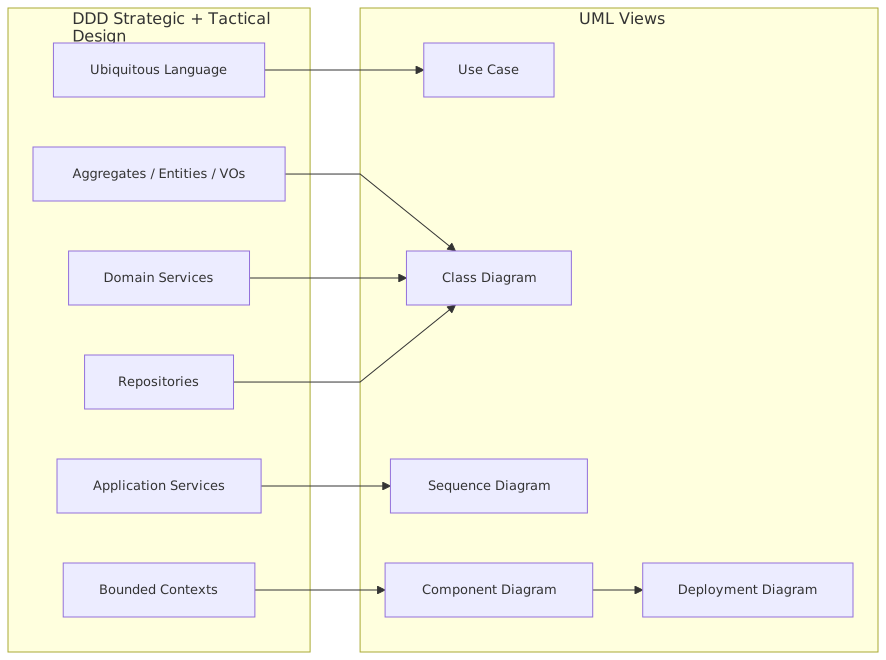
Here’s the practical mapping.
This is where architects usually improve fast once they stop treating UML as a one-size-fits-all blueprint.
You do not need every UML diagram.
You need the few that make DDD decisions operational.
My usual bias is:
- component diagrams for context boundaries and service ownership
- sequence diagrams for use cases, orchestration, Kafka interactions, and IAM flows
- state diagrams for lifecycle-heavy aggregates
- deployment diagrams for cloud/runtime mapping
- small class diagrams only inside a bounded context, never as enterprise master truth
That last part is worth emphasizing. The enterprise-wide class model is usually a mistake. It creates false standardization and destroys domain autonomy.
How this applies in real architecture work
This is where theory gets tested.
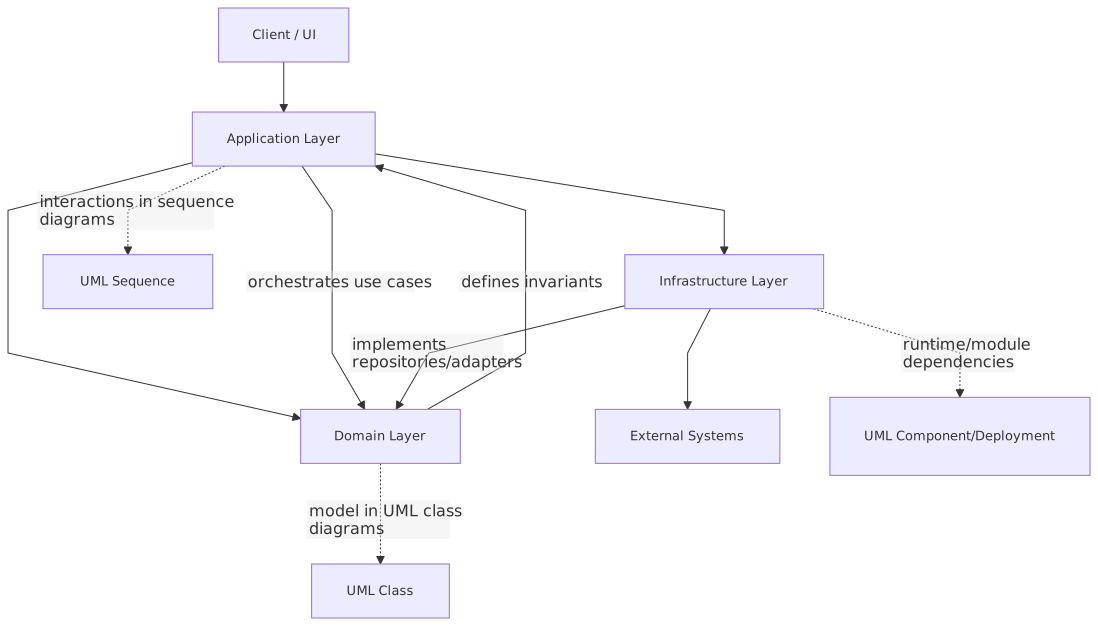
In real architecture, UML + DDD helps with five hard problems.
1. Defining service boundaries that survive delivery pressure
Teams under delivery pressure tend to merge domains because integration is hard. Suddenly onboarding owns identity, fraud owns customer risk, payments owns account limits, and everybody reads everybody else’s tables “temporarily.”
DDD gives you the principle: bounded contexts and ownership.
UML gives you the communication tool: the service/context diagram that shows what is owned where, what APIs exist, what events are published, and what is explicitly not shared.
That matters in architecture reviews. It matters in funding decisions. It matters when a platform team starts “helpfully” centralizing things that should remain domain-owned.
2. Making Kafka event design less chaotic
Kafka is where weak domain modeling gets exposed.
A lot of enterprises say they are event-driven, but what they actually have is topic-driven coupling. Teams publish whatever their local schema emits, call it an event, and then wonder why downstream consumers are brittle.
DDD helps define whether an event is actually meaningful in the business domain:
CustomerOnboardedPaymentInitiatedCardBlockedLoanApplicationSubmitted
UML sequence diagrams help show:
- who emits the event
- what triggers it
- what follows synchronously vs asynchronously
- where retries and compensations happen
- where IAM checks are required
- where cloud services enter the picture
This is not academic. It’s the difference between a stable event backbone and an integration swamp.
3. Clarifying IAM responsibilities
IAM is one of the most misunderstood areas in enterprise architecture because the word “identity” gets overloaded instantly.
DDD helps separate:
- business identity
- legal party identity
- user account identity
- authentication credentials
- entitlements and authorization policies
Then UML helps show the flows:
- login
- token issuance
- customer consent
- privileged admin access
- service-to-service authorization
- role propagation into applications
If you don’t do this, your architecture documents usually imply that the IAM platform “owns identity.” It doesn’t. It owns some identity concerns. In a bank, the customer domain, party domain, IAM domain, and compliance domain all own different parts of the truth. ARB governance with Sparx EA
That distinction prevents disasters.
4. Connecting domain design to cloud deployment
DDD by itself does not tell you how to deploy on cloud. It should not. But cloud design without domain boundaries becomes generic platform nonsense.
UML deployment diagrams become useful when grounded in DDD:
- which bounded contexts deploy as separate services
- which contexts share a runtime for practical reasons
- where Kafka clusters sit
- where IAM gateways and policy engines sit
- how data residency constraints affect deployment
- which workloads are multi-region and which are not
This is where architecture gets real. The board does not care that your aggregate is elegant if your deployment model breaks data sovereignty or resilience requirements.
5. Governance without centralizing everything
Good governance is not drawing more boxes. It is making ownership and contracts visible.
DDD provides ownership logic.
UML provides governance-friendly artifacts.
Architecture review boards, security teams, platform teams, and delivery teams can all read a decent component diagram and sequence diagram. They may not all agree, but at least they are arguing about the same thing.
That’s a big improvement over 50-page prose documents full of vague intentions.
A real enterprise example: retail banking onboarding and access
Let’s use a realistic banking example.
A large retail bank wants to modernize customer onboarding. Current state:
- branch onboarding in a legacy core system
- mobile onboarding through a separate digital app stack
- IAM platform for authentication and MFA
- Kafka as the enterprise event backbone
- cloud-native services for new workflows
- compliance, fraud, and KYC checks spread across multiple teams
The bank says, “We need a customer domain service.”
That sentence is already dangerous.
Step 1: DDD clarifies the domain
A proper domain exercise usually reveals several bounded contexts instead of one “customer service”:
- Party Profile: legal person/org data, identifiers, demographic profile
- Onboarding: application process, submitted documents, workflow status
- IAM: digital identity, credentials, MFA enrollment, authentication events
- KYC/Compliance: verification decisions, risk flags, screening outcomes
- Fraud: behavioral and onboarding fraud signals
- Product Eligibility: whether a person can open a given banking product
- Customer Communications: notifications and consent messages
Already the architecture is better. We are not building “the customer microservice.” We are identifying ownership.
Step 2: UML makes the boundaries usable
A component diagram can show:
- each bounded context as a service or service group
- APIs exposed by each
- Kafka topics/events exchanged
- anti-corruption layer to the legacy core
- IAM integration points
- external compliance providers
- cloud deployment zones
A sequence diagram for “Open mobile savings account” can show:
- User authenticates or creates digital identity through IAM
- Onboarding receives application
- Party Profile checks for existing legal identity match
- KYC requests verification
- Fraud evaluates onboarding risk
- Product Eligibility checks rules
- Onboarding emits
OnboardingApproved - Account Opening service consumes event and opens product account
- Notifications service sends confirmation
- IAM may trigger stronger MFA enrollment for activated account
Now architecture teams can discuss real things:
- Is approval orchestrated synchronously or event-driven?
- Which events are domain events versus process events?
- Can Onboarding own workflow state without owning legal identity?
- Should IAM be called synchronously in every step?
- What happens if Kafka delivery is delayed?
- Where are audit trails stored?
That’s real architecture work.
Step 3: Contrarian but important point — don’t over-microservice the bounded contexts
This is where many architects go wrong. They discover six bounded contexts and immediately want twelve microservices. Bad move.
A bounded context is not automatically a deployable unit.
For the bank, you may choose:
- one deployable service for Onboarding workflow
- one for Party Profile
- one for Product Eligibility
- one IAM platform integration layer
- KYC and Fraud as external/internal services
- Kafka for event propagation
Maybe later you split more. Maybe not. DDD should inform boundaries of responsibility, not force premature runtime fragmentation.
A lot of architects confuse conceptual purity with operational maturity. Enterprises pay for that confusion in latency, support overhead, and incident volume.
Common mistakes architects make
Let’s be blunt. These are the usual failures.
Mistake 1: Using UML to standardize language across domains
Architects often think standardization is always good. It isn’t.
Forcing one enterprise definition of Customer, Account, or Role across all domains usually creates ambiguity, not clarity. DDD says language is local to a bounded context. That is healthy. UML should reflect that, not erase it.
You can standardize integration contracts where needed. You should not flatten domain meaning just to make diagrams look tidy.
Mistake 2: Treating bounded contexts as technical layers
I still see diagrams where contexts are named:
- API Context
- Database Context
- Workflow Context
- UI Context
That is not DDD. Those are technical partitions. They may be useful implementation layers, but they are not domain boundaries.
If your “bounded contexts” are basically architecture tiers, you have missed the point.
Mistake 3: Creating giant class diagrams as the primary architecture artifact
This is a classic UML anti-pattern.
Class diagrams are seductive because they look precise. But in enterprise architecture they often become fake certainty. You model entities before responsibilities, then spend months trying to fit delivery around the picture.
Use class diagrams sparingly and within bounded contexts. If your first artifact is a 200-entity model, stop.
Mistake 4: Confusing domain events with integration mechanics
A Kafka message is not automatically a domain event.
customer_table_updated_v3 is not a domain event. It’s a technical emission. Maybe useful, but not the same thing.
A domain event should mean something in the language of the business. UML sequence diagrams can help distinguish:
- domain event
- command
- notification
- replication message
- CDC stream
If you do not make this distinction, your event architecture turns into accidental coupling.
Mistake 5: Letting IAM leak into every domain model
IAM often becomes a conceptual parasite in enterprise designs. Suddenly every domain object contains user IDs, roles, entitlements, and token assumptions.
That’s usually poor modeling.
DDD helps isolate IAM as its own context. UML then shows where identity and authorization are checked, translated, or propagated. Keep IAM concerns explicit. Do not smear them across every domain model.
Mistake 6: Ignoring the anti-corruption layer
In enterprises, you almost always have legacy systems, acquired platforms, SaaS products, and strange data contracts. DDD gives you the anti-corruption layer concept for a reason.
Architects skip it because they want direct integration and faster delivery. Then the new domain model slowly mutates to match the old system’s weirdness. That is how modernization quietly fails.
Use UML component and sequence diagrams to show translation layers clearly. If they are not visible, they usually don’t get built properly.
What good looks like in practice
A healthy UML + DDD architecture approach usually produces a small set of artifacts, not a modeling encyclopedia.
1. Context map / component model
This shows:
- bounded contexts
- ownership
- upstream/downstream relationships
- APIs and Kafka topics
- anti-corruption layers
- external dependencies
2. Key sequence diagrams for major business flows
For example:
- customer onboarding
- payment initiation
- failed authentication and step-up MFA
- privileged admin provisioning
- account closure
These expose orchestration, event timing, IAM checks, and exception handling.
3. State diagrams for lifecycle-heavy aggregates
Very useful for:
- onboarding application
- payment instruction
- access request
- fraud case
- loan application
This is where invariants become visible.
4. Deployment/runtime view
Map bounded contexts to:
- Kubernetes clusters
- managed Kafka
- IAM services
- cloud regions
- data stores
- API gateways
- observability stack
This prevents the common disconnect between domain design and platform design.
5. Lightweight glossary tied to the diagrams
Because if your team cannot explain the difference between:
- Party
- Customer
- User
- Account Holder
- IAM Principal
then your diagrams are decorative.
Banking, Kafka, IAM, and cloud: how they intersect
This combination is common now, and it’s exactly where UML and DDD together are worth the effort.
Imagine a bank moving customer channels to cloud while keeping parts of core banking on-prem. It uses Kafka for event streaming, a centralized IAM platform for workforce and customer identity, and domain-oriented teams for products.
Without DDD:
- teams publish inconsistent events
- IAM gets overloaded as the source of all identity truth
- cloud migration becomes lift-and-shift by another name
- architecture diagrams become platform-centric and business-blind
Without UML:
- context definitions remain fuzzy
- sequence dependencies stay hidden
- runtime and security implications are missed
- governance becomes verbal and political
With both:
- Party Profile owns legal identity facts
- IAM owns authentication lifecycle and credentials
- Payments owns payment intent and execution state
- Lending owns application and underwriting decisions
- Kafka carries domain events with clear publishers and consumers
- cloud deployment reflects domain ownership, resilience, and regulatory boundaries
That’s the difference between “modern architecture” as a slogan and architecture that can actually run a bank.
A few strong opinions that are worth saying out loud
Not every architect needs to love UML, but every architect needs modeling discipline
You can dislike UML notation and still need structured models. Fair enough. But if your alternative is vague boxes and hopeful prose, that is not maturity. That is avoidance.
DDD is not a replacement for integration architecture
Some teams act like bounded contexts solve integration. They don’t. They make integration cleaner, if you do the hard work. Kafka topic strategy, schema evolution, idempotency, replay, failure handling, and IAM token propagation still need serious architectural design.
The enterprise canonical data model is usually an attractive trap
Sometimes a small shared model is necessary. Usually, though, the canonical model becomes a political artifact that slows change and hides domain differences. Prefer translated contracts over forced semantic uniformity.
Architecture diagrams should be disposable, but not casual
Yes, diagrams should evolve. No, that does not mean they should be sloppy. “We’ll update later” is how architecture drifts into folklore.
If your UML cannot explain your IAM model, your architecture is incomplete
Security is not a side appendix anymore. In cloud-native enterprise systems, identity and authorization flows are core architecture, not implementation details.
So how should an enterprise architect actually use UML with DDD?
Here is the practical pattern I recommend.
Start with domain discovery
Use event storming, interviews, process analysis, and capability mapping. Find the bounded contexts. Name things carefully. ArchiMate capability map
Then create a context-level UML view
Do not jump into classes. Draw components/packages representing bounded contexts, interfaces, event channels, legacy boundaries, and ownership.
Model key business flows with sequence diagrams
Choose 5–10 important flows, not 50. Include Kafka, IAM, cloud services, retries, and exception paths where they matter.
Add state diagrams where lifecycle is business-critical
Especially in banking, state transitions are often where compliance and risk live. EA governance checklist
Keep class diagrams local
Use them only inside a bounded context and only where they help with aggregate design or invariants.
Reconcile with deployment reality
Show where those services run, what cloud services they use, what is on-prem, where IAM trust boundaries sit, and how Kafka spans environments.
Review the model with both business and engineering stakeholders
If business people cannot recognize their language, your DDD failed. If engineers cannot build from the model, your UML failed.
That’s the test.
Final thought
UML and DDD are not rivals. They solve different failures.
DDD protects architecture from becoming technically neat but semantically empty.
UML protects architecture from becoming semantically rich but operationally vague.
In enterprise environments, especially banks with Kafka event fabrics, IAM complexity, cloud migration pressure, and legacy gravity, you need both. Not more process. Not more notation. Just better use of each.
Use DDD to decide what the system means.
Use UML to show how that meaning is structured and executed.
That combination is still one of the most practical tools an architect has. Not trendy maybe. But very effective. And frankly, effectiveness matters more than fashion.
FAQ
1. Is UML still relevant in modern cloud-native architecture?
Yes, if used selectively. UML is very relevant for component, sequence, state, and deployment views. What is not relevant is over-modeling everything. In cloud-native systems, UML is useful when it clarifies service boundaries, event flows, IAM interactions, and runtime topology.
2. Can DDD work without UML?
Yes, but usually not well at enterprise scale. Small teams can keep a lot in their heads. Large organizations cannot. DDD without durable visual models often stays trapped in workshop output and inconsistent interpretation.
3. Which UML diagrams are most useful for DDD?
Usually:
- component diagrams for bounded contexts and dependencies
- sequence diagrams for use cases and event flows
- state diagrams for aggregate lifecycles
- deployment diagrams for cloud/runtime mapping
Class diagrams are useful too, but only within a context and in moderation.
4. How do Kafka events fit into DDD?
Kafka is a transport and streaming platform, not a domain model. DDD helps define which events are meaningful domain events. UML helps show how those events move between contexts, what triggers them, and how consumers react.
5. What is the biggest mistake when combining UML and DDD?
Trying to create one enterprise-wide “master model.” That usually destroys bounded contexts, creates false agreement, and leads to brittle integration. Better to model local domain truth clearly and connect contexts through explicit contracts and translation layers.
Frequently Asked Questions
What is enterprise architecture?
Enterprise architecture is a discipline that aligns an organisation's strategy, business processes, information systems, and technology. Using frameworks like TOGAF and modeling languages like ArchiMate, it provides a structured view of how the enterprise operates and how it needs to change.
How does ArchiMate support enterprise architecture practice?
ArchiMate provides a standard modeling language that connects strategy, business operations, applications, data, and technology in one coherent model. It enables traceability from strategic goals through business capabilities and application services to the technology platforms that support them.
What tools are used for enterprise architecture modeling?
The main tools are Sparx Enterprise Architect (ArchiMate, UML, BPMN, SysML), Archi (free, ArchiMate-only), and BiZZdesign Enterprise Studio. Sparx EA is the most feature-rich option, supporting concurrent repositories, automation, scripting, and integration with delivery tools like Jira and Azure DevOps.