⏱ 19 min read
Enterprise systems rarely fail in one dramatic moment. They fail by drifting. A team adds a field here, another invents a status there, a reporting service copies business rules “just for now,” and before long the same customer, claim, order, or policy means three different things depending on who you ask. The architecture still runs. Dashboards are green. But the business language has cracked underneath it.
That crack is domain model fragmentation.
It is one of the most common and least honestly discussed problems in Domain-Driven Design. People talk about bounded contexts as if drawing the context map solved the hard part. It does not. A bounded context is not a magical fence. It is a social and technical agreement that must survive mergers, reorganizations, microservice sprawl, analytics demands, and the constant temptation to share “just one little canonical model.” microservices architecture diagrams
And that is where things get interesting.
Fragmentation is not simply duplication. Duplication can be healthy. Sometimes you absolutely want the shipping team’s concept of an order to differ from finance’s concept of an order. Fragmentation becomes a problem when semantic drift destroys trust: when two models represent the same business concept but evolve without explicit translation, reconciliation, or ownership. Then the architecture starts lying to the enterprise. Integration becomes archaeology. Kafka topics become rumor mills. Every migration takes twice as long because nobody agrees what the data means. event-driven architecture patterns
This article is about that mess. Not the textbook version. The real one.
We will look at why domain model fragmentation happens, how it shows up in distributed systems and event-driven architectures, what a pragmatic solution looks like, and how to migrate without stopping the business. We will also talk about the uncomfortable tradeoffs: local autonomy versus enterprise consistency, speed versus semantic governance, and when the right answer is to stop pretending Domain-Driven Design is the problem and admit your organization model is. EA governance checklist
Context
Domain-Driven Design begins with a deceptively simple idea: software should reflect the language and structure of the business domain. Not vaguely. Precisely. The model is not an implementation detail; it is the heart of the system. Ubiquitous language, bounded contexts, aggregates, domain services, context maps—these are all tools to preserve meaning.
In a single-team system, this is hard but manageable.
In an enterprise, it is a knife fight.
Large organizations do not have one domain model. They have many. Sales sees a customer as an account with pipeline, hierarchy, and contractual relationships. Billing sees the same customer as a legal entity, tax boundary, and payment responsibility. Support sees entitlements and incident history. Identity sees principals and credentials. Marketing sees segments and consent. All are reasonable. None are complete. Each is optimized for different outcomes.
That plurality is not a flaw. It is the whole point of bounded contexts.
The trouble starts when systems are integrated in ways that assume semantic sameness where only linguistic similarity exists. Shared databases, copied schemas, “enterprise customer” topics in Kafka, downstream read models promoted into source-of-truth status, data lake transformations turned into operational APIs—each of these can turn healthy contextual variation into fragmented meaning.
Fragmentation also grows during migration. Legacy monoliths often contain a single giant schema that gives the illusion of semantic unity. Once decomposition begins, teams carve services around processes, channels, or organizational boundaries, and the old implicit consistency evaporates. If the migration strategy focuses only on technical extraction and not domain semantics, the organization replaces one big muddle with twenty smaller muddles connected by asynchronous messaging.
Microservices do not cause fragmentation. They reveal it. Kafka does not create semantic ambiguity. It distributes it efficiently.
That distinction matters.
Problem
Domain model fragmentation occurs when business concepts that should have explicit contextual boundaries instead spread across multiple services, schemas, topics, and teams without disciplined ownership or translation.
It usually looks like one of these patterns:
- The same concept exists in multiple services with different states and rules, but no published mapping.
- An upstream domain event is treated as a universal truth by downstream consumers, even though it only reflects the publisher’s context.
- A reporting or integration model becomes an accidental operational model.
- Teams reuse names like
Customer,Order,Policy, orProductwhile meaning fundamentally different things. - Reconciliation is done manually or ad hoc because nobody trusts any single model fully.
- A canonical enterprise schema is introduced to “fix” inconsistency and instead becomes a lowest-common-denominator compromise that nobody loves and everybody works around.
The result is expensive in ways that are not always visible on architecture diagrams.
Projects slow down because integration requires semantic negotiation. Incident response gets messy because discrepancies are interpreted as “data quality issues” rather than model boundary failures. Audit findings increase because derived systems cannot explain how a business state was constructed. Analytics teams build one more translation layer. Migrations stall because there is no stable semantic target.
Most dangerously, the business loses confidence. If executives hear three different customer counts in the same meeting, they do not blame context maps. They blame IT.
And often, they are right.
Forces
A good architecture discussion starts with the forces at play, because fragmentation is rarely caused by ignorance alone. More often, teams are making locally rational decisions under conflicting pressures.
1. Local optimization versus enterprise coherence
A bounded context should optimize for local business meaning. That is healthy. But enterprises also need cross-context reporting, compliance, customer experience continuity, and process orchestration. The more independently teams evolve, the more translation work the enterprise must absorb.
2. Speed of delivery versus semantic discipline
It is always faster to copy a field than to negotiate its meaning. It is always faster to subscribe directly to a Kafka event than to establish a published language, anti-corruption layer, and reconciliation rule. Short-term speed is the natural enemy of long-term semantic integrity.
3. Legacy gravity
Legacy platforms contain years of embedded business logic, often undocumented. During migration, teams extract data first because data feels tangible. But data without business rules is taxidermy: it looks like the animal, but it no longer moves.
4. Organizational boundaries
Conway’s Law does not politely influence architecture; it dominates it. If risk, operations, sales, and finance report into different structures with different incentives, you will get different models. The architecture can only channel that energy, not wish it away.
5. Event-driven decoupling
Kafka and event streaming are powerful because they loosen temporal coupling. But they also make semantic overreach easy. A topic named customer-updated invites every team to believe they now understand “customer.” Often they do not.
6. Data platform ambitions
Data lakes, warehouses, and lakehouses are valuable. But when analytical models bleed back into operational systems, business semantics flatten. A conformed dimension is not a bounded context. It is a reporting convenience.
These forces do not disappear. Good architecture works with them, not against fantasy.
Solution
The core solution is simple to say and hard to practice:
Treat fragmentation as a semantic architecture problem, not merely an integration problem.
That means four things.
1. Make bounded contexts explicit and business-led
If two teams use the same word differently, that is not a nuisance; it is architectural information. Capture it. Define where one model is authoritative and where another is merely a translated view. Put the language in front of engineers, analysts, architects, and business stakeholders.
A bounded context is not just a box around a service. It is a contract about meaning.
2. Introduce deliberate translation, not accidental sharing
When information crosses contexts, it should pass through translation mechanisms: anti-corruption layers, mapping services, event transformation pipelines, or context-specific APIs. The goal is not to eliminate duplication. The goal is to ensure that duplication is intentional and traceable.
3. Separate operational authority from enterprise reconciliation
Not every enterprise concept needs a single operational source of truth. That phrase has done enough damage already. What many organizations actually need is a system of record per bounded context, plus an enterprise reconciliation capability that can explain differences and derive agreed views for analytics, process coordination, or compliance.
This distinction is vital. Authority is local. Reconciliation is cross-context.
4. Design migration as progressive semantic extraction
In legacy modernization, do not begin by asking, “Which tables become which services?” Begin with, “Which meanings are currently entangled, and which business capabilities need their own model?” Then extract behavior and semantics together using a strangler pattern, not a schema-splitting exercise disguised as architecture.
If you only move data, fragmentation follows you.
Architecture
A pragmatic architecture for managing domain model fragmentation usually combines bounded contexts, event-driven integration, translation layers, and reconciliation services.
Here is the shape of it.
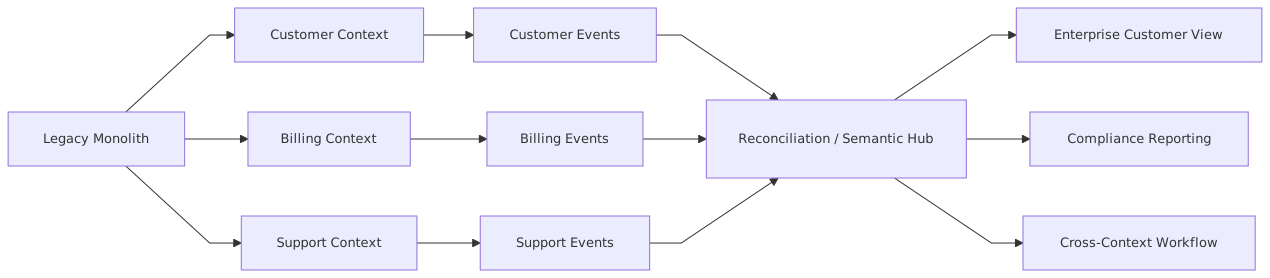
The important point in this diagram is what the reconciliation hub is not. It is not a canonical domain model imposed back onto every service. It is a semantic mediation layer that understands context-specific representations and can produce derived views for enterprise use cases.
That hub might be implemented through stream processing on Kafka, a set of domain translation services, a master data capability, or a combination of all three. The implementation matters less than the architectural stance: preserve local meaning, reconcile centrally where necessary.
Context-specific models
Within each bounded context, teams should model aggregates, invariants, and state transitions according to local business rules. A billing customer may require legal ownership and invoice preferences. A support customer may require entitlement windows and service tiers. There is no need to force these into one giant class diagram.
Event publication with semantic discipline
Publish events as facts meaningful in the source context. Name them accordingly. BillingAccountOpened is better than CustomerCreated if the event reflects billing semantics. Event contracts should carry enough context to be useful but not pretend to define universal truth.
A common failure in Kafka estates is the enterprise topic that becomes semantically overloaded. One team publishes lifecycle events, another publishes profile changes, another infers identities, and consumers stitch together a mythical unified customer through tribal knowledge. That is not event-driven architecture. That is distributed ambiguity.
Translation and anti-corruption layers
When one service needs another context’s data operationally, consume it through an explicit anti-corruption layer. Translate terms, statuses, and identifiers. Make policy visible. If billing says SUSPENDED and support says ON_HOLD, do not let developers quietly map enums in a UI adapter and call it done. That mapping is business logic. Give it a home.
Reconciliation as a first-class concern
Many enterprises resist this because it sounds like admitting inconsistency. Good. They should admit it. Reconciliation is not a sign of weak architecture; it is a sign of mature architecture in a distributed business landscape.
Reconciliation answers questions like:
- Which identifiers represent the same real-world entity?
- Which view is authoritative for which attributes?
- What happens when contexts disagree?
- Which differences are expected lag versus actual defects?
- How can we produce an enterprise-grade customer, policy, or order view with lineage?
These are architectural questions, not merely data engineering chores.
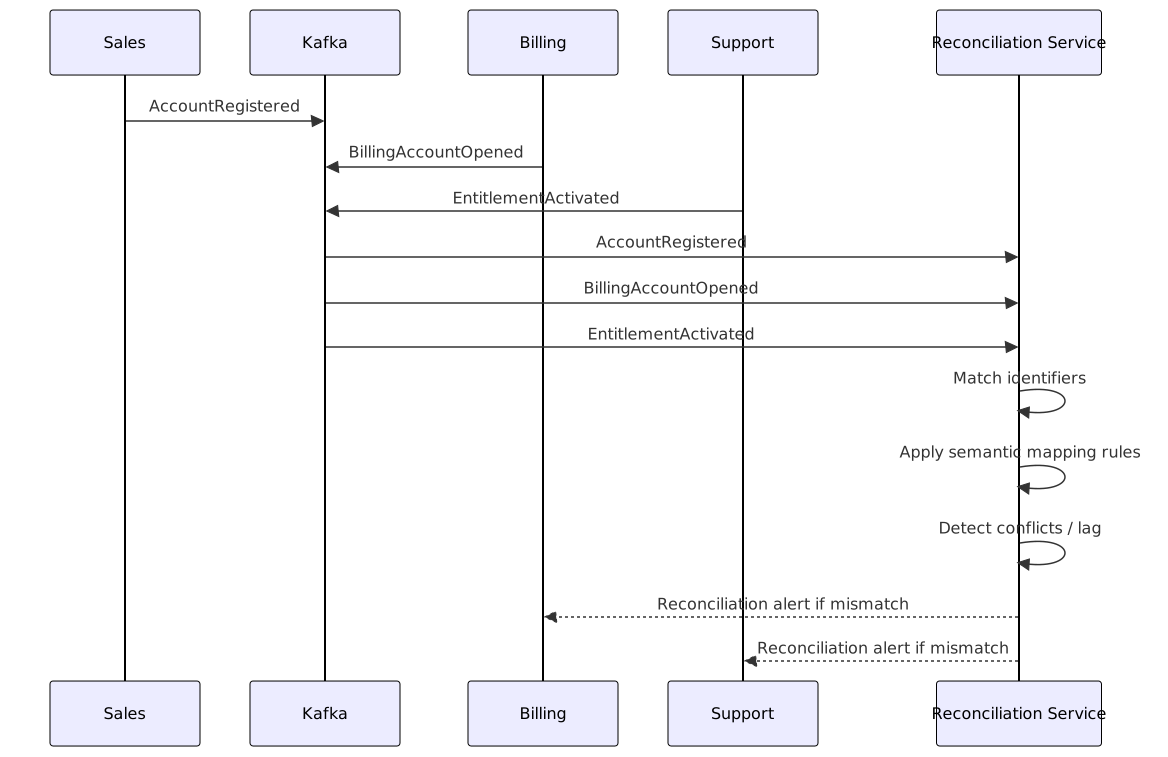
This pattern works especially well when Kafka is used as the integration backbone. Event streams provide temporal history and support replay. That is useful because reconciliation logic changes. You will discover better matching rules, more precise semantics, and edge cases in production. Replayability is not just an operational feature; it is a semantic correction mechanism.
Semantic governance
Some architects hear “governance” and immediately reach for a bunker. Fair enough. Most governance programs deserve the suspicion. But lightweight semantic governance is necessary. Someone must own: ArchiMate for governance
- business glossary and context definitions
- event naming conventions
- cross-context identifier strategy
- attribute-level authority rules
- reconciliation policies
- deprecation of obsolete semantic contracts
Without this, fragmentation becomes institutionalized.
Migration Strategy
Migration is where most noble DDD intentions go to die. Teams say they are moving toward bounded contexts, but the actual work consists of carving API shells around old tables and moving integration pain into Kafka.
A better strategy is progressive strangler migration with semantic checkpoints.
Step 1: Discover semantic seams
Do not start from the application topology. Start from business language. Interview domain experts. Map where terms differ. Find the concepts whose rules are currently tangled in the monolith. These are your candidate bounded contexts.
A useful question is: where would the business tolerate divergence if it improved local decision-making? That usually reveals real context boundaries.
Step 2: Identify authority and dependency
For each concept, define:
- which context is authoritative for which attributes
- which contexts consume derived or translated versions
- where identifiers originate
- where reconciliation will be needed
This avoids the classic migration mistake where every extracted service assumes it owns the whole concept.
Step 3: Strangle one workflow, not one table
Pick a business workflow with clear value and manageable dependencies. Extract behavior and the local model together. For example, move support entitlement activation into its own service with its own model, even if customer identity still originates elsewhere.
Step 4: Publish context events, not enterprise fantasies
When the new service emits events, keep them local in meaning. Introduce translation downstream if broader consumers need them. Resist the temptation to create a universal event schema too early.
Step 5: Build reconciliation in parallel
This is the part teams skip. They say, “We’ll reconcile later,” which is architecture-speak for “We’ll have a data incident next quarter.” As soon as two contexts represent overlapping entities, establish matching and discrepancy handling. Start simple: correlation IDs, deterministic matching, exception queues.
Step 6: Retire semantic dependencies incrementally
As more workflows are strangled out, remove direct reads from monolith tables and replace them with context APIs or event-fed read models. Every retired direct dependency is a semantic win, not just a technical one.
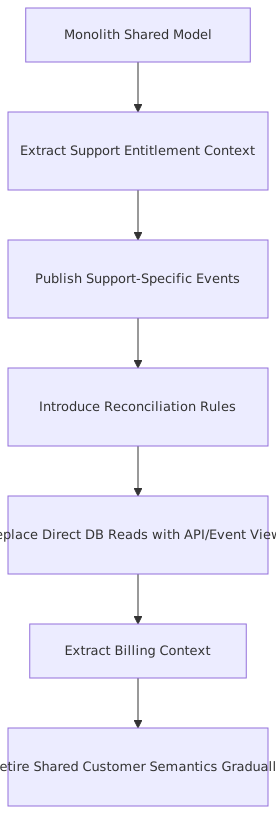
The migration logic is progressive for a reason. Enterprises cannot freeze operations while architects chase purity. The strangler pattern works because it aligns technical change with business continuity. But a strangler without semantic design just wraps confusion in nicer deployment pipelines.
Enterprise Example
Consider a global insurance company modernizing a policy administration platform. The legacy system had one enormous POLICY_HOLDER structure used by underwriting, billing, claims, CRM, and regulatory reporting. For years, leadership referred to it as the “golden record.” It was nothing of the sort. It was a negotiated truce encoded in COBOL and replicated into Oracle.
When the company launched a microservices program, the first wave extracted:
- Customer Profile Service
- Billing Account Service
- Claims Party Service
- Broker Relationship Service
All four services had a notion of customer or party. All four published Kafka events. Within a year, the organization had:
- four identifiers for the same real-world person or organization
- five different status models
- duplicated address logic
- inconsistent deceased-customer handling
- regulatory reports with reconciliation gaps
The first instinct was predictable: build an enterprise canonical customer service. That path looked clean on slides and terrible in reality. Underwriting needed prospect and risk attributes. Billing needed legal debtor precision. Claims needed claimant, witness, and third-party representations. Broker relationships involved intermediaries not treated as customers elsewhere. A single canonical model would either explode in complexity or flatten critical distinctions.
So the company changed course.
They re-established bounded contexts around underwriting party, billing account holder, claims party, and CRM relationship. Then they introduced a reconciliation platform fed by Kafka topics, with explicit semantic rules:
- identity matching using source-specific confidence rules
- authority by attribute, such as billing owning invoicing preferences and claims owning litigation markers
- survivorship logic for enterprise reporting views
- exception queues for unresolved collisions
- lineage metadata for every derived enterprise profile
Operational systems remained context-specific. Regulatory and customer-360 use cases consumed reconciled views. The company also introduced anti-corruption layers where claims needed CRM data and where billing needed underwriting references.
The outcome was not “one customer model.” It was better: several honest customer models and one transparent reconciliation capability.
That reduced incident volume, accelerated future service extraction, and—crucially—gave auditors a clear explanation for why customer data differed across processes. In an enterprise, explainability is often more valuable than artificial uniformity.
Operational Considerations
Architects often stop at design and forget that fragmentation becomes visible in operations long before it is visible in governance documents.
Observability
You need semantic observability, not just technical telemetry. Monitor:
- event lag between related contexts
- reconciliation mismatch rates
- unmatched identifier counts
- contract version adoption
- frequency of manual overrides
- drift in translated enums and statuses
A distributed system can be perfectly healthy from an infrastructure perspective while semantically broken.
Data lineage
If enterprise views are derived from multiple bounded contexts, every field should have lineage. Which source contributed it? Under what rule? At what timestamp? What confidence level? This is especially important in finance, insurance, healthcare, and regulated retail.
Contract evolution
Kafka event contracts will evolve. Manage versioning deliberately. Consumers should not infer semantics from optional fields added without explanation. Schema registries help, but they solve syntax, not meaning. Pair schema evolution with semantic notes and deprecation policy.
Replay and backfill
Reconciliation logic changes. Matching improves. Reference data gets corrected. Build for replay. Event sourcing is not mandatory here, but stream retention, snapshots, and deterministic processing are very useful.
Exception handling
Some mismatches cannot be resolved automatically. Design operational workflows for stewardship. If the enterprise architecture assumes all semantic conflicts are machine-solvable, it has not spent enough time in production.
Tradeoffs
There is no free lunch here. If someone sells you “perfect domain consistency with fully autonomous teams,” ask for a demo and popcorn.
Autonomy versus consistency
More autonomy means more local optimization and often more semantic divergence. More consistency means more coordination and slower change. The art is deciding where enterprise alignment is worth the tax.
Reconciliation versus simplicity
A reconciliation layer adds complexity. It introduces processing, rules, stewardship, and another place where things can fail. But removing it does not remove the underlying inconsistency. It merely hides it until the quarterly close or the regulator asks questions.
Event-driven flexibility versus semantic sprawl
Kafka is excellent for decoupling and scale. It is also excellent at letting dozens of consumers independently reinterpret producer semantics. Without clear event design and context boundaries, your streaming platform becomes an ambiguity amplifier.
Canonical model versus translated plurality
Canonical models look elegant. In small, stable domains they can work. In large enterprises, they often become abstract, overgeneralized, and politically loaded. Contextual translation is messier but more truthful.
My bias is clear: prefer honest plurality with disciplined reconciliation over false unity with hidden workarounds.
Failure Modes
This pattern can fail. Usually in predictable ways.
1. The fake bounded context
A team draws context boundaries but still shares the same database tables, enums, and validation rules. This is not a bounded context. It is a naming exercise.
2. The accidental canonical event
One service publishes an event and, because it arrives first, every other team treats it as the enterprise truth. Over time the event contract becomes overloaded, brittle, and politically untouchable.
3. Reconciliation without authority rules
A reconciliation platform ingests everything but nobody defines which context owns which attributes. The result is endless conflict resolution meetings and arbitrary survivorship logic.
4. Governance theater
A glossary, context map, and schema review board exist, but delivery teams bypass them because they are too slow or disconnected from real product work. Semantic debt grows behind a wall of documentation.
5. Migration by database extraction
Teams split the monolith schema into service-owned databases without redefining domain boundaries. Fragmentation increases because old conceptual ambiguity is now physically distributed.
6. Ignoring failure asynchrony
In event-driven systems, temporary divergence is normal. If the architecture or business process cannot tolerate lag, asynchronous reconciliation may be the wrong mechanism for that part of the domain.
When Not To Use
This approach is not always worth it.
Do not lean heavily into fragmentation-aware DDD patterns if:
- your domain is small, stable, and handled by one team
- a modular monolith can preserve semantics with less overhead
- the business genuinely needs one tightly controlled transactional model
- regulatory constraints require synchronous consistency across all operations
- your organization lacks the maturity to support event contracts, semantic governance, and reconciliation stewardship
In those cases, a simpler architecture may be better. There is no virtue in building anti-corruption layers and reconciliation engines for a domain that could be served by clear modular boundaries inside one deployable unit.
Also, if the enterprise has not done the organizational work—aligned ownership, language, incentives—then technical mechanisms will only paper over the problem. Domain model fragmentation is often an organizational smell wearing a software badge.
Related Patterns
Several related patterns help manage or prevent fragmentation:
- Bounded Context: the foundational DDD mechanism for preserving local meaning.
- Context Map: captures relationships such as customer-supplier, conformist, and anti-corruption layer.
- Anti-Corruption Layer: protects a context from importing another context’s model directly.
- Strangler Fig Pattern: enables incremental migration from legacy systems.
- CQRS: useful when operational write models and reconciled read views need different shapes.
- Event Carried State Transfer: common in Kafka ecosystems, but dangerous if semantics are unclear.
- Master Data Management: sometimes helpful, especially for cross-context identity and reference data, but should not be mistaken for universal domain modeling.
- Data Mesh: relevant for analytical ownership, though operational semantics still need bounded-context discipline.
A mature enterprise architecture often uses several of these together. The trick is to understand their job. MDM is not DDD. Kafka is not a domain model. A data product is not an operational authority. Patterns are tools, not absolution.
Summary
Domain model fragmentation is what happens when enterprise systems lose control of meaning. It is not just duplicated data, not just messy integration, and not just a side effect of microservices. It is a semantic breakdown.
Domain-Driven Design gives us the right starting point: bounded contexts, ubiquitous language, and explicit model boundaries. But in real enterprises, that is only the start. We also need translation, reconciliation, migration discipline, and operational visibility.
The practical answer is not to force one universal model onto every team. That path usually ends in brittle abstractions and quiet rebellion. The better answer is to let contexts be local, make semantics explicit, and build enterprise reconciliation where cross-context coherence is genuinely needed.
That means:
- defining authority per context
- publishing context-specific events
- using anti-corruption layers for translation
- introducing reconciliation as a first-class architectural capability
- migrating progressively with a semantic strangler strategy
- monitoring mismatch, lag, and drift as operational concerns
The memorable line here is simple:
In enterprise architecture, the problem is rarely that the models are different. The problem is pretending they are the same.
Once you accept that, the design becomes clearer. And, more importantly, more honest.
Frequently Asked Questions
What is enterprise architecture?
Enterprise architecture aligns strategy, business processes, applications, and technology in a coherent model. It enables impact analysis, portfolio rationalisation, governance, and transformation planning across the organisation.
How does ArchiMate support architecture practice?
ArchiMate provides a standard language connecting strategy, business operations, applications, and technology. It enables traceability from strategic goals through capabilities and services to infrastructure — making architecture decisions explicit and reviewable.
What tools support enterprise architecture modeling?
The main tools are Sparx Enterprise Architect (ArchiMate, UML, BPMN, SysML), Archi (free, ArchiMate-only), and BiZZdesign. Sparx EA is the most feature-rich, supporting concurrent repositories, automation, scripting, and Jira integration.