⏱ 21 min read
There is a particular kind of optimism that shows up right before a large enterprise breaks apart a monolith.
It usually arrives in a slide deck. A capability map appears. Boxes get colored. Arrows multiply. Somebody says, “We’ll just carve the system by business capability.” The room nods, relieved. At last, a clean answer to an ugly problem.
Then reality walks in.
Capabilities are not services. Org charts are not domains. A module with a neat name like Customer Management often hides five competing models, two decades of workflow sediment, and a database schema that behaves like a hostage situation. The monolith is rarely a single thing. It is a crowded city built over many years, where streets were added as traffic appeared, zoning laws were ignored, and old tunnels still carry critical water.
Decomposing that city is not an act of code motion. It is an act of semantic archaeology followed by careful civic engineering.
That is why domain-driven design matters here. Not because it gives us pretty nouns, but because it forces us to ask the only question that actually matters in decomposition: where does one business meaning end and another begin? If you get that wrong, no amount of Kubernetes, Kafka, or API gateways will save you. You do not have microservices. You have distributed confusion.
This article lays out an opinionated approach to decomposing a monolith by capability using domain-driven design. It is not a romantic story about “moving fast.” It is about extracting services around business capabilities in a way that survives enterprise reality: conflicting domain semantics, long migrations, event reconciliation, regulatory needs, operational drag, and the fact that the old monolith often has to keep paying the bills while you replace it.
Context
Large monoliths are not usually failures. They are successful systems that stayed successful long enough to accumulate obligations. They contain the truth of the business, the scars of previous reorganizations, and more integration logic than anyone wants to admit.
In many enterprises, pressure to decompose comes from several directions at once:
- delivery bottlenecks caused by tightly coupled release cycles
- scaling mismatches where one function needs elasticity but the whole application must be deployed
- rising cognitive load for teams navigating giant codebases
- domain ambiguity hidden by a shared database
- platform modernization goals such as cloud adoption or event-driven integration
- merger activity, regional expansion, or regulatory change exposing model inconsistencies
Capability-based decomposition becomes attractive because business capability maps are already familiar to enterprise architecture. They offer a language that executives understand. “Order Management,” “Pricing,” “Claims,” “Billing,” “Identity,” “Fulfillment” — these feel stable, business-facing, and independent of application modules.
But capability maps are strategic tools, not implementation boundaries. They tell you what the business does, not necessarily how software should be split. The move from capability map to service extraction requires a second level of thinking: bounded contexts, domain semantics, transactional boundaries, dependency flows, ownership, and migration sequence.
That move is where most decomposition efforts succeed or fail.
Problem
The core problem is simple to state and difficult to solve:
How do you extract services from a monolith in a way that aligns with business capabilities without creating brittle, chatty, duplicated, or semantically inconsistent distributed systems?
Most monoliths do not decompose cleanly because they were not assembled around explicit bounded contexts. They grew around projects, channels, products, teams, and deadlines. The code may have package names that sound domain-oriented, but the actual behavior often crosses domain boundaries freely:
- order logic updates customer status
- billing rules influence fulfillment decisions
- inventory reservations are embedded in checkout transactions
- pricing uses customer segmentation from a CRM replica
- reporting queries reach into every table because “it was easiest”
The shared database hides these couplings. The monolith can perform local transactions across them, so nobody feels the conceptual damage until decomposition starts. Once services are extracted, every hidden assumption surfaces as a network call, a duplicated concept, an eventual consistency gap, or an ownership dispute.
Worse, capability maps can mislead. A capability called “Customer” may include identity, profile, credit exposure, loyalty, consent, legal party relationships, and support interactions. That is not one service. It may not even be one domain.
The problem is therefore not merely selecting extraction candidates. It is separating business meaning, responsibility, and change cadence in a way that can be implemented safely.
Forces
There are several forces at play, and they pull against one another.
Business wants stable language; software needs precise boundaries
Executives love broad capability labels because they simplify conversation. Engineers need sharper edges. “Billing” sounds clear until you discover invoice generation, tax calculation, payment collection, dispute handling, revenue recognition, and dunning all have different rules, stakeholders, and tempos of change.
Domain-driven design helps because it insists on ubiquitous language within bounded contexts, not across the whole enterprise. That distinction matters. One word may have different meanings in different contexts. A “customer” in support is not the same thing as a “customer” in billing. One is a service recipient. Another is a legal account holder. Pretending otherwise produces accidental coupling.
The monolith has transactional convenience
Inside a monolith, one use case may update ten tables and commit once. After decomposition, those changes span services. Strong consistency disappears unless you reintroduce a distributed transaction mechanism — which is usually a terrible trade in heterogeneous enterprise environments.
So every extraction faces a hard choice: preserve local transactionality by keeping more together, or accept eventual consistency and design reconciliation. Many teams say they accept eventual consistency in architecture documents, then rediscover they cannot tolerate it in real operations.
Teams need autonomy; enterprises need coherence
The whole point of decomposition is to let teams move independently. But the enterprise still needs coherent business processes, lineage, controls, security, and reporting. If every service invents its own interpretation of core entities, autonomy turns into semantic drift.
Good decomposition therefore creates local ownership with explicit contracts. Not a central data dictatorship. Not semantic anarchy either.
Migration has to coexist with current operations
Enterprises cannot freeze the business while architecture catches up. The monolith often remains system of record for months or years. During that period, you have dual writes to avoid, synchronization to manage, and users who should not notice your architectural ambitions.
This is why progressive strangler migration beats big-bang rewrites nearly every time. Not because it is fashionable, but because it reduces the radius of error.
Integration style shapes service boundaries
Synchronous APIs create immediate dependencies and expose latency. Event streams such as Kafka reduce temporal coupling and support broad distribution, but they also create ordering concerns, replay challenges, schema governance needs, and reconciliation work. Messaging is not magic. It simply moves complexity into time. event-driven architecture patterns
Solution
The practical solution is this:
Use business capability maps to identify candidate domains, then apply domain-driven design to refine those candidates into bounded contexts, and extract services progressively using a strangler pattern with explicit ownership, anti-corruption boundaries, and reconciliation-first thinking.
That sentence hides a lot. Let’s unpack it.
Start with capabilities, but do not stop there
A capability map is a navigation aid. It helps identify areas of business significance, strategic differentiation, and operational pain. It is useful for asking:
- Which capabilities change frequently?
- Which capabilities constrain delivery?
- Which capabilities deserve dedicated ownership?
- Which capabilities have different scaling, resilience, or regulatory needs?
- Which capabilities form natural seams in business process?
This gives you candidate extraction zones, not service definitions.
Refine with bounded contexts
Within each capability, discover the bounded contexts. This means looking at:
- distinct business vocabularies
- different policies or decision logic
- divergent data lifecycles
- separate actors and workflows
- independent reasons for change
- transactional cohesion
This is where domain semantics become the main event. If two parts of the system use the same term differently, they likely do not belong in the same service. If a group of concepts must change together to preserve business invariants, they probably do.
A useful test is to ask: what rules must be atomically true at the end of a business operation? Those rules usually define a stronger boundary than package names or UI menus.
Extract around authority, not just access
One of the most common mistakes is extracting a service because a capability “owns” a set of screens or because a table cluster seems cohesive. Better question: which service should be authoritative for a business decision?
For example:
- Pricing service is authoritative for price determination.
- Inventory service is authoritative for reservation and availability promise.
- Order service is authoritative for order lifecycle state.
- Billing service is authoritative for invoice issuance and receivable state.
A service should own the rules and state necessary to make its authoritative decisions. Other services should not reach into its database or recreate its logic casually.
Design for asynchronous truth where appropriate
Kafka and event-driven patterns are especially useful once services begin to own their own data. They allow publication of domain events such as:
OrderPlacedInventoryReservedPaymentAuthorizedInvoiceIssuedShipmentDispatched
These events are not merely integration notifications. Done well, they represent meaningful business facts. Done badly, they are table-change exhaust with business names painted on.
The distinction matters because event consumers need semantics they can trust. If an OrderConfirmed event sometimes means “payment accepted” and sometimes means “ops manually reviewed,” consumers will encode tribal knowledge and your architecture will rot from the inside.
Build anti-corruption layers during extraction
The monolith often contains mixed concepts and awkward legacy behavior. When extracting, do not let that ambiguity leak directly into new services. Put an anti-corruption layer between old and new models. Translate. Normalize. Reject invalid assumptions. This can feel slower, but it avoids infecting the new architecture with the monolith’s semantic debt.
Architecture
A useful target architecture is not “all microservices.” It is a domain-aligned operating model where a few extracted services surround a shrinking monolith, with explicit integration and ownership boundaries. microservices architecture diagrams
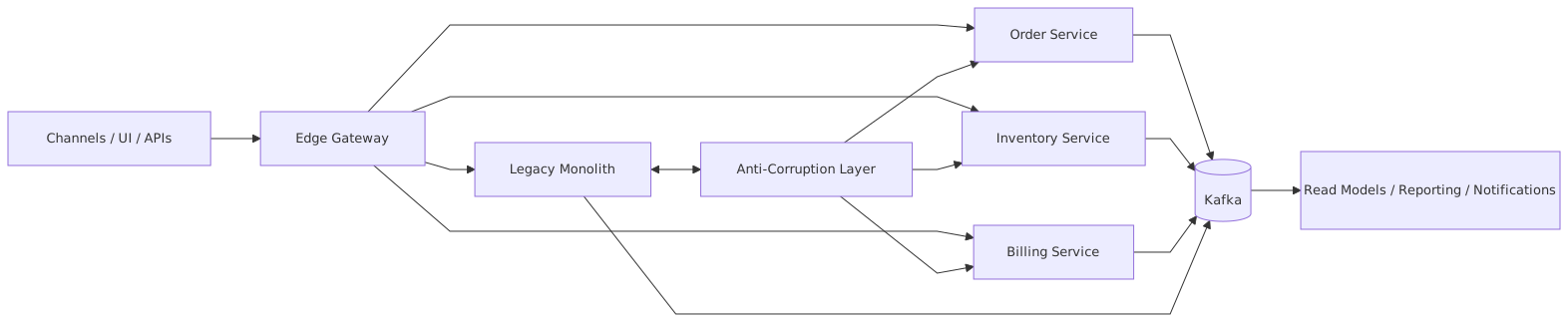
A few principles matter here.
Keep the monolith in the picture
The monolith is not the villain. During migration it becomes one participant among others. It may still own significant domains while extracted services take over specific capabilities. Route requests intentionally. Let some journeys continue through the monolith and others through new services. This is more honest than pretending the old system vanished because a new diagram says “target state.”
Separate operational APIs from integration events
A service should not use Kafka to avoid making hard boundary decisions. Commands and queries usually need APIs. Domain events distribute facts after decisions have been made. When teams mix those concerns, they create event-driven request/response systems that are harder to reason about than either style alone.
Prefer coarse-grained domain services over fine-grained fragments
If you split too early into tiny services, you create a distributed monolith. Capabilities become a confetti cannon. For most enterprises, the right first step is a set of domain services with meaningful transactional cohesion, not twenty-seven slivers because the capability map had twenty-seven boxes.
Use read models for cross-domain views
Enterprise users often need composite views: order plus customer plus payment plus shipment. Do not rebuild the monolith’s shared database via synchronous fan-out calls from the UI if you can avoid it. That path leads to latency, fragility, and expensive runtime coupling.
Instead, use event-fed read models or materialized views for operational dashboards and reporting where freshness tolerates seconds or minutes. For workflows requiring immediate decisions, call the authoritative service directly and keep the interaction focused.
Migration Strategy
This is where architecture stops being decorative.
A monolith should be decomposed progressively, one capability area at a time, with each extraction justified by business value and architectural leverage. The migration pattern is usually a form of strangler fig: wrap, divert, extract, reconcile, retire.
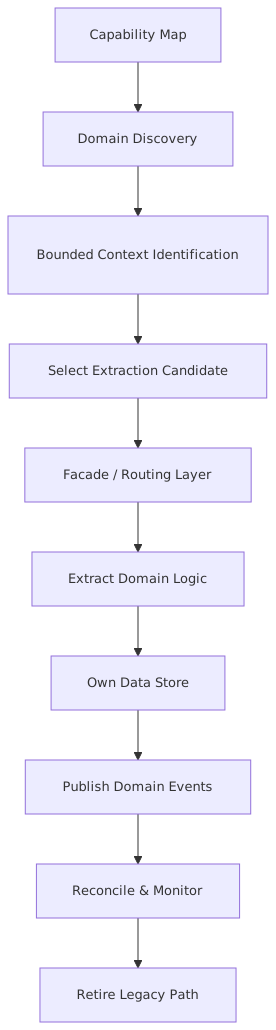
1. Choose extraction candidates by value and seam quality
Do not start with the noisiest executive demand or the easiest technical module. Start where three things overlap:
- meaningful business value from autonomy
- a reasonably discoverable domain boundary
- a migration seam that does not require immediate enterprise-wide semantic cleanup
Identity, product catalog, pricing, order capture, and notification orchestration are often candidates, but context matters. The best first extraction is the one that teaches the organization how to migrate safely while reducing pain.
2. Put in a routing or facade layer
Before extracting logic, create a stable ingress. This can be an API gateway, backend-for-frontend layer, or internal facade. Its purpose is not vanity abstraction. It gives you a switchboard so traffic can be redirected from monolith to new service without breaking callers.
This layer also lets you normalize authentication, observability, and version handling during migration.
3. Extract behavior before chasing database purity
Many teams begin by replicating tables and arguing about schemas. Better move: identify a specific business operation and make the new service authoritative for it. If the service can own a meaningful decision, the rest of the design sharpens.
For example, instead of “extract Customer service,” start with “extract address validation and customer contact preference management” only if those form a coherent bounded context. Better still, “extract pricing decision service” if the business desperately needs pricing agility and the rules can be isolated.
4. Introduce dual-read before dual-write
Dual-write is where migration projects go to die. If both monolith and service write the same concept during transition, divergence arrives quietly and leaves expensively.
Prefer a staged sequence:
- new service owns new writes for a specific operation
- legacy system reads from service via API or replicated view where needed
- historical data is synchronized in batches or streams
- old write path is retired
- only then consider shifting broader read ownership
If temporary coexistence requires mirrored state, make one side authoritative and design explicit reconciliation.
5. Reconciliation is not a side task
In real enterprise migrations, reconciliation is a first-class architecture concern. Event-driven synchronization, especially with Kafka, introduces delays, retries, ordering anomalies, poison messages, and schema evolution issues. A reconciliation process answers:
- What happens if an event is missed?
- How do we detect divergence between monolith and service?
- Who is authoritative when records disagree?
- Can we replay from Kafka safely?
- How do we handle historic corrections?
- What operational dashboard shows semantic drift, not just technical errors?
A mature migration includes reconciliation jobs, discrepancy reports, replay controls, and stewardship procedures. That may sound boring. It is also the difference between a migration and a confidence trick.
6. Retire paths, not just code
Extraction is complete only when old operational paths are shut off, support runbooks are updated, lineage is revised, data consumers are redirected, and teams stop depending on legacy behavior. Many so-called decomposed estates still have dead code and live assumptions tangled together years later.
Enterprise Example
Consider a global retail and wholesale distributor with a fifteen-year ERP-adjacent commerce monolith. The company sells through e-commerce, field sales, and partner channels. The monolith handles product catalog, customer accounts, pricing, order entry, inventory allocation, billing handoff, and reporting.
Leadership wants microservices. Fair enough. But the real business pain is more specific:
- pricing changes take weeks because rules are embedded across checkout, quote management, and back-office approval flows
- inventory promises are unreliable because availability logic mixes stock, inbound supply, and manual reservations
- order changes trigger support tickets because state transitions are hidden across modules
- regional business units use the same terms differently, especially around “customer,” “account,” and “ship-to”
A capability map shows major areas: Customer, Product, Pricing, Inventory, Order Management, Billing, Fulfillment. An inexperienced team might extract each as a service. That would be a mistake.
Domain discovery reveals this instead:
- Customer Identity and Access is separate from Commercial Account Management
- Pricing Decisioning is distinct from Contract Management
- Inventory Availability is distinct from Warehouse Execution
- Order Lifecycle Management overlaps with but should not absorb Fulfillment Execution
- Billing depends on order events but has its own legal and financial semantics
The company chooses Pricing Decisioning as the first extraction. Why?
- It is a strategic differentiator.
- It changes often.
- It is heavily constrained by monolith release cadence.
- It has a reasonably coherent authority boundary: produce prices, discounts, and explanations for a given selling context.
The team creates a Pricing service with its own rules store and API. Initially, the monolith calls it synchronously during quote and checkout flows. No grand rewrite. Just one authoritative service making pricing decisions.
Next, pricing decisions publish Kafka events for downstream analytics and audit. Not because events are fashionable, but because the enterprise needs traceability and near-real-time downstream consumption.
Then they extract Order Lifecycle Management, but only after clarifying semantics. The new Order service becomes authoritative for state transitions such as placed, confirmed, backordered, partially allocated, cancelled. Inventory remains authoritative for reservation outcomes. Billing remains authoritative for invoice state. Kafka events connect them.
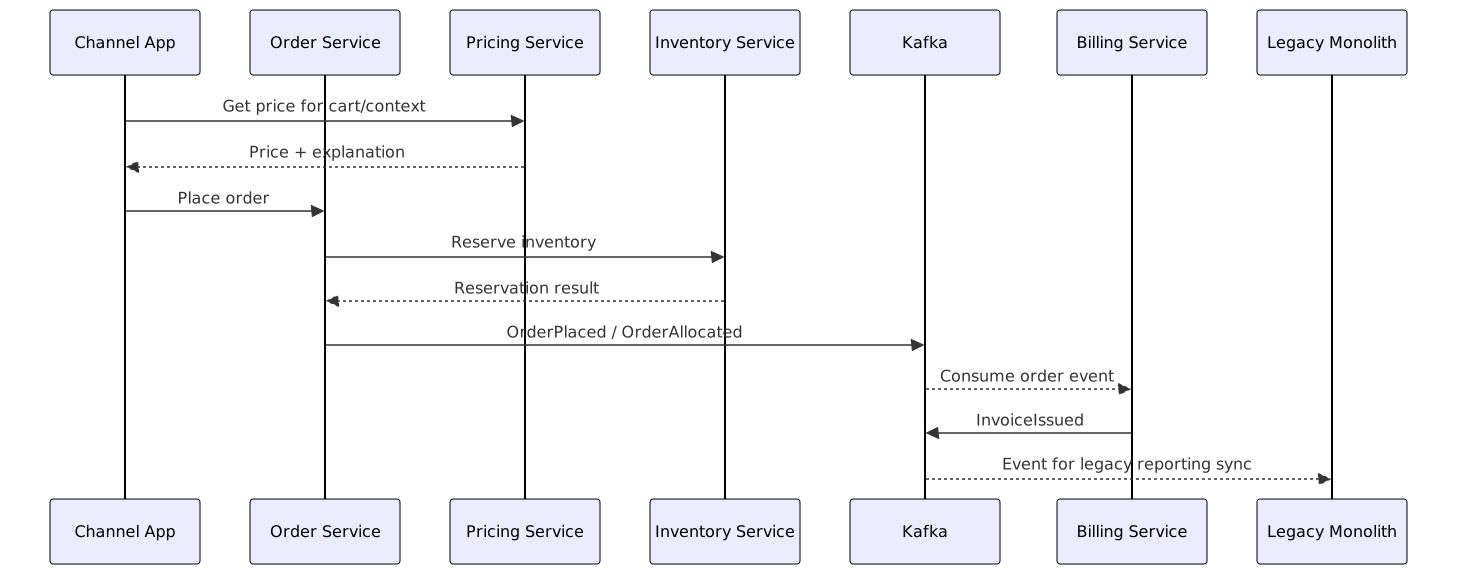
During migration, the monolith still handles reporting and some amendment flows. That creates reconciliation needs. If an order is amended through a legacy path, the change must be reflected in the new Order service or prohibited. The company chooses the harder but healthier option: lock certain amendment types in legacy UI and route them through the new service. They also build nightly reconciliation comparing order totals, status, and invoice references across systems.
The result after eighteen months is not a fully decomposed platform. It is better than that. It is an architecture where the most volatile and business-critical capabilities have explicit ownership, independent delivery, and clearer semantics. The monolith is smaller, but more importantly, the business language is less muddy.
That is progress you can bank.
Operational Considerations
Architecture articles often stop at service boundaries. Enterprises do not have that luxury.
Observability must follow business flows
You need technical telemetry, yes. But also business observability. Trace an order across services. Show when inventory reserved but billing failed. Correlate Kafka events by business key. Measure semantic lag, not just CPU.
If your dashboards say all services are healthy while customers are seeing duplicate invoices, your observability is decorative.
Schema and event governance matter
Kafka gives you wonderful decoupling and terrible opportunities for casual breakage. Use schema versioning, compatibility rules, and event ownership. Treat domain events as contracts. A topic is not a dumping ground for whatever the ORM emitted this week.
Data lineage and reporting need design
Executives still want enterprise reports. Regulators still want auditable trails. Finance still wants numbers to tie out. As domains separate, reporting has to move from direct SQL over one giant schema to curated data products, event-fed warehouses, or governed read models. This transition is architectural work, not downstream BI housekeeping.
Security and compliance boundaries may drive extraction
Sometimes a capability should be isolated not because of domain elegance but because of compliance: payment data, PII, health data, export controls. That is valid. But do not confuse compliance segmentation with domain design. They intersect; they are not identical.
Team topology is part of the architecture
A service without a team is a liability. Domain ownership must map to team ownership strongly enough that decisions, incidents, and roadmap tradeoffs have a home. If five teams all “sort of own” Order Management, you have recreated the monolith socially.
Tradeoffs
There is no free decomposition.
Benefits
- faster change in domain areas with independent ownership
- reduced release coupling
- more explicit business semantics
- scaling and resilience tailored to capability needs
- clearer accountability for rules and data
- better fit for event-driven integration and platform evolution
Costs
- eventual consistency and the operational burden that comes with it
- more complex testing, especially end-to-end business journeys
- duplicated reference data and synchronization concerns
- contract governance overhead
- increased need for observability, SRE discipline, and support maturity
- longer migration timelines than stakeholders hope for
The hardest tradeoff is usually between semantic purity and migration practicality. Sometimes the ideal bounded context cannot be extracted first because it sits in the middle of too many dependencies. Fine. Architecture is not a religion. Sequence matters. But be honest when you are taking a pragmatic step so you can avoid canonizing a temporary compromise into permanent structure.
Failure Modes
I have seen the same failure patterns repeatedly.
Capability map literalism
Teams turn every capability box into a service. This creates coarse labels with poor semantic cohesion or, worse, tiny services with constant chatter. A capability map is a conversation starter, not a code generation template.
Shared database after “decomposition”
Services are declared, but they still read and write the same schema. This is not decomposition. It is a team boundary painted over a technical dependency. It postpones conflict until later, when it becomes more expensive.
Event theater
Everything becomes an event. Commands are hidden in topics. Consumers depend on incidental field meanings. Nobody knows which events are authoritative facts versus processing milestones. Kafka turns into a distributed rumor mill.
Ignoring reconciliation
The migration plan assumes happy-path synchronization. No serious divergence detection is designed. Months later, support teams manually compare records between systems while architects discuss target state maturity.
Wrong bounded context
A service is extracted around a noun instead of a business responsibility. “Customer service” becomes identity, profile, credit, preferences, legal party, and support history mashed together. It grows into a new monolith with network latency.
Team misalignment
Even well-designed service boundaries fail when teams are structured around channels, projects, or technologies instead of domains. If the mobile team owns one half of Order logic and the back-office team owns the other, your architecture diagram is fiction.
When Not To Use
You should not decompose a monolith by capability in every situation.
Do not do it when the monolith is small, cohesive, and maintained by a team that can change it safely. A monolith with good modularity often beats a poorly decomposed service estate.
Do not do it when the main problem is weak engineering discipline. Microservices are not a cure for bad testing, unclear ownership, or chaotic release practices. They amplify those problems.
Do not do it when domain boundaries are deeply unclear and the organization is unwilling to invest in discovery. If people cannot agree what an order, account, or policy actually means, distributing those concepts just spreads confusion faster.
Do not start with decomposition if your operational maturity is low. If you cannot monitor, deploy, secure, and support multiple independently running components, extraction will create fragility, not agility.
And do not decompose because the cloud migration program needs a slogan. That path produces expensive architecture with little business gain. cloud architecture guide
Related Patterns
A few patterns pair naturally with capability-based decomposition.
- Bounded Context: the key DDD construct for defining semantic and ownership boundaries.
- Strangler Fig Pattern: progressive replacement of monolith behavior through routing and staged extraction.
- Anti-Corruption Layer: translation layer that prevents legacy model pollution.
- Domain Events: business facts emitted by authoritative services.
- Saga / Process Manager: coordination for long-running workflows across services where no single transaction exists.
- CQRS and Read Models: useful for cross-domain views and reporting without synchronous fan-out.
- Outbox Pattern: reliable publication of domain events from service transactions.
- Data Product / Analytical Integration: for enterprise reporting once direct monolith SQL access is retired.
These are not ingredients to use all at once. They are tools. Use the few that solve the actual migration and domain problems in front of you.
Summary
Decomposing a monolith by capability sounds clean because capabilities sound clean. Real systems are not.
The useful move is to treat the capability map as the first sketch, not the final blueprint. Then apply domain-driven design to uncover bounded contexts, clarify business semantics, and identify authoritative decision boundaries. Extract progressively. Keep the monolith alive where necessary. Use strangler migration, anti-corruption layers, and Kafka-backed domain events where they genuinely reduce coupling. Design reconciliation from the start, because eventual consistency without reconciliation is just deferred failure.
The goal is not a landscape of tiny services. The goal is a software estate whose structure matches the business well enough that teams can change it without fear and operations can trust it under stress.
That takes more than slicing code. It takes semantic honesty.
And in enterprise architecture, semantic honesty is rare enough to be a competitive advantage.
Frequently Asked Questions
What is enterprise architecture?
Enterprise architecture aligns strategy, business processes, applications, and technology in a coherent model. It enables impact analysis, portfolio rationalisation, governance, and transformation planning across the organisation.
How does ArchiMate support architecture practice?
ArchiMate provides a standard language connecting strategy, business operations, applications, and technology. It enables traceability from strategic goals through capabilities and services to infrastructure — making architecture decisions explicit and reviewable.
What tools support enterprise architecture modeling?
The main tools are Sparx Enterprise Architect (ArchiMate, UML, BPMN, SysML), Archi (free, ArchiMate-only), and BiZZdesign. Sparx EA is the most feature-rich, supporting concurrent repositories, automation, scripting, and Jira integration.