⏱ 19 min read
Most architecture diagrams lie.
Not maliciously. Just optimistically. They present a clean world of boxes, arrows, and tidy ownership boundaries, while the actual business runs on exceptions, phone calls, spreadsheets, late approvals, tacit knowledge, and the institutional folklore of “how things really work.” The reason event storming is so powerful is not that it creates better sticky note walls. It drags the mess into the open. And once you see the mess clearly, architecture stops being a technical composition exercise and becomes what it should have been all along: a decision about business change.
That is the real move from event storming to architecture in Domain-Driven Design. You are not translating orange notes into microservices as if one note equals one API. You are discovering where the business changes state, who cares about that change, what language different groups use for the same thing, and where responsibility truly sits. The sticky notes are not the architecture. They are evidence. microservices architecture diagrams
Good architects know this. Bad architects skip it.
They leap from workshop artifacts to technology choices—Kafka, Kubernetes, event sourcing, sagas, service meshes—because technology feels precise. Domain semantics do not. But semantics are where the cost lives. If Sales says “order booked,” Finance says “order recognized,” and Fulfillment says “order releasable,” then a single OrderService is not simplification. It is a future outage with a REST API.
This article is about that journey: from collaborative event discovery to a practical architecture shaped by Domain-Driven Design, suitable for large enterprises, legacy migration, and the awkward middle states where old and new systems must coexist. We will talk about bounded contexts, service boundaries, Kafka, reconciliation, progressive strangler migration, operational concerns, and the places where this approach fails. Because it does fail. Every useful architecture idea has a blast radius when applied carelessly. event-driven architecture patterns
Context
Event storming became popular because it solved a problem most architecture methods politely ignored: people in different parts of the organization do not share the same mental model of the business. They often do not even share the same nouns.
In a typical enterprise, the process appears unified on PowerPoint. In reality, it is fractured across departments, systems, and incentives. Customer onboarding spans CRM, risk, pricing, identity verification, contract management, and billing. Claims processing stretches from intake to investigation to decision to payment to recovery. Supply chain planning dances between forecasts, allocations, procurement rules, warehouse constraints, and carrier failures. The business process is one story to executives and seven incompatible stories to the systems.
Event storming is useful because it starts with behavior, not structure. It asks: what happened? What triggered it? What policy reacted? What command caused the next change? Which aggregate, if any, guarded consistency? Who depended on the outcome? It surfaces domain events as a shared narrative of business change.
That matters because architecture in DDD begins with the shape of change.
Entities and data models matter, but they are often too static to reveal the seams that matter operationally. Events tell you where time matters, where coordination matters, where consistency matters, and where language diverges. If an “application submitted” event means one thing to underwriting and another to onboarding, you have found an architectural fault line. If a cancellation can happen after fulfillment planning but before shipment booking, you have found a temporal hazard. If one domain emits state changes that five others reinterpret, you have found either a platform capability or a dangerous source of semantic coupling.
The workshop is not the destination. It is reconnaissance.
Problem
The hard problem is not producing an event storming board. The hard problem is converting discovery into a durable architecture without flattening the domain into technical convenience.
Many teams make one of three mistakes.
First, they map every cluster of sticky notes into a microservice. This creates a confetti architecture: too many services, too little autonomy, and endless choreography for work that was never meaningfully separate. The result is distributed transaction pain disguised as “modernization.”
Second, they retain a giant shared domain model and simply wire events around it. This preserves the old conceptual monolith under a new transport layer. Teams congratulate themselves for adopting asynchronous messaging while continuing to share semantics they have never actually aligned.
Third, they overcorrect into platform fetishism. Kafka becomes the architecture. Every state change becomes an event, every event becomes durable, every service becomes event-driven whether it should be or not. The business gets a highly available stream of confusion.
The real challenge is choosing boundaries that reflect domain meaning, support team autonomy, and survive change. That means deciding where strong consistency is required, where eventual consistency is acceptable, which domain events are facts versus notifications, and how legacy systems are strangled without breaking operations.
Those decisions are not obvious from the wall of sticky notes. They emerge from judgment.
Forces
A good architecture is a negotiated settlement among forces that do not naturally agree.
Domain semantics versus technical neatness
The enterprise rewards simplification, but the domain punishes oversimplification. “Customer,” “account,” “shipment,” “claim,” and “order” are often overloaded terms. Event storming exposes these collisions. DDD tells you not to erase them prematurely. If different bounded contexts need different meanings, let them. Translation is cheaper than semantic corruption.
Consistency versus flow
Some decisions must be atomic. Credit exposure updates, double-spend prevention, inventory reservation, and legal commitments often need strong consistency inside a boundary. But enterprise processes usually span multiple boundaries. There, trying to preserve global ACID guarantees becomes expensive theater. Event-driven coordination, compensations, and reconciliation become the practical tools.
Team autonomy versus operational complexity
Splitting a domain into services can let teams move independently. It can also create brittle networks of dependencies, duplicate data, and hard-to-debug asynchronous failure. Independence is earned through good boundaries, not declared through container counts.
Legacy reality versus greenfield fantasy
No serious enterprise starts from a blank page. There is usually an ERP, a policy administration platform, a mainframe, a CRM with too much power, and three undocumented batch jobs holding the business together. Migration has to coexist with these realities. Strangler patterns, anti-corruption layers, and parallel run matter more than doctrinal purity.
Auditability versus speed
Regulated domains need traceability. You must explain why a decision was made, which data was used, what changed, and who was informed. Event-driven architecture helps here, but only if events are meaningful business facts, not implementation noise.
Solution
The path from event storming to architecture is not “identify events, then make services.” It is more deliberate:
- Use event storming to reveal business change and language.
- Derive bounded contexts from semantic and policy boundaries.
- Assign consistency rules inside contexts, and coordination patterns between them.
- Choose service boundaries only where they support those contexts operationally.
- Design migration through progressive strangler steps, not replacement fantasies.
- Build reconciliation into the architecture from day one.
That last point deserves emphasis. In enterprise systems, reconciliation is not a sad afterthought for when eventual consistency goes wrong. It is how the business lives with distributed reality. Financial ledgers reconcile. Shipment plans reconcile. Claims statuses reconcile. Inventory positions reconcile. If your target architecture has no explicit reconciliation model, it is not enterprise architecture. It is a demo.
From event storming to bounded contexts
The first architectural move is to identify where ubiquitous language holds and where it breaks. During event storming, watch for these signals:
- the same term used with different acceptance criteria
- policies owned by different departments
- events interpreted differently by different consumers
- conflicting timelines or state transitions
- different reasons for change
- different measures of success
These are candidates for bounded contexts.
For example, in retail commerce, OrderPlaced may appear straightforward. But the sales domain may care about customer commitment, pricing, and channel attribution. Fulfillment cares about pickability, sourcing, and shipping constraints. Finance cares about invoice eligibility and revenue recognition. A single all-powerful Order context often becomes a semantic landfill. Better to separate Sales Order, Fulfillment Order, and Financial Obligation if the language and policies truly differ.
From bounded contexts to architecture
Once the contexts are clearer, choose how they interact:
- Shared nothing with domain events when autonomy is high and consistency can be eventual.
- Published language when a context exposes carefully defined events for others.
- Anti-corruption layer when integrating with legacy or a foreign model.
- Process manager or saga when long-running coordination is required.
- Synchronous API when immediate feedback is needed and semantic dependency is acceptable.
- Batch or file integration when the domain tolerates periodic convergence and the estate demands it.
Architecture is less about picking one style and more about knowing which style belongs where.
Architecture
A useful target architecture typically has three levels of concern: domain boundaries, interaction patterns, and platform capabilities.
1. Domain boundaries
The primary structure is bounded contexts. Not layers. Not databases. Contexts.
Each context owns its model, rules, and persistence. It emits domain events that reflect meaningful state changes in its own language. It does not expose internal tables disguised as topics. A topic named customer_master_all_fields_v12 is not event-driven architecture. It is database replication with Kafka in the middle.
2. Interaction patterns
Contexts interact through a mix of commands, queries, and events.
- Commands express intent to a context that owns a decision.
- Domain events announce facts after a decision.
- Queries retrieve information where coupling is acceptable and latency matters.
This combination is healthy. A mature architecture is not allergic to synchronous calls. It uses them sparingly where the domain warrants immediacy, and uses events where decoupling, replay, and time-shifted processing matter.
3. Platform capabilities
Kafka is often useful here, especially in enterprises with many downstream consumers, audit needs, or event-driven workflows. But Kafka is transport and retention. It is not your domain model. Use it to distribute stable business events, support retries, enable stream processing where justified, and decouple consuming teams from producing release cycles.
Do not put every internal state transition on Kafka. That way lies topic sprawl and semantic debt.
Here is a simplified view of how event storming insight becomes bounded contexts and interactions:

A note on aggregates
DDD aggregates still matter. They are not old-fashioned. They define transactional consistency boundaries inside a context. If PaymentAuthorized and CreditExposureUpdated must move together to maintain an invariant, they likely belong within one consistency boundary or behind one decision point. Event storming often highlights where those invariants are hiding.
Do not confuse aggregates with services either. An aggregate is a model-level consistency boundary. A service is a deployment and operational boundary. Sometimes they align. Often they do not.
Event taxonomy matters
In enterprise systems, it helps to distinguish:
- Domain events: business facts, meaningful to the domain.
- Integration events: externalized versions suitable for other contexts or external systems.
- System events: implementation-level signals for operations.
Keep them separate conceptually. Publishing every domain event verbatim to the enterprise can expose unstable language or confidential internals. Sometimes a context needs to translate an internal event into a public integration event.
Here is a representative architecture pattern for a context-rich event-driven estate:
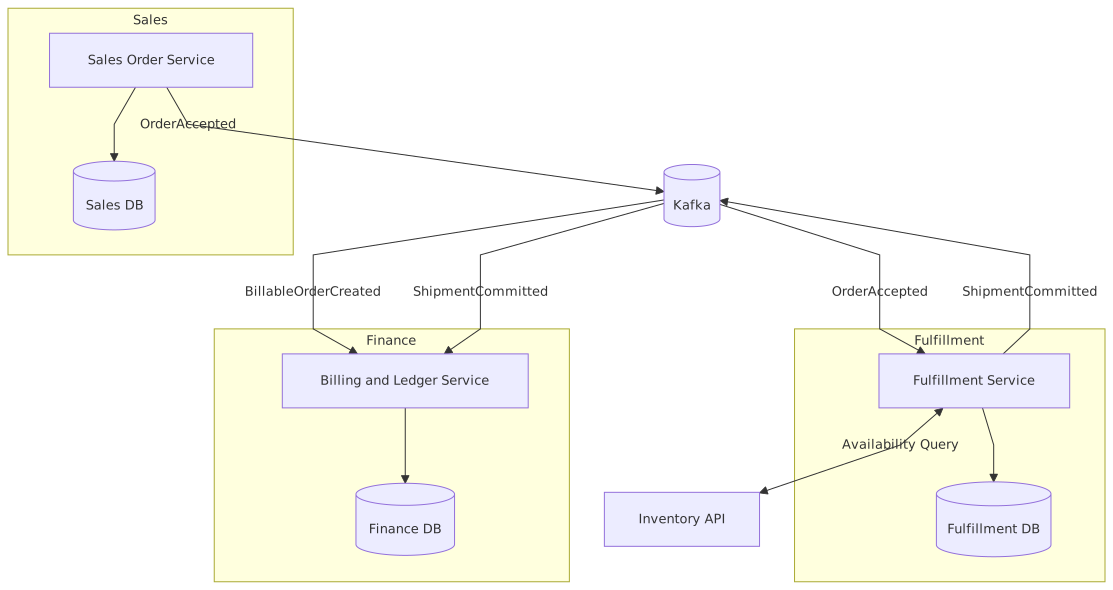
Notice the asymmetry. Fulfillment queries inventory synchronously because an immediate sourcing answer may be needed. Finance consumes events because billability follows business progression and can tolerate asynchronous coordination. This is what architecture looks like when you allow the domain to choose the mechanism.
Migration Strategy
Most enterprises cannot replace core systems in one motion. Nor should they try. The better path is a progressive strangler migration, guided by domain boundaries and business events.
The goal is not to “move to microservices.” The goal is to relocate decision-making and change over time from the old model to the new one, with controlled risk.
Step 1: Observe before you replace
Start by instrumenting the legacy landscape. Capture business events around key transitions, even if initially emitted from adapters around the old system. You need a reliable view of actual business behavior before you can safely carve out responsibilities.
This is where Kafka can be valuable as an event backbone for observation and downstream consumers, even before major domain extraction. But be careful: observed events from a legacy monolith are often polluted by legacy semantics. Treat them as temporary integration events, not eternal truth.
Step 2: Extract a bounded context at a seam of business value
Pick a context where:
- business pain is visible,
- semantic boundaries are reasonably clear,
- integration points are manageable,
- and failure will not halt the company.
This is often not the biggest system. It is the system with the cleanest seam.
Examples include pricing, notifications, appointment scheduling, returns initiation, fraud screening, or partner onboarding. In banking, customer dispute intake may be easier to extract than core account posting. In insurance, first notice of loss is often easier than claims adjudication.
Step 3: Build an anti-corruption layer
The anti-corruption layer translates between the old model and the new context’s language. This is not glamorous work, but it is essential. Without it, the new bounded context becomes infected with old semantics and the migration becomes cosmetic.
Step 4: Run in parallel and reconcile
For a period, both worlds may process overlapping concerns. You need explicit reconciliation:
- compare event counts,
- compare aggregate states,
- identify drift windows,
- define tolerance thresholds,
- and establish manual resolution paths.
Architects who skip reconciliation because it sounds “operational” usually end up debugging business discrepancies in executive war rooms.
Step 5: Shift authority, not just traffic
The key milestone in strangler migration is when the new context becomes the system of decision for a capability. Not merely the system of record copy. Authority matters more than storage.
Step 6: Retire old paths
Only when the authority is shifted, reconciliations are stable, and exception handling is mature should the old path be removed.
A typical progressive strangler looks like this:
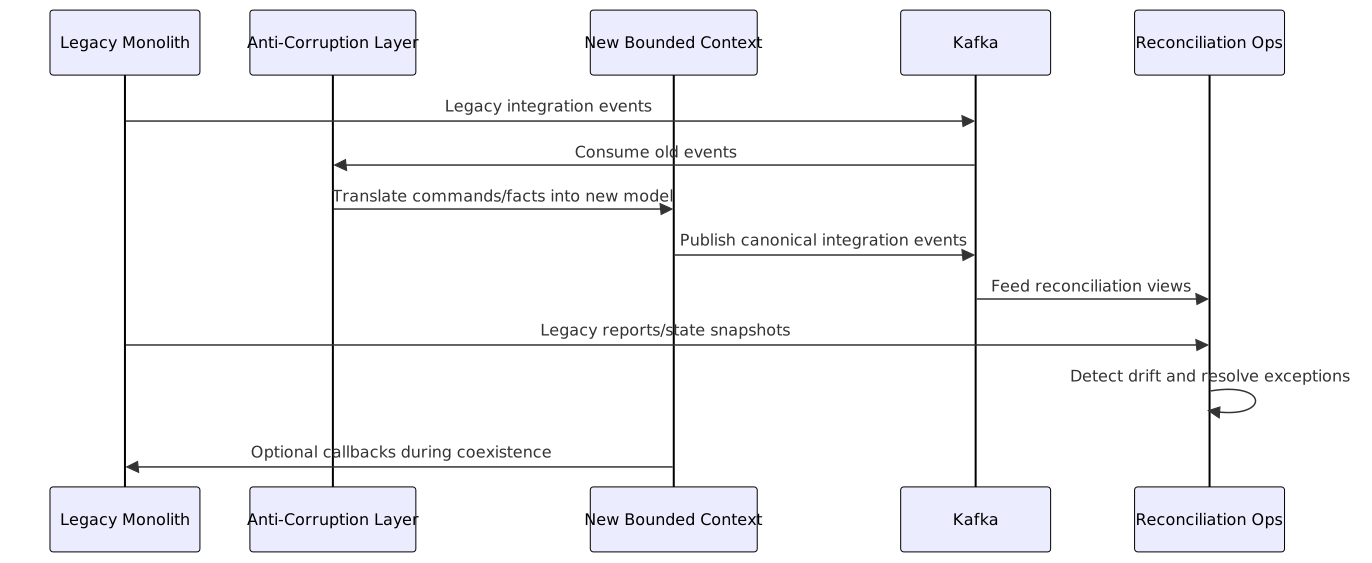
This is messy. It is supposed to be. Migration architecture is about controlling mess, not pretending it can be avoided.
Enterprise Example
Consider a large insurer modernizing claims processing.
The legacy estate includes a policy administration system, a claims mainframe, document management, payment engine, and an analytics platform. On paper, “claims” looks like one domain. In reality, event storming reveals several bounded contexts:
- Claim Intake: receiving notice of loss, validating initial details, assigning claim identifiers.
- Coverage Assessment: determining whether the policy covers the event.
- Claim Handling: investigations, adjuster tasks, reserve changes, liability decisions.
- Settlement: payment approval, disbursement, recovery.
- Fraud Screening: separate models, thresholds, and actions.
- Customer Communication: notifications, preferences, statutory notices.
A naive design would create a ClaimsService and put everything behind it. That would reproduce the monolith in distributed form.
A better design recognizes that claim intake and fraud screening can be extracted earlier. They have clearer seams, strong business value, and can publish meaningful events such as ClaimReported, FraudCheckRequested, and FraudCheckCompleted. Coverage assessment may remain closer to policy administration at first because the semantic coupling is high and the rules are deeply embedded in legacy systems. Settlement may need to coordinate with the payment engine and ledger systems using robust reconciliation and idempotent integration.
Kafka becomes useful here because many parties care about claim progression: analytics, customer communication, document workflows, reserve monitoring, and compliance reporting. But the insurer must publish stable integration events, not internal workflow chatter. ClaimReported is useful. Step42ValidationPassed is not.
The migration proceeds by first extracting claim intake behind an anti-corruption layer. New digital channels submit claims to the new intake context. The old claims mainframe still receives translated records during coexistence. Reconciliation compares claim identifiers, intake timestamps, and key attributes. Fraud screening then consumes the canonical intake events and publishes decisions asynchronously. Over time, authority for claim registration shifts to the new intake context. The mainframe becomes downstream rather than primary for that capability.
This is where DDD earns its keep. The architecture is not organized around the existing application suite. It is organized around domain meaning and migration economics.
Operational Considerations
Enterprise architecture lives or dies in operations.
Idempotency
Events will be duplicated. Messages will be replayed. Consumers will restart after partial failure. Idempotency is not optional. Commands and event handlers should tolerate duplicates through natural keys, processed-event tracking, version checks, or business-safe merge logic.
Ordering
Kafka can preserve order within a partition, but enterprises routinely assume more ordering than they actually have. Cross-partition and cross-topic ordering is not guaranteed. Design consumers so they rely on causal keys only where necessary, and make sequence assumptions explicit.
Reconciliation
Reconciliation deserves first-class architecture treatment:
- periodic comparison jobs
- exception queues
- business dashboards for drift
- replay tooling
- operator workflows for correction
- audit trails for manual intervention
In finance-heavy domains, this often means maintaining ledger-like views or control totals. In logistics, it may mean comparing shipment states across WMS, TMS, and customer-facing systems. In insurance, reserve and payment states must reconcile across claim and finance contexts.
Observability
Trace by business key, not just technical correlation ID. If an operator cannot follow Claim-12345 or Order-98765 across contexts, your observability is developer-centric but enterprise-useless.
Data retention and schema evolution
Event contracts evolve. Use versioning discipline, schema registries where helpful, and consumer-tolerant changes. Breaking event schemas casually in a large estate is a slow-motion outage.
Security and privacy
Domain events can leak more than intended. Personal data, financial details, and regulated fields should not be sprayed across topics without design discipline. Event minimization is as important as API minimization.
Tradeoffs
This approach is strong, but not free.
Pros
- clearer alignment between business semantics and system boundaries
- better team autonomy when contexts are real
- stronger auditability around business facts
- safer migration through strangler steps
- resilience through asynchronous decoupling where appropriate
Costs
- more translation work across contexts
- eventual consistency and the operational burden that follows
- higher demand for mature product and domain stewardship
- more difficult debugging across asynchronous flows
- risk of over-fragmentation if services are split too eagerly
There is no architecture without tax. The question is whether you are paying in places that matter. I would rather pay for translation and reconciliation than pay for semantic confusion hidden inside a giant service that no team can safely change.
Failure Modes
There are predictable ways this goes wrong.
Sticky-note literalism
Teams convert workshop clusters directly into services. The result is thin services with constant chatter and no real autonomy.
Event inflation
Every internal method call becomes an event. Kafka fills with low-value signals. Consumers couple to transient implementation details. The architecture becomes noisy and brittle.
Shared database relapse
Contexts are declared but still read each other’s tables “temporarily.” Temporary in enterprises is a geological term. This destroys ownership and makes event contracts performative rather than real.
Ignoring reconciliation
Teams embrace eventual consistency but provide no tools to detect or correct divergence. Business trust collapses quickly when numbers do not match.
Semantic leakage from legacy
The anti-corruption layer is skipped or underbuilt. Legacy statuses, codes, and assumptions seep into the new model. The new architecture inherits the old disease.
Choreography without governance
Too many contexts react to each other’s events without clear ownership of process outcomes. No one knows who is responsible when the journey stalls. Sometimes a process manager or saga is the right answer precisely because the business wants explicit coordination ownership.
When Not To Use
DDD-driven event storming leading to event-heavy service architecture is not universally appropriate.
Do not use it when the domain is simple, stable, and mostly CRUD. A back-office reference data application does not need six bounded contexts and Kafka topics with poetic names.
Do not use it when the organization lacks the capacity to own semantics. If teams are not able or willing to steward language, contracts, and operational responsibility, distributed boundaries will amplify confusion.
Do not use event-first architecture for latency-critical, tightly coupled computation that genuinely belongs in one consistency boundary. Some workloads are better as modular monoliths. That is not failure. It is judgment.
Do not launch into this approach solely because the enterprise wants microservices. Microservices are a deployment consequence of boundary decisions, not a strategy in themselves.
And do not confuse workshop enthusiasm with readiness. A brilliant event storming session can produce terrible architecture if the surrounding governance, operational tooling, and migration discipline are missing. EA governance checklist
Related Patterns
Several patterns routinely appear alongside this approach:
- Bounded Contexts for semantic separation
- Context Mapping to define relationships between models
- Anti-Corruption Layer for legacy and external integration
- Saga / Process Manager for long-running business coordination
- Outbox Pattern for reliable event publication
- CQRS where write and read concerns genuinely diverge
- Event Sourcing in selected domains needing full behavioral history, not as a default
- Strangler Fig for progressive migration
- Canonical event contracts with caution; useful for integration, dangerous when over-centralized
A word on event sourcing: it is often mentioned in the same breath as event storming, but they are not twins. Event storming is a discovery method. Event sourcing is a persistence strategy. Sometimes they fit beautifully together. Often they do not. Do not let one drag in the other without need.
Summary
Event storming is valuable because it reveals how the business actually changes. Domain-Driven Design is valuable because it gives those discoveries architectural shape. The move from sticky notes to services is not a translation exercise. It is an act of boundary judgment.
Start with behavior. Listen for language collisions. Draw bounded contexts where meaning and policy cohere. Keep strong consistency inside those contexts where invariants demand it. Use events between contexts where decoupling and time matter. Use Kafka as a backbone when it serves the domain, not as a substitute for one. Build anti-corruption layers for legacy. Migrate progressively with strangler patterns. And treat reconciliation as a first-class citizen, because the enterprise certainly will.
The best architecture is not the one with the prettiest event map or the most topics. It is the one that lets the business change safely without making every change a negotiation with accidental complexity.
Sticky notes are where the truth first peeks out.
Architecture is what you do once you believe it.
Frequently Asked Questions
What is enterprise architecture?
Enterprise architecture aligns strategy, business processes, applications, and technology in a coherent model. It enables impact analysis, portfolio rationalisation, governance, and transformation planning across the organisation.
How does ArchiMate support architecture practice?
ArchiMate provides a standard language connecting strategy, business operations, applications, and technology. It enables traceability from strategic goals through capabilities and services to infrastructure — making architecture decisions explicit and reviewable.
What tools support enterprise architecture modeling?
The main tools are Sparx Enterprise Architect (ArchiMate, UML, BPMN, SysML), Archi (free, ArchiMate-only), and BiZZdesign. Sparx EA is the most feature-rich, supporting concurrent repositories, automation, scripting, and Jira integration.