⏱ 21 min read
Most architecture diagrams lie.
Not because architects are dishonest, but because diagrams usually freeze a living system into a dead picture. They show boxes and lines, environments and arrows, maybe a database cylinder or two for comfort. The result looks precise and feels reassuring. But the real enterprise doesn’t behave like that. It behaves like a city: routes appear, neighborhoods drift, boundaries harden in one place and blur in another, and the meaning of “connected” depends very much on who is asking.
That is why topology matters.
When topology is treated as decoration, architecture becomes cosmetics. When topology is treated as a domain model, architecture becomes operationally useful. You stop drawing infrastructure as if it were furniture placement and start modeling the actual semantics of adjacency, containment, reachability, ownership, trust, dependency, propagation, and failure. And once you do that, a surprising thing happens: your architecture models begin to support reasoning rather than merely documentation.
This is especially important in modern enterprises where microservices, Kafka event streams, API gateways, identity zones, cloud landing zones, data products, and regulated boundaries all intersect. In those environments, topology is not just “where things run.” It is part of what the business is. event-driven architecture patterns
If a payment service may communicate with a fraud engine only through an approved event channel, that is not a low-level implementation detail. It is a business constraint expressed through architecture. If customer data may cross from one region to another only after tokenization, that is topology carrying domain semantics. If a claims platform reconciles asynchronous records from policy, billing, and provider systems because the enterprise is inherently federated, then the shape of the system is itself a model of the organization’s operating reality.
That is the heart of the matter: topology can and should be modeled as a first-class domain concept.
This article makes that case in practical enterprise terms. We’ll look at the problem with static architecture diagrams, the forces that make topology meaningful, the solution pattern of treating topology as domain model, and the migration path from legacy landscapes through progressive strangler approaches. We’ll cover Kafka and microservices where they matter, discuss reconciliation explicitly, and examine the tradeoffs, failure modes, and situations where this approach is the wrong tool. microservices architecture diagrams
Context
In most organizations, architecture models are split across too many mental worlds.
Business architecture talks about capabilities, value streams, products, and operating models. Application architecture talks about services, APIs, and systems of record. Infrastructure architecture talks about networks, clusters, environments, and cloud services. Security architecture talks about trust zones, policy boundaries, and identity control planes. Data architecture talks about lineage, domains, governance, and platform patterns. EA governance checklist
Each of these views is valid. The trouble starts when they cannot be reconciled.
A business domain such as customer onboarding might span CRM, KYC services, fraud checks, document stores, workflow engines, event brokers, and multiple regional data zones. In the usual architecture repository, each of those elements exists in a different modeling vocabulary. The “topology diagram” is often relegated to deployment detail, while the “domain model” is kept abstract and business-friendly. That separation looks neat on paper and fails under pressure.
Real enterprises don’t break in one modeling layer at a time.
They break because a business process crosses a trust boundary. Because an event stream introduces eventual consistency no one budgeted for. Because the ownership boundary of a service doesn’t match the lifecycle of the data it emits. Because a platform team assumed network reachability implied business legitimacy. Because an architecture review blessed a service decomposition without understanding the topology of reconciliation.
This is where domain-driven design helps. DDD has always insisted that software structure should reflect business meaning. Bounded contexts, ubiquitous language, aggregates, context maps—these are not coding techniques dressed up as strategy. They are methods for making system shape correspond to domain truth. If we take that seriously, then topology should not sit outside the model. It should be part of the model wherever connectivity, containment, policy, routing, timing, or propagation have business meaning.
And in enterprises, they almost always do.
Problem
Traditional architecture modeling treats topology as passive.
A typical topology model diagram answers questions like:
- What runs in which environment?
- Which systems talk to which?
- Where are the databases?
- Through which network segments do calls pass?
Those are useful questions. They are not sufficient.
The deeper problem is that topological relationships often encode domain rules, operational policy, and organizational intent, but the model doesn’t admit that. So architects compensate with prose, tribal memory, spreadsheets, and review boards. The architecture becomes dependent on meetings. That is always a bad sign.
Consider a few familiar enterprise conditions:
- A service may consume customer identity events but may not query the golden record directly.
- A regional order system can emit shipment updates globally, but inventory corrections must remain within legal jurisdiction.
- A fraud model may score a payment synchronously, but customer account state is reconciled asynchronously from several source systems.
- A partner integration is allowed to publish onto a Kafka topic namespace only through a controlled gateway with schema validation and tenancy isolation.
- A support workflow can read masked customer history from analytics storage, but only a case management service may trigger remediation actions.
These are topological statements. They describe allowable paths, reachable states, and meaningful boundaries. Yet many architecture approaches bury them under implementation detail. The result is subtle but costly: the architecture repository describes the pieces, but not the shape of the enterprise reality.
That gap shows up in several ways:
- Microservice boundaries become arbitrary. Teams draw service boundaries from technical convenience rather than domain semantics and then discover that communication patterns violate business ownership.
- Kafka becomes a dumping ground. Event streaming is introduced for decoupling, but topic design reflects technical pipelines rather than bounded contexts and business events. Soon everything is connected to everything.
- Reconciliation is discovered late. Multiple systems hold partial truth, but the architecture model assumes a single authoritative source. Then operations invent manual balancing processes after go-live.
- Security and compliance become add-ons. Trust zones are modeled as infrastructure overlays rather than domain-relevant constraints on what relationships are legal.
- Migration plans understate coupling. Legacy replacement is scoped around applications, while the real challenge lies in untangling topological dependencies and synchronization behavior.
This is one of those architecture problems that looks abstract until the invoices arrive.
Forces
Several forces push enterprises toward topology-aware modeling.
Domain semantics are spatial, not just structural
A domain often has meaningful notions of inside, outside, near, allowed, isolated, upstream, downstream, and transit. Financial systems care about control points. Healthcare systems care about custody and consent boundaries. Retail platforms care about channel adjacency and fulfillment reachability. These are not metaphors. They affect what can happen.
Organizations are federated
Large enterprises are rarely monoliths in governance. They are coalitions. Product teams, platform teams, data teams, regional entities, and risk functions all own different slices of truth. Topology expresses those ownership boundaries whether the architecture model admits it or not. ArchiMate for governance
Event-driven systems introduce delayed truth
Kafka and similar platforms shift coupling from direct invocation to temporal coordination. That can be excellent. It can also create a world where state is valid in one context, pending in another, and disputed in a third. Reconciliation stops being an exception and becomes part of the normal shape of the domain.
Cloud platforms make connectivity easy
And easy connectivity is dangerous. In old estates, the network team accidentally enforced architecture by making change slow. In cloud estates, engineers can wire almost anything to almost anything. Without topological semantics, local optimizations create enterprise spaghetti at higher speed.
Regulation attaches to paths, not just data
Compliance is often modeled as metadata on records. In practice, regulators care about where data goes, who can cause movement, what transformations happen in transit, and whether paths are auditable. Again, topology is carrying business significance.
Migration is about shape, not just code
Legacy modernization fails when teams try to replace applications without replacing their position in the enterprise topology. A new microservice that still depends on old synchronization paths is not modernized. It is just younger.
Solution
Treat topology as a domain model.
That does not mean every network hop belongs in the business model. It means architectural topology should be modeled in a language that captures domain semantics, not only deployment mechanics. A topology element is not simply a node. It may represent a bounded context, trust zone, tenancy boundary, jurisdiction, event channel, ownership domain, or reconciliation surface. A relationship is not simply a line. It may represent command authority, information flow, policy-mediated access, event propagation, or eventual convergence.
This approach works best when you define a small, opinionated vocabulary.
For example:
- Domain Zone: a meaningful boundary of ownership, policy, or legal control.
- Capability Node: a system or service cluster that realizes a domain capability.
- Interaction Path: a typed connection such as command, query, event, file transfer, or workflow signal.
- Trust Boundary: a boundary that changes authentication, authorization, inspection, or audit requirements.
- Reconciliation Surface: a place where multiple truths must be resolved into an operationally accepted state.
- Transit Policy: rules governing movement across zones, including transformations, masking, validation, and lineage.
- Authority Gradient: explicit distinction between systems that decide, systems that observe, and systems that derive.
Now the topology model diagram becomes more than a picture. It becomes a representation of the enterprise’s operating semantics.
Here is a simple conceptual view:
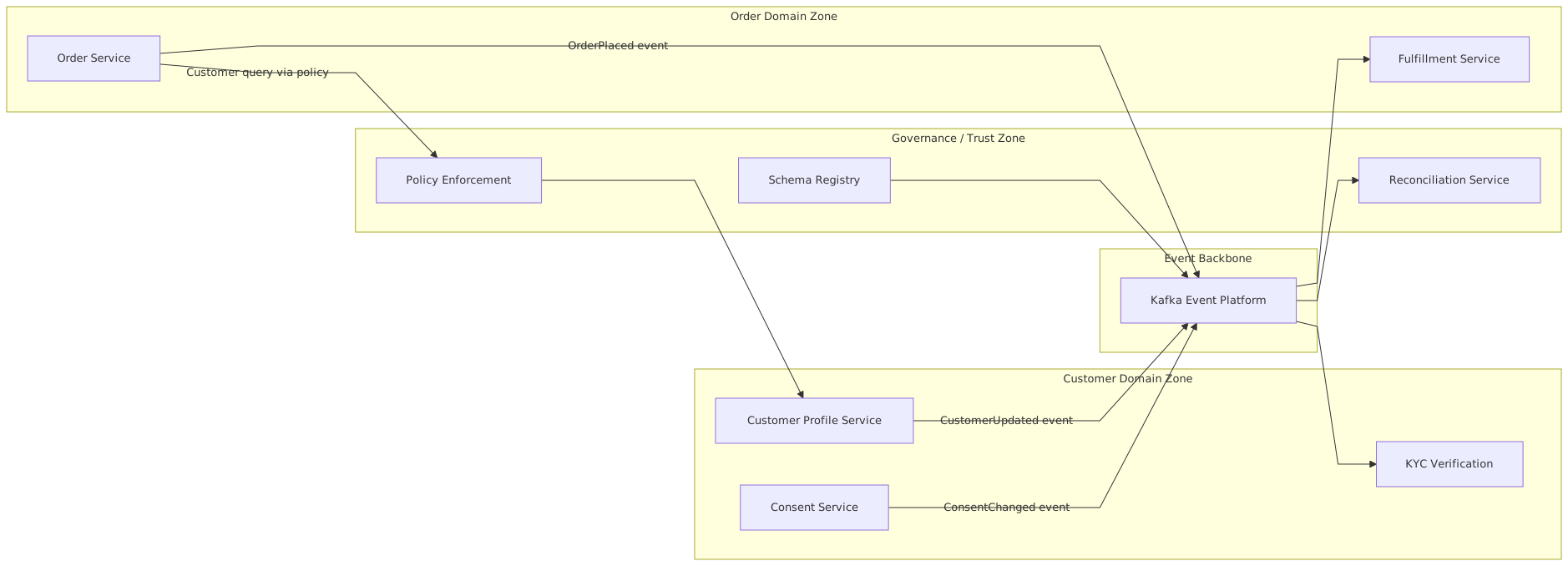
The value of this model is not visual neatness. The value is that each relationship is typed and meaningful. The architecture can answer important questions:
- Which paths are event-based versus authority-based?
- Where is direct query allowed and where is it prohibited?
- What zone owns consent semantics?
- Where must reconciliation happen because multiple asynchronous truths exist?
- Which interactions are policy-mediated?
That is domain-driven design in architectural clothing.
Domain semantics discussion
The critical step is to distinguish topological shape from technical layout.
A Kubernetes cluster is not automatically a domain boundary. A Kafka topic is not automatically a bounded context. A VPC is not automatically a trust zone in business terms. Sometimes they align. Often they do not. Good architecture names the difference.
In DDD terms, topology should help make bounded contexts visible and enforceable. If “Customer Identity” and “Customer Engagement” are separate contexts, the topology should show the approved forms of relationship between them: shared events, anti-corruption layer, policy-gated query, or scheduled reconciliation. If those contexts must remain distinct because one owns legal identity while the other owns campaign segmentation, then direct shared database access is not just poor engineering. It is a violation of domain semantics.
Topology, then, is how architecture remembers what is allowed.
Architecture
A useful topology-as-domain-model architecture usually has five layers of concern.
1. Domain boundaries
These are bounded contexts and capability zones. They should map to business ownership and language, not technical tiers. In a bank, “Payments,” “Customer Identity,” “Fraud,” and “Ledger” are not modules inside one box. They are distinct semantic territories.
2. Interaction types
Every path should be typed. Command, query, event, bulk transfer, workflow callback, and reconciliation feed are fundamentally different relationships. Architects often flatten them into arrows. That is like drawing roads, railways, and shipping lanes all as “transport.”
3. Policy and trust mediation
Where identity changes, policy changes. Where trust changes, controls change. This is where API gateways, service mesh policy, data product controls, and Kafka schema and ACL governance belong. Not as side notes, but as first-class model elements.
4. Reconciliation surfaces
If the enterprise contains multiple systems of record or delayed propagation, model where consistency is evaluated and accepted. This is the part many teams avoid because it feels messy. It is also the part that saves operations from living in denial.
5. Runtime realization
Only after the semantic topology is clear should you map to platforms: microservices, Kafka clusters, cloud accounts, network segments, Kubernetes namespaces, databases, and observability tooling.
A fuller topology model might look like this:
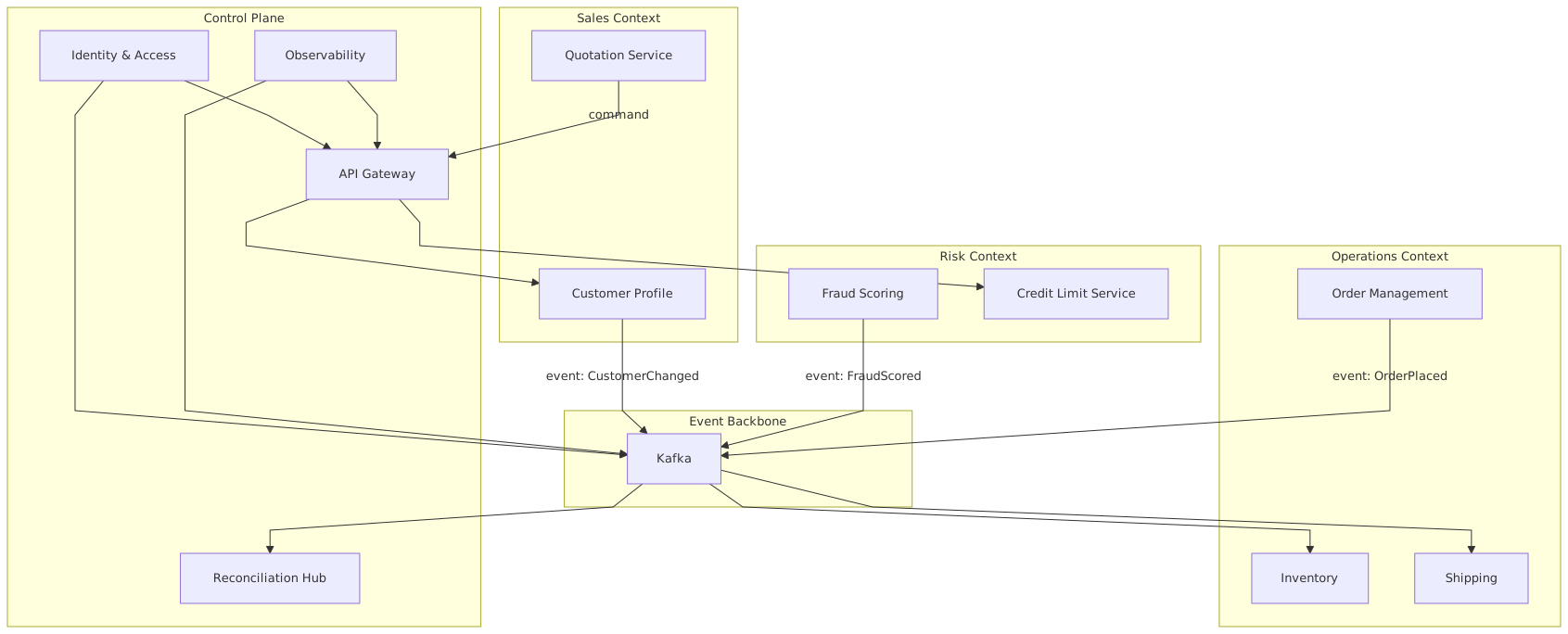
This style makes a practical point: topology is not infrastructure after the fact. It is the architecture of interaction.
Kafka and microservices where relevant
Kafka is especially valuable in this pattern because it makes propagation paths explicit. But Kafka should be used as a domain event backbone, not as a universal solvent.
A healthy topology-aware Kafka design will:
- align topic ownership with bounded contexts,
- publish business events rather than internal state churn,
- use schema evolution deliberately,
- separate event notification from full data replication,
- model consumer classes by semantic role, and
- define where replay is a business recovery mechanism versus a technical convenience.
Microservices fit when bounded contexts are truly separable and can own their lifecycle. But topology modeling often reveals that some so-called microservices are merely distributed methods with no independent domain authority. In such cases, service sprawl is theater. Better to keep a larger service boundary and represent the domain honestly.
Migration Strategy
Migration is where this approach earns its keep.
A progressive strangler migration should not begin with code extraction. It should begin with topological refactoring. The real question is not “Which application do we replace first?” It is “Which relationships do we need to make explicit, mediate, or reroute so that the old shape can gradually die?”
That leads to a sensible sequence:
Step 1: Model the current semantic topology
Document the actual interaction types, not the intended ones. Include batch jobs, file drops, spreadsheet uploads, side-door database access, shadow APIs, and manual reconciliations. Enterprises often discover that the most important topology is the one no official diagram shows.
Step 2: Identify authority and derived truth
For each significant domain concept—customer, order, payment, claim, inventory—state where authority lives, where derivatives live, and where operational truth is reconciled. This alone eliminates a lot of modernization fantasy.
Step 3: Introduce policy-mediated edges
Before replacing systems, constrain relationships. Put gateways in front of direct calls. Put CDC or event publication around legacy records. Create anti-corruption layers. Introduce schema governance on event channels. The point is to shape the topology before changing every node.
Step 4: Extract bounded capabilities
Move one capability at a time into a topology position with clean, typed relationships. This is the strangler pattern done with architectural semantics rather than just routing tricks.
Step 5: Build reconciliation consciously
If a new service and a legacy platform will coexist, create explicit reconciliation processes and observability from the start. During migration, reconciliation is not optional. It is the cost of staged truth.
Step 6: Retire obsolete paths
The final step is usually missed. Teams launch new paths and never delete the old ones. Then the architecture becomes dual-write purgatory. A migration is only complete when legacy connectivity is actually severed.
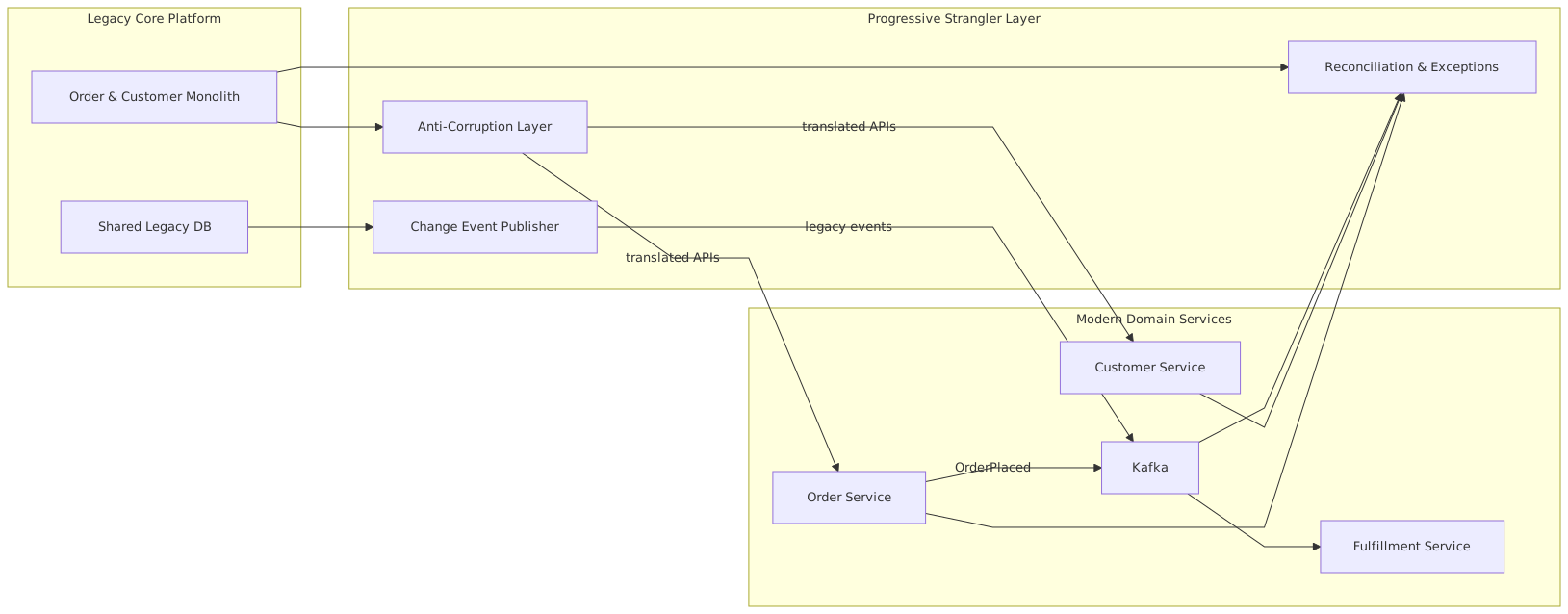
Here is a representative migration topology:
Reconciliation discussion
This deserves direct language: if you adopt event-driven microservices in an enterprise and do not design reconciliation, you are not simplifying architecture. You are outsourcing truth to hope.
Reconciliation is the set of processes and models that compare, align, and where necessary correct divergent states across systems. It appears in several forms:
- Transactional reconciliation: did all required downstream effects occur after an event or command?
- State reconciliation: does one system’s current view materially match another’s authoritative or accepted view?
- Financial or quantity reconciliation: do totals, balances, or counts align within expected tolerances?
- Semantic reconciliation: do two contexts mean the same thing by “active customer” or “fulfilled order,” and if not, what crosswalk applies?
In a topology-aware model, reconciliation surfaces are explicit. They are places where asynchronous propagation meets business accountability. They often deserve their own service or hub, complete with audit trail, exception handling, replay support, and human workflow.
This is not glamorous architecture. It is enterprise architecture.
Enterprise Example
Consider a global insurer modernizing claims processing.
The legacy estate consists of a regional claims system, a policy administration platform, a billing engine, a document repository, and several partner integrations. Claims handlers need a consolidated view of claimant, policy, coverage, payment status, and supporting evidence. The original architecture had point-to-point APIs, nightly file transfers, and direct reporting queries into several operational databases. Everyone believed policy was the “master.” It wasn’t. Billing had the real payment state, regional systems had local claims truth, and documents lived in a separate retention domain with different legal controls.
The first modernization attempt created a set of microservices: Claim Service, Policy Service, Customer Service, Payment Service. On paper, this looked clean. In production, the handlers still could not trust the case view. Why? Because the architecture team had moved applications without modeling topology as domain semantics.
The breakthrough came when the enterprise reframed the architecture around topological meaning.
- Policy Domain Zone owned coverage semantics.
- Claims Domain Zone owned claim lifecycle and adjudication status.
- Billing Domain Zone owned payable and paid states.
- Evidence Domain Zone owned documents and retention policy.
- Partner Zone was explicitly untrusted and only allowed through controlled ingestion paths.
- Case View Zone became a derived operational context, not a system of record.
- Reconciliation Hub tracked convergence between claim, payment, and evidence states.
Kafka was introduced, but carefully. Topics were aligned to bounded contexts: ClaimRegistered, CoverageValidated, PaymentAuthorized, PaymentSettled, DocumentReceived. Consumers for the case view were read-model builders, not hidden transactional participants. Direct synchronous calls were limited to policy-mediated queries where immediate decisioning was required. The architecture accepted that “case complete” was not a simple database fact but a reconciled business state.
That changed both delivery and operations.
Migration proceeded by strangling partner ingestion first, then case view assembly, then claim lifecycle steps, while keeping policy and billing as external authorities for a period. Manual exception workflows were reduced because reconciliation was explicit. Audit quality improved because every domain-significant movement had a typed path and event trail. Most importantly, service ownership became clearer because topology reflected the business operating model rather than technical aspiration.
This is what enterprises need more of: less service-count vanity, more semantic honesty.
Operational Considerations
Once topology becomes a domain model, operations improve—but only if you instrument accordingly.
Observability must follow semantic paths
Tracing every HTTP call is not enough. You need visibility into domain interactions: event lag by bounded context, reconciliation backlog, policy-mediated access failures, schema drift, and trust-boundary violations. A broken business path may consist of several technically healthy components.
Topology metadata needs stewardship
If the model captures ownership, authority, and allowed interactions, it must be governed like code. Store it in version control. Review changes. Tie it to platform policy where possible. Static Visio files are not governance.
Schema management matters
In Kafka-based architectures, schema evolution is where topology often decays. If producers can casually mutate event meaning, the domain model dissolves. Strong schema discipline and event contracts are not bureaucracy here. They are boundary preservation.
Reconciliation is an operational product
Treat reconciliation capabilities as first-class operational products: dashboards, exception queues, replay controls, drift thresholds, and human resolution workflows. If these are improvised after launch, expect expensive confusion.
Security must be path-aware
Identity and access controls should reflect typed relationships, not just service identities. “Can connect” is too weak a control. “Can publish these event classes from this zone under these schemas” is closer to what enterprises actually need.
Tradeoffs
This approach is not free.
First, it introduces modeling discipline. Teams must think harder about semantics, authority, and interaction types. Some engineers will see this as slowing down delivery. In the short term, they are right.
Second, topology-as-domain-model can expose uncomfortable truths. It reveals that some services have no legitimate autonomy, that some business processes depend on manual balancing, and that some “golden records” are mythology. Organizations do not always welcome that kind of honesty.
Third, the model can become overdesigned. If you attempt to encode every technical detail into semantic topology, you create a baroque map no one can use. The point is not maximal description. The point is meaningful description.
Fourth, reconciliation and governance add platform burden. There is real cost in running schema registries, policy enforcement, lineage capture, and exception workflows.
Still, the alternative is cheaper only on slide decks.
Failure Modes
There are several predictable ways to get this wrong.
Confusing technical topology with domain topology
Putting Kubernetes namespaces or AWS accounts directly into the domain model is seductive and often incorrect. Runtime deployment structures can realize domain boundaries, but they are not automatically equivalent.
Treating Kafka as the domain model
An event backbone is a transport and propagation mechanism, not the business language by itself. If your architecture devolves into topic diagrams with no explicit bounded contexts or authority model, you have traded one kind of vagueness for another.
Ignoring reconciliation
This is the classic failure. Teams embrace eventual consistency because it sounds modern, then forget that the business eventually wants certainty.
Making the model too abstract
If the topology cannot answer practical questions about access, ownership, migration sequencing, or failure impact, it is decorative.
Failing to delete old paths
During strangler migration, enterprises often keep legacy integrations “for safety.” These become permanent. Dual paths create permanent ambiguity and subtle data divergence.
No ownership for boundaries
Boundaries without owners are just lines on a slide. Someone must own the policy and semantics of each major interaction surface.
When Not To Use
Do not use this approach everywhere.
If you are building a small, cohesive application with one team, one data model, and minimal regulatory complexity, topology as domain model is likely overkill. A simpler modular monolith with clear internal boundaries may do the job better.
If your domain has low semantic complexity and little need for federation, reconciliation, or cross-zone policy, then a conventional architecture view is enough. Not every internal tool needs a topological theory.
If the organization lacks the discipline to maintain domain language, service ownership, and event contracts, this approach can degrade into ornate documentation with no enforcement. In that case, invest in basic engineering governance first.
And if your main problem is poor product direction rather than architectural shape, no amount of topological sophistication will save you. Architecture cannot rescue a business that does not know what it wants.
Related Patterns
Several patterns sit naturally alongside topology as domain model.
- Bounded Contexts from domain-driven design: the primary semantic boundaries.
- Context Mapping: clarifies translation, partnership, upstream/downstream, and anti-corruption relationships.
- Strangler Fig Pattern: ideal for progressive topological migration.
- Event-Driven Architecture: useful when propagation and autonomy are explicit and governed.
- CQRS / Read Models: often effective for derived operational views such as case summaries or customer 360.
- Anti-Corruption Layer: essential when modern contexts must coexist with legacy semantics.
- Service Mesh / Policy Enforcement: useful as runtime realization of topological constraints, though not a substitute for the model.
- Data Mesh: sometimes complementary, especially where data products align with domain zones, but only when ownership and interoperability are truly mature.
A practical rule: use these patterns to realize the topology, not to avoid thinking about it.
Summary
Topology is not just where systems sit. It is how enterprise meaning travels.
When treated as a first-class domain model, topology makes architecture capable of expressing ownership, trust, authority, event propagation, jurisdiction, and reconciliation. It gives shape to bounded contexts. It clarifies when Kafka helps and when it merely amplifies disorder. It turns migration from a code rewrite into a controlled reshaping of enterprise relationships. And it brings the messy, essential truth of reconciliation into the center of design where it belongs.
The core idea is simple and unfashionably practical: model the paths that matter in the language of the business.
If a relationship carries policy, risk, delay, transformation, or accountability, it is not “just plumbing.” It belongs in the architecture model. If a state only becomes meaningful after several systems converge, model the reconciliation surface. If a microservice has no independent domain authority, stop pretending that distribution is architecture.
Architecture is not the art of drawing more boxes. It is the discipline of making important constraints visible.
That is why topology, done properly, becomes more than a topology model diagram. It becomes the map of how the enterprise is actually allowed to function.
Frequently Asked Questions
What is enterprise architecture?
Enterprise architecture aligns strategy, business processes, applications, and technology in a coherent model. It enables impact analysis, portfolio rationalisation, governance, and transformation planning across the organisation.
How does ArchiMate support architecture practice?
ArchiMate provides a standard language connecting strategy, business operations, applications, and technology. It enables traceability from strategic goals through capabilities and services to infrastructure — making architecture decisions explicit and reviewable.
What tools support enterprise architecture modeling?
The main tools are Sparx Enterprise Architect (ArchiMate, UML, BPMN, SysML), Archi (free, ArchiMate-only), and BiZZdesign. Sparx EA is the most feature-rich, supporting concurrent repositories, automation, scripting, and Jira integration.
When the picture stops being the point
The argument above — that a diagram freezes a living system into a dead picture — is really an argument about where the truth lives. If the drawing is the artefact, it starts decaying the moment the topology moves. If the drawing is generated from something that knows what a node and a dependency actually are, it doesn't.
That is the premise behind Mooodels: the model is the artefact and every diagram is one view of it, so a change made once shows up everywhere it is relevant instead of being re-drawn in five places.