⏱ 19 min read
Most enterprise systems do not fail because teams forgot a framework. They fail because the software starts lying about the business.
At first the lie is small. A customer object quietly grows shipping preferences, loyalty rules, payment risk flags, and fulfillment state. A pricing service reaches into order logic “just for one field.” An inventory team publishes events that sound useful but mean something subtly different in every consuming system. Nobody notices right away, because the system still compiles, the sprint board still moves, and the dashboards still blink green.
Then one day the organization discovers it has not built a platform. It has built a diplomatic crisis.
That is the real shape of a model boundary violation in Domain-Driven Design. It is not merely a coding smell. It is a semantic leak between business capabilities. A bounded context is supposed to be a membrane that protects language, rules, and meaning. When that membrane is punctured, the domain model stops representing one business perspective and begins absorbing fragments of several. The result is familiar: brittle integrations, accidental coupling, Kafka topics that spread confusion at scale, microservices that are independently deployable but not independently understandable, and architecture diagrams that look clean while reality is doing something much messier. event-driven architecture patterns
This article is about that mess.
I will argue three things. First, model boundary violations are one of the most common reasons DDD efforts stall in the enterprise. Second, most violations are not caused by bad intentions; they are caused by delivery pressure, shared data gravity, and the false comfort of “reuse.” Third, the remedy is rarely a heroic rewrite. It is usually a progressive migration: make the semantics explicit, isolate the corruption, introduce translation, reconcile where necessary, and strangle the old interactions one seam at a time.
That is architecture in the real world. Not purity. Managed separation.
Context
Domain-Driven Design gave us a language for something enterprise architects had been feeling for years: large systems fail when we pretend the business has one universal model. It doesn’t.
A retail bank has a “customer” in onboarding, in lending, in fraud, in servicing, and in collections. Those are not simply different views over the same entity. They are different operational truths, with different invariants, different life cycles, different risk assumptions, and different teams accountable for outcomes. Trying to force them into one all-purpose enterprise object is how you get data warehouses masquerading as operational architecture.
Bounded contexts are therefore not just a decomposition technique. They are a statement that language is local. “Order,” “shipment,” “account,” “policy,” “exposure,” “reservation,” “claim”—all of these terms drift as they cross organizational lines. In a healthy architecture, that drift is acknowledged and managed. In an unhealthy one, the drift is hidden under shared schemas, common libraries, canonical events, and API contracts that pretend everyone means the same thing.
Model boundary violations happen when one context starts depending on another context’s internal semantics rather than interacting through an explicit relationship. Sometimes that means direct database reads. Sometimes it means reusing a domain object library across services. Sometimes it means consuming Kafka events as if they were a stable enterprise truth when they were really published for one context’s local needs. Sometimes it means a team exposes a convenient API that lets callers orchestrate rules they should never own.
A bounded context should reduce ambiguity. A violation imports it.
Problem
The core problem is simple to state and hard to fix: one model is making decisions using concepts that belong to another model.
That sounds abstract, so let’s make it concrete.
Suppose a commerce platform has separate contexts for Sales, Pricing, Inventory, and Fulfillment. Sales owns the order lifecycle from quote to purchase. Pricing owns promotions, discount eligibility, and list price rules. Inventory owns stock reservation and availability. Fulfillment owns shipment planning and carrier execution.
A healthy interaction says: Sales asks Pricing for a priced offer. Sales places an order. Inventory reserves stock against that order. Fulfillment plans shipments from fulfillment-relevant data.
A boundary violation says: Sales imports Pricing’s discount rule objects so it can “pre-calculate” offers. Fulfillment reads Inventory’s reservation tables directly because “the event is delayed.” Pricing consumes Sales’ order aggregate events and starts inferring customer intent from internal order statuses. Soon every context knows too much, and worse, knows it incorrectly.
The visible symptoms are familiar:
- duplicate but inconsistent business rules
- API contracts that expose internal aggregate structure
- Kafka topics with overloaded meanings
- shared entity definitions across teams
- endless debates about “source of truth”
- release coordination between supposedly independent services
- reconciliation jobs multiplying in the background
- production incidents that trace back to semantic mismatch, not infrastructure failure
This is why model boundary violations are dangerous. They don’t just create coupling. They create false agreement. And false agreement is more expensive than obvious disagreement because it fails later, farther from the point of design.
Forces
There are always forces pushing teams toward violations. If you ignore them, you end up writing architecture guidance nobody can use.
1. Delivery pressure rewards shortcuts
A team under a deadline will happily reuse another service’s DTOs, event schema, or database tables if it avoids waiting for a new contract. The shortcut works. Until it doesn’t.
2. Shared data exerts gravitational pull
Enterprise data platforms, MDM programs, and lakehouse initiatives often create the impression that operational semantics can also be centralized. They cannot. Shared analytical truth is not the same thing as shared operational meaning.
3. Organizations align around systems, not domains
Many enterprises still organize around ERP modules, channels, or application portfolios. Teams inherit boundaries from systems of record, not from business capabilities. Violations are almost inevitable.
4. Event-driven architecture can scale confusion
Kafka is excellent at decoupling in time. It is not magic for decoupling semantics. A poorly defined event published to a shared topic can distribute ambiguity faster than any REST API ever could.
5. The “canonical model” promise is seductive
Architects love the idea of standardization. Executives love hearing “one enterprise customer model.” The trouble is that canonical operational models become either too generic to be useful or too detailed to remain stable.
6. Legacy systems force compromise
When migrating from a monolith or package platform, teams often have no choice but to accept partial overlap, duplicated data, and synchronization gaps. The trick is to treat these as transitional scars, not target architecture.
7. Compliance and audit requirements increase data reuse
Risk, finance, and regulatory reporting often require cross-context consistency. That pressure can tempt organizations to centralize behavior rather than reconciling outcomes. Behavior should stay local; reporting can be consolidated downstream.
These forces are real. Good architecture does not deny them. It channels them.
Solution
The solution is not “make better boundaries” as if boundary design were a workshop artifact. The solution is to establish semantic ownership, interaction discipline, and controlled translation.
In DDD terms, the guiding principle is this: each bounded context owns its model, its invariants, and its language. Interactions across boundaries must happen through explicit contracts that preserve autonomy and acknowledge translation. That can take the form of published language, anti-corruption layers, process orchestration, event collaboration, or replicated read models. The choice depends on the business dependency, not on fashion.
A useful mental model is to treat boundaries like electrical transformers rather than walls. Power crosses, but voltage changes. If you wire systems directly without transformation, you fry something eventually.
The practical measures usually include:
- identify which context owns each business concept and decision
- stop sharing domain classes, database schemas, and internal status codes
- define boundary contracts in terms of business intent, not object structure
- use anti-corruption layers where a consuming context must interact with a foreign model
- publish integration events that reflect stable business facts, not internal workflow noise
- replicate data for local use when needed, but make the translation explicit
- design reconciliation for inevitable divergence, especially in asynchronous flows
- treat migration seams as first-class architecture elements
This is where architects often get too pure. In enterprise systems, some duplication is healthy. Some delay is acceptable. Some eventual consistency is unavoidable. The goal is not zero overlap; the goal is controlled overlap with explicit ownership.
Architecture
A good way to spot a boundary violation is to ask two questions:
- Which team is allowed to change the meaning of this concept?
- If that meaning changes, who must coordinate?
If the answer to both spans multiple contexts, you probably have a violation.
Here is a simple contrast.
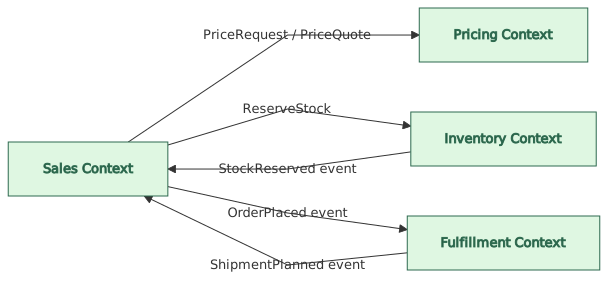
That is not “loosely coupled” because arrows are asynchronous or because there are multiple services. It is loosely coupled because each interaction expresses intent in the language of the boundary.
Now compare it with a violation pattern.
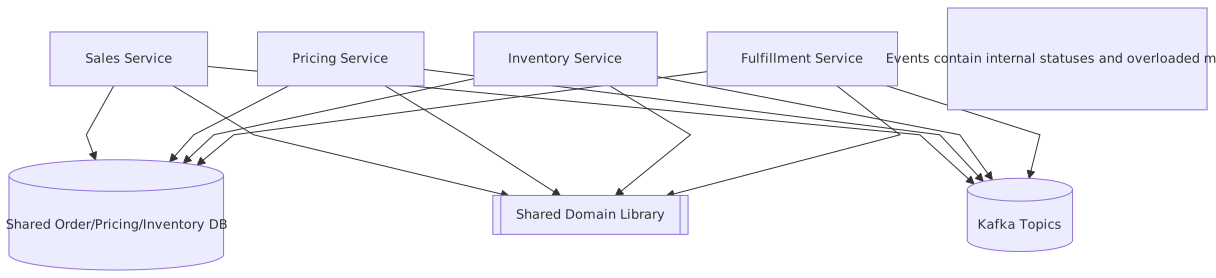
This is the architecture equivalent of everyone keeping a copy of everyone else’s diary and then being surprised by the arguments.
Domain semantics and contract shape
Boundary-safe contracts are not generic CRUD wrappers. They carry domain intent.
Bad:
PUT /customer- event:
CustomerUpdated - field:
status = ACTIVE
Better:
SubmitApplicationApproveCreditLineReserveInventoryShipmentDispatchedPaymentCaptured
The second set names business facts and actions. That matters because semantics survive organizational change better than generalized entity mutations.
Kafka and event boundaries
Kafka is often where violations become institutionalized. Teams publish every internal state transition because it seems future-proof. It is not. It externalizes accidental workflow design and invites consumers to bind themselves to internals.
A better approach is to separate:
- domain events used inside a context
- integration events published across contexts
- derived analytical events shaped for reporting and data platforms
Not every aggregate transition deserves a public topic. If Fulfillment internally moves from ALLOCATED to READY_TO_PICK, Sales may not need to know. But ShipmentDispatched may be a cross-context business fact worth publishing.
Reconciliation is part of the architecture
Many teams treat reconciliation as a temporary annoyance. In reality, it is a permanent capability in distributed enterprise systems. If Sales believes an order is accepted and Inventory later fails reservation, somebody must detect, repair, compensate, or escalate.
That means boundary design should include:
- idempotent commands
- business correlation identifiers
- retriable consumers
- exception workflows
- operational dashboards for mismatches
- replay-safe event handling
- explicit ownership of corrective action
Reconciliation is what turns eventual consistency from a slogan into an operating model.
Migration Strategy
Most boundary violations are inherited. That matters, because inherited architecture is not fixed by drawing a cleaner target-state diagram.
The right migration strategy is usually a progressive strangler. Do not rip out the old model all at once. Encapsulate it, redirect interactions, and gradually move decision-making to the right bounded contexts.
A practical sequence looks like this:
1. Identify semantic hotspots
Start where business rules are duplicated, incidents are frequent, or release coordination is painful. These are usually the hottest boundary seams.
2. Classify the violation
Is it:
- shared persistence?
- shared code model?
- shared event semantics?
- orchestration leakage?
- reporting model used operationally?
Different violations need different cuts.
3. Freeze the damage
Before redesigning, stop making the seam worse. Ban new direct DB reads. Stop adding fields to shared DTOs. Prevent more consumers from binding to unstable events.
4. Introduce an anti-corruption layer
If one context depends on another’s model, add a translation layer that converts foreign concepts into local language. This is often the first real architectural win because it reveals hidden semantic mismatch.
5. Publish stable integration contracts
Move from internal object shape to business-level API or event contracts. This often requires creating new Kafka topics rather than “cleaning up” old ones in place.
6. Replicate read data locally
If a context needs foreign data for decision support or UX, replicate what it needs into a local read model. Do not call across boundaries for every screen render if latency or availability matters.
7. Reassign behavior, not just data
The real migration is moving decision authority. It is not enough to copy tables into a new service if another team still owns the rules.
8. Add reconciliation and compensations
During migration, there will be periods where old and new paths coexist. That means divergence is guaranteed. Build comparison and repair mechanisms early, not after go-live.
9. Decommission the old seam
Only when traffic, ownership, and operational confidence have shifted should you remove the old shared dependency.
Here is a typical strangler migration pattern for model boundaries:
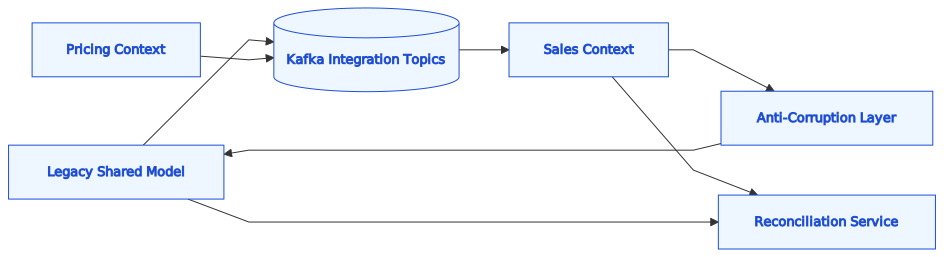
Progressive strangler in practice
The mistake many teams make is strangling by technical interface rather than by domain capability. For instance, they replace a monolith’s order API with a new order service but keep pricing, stock, and shipment rules entangled inside it. That is movement, not progress.
A better strangler step is to peel out one decision boundary at a time:
- price calculation
- stock reservation
- shipment planning
- refund policy
- fraud approval
Each extracted capability should come with its own language, contract, and operational ownership.
Enterprise Example
Consider a global insurer modernizing its policy administration landscape.
The legacy platform had one giant “Policy” model used by underwriting, billing, claims intake, customer servicing, and regulatory reporting. It was marketed internally as a single source of truth. In reality it was five truths sharing a table.
Underwriting used “policy” to mean a risk decision structure with coverage rules and eligibility. Billing used it to mean a premium schedule and receivables plan. Claims intake used it to mean a coverage validation reference. Servicing used it as a customer change workflow. Reporting used it as a historical legal record. Those meanings overlapped, but they were not the same thing.
Boundary violations appeared everywhere:
- claims services read underwriting tables directly for endorsements
- billing reused underwriting status values to trigger invoice generation
- Kafka events like
PolicyUpdatedcontained dozens of fields, and every downstream consumer inferred different business meaning - teams coordinated releases because a schema change in one module broke another
- reconciliations were manual and done in spreadsheets after month-end close
The architecture team did not start with a grand rewrite. They started by acknowledging that “policy” was overloaded and splitting the landscape into bounded contexts:
- Underwriting
- Policy Issuance
- Billing
- Claims Coverage View
- Customer Servicing
- Regulatory Reporting
That required hard decisions. Claims would no longer query underwriting directly. Instead it would receive a coverage view tailored to claims semantics: effective coverage, endorsements relevant to loss date, exclusions, and policy linkage. Billing would not consume generic PolicyUpdated events. It would receive explicit issuance and premium-adjustment events.
The migration used Kafka, but carefully. New integration topics were introduced with names like:
PolicyIssuedCoverageAdjustedPremiumScheduleChangedPolicyCancelled
Older, overloaded topics remained for legacy consumers during transition, but new services were forbidden from subscribing to them. An anti-corruption layer translated legacy policy records into new context-specific events and query views.
Reconciliation became a first-class concern. Because billing and servicing had different cutover timelines, a reconciliation service compared issued policy state, premium schedules, and customer-visible servicing records. Mismatches produced repair workflows rather than silent divergence.
What changed operationally was more important than what changed technically. Teams stopped arguing over “the policy schema” and started talking about what each context actually needed to decide. Incident rates fell, not because there were fewer systems, but because there were fewer semantic misunderstandings.
That is a very enterprise lesson: good boundaries reduce meetings as much as they reduce coupling.
Operational Considerations
Architecture drawings often end where operations begin. Boundary discipline has to survive runtime.
Observability by business correlation
Cross-context flows need correlation IDs tied to business artifacts: order number, policy ID, claim reference, reservation ID. Technical trace IDs are useful, but operational teams need to answer business questions like “which accepted orders are missing stock reservations?”
Contract governance without bureaucracy
You need versioning, schema validation, and ownership for integration events and APIs. But if governance becomes a review board that takes six weeks, teams will route around it. The right model is lightweight standards plus automated contract testing. EA governance checklist
Dead letter queues are not reconciliation
A dead letter topic tells you a consumer failed technically. It does not tell you whether the business process is now inconsistent. You need both technical retry handling and business-level discrepancy management.
Data retention and replay
Kafka retention, compaction, and replay policies can affect recovery and reconciliation. If downstream services rely on replay to rebuild local state, event contracts must remain interpretable over time. Publishing vague status blobs is a time bomb.
Security and compliance
Boundary violations sometimes hide inside security shortcuts. One service gets broad data access because “it needs customer context.” In regulated environments, local read models and purpose-specific contracts are often more compliant than broad shared access.
Team ownership
If no team owns the seam, the seam rots. Every cross-context contract needs a publishing owner, consumer commitments, and a process for semantic change. This is not governance theater. It is basic survivability. ArchiMate for governance
Tradeoffs
There is no free lunch here.
Stronger model boundaries usually mean:
- more translation code
- some duplication of data
- eventual consistency
- more explicit contracts to maintain
- a need for reconciliation
- more up-front domain analysis
That is the price of autonomy.
The alternative is also expensive:
- hidden coupling
- slower delivery over time
- harder change impact analysis
- semantic drift
- brittle testing
- larger blast radius for failures
The right tradeoff depends on volatility and business criticality. High-change, high-complexity domains benefit enormously from strong boundaries. Stable reference domains may not need the same rigor.
One more tradeoff is worth naming: too much zeal for local models can fragment the enterprise. If every team invents entirely different semantics for obviously shared concepts, collaboration becomes impossible. DDD is not a license for chaos. Bounded contexts should be distinct where the business is distinct, not because every team wants to feel sovereign.
Failure Modes
Boundary work fails in predictable ways.
1. Superficial microservices
Teams split deployment units but keep a shared domain library and shared database semantics. The result is distributed monolith behavior with network latency added for flavor.
2. Canonical event theater
An enterprise event council defines universal event schemas that are too generic to support real work and too central to evolve safely. Teams then bypass them.
3. Anti-corruption layers that become permanent junk drawers
An ACL should translate and protect. It should not become the place where all missing domain decisions are hidden forever.
4. Event over-publication
Publishing all internal state changes invites accidental dependencies and makes future refactoring expensive.
5. Ignoring reconciliation
Teams accept eventual consistency in architecture slides but do not build the operational machinery to detect and resolve divergence.
6. Overfitting boundaries to current org charts
Organizations change. If the bounded contexts simply mirror team names without domain reasoning, the model will rot as soon as the org is restructured.
7. Chasing purity during migration
Trying to eliminate every semantic overlap before shipping often stalls modernization. Transitional duplication is acceptable if ownership and retirement plans are explicit.
The recurring pattern is this: teams focus on technical separation and neglect semantic separation. Technology can only carry architecture so far.
When Not To Use
Not every system needs aggressive bounded-context partitioning or heavy concern about model boundary violations.
Do not over-engineer this when:
- the domain is simple and stable
- one team owns the whole lifecycle
- the model has low business ambiguity
- the cost of inconsistency is trivial
- the system is essentially CRUD over a well-understood record
- integration needs are limited and unlikely to expand
A small internal application for managing office assets probably does not need separate contexts for Asset Registry, Allocation, Maintenance, and Procurement unless the business actually behaves that way.
Likewise, if you are in the earliest stage of a product and still discovering the domain, locking into rigid boundaries too early can be counterproductive. In that case, keep the code modular, watch where language diverges, and let bounded contexts emerge from real pressure.
DDD is a scalpel, not a religion.
Related Patterns
Several patterns help prevent or manage model boundary violations.
Bounded Context
The primary DDD construct for localizing language, rules, and models.
Context Map
Useful for making relationships explicit: customer-supplier, conformist, partnership, shared kernel, anti-corruption layer. The map matters because not all context relationships deserve the same coupling.
Anti-Corruption Layer
Essential when a context must consume a legacy or foreign model without contaminating its own semantics.
Published Language
A deliberate shared contract for communication between contexts. Narrow and stable beats broad and “reusable.”
Open Host Service
A way for one context to expose services to others without leaking its internal model.
Saga / Process Manager
Helpful when business processes span contexts and require coordination with compensation.
CQRS and Local Read Models
Very useful where one context needs foreign data for queries but should not inherit foreign behavior.
Event Collaboration
Powerful when used with discipline. Dangerous when used as a substitute for semantic design.
These patterns are not a menu to collect. They are tools to preserve meaning while allowing systems to collaborate.
Summary
Model boundary violations are what happen when software forgets that business language is local.
They show up as shared entities, overloaded events, direct database reads, reusable domain libraries, and “temporary” shortcuts that become the architecture. The damage is not just technical coupling. It is semantic corruption. One model starts making promises it cannot keep because it is borrowing concepts, statuses, and rules from another context.
The cure is explicitness. Define bounded contexts around real business semantics. Keep ownership of rules local. Cross boundaries through intent-rich contracts. Use Kafka carefully, publishing integration events rather than internal noise. Introduce anti-corruption layers where legacy or foreign models must be consumed. Replicate data when needed, but translate it. Expect divergence and design reconciliation as a real capability, not a cleanup script.
And when migrating, do it progressively. Strangler patterns work best when they carve along decision boundaries, not just API endpoints. Move behavior to the right context, one seam at a time. Let the old model shrink until it becomes a shell.
The memorable line, if you want one, is this: a bounded context is not there to keep systems apart; it is there to keep meanings intact.
That is the point. In enterprise architecture, integrity of meaning is what lets change happen without turning every release into negotiation by incident.
Frequently Asked Questions
What is enterprise architecture?
Enterprise architecture aligns strategy, business processes, applications, and technology in a coherent model. It enables impact analysis, portfolio rationalisation, governance, and transformation planning across the organisation.
How does ArchiMate support architecture practice?
ArchiMate provides a standard language connecting strategy, business operations, applications, and technology. It enables traceability from strategic goals through capabilities and services to infrastructure — making architecture decisions explicit and reviewable.
What tools support enterprise architecture modeling?
The main tools are Sparx Enterprise Architect (ArchiMate, UML, BPMN, SysML), Archi (free, ArchiMate-only), and BiZZdesign. Sparx EA is the most feature-rich, supporting concurrent repositories, automation, scripting, and Jira integration.