⏱ 8 min read
In many enterprises, strategic intent, architectural documentation, and software implementation evolve in parallel but rarely in synchrony. Executives define strategy in terms of market expansion, customer experience, and regulatory positioning. Enterprise architects model capability maps, value streams, and application portfolios. Engineering teams deliver APIs, microservices, event pipelines, and cloud-native workloads.

Despite all this effort, a fundamental disconnect often remains: systems do not truly embody business intent. Instead, they reflect historical structures, departmental silos, or technical convenience.
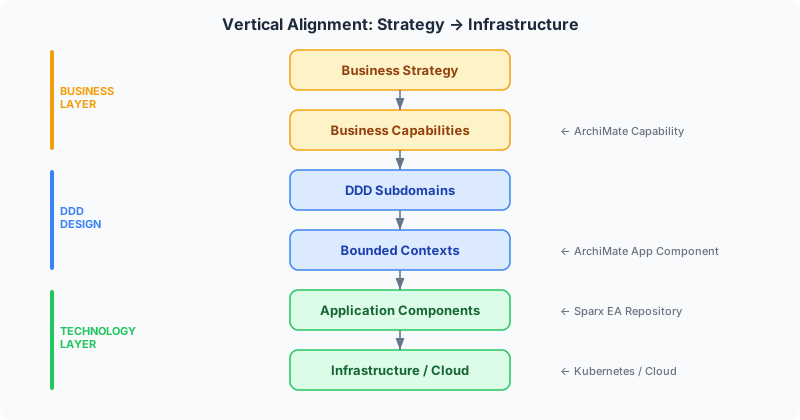
This article proposes a disciplined and vertically integrated approach that connects Business Capabilities as the strategic anchor, Domain-Driven Design (DDD) as the structural design philosophy, ArchiMate modeling guide as the formal modeling language, and Sparx Enterprise Architect as the operational modeling repository.
When combined, these elements create traceability from strategy to infrastructure, from capability to code.
Business Capabilities: The Stable Strategic Backbone
A business capability describes what an organization must be able to do in order to achieve its mission. It is independent of organizational structure, processes, applications, and technologies. Capabilities are expressed in outcome-oriented terms: Customer Relationship Management, Credit Risk Evaluation, Fraud Detection, Claims Handling, Payment Processing, Regulatory Reporting.
A capability does not describe how something is performed. It describes the ability itself.
Characteristics of Well-Defined Capabilities
Well-defined capabilities are stable over time, measurable in maturity, technology-agnostic, hierarchically decomposable, and directly linked to strategy. This stability makes capabilities ideal anchors for enterprise architecture.
Capability Hierarchies
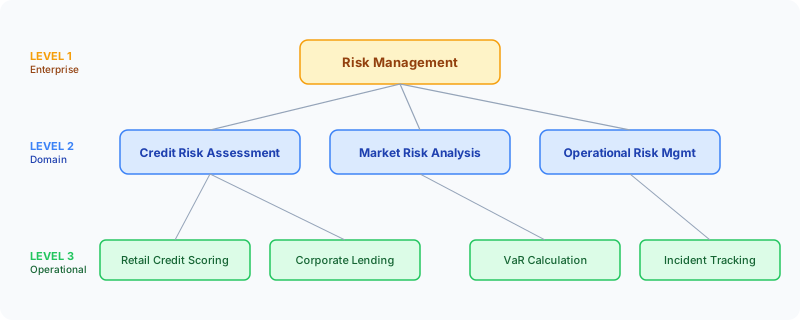
Capabilities are usually structured in multiple levels. Level 1 covers enterprise capabilities (e.g. Risk Management), Level 2 covers domain capabilities (e.g. Credit Risk Assessment), and Level 3 covers operational capabilities (e.g. Retail Credit Scoring). This layered structure enables strategic prioritization and architectural granularity.
Domain-Driven Design: Structuring Complexity Around Meaning
Domain-Driven Design (DDD), introduced by Eric Evans in 2003, provides a design approach where software reflects business meaning. DDD operates at two levels.
Strategic Design
Strategic design determines where to invest effort. It involves core domain identification, supporting and generic subdomain classification, bounded context definition, and context mapping.
Tactical Design
Tactical design determines how to implement the model. It includes aggregates, entities, value objects, domain events, repositories, and application services.
Strategic DDD aligns directly with capability modeling — and this alignment is the key insight of this article.
The Key Alignment: Capability → Subdomain → Bounded Context
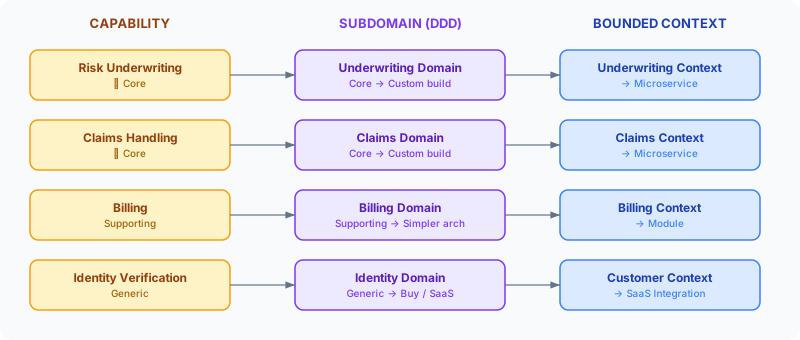
The central architectural alignment is the progression from business capability to subdomain to bounded context:
| Business View | DDD View | Technical View |
|---|---|---|
| Capability | Subdomain | Logical Problem Space |
| Ownership | Bounded Context | Service / Module |
| Value | Domain Model | Behavioral Implementation |
This progression prevents premature microservice decomposition. Rather than jumping from business requirements to technical services, the capability→subdomain→bounded context chain ensures that each service boundary is justified by business semantics, not technical convenience.
Core, Supporting, and Generic Domains
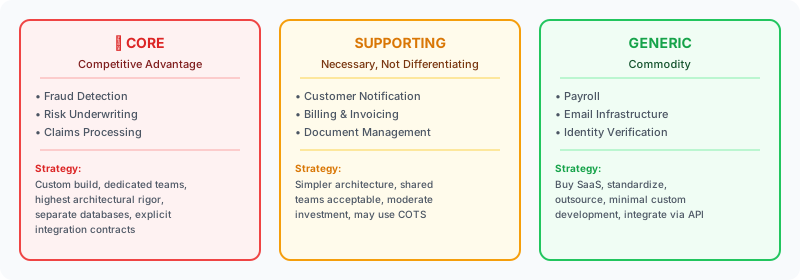
Not all capabilities deserve equal investment. DDD classifies domains into three categories that directly drive architectural and investment decisions.
Core Domains
These provide competitive differentiation. Example: Fraud Detection in fintech. Core domains receive the highest architectural discipline, dedicated teams, and custom implementation.
Supporting Domains
Necessary but not differentiating. Example: Customer Notification. These domains may use simpler architectures and shared teams.
Generic Domains
Commodity capabilities. Example: Payroll, Email Infrastructure. Generic domains should be sourced from SaaS, standardized, or outsourced.
This classification drives investment prioritization, team allocation, architectural rigor, and buy-versus-build decisions.
ArchiMate: Formalizing the Architecture
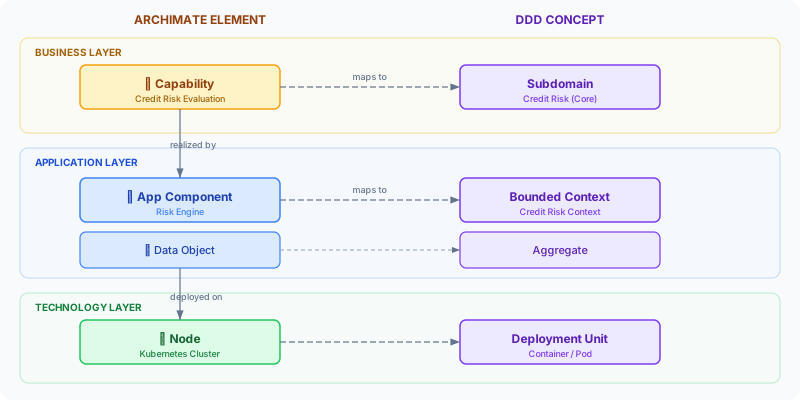
ArchiMate provides a standard modeling language across the business, application, and technology layers. When modeling capabilities in ArchiMate, the traceability chain becomes explicit:
Capability (Business Layer) → realized by Business Process → supported by Application Component → deployed on Node
For example: the Credit Risk Evaluation capability is realized by the Credit Assessment process, supported by the Risk Engine application component, deployed on a Kubernetes cluster. This chain ensures full traceability from strategy to running infrastructure.
Integrating DDD Concepts with ArchiMate
| ArchiMate Concept | DDD Equivalent |
|---|---|
| Capability | Subdomain |
| Application Component | Bounded Context |
| Data Object | Aggregate |
| Application Service | Domain Service |
| Application Collaboration | Context Integration |
Bounded contexts frequently map to application components, but not always 1:1. A single bounded context may be realized by multiple components, or multiple bounded contexts may share infrastructure. The ArchiMate model makes these relationships explicit. ArchiMate tutorial for enterprise architects
Implementing in Sparx Enterprise Architect
Sparx EA provides a repository-centric approach to integrate all layers. The recommended repository structure organizes content into strategy (capability map), business architecture (ArchiMate business views), application architecture (bounded context models), domain models (UML class diagrams), and technology architecture.
Each capability should maintain traceability links to its owning business actor, realizing application components, UML domain packages, and technology nodes.
End-to-End Insurance Example
To make these concepts concrete, consider an insurance company implementing a modern architecture.
Capability Identification
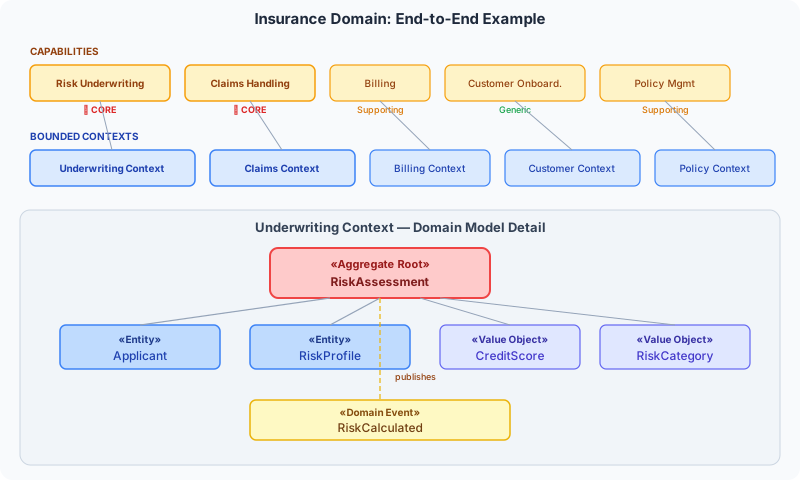
The enterprise identifies five core capabilities: Policy Management, Claims Handling, Risk Underwriting, Billing, and Customer Onboarding.
Subdomain Classification
Risk Underwriting and Claims Handling are classified as core domains (competitive differentiation). Billing is supporting (necessary but not differentiating). Identity Verification is generic (commodity, suitable for SaaS).
Bounded Context Definition
Each subdomain maps to a bounded context: Underwriting Context, Claims Context, Billing Context, and Customer Context. Each context becomes an ArchiMate application component, a UML package in Sparx EA, and a deployment unit in Kubernetes. ArchiMate layers explained
Domain Model: Underwriting Context
The Underwriting Context contains an aggregate root (RiskAssessment), entities (Applicant, RiskProfile), value objects (CreditScore, RiskCategory), and domain events (RiskCalculated). This model is implemented using UML class diagrams and sequence diagrams in Sparx EA.
Context Mapping and Integration Patterns
Bounded contexts interact through well-defined patterns: Customer/Supplier, Conformist, Anti-Corruption Layer, Published Language, and Shared Kernel. In ArchiMate, these interactions are represented through serving relationships, flow relationships, and application collaborations. This prevents tight coupling and preserves model integrity across context boundaries. ArchiMate relationship types
Cloud-Native Alignment
Each bounded context may be realized as an independent microservice with a separate database and event publisher/subscriber. The mapping to the technology layer follows the chain: Application Component → Artifact (container image) → Node (Kubernetes cluster). This supports autonomous deployment, independent scaling, and fault isolation — the key benefits of cloud-native architecture.
Governance and Portfolio Optimization
Capabilities enable powerful governance tools: maturity heatmaps, investment tracking, technical debt mapping, and risk visualization. Core domains should receive higher architectural discipline, avoid shared databases, and maintain explicit integration contracts. Generic domains may use SaaS, be standardized, or be outsourced.
Organizational Alignment and Conway's Law
Conway's Law states that systems mirror communication structures. When teams align with bounded contexts, cognitive load decreases, deployment independence increases, and cross-team coordination reduces. In Sparx EA, business roles can be linked to application components to visualize ownership and ensure organizational alignment supports the architecture.
Roadmapping with Capability-Based Planning
Using ArchiMate plateaus and gaps, enterprises can define baseline, target, and transition architectures. For example, the Risk Analytics capability might have a legacy monolith as baseline and event-driven microservices as target. Traceability ensures transformation remains strategy-driven rather than technology-driven.
Common Anti-Patterns to Avoid
- Treating capabilities as processes — Capabilities describe what, not how
- Equating capabilities directly to microservices — The subdomain and bounded context layers must not be skipped
- Ignoring bounded context isolation — Shared databases and tight coupling defeat the purpose of DDD
- Over-modeling without strategic prioritization — Not every capability needs the same architectural depth
A Repeatable Enterprise Method
The complete method follows ten steps: (1) define the enterprise capability map, (2) classify core/supporting/generic, (3) identify subdomains, (4) define bounded contexts, (5) model in ArchiMate, (6) implement domain models in UML, (7) map to application components, (8) map to infrastructure, (9) align teams, and (10) continuously refine. ArchiMate modeling best practices
Conclusion
Business capabilities provide the stable strategic backbone. Domain-Driven Design structures complexity around meaning. ArchiMate provides the formal modeling language. Sparx Enterprise Architect operationalizes traceability. ArchiMate viewpoints
Together, they create a vertically aligned architecture approach: Strategy → Capability → Subdomain → Bounded Context → Domain Model → Application → Infrastructure.
This is how software evolves from a technical asset into a strategic instrument.
If your organization wants to implement this approach, we offer ArchiMate modelling coaching, Sparx EA training, and enterprise architecture consulting to help you build capability-driven, domain-aligned architectures.
Frequently Asked Questions
What is Sparx Enterprise Architect used for?
Sparx Enterprise Architect (Sparx EA) is a comprehensive UML, ArchiMate, BPMN, and SysML modeling tool used for enterprise architecture, software design, requirements management, and system modeling. It supports the full architecture lifecycle from strategy through implementation.
How does Sparx EA support ArchiMate modeling?
Sparx EA natively supports ArchiMate 3.x notation through built-in MDG Technology. Architects can model all three ArchiMate layers, create viewpoints, add tagged values, trace relationships across elements, and publish HTML reports — making it one of the most popular tools for enterprise ArchiMate modeling.
What are the benefits of a centralised Sparx EA repository?
A centralised SQL Server or PostgreSQL repository enables concurrent multi-user access, package-level security, version baselines, and governance controls. It transforms Sparx EA from an individual diagramming tool into an organisation-wide architecture knowledge base.