⏱ 20 min read
Most event-driven systems don’t fail because Kafka is slow, schemas are wrong, or teams picked the “bad” broker. They fail because people tell themselves a comforting lie: _an event is just a message_. It isn’t. A message is plumbing. A domain event is language. A message moves bytes; a domain event moves meaning. Confuse the two and you get a distributed estate that looks modern on the surface and behaves like a rumor mill underneath.
That distinction matters more than architects often admit. In large enterprises, events travel farther than the teams who minted them. They cross bounded contexts, survive reorganizations, outlive product managers, and become implicit dependencies in places nobody intended. Once an event is published and relied upon, it stops being a mere integration mechanism and starts behaving like a contract. And contracts, unlike messages, demand stewardship.
This is where many “event-first” programs stumble. A team emits CustomerUpdated, another subscribes, a third team copies the pattern, Kafka topics multiply, and six months later nobody can answer the basic questions: _what exactly does this event mean, who owns it, what changes are safe, and what state does it promise consumers can infer?_ The topology is event-driven. The semantics are accidental. That is not architecture. That is distributed improvisation.
The better framing is blunt: domain events are contracts, not messages. If you adopt that view, a lot of architecture decisions become clearer. You think in domain-driven design terms. You publish events from aggregates and bounded contexts, not from random CRUD tables. You version with care. You model intent and business facts separately from internal implementation churn. You plan migration around coexistence, translation, and reconciliation. You accept that event streams create obligations, not just flexibility.
And yes, Kafka still matters. Microservices still matter. But they matter as infrastructure for semantic contracts, not substitutes for them. microservices architecture diagrams
Context
Enterprises modernizing from monoliths into service-based or event-driven landscapes usually start with sensible goals: decoupling, scale, autonomous teams, better integration, less brittle point-to-point coupling. The path from there to Kafka, CDC, event buses, and microservices is short. Sometimes too short. event-driven architecture patterns
A legacy core platform—say policy administration, order management, billing, or customer master—contains rich business state but poor external interfaces. Teams want near real-time propagation. Reporting wants fresh data. Digital channels want reactive workflows. Fraud, risk, inventory, fulfillment, and customer communications all want a copy of the truth, preferably now. Events look like the obvious answer.
So the organization starts publishing them.
The first generation tends to be technically efficient and semantically sloppy. Events are derived from database changes because CDC is faster than domain modeling. Payloads mirror internal entity structures because that’s what the code already has. Topics are named after tables, services, or generic verbs because naming seems cosmetic until somebody has to maintain it. Consumers build around these payloads because they are available, not because they are stable. This works right up until it doesn’t.
Then the second-order effects arrive.
Teams discover that changing a column name is now a cross-enterprise negotiation. “Update” events become impossible to interpret because consumers cannot tell what changed, why it changed, or whether intermediate states matter. Different services infer different meanings from the same event. Data lakes ingest everything but trust nothing. The estate gains asynchrony without gaining clarity.
This is the architectural backdrop for treating domain events as contracts. It is not a theoretical preference. It is a survival mechanism for complex organizations.
Problem
The core problem is semantic drift disguised as technical decoupling.
When teams publish events as if they are just serialized notifications, they externalize internal implementation details. The event stream becomes a leaky extension of the service’s data model rather than an explicit statement of business fact. Consumers latch onto those details. Over time, the publisher loses freedom to evolve, the consumers become fragile, and nobody has a clear map of what is guaranteed.
In domain-driven design terms, the mistake is publishing _inside the bounded context_ instead of publishing _from the bounded context_. Those are not the same thing.
An internal event might say: “row changed,” “status column moved from A to B,” or “document version incremented.” Those are useful implementation signals. They are not necessarily useful domain contracts. A domain contract should say something the business would recognize as a fact with meaning: PaymentAuthorized, PolicyIssued, OrderCancelled, CustomerEmailChanged, ClaimRejected. The wording matters because the semantics matter.
A weak event contract creates several pathologies:
- Consumers reverse-engineer meaning from technical fields.
- Multiple teams encode the same business rule differently.
- Publisher refactoring becomes breaking change by stealth.
- Historical replay becomes dangerous because event intent is ambiguous.
- Reconciliation becomes expensive because there is no canonical business fact to compare against.
A lot of architects still treat this as a documentation problem. It isn’t. It is a modeling problem.
Forces
Good architecture is not about purity. It is about choosing which pain you want to own. Event contracts sit at the center of several competing forces.
Decoupling versus semantic precision
Loose coupling is the sales pitch of event-driven architecture. But semantic vagueness is not loose coupling; it is deferred coupling. If an event can mean three things depending on who reads it, consumers will couple to assumptions instead of contracts.
Team autonomy versus enterprise stability
You want teams to move quickly within their bounded contexts. You also want enterprise-wide integrations not to explode every sprint. Strong contracts create friction at the point of publication so you avoid chaos at the point of consumption.
Speed of migration versus correctness of domain language
CDC, outbox relays, and topic mirroring can get an event stream running fast. But the fastest path often emits technical change notifications rather than business events. Sometimes that is acceptable as an intermediate step. Often it becomes permanent because nobody budgets time for semantic hardening.
Real-time propagation versus recoverability
The more systems react in real time, the more costly ambiguity becomes. A nightly batch can be reconciled by hand. An automated fraud hold, policy cancellation, or stock reservation cannot.
Consumer convenience versus publisher evolvability
Fat payloads make life easier for consumers, at least today. They also invite consumers to depend on fields the publisher never intended to support long term. Thin payloads force lookups and reduce convenience. There is no universal answer. There is only context and discipline.
Local truth versus enterprise truth
A domain event is authoritative within the publisher’s bounded context. It is not necessarily the enterprise master for every concept in the payload. This distinction is routinely ignored. One service emits customer details because it happened to know them; five downstream systems start treating it as customer master. That’s how shadow masters are born.
Solution
The solution is to model domain events explicitly as public contracts of bounded contexts, with clear semantics, ownership, versioning rules, and operational guarantees.
That sounds obvious. It rarely is.
A good domain event contract has five properties.
1. It states a business fact, not a technical mutation
OrderSubmitted is a business fact.
OrderRowUpdated is plumbing.
CustomerRelocated may be a business fact if relocation matters to underwriting, taxation, or routing. CustomerUpdated is usually a confession that the model was rushed.
2. It is owned by a domain, not by infrastructure
Kafka topics, Avro schemas, Protobuf definitions, and JSON payloads are implementation forms. Ownership sits with the domain team responsible for the bounded context and its ubiquitous language. Platform teams can enable the mechanism; they should not invent the semantics.
3. It defines what consumers may rely on
A contract is not the same as a payload. The contract includes:
- event meaning
- invariants
- identifiers
- temporal semantics
- ordering expectations
- delivery characteristics
- idempotency expectations
- version compatibility policy
If consumers cannot answer “what is safe to assume?” the event is not a contract.
4. It is designed for evolution
Events live longer than endpoints. The publisher must expect additive change, deprecation, coexistence of versions, and downstream lag. If you design an event with no path to evolve, you are designing a trap.
5. It fits the aggregate and bounded context model
In DDD, aggregates protect invariants. Events should often arise from aggregate state transitions or business decisions that matter outside the context. Not every internal state change deserves publication. If every setter emits an event, the architecture is just a distributed ORM with better marketing.
A practical event contract model looks something like this:

The key point in that diagram is the translation step. Internal domain events and published integration contracts are related, but they are not always identical. Mature teams keep that seam explicit.
Architecture
An event contract architecture should separate business semantics from transport mechanics while still being practical enough for enterprise delivery.
Canonical pattern
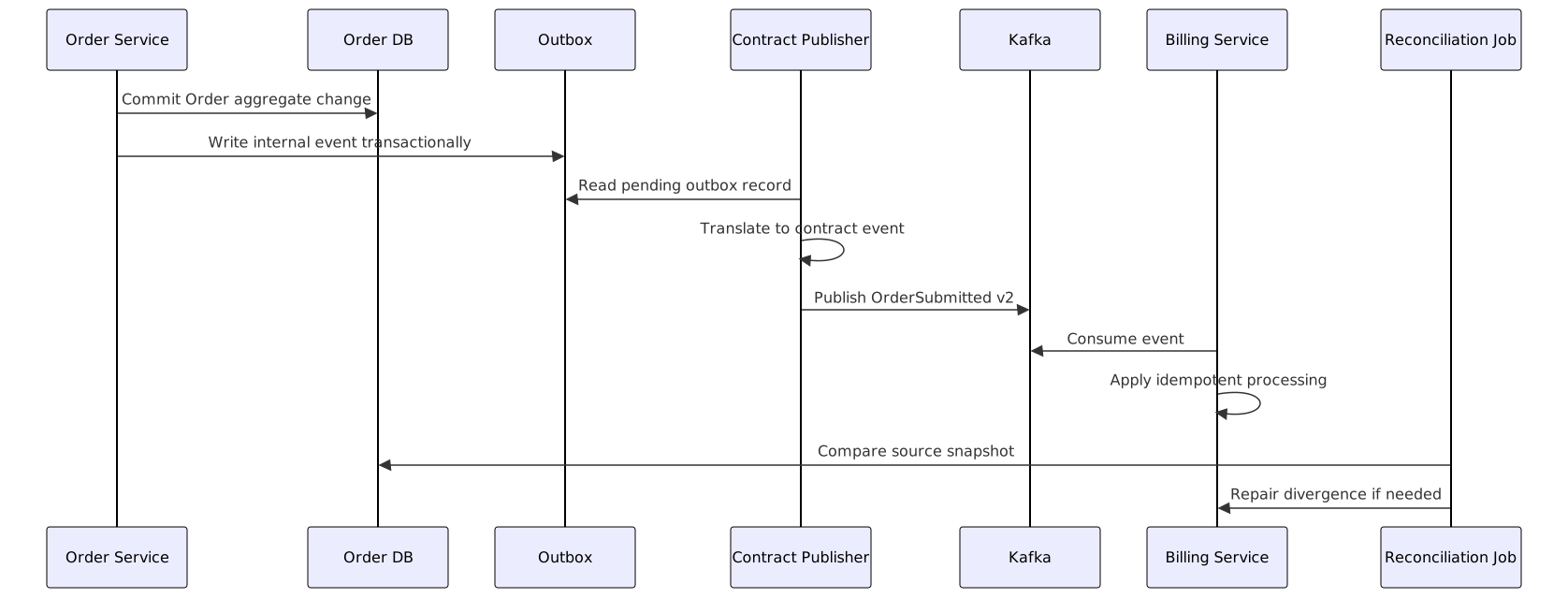
A common pattern is:
- Aggregate changes inside a service.
- The service records domain events transactionally, often via an outbox.
- A publisher translates internal events into stable contract events.
- Contract events are emitted to Kafka topics aligned to domain boundaries.
- Consumers process events idempotently and maintain their own projections.
- Reconciliation processes compare projections with source-of-truth snapshots or compensating feeds.
This gives you a strong center: domain meaning at the source, operational reliability in the middle, and consumer autonomy at the edge.
Topic design
Kafka topics should align to event ownership and domain boundaries more than to consumer convenience. A topic named customer-service-events is weaker than customer-profile.domain-events if the former reflects org chart and the latter reflects semantic ownership.
There are two bad extremes:
- one giant enterprise topic with everything in it
- one topic per event type with no coherent domain grouping
A reasonable middle is domain-scoped topics with event type discrimination in headers or schema metadata.
Schema strategy
You need schema governance, but governance should serve semantics, not bureaucratize them. EA governance checklist
Use explicit schemas. Avro, Protobuf, or JSON Schema all work if versioning discipline is real. Additive evolution is usually the safest path. Renaming fields casually is how you manufacture outages. Breaking changes should be rare and managed through parallel version publication or translation layers.
But schema alone is not enough. A field called status with no semantic definition is still a weak contract, even if registered in a schema registry.
Semantic metadata
Useful contracts typically include:
- event id
- event type
- occurred-at timestamp
- producer/version metadata
- aggregate or business entity identifier
- causation/correlation id
- tenant or business partition key where relevant
- event version
That metadata supports ordering analysis, tracing, replay, and reconciliation.
Ordering and consistency
Architects often oversell ordering. Kafka can preserve order within partitions, not across the universe. If your business process depends on strict global ordering, you need either a stronger design or a smaller ambition.
Model for:
- per-aggregate ordering where possible
- idempotent consumers
- out-of-order tolerance where feasible
- compensating logic when not
Domain events are statements of fact from a source context. Consumers should treat them as eventually consistent inputs, not as distributed transaction participants.
Reconciliation as first-class architecture
If you are running an event-driven enterprise and you have not designed reconciliation, then you have designed denial.
Things will diverge. Consumers will miss events. Backfills will arrive late. Topics will be replayed into code that changed. Data corrections will bypass the normal path. Reconciliation is not a patch for bad systems; it is a standard control in distributed ones.
At minimum, define:
- source-of-truth boundaries
- comparison keys and business keys
- tolerance windows
- repair mechanisms
- human escalation paths
This matters especially in regulated domains where “eventually consistent” does not satisfy auditors.
Migration Strategy
Most enterprises do not get to start clean. They migrate from monoliths, ERP suites, vendor platforms, or integration spaghetti. So the real question is not “how should we design ideal events?” but “how do we get there without breaking the estate?”
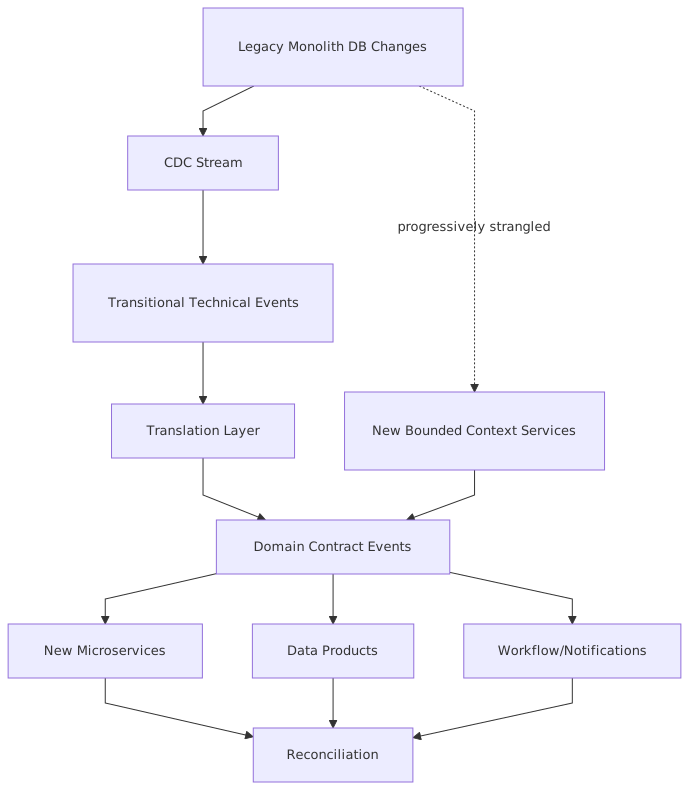
The answer is progressive strangler migration, with semantics improving in stages.
Stage 1: Expose technical signals carefully
At the start, CDC or table-level change events may be the only feasible option. That is acceptable if everyone understands they are transitional integration artifacts, not long-term domain contracts.
The mistake is letting transitional events become public truth.
Label them accordingly. Keep consumers limited. Avoid broadcasting them as enterprise-standard events.
Stage 2: Introduce translation at the edge of the legacy core
Build a translation layer that maps technical mutations into domain-aligned events. This often sits beside the monolith or in a façade service. The translation may enrich, filter, deduplicate, and interpret internal changes into business facts.
This is the architectural hinge. You are no longer publishing what changed in the database. You are publishing what happened in the business.
Stage 3: Move ownership to bounded contexts
As capabilities are strangled out of the monolith into services, event ownership should move with the domain capability. If order capture leaves the monolith, the new Orders context should become the authority for OrderSubmitted, not the old core.
Coexistence is normal for a while. During that period, translation and routing rules matter enormously.
Stage 4: Add reconciliation and backfill patterns
As new services build projections or downstream copies, run reconciliation in parallel. During migration, there will be duplicate producers, timing differences, and edge-case data quality problems. Reconciliation prevents migration optimism from becoming operational fiction.
Stage 5: Retire technical event dependencies
Once domain contracts are stable and consumers are moved, decommission direct dependencies on technical change feeds. This is one of those tasks everyone agrees with and nobody schedules. Schedule it.
Migration reasoning
A strangler approach works because semantics and topology can evolve separately but deliberately.
You do not need to wait for perfect microservices before defining proper domain events. In fact, you should do the opposite: define event contracts early, because they provide a stable seam around which services can later emerge. A clean event contract can outlive both the monolith and the first generation of replacement services.
But migration is full of tradeoffs. Translation layers add latency and complexity. Dual publication can create duplicate semantics. Temporary overlap confuses consumers. These are manageable costs. The unmanaged cost is letting raw internal data changes become your enterprise contract.
Enterprise Example
Consider a large insurer modernizing policy administration.
The legacy platform is a twenty-year monolith. It owns customer details, quotes, policies, endorsements, billing triggers, and documents. A digital channel is being built in microservices. Underwriting analytics wants near real-time feeds. Claims wants policy snapshots. Billing is moving to a separate platform. Kafka is chosen as the event backbone.
The first instinct is classic: emit CDC events from the policy tables.
That creates immediate problems. A single customer address change touches multiple tables. Endorsements and policy renewals both look like “policy updated.” Billing needs to know whether coverage changed, not whether a row changed. Claims needs policy effective periods, not raw mutation history. Analytics wants business events. The digital team wants deterministic flows. Nobody wants to subscribe to database archaeology.
So the insurer creates a Policy domain event model.
Instead of exposing technical updates, it publishes:
QuoteCreatedQuotePricedPolicyIssuedPolicyEndorsedPolicyRenewedPolicyCancelledInsuredAddressChanged
Notice the asymmetry. Not every internal change becomes an external event, and not every external event is a one-to-one mirror of a database transaction.
This is important. PolicyEndorsed is not “policy row updated.” It is a meaningful business fact that indicates coverage changed under an existing policy. Billing reacts to premium deltas. Document services generate endorsement packs. Claims updates policy lookup views. Analytics tracks endorsement frequency. All of them consume the same event with different local models because the contract is about business meaning, not source storage.
Migration happens in phases. Initially, the monolith still produces these events through a translation service fed by CDC plus business rule interpretation. Later, as quote and issuance move into separate bounded contexts, those services take over event ownership. During coexistence, a reconciliation process compares policy state in the target systems against nightly source snapshots and flags mismatches for repair.
Failure modes still occur. A bug in translation emits PolicyIssued before document generation completed, causing downstream customer communications to fire too early. Another consumer incorrectly assumes InsuredAddressChanged means the policy risk address changed, when in fact it reflected the mailing address only. Both incidents are contract failures, not infrastructure failures. The fix is semantic hardening: clearer event names, better definitions, explicit fields for address type, and stronger publication criteria.
That is what real enterprise event architecture looks like. Less glamour, more discipline.
Operational Considerations
Once event contracts are in production, operations becomes part of design.
Contract governance
You need lightweight but real governance: ArchiMate for governance
- who owns each event type
- how changes are proposed
- compatibility expectations
- deprecation timelines
- documentation standards
- consumer communication channels
Not a giant architecture review board. Just enough structure to stop semantic entropy.
Observability
Monitor:
- publish failures
- consumer lag
- dead-letter rates
- schema validation errors
- duplicate processing rates
- reconciliation drift
- replay outcomes
The architecture is only as trustworthy as your ability to see divergence early.
Replay strategy
Replay sounds easy until contracts evolve. Consumers may not be able to reprocess five years of event history under current logic. Some events may need translation before replay. Some projections should be rebuilt from authoritative snapshots rather than raw streams.
Have a replay policy before the incident.
Data classification and privacy
Domain events often carry personal or regulated data. Kafka is not a moral exemption zone. Minimize payloads where possible, classify fields, encrypt where required, and define retention policies. “It was on the bus” is not a compliance strategy.
Consumer onboarding
Make it easy for consumers to understand:
- what event means
- whether it is authoritative
- expected cardinality
- ordering guarantees
- retry guidance
- idempotency requirements
- reconciliation options
If onboarding requires oral tradition, the contract is incomplete.
Tradeoffs
This approach is not free.
Treating domain events as contracts slows down publication design. Teams must invest in language, semantics, versioning, and documentation. There is more up-front modeling than “just emit the change.” Translation layers add complexity. Outbox patterns add moving parts. Reconciliation adds operational cost. Governance can become cumbersome if overdone.
And yet the trade is worth it in most medium-to-large enterprises, because the alternative is hidden coupling spread across dozens of consumers.
The central tradeoff is this: you pay for semantic discipline once, or you pay for semantic ambiguity forever.
There are also architectural tradeoffs in contract shape:
- richer payloads reduce lookup chatter but increase coupling
- thinner payloads preserve publisher freedom but shift burden to consumers
- broad business events simplify topology but may hide needed detail
- highly specific events improve precision but increase event proliferation
There is no universal optimum. The right answer depends on domain volatility, consumer diversity, latency needs, and governance maturity.
Failure Modes
The interesting failures are rarely transport failures. They are semantic and operational mismatches.
Event name says too little
CustomerUpdated becomes the junk drawer of the enterprise. Consumers branch on changed fields and infer business meaning differently. Eventually every team is wrong in a different way.
Event name says too much too early
An event called PaymentSettled is published when in reality the upstream capability only knows “settlement requested.” The contract overstates business certainty and downstream systems automate on false confidence.
Internal model leaks into external contract
Fields like internal status codes, nullable implementation details, or denormalized convenience attributes become consumer dependencies. Refactoring later becomes hostage negotiation.
Consumers treat event as command
A domain event should announce something that happened, not tell other bounded contexts what to do. When consumers interpret events as mandatory workflow instructions, coupling tightens and ownership blurs.
No reconciliation path
Missed events, poison messages, backfills, and manual corrections leave projections stale. Without reconciliation, teams discover inconsistencies through customer complaints.
Versioning without coexistence
A publisher rolls out v2 and assumes consumers will adapt instantly. They won’t. Enterprises contain forgotten consumers like old buildings contain asbestos.
Domain ambiguity across contexts
“Customer,” “account,” “party,” and “insured” are not synonyms just because they share a person id. If contracts flatten contextual differences, downstream confusion follows.
When Not To Use
This pattern is powerful, but it is not universal.
Do not overengineer domain event contracts when:
- the integration is strictly internal and ephemeral
- there is only one consumer and the lifecycle is short
- synchronous request-response is a better fit for the business interaction
- the source capability cannot honestly define a stable business fact yet
- the organization lacks the discipline to govern event evolution and would be better served by APIs
- the domain is operationally simple and batch interfaces are sufficient
Also, not every event stream deserves DDD-level treatment. Infrastructure telemetry, low-level technical notifications, and transient workflow signals are not automatically domain contracts. Calling everything an event does not make everything domain-driven.
And if a process requires immediate transactional consistency across systems, events may support the workflow, but they should not be used to pretend distributed transactions are solved by optimism and a topic name.
Related Patterns
Several adjacent patterns fit naturally here.
Transactional Outbox
A practical way to ensure domain changes and event publication are coordinated without distributed transactions.
CDC
Useful as a migration aid or technical feed, but dangerous when mistaken for a domain contract source.
Event Notification vs Event-Carried State Transfer
A useful distinction. Notification keeps contracts thinner but may require follow-up queries. Event-carried state transfer reduces chatter but can increase coupling. Choose deliberately.
Anti-Corruption Layer
Essential during migration. It protects new bounded contexts from inheriting legacy semantics unchanged.
Saga / Process Manager
Useful for long-running workflows across contexts, but do not confuse saga choreography with domain contract design. A saga built on ambiguous events is just ambiguity with orchestration.
CQRS Projections
Consumers often build read models from domain events. That works well when event semantics are strong and replay/reconciliation are designed properly.
Summary
The phrase “event-driven architecture” has seduced too many enterprises into thinking topology is enough. It isn’t. A mesh of Kafka topics and microservices can still be semantically brittle if the things moving through it are treated as mere messages.
The durable idea is simpler and stricter: a domain event is a contract emitted by a bounded context about a business fact it is authoritative to state.
That framing changes design. It pulls event modeling back into domain-driven design. It forces teams to define meaning, ownership, and safe assumptions. It makes migration more honest, because CDC and technical feeds are recognized as transitional tools rather than end-state architecture. It makes reconciliation first-class. It exposes tradeoffs instead of hiding them under the word “decoupled.”
In enterprise modernization, this matters enormously. Systems change. Teams change. Platforms change. Contracts remain. They become the load-bearing walls of the landscape.
Treat them like plumbing and one day the house floods. Treat them like language and the architecture has a chance to endure.
Frequently Asked Questions
What is enterprise architecture?
Enterprise architecture aligns strategy, business processes, applications, and technology in a coherent model. It enables impact analysis, portfolio rationalisation, governance, and transformation planning across the organisation.
How does ArchiMate support architecture practice?
ArchiMate provides a standard language connecting strategy, business operations, applications, and technology. It enables traceability from strategic goals through capabilities and services to infrastructure — making architecture decisions explicit and reviewable.
What tools support enterprise architecture modeling?
The main tools are Sparx Enterprise Architect (ArchiMate, UML, BPMN, SysML), Archi (free, ArchiMate-only), and BiZZdesign. Sparx EA is the most feature-rich, supporting concurrent repositories, automation, scripting, and Jira integration.