⏱ 22 min read
Most enterprise architecture failures do not begin with a database crash or a cloud bill gone feral. They begin with language. One system says customer. Another means account holder. A third quietly treats the same person as a party, a contact, and a billing entity, depending on which screen you are staring at. The real damage is not technical at first. It is semantic. Teams stop trusting data. Integrations become folklore. The business starts paying a tax on misunderstanding.
That is the territory where the Anti-Corruption Layer earns its keep.
An Anti-Corruption Layer, in the Domain-Driven Design sense, is not just an adapter and not just an API façade. It is a deliberate translation boundary that prevents one model from polluting another. It protects the language of a bounded context when that context must interact with a legacy platform, a vendor package, a shared enterprise service, or even another internal microservice with badly aligned concepts. If architecture has a moral duty, it is this: do not let accidental semantics leak across the borders. microservices architecture diagrams
This pattern is easy to describe and surprisingly easy to misuse. Many teams slap the ACL label on a thin mapping class and declare victory. Then six months later they discover they have recreated the old domain in a new codebase, coupled to every quirk, every status code, and every undocumented edge case. That is not protection. That is importing the swamp and renaming the files.
A real Anti-Corruption Layer is opinionated. It says: our domain terms matter. It translates behavior, identity, state transitions, error meaning, and timing assumptions. Sometimes it is synchronous. Sometimes it is event-driven. Sometimes it lives as a service, sometimes as a component, sometimes as a strangler bridge around a monolith. There is no single canonical implementation because the pattern is defined by its purpose, not its shape.
This article digs into the major variants of the Anti-Corruption Layer, where each one works, where it breaks, and how to use it in serious enterprise migration. We will look at domain semantics, reconciliation, Kafka and microservices, progressive strangler patterns, operational concerns, and the ugly failure modes that appear after the slide deck is over. event-driven architecture patterns
Context
Domain-Driven Design gives us bounded contexts because large organizations do not have one universal truth. They have many useful truths with local precision. The sales organization thinks in opportunities and quotes. Finance thinks in receivables and tax liability. Customer support thinks in cases and entitlements. The same real-world thing appears under different models because each context is optimized for a different purpose.
That is healthy.
The trouble begins when integration assumes sameness where only overlap exists. Legacy ERP packages, CRM suites, warehouse systems, payment platforms, and bespoke core applications often come with giant conceptual shadows. They are old enough, central enough, or politically important enough that everyone else bends around them. New teams then build a service for, say, Order Management, but instead of defining an order in their own bounded context, they inherit the ERP’s line-type codes, shipment states, return conventions, and account hierarchy. The new service may be technically modern, but semantically it is still trapped in the old system’s worldview.
That is contamination.
The Anti-Corruption Layer exists because integration is unavoidable, but conceptual surrender is optional.
In modern enterprises, this shows up in several recurring situations:
- a microservice must read or write to a legacy monolith
- a greenfield domain must consume data from a vendor SaaS platform
- event streams from Kafka carry concepts that do not match the receiving context
- a strangler migration needs coexistence between old and new workflows
- multiple business units use the same “master” system, but each has different semantics
- post-merger integration requires bridging two incompatible business vocabularies
The pattern matters most when the downstream or upstream model is strong enough to distort yours. The danger is not just technical dependency. It is semantic gravity.
Problem
A bounded context needs to collaborate with an external model without absorbing its assumptions, terminology, invariants, and defects.
That sentence sounds clean. Reality is not.
The external system may identify customers by account number while your domain identifies them by party relationship and legal entity. It may model cancellations as negative orders, returns as inventory movements, and discounts as line item overrides. It may publish events with names that are operationally convenient but domain-wise misleading. Worse, it may have hidden business rules embedded in interfaces, database triggers, message sequencing, or batch jobs.
If you integrate naively, several things happen:
- Ubiquitous language collapses. Your team starts speaking in legacy codes.
- Core domain logic leaks. Business rules become scattered across adapters, controllers, and schema mappings.
- Change becomes expensive. Any external change forces internal redesign.
- Testing loses meaning. You validate transport and field presence, not business semantics.
- Migration stalls. New services remain dependent on old concepts forever.
- Data quality erodes. Partial translation creates ambiguity and reconciliation pain.
The anti-pattern here is common: direct integration masquerading as clean architecture.
A team creates DTOs from the legacy interface, reuses them across layers, stores them in internal databases, emits them on internal topics, and then writes “mappers” at the edge. It looks tidy in code reviews because everything compiles. But the corruption has already happened. The translation boundary sits too close to the outside, and the inside has already been colonized.
Forces
Architecture is never just pattern matching. There are real forces pulling in opposite directions.
Semantic fidelity vs delivery speed
A rich Anti-Corruption Layer takes time. It requires domain modeling, translation rules, explicit invariants, and careful edge-case handling. Teams under delivery pressure often choose a simpler pass-through integration. That is understandable. It is also how technical debt earns compound interest.
Legacy behavior vs domain clarity
Sometimes the external system behaves in ways your domain would never choose. A shipment might become “complete” before all parcels leave because the warehouse system optimizes around manifest generation. An invoice may be “posted” long before payment risk is settled. You must decide whether to mirror those states, reinterpret them, or model a separate lifecycle internally.
Synchronous consistency vs asynchronous autonomy
A direct API call gives immediate feedback but couples availability and latency. Event-driven integration gives autonomy and resilience but introduces eventual consistency, replay issues, and reconciliation work. Neither is universally better.
Reuse vs protection
The enterprise platform team may encourage canonical schemas, shared libraries, or common event contracts. Sometimes this helps. Often it creates semantic flattening. A canonical model can become a bureaucratic way to spread vagueness.
Migration pragmatism vs architectural purity
During strangler migration, you may need temporary compromises: dual writes, shadow reads, replicated reference data, coarse mappings, or manual reconciliation queues. A good architect knows the difference between a bridge and a destination.
Operational transparency vs translation complexity
The richer the translation, the harder observability becomes. When one order in your domain becomes three commands, five events, and a compensating workflow in the external system, diagnosing failures requires much better tracing and support tooling.
These forces explain why ACL implementations vary so much. The pattern is stable. The mechanics are not.
Solution
The Anti-Corruption Layer is a translation boundary between bounded contexts. Its purpose is to preserve the integrity of the consuming or protected domain by converting language, models, behaviors, and interaction styles.
A proper ACL typically performs some combination of:
- model translation
- identity mapping
- protocol adaptation
- workflow orchestration
- validation and invariant enforcement
- error and status normalization
- temporal decoupling
- event reinterpretation
- reconciliation support
The simplest way to think about it is this: the ACL speaks both languages, but dreams in only one.
It understands the external model deeply enough to deal with it on its own terms. But internally it presents only the protected domain’s concepts. That distinction is crucial. If the ACL starts exposing external terms inward for convenience, the wall has a door in it, and corruption walks through.
Common variants
There is no single ACL design. In practice, I see a handful of useful variants.
1. In-process adapter ACL
This is a library or component inside an application service that translates external requests and responses into domain commands and objects. It works well when integration is narrow and latency matters.
Use it when:
- one service integrates with one external system
- traffic volume is moderate
- orchestration complexity is low
- separate deployment of translation logic would add needless overhead
Risk:
- the adapter can become too close to the application layer and leak external DTOs inward
2. Standalone translation service
A dedicated service encapsulates translation and integration concerns. This is useful when several internal consumers need protection from the same external platform, or when the external protocol is ugly enough to deserve quarantine.
Use it when:
- multiple bounded contexts depend on the same external system
- translation rules are complex and evolving
- security, throttling, auditing, or partner-specific rules matter
Risk:
- it can degenerate into a mini-enterprise service bus if made too generic
3. Event-driven ACL
The ACL consumes external events, translates them into domain events or commands, and may also publish outward-facing translations in the opposite direction. Kafka makes this pattern practical at scale.
Use it when:
- the external system is event-capable
- eventual consistency is acceptable
- replay, buffering, and decoupling are valuable
- you are migrating incrementally around a monolith
Risk:
- semantic drift across topics is hard to detect
- duplicate, out-of-order, or missing events require disciplined handling
4. Process-oriented ACL
Here the translation boundary is not just data mapping. It manages a multi-step workflow because one domain action maps to several external actions or vice versa.
Use it when:
- external interactions are transactional in business terms but not technically atomic
- compensation and reconciliation are unavoidable
- the external system exposes only low-level operations
Risk:
- the ACL begins to own business process that really belongs in the domain or a separate saga
5. Read-optimized ACL
Sometimes the need is primarily to protect read models and reporting semantics. The ACL transforms source data into a query-friendly projection aligned with the target context.
Use it when:
- read concerns dominate
- source systems are messy
- query semantics differ sharply from operational systems
Risk:
- teams mistake transformed projections for authoritative source of truth without governance
Architecture
A useful Anti-Corruption Layer has three architectural qualities: explicit translation, isolation of external knowledge, and operational traceability.
Here is the basic shape.

The diagram is simple because the core idea is simple. The implementation is where things get serious.
Translation is more than mapping fields
A weak architecture treats translation as a mechanical exercise: rename fields, reshape payloads, convert enums. A strong architecture translates meaning.
For example:
- Legacy
status=BOOKEDmay mean “financially committed” in one context, but your domain may require separate concepts forReserved,Confirmed, andAuthorized. - Legacy
customer_idmight identify a billing account, whereas your domain customer is a party aggregate with roles, channels, and consent state. - Legacy “delete” may really mean “mark inactive,” and your domain might prohibit deletion entirely.
This is where domain-driven design earns its keep. The target domain model should not be bent to fit the external source. Instead, the ACL should absorb the mismatch and present an internally coherent model.
Domain semantics must be first-class
Every serious ACL should make semantic translation explicit in code and in design artifacts.
Not just:
LegacyOrderDTO -> Order
But:
LegacyOrderType.BACKORDER -> OrderIntent.ReserveWhenAvailableERPInvoiceStatus.POSTED -> ReceivableState.OpenCRMContact + Account -> CustomerRelationship aggregateShipmentManifestCreated -> FulfillmentCommitted?maybe, maybe not
That “maybe” matters. The ACL often needs policy decisions because semantics are not always one-to-one. When rules are ambiguous, the boundary should surface that ambiguity rather than bury it.
Identity and referential continuity
Identity mapping is usually underestimated. During migration, the same conceptual entity may exist under multiple identifiers:
- legacy customer number
- CRM party ID
- new domain aggregate ID
- external vendor reference
- Kafka event key
The ACL needs a strategy for correlation and survivorship. Without it, reconciliation becomes detective work.
A practical design often includes:
- cross-reference tables
- deterministic key derivation where possible
- immutable external references
- idempotency keys for commands and event handling
- explicit handling of splits and merges
Event-driven translation with Kafka
When Kafka is involved, the ACL often sits as a consumer-producer bridge. It reads events from one bounded context or legacy integration stream, interprets them, and emits events meaningful to the protected domain.
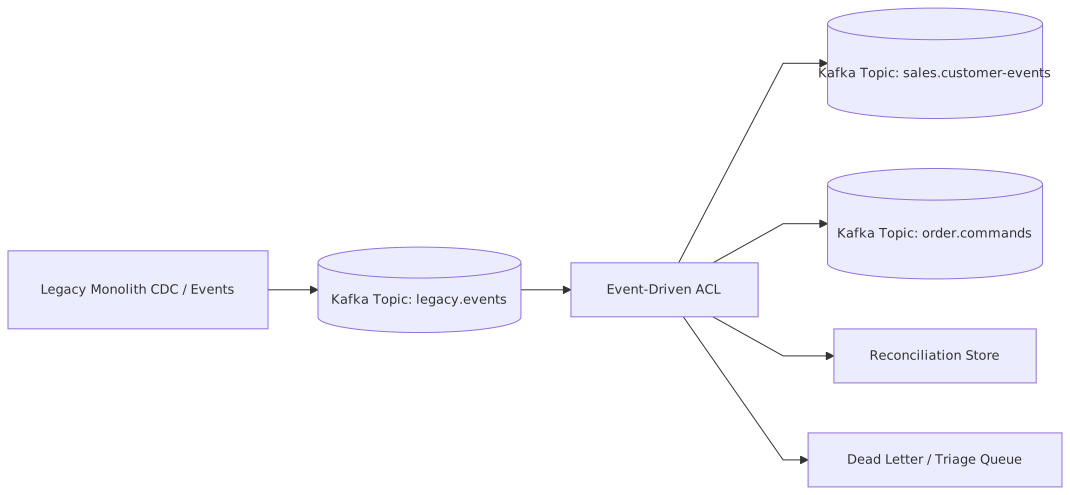
This is useful, but dangerous if done lazily. Publishing a new topic with the same old semantics and fresher Avro schemas is not domain modernization. It is lipstick on COBOL.
A good event-driven ACL should:
- version contracts deliberately
- preserve traceability from source event to translated outcome
- handle duplicates and replays
- separate factual events from interpreted domain events
- maintain audit metadata for support and compliance
Reconciliation is not a side issue
In synchronous designs, teams tend to assume the world is immediately aligned. In enterprise systems, it rarely is. Timeouts, retries, partial failures, batch windows, stale reference data, and human interventions all create divergence.
That means an ACL often needs reconciliation capabilities:
- compare source and target state
- detect missing or inconsistent translations
- repair drift
- route exceptions for manual review
- support periodic replay
If the translation boundary is part of a migration, reconciliation is not optional. It is the price of sleeping at night.
Migration Strategy
The ACL is one of the best tools for progressive strangler migration because it lets a new bounded context coexist with a legacy model without inheriting it.
The trick is to treat migration as a sequence of increasing semantic independence.
Stage 1: Observe and model
Before writing a line of translation code, understand the legacy semantics in operational detail. Not the PowerPoint version. The real one.
Ask:
- which fields actually drive decisions?
- what statuses are overloaded?
- what hidden sequencing rules exist?
- where do users compensate manually?
- which nightly jobs mutate meaning?
- what exceptions matter in practice?
Map legacy concepts to the new ubiquitous language. Expect mismatch. That mismatch is the point.
Stage 2: Read through the ACL
Start by protecting reads. Translate legacy data into the new domain for query and decision support. This is lower risk than writes and surfaces semantic gaps early.
Useful tactics:
- shadow reads
- translated read models
- side-by-side comparison reports
- quality dashboards for semantic completeness
Stage 3: Introduce command translation
Once the new domain is stable, route selected commands through the ACL into the legacy system. At this phase the ACL often performs orchestration, policy checks, and idempotency enforcement.
Be careful with dual write temptations. If a command updates both the new and old systems independently, you have built a race condition with executive sponsorship.
Stage 4: Shift system of record responsibilities
As capabilities move, some aggregates become mastered in the new bounded context while others remain in legacy. The ACL now mediates authority boundaries as well as translations.
This is where teams often get sloppy. They continue to let the old system “just update that field for now.” That “for now” becomes two years.
Stage 5: Strangle legacy pathways
Move traffic, events, and operational procedures away from the old model. Retire translation rules that were only needed for coexistence. Shrink the ACL over time as dependency decreases.
That is worth saying plainly: a migration ACL should ideally get smaller. If it keeps growing after the migration milestones, it may be hiding unresolved ownership and poor context boundaries.
Here is a typical progressive strangler setup.
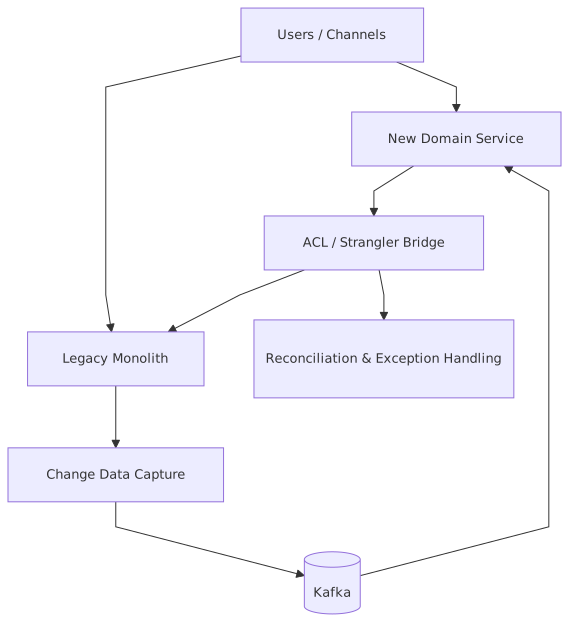
Reconciliation during migration
Migration without reconciliation is wishful thinking in a suit.
During coexistence, you need explicit practices:
- periodic balance checks between systems
- semantic comparison, not just row counts
- exception queues with business-friendly reason codes
- replay tools
- lineage from command to side effects
- rules for conflict resolution when both sides changed
A mature architecture names the conflict policy:
- legacy wins
- new domain wins
- field-level survivorship
- timestamp precedence
- manual review
- context-specific merge
If that policy is absent, support staff will invent one under pressure.
Enterprise Example
Consider a global insurer replacing a 20-year-old policy administration platform with domain-aligned services for Customer, Policy, Billing, and Claims. The legacy platform stores “policy holder,” “insured party,” and “payer” in a tangled customer hierarchy optimized for batch billing and product constraints. The new Customer context models Party, Relationship, Role, Address, Consent, and Communication Preference as distinct concepts.
If the new services integrate directly with the legacy customer tables and SOAP services, the result is immediate confusion:
- one customer appears as multiple parties
- policy renewals create “new” customer versions
- cancellation codes imply relationship changes that do not match reality
- claims events identify participants differently than billing does
So the team introduces an Anti-Corruption Layer between the new Customer service and the policy platform.
The ACL does several things:
- translates legacy policy-holder structures into a customer relationship model
- maintains cross-reference identities between old customer numbers and new party IDs
- interprets policy lifecycle events from Kafka and emits customer-relevant domain events
- handles write-back for selected changes, such as address updates, where legacy remains the operational master during transition
- runs nightly reconciliation to detect divergence in critical attributes and unresolved merges
An address change is a good example. In the new Customer context, address is attached to a party with effective dates and usage types. In legacy, mailing address may be duplicated across policy records and billing profiles. The ACL takes one domain command, decides which legacy representations need change, applies them idempotently, and records translation lineage. If one downstream update fails, the ACL does not pretend success. It marks the translation incomplete, emits an operational alert, and routes the case into reconciliation.
That is architecture doing real work.
Over time, as more customer capabilities move into the new platform, the ACL’s write-back logic shrinks. Legacy still consumes translated customer snapshots for old screens, but authority has shifted. Eventually the customer-facing portion of the policy platform can be retired without the new model ever having accepted the legacy hierarchy as its own truth.
This is why the pattern matters in enterprise modernization. It is not a wrapper. It is a controlled decolonization.
Operational Considerations
An ACL that works only in design diagrams is a liability. In production, translation boundaries need disciplined operations.
Observability
You need end-to-end traceability across:
- inbound request or event
- translation decision
- downstream calls or produced events
- reconciliation outcomes
- user-visible effects
At minimum capture:
- correlation ID
- source system reference
- target domain entity ID
- translation version
- rule path or policy applied
- retries and compensations
Without this, support teams cannot answer the simplest question: “What happened to this order?”
Versioning
External contracts change. So do internal models. The ACL is where versioning collisions surface first.
Good practice:
- version external adapters separately from internal translation logic
- keep translation rules backward compatible where feasible
- avoid exposing raw external schemas internally
- treat event schema evolution as a domain concern, not just a serialization concern
Throughput and backpressure
Event-driven ACLs on Kafka need clear handling for spikes, poison messages, replay storms, and downstream rate limits. Throttling and buffering are part of the design, not afterthoughts.
Security and compliance
The ACL often sees sensitive data from both worlds. That makes it a concentration point for:
- PII masking
- consent interpretation
- audit trails
- partner-specific access policies
- encryption boundaries
Test strategy
Testing should include:
- semantic translation tests
- golden datasets for edge cases
- consumer-driven contracts where useful
- replay tests from production-like event samples
- reconciliation simulations
- failure injection for partial downstream success
A mapper test that checks 37 fields line up is fine. A semantic test that proves “policy cancellation due to non-payment does not terminate the insured relationship unless confirmed by underwriting state” is much better.
Tradeoffs
The Anti-Corruption Layer is powerful, but it is not free.
Benefits
- protects bounded context integrity
- enables migration without semantic surrender
- localizes legacy complexity
- supports parallel evolution of systems
- creates a seam for testing, observability, and policy enforcement
Costs
- more code and more moving parts
- translation logic must be maintained as both sides evolve
- latency may increase
- debugging becomes more involved
- ownership can become politically awkward when multiple teams depend on the boundary
There is also a subtler tradeoff: every ACL embodies interpretation. If the translation is too aggressive, you risk oversimplifying the external model and losing important distinctions. If it is too faithful, you import contamination through the back door. Good architects live in that tension.
Failure Modes
This pattern fails in predictable ways.
1. Thin mapping disguised as an ACL
The team renames fields and calls it done. External statuses, IDs, and concepts still leak into the domain. Nothing is actually protected.
2. ACL becomes shared enterprise middleware
A generic translation hub emerges, serving dozens of teams with “canonical” models. Soon nobody owns semantics, and the ACL becomes the integration monolith you swore you were escaping.
3. Business logic gets trapped in the boundary
When every rule is easier to add in the translator than in the domain, the ACL becomes the real application. Now your architecture is upside down.
4. Reconciliation is ignored
Partial failures accumulate silently until finance or operations discovers the numbers do not tie out. By then, root cause analysis is archaeology.
5. Event semantics drift
A translated Kafka topic starts aligned with the new domain, then slowly absorbs source-system detail because “one more field will help consumers.” Soon the protected language has been polluted.
6. Temporary migration rules become permanent
The worst enterprise systems are full of “interim” bridges old enough to vote. Every ACL needs explicit retirement criteria for coexistence logic.
When Not To Use
An Anti-Corruption Layer is not always the right move.
Do not use it when:
The models are already aligned
If two contexts genuinely share language and semantics, a simpler published language or direct integration may be sufficient.
The external system is trivial and low-risk
For a small commodity service with no meaningful domain overlap, a straightforward adapter may do. Not every REST client deserves DDD theatre.
You control both sides and can redesign together
If both systems are in the same domain and under coordinated ownership, invest in clearer context boundaries and contracts rather than building a heavy translation layer.
The protected domain is not actually well modeled
An ACL cannot protect a domain that has not been defined. If your internal model is vague, the boundary will just encode confusion with extra classes.
The layer would become a bottleneck with no strategic value
Sometimes a direct protocol adapter with limited scope is enough. Use the pattern where semantic protection matters, not as architecture decoration.
In short: do not build an embassy where a footbridge will do.
Related Patterns
The Anti-Corruption Layer sits near several other DDD and enterprise integration patterns, but it is not the same thing.
Adapter
An adapter changes interface shape. An ACL protects domain meaning. Some ACLs contain adapters, but the purpose is broader.
Facade
A facade simplifies access to a subsystem. An ACL translates semantics and isolates corruption.
Open Host Service
An open host service provides a stable protocol for others. An ACL is usually consumer-protective, shielding one context from another.
Published Language
A published language works when parties can agree on shared meaning. ACLs are for when they cannot, or should not.
Conformist
A conformist relationship accepts another model’s dominance. Sometimes that is pragmatic. The ACL is the opposite stance: preserve your own model.
Strangler Fig
The strangler pattern incrementally replaces a legacy system. ACLs are one of the best tools to make that safe by managing coexistence semantics.
Saga / Process Manager
A process-oriented ACL may resemble a saga when multiple steps and compensations are involved. The distinction is purpose. The ACL exists to protect a model boundary; a saga exists to coordinate distributed business workflow.
Summary
The Anti-Corruption Layer is one of the few integration patterns that treats language as a first-class architectural concern. That is why it matters. Enterprises do not merely integrate systems. They integrate meanings, often badly.
A good ACL creates a translation boundary that protects a bounded context from semantic pollution. It may be in-process, standalone, event-driven, or workflow-oriented. It often matters most during modernization, especially in progressive strangler migrations where old and new systems must coexist for longer than anyone likes to admit.
Done well, it handles:
- model translation
- identity mapping
- protocol adaptation
- Kafka event reinterpretation
- reconciliation
- observability
- migration-era coexistence
Done badly, it becomes either a thin mapper that protects nothing or a giant middleware swamp that owns too much.
The practical test is simple. After integrating with the external system, does your team still speak its own ubiquitous language with confidence? Do your aggregates still reflect your domain rather than someone else’s package design? Can you migrate system responsibilities without carrying old semantics forever?
If yes, the Anti-Corruption Layer is doing its job.
If not, then the corruption is already inside the walls.
Frequently Asked Questions
What is enterprise architecture?
Enterprise architecture aligns strategy, business processes, applications, and technology in a coherent model. It enables impact analysis, portfolio rationalisation, governance, and transformation planning across the organisation.
How does ArchiMate support architecture practice?
ArchiMate provides a standard language connecting strategy, business operations, applications, and technology. It enables traceability from strategic goals through capabilities and services to infrastructure — making architecture decisions explicit and reviewable.
What tools support enterprise architecture modeling?
The main tools are Sparx Enterprise Architect (ArchiMate, UML, BPMN, SysML), Archi (free, ArchiMate-only), and BiZZdesign. Sparx EA is the most feature-rich, supporting concurrent repositories, automation, scripting, and Jira integration.