⏱ 21 min read
Most enterprise systems do not fail because the code is bad. They fail because the language rots.
At first, everybody means the same thing when they say customer, order, account, shipment, or policy. Then the business grows teeth. Sales says “customer” means a buyer hierarchy. Finance says it means a bill-to entity. Support says it means the human being calling the help desk. Compliance says it means the legally accountable party. The software, eager and literal, tries to honor all of them at once. That is how a neat model turns into a junk drawer.
This is where bounded contexts earn their keep.
Domain-Driven Design was never really about drawing boxes around microservices. It was about admitting a hard truth: the same word can legitimately mean different things in different parts of the business, and forcing a single model across those meanings is architectural vandalism. But bounded contexts are not static lines on a one-time diagram. They move. They split. They merge. They are born from organizational friction and, if you are lucky, from organizational learning.
That is the real design problem: not merely defining bounded contexts, but evolving them without tearing the enterprise in half.
This article is about that evolution. Not the polished conference-slide version where teams serenely extract services one by one, but the messier enterprise reality: legacy monoliths, Kafka topics with accidental semantics, reporting systems that became integration platforms, and months of reconciliation because two systems each insist they are the truth. We will look at how bounded contexts change over time, why they change, how to migrate toward clearer boundaries, and where this approach breaks down.
A bounded context is a semantic boundary before it is a technical one. If you forget that, the migration may be modern, cloud-native, event-driven, and still wrong. cloud architecture guide
Context
In the early life of a system, a unified model often works surprisingly well. One product, one team, one rough shared understanding. The domain language is small enough to fit in people’s heads. You can keep Customer, Invoice, Order, and Product in a single codebase and nobody gets hurt.
Then success happens.
Different business capabilities mature at different speeds. Pricing starts changing weekly. Regulatory reporting gets new obligations. Fulfillment adds warehouse rules. Customer service needs a conversation history that sales does not care about. Slowly the original domain model becomes less like a coherent language and more like a diplomatic compromise.
The signs are familiar:
- One entity carries fields used by unrelated departments.
- Teams argue over who “owns” a concept.
- The same business event means different things depending on who consumed it.
- Integrations rely on one giant canonical data model no one truly understands.
- Changes in one area trigger regressions in another because they share persistence and object structures.
- Reporting extracts become operational dependencies.
These are not just scaling problems. They are semantic problems.
Bounded contexts in DDD exist to contain semantic consistency. Inside a context, a term should mean one thing. Across contexts, translation is expected. That translation is not a flaw. It is the architecture acknowledging reality.
But enterprises rarely get their bounded contexts right up front. More often, they discover them through pain. A “Customer Management” system turns out to contain CRM, credit risk, service identity, account hierarchy, and billing responsibilities all under one banner. At that point, the architect’s job is not to preach purity. It is to guide evolution.
Problem
The core problem is this: business domains evolve unevenly, but software boundaries tend to fossilize.
A monolith built around one model becomes the de facto source of truth for multiple domains. Over time, teams optimize locally. They add fields, flags, states, workflows, and integrations. The system starts serving incompatible needs using a shared representation. Eventually it becomes impossible to change one part of the business without negotiating with five others.
This creates three kinds of architectural debt.
First, semantic debt. Terms are overloaded. “Active customer” means “has signed contract” to sales, “has unpaid balance” to finance, and “has authenticated in the last 90 days” to digital channels. The code contains all three definitions, often hidden in different services and reports.
Second, change-coupling debt. Shared schemas and shared tables cause unrelated changes to collide. A minor billing enhancement now requires regression testing in onboarding, support, and analytics because they all touch the same core objects.
Third, integration debt. Enterprises often respond by adding interfaces around the monolith without changing the model. This decorates the problem rather than solving it. You end up with APIs and Kafka events that export muddled concepts faster and more widely.
The usual symptom is a migration program that talks in technical nouns—microservices, Kafka, event sourcing, cloud transformation—while the real issue is unresolved domain semantics. You cannot carve clean services out of dirty language. event-driven architecture patterns
Forces
Bounded context evolution is shaped by competing forces. Good architecture lives in those tensions; it does not wish them away.
1. Business specialization vs enterprise consistency
Each function wants a model tailored to its needs. That is sensible. Billing really does need different invariants from customer support. But the enterprise also needs consistency where it matters: legal identity, contract obligations, money movement, auditability. The trick is to isolate difference without losing coherence.
2. Local autonomy vs cross-context workflows
Teams want autonomy to change their systems independently. Yet real business processes cross boundaries. Quote-to-cash, claims handling, employee onboarding, loan servicing—none of these sit inside one context. Architecture must support autonomous models while enabling end-to-end outcomes.
3. Historical data vs current semantics
Legacy systems contain years of business history. That history often reflects older definitions of domain concepts. Migration must respect the past without allowing old semantics to poison the future. This is where reconciliation becomes unavoidable.
4. Transactional certainty vs asynchronous scalability
A monolith often gives the illusion of one transaction and one truth. Distributed bounded contexts replace that with asynchronous messaging, delayed consistency, and compensating action. Kafka makes this practical, but it does not make it simple. Events must carry domain meaning, not just row changes.
5. Governance vs speed
Without governance, every team invents its own language and integration style. With too much governance, every new bounded context becomes a committee exercise. Enterprises need a lightweight but firm discipline around domain language, contracts, ownership, and versioning. EA governance checklist
Solution
The right move is usually not “design all bounded contexts from scratch” and not “split the monolith by technical layer.” The practical solution is bounded context evolution through progressive clarification and selective extraction.
In plain language: learn the domain boundaries by observing where language, invariants, and rates of change diverge; then migrate those seams gradually, using translation and reconciliation as first-class architectural mechanisms.
This requires a few strong opinions.
Opinion one: start with semantics, not service count. A bounded context is justified when it protects a coherent model with its own rules, language, and cadence of change. If all you have is a technical desire to decompose, you will just move the mess into more deployables.
Opinion two: use the strangler pattern progressively, but strangle concepts, not merely endpoints. Re-routing an API call from the monolith to a new service is easy. Establishing that the new service owns a distinct part of the ubiquitous language is the hard part.
Opinion three: translation is architecture. Anti-corruption layers, mapping services, event adapters, and reconciliation processes are not temporary embarrassment. They are the machinery of coexistence while the enterprise learns its own boundaries.
Opinion four: do not chase a single canonical enterprise model unless the domain truly demands it. Canonical models often become semantic graveyards—too generic to be useful, too rigid to evolve. Prefer published language per context and explicit mapping between them.
A mature bounded context evolution strategy usually includes:
- event storming or domain workshops to expose language collisions
- a context map showing upstream/downstream relationships
- explicit ownership of aggregates and invariants
- anti-corruption layers between old and new models
- Kafka topics or integration APIs defined around business events
- reconciliation pipelines to compare, repair, and explain divergence
- gradual data ownership transition rather than immediate database splits
Architecture
A useful way to think about bounded context evolution is as a series of states rather than a one-time redesign.
Stage 1: Shared model, hidden fractures
Everything lives in one large system. Fractures already exist, but they are hidden under shared classes, tables, and process flows.
Stage 2: Semantic segmentation
The enterprise identifies distinct meanings. This is usually the first real breakthrough. Teams stop arguing about the “correct” definition of customer and instead admit there are several context-specific truths.
Stage 3: Context extraction
Capabilities with the clearest semantic independence are extracted first. Usually these are areas with high change rates, specialized rules, or chronic contention with the shared model.
Stage 4: Asynchronous coordination and reconciliation
The enterprise moves from direct shared-state coordination to event-driven synchronization, sagas, and operational reconciliation.
Stage 5: Stable context map
Contexts become durable organizational and technical boundaries. Some remain in a modular monolith. Some become microservices. The technology varies; the semantic integrity does not. microservices architecture diagrams
Here is a simple evolution timeline.

Notice what is absent from that diagram: “rewrite everything.” Enterprise architecture should be suspicious of any migration plan whose main virtue is its dramatic ambition.
Context relationships
Not all contexts are equal. Some are core. Some are supporting. Some are generic. Some publish key events. Some consume and adapt. These relationships matter because they shape migration order.
A typical enterprise context map might look like this:
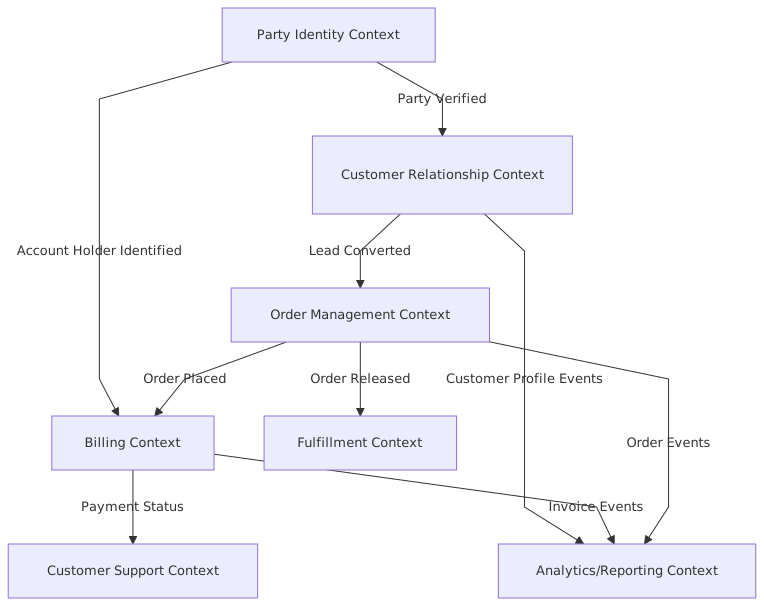
This is where DDD thinking becomes practical. The architecture is not organized around systems; it is organized around language and responsibility. Party Identity is not the same thing as Customer Relationship, even if the old monolith had one CUSTOMER table pretending otherwise.
The role of Kafka
Kafka becomes relevant when contexts need to coordinate through durable business events, especially at enterprise scale. But Kafka is not the architecture. It is the courier.
Use Kafka when:
- contexts need decoupled asynchronous propagation
- event streams must support multiple downstream consumers
- replay is valuable for rebuilding read models or investigating drift
- ordering within a key matters
Do not use Kafka as a row-change exhaust pipe and call it DDD. “Customer table updated” is not a meaningful domain event. “Billing Account Suspended for Non-Payment” is.
Good event design follows context semantics. Events should be owned by the producing context and named in its published language. Downstream consumers translate them into their own models. That translation is the cost of autonomy.
Reconciliation as part of architecture
In bounded context evolution, reconciliation is not a cleanup task. It is a design concern.
During migration, multiple contexts may temporarily hold overlapping facts. For example:
- CRM knows a customer’s preferred contact channels.
- Billing knows bill-to account relationships.
- Identity knows legal party status.
- Support keeps a service profile.
Some overlap is inevitable. The question is not whether divergence can happen. It will. The question is whether the architecture can detect it, explain it, and repair it without panic.
A practical reconciliation design often includes:
- immutable event logs for traceability
- comparison jobs across key identifiers and attributes
- exception queues for unresolved mismatches
- operational dashboards showing lag and drift
- explicit source-of-authority rules per attribute
- human workflows for data conflict resolution
This looks unglamorous because it is. But enterprises live or die in the unglamorous details.
Migration Strategy
The migration strategy that works best in practice is progressive strangler migration guided by domain seams.
Not all seams are worth cutting first. Start where three conditions overlap:
- the language is distinct,
- the business rules are specialized,
- the rate of change is high enough that separation pays for itself.
That often leads to extracting pricing, billing, fulfillment, identity, or customer support before more entangled process orchestration areas.
Step 1: Expose semantic conflict
Run domain workshops with actual business people, not just architects and senior engineers. Ask basic but dangerous questions:
- What does “customer” mean here?
- What makes an order valid?
- Who can change a payment status?
- What does “active” mean?
- Which dates are legally binding?
- What is the source of truth for identity?
The point is not consensus. The point is to surface legitimate differences.
Step 2: Define bounded contexts and published language
Once meanings diverge, give them names. Maybe you have Party, Customer Account, Buyer, and Subscriber instead of one overloaded Customer. This naming work is not cosmetic. It is the architecture clarifying thought.
Step 3: Insert anti-corruption layers
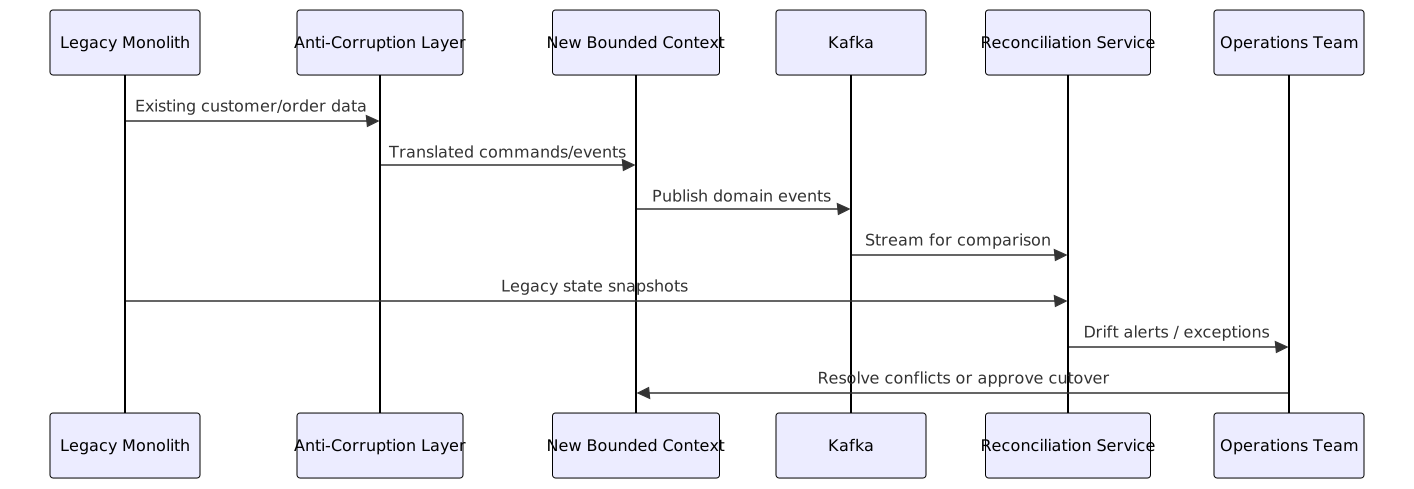
Before extracting a new context, shield it from the legacy model. An anti-corruption layer translates between the monolith’s semantics and the new context’s language. Without this, the new service simply inherits the old mud.
Step 4: Extract behavior before data where possible
A common mistake is to start by copying tables. Better to extract a capability and let it own decisions, then move data ownership over time. If the new Billing context can calculate invoices and publish invoice events, it has a real boundary. If it merely mirrors billing tables, it is just a cache with ambitions.
Step 5: Introduce event-driven integration
Once the new context owns behavior, publish domain events through Kafka or APIs. Keep them stable, meaningful, and versioned. Build consumers that adapt those events into downstream contexts.
Step 6: Reconcile and cut over gradually
For a period, old and new systems may run in parallel. This is where reconciliation matters. Compare outputs, detect anomalies, tune mappings, and establish operational confidence. Only then retire legacy paths.
The migration often looks like this:
Why progressive strangler works
Because it accepts coexistence.
Enterprises do not migrate from one perfect semantic world to another in a weekend. They spend months, sometimes years, with both worlds alive. Progressive strangler migration gives you a controlled way to route new behavior to a cleaner model while old behavior remains in place until confidence grows.
A hard cutover is tempting. It is also how you create executive war rooms.
Enterprise Example
Consider a large telecommunications provider. This is a classic enterprise case because telecoms are masters of semantic confusion. They sell to consumers, households, small businesses, and large enterprises. They have products, bundles, subscriptions, service locations, bill-to accounts, legal account holders, and support relationships. In the old estate, all of this lived in a giant CRM-billing monolith with one Customer entity and several hundred related tables.
For years, every function stretched that model.
Sales used Customer to mean prospect, subscriber, or account hierarchy depending on the workflow. Billing used it to mean the legally liable bill-to account. Support used it to mean the authenticated caller and the services they could discuss. Digital channels cared about login identity and preferences. Analytics stitched all of it together in a warehouse, then fed extracts back into operations.
The pain became severe during a new fiber rollout. Product teams needed faster changes to eligibility, orders, and service activation. Billing, however, remained slow and risk-sensitive. Support wanted a unified customer view but could not trust the shared model because household, contract, and service location data often conflicted.
The enterprise did not begin by “building microservices.” It began by redrawing language.
They identified these bounded contexts:
- Party Identity: legal persons, organizations, verification, consent anchors
- Customer Relationship: prospects, marketing profiles, contact preferences
- Subscription Management: active subscribed services and plans
- Billing Account: invoices, payment responsibility, delinquency
- Order Management: commercial orders and order lifecycle
- Service Fulfillment: activation, provisioning, network tasks
- Customer Care: support interactions, case management, entitlements to discuss accounts
This changed everything. Once Party, Billing Account, and Subscription were treated as distinct concepts, the old Customer table was no longer sacred. It was just legacy storage.
The migration started with Order Management and Service Fulfillment, because they had high change pressure and relatively clearer boundaries. An anti-corruption layer translated monolith order structures into the new order model. Kafka topics published OrderPlaced, OrderValidated, ServiceProvisioningRequested, and ServiceActivated events.
Billing remained in the monolith for a while. That was fine. New orders still generated legacy billing instructions through translation. Meanwhile, a reconciliation service compared order completion and billing account creation across systems. This surfaced surprising failure modes: duplicate bill-to accounts for enterprise hierarchies, address normalization mismatches, and timing gaps where support saw activated service before billing recognized liability.
Later, the telco extracted Billing Account as its own bounded context. This was harder because money has very little tolerance for semantic sloppiness. The team introduced explicit ownership rules:
- Party Identity owned legal party identifiers.
- Billing Account owned payment responsibility and invoice status.
- Subscription owned service-plan relationships.
- Customer Care owned support permissions and interaction history.
The result was not a perfect single customer view. It was better: a composed customer view assembled from context-specific truths. That sounds less elegant on a PowerPoint slide, but it matched reality and reduced change collisions dramatically.
Two lessons stood out.
First, the migration succeeded because they stopped asking “which system owns customer?” and started asking “which context owns which meaning?”
Second, reconciliation was not temporary scaffolding. It became a permanent enterprise capability, especially for analytics, regulatory reporting, and operational exception handling.
Operational Considerations
Architects often stop at target diagrams. Operators do not have that luxury.
Bounded context evolution changes the failure surface of the enterprise. If you move from a shared database to event-driven collaboration, you gain autonomy but inherit lag, duplicates, out-of-order messages, poison events, version drift, and observability challenges.
A few operational disciplines matter enormously.
Observability by business key
Track transactions by domain identifiers, not just technical correlation IDs. If a billing account was not created after an order was activated, operations need to trace that path through contexts using meaningful keys.
Idempotency and replay
Kafka-based integration means consumers will eventually see duplicates or replays. Handlers must be idempotent, and downstream state transitions must tolerate repeated delivery. Otherwise your reconciliation queue becomes a second business.
Event contract governance
Events are public promises. Version them carefully. Publish schemas. Document semantics, not just payload fields. “Status=ACTIVE” is meaningless without business interpretation.
Drift monitoring
Measure data divergence explicitly. Monitor lag between source events and downstream projections. Alert on reconciliation exceptions that matter to business operations, not only on infrastructure metrics.
Security and data minimization
As contexts split, data often spreads. This raises privacy and compliance risks. A support context does not need every billing attribute. A marketing context should not receive all identity verification data. Bounded contexts help limit data sharing, but only if teams are disciplined.
Team topology
A bounded context without a corresponding ownership model quickly decays. Teams need clear responsibility for language, model, APIs/events, and operational outcomes. Conway’s Law is not a theory here. It is gravity.
Tradeoffs
This style of architecture is powerful, but it is not free.
The biggest gain is semantic clarity. Teams can model their domain honestly. Change gets easier because fewer unrelated concerns collide inside one model.
The biggest cost is translation. You lose the lazy convenience of one schema and one transaction. Every boundary introduces mapping, event contracts, eventual consistency, and more operational complexity.
There is also a subtle tradeoff between enterprise reporting simplicity and domain autonomy. Centralized reporting loves a canonical shape. Bounded contexts produce plural truths that must be reconciled and composed. This is more work, but usually more truthful work.
Another tradeoff is speed of initial delivery versus long-term adaptability. A shared model is often faster at the beginning. Bounded contexts pay off as the domain becomes richer and more differentiated. If the business is simple and stable, the extra ceremony may never return value.
And then there is the political tradeoff: clear boundaries clarify ownership, which also clarifies accountability. Not every organization is ready for that.
Failure Modes
Most bounded context programs do not fail because DDD is wrong. They fail because enterprises adopt the shapes without the discipline.
1. Service decomposition without semantic decomposition
The team splits the monolith into microservices, but each service still shares the same muddled domain model. Now the confusion is distributed.
2. Canonical model overreach
Architecture invents an enterprise-wide schema to “solve” translation. In practice it freezes ambiguity into XML or Avro and becomes another legacy asset.
3. Event exhaust instead of domain events
Teams publish CRUD changes as Kafka events. Downstream consumers couple to persistence details and no one can explain business meaning cleanly.
4. No reconciliation strategy
Parallel run begins, inconsistencies appear, and the organization treats them as defects instead of an expected migration condition. Confidence collapses.
5. Wrong extraction order
A team starts with the most entangled context because it looks strategically important. The migration stalls under dependency weight. Better to extract clearer seams first and learn.
6. Boundary mismatch with organization
If one bounded context is shared by five teams with competing priorities, ownership blurs and the model degrades. Architecture must reflect real operating structure, not just ideal diagrams.
7. Underestimating identity
Many enterprise migrations break on identifiers. If party IDs, account IDs, contract IDs, and service IDs are not managed carefully, translation becomes guesswork and reconciliation becomes permanent pain.
When Not To Use
Bounded context evolution is not a universal answer.
Do not reach for it when the domain is genuinely small, stable, and handled by one cohesive team. A well-structured modular monolith may be the right design. In fact, many systems should stay that way.
Do not force separate bounded contexts just because teams want to own services. Team boundaries are not automatically domain boundaries.
Do not adopt Kafka and asynchronous coordination if the business process requires strict immediate consistency and the scale or autonomy benefits are minimal. Distributed systems are a tax. Pay it only when the value is clear.
And do not attempt major bounded context evolution in an organization that refuses to invest in domain discovery, contract discipline, and operations. Without that, this becomes architecture theater.
A useful rule: if the business cannot articulate where meanings differ, the architecture is not ready to split.
Related Patterns
Several patterns commonly travel with bounded context evolution.
- Context Map: makes upstream/downstream and partnership relationships explicit.
- Anti-Corruption Layer: protects a new context from legacy semantics.
- Strangler Fig Pattern: enables progressive replacement of old capabilities.
- Saga / Process Manager: coordinates long-running business workflows across contexts.
- Published Language: formalizes what a context exposes to others.
- Open Host Service: provides stable integration entry points.
- Modular Monolith: often the right intermediate or even final state for some contexts.
- CQRS: useful when operational models and read models differ sharply across contexts.
- Event Sourcing: occasionally helpful, but absolutely not required; use only where event history is central and worth the complexity.
The important thing is not to collect patterns like badges. Use them where the forces demand them.
Summary
Bounded contexts are not static territory markers. They are living boundaries around meaning.
As enterprises grow, language diverges before architecture does. The old shared model starts carrying contradictions, and no amount of API polish can fix that. The answer is to evolve bounded contexts deliberately: identify semantic fractures, define clearer language, insert anti-corruption layers, extract behavior along domain seams, and coordinate through published events and reconciliation.
Progressive strangler migration works because it respects coexistence. It allows old and new models to live side by side while the business learns where its true boundaries are. Kafka can help carry events between contexts, but only if those events represent business meaning rather than database gossip. Reconciliation is not optional bureaucracy; it is how an enterprise survives the messy middle.
The best enterprise architectures are not the ones with the most services. They are the ones with the clearest language.
If you remember one line, make it this: a bounded context is where a word is allowed to mean one thing at a time. Everything else—microservices, timelines, migrations, event streams—is there to protect that honesty.
Frequently Asked Questions
What is enterprise architecture?
Enterprise architecture aligns strategy, business processes, applications, and technology in a coherent model. It enables impact analysis, portfolio rationalisation, governance, and transformation planning across the organisation.
How does ArchiMate support architecture practice?
ArchiMate provides a standard language connecting strategy, business operations, applications, and technology. It enables traceability from strategic goals through capabilities and services to infrastructure — making architecture decisions explicit and reviewable.
What tools support enterprise architecture modeling?
The main tools are Sparx Enterprise Architect (ArchiMate, UML, BPMN, SysML), Archi (free, ArchiMate-only), and BiZZdesign. Sparx EA is the most feature-rich, supporting concurrent repositories, automation, scripting, and Jira integration.