⏱ 21 min read
Microservices are supposed to give you independence. Teams deploy on their own cadence. Services scale on their own curves. Failure stays local. That is the promise.
Then morning comes, the cluster restarts, and reality barges in through the side door.
One service will not start until it can read configuration from another. A second refuses to come up until the first has warmed its cache. A third needs the identity provider. The identity provider needs the network policy controller. The controller expects the policy registry. Somewhere in the middle, Kafka is waiting for schemas, the schema service is waiting for a database migration, and the migration job is waiting for credentials from a secret store that itself is still converging. What you thought was a fleet turns out to be a procession. event-driven architecture patterns
This is the dirty secret of many microservice estates: at runtime they look decoupled enough, but at bootstrap they are lashed together by a hidden dependency graph. And hidden graphs are dangerous graphs. They fail in surprising places. They create long recovery times. They turn a simple restart into a partial outage. Worse, they expose a deeper problem: the architecture has confused business dependency with startup dependency.
That distinction matters. In a healthy design, a service may depend on business facts from another bounded context, but it should rarely require that other service to be alive before it can even start. The service should boot, declare itself partially available if needed, and converge toward correctness as dependencies recover. If every service needs every other service before it can inhale, you don’t have microservices. You have a distributed monolith with better marketing. microservices architecture diagrams
This article is about that bootstrap dependency graph: what it is, why it appears, how to reason about it with domain-driven design, and how to dismantle it without pretending that enterprise systems live in a world of perfect autonomy. We will talk about migration, Kafka, reconciliation, failure modes, and the kind of tradeoffs architects get paid to make but are rarely thanked for.
Context
Bootstrap dependencies are the requirements a service has in order to start and become useful. Not “useful” in the broad marketing sense. Useful in the operational sense: able to accept requests, process events, expose health, and participate in the system without causing harm.
In a monolith, bootstrap was mostly a local concern. You loaded configuration, connected to a database, initialized caches, and went on with your day. In microservices, bootstrap becomes a systems problem. Every service has its own lifecycle, and those lifecycles overlap in awkward ways.
This gets especially ugly in enterprises because startup is not only about code. It is about:
- infrastructure readiness
- database migrations
- schema registration
- credentials and secret rotation
- service discovery
- policy enforcement
- feature flags
- external SaaS dependencies
- event log catch-up
- read model hydration
- tenant metadata
- regional failover state
And all of those things can be modeled badly.
The trap is subtle. Teams often encode external dependencies directly into startup logic because it feels responsible. “If I can’t connect to customer-profile, I should fail fast.” “If Kafka is down, don’t start the order projector.” “If I can’t load reference data, stay dead.” Each decision is defensible in isolation. Taken together, they build a dependency chain that makes recovery brittle and orchestration theatrical.
A service should not ask, “Can every dependency answer me right now?” It should ask, “What minimum state do I need to start safely, and what can I defer, retry, reconstruct, or reconcile later?”
That is an architectural question, not a framework option.
Problem
The startup dependency graph becomes dangerous when it is accidental, implicit, and wider than the business truly requires.
Here is the pattern I see repeatedly:
- A service owns a domain capability.
- It also needs reference data, credentials, feature flags, schemas, and authorization context.
- Rather than persisting what it needs locally or consuming asynchronous facts, it synchronously fetches these at startup.
- Platform health checks treat any dependency failure as unready.
- Orchestration systems restart the service aggressively.
- Recovery amplifies load on the very dependencies already under stress.
That is the mechanics. The deeper issue is semantic. The architecture has blurred three different kinds of dependency:
- Build-time dependency: code libraries, contracts, generated clients.
- Runtime dependency: another service is needed to fulfill a request or emit an event.
- Bootstrap dependency: another service is needed before this service can even start.
Those are not the same thing. Yet many systems treat all three as one giant knot.
A customer-order service may need customer credit status to approve an order. That is a valid runtime business dependency. But if the order service cannot even boot because the credit service is temporarily unavailable, someone moved a business relationship into the platform’s airway.
The result is a startup graph like this:
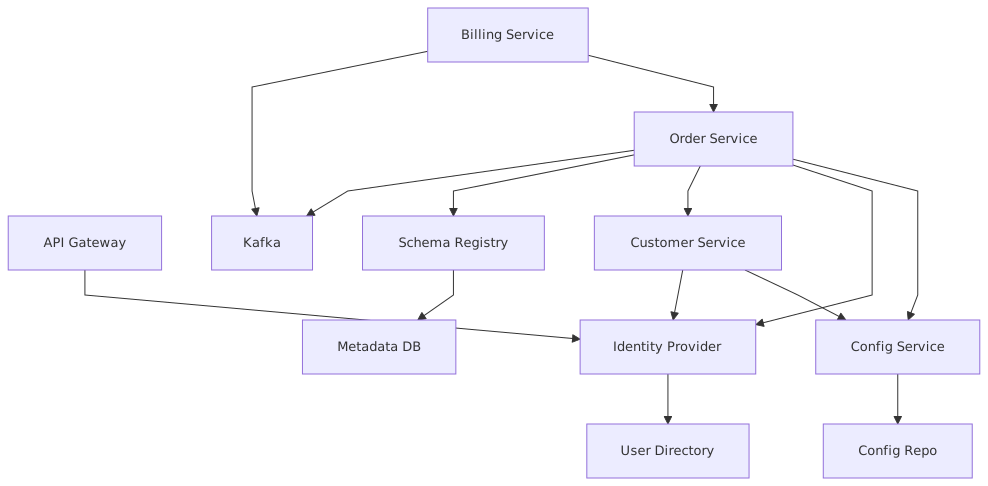
This diagram is not unusual. It is also a warning. If startup order needs to be curated like a wedding seating plan, the design is carrying the wrong dependencies in the wrong place.
Forces
Good architecture lives in tension. Startup dependency design is no different.
1. Fast recovery vs safe behavior
You want services to recover quickly after restarts, deployments, or zone failures. But you also want them to avoid serving nonsense while they are cold or missing critical data. Those goals pull against each other.
A pricing service that starts before loading tariff tables may produce wrong answers. A reporting service that starts without access to yesterday’s aggregates may merely be stale. The semantics matter.
2. Domain autonomy vs shared enterprise concerns
Bounded contexts should own their models and policies. Yet enterprises centralize cross-cutting concerns: identity, policy, configuration, observability, schema governance. These shared platforms are sensible at scale. They also become magnets for bootstrap dependency. EA governance checklist
The mistake is to let platform concerns invade domain liveness.
3. Consistency vs availability
A service can wait for authoritative state before starting, or it can start with local state and reconcile later. The first favors consistency. The second favors availability. In event-driven systems, especially around Kafka, the right answer is often not “choose one,” but “define where staleness is acceptable and make reconciliation explicit.”
4. Simplicity vs resilience
It is simple to fail startup if a dependency is unreachable. It is harder to support partial readiness, deferred initialization, replay, backfill, and reconciliation. But simple code can produce a very complicated system. Architects should be suspicious of local simplicity that exports complexity to operations.
5. Operational visibility vs hidden coupling
Many dependency edges are not documented because they arise in code paths, framework defaults, sidecars, startup hooks, or health probes. What is invisible cannot be governed. Enterprises need a real dependency model, not a folk tale.
Solution
The core solution is blunt:
Design services to start independently wherever the domain allows, and make business completeness converge after startup rather than block startup.
That means changing the question from “What do I depend on?” to “What must exist before I can safely begin, and what can be reconstructed from durable facts?”
The practical architecture has five moves.
1. Separate liveness from business readiness
A process being alive is not the same as being fully useful. Use multiple readiness states:
- alive: process runs
- ready for platform traffic: can accept requests/events safely
- domain-ready: enough domain state is loaded for full behavior
- degraded: serving a subset or stale behavior under policy
This avoids the fatal habit of wiring every external dependency into a single startup gate.
2. Prefer local durable state over synchronous bootstrap calls
If a service needs domain facts repeatedly, store a local projection, cache, or replicated reference dataset that survives restarts. Rebuild it from events if needed. In DDD terms, let each bounded context maintain the information it needs in its own language, instead of asking another context for permission to breathe.
This is where Kafka helps. Event streams let a service reconstruct read models and warm itself from durable facts, rather than from a synchronous chain of service calls.
3. Treat configuration, reference data, and domain facts differently
These categories are often mixed together, and that causes confusion.
- Configuration: how the service behaves technically; usually should be packaged, injected, or cached locally.
- Reference data: shared but slow-changing facts; should often be replicated.
- Domain facts: owned by another bounded context; should be consumed through explicit contracts, events, or anti-corruption layers.
If your startup sequence fetches all three from the same central API, you are probably building a dependency farm.
4. Make reconciliation a first-class mechanism
Eventually, some services will start with stale or incomplete state. That is not a bug if the design includes reconciliation:
- replay from Kafka offsets
- compare local projections with source-of-truth snapshots
- run periodic gap detection
- emit compensating events
- quarantine uncertain transactions
Reconciliation is what turns “we allowed startup without perfect state” from recklessness into engineering.
5. Identify hard dependencies and keep them few
Some bootstrap dependencies are real. A service may genuinely need:
- its own primary datastore
- essential credentials
- Kafka brokers if event consumption is its only mode of work
- mandatory cryptographic material
- tenant metadata if requests cannot be interpreted otherwise
The discipline is not to eliminate all dependencies. It is to know which ones are intrinsic and which ones are laziness dressed as prudence.
Architecture
A useful way to think about startup is in layers.
- Self-contained bootstrap: process starts, loads packaged config, reads secrets, connects to owned data.
- Asynchronous convergence: catches up event streams, hydrates projections, refreshes reference data.
- Business activation: enables endpoints or command handling once policy thresholds are met.
- Continuous reconciliation: detects and corrects divergence while running.
That gives us an architecture like this:

This structure mirrors good domain-driven design.
A bounded context should own its own model, persistence, and lifecycle. It can consume events from upstream contexts, but it should translate them into local semantics. That translation is important. You do not want startup logic entangled with external schemas and meanings. Use anti-corruption layers so that “customer suspended” in one context becomes the local concept your order context actually cares about, such as “credit hold active.”
That is not pedantry. It determines whether your service can safely run when source systems are slow, unavailable, or evolving.
Health model
One of the most common enterprise mistakes is a single readiness check that pings everything:
- database
- Kafka
- schema registry
- identity provider
- customer service
- billing service
- feature flag service
- config server
Then any one failure marks the pod unready. This looks comprehensive. It is actually indiscriminate. Health checks should express serving safety, not architectural anxiety.
A healthier pattern:
- liveness checks only local process integrity
- readiness checks only dependencies required for safe current behavior
- domain readiness is exposed separately as telemetry, not always as traffic gating
- degraded modes are explicit and bounded
Kafka-specific considerations
Kafka can be either your bootstrap ally or your bootstrap tyrant.
It helps when:
- services rebuild local projections from topics
- replay is supported and offset management is deliberate
- topics represent durable business facts
- schema evolution is backward-compatible
- consumers can tolerate lag and catch up
It hurts when:
- services cannot start without immediate access to the schema registry
- consumers fail hard on offset gaps or poison messages
- startup includes synchronous topic creation, ACL provisioning, and schema registration
- exactly-once fantasies create heavy transactional coupling
Use Kafka to decouple business state propagation, not to introduce another central startup choke point.
Migration Strategy
Most enterprises already have a tangled startup graph. Nobody gets to redesign from a blank page. This calls for a progressive strangler migration.
Do not try to “fix startup” in one heroic program. You will create a second outage while trying to prevent the first. Instead, peel away dependencies in a controlled sequence.
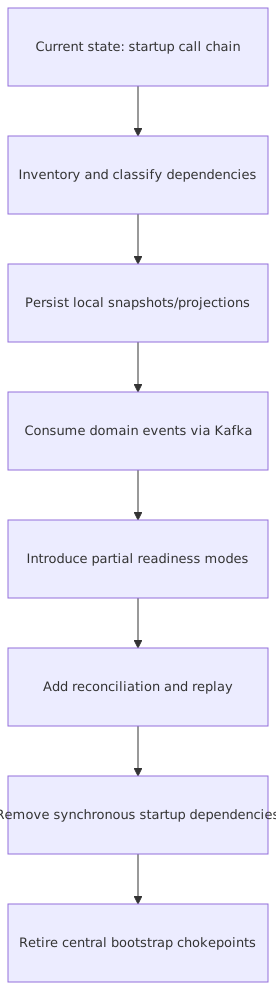
Step 1: Map the actual startup dependency graph
Not the intended graph. The actual one.
Collect:
- startup logs
- health probe logic
- sidecar requirements
- DNS and service call traces during startup
- init container behavior
- secret and config fetch paths
- Kafka/topic/schema interactions
- orchestration restart events
Make the graph visible. Architects are paid to turn folklore into models.
Step 2: Classify edges by meaning
For every dependency, ask:
- Is it intrinsic to the service’s bounded context?
- Is it technical, domain, or convenience coupling?
- Must it be present at startup, or only before specific operations?
- Can the needed state be persisted locally?
- Can it be supplied asynchronously?
- What is the blast radius if it is missing?
This is where domain semantics matter. A payment authorization service may not be allowed to authorize without current fraud policy. Fine. But it may still be allowed to start, reject new authorizations with a clear degraded code, and continue processing settlement events.
Step 3: Introduce local state and asynchronous feeds
Replace startup calls with:
- local replicated reference tables
- event-driven projections
- precomputed materialized views
- cached tenant metadata with expiration policy
- persisted feature flag snapshots
- local schema bundles for known versions where practical
The goal is not perfect autonomy. The goal is fewer hard edges.
Step 4: Split readiness modes
Make services operationally honest:
- alive but not activated
- activated for reads only
- activated for selected commands
- degraded due to stale reference data
- suspended pending reconciliation
This is a major improvement over binary up/down.
Step 5: Add reconciliation before loosening gates
Do not remove startup checks until you know how drift will be detected and repaired. Otherwise you are not becoming resilient. You are becoming careless.
Step 6: Strangle central bootstrap services
Many estates have a “universal config service” or “master metadata service” that everything hits at startup. These become outage multipliers. Strangle them gradually by:
- packaging immutable deployment config
- pushing config via GitOps or sidecar sync
- replicating tenant and reference metadata locally
- moving domain data onto events
- leaving only truly dynamic policy behind central APIs
This migration often produces immediate reliability gains.
Here is the migration path in simplified form:
Enterprise Example
Consider a global retail bank building a new card servicing platform. It has microservices for card accounts, customer profile, fraud posture, transaction ledger, rewards, and notifications. Kafka is the backbone for domain events. Kubernetes runs the estate across regions.
At first glance, this looks modern. Under restart, it behaves like a nervous 1990s middleware stack.
The Card Service cannot start until it:
- pulls product configuration from a central config API
- fetches customer segmentation from Customer Profile
- verifies fraud rules version from Fraud Service
- validates Avro schemas from Schema Registry
- checks entitlement metadata from IAM
- warms a card-status cache by querying Ledger
This startup sequence made sense to each team. Together it created a graph where regional restart after a maintenance window took 40 minutes to stabilize. Worse, a transient issue in Customer Profile caused Card Service pods to flap, which in turn delayed notifications and rewards updates. A “profile outage” became a “cards platform instability” event.
The redesign started with DDD, not with Kubernetes tuning.
The architects asked: what does the Card bounded context truly need to own and know?
- Product configuration relevant to card behavior was versioned and deployed as local immutable config for baseline operation.
- Customer segmentation was redefined as a local derived concept, fed by Customer Profile events. The card context no longer depended on profile APIs at startup.
- Fraud rules were split into two classes: mandatory blocking rules and advisory enrichment. Mandatory rules were replicated locally with version stamps and expiry policy. Advisory rules became asynchronous enrichment.
- Ledger no longer warmed the cache through synchronous calls. Instead, Card Service maintained a local projection of card balances and recent activity from Kafka topics.
- IAM remained a hard runtime dependency for operator actions, but not a startup blocker for internal event processing.
The result was not “zero dependencies.” That would be fantasy. The result was that Card Service could start against its own database, local config, secrets, and Kafka. It exposed:
- alive immediately
- read-ready after local projections reached an acceptable lag threshold
- write-ready only after mandatory fraud policy and account metadata were current
Anything outside those conditions returned bounded degraded responses.
Reconciliation mattered. During a broker partition, some customer segmentation events arrived late. The service continued operating with stale segmentation for a subset of low-risk interactions. A nightly reconciliation compared local segmentation-derived offers against authoritative profile snapshots and emitted correction events. No human panic. No hidden inconsistency. Just explicit convergence.
This is what grown-up microservice architecture looks like. Not purity. Control.
Operational Considerations
Bootstrap architecture lives or dies in operations.
Observability
You need telemetry for:
- startup duration by phase
- dependency wait time
- Kafka lag at activation
- projection rebuild time
- percentage of requests served in degraded mode
- reconciliation backlog
- freshness age of replicated reference data
- restart storm detection
If you cannot see those signals, your startup graph is still hidden.
Deployment orchestration
Avoid orchestrators becoming amateur dependency managers. Kubernetes is good at scheduling containers, not at understanding your domain. Resist encoding business sequencing into init containers and brittle startup scripts. Use orchestration for coarse control, and let services manage fine-grained activation internally.
Data freshness policies
Every local replica or projection needs a freshness contract:
- maximum tolerated age
- actions when stale
- whether reads remain allowed
- whether commands are blocked, queued, or rejected
- whether human approval is required beyond thresholds
This is where compliance-heavy domains need precision.
Schema evolution
If Kafka is central, schema evolution is part of bootstrap resilience. Consumers should survive compatible schema changes without requiring synchronous startup coordination with a registry service every time the process launches. Cache known schemas or embed compatibility strategies where sensible.
Security
Secret retrieval is often a real startup dependency. Treat it as such. But distinguish between:
- initial boot credentials needed to run
- secondary credentials needed only for optional downstream calls
Otherwise security architecture can accidentally centralize your liveness model.
Tradeoffs
No serious architecture decision comes free.
More local state
Reducing startup dependency usually means increasing local persistence, projections, caches, or replicas. That adds storage, synchronization, replay logic, and data governance overhead. ArchiMate for governance
More nuanced readiness
Partial readiness and degraded modes are better than binary failure, but they require discipline from client teams, operations, and support staff. Someone has to understand what “read-ready but command-gated” means at 3 a.m.
Event-driven complexity
Kafka-based convergence reduces synchronous startup coupling, but it introduces lag, reordering concerns, poison events, replay costs, and schema compatibility work. Event-driven architecture is not a magic eraser. It is a trade.
Reconciliation cost
Reconciliation is essential, but it is not free. Batch compare jobs, replay pipelines, compensation logic, and exception handling all consume engineering energy. Still cheaper than cascading bootstrap failure in most enterprises, but not free.
Domain clarity required
This approach works best when bounded contexts and semantic ownership are clear. If the enterprise does not know which service owns which business facts, startup decoupling efforts will degrade into random caching.
Failure Modes
Let’s be plain about how these systems fail.
1. Cascading restart storms
A shared dependency slows down. Readiness fails. Pods restart. Restarting pods generate more load on the struggling dependency. The outage deepens. This is one of the most common and most preventable failure modes.
2. False “up” states
A service starts independently but serves materially wrong results because activation criteria are too loose. This is the dark side of decoupling. Independence without semantic guardrails is just fast failure in disguise.
3. Stale local truth becoming operational truth
Replicated reference data is useful until nobody notices it is two days old. Freshness metrics and expiry policy are not optional.
4. Reconciliation drift never closes
Events are lost, schemas diverge, or comparison jobs are weak. The system says “eventually consistent” but means “quietly inconsistent forever.”
5. Platform dependencies disguised as domain necessity
Teams insist a service must contact central config, IAM, or metadata APIs before startup when in fact they simply have not designed local fallback or state separation. This is organizational coupling masquerading as technical necessity.
6. Overcorrection
Some teams react by making every startup check local-only and every external dependency optional. That creates zombie services that are technically up and business-useless. Independence is a means, not a religion.
When Not To Use
This pattern is powerful, but not universal.
Do not push hard for startup independence when:
The domain requires immediate authoritative state
If you are making real-time high-risk decisions, such as final securities trades or critical fraud blocks, stale replicas may be unacceptable. Start independently only if you can safely refuse work until authoritative state is present.
The service is tiny and truly internal
A small utility service with one clear dependency may not need a full activation and reconciliation architecture. Sometimes a direct hard dependency is fine. Architecture should earn its keep.
The cost of local replication exceeds the value
Some datasets are huge, fast-changing, or tightly regulated. Replicating them everywhere may be irresponsible.
You do not have operational maturity for reconciliation
If the organization cannot monitor lag, handle replay, or understand compensating actions, then reducing startup coupling without those capabilities is dangerous.
The problem is really modularity, not startup
If ten services must all coordinate tightly because the domain was split for team politics rather than bounded contexts, fixing bootstrap symptoms will not save you. Merge them or redraw the boundaries.
That last one is worth saying twice in spirit: sometimes the answer to startup dependency pain is fewer services.
Related Patterns
Several patterns sit close to bootstrap dependency design.
- Bounded Context: clarifies what a service should own and what it should consume.
- Anti-Corruption Layer: prevents external semantics from contaminating local startup and behavior.
- CQRS and Materialized Views: allow local read models that survive restarts.
- Event Sourcing: can support full reconstruction, though it is often more machinery than needed.
- Saga: coordinates long-running workflows without central startup coupling.
- Bulkhead: contains dependency failure and stops one subsystem from drowning another.
- Circuit Breaker: helps runtime resilience, though it is not a substitute for bootstrap independence.
- Strangler Fig: ideal for progressively removing synchronous startup dependencies from legacy estates.
- Outbox Pattern: makes event publication reliable during transitions.
- Health Endpoint Segmentation: separates liveness, readiness, and domain health.
These patterns are not ornaments. Used together, they turn startup from a brittle event into a managed convergence process.
Summary
Startup dependency graphs are where many microservice architectures reveal their true nature. The sales brochure says “independent services.” The restart sequence says “tightly coupled estate.”
The fix is not to pretend dependencies do not exist. It is to classify them honestly.
Use domain-driven design to distinguish business relationships from bootstrap requirements. Keep intrinsic startup dependencies few. Persist local state where the bounded context needs repeated facts. Use Kafka and asynchronous propagation to rebuild and hydrate rather than synchronously query and block. Introduce partial readiness instead of a single theatrical up/down switch. And above all, make reconciliation explicit. Systems that converge intentionally are robust. Systems that merely hope to be correct are not.
A good microservice should be able to wake up groggy, check its own pulse, recover its memory, and rejoin the conversation without demanding the whole enterprise stand at attention first.
That is the real startup dependency graph worth designing for.
Frequently Asked Questions
What is a service mesh?
A service mesh is an infrastructure layer managing service-to-service communication. It provides mutual TLS, load balancing, circuit breaking, retries, and observability without each service implementing these capabilities. Istio and Linkerd are common implementations.
How do you document microservices architecture for governance?
Use ArchiMate Application Cooperation diagrams for the service landscape, UML Component diagrams for internal structure, UML Sequence diagrams for key flows, and UML Deployment diagrams for Kubernetes topology. All views can coexist in Sparx EA with full traceability.
What is the difference between choreography and orchestration in microservices?
Choreography has services react to events independently — no central coordinator. Orchestration uses a central workflow engine that calls services in sequence. Choreography scales better but is harder to debug; orchestration is easier to reason about but creates a central coupling point.