⏱ 19 min read
Most microservice failures do not begin as failures. They begin as ambiguity.
A customer says, “my order disappeared.” Finance says revenue is down but can’t explain where. Operations sees elevated latency in three services but no obvious outage. The incident channel fills with charts, partial logs, and nervous theories. People start hunting in the dark with expensive tools and cheap guesses. That is the real tax of distributed systems: not just complexity, but uncertainty.
This is why “add observability later” is one of the more expensive lies in enterprise architecture.
In a monolith, you can often survive with weak diagnostics because the system’s boundaries are largely technical and local. In microservices, boundaries are business boundaries, runtime boundaries, team boundaries, and often supplier boundaries too. Once you spread a business process across services, queues, APIs, event streams, and cloud infrastructure, understanding behavior becomes part of the architecture itself. Observability is no longer an operational accessory. It is structural. It belongs in the design, not in the postmortem.
An observability-first architecture treats telemetry as a first-class output of the system, alongside business outcomes. That means traces are shaped around domain flows, logs carry business context, metrics reflect service health and business intent, and event streams support reconciliation instead of merely transport. You do not just ask, “is the service up?” You ask, “can we explain the life of an order, a payment, a claim, or a shipment from intent to outcome?”
That shift sounds obvious. In practice, it is rare.
Most organizations still instrument infrastructure better than they instrument the business. They can tell you CPU saturation on a node but not why refund approval time doubled for premium customers in France after a rules change. They can graph Kafka lag to the decimal point, yet cannot reliably answer whether an event was ignored, retried, dead-lettered, or semantically rejected by downstream policy. The machine is visible. The business is not. event-driven architecture patterns
That is the wrong way round.
Context
Microservices promised speed through decoupling. And to be fair, they often deliver it. Teams can evolve independently. Domains can own their own models. Release cadences improve. Different bounded contexts can choose persistence, scaling, and deployment patterns that match their needs. This is domain-driven design at its best: architecture mirroring the business rather than forcing the business through one giant technical funnel.
But every service boundary introduces a new question: what happened at that seam?
A customer journey that was once a simple in-process call chain becomes a distributed narrative. An order may pass through Order Management, Pricing, Inventory, Payment, Fraud, Shipping, Notification, and Finance. Some interactions are synchronous APIs. Others are Kafka topics. Some are commands. Some are events. Some are retried. Some are compensating actions. Some fail loudly. Many fail sideways.
The result is not merely more moving parts. It is more hidden state.
Observability-first architecture exists to make those hidden states legible. It combines telemetry design, domain semantics, event lineage, correlation strategy, and operational governance so that business flows remain explainable as systems scale and diversify. EA governance checklist
This matters especially in large enterprises where platform teams, product teams, integration teams, and control functions all need different views of the same truth. Support wants rapid diagnosis. Risk wants auditability. Product wants customer journey insight. SRE wants latency and error budgets. Finance wants reconciliation. Security wants provenance. A decent architecture serves all of them without turning every service into a surveillance apparatus or every team into a data janitor.
Problem
The classic microservice estate degrades into one of three bad states.
First, the black box estate. Services emit logs, but each team invents its own formats. Trace propagation is inconsistent. Events are not correlated to business transactions. You know pieces of what happened, but never the whole thing.
Second, the monitoring theater estate. There are dashboards everywhere, and almost none of them answer the operational questions that matter. CPU, memory, request count, p95 latency, broker lag. Useful, yes. Sufficient, no. The dashboards measure the plumbing while the business process leaks upstairs.
Third, the forensics estate. Every serious incident becomes archaeology. Teams scrape logs from multiple tools, replay Kafka messages, inspect dead-letter topics, compare database records, and manually reconstruct timelines. Resolution depends less on design quality and more on who remembers the quirks of the system from three reorganizations ago.
The core problem is simple: most microservices are designed around service autonomy, but not around flow visibility. microservices architecture diagrams
And that is a design bug, not an operational one.
A service does not exist merely to process requests. It exists to participate in a business capability. If your architecture can scale services but cannot explain capability behavior end to end, it is incomplete.
Forces
Several forces push architects into bad compromises.
Service autonomy vs end-to-end explainability
Teams want to move independently. Quite right. But customer journeys cross bounded contexts. If each team optimizes telemetry in isolation, no one gets end-to-end understanding. Standardization becomes necessary, but too much of it crushes autonomy.
Domain purity vs operational reality
DDD encourages each bounded context to model its own language and rules. Also right. But an enterprise still needs common correlation conventions, event lineage, and platform-level telemetry standards. You need local models with shared observability contracts.
High-throughput events vs rich context
Kafka-based systems often strip events down to business payloads for throughput and decoupling. Reasonable. But if events lose causation metadata, idempotency references, correlation identifiers, version information, and actor context, diagnostics become guesswork.
Cost vs fidelity
Full-fidelity logs, traces, and metrics are expensive. Storage costs rise. Query performance suffers. Teams drown in cardinality. Sampling can help, but sampling the wrong things during an incident is like packing half a parachute.
Real-time insight vs eventual consistency
Microservices often embrace asynchronous workflows and eventual consistency. Good architecture accepts this. The business, however, still expects timely and accurate answers. That tension is where reconciliation becomes crucial.
Compliance vs usability
Audit and privacy controls matter. But many enterprises over-rotate, producing opaque, inaccessible telemetry that technically exists yet is practically useless. Compliance that destroys operability is another form of failure.
Solution
An observability-first architecture starts with one opinionated idea:
Instrument the domain flow, not just the components.
That means telemetry design begins with business capabilities and bounded contexts. Before you talk about OpenTelemetry collectors, log aggregation, or Kafka lag, you identify the critical domain journeys that must be explainable. Order placement. Payment authorization. Policy issuance. Claims adjudication. Shipment fulfillment. Customer onboarding. Those are the units of understanding.
For each journey, define:
- the domain command or intent
- the significant state transitions
- the domain events emitted
- the ownership boundaries crossed
- the correlation strategy
- the expected invariants
- the reconciliation points
This is where domain-driven design earns its keep. Observability should reflect bounded contexts and domain semantics, not merely deployment topology. If Order Service emits OrderAccepted, that event should carry enough context to identify the order aggregate, the customer journey, the causation chain, the schema version, and the actor or system intent. Not every field belongs in every event, but every event should be traceable in business terms.
A useful rule: if support cannot explain a business outcome without reading source code, your observability model is underdesigned.
The architecture usually rests on five pillars:
- Standardized telemetry envelope
- Correlation ID
- Causation ID
- Trace/span context
- Tenant or business partition
- Domain entity identifiers
- Event version
- Processing timestamp and source
- Domain-aware instrumentation
- Logs and spans named using business actions, not just HTTP endpoints
- Metrics reflecting business throughput and quality, not infrastructure alone
- Domain events linked to traces where possible
- Event lineage and state visibility
- Track event production, consumption, retries, dead-lettering, and compensations
- Record semantic outcomes, not just technical delivery
- Reconciliation capability
- Scheduled or streaming checks comparing intended and actual state across services
- Detect silent divergence in eventually consistent workflows
- Operational feedback loop
- Dashboards, alerts, and runbooks aligned to customer journeys and bounded contexts
This does not mean every service becomes bloated with telemetry logic. The platform should provide conventions, libraries, sidecars, collectors, schema registries, and dashboard templates. But the semantics still belong to the domain teams. Platform can standardize the grammar. Domains must write the sentences.
Architecture
At a high level, the architecture combines service-level instrumentation with a shared observability backbone. Telemetry is collected from APIs, Kafka clients, databases, and service runtimes; enriched with business context; and sent to centralized systems for traces, logs, metrics, and event analytics.
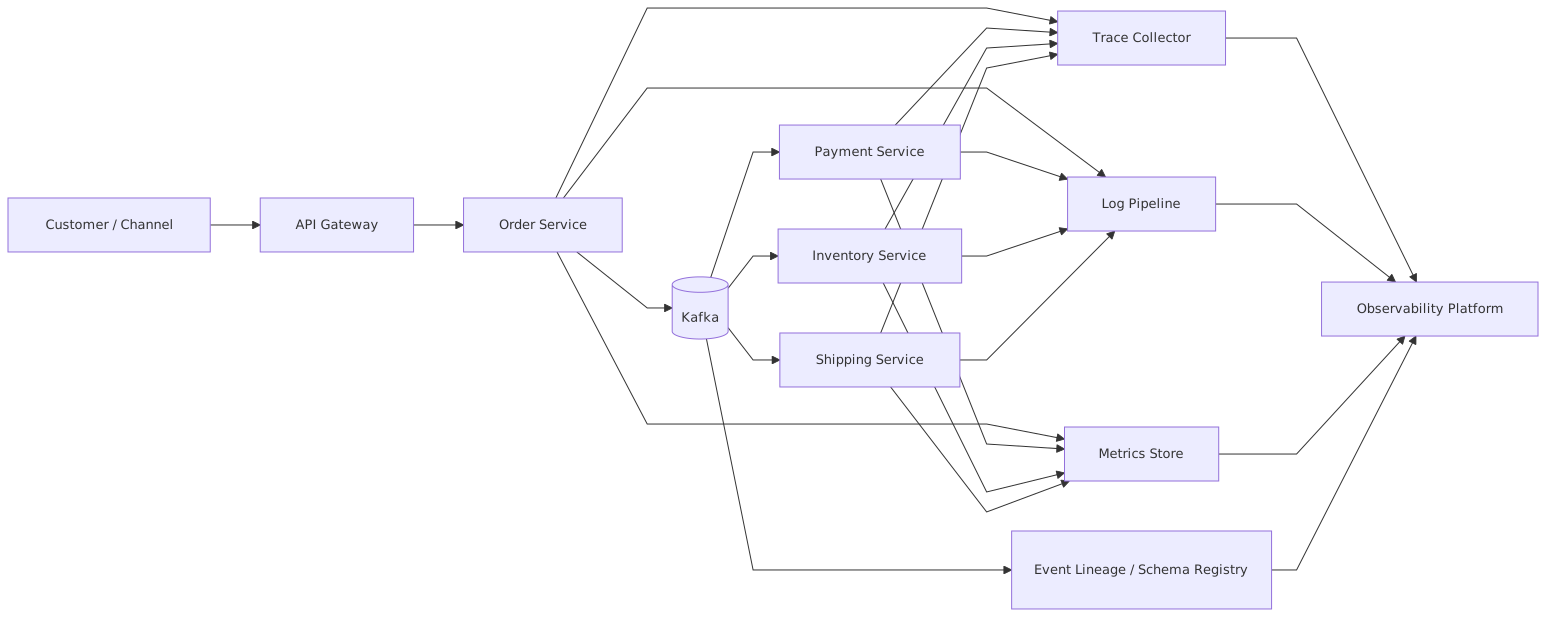
That diagram is the easy part. The harder part is deciding what to observe and how to structure it.
Domain semantics as the spine
Suppose we model retail commerce with bounded contexts for Ordering, Payments, Inventory, Fulfillment, and Customer Care. Each context owns its own ubiquitous language. Good. Keep that. But define a cross-context observability vocabulary that does not erase domain meaning.
For example:
business_flow:order-placementaggregate_type:Orderaggregate_id:ORD-12345causation_id: the event or command that triggered current processingcorrelation_id: groups all activity for the customer journeyoutcome:accepted,rejected,compensated,duplicate_ignoredreason_code: meaningful business or policy reasonprocessing_stage:payment_authorization,inventory_reservation, etc.
These fields allow support, SRE, and analytics teams to reason across service boundaries without flattening the domain model into mush.
Tracing that follows intent
Distributed tracing often stops at HTTP. That is not enough. In modern estates, Kafka and asynchronous messaging carry much of the actual business process. Trace context must propagate through events, consumers, retries, and compensations. Otherwise the trace tells the story of the first API call and then fades into folklore.
You should also distinguish between technical spans and business spans. Technical spans measure RPCs and database calls. Business spans represent milestones like “Authorize Payment,” “Reserve Inventory,” or “Finalize Shipment.” Both matter. One helps performance tuning; the other helps operational understanding.
Logs that declare outcomes
Most enterprise logs are still glorified stack dumps. An observability-first service emits structured logs at meaningful state transitions:
- command received
- validation failed
- event published
- event consumed
- state transition applied
- duplicate detected
- retry scheduled
- dead-lettered
- compensation initiated
- reconciliation mismatch found
Notice the pattern: these are business and process outcomes, not just technical noise.
Metrics that reveal system health and business quality
You still need the classics: error rates, saturation, latency, throughput. But also include domain metrics:
- orders accepted per minute
- payment authorization failure by reason code
- inventory reservation timeout rate
- age of unresolved saga instances
- dead-letter ratio by event type
- reconciliation mismatch count
- duplicate message suppression count
A mature architecture does not force teams to choose between reliability metrics and business metrics. It understands that in distributed systems, they are often the same story told from different windows.
Reconciliation as a designed capability
This is where many architectures become honest.
Event-driven microservices rarely guarantee instantaneous consistency. Fine. But eventual consistency without reconciliation is merely delayed uncertainty. Reconciliation is the safety net that tells you whether the final state converged as intended.
There are several approaches:
- Batch reconciliation: compare source-of-truth records periodically across contexts
- Streaming reconciliation: check expected follow-up events within windows
- Invariant-based reconciliation: verify domain rules such as “an authorized payment must correspond to either a confirmed order or a compensation within N minutes”
Reconciliation should be treated as part of the domain architecture, not just an ops script.
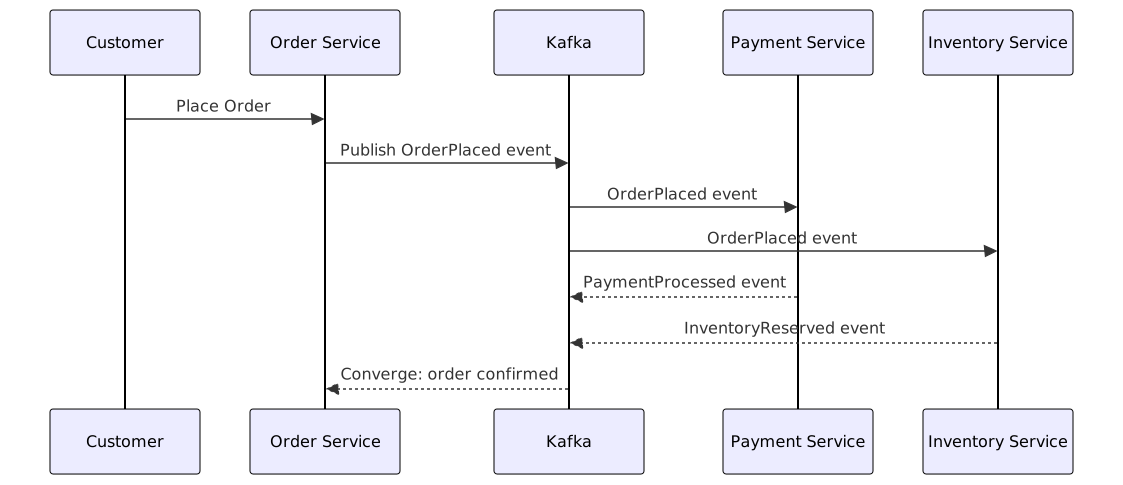
That mismatch event is powerful. It creates an operational and auditable object, not a tribal-memory problem.
Migration Strategy
You do not migrate to observability-first by declaring a standard and scheduling training. That is bureaucracy wearing an architecture badge.
You migrate by following the flows that hurt.
A sensible path is a progressive strangler migration, not just of application logic, but of visibility capability.
Step 1: Identify critical business journeys
Choose a small number of high-value, high-pain journeys. Revenue flows are usually best: order-to-cash, quote-to-bind, claim-to-settle, onboarding-to-activation. Pick flows where ambiguity is expensive.
Step 2: Define the canonical telemetry envelope
Before instrumenting everything, agree the minimum shared telemetry contract:
- trace and correlation propagation
- domain IDs
- event metadata
- outcome and reason conventions
- schema versioning approach
This should be strict enough to support cross-service analysis and light enough that teams actually adopt it.
Step 3: Wrap the legacy edge first
In strangler migrations, the perimeter is your friend. Put API gateways, facades, or anti-corruption layers in front of legacy capabilities and start emitting observability metadata there. Even when the core remains monolithic, you can begin tracing business journeys across old and new worlds.
Step 4: Instrument the first new bounded context deeply
Do not spread effort thinly across twenty services. Pick one bounded context in the new architecture and do it properly: traces, structured logs, domain metrics, event lineage, and dashboards aligned to business flows. Show the value.
Step 5: Add Kafka lineage and consumer semantics
If Kafka is central, do not stop at broker metrics. Track producer identity, topic, partition, offset, schema version, consumer group, retry count, dead-letter routing, and semantic result. “Message consumed” is not enough. You need “message consumed and rejected as stale policy version” or “message processed but downstream write timed out.”
Step 6: Introduce reconciliation before scale makes it painful
The earlier you implement reconciliation, the less mythology accumulates around “sometimes the system catches up.” Mature systems do not rely on hope as a consistency model.
Step 7: Strangle legacy reporting and support workflows
Many enterprises keep old reporting databases and support scripts because new microservices never become explainable enough to replace them. That is a warning sign. Build operational views and customer-support flows off the new observability model so legacy dependence can shrink.
Here is the migration shape:
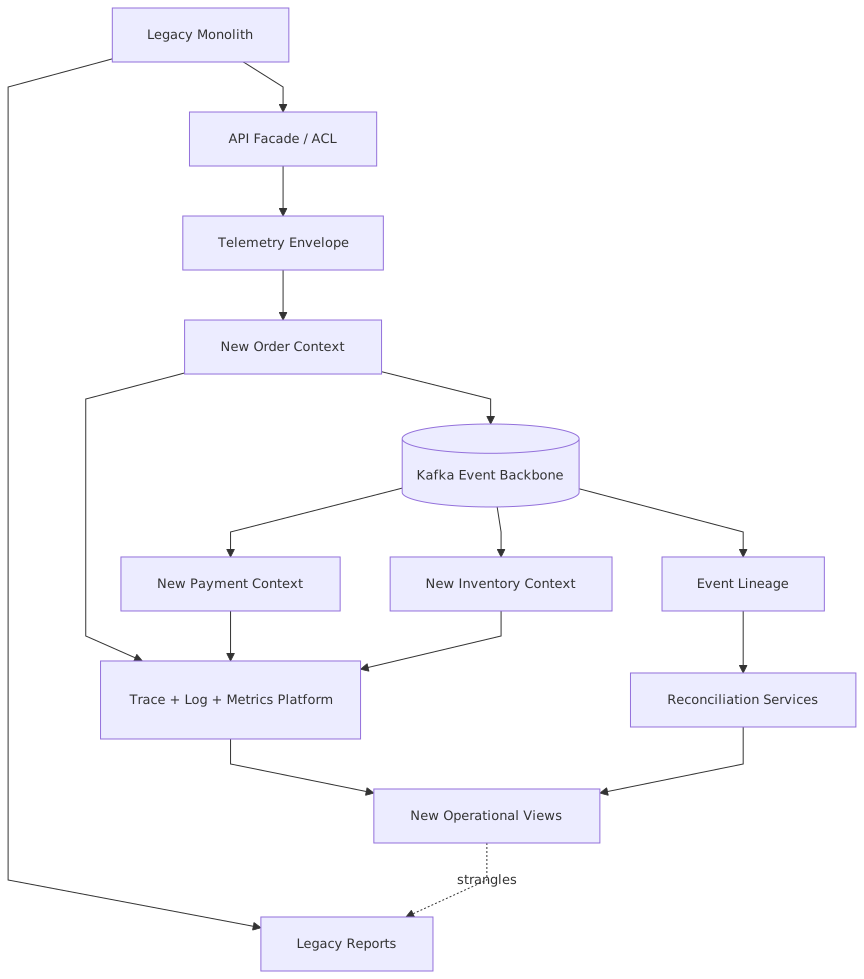
The important point is this: observability migrates with the architecture. If you leave it until after decomposition, you will spend years rediscovering what the monolith used to tell you for free.
Enterprise Example
Consider a global insurer modernizing its policy administration platform.
The legacy estate was a large policy monolith with nightly batch interfaces into billing, claims, and customer communications. It was ugly in the way old enterprise systems often are, but support teams could usually answer one simple question: what happened to policy P-784312?
The modernization split capabilities into microservices aligned to bounded contexts: Quote, Underwriting, Policy Issuance, Billing, Document Generation, and Customer Notification. Kafka became the backbone for asynchronous domain events. Teams moved faster. Releases improved. But within nine months, support quality collapsed.
Why? Because policy issuance was no longer a transaction. It was a distributed story.
A quote could be accepted, underwriting could add conditions, billing could reject payment setup, document generation could timeout, and notification could process a stale version of the policy event. Every team had some telemetry. No one had the narrative.
The architecture team reset the design around observability-first principles.
They defined a policy journey envelope with:
policy_flow_idquote_id,policy_id,customer_idcausation_idandcorrelation_id- decision codes from underwriting
- billing setup outcome
- document pack version
- channel and jurisdiction metadata
They instrumented business spans for:
- quote acceptance
- underwriting referral
- policy issuance decision
- billing account creation
- document pack generation
- customer notification
Kafka events were enriched with lineage metadata and schema registration. Dead-letter topics were not treated as dumping grounds; they were surfaced as operational signals with ownership and semantic reason codes. A reconciliation service checked that every issued policy had corresponding billing, document, and notification outcomes within defined windows. Mismatches created domain incidents, not vague technical alerts.
The practical result was striking. Mean time to understand an issuance failure dropped dramatically. Customer support could search by policy flow and see the chain of decisions and processing stages. Compliance gained better auditability. Product teams found hidden friction in referral paths. And perhaps most importantly, architecture conversations improved. Teams started discussing domain outcomes and failure semantics rather than merely “message delivery.”
That is what good enterprise architecture does. It changes the quality of the conversation.
Operational Considerations
Observability-first sounds noble until the bill arrives. So let’s be blunt about operations.
Cardinality will punish laziness
If every metric label includes raw customer IDs, session IDs, or unconstrained reason strings, your metrics platform will revolt. High-cardinality dimensions belong selectively in logs or traces, not everywhere. Design dimensions carefully.
Sampling must be policy-driven
Trace sampling should not be random alone. Consider tail-based sampling for slow or failed flows, and always retain traces for certain business-critical or regulated journeys. The point is not maximum data. The point is retaining the right evidence.
Schema governance matters
Event schemas evolve. Telemetry fields evolve. Without schema governance, your observability estate becomes a multilingual argument. Use registries, compatibility rules, and ownership. This is especially important with Kafka where producers and consumers evolve independently. ArchiMate for governance
Security and privacy cannot be bolted on
Observability data often contains the most dangerous mix in the enterprise: identifiers, behavior, chronology, and system access patterns. Mask sensitive fields. Tokenize where necessary. Apply retention by value, not by habit. Build role-based access into observability tools.
Runbooks should map to domain failures
Alerts saying “consumer lag high” are useful only to specialists. Alerts saying “payment authorization outcomes delayed for premium checkout flow” mobilize the right people faster. Pair technical symptoms with business impact in alerting and incident response.
Tradeoffs
There is no free lunch here.
Observability-first increases design effort. Teams must think about semantics, correlation, and failure behavior up front. Some engineers will resent this because it feels like overhead. They are not entirely wrong. It is overhead. It is just cheaper overhead than ignorance.
It also introduces a degree of standardization that can irritate autonomous teams. Again, fair. Shared telemetry contracts constrain local freedom. But the alternative is every incident becoming a customs inspection at every service boundary.
There is also the risk of over-instrumentation. Too many logs, too many spans, too many dashboards. Noise is not visibility. A bad observability program creates more confusion, not less.
And finally, there is cultural tradeoff. Once business flows become visible, hidden process flaws become visible too. Some organizations are less ready for that than they claim.
Failure Modes
Observability-first can fail in predictable ways.
Tool-first implementation
Buying a shiny observability platform and expecting architecture to emerge afterward. It won’t. Tools amplify design; they do not replace it.
Correlation gaps
One missing propagation step between API, Kafka producer, consumer, or async worker can break end-to-end lineage. These gaps are maddening because the system appears “mostly traced,” which is often worse than not traced at all.
Semantic inconsistency
If one team logs status=failed, another logs result=declined, and another uses numeric codes with no dictionary, enterprise analysis becomes brittle. Shared semantics matter.
Dead-letter denial
Many organizations quietly accept dead-letter queues as normal runoff. They are not. A DLQ is an operational debt bucket. If not owned, measured, and reconciled, it becomes a graveyard of business promises.
Reconciliation without authority
A reconciliation service that finds mismatches but cannot trigger compensation, escalation, or case handling is just an expensive guilt engine. Detection must connect to action.
When Not To Use
Observability-first is not a religion. There are cases where it is overkill.
Do not build this in full form for:
- small systems with simple synchronous flows
- low-change internal tools with limited business impact
- tightly coupled domains that should probably remain modular monoliths
- short-lived products where operational complexity does not justify the investment
In those cases, basic monitoring and structured logging may be entirely sufficient. The architecture should fit the economics of the system.
Also, if your “microservices” are really just a distributed monolith with chatty synchronous calls and no meaningful domain boundaries, observability-first will help diagnose pain, but it will not cure the underlying design. Sometimes the right answer is fewer services, not better dashboards.
Related Patterns
Several patterns commonly sit beside observability-first architecture.
- Saga orchestration/choreography: useful for long-running business flows, but must be observable at the domain level
- Outbox pattern: improves event publication reliability and traceability
- Anti-corruption layer: essential in migration, and a good place to inject telemetry normalization
- CQRS: can support read models for operational visibility, but beware duplicating truth without reconciliation
- Event sourcing: naturally rich in history, though not automatically strong in operational observability
- Strangler fig pattern: ideal for progressive migration of both functionality and visibility
- Dead-letter handling with replay: valuable only when replay semantics and idempotency are well understood
The common thread is simple: patterns that spread behavior across time and boundaries require patterns that make that spread understandable.
Summary
Microservices do not fail because they are distributed. They fail because they become unknowable.
An observability-first architecture addresses that directly. It treats telemetry as a design concern, aligns instrumentation to domain semantics, propagates lineage across APIs and Kafka events, and builds reconciliation into the operating model. It supports migration through progressive strangling, gives enterprise teams a shared understanding of business flows, and turns support, operations, and audit from archaeology into disciplined practice.
The best test is brutally practical: can you explain the life of a business transaction across bounded contexts, including retries, delays, compensations, and mismatches, without assembling a war room?
If not, your architecture is still asking people to trust a machine it cannot adequately describe.
And in enterprise systems, opacity is not merely inconvenient. It is expensive, political, and eventually existential.
Observability first is not about watching everything. It is about making the important things explainable. That is a far more architectural ambition.
Frequently Asked Questions
What is a service mesh?
A service mesh is an infrastructure layer managing service-to-service communication. It provides mutual TLS, load balancing, circuit breaking, retries, and observability without each service implementing these capabilities. Istio and Linkerd are common implementations.
How do you document microservices architecture for governance?
Use ArchiMate Application Cooperation diagrams for the service landscape, UML Component diagrams for internal structure, UML Sequence diagrams for key flows, and UML Deployment diagrams for Kubernetes topology. All views can coexist in Sparx EA with full traceability.
What is the difference between choreography and orchestration in microservices?
Choreography has services react to events independently — no central coordinator. Orchestration uses a central workflow engine that calls services in sequence. Choreography scales better but is harder to debug; orchestration is easier to reason about but creates a central coupling point.