⏱ 21 min read
Distributed systems do not fail like monoliths. They fail like airports.
A gate changes without warning. One bag goes to Madrid while the passenger goes to Manchester. The runway is clear, but the catering truck is late, so the whole departure board starts lying to people. Nothing is fully broken. Everything is slightly wrong, and the pain comes from the gaps between systems rather than the collapse of any single one.
That is exactly what async error handling feels like in microservices. microservices architecture diagrams
Teams often build event-driven architectures because they want speed, autonomy, and resilience. They get Kafka, queues, retries, pub/sub, independent deployability, and all the clean lines of a modern architecture diagram. Then production arrives and teaches the old lesson again: the hardest part is not moving messages. The hardest part is deciding what an error means when nobody is waiting synchronously for an answer.
In a synchronous call chain, failure is at least visible. A request times out. A 500 comes back. A circuit breaker opens. Ugly, but legible. In an asynchronous system, failure becomes a matter of semantics, timing, ownership, and evidence. A message may be delivered and still be unusable. An event may be technically valid and business-invalid. A downstream service may process it twice, too late, or out of sequence. A retry may heal the system or poison it. A dead-letter queue may be a safety net or a graveyard.
This is where architecture matters. Not the ceremonial kind with laminated principles and governance boards, but the practical kind that decides which failures are transient, which are business outcomes, which require compensation, and which must become explicit domain facts. Good async error handling is not a library choice. It is a model of the business under stress. EA governance checklist
My view is simple: if you treat asynchronous errors as infrastructure exceptions, your platform will slowly turn into a crime scene. If you treat them as part of the domain and design the operational mechanics around that truth, you can build systems that fail noisily, recover predictably, and reconcile honestly.
That is the point of this article.
Context
Microservices and event-driven systems changed the shape of enterprise integration. Instead of one big application hiding data and behavior behind internal method calls, we now have bounded contexts exchanging commands, events, and state changes over brokers such as Kafka. This is usually the right move when different business capabilities need independent release cycles, scaling profiles, and ownership. event-driven architecture patterns
But asynchronous communication changes the contract between systems.
A synchronous API says, in effect, “do this now, and tell me if it worked.” An asynchronous interaction says, “here is something that happened or should happen; process it when you can, and we will discover the outcome through later facts.” That difference sounds small on a whiteboard. In production, it is the difference between immediate certainty and eventual truth.
This has direct implications for error handling:
- There may be no caller waiting for an error response.
- The producer often cannot know whether the consumer has succeeded.
- Retries can create duplicates or reorder effects.
- Some “errors” are not technical faults at all; they are valid business rejections.
- Detection, diagnosis, and recovery happen across time and across teams.
This is why async error handling sits at the intersection of distributed systems engineering and domain-driven design. You need both. Infrastructure patterns alone are too blunt. Domain modeling alone is too romantic. Enterprises need mechanisms and meaning.
Problem
Most organizations start with one of two bad habits.
The first is pretending asynchronous interactions are just delayed synchronous calls. A service emits a command or event and expects the world to line up neatly behind it. When something goes wrong, the platform team adds retries, the service team adds logs, and operations adds a dead-letter queue. Three months later, nobody knows whether a failed order is actually failed, still in-flight, duplicated, or quietly abandoned.
The second bad habit is treating every failure as a transport concern. If consumption fails, retry. If retries fail, dead-letter. If dead-letter grows, create a support process. This works for malformed payloads and transient database outages. It fails badly for business semantics. A rejected payment because of credit policy is not a transient failure. A shipment request for a cancelled order is not a message handling exception. Those are domain outcomes.
The core problem is this: in an asynchronous microservice architecture, errors have multiple meanings and different recovery paths, but most implementations collapse them into one generic failure bucket.
That leads to familiar enterprise symptoms:
- Infinite or wasteful retries
- Poison messages clogging partitions
- Dead-letter queues used as permanent storage
- Manual reconciliation becoming the actual integration strategy
- Upstream systems showing “completed” while downstream systems are missing state
- Compliance risk because the audit trail cannot explain why business facts diverged
The architecture is not failing because Kafka is unreliable. Kafka is usually doing exactly what it promised. The architecture is failing because the business semantics of failure were never designed.
Forces
Several forces pull against each other here, and good architecture is mostly about deciding which tension you are willing to live with.
Reliability versus throughput
Aggressive retries and exactly-once fantasies tend to reduce throughput and increase coupling. On the other hand, “just process later” can hide real business damage. If your fraud check is delayed by ten minutes, that might be acceptable. If your credit exposure update is delayed by ten minutes, your treasury people may have a different opinion.
Local autonomy versus end-to-end consistency
Microservices work best when each bounded context owns its model and lifecycle. But business processes cross contexts. Order Management, Payment, Fulfilment, and Customer Service all see different truths at different times. Async error handling must preserve local ownership without leaving the enterprise blind to process state.
Technical failure versus business rejection
A timeout to a database replica is a technical fault. An order rejected because the item is embargoed in the destination country is a business outcome. Both may look like “processing failed” in a log. They should not share the same retry policy, escalation route, or operational dashboard.
Eventual consistency versus human expectation
Architects like saying “eventual consistency” because it sounds measured and mature. Business users hear “sometimes wrong for a while.” Both are true. Error handling patterns need to define how long inconsistency is acceptable, who can see it, and how it gets repaired.
Generic platform patterns versus domain semantics
A platform team wants reusable error topics, retry frameworks, DLQ handlers, and standard observability. They should. But the business still needs explicit concepts like PaymentDeclined, CreditLimitExceeded, InventoryReservationExpired, or CustomerRecordQuarantined. Generic plumbing without explicit domain outcomes is efficient nonsense.
Ordering versus availability
Kafka gives powerful ordering guarantees within partitions, not across your whole enterprise narrative. If your business depends on strict ordering, your partitioning strategy, idempotency model, and replay behavior become architecture decisions, not implementation details.
Solution
The solution is not one pattern. It is a stack of patterns with a strict rule:
Separate technical handling from domain meaning.
That single move clears most of the fog.
At a practical level, async error handling in microservices should use five layers.
1. Classify errors by semantics
Do not begin with retries. Begin with taxonomy.
A useful classification looks like this:
- Transient technical failures: network glitch, broker timeout, temporary lock, dependency unavailable
- Persistent technical failures: schema mismatch, deserialization error, missing mandatory field, incompatible contract
- Business rejections: credit denied, policy violation, invalid state transition, duplicate business command
- Process conflicts: out-of-order event, stale version, already compensated, race condition across services
- Unknown or toxic conditions: code defect, unbounded data issue, corrupted message, impossible state
These categories deserve different responses. Lumping them together is the original sin.
2. Make domain failures explicit events
If a payment cannot be authorized due to business policy, publish PaymentDeclined. If inventory cannot be reserved because stock is exhausted, publish InventoryUnavailable. If an onboarding record is quarantined due to sanctions screening, publish CustomerQuarantined.
These are not “errors” in the technical sense. They are business facts.
This is classic domain-driven design thinking. Every bounded context should express failures in the language of its domain. Downstream consumers should react to those facts, not infer state from missing success events or buried exception logs.
3. Use retries narrowly and intentionally
Retries are right for transient conditions and wrong for many others.
A sound retry strategy usually includes:
- Short in-memory retry for clearly transient issues
- Deferred retry via retry topic or delay queue
- Capped attempts
- Jitter to prevent synchronized storms
- Different policies by error class
- Clear transition to quarantine or DLQ after exhaustion
If your architecture retries business rejections, it is not robust. It is confused.
4. Design idempotency and reconciliation as first-class capabilities
Async systems will redeliver. They will replay. They will process duplicate messages after failover. They will produce divergent state after partial outages. This is not a bug in your architecture. This is your architecture.
So every critical consumer needs idempotent handling keyed on domain identity, not just message identity. And every critical cross-service process needs reconciliation: the periodic or event-driven comparison of expected and actual business state, with automated or manual repair paths.
A dead-letter queue catches failed processing. Reconciliation catches silent inconsistency. Enterprises need both.
5. Expose process state outside local service logs
If the only place to understand an async failure is by tailing logs in six services, you do not have observability. You have archaeology.
Long-running business processes need explicit status views, correlation IDs, and operational timelines. Whether implemented through process managers, sagas, materialized views, or workflow state stores, the enterprise must be able to answer: what happened, what failed, what was compensated, what is pending, and what needs intervention?
Architecture
A durable architecture for async error handling usually combines event streaming, local transaction integrity, semantic events, and operational quarantine.
Here is a reference flow for a Kafka-based microservices landscape.
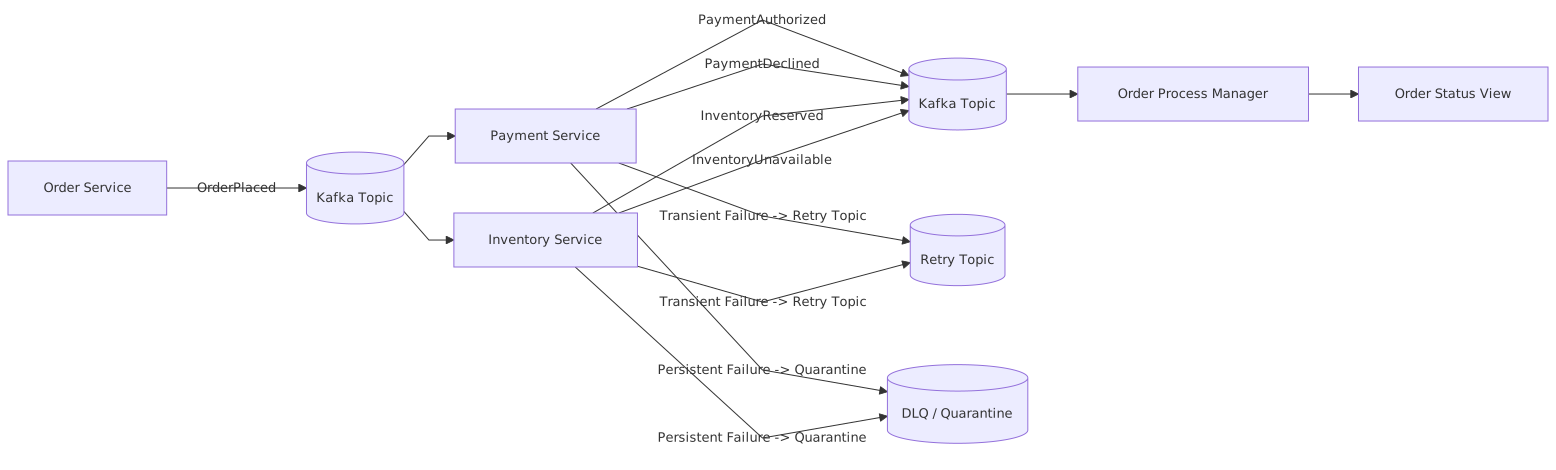
There are a few important points hidden in this simple picture.
First, the broker is not the process owner. Kafka moves facts around. It does not decide business outcomes. The services and process logic do.
Second, the retry path is separate from the semantic event path. A transient database timeout is not published as a business event. It stays in the technical handling lane. A payment decline is not sent to a retry topic. It is published as a domain event.
Third, quarantine is not a substitute for process design. Messages in DLQ or quarantine must be triaged with enough metadata to support recovery, replay, or manual intervention. If your DLQ has become your unofficial backlog system, the architecture is already telling you something unpleasant.
The outbox matters
For services that publish events after changing local state, the transactional outbox pattern remains one of the most useful boring tools in the cabinet. Write business state and the outgoing event record in one local transaction. Then publish from the outbox asynchronously.
This avoids the classic split-brain where the database commits but the event publish fails, or vice versa.
Process managers and sagas
Not every async interaction needs orchestration. Sometimes choreography is enough. But when multiple services contribute to a business process and failure paths matter, an explicit process manager or saga earns its keep. It gives you a place to model states such as:
- Awaiting payment
- Payment declined
- Inventory reservation pending
- Reservation expired
- Shipment blocked
- Compensation initiated
- Reconciliation required
That state model is where enterprise clarity comes from.
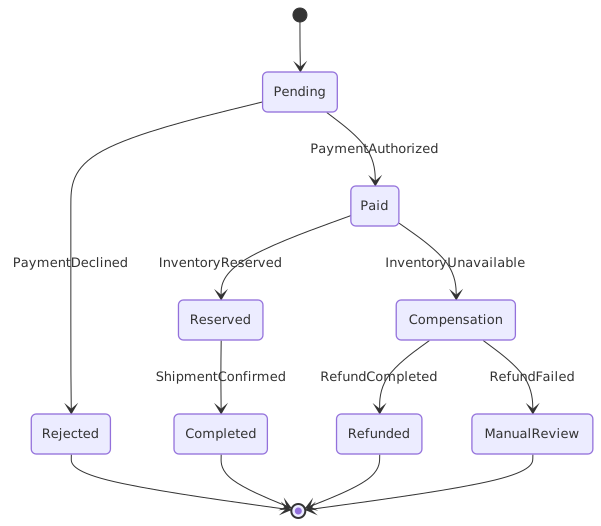
This diagram is not just process decoration. It is an error handling model. It says which failures become business facts, which demand compensation, and where human intervention enters.
Domain semantics discussion
This is the part many teams skip because it feels slower than writing consumers.
Suppose OrderPlaced reaches the Payment service and the customer exceeds their credit policy. Is that an error? From the perspective of the Payment service runtime, no. The service did exactly what it should. From the perspective of the business process, the order cannot proceed. The right output is not an exception. It is a domain event: PaymentDeclined.
Likewise, if the Inventory service receives an event for an order that has already been cancelled, that may not be a technical fault either. Depending on the bounded context, it may be a valid no-op, a stale event to ignore, or a signal to emit InventoryReservationNotRequired.
The lesson is blunt: error handling in async systems is largely a language problem. If your services cannot name business-negative outcomes explicitly, operations will be forced to infer them from transport behavior. That is how enterprises end up reconciling customer commitments with Splunk searches.
Migration Strategy
Most enterprises do not get to rebuild error handling from scratch. They inherit a tangle of point-to-point integrations, batch jobs, tightly coupled APIs, and event consumers that grew like ivy around core systems. So the migration needs to be progressive, not heroic.
This is where the strangler pattern is useful. Not as theatre. As discipline.
Start with visibility before behavior
Before changing business flow, introduce correlation IDs, event lineage, failure classifications, and simple process views. You need to see where async failures are happening and what kind they are. Without that, migration is only rearranging uncertainty.
Add semantic failure events at the edges
Find one or two high-value flows — say order-to-payment and customer onboarding — and introduce explicit domain outcome events for the most common business-negative scenarios. Do not start by redesigning every topic. Start where support tickets already prove the pain.
Introduce quarantine separate from DLQ
A dead-letter queue is often too raw for enterprise operations. Create a quarantine capability with metadata: source topic, consumer group, correlation ID, schema version, failure class, first seen time, attempt count, and recommended action. This turns technical leftovers into an operational asset.
Apply outbox on services with business-critical emissions
Especially where legacy systems still own the source of truth, use outbox or change data capture patterns to create reliable event publication. This is often the bridge between a transactional monolith and emerging microservices.
Move from hidden retries to policy-driven retries
Replace ad hoc consumer retries with explicit policies by error class. This is a migration that pays off quickly because it reduces both noise and self-inflicted load.
Add reconciliation before full autonomy
This is a point architects underestimate. During strangler migration, old and new worlds coexist. They will disagree. Build reconciliation early: compare order states, payment states, account balances, shipment requests. Detect drifts before the business does.
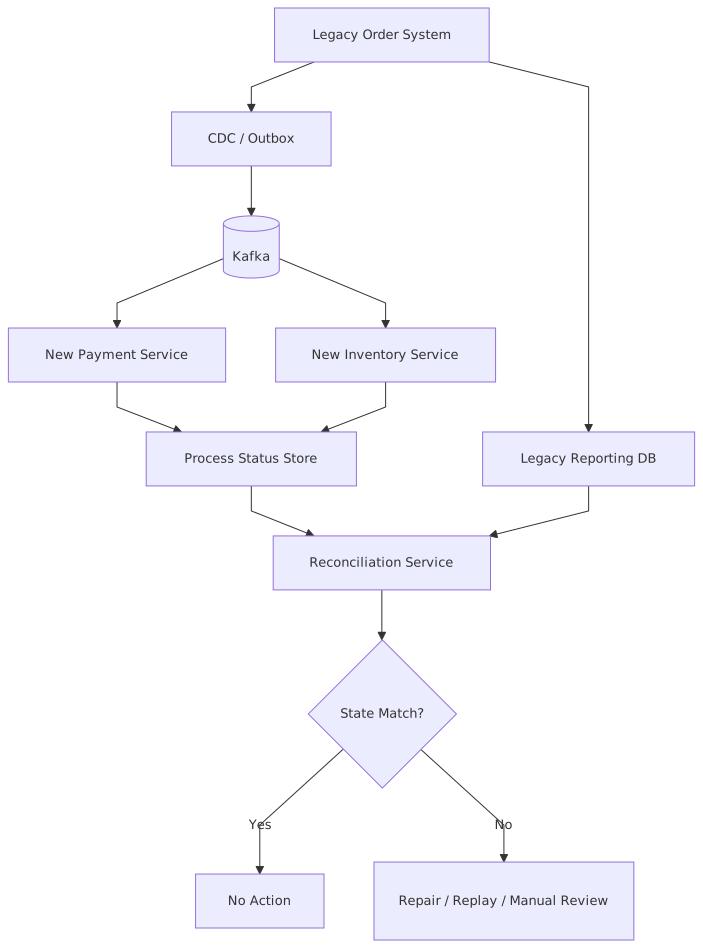
Progressive strangler migration reasoning
The reason for this staged approach is not just risk reduction. It is semantic preservation. Legacy systems often encode business failure rules implicitly in status codes, operator procedures, or overnight corrections. If you migrate transport first and semantics later, you can create a cleaner architecture that is less faithful to the business. That is a common failure in modernization programs.
Strangler migration done well preserves what matters, exposes hidden rules, and replaces opaque failures with explicit domain behavior.
Enterprise Example
Consider a global retailer with stores, e-commerce, and a marketplace channel. Orders originate in multiple channels and pass through Order Management, Payment, Inventory, Fulfilment, Customer Notification, and Finance. They adopted Kafka to reduce coupling and support regional scaling.
On paper, the architecture looked excellent. In reality, they had three ugly classes of async failure.
First, Payment consumers retried almost everything, including card declines and fraud rejections. That produced duplicate authorization attempts, noisy bank responses, and customer service calls from shoppers seeing multiple pending charges.
Second, Inventory events occasionally arrived out of order after regional failover. Reservation release events could be processed before the original reservation event reached a lagging consumer. The Inventory service raised generic processing errors, sent messages to DLQ, and operators replayed them manually, often making the order state worse.
Third, Finance had no trustworthy view of completed versus compensated orders because compensation was implicit in service logs, not explicit in domain events. End-of-day reconciliation became a semi-manual operation.
The fix was not “improve Kafka.” The fix was architectural.
They introduced a semantic event model:
PaymentAuthorizedPaymentDeclinedFraudReviewRequiredInventoryReservedInventoryUnavailableReservationReleasedOrderCompensationInitiatedRefundCompleted
They split retry policy into transient-only categories. Schema and deserialization failures went to quarantine immediately. Business rejections stopped retrying. Process conflicts, like stale or out-of-order events, went through a dedicated handler that checked aggregate version and process state before deciding whether to ignore, defer, or escalate.
Most importantly, they added a reconciliation service comparing order, payment, inventory, and refund state across bounded contexts every fifteen minutes, plus a stronger overnight financial reconciliation. This did not replace event-driven flow. It closed the honesty gap.
The result was not magical. Some failures still needed manual action. But support tickets dropped, duplicate payment attempts collapsed, and finance stopped treating the architecture as an elaborate rumor.
That is what good async error handling does. It reduces ambiguity.
Operational Considerations
Architecture drawings tend to stop where operations begin. That is a mistake.
Observability
At minimum, track:
- Message age and consumer lag
- Retry counts by topic and error class
- Quarantine volume and aging
- Business failure events by type
- Correlation across process steps
- Compensation rates
- Reconciliation mismatches
A useful rule: dashboards should show both technical distress and business distress. Broker lag tells you one thing. A spike in PaymentDeclined after a policy rollout tells you another.
Runbooks
Every quarantine category should have a runbook:
- replay as-is
- transform and replay
- ignore safely
- escalate to service owner
- route to business operations
- create compensating event
Runbooks are architecture made executable.
Ownership
Platform teams should own generic mechanics: retry infrastructure, quarantine tooling, schema governance, tracing foundations. Domain teams should own semantic failure definitions, compensation logic, and reconciliation rules for their bounded contexts. If these are blurred, everything becomes everybody’s problem and nobody’s accountability. ArchiMate for governance
Data retention and compliance
Error payloads often contain sensitive business data. Quarantine stores, replay logs, and DLQs must follow the same data classification and retention controls as primary systems. Enterprises regularly forget this and accidentally create shadow data lakes full of payment or personal information.
Testing
Most teams test the happy event path and a couple of exceptions. Serious async systems need failure injection:
- duplicate delivery
- delayed delivery
- out-of-order delivery
- schema evolution mismatch
- partial compensation failure
- replay after consumer code change
- downstream outage during saga progression
If you do not test replay and reconciliation, you have not tested your async architecture.
Tradeoffs
There is no free lunch here, and anybody promising one is selling middleware.
More explicit semantics means more modeling work
Publishing business-negative outcomes as domain events takes design effort. Teams need shared language, event contracts, and process understanding. It is slower than catching exceptions and pushing them to DLQ. It is also the difference between operating a business system and operating a pipe.
Reconciliation adds cost
Periodic checks, comparison stores, and repair workflows consume compute, storage, and engineering time. But the alternative is hidden divergence discovered by customers, auditors, or finance. In enterprise terms, reconciliation is often cheap insurance.
Process managers can become central choke points
Used carelessly, orchestration components become mini-monoliths. Not every workflow needs one. Reserve them for long-running, stateful, failure-sensitive processes where visibility and compensation matter.
Quarantine can become operational debt
If teams dump messages into quarantine without triage discipline, they recreate the dead-letter graveyard problem under a nicer name. Tooling and ownership matter.
Exactly-once is often oversold
Kafka and related platforms offer strong delivery semantics, but exactly-once end-to-end business effects are rare and expensive. In most enterprises, idempotent consumers plus reconciliation produce a better cost-benefit balance than chasing perfect execution semantics across databases, brokers, and side effects.
Failure Modes
Let us be blunt about how these architectures go bad.
The infinite retry storm
A consumer retries a non-transient error, often quickly, often at scale. CPU rises, lag grows, downstream dependencies buckle, and one bad message degrades the whole flow. This is common, avoidable, and usually self-inflicted.
The silent semantic failure
A service swallows a business rejection as an internal exception, emits no domain event, and upstream process state remains “in progress” forever. Support discovers it via customer complaint. This is one of the nastiest failure modes because nothing technical appears obviously broken.
The poison partition
A single malformed message blocks ordered consumption on a partition tied to a hot business key. Throughput is fine elsewhere, but one customer, account, or region is effectively frozen.
Compensation drift
A saga triggers compensating actions, but one compensation step fails or is delayed, leaving the process half-undone. Without explicit compensation state and reconciliation, this becomes accounting folklore.
Replay corruption
A team replays old events after fixing a bug, but consumers are not version-safe or idempotent enough. The replay creates duplicate side effects or applies obsolete business rules to historical facts.
Dead-letter amnesia
Messages accumulate in DLQ for weeks because there is no owner, no SLA, and no business visibility. The system appears stable until audit, quarter-end close, or a major customer incident reveals the backlog.
When Not To Use
Not every system needs a sophisticated async error handling architecture.
Do not reach for this full pattern set when:
- The workflow is simple, synchronous, and short-lived
- Business value depends on immediate confirmation more than decoupling
- Failure semantics are trivial and can be handled in a single bounded context
- Team maturity and operational capability are too low to support replay, reconciliation, and event governance
- The real requirement is transactional consistency over a small cohesive domain, where a modular monolith would be simpler and safer
This is worth saying clearly: microservices are not a virtue signal. If your domain is tightly coupled, your team is small, and your error handling needs are mostly request-response, a well-structured monolith with clear module boundaries will beat a distributed architecture full of ceremony.
Likewise, if the business cannot tolerate eventual consistency and compensation for a process, asynchronous decoupling may be the wrong default. Some capabilities need synchronous confirmation and strong transactional guarantees.
Related Patterns
Several patterns usually travel with async error handling.
Transactional Outbox
Ensures local state change and event emission stay aligned.
Saga / Process Manager
Coordinates long-running business processes and compensation.
Idempotent Consumer
Protects against duplicate delivery and replay.
Dead-Letter Queue
Holds messages that cannot be processed, though it should not be the final answer.
Quarantine Pattern
A richer operational holding area with context, classification, and recovery actions.
Retry Topic / Delayed Retry
Supports deferred retries for transient issues without blocking hot paths.
Reconciliation Process
Compares distributed state and repairs mismatches. Essential in enterprise landscapes.
Schema Evolution Governance
Prevents consumer breakage from incompatible event changes.
Strangler Fig Migration
Lets you introduce semantic eventing and modern failure handling progressively around legacy systems.
These patterns are not independent collectibles. They work as a system. Outbox without idempotency is incomplete. Retry without classification is dangerous. Saga without reconciliation is optimistic. DLQ without ownership is negligence.
Summary
Async error handling in microservices is not about what happens when code throws an exception. It is about how an enterprise tells the truth when work happens across time, across services, and across imperfect infrastructure.
The winning approach is straightforward, though not easy:
- classify failures by meaning
- separate technical handling from business outcomes
- publish domain-negative events explicitly
- retry only what is genuinely transient
- design for idempotency
- build reconciliation into the operating model
- migrate progressively with strangler tactics
- give operators and business users visibility into process state
The important shift is conceptual. In a distributed architecture, many “errors” are not defects. They are legitimate outcomes in the language of the domain. Once you model them that way, the rest of the architecture gets cleaner. Retries become rarer and smarter. DLQs become smaller. Reconciliation becomes honest. And support teams stop reading tea leaves in logs.
That is the real async error diagram: not boxes and arrows, but a clear separation between transport failure, processing failure, and business truth.
Build that separation well, and your microservices will still fail — of course they will — but they will fail in ways the business can understand, operate, and recover from. In enterprise architecture, that is as close to elegance as we usually get.
Frequently Asked Questions
What is a service mesh?
A service mesh is an infrastructure layer managing service-to-service communication. It provides mutual TLS, load balancing, circuit breaking, retries, and observability without each service implementing these capabilities. Istio and Linkerd are common implementations.
How do you document microservices architecture for governance?
Use ArchiMate Application Cooperation diagrams for the service landscape, UML Component diagrams for internal structure, UML Sequence diagrams for key flows, and UML Deployment diagrams for Kubernetes topology. All views can coexist in Sparx EA with full traceability.
What is the difference between choreography and orchestration in microservices?
Choreography has services react to events independently — no central coordinator. Orchestration uses a central workflow engine that calls services in sequence. Choreography scales better but is harder to debug; orchestration is easier to reason about but creates a central coupling point.