⏱ 19 min read
Microservices rarely fail because of the things we put on architecture diagrams. They fail because of the things we hand-wave away as “just integration.” A team publishes an event with a field that means one thing to Billing and another to Fulfillment. An API says status, but one consumer reads “submitted” as legally committed while another treats it as merely accepted for validation. A partner integration sends partial payloads during a backlog spike, and suddenly “optional” turns out to mean “mission critical.” Systems don’t collapse in a dramatic blaze. They rot at the seams.
That is where contract hardening matters.
I don’t mean the simplistic version: add JSON schema, slap on version numbers, and declare victory. Real contract hardening is a gradual architectural move from loose, ambiguous, socially enforced integration to explicit, governed, testable service boundaries. It is not just a technical hygiene exercise. It is a domain move. It forces teams to confront what their messages and APIs actually mean, who owns that meaning, and what must remain stable while the business keeps moving.
The adjective that matters here is incremental. In an enterprise, contracts are never greenfield. They are inherited. They carry the sediment of old product launches, emergency partner deals, hurried ERP integrations, and ten years of exceptions that became policy. If you try to harden all of that in one sweep, you will either stop delivery or trigger a rebellion. So the sensible path is progressive hardening: make the most valuable interactions explicit first, constrain ambiguity where it hurts most, and migrate from permissive integration toward stronger contracts one edge at a time.
This is not glamorous work. It is the plumbing behind trust. But in a microservices estate with Kafka, APIs, partner channels, and domain-aligned teams, this work often separates systems that can evolve from systems that merely survive. event-driven architecture patterns
Context
Most enterprises do not start with crisp service contracts. They start with delivery pressure.
A team builds an Order service. Another builds Inventory. Billing comes later. Then Notifications, Fraud, Customer Support tooling, analytics consumers, machine learning pipelines, and eventually external partners. Somewhere in this growth, synchronous APIs are joined by events on Kafka. A handful of “temporary” fields become de facto integration dependencies. Consumer teams parse free-text comments. Producers add nullable fields to avoid breaking anyone. Backward compatibility becomes folklore rather than policy.
The integration style becomes permissive by default:
- APIs accept broad payloads and validate weakly.
- Events are published with sparse semantic guarantees.
- Consumers infer business meaning from incidental data structures.
- Teams coordinate through release notes and Slack messages.
- Reconciliation jobs quietly patch over inconsistencies.
This feels agile at first. It is not. It is deferred brittleness.
Domain-driven design gives us the lens to see why. A contract is not merely a schema. It is a published expression of a bounded context. If the language inside the contract is muddy, then the boundary itself is muddy. “OrderPlaced” may sound precise, but does it mean customer intent captured, payment authorized, inventory reserved, or legal commitment accepted? If the event name is stable but the semantics are fuzzy, the contract is soft no matter how many Avro definitions you write.
Incremental contract hardening is the architectural discipline of making these boundaries explicit over time without freezing the organization.
Problem
In microservices, loose contracts create four classes of pain.
First, semantic drift. A field keeps the same name while its meaning changes. customerType=PREMIUM once drove a UI badge, then later determined shipping SLA, then eventually became a pricing determinant. Nothing in the wire contract exposes that escalation in business significance. Consumers quietly diverge.
Second, consumer capture. Producers believe they own their API or event, but consumers have already coupled themselves to every quirk in the payload. A supposedly internal field becomes externally significant because someone depended on it. The producer is now trapped by undocumented dependencies.
Third, integration ambiguity under failure. During retries, duplicates, out-of-order Kafka events, partial writes, and compensating actions, weak contracts stop being survivable. If idempotency keys are absent or optional, if state transitions are underspecified, if timestamps are business-meaningless, reconciliation becomes guesswork.
Fourth, migration paralysis. Once a contract is consumed widely, teams fear changing it at all. They either fork versions endlessly or leave broken semantics in place forever. Both are expensive. One creates contract sprawl. The other creates semantic debt.
The heart of the problem is simple: systems that are easy to integrate today become hard to change tomorrow if the contract is permissive and underspecified.
Forces
A good architecture article lives in the forces. This one is no exception.
Business speed vs semantic precision
Teams want to move quickly. Strongly hardened contracts feel slower because they force decisions: required fields, canonical state transitions, error models, compatibility rules, ownership. But without those decisions, complexity simply moves downstream.
Producer autonomy vs ecosystem stability
Microservices promise independent deployability. Yet every public API and every widely shared event becomes shared infrastructure. Hardening improves stability for consumers but constrains producer freedom. That tradeoff is real, not ideological.
Domain purity vs enterprise reality
DDD encourages bounded contexts and explicit ubiquitous language. Enterprises have CRMs, ERPs, legal rules, regional product variants, and compliance overlays. Domain terms are rarely pure. Hardening must reflect business semantics as they exist, not as we wish they did.
Event-driven flexibility vs replay safety
Kafka gives a seductive sense of decoupling. Publish now, consume later, scale independently. But replaying events through new consumers exposes every old semantic shortcut. If event contracts were loose, replay becomes archaeology.
Standardization vs local optimization
A central platform team may want common schema tooling, contract registries, and compatibility checks. Domain teams want freedom to model their own contexts. Too much centralization produces bureaucracy. Too little produces chaos with better branding.
Backward compatibility vs conceptual integrity
Sometimes preserving backward compatibility means preserving nonsense. A contract field called isConfirmed that means three different things may be technically stable and architecturally toxic. Hardening requires deciding when to preserve old forms, when to translate, and when to retire.
Solution
Incremental contract hardening is a staged approach to strengthening service and event contracts while preserving delivery flow. The move is from permissive integration to semantic contracts.
The essential ideas are these:
- Start with business-critical interactions, not all interactions.
- Harden semantics before syntax.
- Introduce anti-corruption and translation layers instead of breaking consumers outright.
- Use compatibility gates and consumer testing to make evolution safe.
- Treat reconciliation as a first-class design concern, not a clean-up script.
A hardened contract has several characteristics:
- Clear domain ownership
- Explicit required fields and invariants
- Stable identifiers and idempotency semantics
- Defined lifecycle and state transitions
- Backward and forward compatibility policies
- Error and retry behavior made visible
- Observability aligned to contract usage
- Sunset path for old forms
This is where many teams make a mistake. They focus on schema registries and miss domain semantics. A stronger Avro schema on top of a muddled event is just a better-preserved misunderstanding.
Hardening ladder
In practice, contracts mature through a ladder:
- Ad hoc contract
Informal payload shape, weak validation, social coordination.
- Documented contract
OpenAPI or schema exists, but semantics still partly tribal.
- Validated contract
Producers enforce shape and basic invariants. Consumers verify assumptions.
- Governed contract
Compatibility rules, contract tests, schema registry, lifecycle policy.
- Semantic contract
Event/API meaning, domain state transitions, idempotency, reconciliation, and ownership are explicit.
That last step is the one that matters.
Architecture
A practical architecture for incremental hardening uses a small set of components: producer services, consumer services, a schema or contract registry, compatibility validation in CI/CD, translation adapters, and reconciliation capabilities for the ugly edges.
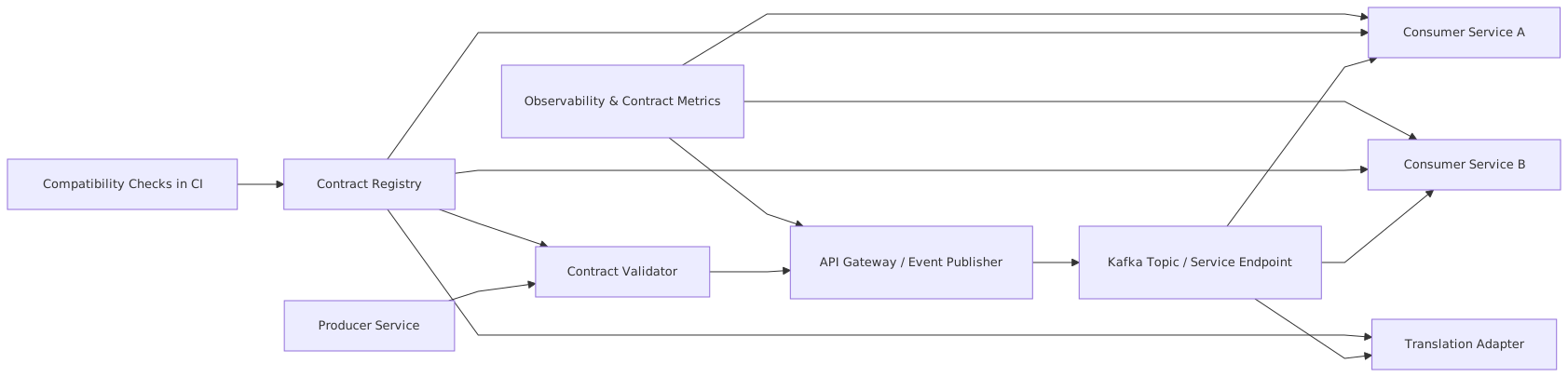
This architecture is not exotic. That is its virtue. Most enterprises can adopt it without rebuilding the world.
Contract as boundary artifact
In DDD terms, each contract is a published boundary artifact of a bounded context. The producer owns the contract, but ownership is not unilateral power. The producer owns the language and guarantees. Consumers own how they depend on it. Hardening requires making both visible.
For synchronous APIs, this means:
- explicit resource semantics
- strict request validation
- clear error contracts
- deprecation headers and lifecycle markers
- predictable idempotency behavior for write operations
For Kafka events, it means:
- stable event keys
- event type with domain meaning
- event time vs processing time separation
- immutable facts where possible
- compatibility strategy for field evolution
- replay and ordering assumptions documented
Domain semantics discussion
This is where architecture stops being plumbing and becomes strategy.
Suppose an Order service publishes OrderSubmitted. If this event is emitted before fraud screening, Billing may assume revenue pipeline entry while Fulfillment assumes nothing actionable. The event name is attractive but dangerous. Better domain semantics might distinguish:
OrderIntentCapturedOrderCreditApprovedOrderReadyForFulfillment
That may feel verbose. Good. Ambiguity is usually cheaper only in the sprint where it is introduced.
A hard contract should answer semantic questions directly:
- Is this an immutable business fact or a process milestone?
- What state transition caused this event?
- Which invariants were true when this was emitted?
- Can this event be replayed safely?
- What should a late consumer infer if it sees this event without preceding ones?
- Is absence meaningful?
These are not API design niceties. They determine whether the system remains understandable after three years and six reorganizations.
Contract translation and anti-corruption
You will not get from soft contracts to hard contracts by decree. You need translation.
An anti-corruption layer or translation adapter lets a producer expose a hardened internal contract while continuing to support legacy consumers. This is classic DDD applied pragmatically. It protects the emerging bounded context from the old language while allowing migration in steps.
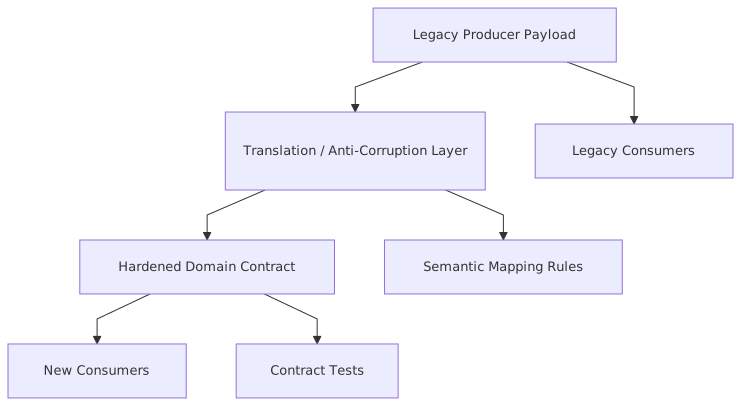
This layer is not free. It adds operational load and another place bugs can hide. But it buys the one thing enterprises desperately need during modernization: optionality.
Reconciliation as part of the architecture
Hardening contracts without designing reconciliation is wishful thinking dressed as discipline.
In event-driven systems, especially with Kafka, there will be duplicates, reordering, delayed consumers, poison messages, partial failures, and external systems that simply do not honor your lovely contract. Reconciliation is how you turn these realities from existential threats into operational routines.
A hardened contract should support reconciliation by design:
- immutable business identifiers
- correlation IDs and causation IDs
- version markers
- source-of-truth designation
- state transition history or reconstructable event streams
- deterministic conflict rules
A reconciliation service or workflow should not invent business meaning after the fact. It should use semantics already embedded in the contract.
Migration Strategy
This is where most architecture advice becomes either too pure or too timid. Let’s be blunt: you cannot harden all contracts at once, and you should not try.
Use a progressive strangler migration. Not around the whole application only, but around the contracts themselves.
Step 1: Find the seams that matter
Inventory APIs and events, then rank by business criticality and change pain:
- customer order lifecycle
- payment authorization
- shipment commitment
- entitlement provisioning
- regulatory reporting
- partner-facing integrations
Do not start with the easiest service. Start where ambiguity already creates outages, manual reconciliation, or release bottlenecks.
Step 2: Define semantic target contracts
For each high-value interaction, define the target contract in domain language. This often means renaming events, splitting overloaded endpoints, or introducing explicit status models.
Keep two questions front and center:
- What business fact or state transition does this represent?
- What guarantees must remain stable for downstream consumers?
Step 3: Introduce compatibility envelope
Before breaking anyone, add a compatibility envelope:
- support old and new fields together temporarily
- publish translated legacy and hardened events in parallel
- add deprecation markers
- instrument consumer usage of legacy fields
You cannot retire what you cannot see.
Step 4: Add contract testing and schema governance
For APIs, consumer-driven contract tests help reveal hidden dependencies. For Kafka, schema compatibility checks plus replay tests and sample fixture validation are essential.
But remember: passing a compatibility test is not proof of semantic compatibility. Use review gates for domain meaning changes, not just field shape changes.
Step 5: Migrate consumers progressively
Move the easiest consumers first, especially internal teams with strong communication paths. Leave external partners and brittle legacy systems behind a translation boundary longer.
Step 6: Establish reconciliation during coexistence
During dual-publish or dual-read phases, mismatches will occur. Build reconciliation reports and workflows before turning on broad migration. Otherwise coexistence will become a hall of mirrors.
Step 7: Retire the old contract deliberately
Set sunset dates. Track field-level dependency. Remove dead translations. Archive old schemas and semantic documentation. If you leave every old contract running forever, hardening becomes preservation, not evolution.
Here is the shape of such a migration:
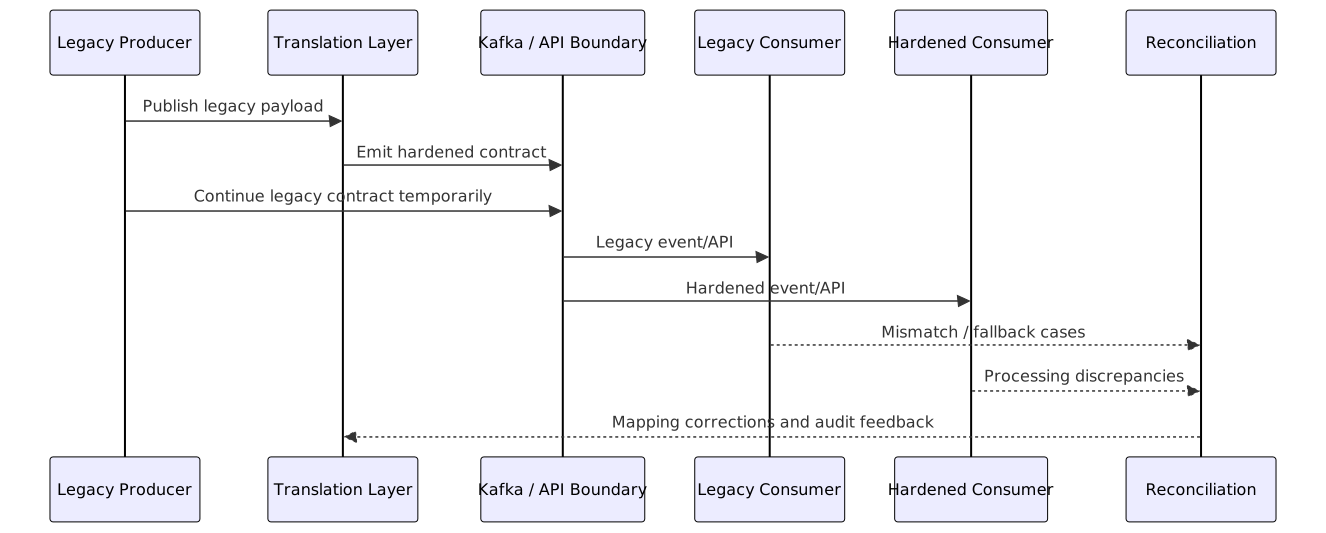
That is the progressive strangler pattern in miniature. New contract grows around old behavior until the old path can be retired.
Enterprise Example
Consider a global retailer modernizing its order management estate.
The company had a central Order Processing platform backed by a commercial package, a homegrown payment service, regional fulfillment systems, and a Kafka backbone introduced later for analytics and downstream automation. Over time, OrderCreated became the universal event everyone consumed: tax, email, inventory, fraud, customer support, warehouse routing, and finance.
The event was a mess.
It contained customer info, line items, promo details, tax estimates, payment summaries, and a mutable status field. Some consumers treated status=CREATED as ready for picking. Others saw it as only a draft with a cart converted to an order shell. The finance team depended on a nullable authorizedAmount; the warehouse had logic keyed on missing fraudCheck. During peak events, retries caused duplicate OrderCreated messages, and some consumers simply hoped deduplication would happen somewhere else. That “somewhere else” was usually a support team with a spreadsheet.
The retailer did not replace the platform in one move. Instead, it hardened the order contract in increments.
First, domain workshops established the actual lifecycle:
OrderIntentCapturedPaymentAuthorizedInventoryReservedOrderReleasedToFulfillment
This was classic DDD work: separate the bounded contexts and stop pretending one event represented the whole universe. Payments owned payment authorization semantics. Fulfillment owned release semantics. Order Management owned intent capture.
Second, they introduced a translation layer from the package-driven order payload into hardened Kafka events. Legacy consumers still received OrderCreated. New services consumed the new event family.
Third, they added compatibility governance: EA governance checklist
- Avro schemas in a registry
- producer validation in CI/CD
- consumer contract tests for critical downstream systems
- semantic review board for domain-level event changes
That last point sounds bureaucratic, and it can be. But here it was narrow and effective: if an event’s business meaning changed, architects and domain leads reviewed it. Not every field addition needed a committee.
Fourth, they built reconciliation around business identifiers. A single orderId was not enough because line-level and fulfillment-level flows diverged. They introduced stable IDs for order, payment attempt, reservation, and fulfillment release, plus correlation and causation metadata. This made it possible to detect whether an order had captured intent but failed to release, or released twice, or had payment authorized after inventory timeout.
The result was not perfection. The legacy event remained for partner ecosystems longer than anyone wanted. The translation layer became a hotspot. Some teams complained that event naming got too fine-grained. But release risk dropped, support tickets tied to integration misunderstandings fell sharply, and replaying Kafka topics for new consumers became feasible without tribal knowledge. Most importantly, the company could now evolve payments and fulfillment separately because the contracts finally reflected actual business boundaries.
That is what hardening buys you: not just safer integrations, but more truthful architecture.
Operational Considerations
Architecture that ignores operations is fantasy.
Contract observability
You need metrics that reveal contract health:
- field usage by consumer
- schema/version adoption
- validation failure rates
- replay success rates
- dead-letter volume by contract type
- reconciliation exception rates
- deprecated contract traffic
Most teams monitor latency and error rate and miss the important thing: whether the ecosystem is still depending on fields and semantics they thought were gone.
Kafka-specific concerns
Kafka adds special wrinkles:
- partitioning strategy affects ordering guarantees
- key choice determines reconciliation viability
- compaction changes replay assumptions
- schema evolution must consider historical consumers
- exactly-once semantics are often oversold; idempotent consumers still matter
Do not hide these behind platform abstractions. Teams need to understand the contract implications of keys, ordering, and retention. “Kafka will handle it” is one of those phrases that should make architects nervous.
Governance without theater
A contract registry, schema rules, and review workflows help, but only if they stay close to delivery. If governance adds weeks to a field addition, teams will route around it. Good governance is automated where possible and opinionated where it must be. ArchiMate for governance
Documentation that carries meaning
Documentation should explain semantics, not restate schemas. A contract page should say:
- what this event or API means in the business
- when it is emitted or called
- which invariants hold
- what consumers may safely assume
- how retries, duplicates, and deprecations are handled
Anything less is technical garnish.
Tradeoffs
Incremental contract hardening is not free money.
The first tradeoff is delivery friction. Teams moving from loose payloads to explicit contracts will feel slower, especially at first. That is the price of deciding things before production decides them for you.
The second is translation complexity. Dual contracts, adapters, and compatibility layers create temporary architecture that can become permanent if you lack discipline. Every translation is another spot for semantic distortion.
The third is organizational exposure. Hardening contracts often uncovers that teams do not agree on domain meaning. This is healthy but uncomfortable. You are not just cleaning APIs; you are surfacing ownership disputes.
The fourth is tooling overreach. Schema registries, consumer-driven contracts, OpenAPI linting, and event catalogs are useful. But they can lead teams into thinking compliance equals clarity. It does not.
The fifth is version sprawl risk. If every semantic improvement becomes a new major version with no retirement plan, the estate becomes a museum. Hardening should reduce ambiguity, not multiply historical artifacts.
Failure Modes
This pattern fails in familiar ways.
Schema-first, meaning-later
Teams lock down field shapes without settling business meaning. The result is a beautifully validated contract that still misleads consumers.
Hardening everything
An enterprise-wide crusade to standardize every service contract usually burns political capital and produces uneven adoption. Focus on high-value seams.
No migration runway
If you force all consumers onto a hardened contract too quickly, you create shadow adapters, private transformations, and resentment. Migration needs staging.
Reconciliation bolted on late
Without reconciliation support, coexistence phases become operationally expensive. Teams then blame hardening when the real issue was incomplete design.
Centralized governance choke point
A platform or architecture board becomes the bottleneck for every change. Teams work around it with side channels and undocumented payloads.
Never retiring legacy contracts
Temporary compatibility becomes eternal. The architecture gains cost without shedding risk.
When Not To Use
Do not use incremental contract hardening everywhere.
If you have a small system with a handful of tightly coordinated services owned by one team, full-blown hardening machinery may be overkill. Direct code-level coordination may be enough.
If the interaction is low-value, short-lived, or purely internal and easily refactored, keep it lightweight. Not every internal event deserves a semantic constitution.
If the domain itself is still unstable and the business genuinely has not settled what the concepts mean, heavy hardening too early can freeze confusion into the contract. In those cases, keep boundaries narrow and avoid broad publication until semantics stabilize.
And if your biggest problem is a monolith with no clear domain boundaries, contract hardening on top of random service cuts will not save you. DDD comes first. A bad bounded context with a perfect schema is still a bad bounded context.
Related Patterns
Several patterns sit naturally beside incremental contract hardening.
- Strangler Fig Pattern: used here not just for application replacement, but for progressive contract replacement.
- Anti-Corruption Layer: protects new domain language from legacy semantics.
- Consumer-Driven Contract Testing: useful to reveal hidden dependencies, especially for APIs.
- Schema Registry and Compatibility Validation: important for event evolution in Kafka ecosystems.
- Outbox Pattern: helps ensure published events reflect committed state changes reliably.
- Saga and Process Manager: relevant when hard contracts define process milestones across services.
- Event Sourcing: sometimes helps with replay and reconciliation, though it is not required.
- Canonical Data Model: often overused. A limited shared vocabulary is fine; enterprise-wide canonical models usually become semantic mud.
That last one deserves emphasis. Hardening contracts is not an argument for one universal enterprise schema. DDD teaches the opposite: different bounded contexts may use different models for good reasons. The aim is explicit translation, not forced uniformity.
Summary
Incremental contract hardening is one of those architectural practices that sounds narrower than it is. On the surface, it is about APIs, events, schemas, Kafka topics, compatibility checks, and migration mechanics. Underneath, it is about truth at the boundaries.
Soft contracts let organizations move quickly until they don’t. They hide semantic disagreement, spread accidental dependencies, and make failure handling a matter of folklore. Hardened contracts do the opposite: they make business meaning explicit, integration assumptions visible, and change safer. But only if you approach them incrementally.
Start with the seams that matter. Harden semantics before syntax. Use progressive strangler migration. Introduce anti-corruption and translation where needed. Build reconciliation into the design. Govern with enough force to protect stability, but not so much that teams flee the system. And retire the old world deliberately.
In the end, the quality of a microservices architecture is not measured by how many services it has. It is measured by whether the promises between them can be trusted. Contract hardening is how those promises stop being hopeful and start being real. microservices architecture diagrams
Frequently Asked Questions
What is a service mesh?
A service mesh is an infrastructure layer managing service-to-service communication. It provides mutual TLS, load balancing, circuit breaking, retries, and observability without each service implementing these capabilities. Istio and Linkerd are common implementations.
How do you document microservices architecture for governance?
Use ArchiMate Application Cooperation diagrams for the service landscape, UML Component diagrams for internal structure, UML Sequence diagrams for key flows, and UML Deployment diagrams for Kubernetes topology. All views can coexist in Sparx EA with full traceability.
What is the difference between choreography and orchestration in microservices?
Choreography has services react to events independently — no central coordinator. Orchestration uses a central workflow engine that calls services in sequence. Choreography scales better but is harder to debug; orchestration is easier to reason about but creates a central coupling point.