⏱ 22 min read
Microservice estates rarely fail because teams can’t publish an API. They fail because everyone publishes an API, all the time, and each one quietly assumes the world will stand still long enough for clients to catch up.
It won’t.
That is the dirty secret behind distributed systems in large enterprises. Change arrives unevenly. A billing team ships weekly. The policy admin platform moves every quarter. Mobile apps linger in the field for months. Trading partners upgrade only when procurement approves the budget. Meanwhile product management keeps discovering “small tweaks” that turn into semantic earthquakes: a customer becomes an account holder, an order becomes a commitment, a cancel becomes a reversal with compensating obligations. The wire format changes last. The meaning changes first.
That is why API contract negotiation matters. Not as a protocol trick. Not as a fancy version header. As an architectural discipline for surviving semantic change across independently evolving services.
In a healthy microservice landscape, the contract is not merely a schema. It is an agreement about domain meaning, behavior, invariants, and acceptable degradation. Negotiation is how two bounded contexts decide, at runtime or deployment time, what they can honestly promise each other. Without that discipline, teams end up in one of two bad places: brittle lockstep releases or a swamp of backward-compatibility hacks nobody understands.
Contract negotiation is the middle path. It allows evolution without chaos. But let’s be clear: it is not free. It adds machinery. It introduces operational edge cases. It can become a fig leaf for sloppy domain design. Used well, it helps enterprises modernize old integration surfaces, especially during progressive strangler migrations. Used badly, it becomes a compatibility labyrinth with no map and no exit.
This article is about using contract negotiation as an explicit architectural tool in microservices: where it fits, how to shape it around domain-driven design, how Kafka changes the picture, what breaks in production, and when you should walk away from it entirely. event-driven architecture patterns
Context
Microservices pushed a generation of architects to value independent deployability. That was the right instinct. But many organizations interpreted independence too literally: every service owns its contract, every team ships at will, and “just version the API” is considered a strategy.
It isn’t. Versioning is a marker. Negotiation is a behavior.
In a simple system, one provider exposes /v1 and later /v2. Clients migrate over time. Fine. In an enterprise system, however, the landscape is messier:
- internal synchronous APIs between domain services
- event streams over Kafka with multiple consumers at different upgrade levels
- external partner APIs that must remain stable for years
- channels like mobile and web with wildly different release cadences
- legacy systems that cannot consume modern contract forms
- business rules that vary by market, product, jurisdiction, or tenant
The result is not just “multiple versions.” It is multiple semantic expectations coexisting at once.
Take a customer domain. In CRM, a customer may be a marketing profile. In billing, it’s a legal party responsible for payment. In claims, it may be the policyholder, claimant, or beneficiary depending on stage. If a service publishes a CustomerUpdated event without negotiating the meaning and shape of that event for downstream consumers, all the compatibility machinery in the world will not save you. Syntactic compatibility can still carry semantic corruption.
This is where domain-driven design matters. A contract should sit inside a bounded context and speak that context’s language. Negotiation is not primarily about preserving old field names. It is about mediating between bounded contexts that evolve at different speeds and with different models.
That’s why the best negotiation designs look boring from the outside. They expose a stable capability surface, constrain semantic drift, and make incompatibility visible early. The worst ones try to be universal translation engines. Enterprises love those. They should not.
Problem
The core problem is straightforward: consumers and providers in a microservice architecture evolve independently, but their interactions require a shared understanding that changes over time. microservices architecture diagrams
The pain shows up in several familiar forms:
- Lockstep deployment pressure
Provider changes require all consumers to upgrade at once. This kills autonomy and makes release planning political.
- Version proliferation
Every breaking change spawns another endpoint, topic, or message variant. The platform becomes a museum of old assumptions.
- Semantic ambiguity
Two parties accept the same schema but interpret it differently. This is the nastiest failure because it looks successful in logs.
- Legacy drag during migration
During monolith decomposition or platform replacement, old and new models must coexist. Without negotiation, every integration becomes a bespoke adapter.
- Asymmetric evolution in event-driven systems
Kafka consumers often lag producers. Producers may publish richer events before all consumers can understand them. Consumers may also require different projections or quality guarantees.
- Operational invisibility
Teams know requests are succeeding, but not whether contracts are being downgraded, transformed, or partially honored.
The common but shallow answer is “make everything backward compatible.” Useful advice, but incomplete. Backward compatibility only works for a subset of changes, and only if semantics remain stable. It does nothing for domain refactoring, capability discovery, contextual policy differences, or staged migrations.
At scale, negotiation becomes necessary because change is not binary. It is a series of accommodations.
Forces
Architectural decisions here are driven by a set of competing forces. Ignore any one of them and the design will look elegant on paper and painful in production.
1. Consumer independence vs provider simplicity
Consumers want flexibility: support for old clients, different representations, optional fields, and progressive adoption of new capabilities. Providers want one clean model. Both instincts are legitimate. The tension is structural.
2. Domain purity vs integration pragmatism
DDD tells us to protect bounded contexts and avoid shared enterprise-wide canonical models. Correct. But enterprises still need systems to interoperate. Negotiation sits in that uneasy borderland. Too much purity and integrations fracture. Too much canonical standardization and every domain gets flattened into mush.
3. Runtime negotiation vs explicit versioning
Runtime negotiation via headers, media types, or capability exchange can reduce endpoint proliferation. But it increases request complexity and observability needs. Explicit versioned APIs are simpler to reason about, yet often lead to long-lived duplication.
4. Synchronous vs asynchronous interaction
In HTTP APIs, negotiation can happen per request. In Kafka, contract compatibility is usually managed through schema evolution, topic conventions, consumer groups, and out-of-band capability alignment. The mechanics differ, but the architectural concern is the same: how do independently evolving parties maintain a valid conversation?
5. Reuse vs local adaptation
A central negotiation gateway can enforce standards and simplify governance. It can also become a bottleneck and a semantic choke point. Local adapters at service boundaries preserve autonomy but create duplication. EA governance checklist
6. Migration speed vs long-term cleanliness
During a strangler migration, temporary translation layers are often worth their weight in gold. But temporary code in enterprises has a habit of becoming constitutional law. Every adapter added for migration needs an expiry plan.
7. Correctness vs resilience
Strict contract enforcement catches drift early. Lenient interpretation keeps systems running under partial mismatch. You need both, but not in equal measure everywhere. For payment instructions, be strict. For optional profile enrichment, be forgiving.
Solution
The practical solution is to treat API contract negotiation as a layered mechanism with clear domain boundaries, rather than a single feature.
At a high level:
- define contracts around bounded contexts, not enterprise-wide nouns
- publish explicit capabilities and semantic guarantees
- negotiate representation and optional features at the edge
- keep core domain services speaking a smaller set of stable internal contracts
- use anti-corruption layers to reconcile old and new models during migration
- separate compatibility policy from business logic
- make downgrade, transformation, and semantic loss observable
This is not “support every client forever.” It is controlled, explicit compatibility.
There are three common negotiation scopes:
1. Representation negotiation
This is the familiar layer: media type, schema version, field presence, format variants.
Examples:
- JSON vs Avro
- compact vs expanded payload
application/vnd.order+json;version=2- optional inclusion of enrichment fields
Useful, necessary, not sufficient.
2. Capability negotiation
Here the parties agree on supported operations or feature flags.
Examples:
- provider supports partial cancellation but not amendment
- consumer can handle asynchronous callback instead of immediate confirmation
- provider can return tax breakdown only for some jurisdictions
- event consumer supports enriched events with nested line-level promotions
This is where many enterprises should spend more time. Capabilities age better than raw version numbers.
3. Semantic negotiation
This is the hardest and most important layer. Parties align on business meaning, constraints, and invariants.
Examples:
- does
cancelledmean before fulfillment only, or can it trigger reversal after settlement? - is
customerIda person, an account, or a tenancy-scoped subject? - is price final gross amount, or net before downstream charges?
- does
effectiveDaterepresent legal effective time or system activation time?
You don’t always negotiate semantics dynamically, but you must model them explicitly. Otherwise teams perform silent reinterpretation and call it compatibility.
A robust architecture usually mixes static and dynamic approaches:
- static compatibility through versioned schemas, consumer-driven contracts, and compatibility tests
- dynamic negotiation through headers, capability exchange, registry lookup, or handshake endpoints
- translation through adapters where bounded contexts cannot or should not align directly
A simple request flow might look like this:
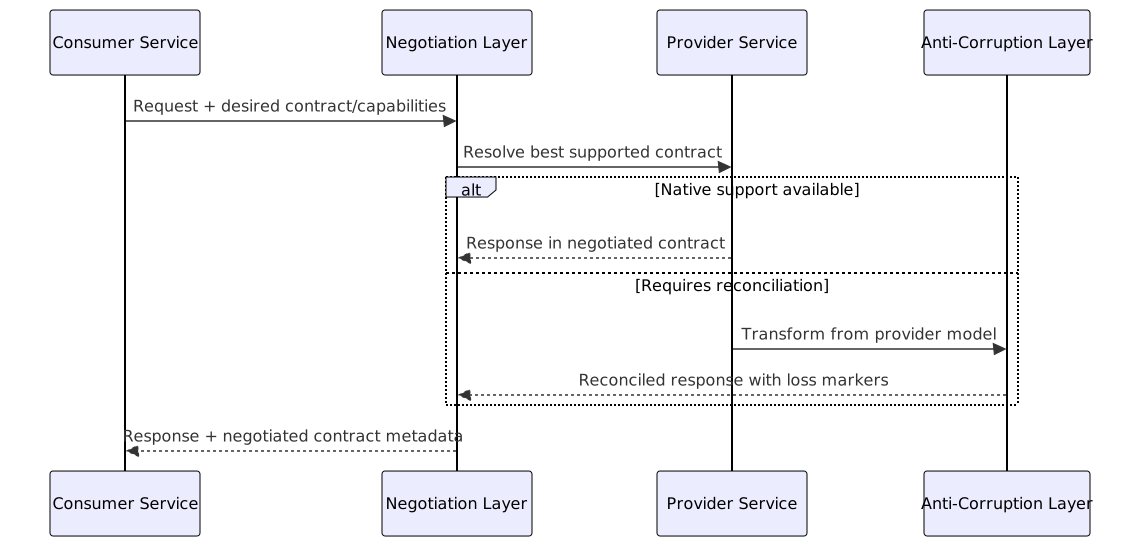
That last line matters: loss markers. If a transformation drops semantics, the caller should know. Quiet downgrade is a liar’s architecture.
Architecture
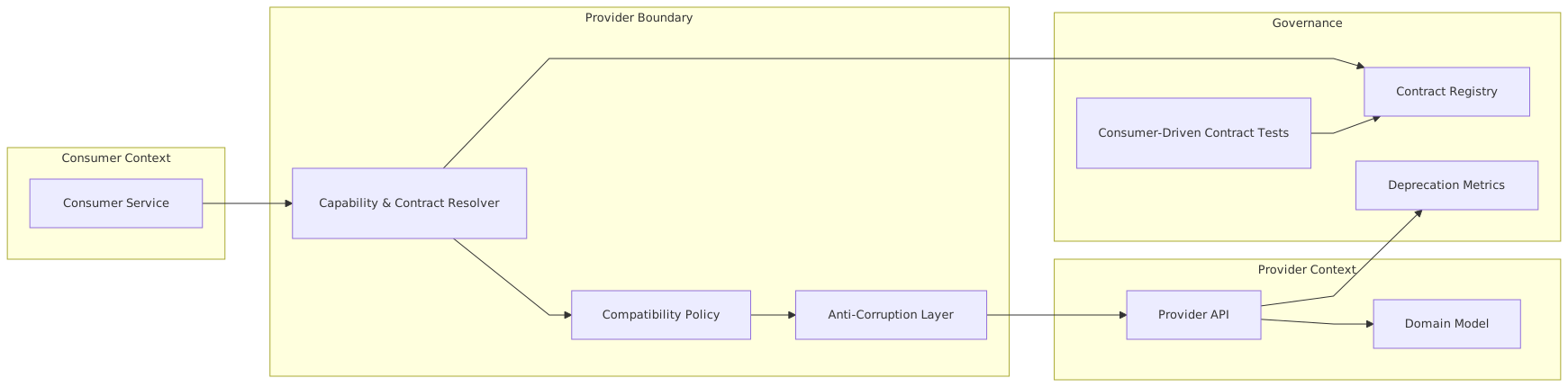
The best way to think about the architecture is as a set of responsibilities, not products.
Contract registry
A contract registry stores machine-readable and human-readable definitions of supported contracts, versions, capabilities, deprecation status, and compatibility rules.
This may include:
- OpenAPI or AsyncAPI definitions
- Avro/Protobuf schemas
- semantic notes and invariants
- compatibility matrices
- deprecation timelines
- ownership metadata
The registry should not be a passive documentation graveyard. It should participate in CI/CD validation and release governance. ArchiMate for governance
Negotiation layer
This can be implemented in several places:
- API gateway for external-facing traffic
- service-side negotiation module for internal APIs
- client SDK for outbound calls
- Kafka schema and metadata strategy for event contracts
I prefer negotiation at the boundary nearest the provider, with a very thin gateway role. Why? Because semantics live with the domain team. A central gateway can route and validate, but it should not become the brains of every business translation.
Anti-corruption layer
This is the bridge between bounded contexts or between legacy and modern services. In DDD terms, the anti-corruption layer protects the target domain from upstream conceptual pollution.
When contract negotiation requires true model reconciliation, put that logic here. Do not smear it across controllers, Kafka consumers, and random utility libraries.
Policy engine
Compatibility rules should be explicit:
- what versions are accepted
- what capabilities can be downgraded
- what transformations are lossy
- which consumers are exempt temporarily
- what sunset dates apply
This policy can be implemented as configuration plus tests. It doesn’t need to be a giant enterprise platform. Most organizations overbuild this.
Observability and audit
You need to see:
- negotiated contract chosen
- downgrade frequency
- transformation failures
- semantic loss incidents
- unsupported capability requests
- stale consumers still on near-expired contracts
Negotiation without telemetry is just hidden coupling.
Here is a useful conceptual view:
Kafka and event negotiation
Kafka complicates the story because consumers do not negotiate with producers request-by-request. The coupling is temporal and indirect.
In event-driven systems, contract negotiation becomes a combination of:
- schema evolution strategy
- topic versioning policy
- event envelope metadata
- capability segmentation by topic or event type
- replay and reconciliation workflows
A mature Kafka design often uses an event envelope containing:
- event type
- schema/version ID
- domain context
- semantic markers
- producer capabilities
- correlation and causation IDs
Consumers then decide whether they can process the event, partially process it, route it to a compatibility adapter, or dead-letter it.
This is where reconciliation becomes crucial. In asynchronous systems, consumers may derive read models, trigger workflows, or update downstream aggregates based on events from different semantic eras. If the same real-world fact arrives in old and new forms, you need reconciliation logic to determine equivalence, precedence, and compensation.
A surprisingly common enterprise failure mode is dual-publishing old and new events during migration without any clear reconciliation rule. That creates a distributed double-entry bookkeeping problem, except nobody agrees on the chart of accounts.
Migration Strategy
Contract negotiation earns its keep during migration.
Most enterprises adopting it are not building greenfield systems. They are untangling a monolith, replacing an ESB-heavy integration fabric, modernizing partner APIs, or moving from batch feeds to event streams. In those settings, progressive strangler migration is the right instinct.
The migration pattern is simple in idea, hard in execution:
- keep the old contract alive at the edge
- route selected capabilities to new services
- reconcile old and new domain models through anti-corruption layers
- gradually move consumers to native contracts
- remove compatibility paths once usage drops to zero
Not glamorous. Very effective.
Step 1: classify contracts by semantic volatility
Not all APIs need the same negotiation machinery. Start by sorting interfaces into:
- stable, low-change utility contracts
- high-change domain contracts
- externally committed contracts
- migration-only contracts
Spend architecture budget where the semantics move.
Step 2: introduce explicit contract metadata
Even before runtime negotiation, make contracts visible:
- version and capability declarations
- deprecation status
- provider ownership
- consumer inventory
- compatibility guarantees
Many migration programs fail because nobody knows who still depends on what.
Step 3: add an edge compatibility layer
For legacy consumers, create a compatibility façade or gateway that accepts old contracts and translates them into the new provider model. Keep that translation outside the new domain core.
Step 4: support dual-read or dual-publish carefully
During transition, you may need:
- synchronous routing to old and new providers
- event publication in both old and new forms
- read-model backfill from both sources
This is dangerous territory. Reconciliation must be first-class. Define:
- source of truth by business capability
- duplicate suppression strategy
- ordering assumptions
- compensation rules
- audit trail for transformed facts
Step 5: migrate by capability, not just endpoint
Do not think in terms of “we moved /orders.” Think in terms of business capabilities:
- order inquiry
- pricing preview
- order placement
- amendment
- cancellation
- settlement visibility
Negotiation is easier when capabilities are explicit. It also aligns with DDD: each capability often maps to a different subdomain maturity level.
Step 6: enforce sunset policy
A migration without endings is not a migration. It is just sediment.
Track usage, publish deadlines, notify consumers, and turn off compatibility paths deliberately.
Here is a typical strangler shape:
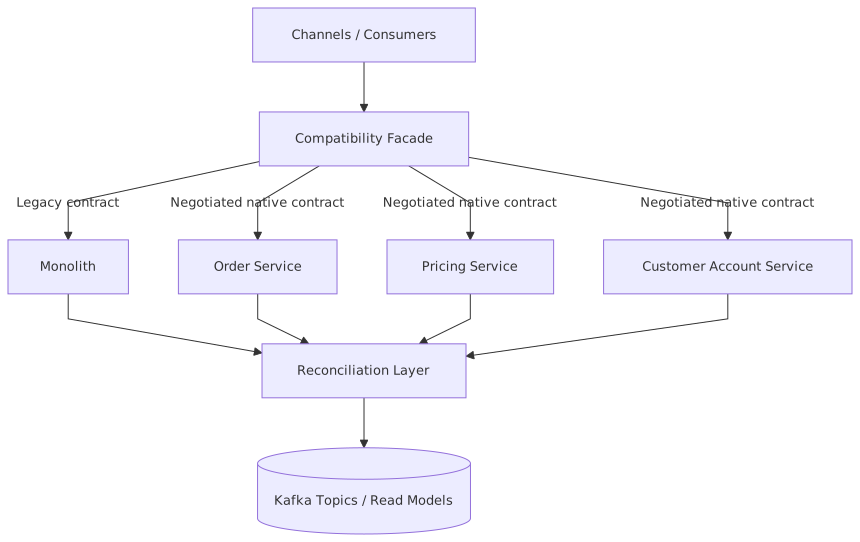
The reconciliation layer in this picture is not optional theater. It is the difference between a migration and a distributed contradiction.
Enterprise Example
Consider a large insurer modernizing its policy administration platform.
The legacy system exposes a SOAP API for policy changes. In that world, a “policy amendment” is a broad operation that can alter coverage, payment frequency, named insured parties, and risk details in one transaction. Downstream systems learned to interpret this one giant concept in different ways.
The modernization program decomposes this into microservices:
- Policy Service
- Billing Service
- Party Service
- Underwriting Decision Service
- Document Service
At first glance the integration challenge looks technical: move from SOAP to REST and events over Kafka. But the real problem is semantic. The old contract bundles multiple domain meanings into one operation. The new services split them across bounded contexts.
If the architecture team simply versions the old API into /v2, they inherit the old ambiguity. Worse, they force new services to pretend they still think in monolithic terms.
So they introduce contract negotiation.
What they did
- Defined a provider-facing capability model
Instead of one “amend policy” operation, they exposed capabilities such as:
- amend coverage terms
- amend billing arrangement
- update party roles
- request re-underwriting
- regenerate compliance documents
- Built a compatibility façade for legacy channels and partners
The old SOAP request was accepted, parsed, and negotiated into one or more capability invocations.
- Created an anti-corruption layer
This layer translated the monolithic amendment payload into bounded-context commands and later reassembled responses for old consumers.
- Used Kafka for domain events
New services emitted events like CoverageTermsAmended, BillingScheduleChanged, and PartyRoleUpdated, each with explicit schema metadata.
- Added reconciliation
Because the monolith remained the source of truth for some policy lines during migration, a reconciliation process compared legacy amendment outcomes with new service events to detect divergence.
What they learned
- The biggest issue was not field mapping. It was temporal semantics. The monolith treated amendment as one transaction. The new services processed some changes asynchronously.
- Some legacy consumers expected a single success/failure outcome. The new world sometimes returned partial acceptance with compensation paths.
- Billing and policy did not agree on the meaning of “effective date.” Negotiation forced that disagreement into the open. Good. Painful, but good.
- A small compatibility façade became strategically important, but they kept business decisions in domain services rather than centralizing them in the gateway.
This is the kind of enterprise case where contract negotiation pays for itself. It absorbs legacy variability while allowing the new domains to become more honest and more precise.
Operational Considerations
Negotiation design lives or dies in operations.
Observability
Log and measure:
- requested contract/capability
- resolved contract/capability
- fallback path chosen
- transformation latency
- lossy translation markers
- unsupported requests
- consumer identity and version
Without this, you cannot retire old contracts or diagnose semantic drift.
Testing
You need more than provider unit tests.
Use:
- consumer-driven contract tests
- schema compatibility tests
- negotiation matrix tests
- replay tests for Kafka events
- reconciliation simulations
The negotiation matrix matters. If three versions and four capability variants exist, your state space grows quickly.
Governance
You do not need a heavyweight architecture review board approving every field rename. You do need:
- ownership of each contract
- deprecation policies
- explicit support windows
- a process for semantic changes
- visibility of top lagging consumers
Governance should be a fence, not a prison.
Performance
Negotiation adds work:
- capability lookup
- policy evaluation
- transformation
- registry access
- serialization conversion
Cache what you can. Keep decision logic local for hot paths. Never put a remote registry call in the critical request path unless you enjoy self-inflicted outages.
Security and compliance
Negotiated contracts may expose different data shapes. That means:
- data minimization rules vary by consumer
- older contracts may leak fields newer contracts removed
- partner-specific contracts may have jurisdictional implications
Treat contract negotiation as part of the security model, not just an integration convenience.
Tradeoffs
Let’s be blunt. Contract negotiation is useful, but it is not pure gain.
Benefits
- reduces lockstep deployments
- supports progressive migration
- allows domain models to evolve more honestly
- contains legacy compatibility at boundaries
- improves visibility into consumer behavior
- works well with DDD when bounded contexts are explicit
Costs
- more moving parts
- more testing combinations
- more telemetry needed
- potential for semantic translation debt
- risk of central compatibility layers becoming mini-monoliths
- temptation to support obsolete consumers forever
The central tradeoff is this: you are buying adaptability with complexity.
That is often a good bargain in enterprises where change is constant and uneven. But if you apply it indiscriminately, you replace one kind of coupling with another. Instead of lockstep release coupling, you get hidden translation coupling.
I prefer simpler versioning unless there is a real asymmetry in change cadence, domain semantics, or migration posture. Negotiation should solve a genuine problem, not decorate an architecture diagram.
Failure Modes
This pattern fails in ways that are painfully familiar.
1. Syntax-compatible, semantically wrong
The most dangerous case. Payload validates. Business meaning is wrong. Claims are processed under the wrong policy role. Refunds become reversals. Nobody notices until reconciliation or audit.
2. Gateway brain syndrome
A central API gateway starts doing translation, capability routing, enrichment, policy decisions, and business orchestration. Congratulations, you rebuilt the monolith in YAML.
3. Infinite backward compatibility
Old contracts are never retired. Teams become afraid to break anything. The provider core is constrained forever by dead clients and zombie integrations.
4. Dual-publish inconsistency in Kafka
Old and new event forms are both emitted, but consumers process both or reconcile them differently. Duplicate side effects follow.
5. Lossy transformations hidden from consumers
A new provider cannot represent an old concept cleanly, so the adapter drops fields or collapses states. If this is hidden, consumers make incorrect assumptions.
6. Registry theater
The organization invests in a contract registry, but teams do not use it in pipelines, do not keep metadata current, and do not monitor deprecations. The registry becomes corporate wallpaper.
7. Negotiation per request where static allocation would do
Some teams dynamically negotiate every call even though each consumer uses one fixed contract for months. That adds runtime complexity with no business value.
When Not To Use
Contract negotiation is not mandatory architecture. Sometimes the best negotiation strategy is none at all.
Do not use it when:
- you have few consumers and coordinated releases are easy
A straightforward versioned API is simpler.
- the domain is still highly unstable and not yet understood
First get the bounded contexts right. Negotiation cannot rescue a muddled domain.
- the interaction is internal, short-lived, and tightly controlled
A private API between two services owned by one team may not need negotiation beyond compatibility tests.
- the cost of semantic mismatch is extreme
For certain financial, medical, or safety-critical workflows, strict explicit version cutovers may be safer than runtime adaptability.
- teams are using negotiation to avoid deprecation discipline
If the real issue is fear of saying no to stale clients, negotiation will make it worse.
- you are trying to build a universal enterprise canonical contract
That road leads to a committee-designed Esperanto no domain truly speaks.
A useful rule: if all you need is /v1 and /v2, use /v1 and /v2. Don’t summon a negotiation engine to solve a numbering problem.
Related Patterns
Contract negotiation works best alongside a few neighboring patterns.
Consumer-Driven Contracts
Useful for verifying provider changes against actual consumer expectations. They help catch accidental breakage, though they do not by themselves solve semantic divergence.
Anti-Corruption Layer
Essential when crossing bounded contexts or integrating with legacy systems. This is the proper home for translation and semantic shielding.
Strangler Fig Pattern
The natural migration companion. Negotiation allows old and new contracts to coexist while capabilities are gradually redirected.
Schema Registry
Especially relevant with Kafka, Avro, or Protobuf. This supports compatibility enforcement and schema discovery, but should be paired with semantic governance.
Backends for Frontends
A BFF may perform client-specific shaping and lightweight negotiation for channel needs. But do not let it become a dumping ground for domain translation.
Event Versioning and Upcasting
In event-driven systems, upcasters and compatibility consumers can bridge old event forms. Useful, but watch for hidden semantics drift.
Reconciliation Pattern
Critical during migration and dual-write or dual-publish periods. If multiple representations of the same business fact exist, reconciliation decides what is true enough to proceed.
Summary
API contract negotiation in microservices is not about being clever with headers. It is about dealing honestly with change.
Real enterprises do not evolve in clean synchronized waves. They creak, fork, modernize unevenly, and carry old meanings longer than anyone planned. In that world, a contract is not just a schema; it is a business promise shaped by bounded contexts, release cadence, migration constraints, and operational reality.
Done well, contract negotiation gives you room to evolve. It helps preserve consumer independence without freezing provider design. It supports progressive strangler migration. It gives Kafka-based architectures a way to manage event evolution without blind faith. It makes reconciliation explicit where multiple truths temporarily coexist.
Done badly, it becomes a compatibility swamp.
So be opinionated. Negotiate capabilities more than formats. Keep semantics close to the domain. Use anti-corruption layers to protect your model. Make downgrades visible. Reconcile deliberately. Retire old paths with discipline.
And remember the simplest architectural truth in this whole topic: every compatibility layer is a loan. Take it when you must. Know how you’ll pay it back.
Frequently Asked Questions
What is a service mesh?
A service mesh is an infrastructure layer managing service-to-service communication. It provides mutual TLS, load balancing, circuit breaking, retries, and observability without each service implementing these capabilities. Istio and Linkerd are common implementations.
How do you document microservices architecture for governance?
Use ArchiMate Application Cooperation diagrams for the service landscape, UML Component diagrams for internal structure, UML Sequence diagrams for key flows, and UML Deployment diagrams for Kubernetes topology. All views can coexist in Sparx EA with full traceability.
What is the difference between choreography and orchestration in microservices?
Choreography has services react to events independently — no central coordinator. Orchestration uses a central workflow engine that calls services in sequence. Choreography scales better but is harder to debug; orchestration is easier to reason about but creates a central coupling point.