⏱ 22 min read
Distributed systems have a talent for turning simple business actions into repeated accidents.
A customer clicks Pay once. The browser retries. The mobile app resends after a timeout. The API gateway retries after a 502. Kafka replays a message after a consumer rebalance. Somewhere in the middle, a payment service sees the same intent two, three, maybe ten times. And suddenly “charge customer once” becomes an architectural problem rather than a coding detail.
This is where many microservice programs reveal their maturity. Teams happily split systems into dozens of services, add asynchronous messaging, put Kafka in the middle, and call it modern architecture. Then they discover the oldest law in distributed computing: if a message can be delivered twice, it will be delivered twice on the worst possible day.
Idempotency keys are the practical answer. Not glamorous. Not intellectually fashionable. But they are one of those patterns that separate systems that survive production from systems that merely demo well.
The important thing, though, is this: command idempotency is not just about duplicate HTTP requests. That framing is too small. In an enterprise landscape, idempotency is about preserving business intent across unreliable delivery paths. It sits at the intersection of domain-driven design, integration architecture, consistency design, and operational resilience. Done well, it protects domain invariants. Done badly, it becomes a leaky cache of request hashes that gives architects false confidence.
This article goes deep on command idempotency keys in microservices: the problem they solve, the forces that shape the design, the architecture options, migration approaches, Kafka implications, reconciliation, tradeoffs, failure modes, and when not to use the pattern. event-driven architecture patterns
Context
Most enterprise systems no longer execute a business transaction in one process, one database, one commit. They execute it across APIs, event streams, service boundaries, and operational retries.
A single “place order” command might travel like this:
- web or mobile client sends HTTP request
- API gateway forwards to an order service
- order service persists the command
- order service emits an event to Kafka
- payment service consumes the event and authorizes payment
- inventory service reserves stock
- fulfillment service starts shipment workflow
- notification service sends confirmation
At every hop, the delivery semantics are weaker than business people assume. Networks fail. Producers time out after the server already committed. Consumers crash after processing but before acknowledging. Brokers redeliver. Humans re-submit forms. Batch jobs replay historical messages. Disaster recovery failovers re-run in-flight work.
The domain, meanwhile, remains stubbornly clear-eyed:
- charge once
- reserve once
- create one policy
- issue one refund
- register one claim
- open one account
That gap between technical delivery semantics and business uniqueness semantics is the architecture problem.
Domain-driven design helps here because it forces the right question. Not “how do I deduplicate requests?” but “what does this domain consider the same command?” Those are not always the same thing. In retail, two identical carts submitted twice may be accidental duplicates. In equities trading, two identical buy orders may be entirely legitimate. In insurance, “submit claim” may be unique by external claim reference, while “add note” is intentionally repeatable.
Idempotency starts with language. If the domain language is fuzzy, the technical implementation will be wrong.
Problem
In a microservices estate, commands are often processed under at-least-once delivery assumptions. That is not a bug. It is the normal condition of reality.
Without idempotency controls, duplicate command processing causes several classes of damage:
- duplicate side effects, such as charging a card twice
- broken invariants, such as over-reserving stock
- inconsistent downstream projections, such as duplicate invoices
- manual reconciliation effort
- customer distrust
- legal and financial exposure
The naive answer is often, “make the operation idempotent.” Reasonable slogan. Weak design guidance.
Because not every command is naturally idempotent.
A PUT /customer/123/address may be naturally idempotent if the same final state is written repeatedly. A POST /payments is not. Every successful execution may create a new payment, ledger entry, provider call, and settlement obligation. Repeating it is not harmless.
This is why command idempotency keys matter. They turn a non-idempotent business operation into a safely repeatable request by attaching a stable identity to the client’s intent.
The core promise is simple:
> If the same business command is received multiple times with the same idempotency key, the system processes it once and returns the same outcome consistently.
Simple to say. Harder to make true in a distributed estate.
Forces
Architectural patterns become useful when we understand the forces pulling in opposite directions. Command idempotency exists because several forces collide.
Reliability vs correctness
Retries improve reliability. But retries without deduplication undermine correctness. Enterprises need both.
Stateless services vs durable memory of intent
Microservice platforms encourage stateless compute. Idempotency requires state: some durable record that a command with a given key has already been accepted or completed.
Domain semantics vs transport mechanics
HTTP headers, Kafka message keys, correlation IDs, and request hashes are transport concerns. The real question is whether two deliveries represent the same business intent. That is a domain concern.
Throughput vs coordination
The stronger the duplicate protection, the more coordination you typically introduce: unique constraints, locks, transactional writes, or conditional upserts. Those protections cost latency and throughput.
Fast local handling vs cross-service consistency
A service can deduplicate its own command handling. It cannot automatically guarantee every downstream side effect is deduplicated unless the pattern continues through the chain.
Retention cost vs replay horizon
How long should idempotency records be kept? Minutes may cover client retries but not delayed redelivery from brokers or replay from dead-letter recovery. Months may become expensive at scale.
Generic platform pattern vs bounded context specificity
Platform teams love one-size-fits-all middleware. Domains resist that. An idempotency policy for card payments should not be blindly reused for securities trades or healthcare observations.
That is the shape of the problem. It is not “save a key in Redis.” It is a balancing act among business semantics, operational risk, and system economics.
Solution
The canonical solution is to treat a command as a first-class object with a client- or upstream-generated idempotency key, then persist the processing outcome against that key in the receiving bounded context.
When the same command arrives again with the same key:
- if processing already completed, return the stored result
- if processing is still in progress, return an “accepted/in-progress” response or block safely
- if the key exists but payload semantics conflict, reject it as misuse
- if no record exists, process the command and store the result atomically with the key
This gives us an idempotency contract, not merely a retry mechanism.
A common shape looks like this:
- Client generates an idempotency key for a business action.
- The receiving service stores a record keyed by
(operation scope, idempotency key). - The service performs command handling.
- It stores the business outcome or a pointer to it.
- Retries use the same key and receive the same semantic result.
The trick is in the scope. Idempotency keys must be unique within a defined domain boundary. A naked UUID without scope is not architecture; it is a hopeful string.
For example:
CreatePaymentwithinPaymentbounded contextSubmitClaimwithinClaimsbounded contextReserveInventorywithinInventorybounded context
Not global across the enterprise. Global uniqueness is usually needless and often harmful.
The semantics matter more than the storage
The most common implementation error is to reduce idempotency to request hashing. That can work for some public APIs, but it often breaks down in enterprise domains.
Consider these commands:
POST /paymentswith same amount, same account, same merchant, same dayPOST /stock-orderswith same symbol, same quantity, same limit price
Technically similar. Semantically different.
The payment may be an accidental retry. The stock order may be a deliberate second order. Domain semantics determine whether replays are duplicates, not field equality alone.
So the proper model is:
- the caller explicitly signals “this is the same business intent” by reusing the key
- the receiver enforces consistency for that declared intent
- the receiver may validate that the payload attached to the same key has not changed materially
That is cleaner than guessing from payload shape.
Architecture
At the heart of the architecture is an idempotency store coupled tightly enough to command processing that duplicates cannot slip through race conditions.
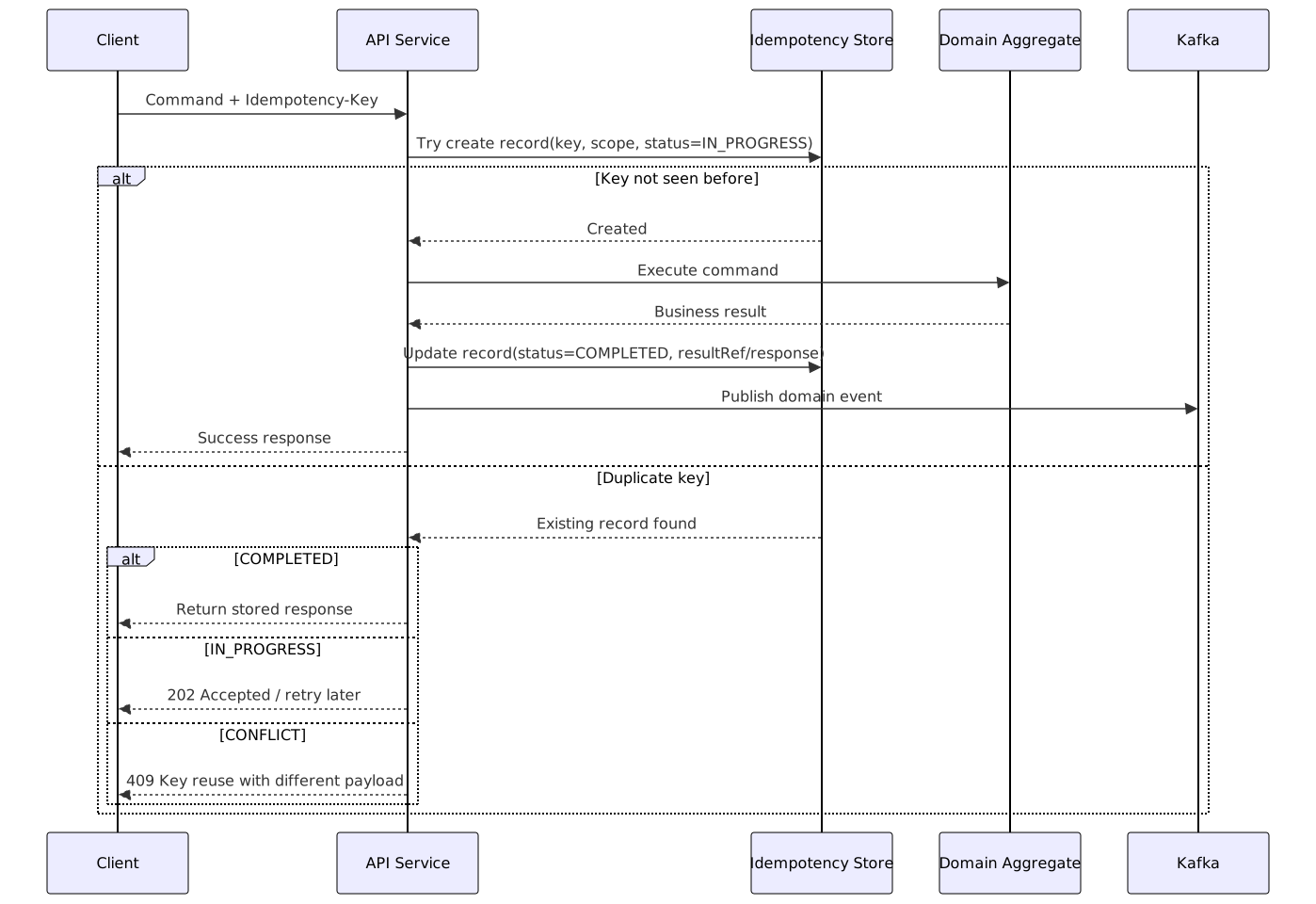
Core components
1. Command endpoint
The service accepts an idempotency key, usually via:
- HTTP header like
Idempotency-Key - command envelope field for internal APIs
- Kafka message header for asynchronous command topics
The endpoint should define:
- required or optional status
- retention duration
- payload consistency rules
- response behavior for duplicates
2. Idempotency record
A typical record contains:
- key
- operation or command type
- tenant or business scope
- payload fingerprint
- status:
IN_PROGRESS,COMPLETED,FAILED - response payload or reference
- business entity reference, such as payment ID
- timestamps and expiry
A unique constraint on (scope, operation, key) is usually the backbone of correctness.
3. Atomic processing boundary
This is where architecture earns its salary.
The system must prevent this failure:
- two duplicate requests arrive simultaneously
- both see no existing key
- both execute side effects
The cleanest approach is to write the idempotency record transactionally in the same database that protects the business invariant, often with:
- insert-if-absent
- unique constraint
- transactional upsert
- row-level locking where necessary
If the service writes to one database and stores idempotency state in another eventually consistent cache, you have already invited a race.
4. Response replay
For synchronous APIs, duplicate requests should ideally receive the same response shape as the original successful call. This is more than convenience. It stabilizes clients and reduces accidental retries escalating into new workflows.
Many teams store:
- the exact HTTP response body and status
- or a reference to the domain object and regenerate the response
The latter is often better for long retention horizons.
5. Event propagation
If the command results in downstream events, those events need a consistent identity too. Otherwise the API layer may be idempotent while Kafka consumers still process duplicate side effects.
This is where the outbox pattern belongs in the conversation. If a service accepts a command once, it should emit downstream events once from its committed state, even if broker publication retries occur.

DDD view: key scope belongs to the bounded context
In domain-driven design terms, the idempotency decision belongs near the aggregate or application service that protects a business invariant.
Take CreatePayment. The payment bounded context decides:
- what counts as the same payment intent
- how long duplicate suppression matters
- whether a second attempt after failure should reuse the same key or create a new command
- whether downstream provider calls need their own propagated idempotency token
This should not be hidden purely in ingress middleware. Middleware can enforce mechanics, but only the domain can define sameness.
Kafka and asynchronous commands
Kafka adds a subtle twist. Teams often rely on Kafka message keys and assume they solve idempotency. They do not.
Kafka keys influence partitioning and ordering. They are not deduplication guarantees.
Consumer-side idempotency is still necessary because:
- producers may resend after uncertainty
- brokers may redeliver on consumer restart
- reprocessing historical topics is common
- exactly-once semantics in Kafka are narrower than many teams believe, especially once side effects outside Kafka are involved
For asynchronous command consumers, the same basic design applies:
- consume command with idempotency key
- attempt insert into idempotency table
- if first-seen, process command and persist result
- if duplicate, skip side effects and optionally emit no-op metrics
This works particularly well when consumer state and idempotency state live together.
Migration Strategy
Most enterprises do not start greenfield. They inherit a tangle: legacy APIs, duplicated orders, overnight batch corrections, hand-built retry logic, maybe a payment platform scarred by years of incident tickets.
You do not fix that by announcing “all services now support idempotency.” That is architecture theatre.
You migrate progressively, with a strangler approach, around the highest-value commands first.
Step 1: Identify commands with asymmetric failure cost
Start where duplicate execution is expensive or embarrassing:
- payment capture
- refund issuance
- account opening
- claim submission
- order creation
- stock reservation
Do not begin with low-value CRUD updates. Go where the fire is.
Step 2: Define domain semantics for duplicates
For each candidate command, ask:
- what does the business consider the same intent?
- who generates the key?
- what is the valid replay window?
- what payload changes are allowed with the same key?
- what response should duplicates receive?
This is the part many migrations skip. Then six months later they discover one channel reuses keys incorrectly and another expects retries to mutate optional metadata.
Step 3: Add an anti-corruption layer at the edge
For legacy clients that cannot generate keys, introduce an API façade or gateway adapter that:
- accepts old requests
- derives or injects provisional idempotency keys where safe
- logs uncertainty
- routes to a new idempotent command handler
Be careful here. Derived keys can be dangerous because they infer intent from data similarity. Use them as a migration aid, not a permanent semantic substitute.
Step 4: Persist command identity before side effects
The first irreversible improvement is not fancy replay logic. It is durable first-write protection. Add a table with a unique constraint and make the command path use it transactionally.
Step 5: Introduce outbox and consumer idempotency
Once the upstream service is protected, continue the discipline downstream:
- emit events from committed state
- ensure consumers handle duplicates safely
- propagate business references needed for reconciliation
Step 6: Reconcile historical duplicates
Migration always exposes old sins. You need reconciliation.
Reconciliation is not an optional reporting function. It is the enterprise safety net that tells you:
- where duplicate side effects already happened
- which downstream systems diverged
- whether suppression logic is too aggressive or too weak
- what business compensations are required
A mature migration includes:
- duplicate detection reports
- manual or automated compensation workflows
- ledger balancing where money is involved
- replay tooling with idempotency awareness
Step 7: Sunset legacy retry behavior
Old clients often contain crude retry loops. Document the new contract and retire dangerous patterns gradually. Otherwise clients may keep generating fresh keys for each retry, defeating the whole design.
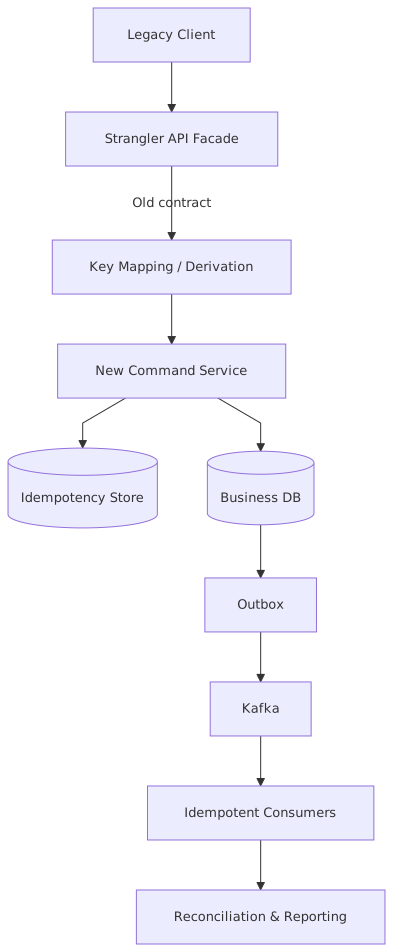
The migration path matters because idempotency is not useful if it only covers the first hop. Enterprises need end-to-end confidence, not local optimism.
Enterprise Example
Consider a global retailer modernizing its order and payment platform.
The legacy estate had:
- a monolithic commerce application
- a separate payment gateway integration
- nightly ERP synchronization
- newer microservices for inventory and shipment
- Kafka introduced for event-driven integration
The business incident was familiar and expensive: under load or during payment provider slowness, customers occasionally got charged twice. The website retried on timeout. The commerce layer retried on ambiguous responses. Kafka replayed some order events after consumer crashes. The payment service itself had no durable command identity.
The executive summary said “duplicate payments.” The real architecture story was broader:
- the same customer intent had no stable identity across channels
- retries were generated independently at several layers
- payment authorization and order creation had split ownership
- reconciliation was batch-based and slow
Domain analysis
The team defined distinct command semantics:
CreateOrderidentified by channel-issued order submission keyAuthorizePaymentidentified by payment intent keyCapturePaymentidentified separately, because capture is not the same business action as authorization- inventory reservation tied to order line reservation command IDs
This was a good DDD move. They resisted the temptation to use one universal key for the whole saga. Different bounded contexts had different notions of sameness.
Architecture changes
For payment authorization:
- clients and orchestration layers propagated a
Payment-Intent-Key - the payment service persisted an idempotency record with a unique constraint
- the call to the external payment provider reused the same provider-side idempotency token where available
- the payment service stored provider response references
- duplicate requests returned the original authorization result
For order creation:
- the order service used an outbox pattern
- order-created events carried stable business IDs and command IDs
- inventory and notification consumers implemented consumer-side idempotency
For reconciliation:
- a daily process compared payment records, provider settlement files, and order states
- any mismatch created a work item for automatic refund or manual review
Result
Duplicate payment incidents fell dramatically. More importantly, the business could explain each anomalous case. That is often the real marker of architectural success: not perfection, but traceability.
The retailer also discovered a useful lesson. Inventory reservation had been over-engineered with long-lived idempotency retention, but the real duplicate window was short and reservation semantics were already protected by aggregate constraints. They reduced retention and simplified storage there. Payments kept stronger controls. Different contexts, different economics.
That is how enterprise architecture should look: principled, but not doctrinaire.
Operational Considerations
Idempotency is a runtime concern as much as a design concern.
Retention policy
Keys cannot live forever without cost. Set retention by business and operational reality:
- a few hours for UI retries
- days for workflow orchestration retries
- longer for financial commands if delayed replay or dispute investigation matters
Short retention saves storage but increases the chance that late duplicates become new commands. Long retention protects more but costs more and may complicate privacy policies.
Payload fingerprinting
Store a normalized payload fingerprint with the key. If the same key is reused with materially different content, reject it. Otherwise clients can accidentally or maliciously mutate intent under an old key.
Normalization matters:
- ignore harmless field ordering
- decide whether metadata changes are material
- avoid fingerprints that break on irrelevant serialization differences
Status management
An IN_PROGRESS state is essential. Without it, concurrent duplicates can create ambiguity. But it also creates stuck records if processing crashes midway.
So you need:
- timeout policy
- recovery job
- ability to inspect abandoned commands
- safe retry or manual intervention path
Observability
Track:
- duplicate hit rate
- key conflict rate
- in-progress age distribution
- replay response count
- downstream duplicate suppression count
- reconciliation exceptions
A rise in duplicate hits may indicate client instability. A rise in conflicts may indicate bad key generation. A rise in stuck in-progress records may indicate partial failure paths.
Multi-region considerations
In active-active systems, idempotency gets harder. If the same key can be processed in two regions before replication converges, duplicates slip through.
You then need one of:
- sticky routing by key
- globally consistent store
- partitioned ownership by tenant or account
- acceptance of rare duplicates plus reconciliation
There is no magic here. Cross-region correctness always charges rent.
Security
Idempotency keys are not authentication tokens, but they can become part of a fraud or abuse path if predictable. Use high-entropy values and scope them to tenant and operation. Never let one tenant’s key affect another’s command space.
Tradeoffs
Let’s be blunt: idempotency keys are excellent, but not free.
Pros
- protect critical business invariants
- enable safe retries
- reduce duplicate side effects
- improve customer experience
- make replay and recovery more disciplined
- provide auditability for command handling
Cons
- introduce persistent state into otherwise stateless paths
- add write amplification and storage costs
- create contention on hot keys or popular tenants
- complicate failure handling around
IN_PROGRESS - require domain-specific contract design
- can lull teams into underestimating downstream duplicate risks
The biggest tradeoff is conceptual. Idempotency creates the appearance of determinism in a non-deterministic environment. That is useful, but only if the boundary is clear. It does not make distributed side effects magically atomic. It simply makes repeated invocation of a defined command safer.
Failure Modes
This pattern fails in recognizable ways. Good architects name them early.
1. Key stored outside the transaction boundary
If business state commits but idempotency state does not, or vice versa, duplicates become possible or valid commands get blocked. This is the classic split-brain bug between cache and database.
2. Reusing the same key for different payloads
Clients accidentally recycle keys across different intents. If the service does not validate payload consistency, it may return stale results for a new command.
3. Infinite IN_PROGRESS
A crash occurs after recording IN_PROGRESS but before completion. Future retries are blocked forever unless timeout and recovery logic exists.
4. Partial downstream side effects
The service marks the command completed, but a downstream call or event publish is lost or duplicated. This is why outbox and reconciliation matter.
5. Retention expiry too short
A delayed duplicate arrives after the key was purged and gets treated as a new command. This often appears during batch replay or disaster recovery exercises.
6. Mis-scoped uniqueness
Keys are unique globally when they should be per tenant, or per endpoint when they should be per business action. Wrong scope causes false duplicates or missed duplicates.
7. Treating Kafka exactly-once as end-to-end exactly-once
This is a common and costly misunderstanding. Kafka can help coordinate producer and consumer behavior around Kafka records. It does not automatically deduplicate your database writes, REST calls, or card processor charges.
8. Assuming idempotent command means idempotent saga
A saga may still trigger compensations, timeouts, and retries downstream. One safe command does not guarantee the whole long-running process is duplication-proof.
Failure modes are not edge cases. They are the normal shape of production.
When Not To Use
Idempotency keys are valuable, but they are not universal.
Do not use them blindly when:
The operation is naturally idempotent already
If setting a customer preference to a specific value can be repeated harmlessly, a key may add unnecessary complexity.
The domain allows intentional repetition of identical-looking commands
In trading, booking, telemetry ingestion, and some manufacturing scenarios, repeated identical payloads may represent distinct legitimate actions. Forcing deduplication would corrupt the domain.
The cost of duplicate handling is lower than the cost of coordination
For low-value, high-volume events, it may be better to tolerate duplicates and resolve in downstream aggregation than to introduce central write contention.
You cannot define stable domain semantics
If the business cannot agree on what makes two commands “the same,” a technical idempotency layer will become inconsistent and political. Solve the language problem first.
The command is internal, ephemeral, and side-effect free
Not every internal message needs enterprise-grade duplicate protection. Spend discipline where it protects meaningful business invariants.
Architecture is the art of putting rigor in the expensive places.
Related Patterns
Command idempotency keys sit alongside several related patterns.
Outbox pattern
Ensures domain state changes and emitted events remain consistent. Essential when command success leads to Kafka publication.
Inbox pattern
Consumer-side deduplication for incoming messages. Especially useful for asynchronous command processing.
Saga orchestration
Coordinates long-running distributed business processes. Idempotency should apply to saga commands and compensations, but sagas do not replace idempotency.
Optimistic concurrency control
Protects aggregate version conflicts. Useful, but different. Concurrency control says “someone changed this aggregate.” Idempotency says “this is the same command as before.”
Reconciliation
The grown-up pattern. When distributed systems inevitably drift, reconciliation detects and repairs divergence. Idempotency reduces drift; reconciliation cleans up what still escapes.
Correlation IDs
Good for tracing. Not sufficient for duplicate suppression. A correlation ID links events in a flow; an idempotency key defines sameness of a command.
The strongest enterprise designs combine these patterns rather than pretending one will do all the work.
Summary
Command idempotency keys are one of those patterns that look small in diagrams and enormous in production.
Their real value is not that they stop duplicate HTTP requests. Their value is that they give a durable identity to business intent in a world of retries, redeliveries, and uncertain outcomes. That makes them deeply relevant to microservices, Kafka-based integration, and any enterprise architecture that depends on at-least-once delivery. microservices architecture diagrams
The right design starts with domain semantics:
- what command is being protected
- within which bounded context
- over what time horizon
- against which side effects
From there, the implementation should be opinionated:
- explicit keys, not inferred magic
- transactional persistence, not best-effort cache writes
- payload validation on key reuse
- outbox for downstream event consistency
- consumer idempotency where asynchronous processing exists
- reconciliation for the cases architecture never fully prevents
Migration should be progressive, using a strangler approach around the commands where duplicates hurt most. And architects should stay honest about tradeoffs. Idempotency adds state, coordination, and complexity. It is worth it when it protects important business invariants. It is overkill when applied mechanically.
The memorable line is this:
Retries are inevitable. Duplicate side effects are optional.
That is what command idempotency keys buy you. Not perfection. Something better: repeatable intent, bounded damage, and systems that behave like the business meant them to.
Frequently Asked Questions
What is a service mesh?
A service mesh is an infrastructure layer managing service-to-service communication. It provides mutual TLS, load balancing, circuit breaking, retries, and observability without each service implementing these capabilities. Istio and Linkerd are common implementations.
How do you document microservices architecture for governance?
Use ArchiMate Application Cooperation diagrams for the service landscape, UML Component diagrams for internal structure, UML Sequence diagrams for key flows, and UML Deployment diagrams for Kubernetes topology. All views can coexist in Sparx EA with full traceability.
What is the difference between choreography and orchestration in microservices?
Choreography has services react to events independently — no central coordinator. Orchestration uses a central workflow engine that calls services in sequence. Choreography scales better but is harder to debug; orchestration is easier to reason about but creates a central coupling point.