⏱ 20 min read
Microservice programs don’t usually fail because teams lack endpoints. They fail because the business asks a simple question—“show me the customer’s current position”—and the answer is scattered across six bounded contexts, three databases, one Kafka topic, and a workflow engine that still thinks in SOAP. The system has plenty of facts. What it lacks is composition. event-driven architecture patterns
That is where fan-out/fan-in aggregation enters. It is one of those patterns that sounds suspiciously mechanical, almost harmless. Call several services. Gather the answers. Return a view. But in enterprise architecture, harmless words hide expensive consequences. Aggregation is not just a technical convenience; it is a decision about where meaning is assembled, where latency is paid, where inconsistency is tolerated, and where the business sees “truth.”
A lot of teams stumble here. They build “just one orchestrator” to combine customer profile, credit exposure, order history, shipping state, and entitlements. It works in the first demo. Six months later, that orchestrator has become a secret monolith with retry logic, policy exceptions, partial failure rules, and enough domain knowledge to start its own religion.
So let’s be clear: fan-out/fan-in aggregation is useful, often necessary, and frequently abused. Used well, it gives a business a coherent read model over fragmented capabilities. Used badly, it centralizes coupling, smears bounded contexts, and creates a distributed traffic jam.
This article looks at the pattern the way architects should: not as a neat sequence diagram, but as a living tradeoff among domain semantics, performance, ownership, failure handling, migration strategy, and operational reality.
Context
Microservices split a large system into independently deployable services aligned to business capabilities. That sentence appears in every architecture deck because it is true. It is also incomplete.
Business capabilities do not eliminate cross-cutting questions. A customer support agent still needs a single screen showing identity, orders, invoices, disputes, shipments, loyalty status, and fraud holds. A mobile app still needs a consolidated dashboard. A risk engine still needs data from several domains before making a decision. Separation of write models does not remove the need for integrated reads.
In a well-shaped domain-driven design landscape, each service owns its model and language. The Order service understands fulfillment commitments. Billing understands invoices and payment states. Customer understands identity and preferences. Risk understands exposure and controls. Each bounded context protects its semantics because shared models rot quickly in enterprises.
But users do not think in bounded contexts. They think in outcomes.
That gap is the birthplace of aggregation.
Fan-out/fan-in aggregation is the pattern where one component receives a request, fans out to multiple downstream services or data sources in parallel, then fans in their responses into a single composite result. Sometimes this is synchronous, often over HTTP or gRPC. Sometimes the fan-out is event-driven and the fan-in builds a materialized view from Kafka topics. Both count. The central idea is the same: gather distributed facts and compose a useful answer.
The temptation is to treat this as plumbing. It isn’t. The key architectural question is not “how do I call five services quickly?” It is “where should this composition live so that the business meaning stays coherent and the platform remains survivable?”
Problem
Microservices make local change easier by pushing responsibility into service boundaries. The price is distributed reads.
Suppose a customer portal needs a “Customer 360” view. The raw information is owned by different services:
- Customer Profile
- Account Management
- Orders
- Payments
- Loyalty
- Fraud
- Notification Preferences
No single service should own all of that. In DDD terms, these belong to different bounded contexts with different aggregates, invariants, and release cadences. Yet the portal needs one response, not seven tabs and a prayer.
Naive solutions appear quickly:
- The frontend calls everything directly.
This pushes orchestration into clients, duplicates logic across channels, and exposes internal topology.
- One domain service grows “helper” APIs for everyone else’s data.
This leaks responsibilities and creates a gateway monolith in disguise.
- A reporting database copies everything ad hoc.
Fast at first, semantically muddy later.
- A new orchestration service aggregates at request time.
Better, but only if it remains a composition layer rather than a second business core.
The hard part is that every choice changes the shape of coupling. Aggregation moves complexity; it never removes it.
Forces
Fan-out/fan-in sits in the middle of several opposing forces. Good architecture is not picking a winner. It is deciding what pain you are prepared to pay for.
1. User experience vs service autonomy
Users want one answer now. Service owners want autonomous models and release cycles. Aggregation is the bridge, but every bridge transmits load in both directions.
2. Freshness vs resilience
If the aggregator calls live systems at request time, the data is fresh but fragile. If it builds a materialized view from events, the result is resilient and fast but eventually consistent. Enterprises often need both, and pretending otherwise usually leads to a 3 a.m. incident.
3. Domain purity vs practical composition
DDD encourages clear boundaries. Aggregation inevitably crosses them. The issue is not whether boundaries are crossed; it is whether they are crossed in a way that preserves semantics. There is a big difference between combining “current invoice balance” and inferring “customer is delinquent” from several services without owning that policy.
4. Latency vs load
Parallel fan-out improves response times compared with sequential calls. It also concentrates demand. A dashboard endpoint hit by 20,000 users can become a multiplier against every dependency. One request can become seven.
5. Reuse vs centralization
A shared aggregation service can reduce duplication across web, mobile, and partner channels. But shared services have gravity. They attract rules, exceptions, and ownership disputes. Before long, every team is “just adding one field.”
6. Migration urgency vs architectural cleanliness
In a legacy modernization, aggregation is often the only sane path. You can front old systems and new services behind a single composed view while strangling functionality gradually. That is practical architecture. But migration shortcuts have a habit of becoming permanent.
Solution
The core pattern is straightforward:
- Receive a request for a composite business view.
- Fan out to the required providers in parallel.
- Apply timeouts, fallbacks, and policy rules.
- Fan in the results into a single domain-relevant response.
- Return complete, partial, or deferred output depending on the use case.
That sounds simple because the control flow is simple. The architecture is not.
The first decision is what kind of aggregation you are building.
Request-time aggregation
A synchronous aggregator calls multiple services at read time. This works best when:
- data must be current,
- the number of downstream calls is controlled,
- partial responses are acceptable or manageable,
- latency budgets are explicit.
Typical technologies are API gateway composition, backend-for-frontend (BFF), GraphQL federation in some cases, or a dedicated aggregation service.
Event-driven aggregation
A read model service subscribes to domain events—often via Kafka—and incrementally builds a materialized view. This works best when:
- query performance matters,
- eventual consistency is acceptable,
- upstream systems are too slow or unreliable for live composition,
- reconciliation can be handled cleanly.
This is often the better enterprise answer, because dashboards, search views, support screens, and analytics-adjacent use cases usually care more about speed and survivability than millisecond-perfect freshness.
Hybrid aggregation
Most mature organizations end up here. Build a durable aggregate view from events, then enrich selected volatile attributes at request time. For example:
- account profile, orders summary, and loyalty can come from a materialized view,
- fraud hold status and credit availability may be fetched live.
This is often the sweet spot. The architecture absorbs normal load with precomputed views and reserves live fan-out for data whose shelf life is measured in seconds.
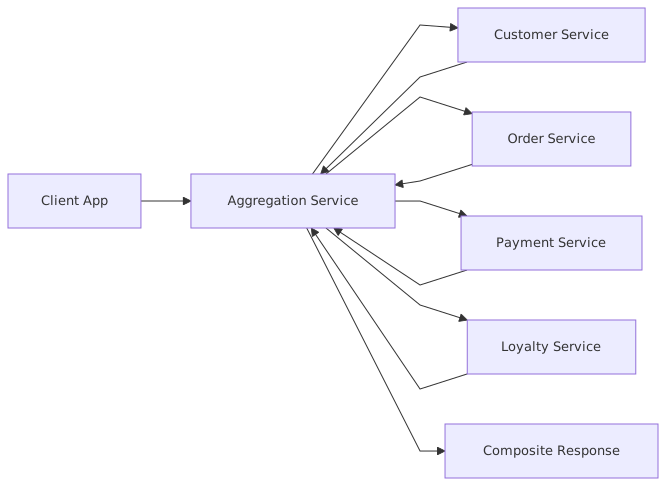
Here is the basic synchronous shape:
And here is the event-driven variant:
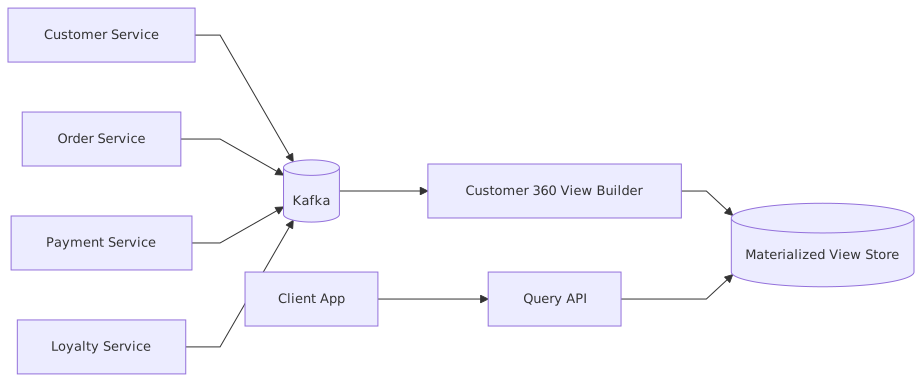
Notice the important difference. In the first diagram, composition happens on demand. In the second, composition happens continuously and is merely read at request time. Different systems. Different failure modes. Different ownership implications.
Architecture
The architecture of an aggregator should follow domain semantics, not just network convenience. This is where many teams go wrong. They aggregate around screens instead of business concepts. A “dashboard aggregator” sounds useful but often becomes a dumping ground. Better to align the composition service with a clear domain view: Customer 360, Shipment Tracking View, Policy Position, Merchant Risk Summary.
That language matters. In domain-driven design, names are not decoration. They define the contract between teams.
Aggregator as a read-model boundary
A good aggregator is usually a read-side construct. It composes data for a use case; it does not become the owner of write invariants that belong elsewhere. It may calculate display-level or view-level derivations. It should be very cautious about introducing new business decisions unless the organization explicitly grants it a domain role.
Bad sign: the aggregator decides credit policy because it sees orders and balances.
Good sign: the aggregator assembles order balance, payment state, and account exposure into a support view while the Risk service remains the policy authority.
Canonical model temptation
Do not create a giant canonical enterprise schema inside the aggregator unless you enjoy committee meetings and semantic drift. Aggregators should translate and compose around a specific use case, not impose a universal model across bounded contexts. Universal models promise alignment and deliver sludge.
Orchestration policies
The aggregator needs explicit policies for:
- timeout per downstream dependency,
- fallback source,
- cache strategy,
- stale-read tolerance,
- partial response behavior,
- ordering and deduplication for event streams,
- idempotent rebuild logic,
- reconciliation triggers.
These are not operational details. They are business behavior encoded in software.
Domain semantics and conflict resolution
Different services can represent similar facts differently. “Account closed” in Billing may not mean the same thing as “customer inactive” in CRM. “Order delivered” in Order Management might conflict with “shipment in transit” from Logistics because events arrive out of order. Aggregation is where semantic mismatches surface.
That means the aggregation layer needs a domain mapping model:
- source precedence,
- event versioning rules,
- effective timestamp logic,
- confidence or freshness metadata,
- conflict markers for reconciliation.
Without this, the composite result becomes a polite lie.
Hybrid enterprise reference architecture
A practical shape looks like this:
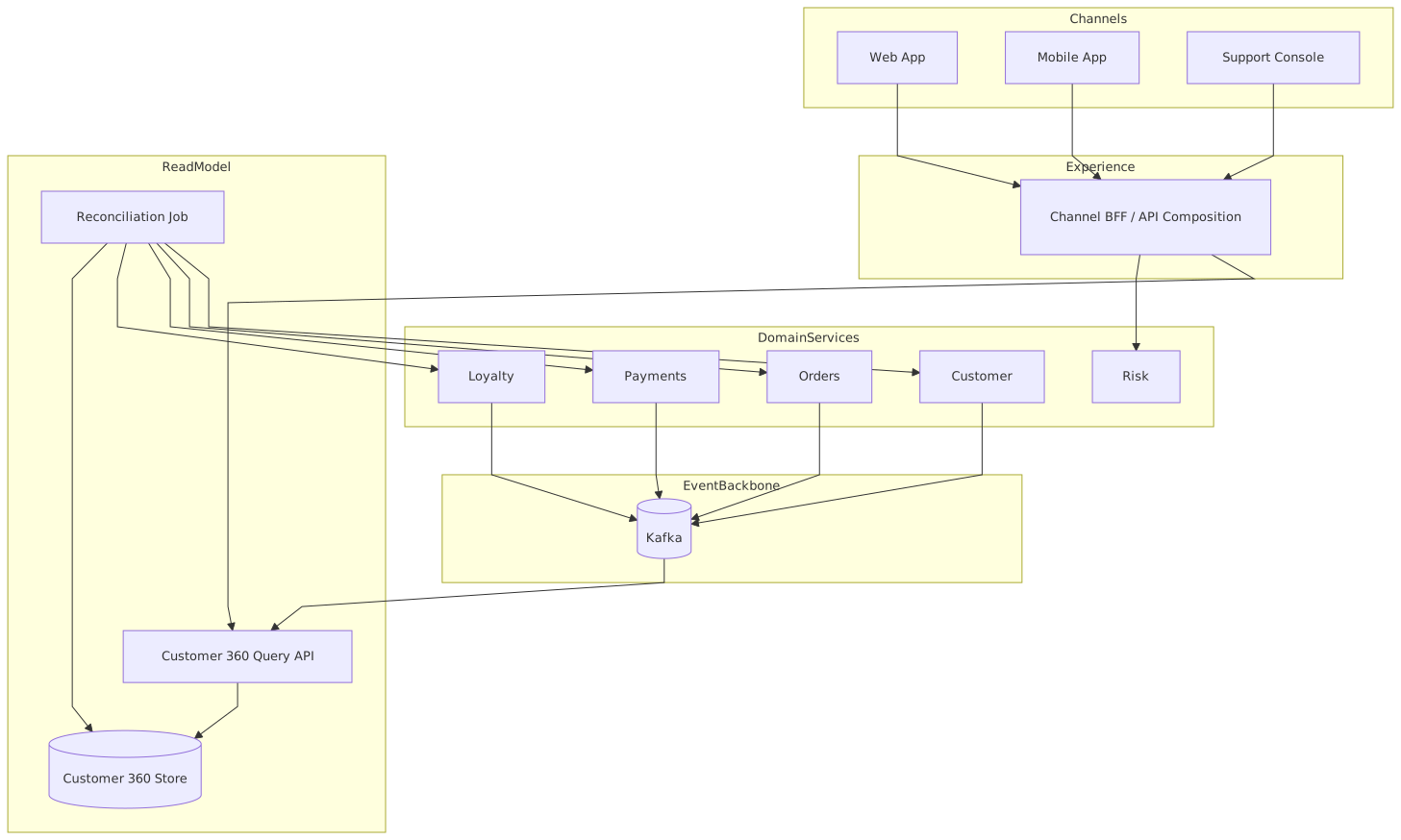
In this model:
- Kafka carries domain events.
- A query service builds and serves the aggregate read model.
- A BFF handles channel-specific shaping.
- Volatile data like real-time risk is fetched live when needed.
- Reconciliation jobs repair drift.
This is not theoretical. It is how many large enterprises survive scale without making every customer page load a synchronous tour of the estate.
Migration Strategy
Migration is where the pattern earns its keep.
In brownfield enterprises, the current state is usually ugly in a very specific way: a large system of record, a stack of tactical APIs, and a business impatient for digital channels. Rewriting everything is fantasy. Fan-out/fan-in aggregation provides a bridge.
Progressive strangler migration
The strangler pattern works well here. Put an aggregation layer in front of the legacy estate and newly carved microservices. At first, the aggregator may call mostly legacy endpoints. Over time, individual capabilities are replaced by new bounded-context services. The external contract remains stable while the internals are progressively strangled. microservices architecture diagrams
The migration logic is simple:
- preserve the user journey,
- replace capabilities one slice at a time,
- keep the aggregate view stable,
- compare old and new outputs during transition,
- move from live federation to event-driven read models where useful.
A practical sequence often looks like this:
- Wrap legacy sources
Expose reliable access to existing systems, even if the wrappers are thin.
- Introduce a composition layer
One endpoint for the consuming channels. This reduces client coupling immediately.
- Extract bounded contexts
Move clear ownership areas—say Loyalty or Notifications—out of the monolith first.
- Publish domain events
New services emit events to Kafka. Legacy can emit CDC-driven or adapter-generated events where feasible.
- Build a materialized aggregate view
Start serving low-risk read use cases from the view.
- Run dual reads and reconcile
Compare live-composed responses against event-built views to detect semantic mismatches.
- Switch traffic gradually
Per use case, not in one dramatic weekend.
- Retire legacy dependencies
Only when reconciliation error rates are understood and accepted.
The crucial point is that migration should not just move bytes. It must move meaning. If the legacy customer status combines fraud hold, billing block, and service suspension into one field, and the new architecture splits those into three bounded contexts, then the aggregate view must deliberately define how “customer status” is composed. This is not a mapping exercise; it is a domain decision.
Reconciliation discussion
Reconciliation is the grown-up part of event-driven aggregation. Teams love Kafka demos and hate the morning after. Events arrive late. Some are duplicated. Some are missing. Schemas evolve. Services replay. Bugs create drift.
So the aggregate read model needs periodic and event-triggered reconciliation:
- compare source-of-truth snapshots with materialized records,
- detect missing joins or stale slices,
- rehydrate records from event history where possible,
- issue targeted pull-based corrections from source services,
- flag irreconcilable semantic conflicts for support or ops.
If you do not design reconciliation, you are not designing an enterprise system. You are designing a slide.
Enterprise Example
Consider a global insurer modernizing its policy servicing platform.
The business needed a single “Policy Position” view for call-center agents. Agents were handling automobile, home, and life products across multiple regions. The information lived in:
- a legacy policy admin platform,
- a billing system,
- a claims platform,
- a customer CRM,
- a document service,
- a newly built underwriting microservice,
- a payment service publishing events to Kafka.
The first instinct was predictable: let the support UI call everything. It worked in lower environments where only ten people were online and every dependency was in a good mood. In production, latency became chaotic. Some claims queries took four seconds. Billing had rate limits. The CRM occasionally returned stale records from a replica. The agent desktop became an exercise in patience.
The architecture team introduced a Policy Position aggregation service. But they made one disciplined choice: it would be a read-side model, not a policy decision engine.
They classified data into three categories:
- Stable and aggregate-friendly
policy summary, named insured parties, product holdings, document indexes.
- Operationally volatile but queryable
billing balances, payment status, open claims summary.
- Highly volatile or policy-sensitive
underwriting referrals, fraud flags, active payment authorization state.
For category 1 and much of category 2, they used Kafka-backed view building. Legacy systems that could not publish events were integrated through CDC and adapter services. A materialized Policy Position store was built per policy and customer. For category 3, the agent request triggered live enrichment at read time with aggressive timeout rules.
The support console then called a single Query API. Ninety percent of the page rendered from the prebuilt view in under 200 ms. The volatile enrichment fields were either present, stale-marked, or unavailable with explicit status labels. Agents could work even when a noncritical dependency was limping.
The hard part was semantics. Billing called a policy “inactive” when premium delinquency crossed a threshold. Underwriting used “referred” for manual review. Claims tracked “open exposure.” The business had historically conflated all of these into a broad support status. The new architecture forced a real domain conversation, and that was healthy. The aggregate view stopped pretending those states were the same thing.
This is what good aggregation does in the enterprise: not just glue systems together, but make hidden semantic debt impossible to ignore.
Operational Considerations
Aggregation amplifies operational concerns because it sits at the point of composition. If one service is where the business sees the whole picture, then that service becomes both valuable and dangerous.
Latency budgets
Set a total response budget and allocate sub-budgets per dependency. If the page has 800 ms to load, do not let one downstream call take 700. Make timeouts explicit. Fast failure is usually kinder than slow uncertainty.
Concurrency control
Parallel fan-out can overwhelm dependencies. Use bulkheads, bounded pools, and concurrency quotas per downstream service. Otherwise the aggregator becomes a denial-of-service machine pointed inward.
Caching
Caching is not optional, but it must be domain-aware:
- short TTL cache for frequently read profiles,
- request coalescing for duplicate in-flight lookups,
- stale-while-revalidate where acceptable,
- event-driven invalidation where available.
Do not cache blindly. Some values, like credit availability or fraud hold, may be too volatile or risky.
Observability
You need distributed tracing, structured logs, dependency heatmaps, and per-field freshness metrics. For event-built views, expose:
- last event timestamp,
- last successful reconciliation,
- source lag by topic/partition,
- rebuild duration,
- stale record count.
An aggregate endpoint without field-level observability is a magician’s trick. It looks impressive until someone asks where the rabbit came from.
Schema and contract evolution
Kafka events evolve. APIs evolve. Composite responses evolve. Version carefully and avoid breaking consumers by smuggling structural changes into “minor” updates. Aggregators often need anti-corruption layers to absorb source churn.
Security and data minimization
Aggregation is a magnet for sensitive data because it pulls multiple views together. Enforce least privilege, field-level authorization, and masking. The more useful the composite view, the more dangerous it becomes if overexposed.
Tradeoffs
Here is the uncomfortable truth: aggregation improves the consumer experience by making the producer landscape more interdependent.
Benefits
- single business-oriented view for clients,
- reduced duplication across channels,
- cleaner migration path from monolith to services,
- better read performance with materialized views,
- controlled exposure of internal service topology,
- opportunity to encode domain-consistent composition rules.
Costs
- another service to own and evolve,
- risk of centralizing too much business logic,
- increased dependency on upstream contracts,
- operational fragility for synchronous fan-out,
- eventual consistency issues for event-driven variants,
- semantic complexity around conflicting source truths.
The best architectures accept these tradeoffs explicitly. The worst ones hide them behind a cheerful “API composition” box.
Failure Modes
This pattern has several classic failure modes. Most are easy to recognize after the fact, which is of course the least useful time.
1. The aggregator becomes a mini-monolith
It starts with composition and ends with entitlement rules, pricing exceptions, workflow triggers, and bespoke transformations for every channel. If too much decision-making moves into the aggregator, you have simply redrawn the monolith in a different shape.
2. Latency collapse under load
One request fans out to many. Traffic spikes multiply across downstream services. Tail latency grows. Retries pile up. The aggregator times out while still consuming resources. This is distributed congestion in business clothing.
3. Semantic drift
Source systems evolve independently. Event meanings change subtly. Field names stay the same while business semantics change underneath. The aggregate view quietly becomes wrong, which is worse than being unavailable.
4. Silent partial failure
The page renders, but a key component is missing and nobody notices because the field defaulted to null or “unknown.” Partial responses must be explicit to users and measurable to operators.
5. Event-read model divergence
Kafka consumers fall behind, replay incorrectly, or miss a schema nuance. The materialized view drifts from source truth. Without reconciliation, the drift becomes institutionalized.
6. Ownership confusion
Who owns the Customer 360 contract? The channel team? The platform team? The customer domain team? Shared ownership is often another name for neglected ownership. Make it explicit.
When Not To Use
This pattern is not a universal answer.
Do not use fan-out/fan-in aggregation when:
- A single bounded context should own the capability outright.
If the business concept really belongs to one domain, let that service model and serve it.
- The query is simple and low value.
Pulling five services into a composition layer to display two labels is architecture cosplay.
- Strong transactional consistency is required across sources.
If the business action depends on atomically consistent cross-domain state, a read-side aggregate is not enough. Revisit the domain boundaries or process model.
- The organization cannot support reconciliation and observability.
Event-driven aggregation without operational discipline is self-harm.
- The team is using aggregation to avoid hard domain conversations.
If nobody agrees what “active customer” means, an aggregator cannot save you. It will merely preserve ambiguity at scale.
- The result is effectively a shared canonical model.
That road ends in governance-heavy stagnation. EA governance checklist
Sometimes the right answer is a simple BFF. Sometimes it is CQRS with a dedicated read store. Sometimes it is just better API design in one service. Architecture should be suspicious of patterns that appear before the domain is understood. API architecture lessons
Related Patterns
Fan-out/fan-in aggregation lives near several adjacent patterns. They overlap, but they are not identical.
Backend for Frontend (BFF)
A BFF shapes APIs for a channel. It may perform aggregation, but its main concern is channel-specific delivery, not necessarily durable read models.
API Composition
Often the synchronous form of aggregation. Good for simple joins and current-state reads, risky at scale if overused.
CQRS
Separates write and read models. Event-driven aggregation often fits naturally on the read side of CQRS.
Materialized View
A persisted denormalized read model built from events or batch pipelines. This is often the operational backbone of enterprise aggregation.
Strangler Fig Pattern
Used in migration. The aggregator can shield clients while legacy sources are replaced incrementally.
Saga / Process Manager
Handles long-running business transactions. This is not the same as aggregation, though teams sometimes accidentally push process logic into aggregators.
Anti-Corruption Layer
Protects a bounded context from external model pollution. Essential when aggregating legacy or third-party semantics.
Summary
Fan-out/fan-in aggregation is one of the indispensable patterns of microservice architecture because enterprises do not ask systems for isolated facts; they ask for coherent business views. The pattern answers that need by composing distributed data into something a human or downstream system can actually use.
But the pattern deserves respect. It is not just parallel HTTP calls or a clever Kafka pipeline. It is a decision about where business meaning is assembled, how bounded contexts remain intact, what freshness guarantees matter, and how inconsistency is repaired. In domain-driven design terms, aggregation should support the ubiquitous language of a real use case without collapsing multiple domains into a muddy pseudo-model.
For migration, it is especially powerful. A progressive strangler approach lets teams front legacy systems and emerging microservices behind a stable aggregate contract. Over time, live federation can give way to event-driven materialized views where performance and resilience matter most. Reconciliation then becomes the discipline that keeps the architecture honest.
Use request-time aggregation when freshness dominates. Use Kafka-backed read models when scale and resilience dominate. Use a hybrid when reality refuses your neat categories—which is to say, most of the time.
And above all, keep one principle in sight: an aggregator should compose truth, not invent it. The moment it starts becoming the place where every unresolved domain question goes to hide, you are no longer building a view. You are building your next monolith, one helpful endpoint at a time.
Frequently Asked Questions
What is a service mesh?
A service mesh is an infrastructure layer managing service-to-service communication. It provides mutual TLS, load balancing, circuit breaking, retries, and observability without each service implementing these capabilities. Istio and Linkerd are common implementations.
How do you document microservices architecture for governance?
Use ArchiMate Application Cooperation diagrams for the service landscape, UML Component diagrams for internal structure, UML Sequence diagrams for key flows, and UML Deployment diagrams for Kubernetes topology. All views can coexist in Sparx EA with full traceability.
What is the difference between choreography and orchestration in microservices?
Choreography has services react to events independently — no central coordinator. Orchestration uses a central workflow engine that calls services in sequence. Choreography scales better but is harder to debug; orchestration is easier to reason about but creates a central coupling point.