⏱ 18 min read
Most enterprise microservices fail long before the first container is deployed.
Not because Kubernetes is hard. Not because Kafka is confusing. Not because teams suddenly forgot how to code.
They fail because the architecture exists as vibes, PowerPoint arrows, and tribal memory.
That’s the uncomfortable truth. A lot of “microservices architecture” in large organizations is just a loose collection of boxes labeled Customer Service, Payment Service, Notification Service, with some lines between them and a promise that “the teams will figure out the details.” They usually do figure out the details. They just figure them out differently, inconsistently, and too late.
This is where UML still matters. Yes, UML. The thing many architects either overuse like it’s 2004, or reject entirely because they once suffered through a 120-page class diagram nobody read. Both extremes are wrong. UML modeling best practices
If you design microservices seriously, in enterprise environments, UML becomes useful again when you stop treating it as documentation theater and start treating it as a metamodel-driven design tool.
That phrase sounds heavier than it is, so let’s simplify it early.
What this means, in plain English
A metamodel-driven approach means you define a small set of architectural concepts that matter in your organization—things like:
- microservice
- API
- event
- bounded context
- data store
- IAM policy
- Kafka topic
- cloud deployment unit
- ownership
- SLA
- dependency type
Then you use UML not just to draw pictures, but to consistently model those concepts and the rules between them.
So instead of every architect drawing whatever they want, you create a shared architectural language.
That’s the real value.
Not prettier diagrams. Better decisions, fewer ambiguities, and architecture that can survive contact with delivery teams, security teams, and operations.
If you’re designing microservices in a bank, an insurer, a retailer, or any cloud-heavy enterprise, this approach helps because the hard part is not drawing services. The hard part is making sure everyone means the same thing when they say “service,” “event,” “ownership,” “identity,” “integration,” or “resilience.”
And frankly, most organizations do not mean the same thing.
Why architects need a metamodel, not more diagrams
Here’s my opinion: too many enterprise architects are addicted to abstraction and allergic to precision.
They say things like:
- “This domain will be decomposed into business capabilities.”
- “The services will interact asynchronously where appropriate.”
- “Security will be federated.”
- “The platform will provide observability.”
That all sounds smart. It also means almost nothing unless the model defines what these things are, how they relate, and what constraints apply.
A metamodel forces discipline.
It says:
- A Microservice owns one bounded context.
- A Microservice exposes one or more APIs and may publish Domain Events.
- A Domain Event must be mapped to a Kafka topic with naming standards.
- A Service Dependency must be classified as synchronous or asynchronous.
- A User-facing API must reference an IAM trust model.
- A Cloud Deployment Unit must map to runtime boundaries.
- A Data Store is owned by one service only.
- A Shared Database is an exception and must be explicitly justified.
Now we’re getting somewhere.
This is where UML helps. UML gives you structure: components, interfaces, packages, deployments, sequences, classes, stereotypes, tagged values, constraints. Not all of UML. God no. You don’t need all of UML. Nobody needs all of UML. You need just enough UML to create a useful architecture language. UML for microservices
That’s the contrarian point here: UML is not the problem. Undisciplined architecture is the problem.
The real issue with microservices in enterprises
Microservices are sold as a technical style, but in enterprises they behave more like an organizational stress test.
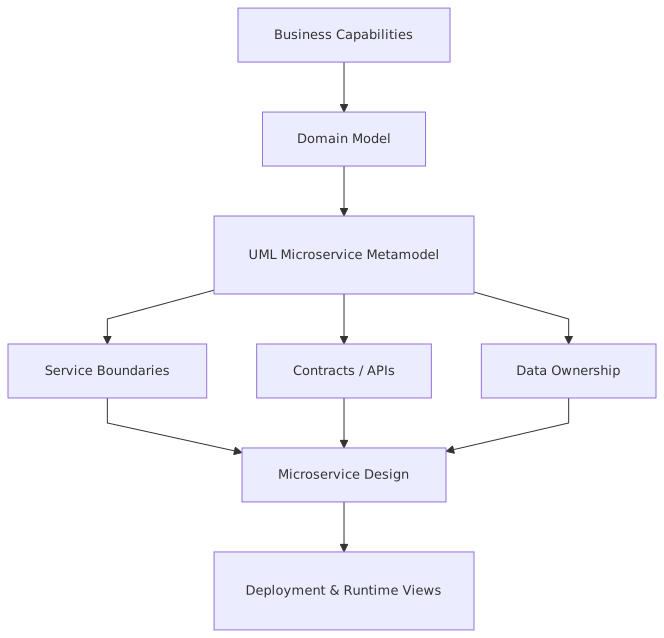
They expose whether your company can answer questions like:
- Who owns this business capability?
- Which data is authoritative?
- What identity model applies across channels?
- Where does synchronous coupling still exist?
- Which events are business facts versus technical notifications?
- What runs in one cloud account, one VPC, one namespace, one region?
- What happens when Kafka is down, IAM tokens expire, or a downstream bank ledger is slow?
If your architecture method cannot represent those things clearly, your microservices initiative becomes expensive chaos.
And that’s why a metamodel-driven UML approach is practical. It creates consistency across architecture work products:
- conceptual architecture
- solution architecture
- integration architecture
- security architecture
- deployment architecture
- governance reviews
- delivery handover
In other words, this is not an academic exercise. This is how you stop architecture from becoming interpretive art.
What a microservices metamodel should actually include
Let’s keep this grounded. A useful metamodel for enterprise microservices does not need 150 element types. That’s another classic architect mistake: building a metamodel so elaborate that nobody uses it.
You need a compact core.
Core metamodel concepts
That’s enough to produce architecture models people can use.
Notice what’s not in the table: every internal class, every DTO, every utility library, every tiny implementation detail. Architects often drift into design modeling because it feels concrete. Resist that. The metamodel should focus on architecturally significant concerns.
UML is useful when you stop trying to model everything
A lot of people say, “We don’t use UML anymore.” Usually what they mean is, “We don’t produce giant formal diagrams nobody trusts.” Fair enough.
But most teams still draw:
- component diagrams, even if they don’t call them that
- sequence flows, even if they do it in Miro
- deployment views, even if they use cloud icons
- domain boundaries, even if they sketch them on whiteboards
That’s UML territory whether people admit it or not. ArchiMate in TOGAF ADM
The difference is whether those views are tied to a metamodel.
Without a metamodel:
- one diagram shows “Payments” as an application
- another shows it as a domain
- another shows it as a team
- another shows it as a Kafka producer
- another shows it as a namespace
That ambiguity kills architecture quality.
With a metamodel:
- “Payment Service” is always a microservice
- “Payments” may also be a bounded context
- “payments.events.settled.v1” is a Kafka topic
- “Retail Payments Squad” is the owner
- “Azure AKS namespace payments-prod” is a deployment unit
That consistency matters. It reduces translation overhead across teams.
How this applies in real architecture work
This is the part many articles skip. They stay at theory level, which is safe but not useful.
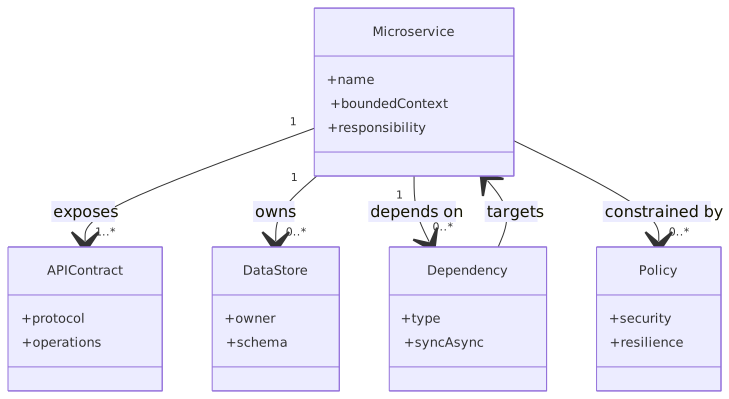
Here’s how this approach shows up in actual enterprise architecture work.
1. During domain decomposition
When the business says, “We need a new digital onboarding platform,” the first question is not “How many microservices?”
That question is usually wrong.
The first questions are:
- What are the bounded contexts?
- What business capabilities need autonomy?
- Where are the transactional boundaries?
- Which systems remain systems of record?
- What identity and consent rules apply?
You model bounded contexts first. Then candidate microservices inside them. Then the APIs and events between them. The metamodel helps stop people from confusing business domains with deployment units.
2. During integration design
This is where architects often make a mess.
They say “event-driven” because it sounds modern, then quietly add synchronous REST calls everywhere because they still need immediate responses. Suddenly every service depends on every other service and Kafka becomes decorative.
A metamodel-driven UML view forces explicit dependency typing:
- synchronous request/response
- asynchronous command
- event publication
- data replication
- identity federation
That one move is surprisingly powerful. It reveals hidden coupling early.
3. During security and IAM design
Microservices in the enterprise are never just about business logic. They are identity systems wearing application clothes.
You need to model:
- human user identity
- machine identity
- token propagation
- trust boundaries
- API gateway enforcement
- role/attribute-based access
- cross-domain authorization
If your architecture diagrams don’t include IAM relationships, they are incomplete. Full stop.
I’ve seen architecture packs with 40 pages on services and zero pages on trust boundaries. That’s malpractice in banking, healthcare, or government.
4. During cloud deployment design
A service that looks independent in a logical diagram can still be operationally entangled in cloud reality.
For example:
- shared cluster dependencies
- shared secrets stores
- shared ingress patterns
- shared Kafka infrastructure
- region-level failover constraints
- IAM role assumptions across accounts
A deployment view tied to the metamodel connects service design to cloud runtime truth. Otherwise, “independently deployable” is just branding.
5. During governance and review
This is where the metamodel pays for itself.
Instead of subjective architecture reviews based on whoever speaks most confidently, you can assess:
- Does every service own its data?
- Are synchronous dependencies justified?
- Are Kafka topics mapped to domain events?
- Is IAM trust modeled for every external API?
- Are shared databases flagged as exceptions?
- Is team ownership clear?
- Are SLOs attached to critical services?
That’s enterprise architecture becoming operationally useful, not ceremonial.
A real enterprise example: retail banking onboarding platform
Let’s make this concrete.
Imagine a large retail bank modernizing customer onboarding. Legacy onboarding is spread across:
- a core banking platform
- a CRM
- an identity proofing vendor
- a document management system
- an AML screening engine
- batch-based customer creation processes
The bank wants a cloud-native microservices platform using Kafka for event streaming, centralized IAM, and deployment on AWS.
Classic scenario. Also a classic place to get architecture wrong.
Step 1: Define bounded contexts
The metamodel-driven UML effort starts by identifying bounded contexts such as:
- Customer Identity
- Onboarding Workflow
- Compliance Screening
- Document Handling
- Account Origination
- Notification Management
Already this helps. It stops the common anti-pattern where teams define services directly from org charts or vendor products.
Step 2: Identify microservices
Within those contexts, candidate microservices emerge:
- Identity Verification Service
- Customer Profile Service
- Consent Service
- AML Screening Service
- Document Intake Service
- Account Application Service
- Notification Service
Each gets modeled as a <
- owner team
- primary API contracts
- domain events published
- data store ownership
- SLO classification
- deployment unit
Step 3: Model interactions honestly
This is where strong architecture matters.
Some interactions are synchronous:
- mobile app → API gateway → Customer Profile Service
- Onboarding Workflow → IAM token validation
- Account Application Service → core banking adapter for account creation status
Some interactions are asynchronous:
- Consent captured → Kafka event published
- Identity verified → Kafka event published
- AML result available → Kafka event published
- Customer onboarded → downstream CRM and analytics subscribers notified
The model explicitly marks these dependency types. No hand-waving.
Step 4: Model Kafka as part of the architecture, not plumbing
A big mistake is treating Kafka as infrastructure detail. In event-driven banking systems, Kafka is architecture.
The UML model links:
- Domain Event:
IdentityVerified - Kafka Topic:
bank.customer.identity.verified.v1 - Publisher: Identity Verification Service
- Subscribers: Onboarding Workflow, Compliance Screening, Analytics
This matters because it lets architects validate:
- event ownership
- schema evolution
- topic naming
- replay implications
- subscriber coupling
- data classification and retention
Banks care deeply about those things. They should.
Step 5: Model IAM trust boundaries
The onboarding platform uses:
- customer authentication via bank identity platform
- machine-to-machine authentication between services
- role-based access for operations staff
- vendor trust for external identity proofing
In the UML model:
- API Gateway trusts enterprise IAM
- Onboarding services trust JWTs with specific claims
- External vendor integration uses isolated machine credentials
- operations portal has separate privileged access paths
This reveals where token propagation is required, where service-to-service trust is direct, and where token exchange is safer.
Again, this is not decoration. It is architecture.
Step 6: Map deployment to AWS
The bank deploys:
- customer-facing APIs in EKS
- Kafka via managed streaming
- secrets in AWS Secrets Manager
- IAM roles per service account
- separate AWS accounts for dev/test/prod
- isolated VPC segments for sensitive workloads
The deployment model shows:
- which services are internet-facing
- which require private connectivity
- which consume managed Kafka
- which have cross-account access
- which need multi-region recovery
Now the architecture can be challenged properly. For example:
If the Account Application Service depends synchronously on a core banking adapter hosted in one region, can the onboarding journey really claim high availability? Maybe not.
That’s the kind of truth a good architecture model exposes.
Common mistakes architects make
Let me be blunt here. These are recurring mistakes, and they show up in almost every enterprise microservices program.
1. Confusing diagrams with architecture
Drawing a lot is not the same as designing well.
If the semantics are inconsistent, more diagrams just create more confusion.
2. Modeling services before modeling domain boundaries
This is probably the biggest mistake.
Teams jump straight to:
- Customer Service
- Payment Service
- Notification Service
Those names are so generic they should make you nervous.
Without bounded contexts, service decomposition becomes arbitrary. You end up with either distributed monoliths or random service granularity.
3. Ignoring data ownership
If multiple services write to the same database schema, you do not have microservices. You have a shared persistence accident.
Sometimes enterprises need transitional exceptions. Fine. But call them exceptions, not architecture principles.
4. Pretending everything should be event-driven
This one needs saying. Not every interaction should go through Kafka.
If a fraud decision must be returned immediately during card application processing, a synchronous call may be the correct choice. Architects who force asynchronous patterns everywhere are usually optimizing for ideology, not outcomes.
5. Treating IAM as a platform team problem
Wrong.
Identity and access shape service boundaries, API design, trust zones, and user journeys. If IAM is absent from the architecture model, the architecture is incomplete.
6. Failing to model operational reality
A service is not independent because the slide says so. It is independent if:
- it can deploy separately
- it owns its data
- it has manageable dependencies
- it can fail without collapsing the platform
- it has clear observability and support ownership
If those aren’t modeled somewhere, the architecture is lying.
7. Overengineering the metamodel
This is the opposite failure.
Some architects discover metamodeling and build a cathedral:
- 90 stereotypes
- 200 tagged values
- constraints nobody can remember
- repository governance no delivery team wants to touch
Then they wonder why teams go back to whiteboards.
Keep the metamodel small. Useful beats pure.
Contrarian view: not every enterprise needs deep UML tooling
Now for the contrarian part.
You do not always need a heavyweight modeling repository or a full formal UML governance stack.
That’s where architects can get carried away.
If your organization has:
- 8 teams
- one cloud platform
- simple IAM
- limited integration complexity
then a lightweight metamodel applied through a few disciplined diagram templates may be enough.
But once you’re in a real enterprise setting—multiple domains, Kafka event meshes, IAM federation, cloud landing zones, audit requirements, outsourced delivery, regulatory controls—you need stronger semantics.
Not because UML is elegant. Because ambiguity becomes expensive.
So I’m not arguing for model-driven utopia. I’m arguing for just enough formalism to keep enterprise architecture coherent.
That’s a very different thing.
What views to produce in practice
In real architecture work, I’ve found a metamodel-driven approach works best when you standardize a handful of views.
Recommended architecture views
That’s enough for most enterprise initiatives.
You don’t need twenty-seven views. You need the right six, maintained consistently.
How to introduce this approach without annoying everyone
Architects love methods. Delivery teams love getting work done. Those two things do not always meet naturally.
If you want this to stick, don’t introduce it like a governance crusade. architecture decision records
Do this instead:
- Pick one strategic initiative
A banking onboarding platform, payment modernization, IAM transformation—something with real stakes.
- Define a minimal metamodel
Ten to fifteen core concepts. No more at first.
- Create diagram patterns
One template for service interaction, one for IAM trust, one for deployment.
- Model one end-to-end journey
For example: customer opens account, identity verified, AML checked, account created, notification sent.
- Use the model in actual reviews
Security review, integration review, operational readiness review.
- Refine based on friction
If teams keep needing “data classification” or “resilience tier” as concepts, add them. If nobody uses “business object lifecycle,” remove it.
This is architecture as a working practice, not an artifact factory.
What good looks like
A good metamodel-driven UML architecture for microservices has a few visible traits:
- service boundaries align to domain boundaries more often than org charts
- Kafka topics represent meaningful business events, not random technical chatter
- IAM trust is explicit, not implied
- cloud deployment constraints are visible early
- data ownership is unambiguous
- synchronous dependencies are few and justified
- diagrams across teams use the same semantics
- architecture reviews become faster because the language is shared
And maybe most importantly: delivery teams can actually use the models.
That’s the standard. Not “is the notation academically correct?” but “does this improve architectural decision-making in the enterprise?”
Final thought
Microservices are not hard because they are distributed. They are hard because enterprises are distributed—across teams, priorities, controls, platforms, and interpretations.
That is why a metamodel-driven UML approach works.
It gives architecture a backbone.
Not a bureaucratic one. A semantic one.
It helps architects stop producing decorative diagrams and start producing models that clarify ownership, coupling, trust, data, and deployment. In banking especially, where Kafka, IAM, cloud controls, and regulatory scrutiny all collide, that clarity is not optional.
And yes, UML can absolutely help with that—if you use it with restraint, precision, and a little humility.
The irony is that the teams who say “we’re too agile for modeling” often end up buried in rework caused by assumptions nobody made explicit.
So my advice is simple: model less, but mean more.
That’s the real enterprise architecture move.
FAQ
1. Is UML still relevant for microservices architecture?
Yes, if used selectively. UML is useful when it provides a consistent language for architecture concepts like services, APIs, events, trust boundaries, and deployment. It becomes useless when it turns into exhaustive documentation nobody maintains.
2. What is the main benefit of a metamodel-driven approach?
Consistency. It ensures that terms like microservice, event, Kafka topic, API, and IAM trust mean the same thing across architecture views and teams. That reduces ambiguity, improves reviews, and helps delivery align with design.
3. How does this help in a banking environment specifically?
Banking architectures have high integration complexity, strict IAM requirements, auditability demands, and many systems of record. A metamodel-driven approach helps model synchronous and asynchronous flows, Kafka events, access control, and cloud deployment boundaries in a way that supports governance and delivery. EA governance checklist
4. Do we need a formal modeling tool to do this?
Not always. Smaller organizations can apply a lightweight metamodel using standard diagramming tools and a few strict templates. Larger enterprises with many teams and regulatory requirements often benefit from a shared repository and stronger governance.
5. What is the most common mistake when designing microservices with UML?
Starting with service boxes instead of domain boundaries. If architects skip bounded contexts and data ownership, the resulting microservices are usually arbitrary, tightly coupled, and difficult to operate.
Frequently Asked Questions
What is a UML metamodel?
A UML metamodel is a model that defines UML itself — it specifies what element types exist (Class, Interface, Association, etc.), what relationships are valid between them, and what constraints apply. It uses the Meta Object Facility (MOF) standard, meaning UML is defined using the same modeling concepts it uses to define other systems.
Why does the UML metamodel matter for enterprise architects?
The UML metamodel determines what is and isn't expressible in UML models. Understanding it helps architects choose the right diagram types, apply constraints correctly, use UML profiles to extend the language for specific domains, and validate that models are internally consistent.
How does the UML metamodel relate to Sparx EA?
Sparx EA implements the UML metamodel — every element type, relationship type, and constraint in Sparx EA corresponds to a metamodel definition. Architects can extend it through UML profiles and MDG Technologies, adding domain-specific stereotypes and tagged values while staying within the formal metamodel structure.