⏱ 21 min read
There is a particular kind of architectural mistake that only appears after a system becomes important.
At first, everything looks clean enough. Services publish events. Kafka hums along in the background. Teams celebrate their decoupling. Someone sketches arrows on a whiteboard and calls it “event-driven architecture.” And for a while, the machine behaves. Orders are placed, payments are taken, shipments are triggered, emails go out. event-driven architecture patterns
Then reality arrives.
A customer changes an order after payment authorization but before fulfillment. A fraud hold pauses one branch of processing while another branch has already emitted downstream events. A regulator asks for the exact sequence of business decisions that led to a denied claim. Finance needs to reconcile which “completed” workflows actually completed versus which merely looked complete because all the right events happened to appear eventually. Suddenly the simple event stream starts to resemble a detective novel with missing pages.
This is where many enterprises discover the hard boundary between event pipelines and workflow engines. They are related. They often coexist. They are not interchangeable.
The difference is not technical first. It is semantic.
An event pipeline is excellent at moving facts across a landscape of autonomous services. A workflow engine is excellent at managing progress through a business process with explicit state, decisions, timing, compensation, and visibility. One distributes facts; the other governs commitments. Confusing the two is how teams end up encoding business process semantics inside consumer groups, retry policies, dead-letter topics, and tribal knowledge.
That is the central question of this article: when should you model a process as a workflow graph, and when should you let it emerge from an event DAG? In microservices, especially Kafka-heavy environments, this choice shapes operability, auditability, migration paths, and even team boundaries more than most architecture diagrams admit.
My view is unapologetically opinionated: if the business cares about the journey, not just the messages, then you probably need workflow semantics somewhere. If the business cares only that independent reactions happen to published facts, then an event pipeline is often enough. Most enterprises, of course, need both. The art is knowing where the seam belongs.
Context
Microservices encouraged us to split systems along business capabilities. Domain-driven design gave us a better compass: align services to bounded contexts, protect domain language, and avoid accidental coupling. Event streaming platforms like Kafka then gave us a fast, scalable way to publish domain events and build reactive systems.
This was a real improvement over monolith-era orchestration servers that knew too much and owned too many dependencies.
But the pendulum swung. In some organizations, every process became “just events.” Teams built order fulfillment, claims handling, onboarding, account opening, subscription lifecycle, and returns processing as loosely connected event consumers. They called it choreography. Sometimes it was. Often it was simply hidden orchestration with no conductor.
That distinction matters.
In domain-driven design terms, not every business concept is just another event. Some concepts are long-running business processes that maintain intent over time. A customer onboarding flow, for example, is not merely a series of emitted facts. It has milestones, waiting states, compensations, SLA timers, regulatory checkpoints, and a business owner who wants a clear answer to a very non-technical question: “Where is this customer in the process, and why?”
An event log can help answer that question. A workflow engine is designed to answer it.
The modern enterprise rarely gets to choose from a blank slate. It already has Kafka topics, microservices, batch jobs, external SaaS systems, and a thicket of existing integrations. So the practical question is not “which is universally better?” It is “which semantics belong where, and how do we migrate without breaking the business?” microservices architecture diagrams
Problem
Architects usually encounter this issue in one of three forms.
First, there is the invisible process problem. Teams built a business flow through a chain of events. It works, mostly. But no single place knows the authoritative state of the process. To understand what happened, engineers replay topics, inspect service logs, correlate IDs, and infer intent after the fact. That is acceptable for telemetry. It is miserable for business operations.
Second, there is the semantic leakage problem. Services that should be focused on their own domain rules start carrying process coordination logic. A payment service should know how to authorize or reverse a payment. It should not quietly become the place where “if fulfillment has not confirmed within 48 hours and fraud has escalated, then emit a manual-review-needed event unless customer tier is platinum.” That is process logic masquerading as local reaction.
Third, there is the reliability illusion problem. Event pipelines scale well and tolerate local failures, but they do not magically provide end-to-end business correctness. Retries may duplicate actions. Consumers may observe events in unexpected timing windows. Downstream systems may partially apply side effects. Eventually consistent does not mean eventually correct.
The heart of the problem is this: an event DAG and a workflow graph may look similar on a slide, but they answer different questions.
- An event DAG describes propagation: when a fact occurs, what may react?
- A workflow graph describes coordinated progress: what step is next, what are the rules, what are we waiting for, and what happens if something goes wrong?
That difference becomes painfully expensive at enterprise scale.
Forces
Several forces push architects toward one model or the other.
1. Domain autonomy vs process visibility
Microservices thrive on autonomy. Event pipelines preserve that by letting services react independently to published facts. No central coordinator needs to know every implementation detail.
But autonomy has a cost: process visibility becomes emergent rather than explicit. If the business needs a single case record for “application 123 is waiting on KYC review,” a purely emergent model gets brittle quickly.
2. Throughput vs semantic control
Kafka and similar platforms are superb at high-throughput event distribution. They encourage fan-out, replay, and stream processing at scale. Workflow engines, by contrast, optimize for deterministic state progression, timers, retries, compensation, and human tasks. They can handle scale, but they are not just pipes.
If you treat every domain event as a workflow step, you may centralize too much and lose independent scaling benefits. If you treat every business process as a pipeline, you may gain throughput while losing control.
3. Bounded contexts vs cross-context journeys
DDD tells us to respect bounded contexts. That is good advice. But many enterprise processes cross multiple contexts: sales, pricing, payments, fraud, logistics, notifications, compliance.
The trick is that the journey itself may deserve modeling as a first-class concept without collapsing all participating domains into one giant service. A workflow engine can be the keeper of process state while each domain service remains sovereign over its own rules and data.
4. Auditability and compliance
Regulated environments care less about architectural purity and more about traceable decisions. If you need explainability, time-based checkpoints, evidence of approvals, and exact business state transitions, explicit workflow modeling often wins.
5. Change frequency and business ownership
Processes change. Promotions affect checkout. Regulation changes onboarding. Claims handling introduces new review branches. If these changes are frequent and business-visible, a workflow model often gives a cleaner place to evolve them. Event DAGs, by contrast, tend to distribute process knowledge across many teams and services, making change slower and riskier.
Solution
The practical answer is not to pick one universal pattern. It is to separate domain events from process control semantics.
Use event pipelines when you are propagating facts across bounded contexts and enabling independent reactions. Use workflow engines when you need explicit management of a business process instance over time.
That sounds simple. It is not. So let’s make it concrete.
Event pipeline: best for fact propagation
An event pipeline is a good fit when:
- events represent completed domain facts
- consumers can act independently
- there is no strong need for a central notion of process state
- ordering needs are local, not global
- retries and eventual consistency are acceptable
- fan-out is desirable
- replay and stream analytics matter
Examples:
- customer profile updated
- product price changed
- inventory threshold crossed
- shipment delivered
- fraud score recalculated
In these cases, Kafka is doing exactly what it is good at: durable publication and decoupled consumption.
Workflow engine: best for business process progression
A workflow engine is a better fit when:
- a business process has explicit stages and transitions
- the business asks “where is it stuck?”
- timers, SLAs, or waiting states matter
- compensation is part of the design
- human tasks or approvals exist
- auditability of decisions matters
- process logic spans multiple bounded contexts
- deterministic retry semantics are required at the process level
Examples:
- loan origination
- insurance claim handling
- returns and refund processing
- employee onboarding
- telecom service activation
- complex order fulfillment with exceptions
In these cases, the workflow is not replacing domain services. It is coordinating them.
The key design move
The best enterprise designs typically do this:
- domain services emit domain events to Kafka
- a workflow engine subscribes where process state matters
- the workflow issues commands or task requests to participating services
- services remain owners of domain decisions and data
- reconciliation exists to compare workflow state with event reality
This avoids the two common extremes:
- central orchestration that knows too much
- fully choreographed chaos that knows too little
Architecture
The cleanest way to think about this is to distinguish three layers of meaning:
- Domain state changes inside bounded contexts
- Process state spanning multiple contexts
- Integration transport used to move signals between them
Kafka belongs primarily in the transport and event distribution role. A workflow engine belongs in the process state role. Domain services belong in the bounded context role.
Event DAG architecture
In an event pipeline model, a service emits an event and downstream consumers react. Dependencies are implicit and distributed.

This pattern is excellent for reactive propagation. But notice what is missing: there is no explicit owner of the end-to-end process instance. “Order fulfillment” exists only as an inferred narrative across events.
That may be enough. Often it is not.
Workflow graph architecture
In a workflow model, the process instance is explicit. The workflow manages progression and invokes domain capabilities.
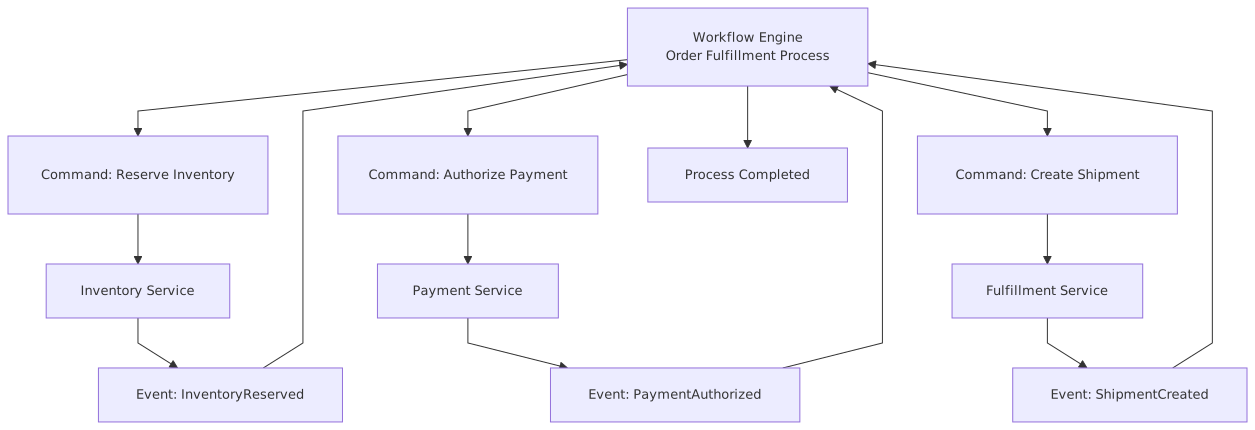
Now the business can ask the engine, “What step is order 84721 in?” The answer is immediate and business-shaped, not reconstructed from logs.
Hybrid enterprise architecture
The real world is hybrid. Some consumers simply react to events. Some processes need orchestration. The architecture should allow both.
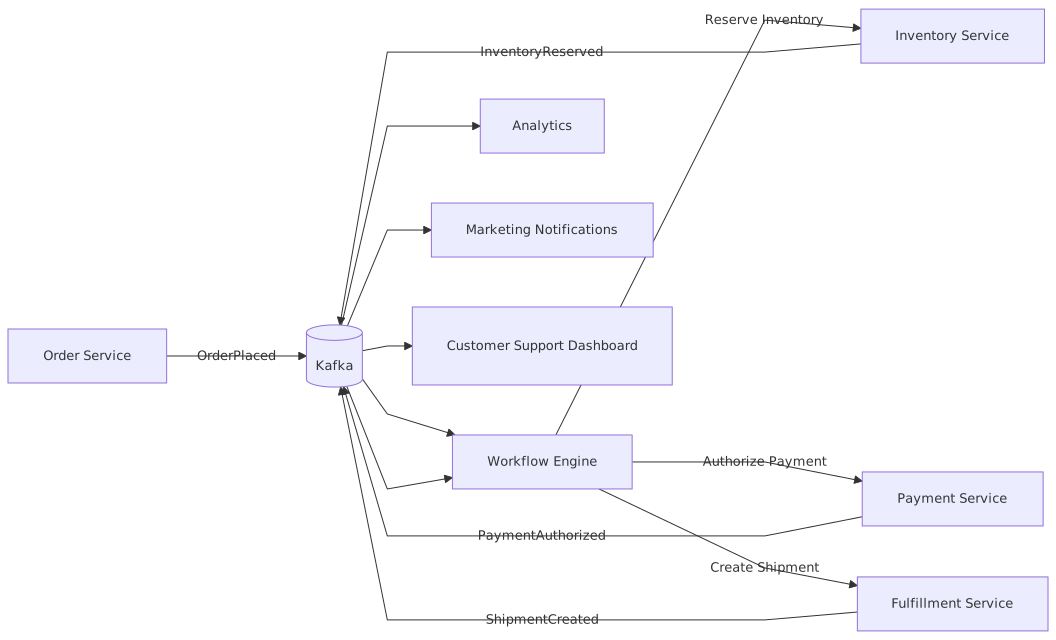
This hybrid model is usually the sweet spot in enterprises. Kafka remains the event backbone. The workflow engine becomes the steward of business process semantics for selected journeys.
Domain semantics matter
Here is where DDD earns its keep.
Do not model workflow steps as if they were domain facts. “Awaiting manager approval” is process state, not necessarily a domain event worth publishing broadly. Conversely, “PaymentAuthorized” is a domain fact with broad usefulness.
Likewise, do not let cross-context workflow language contaminate local bounded contexts. A fulfillment service should understand “shipment created,” “picking started,” or “label printed.” It should not need to know the entire enterprise returns-and-refunds journey.
A useful rule is this:
- Domain events describe something that happened in a domain
- Workflow states describe where a business process currently stands
Those are different nouns. Preserve that difference.
Migration Strategy
Most enterprises do not replace an event-driven landscape with a workflow engine in one move. Nor should they. Big-bang migration is where architecture ambitions go to die.
The right approach is progressive strangler migration.
Step 1: Identify the painful journeys
Do not start with ideology. Start with pain.
Find flows where teams struggle with:
- customer-visible delays
- operational blind spots
- reconciliation effort
- regulatory audit demands
- exception handling
- compensation complexity
- duplicated process logic across services
These are your candidates for explicit workflow.
Step 2: Model the business process, not the current topology
This is crucial. If you merely encode today’s event chain into a workflow engine, you have fossilized accidental complexity.
Instead, model:
- process milestones
- domain commands
- expected events
- timeout rules
- compensation paths
- manual intervention points
- success criteria
Think in business semantics first.
Step 3: Wrap existing services, do not rewrite them
Existing microservices should remain as the providers of domain capabilities. The workflow should call them via commands, APIs, or task messages, and listen for resulting events.
This lets you introduce workflow semantics without tearing apart the current estate.
Step 4: Run shadow workflow tracking
A highly effective migration tactic is to start by having the workflow engine observe existing Kafka events and build process state passively. It does not yet control anything. It simply tracks the process.
This gives you:
- visibility into whether your process model matches reality
- data quality insight
- event correlation validation
- early operational dashboards
- confidence before making the workflow authoritative
Step 5: Move control points gradually
Once confidence grows, shift selected coordination points from distributed consumers into the workflow:
- timeout handling
- retries with business awareness
- manual review routing
- compensation initiation
- SLA escalation
Do not migrate every branch at once. Pull process logic inward one seam at a time.
Step 6: Add reconciliation from day one
Reconciliation is not a patch for bad architecture. It is a fact of enterprise life.
In hybrid architectures, there will always be timing gaps, duplicate events, partial side effects, and integration mismatches. Build reconciliation capabilities that compare:
- workflow state
- emitted domain events
- downstream system records
- external provider acknowledgments
A mature architecture assumes that truth may need to be re-established periodically.
A note on idempotency
Migration exposes duplicate delivery and retried commands quickly. Every command handler and event consumer involved in the process must support idempotency. Without it, workflow control simply turns latent inconsistency into visible inconsistency.
Enterprise Example
Consider a large retail bank modernizing its mortgage application process.
Originally, the bank had over twenty services and platforms involved: application intake, document collection, credit decisioning, fraud, valuation, underwriting, pricing, e-signature, core banking, notifications, and regulatory archives. Kafka connected many of these systems. Teams proudly described the setup as event-driven.
In practice, it was a patchwork of hidden workflow.
A “mortgage submitted” event triggered document checks. Missing documents generated follow-up notifications. Credit decisions emitted scores. Underwriting listened to some events but also queried APIs because event timing was unreliable. Fraud review could pause the process, but nothing prevented other consumers from continuing unless they happened to notice a hold event. Operations staff used spreadsheets to track applications stuck between valuation and underwriting. Reconciliation jobs ran nightly to identify cases where the customer portal said “in progress” but the core process had effectively stalled.
Technically, every service was functioning. Business-wise, the process was opaque.
The bank introduced a workflow engine for the mortgage application journey, while keeping Kafka as the event backbone.
What changed
- The workflow became the explicit owner of application process state.
- Services still owned domain decisions: credit, fraud, underwriting, pricing.
- Kafka remained the publication channel for domain events and analytics.
- The workflow subscribed to the relevant events and issued process commands.
- SLA timers were modeled explicitly: document wait windows, underwriting thresholds, valuation delays.
- Manual review queues were integrated into the process model.
- Reconciliation jobs compared workflow state with the core banking and document systems.
Why this worked
The bank did not centralize business rules into the workflow. Credit policy still lived in the credit service. Fraud policy stayed with fraud. Underwriting remained a bounded context with rich local logic. The workflow managed progress and coordination, not local domain intelligence.
That is the line many teams miss.
Results
Operations could finally answer:
- how many applications are waiting on customer action
- how many are paused due to fraud review
- how many exceeded underwriting SLA
- which applications require manual reconciliation
- why a specific application did not progress
The bank also reduced duplicate notifications and inconsistent portal statuses because process state became authoritative rather than inferred.
It was not free. The workflow model introduced a new platform and required careful process design. But for this domain, the payoff was enormous because the business process itself was a first-class asset.
Operational Considerations
Architecture diagrams are the easy part. Running the thing is where truth appears.
Correlation and identity
Every process instance needs a durable correlation strategy. Do not assume one global ID will magically exist across all systems. Define:
- process instance ID
- business key such as order number or application ID
- causation IDs for commands and events
- idempotency keys for command execution
Without this, observability collapses into guesswork.
Replay and reprocessing
Kafka encourages replay. Workflow engines often maintain durable execution state. These two models interact awkwardly if you are careless.
If an old event is replayed, should it:
- rebuild read models only?
- re-drive workflow transitions?
- be ignored because the process has already advanced?
You need explicit policies. Reprocessing without semantic fences is how old facts reopen closed business cases.
Timeouts are business rules
In workflow systems, timers are not technical details. They are domain semantics. “If supplier acknowledgment is not received within four hours, escalate to manual review” is business logic. Treat timer configuration and ownership accordingly.
Compensation vs rollback
Distributed business processes do not roll back the way database transactions do. They compensate.
A compensation is a new business action:
- reverse payment authorization
- release inventory hold
- cancel shipment
- issue refund
- revoke entitlement
Compensation can fail too. Design for that. A workflow engine helps, but it does not erase the hard parts.
Reconciliation as a standing capability
Even with strong workflow control, enterprises still need reconciliation. Why?
- external providers may respond late or inconsistently
- batch-fed systems may not be fully evented
- manual interventions may bypass standard flows
- historical migrations may leave data gaps
A sound approach is to establish reconciliation as a product capability with:
- scheduled comparison jobs
- discrepancy classifications
- repair actions
- operator dashboards
- audit trails
This is especially important in Kafka-centric architectures where eventual consistency is normal but silent divergence is unacceptable.
Tradeoffs
No serious architecture choice comes without scars.
Why event pipelines are attractive
- simpler mental model for local service reactions
- excellent scalability and decoupling
- easy fan-out to new consumers
- strong fit for streaming analytics
- natural support for event sourcing and reactive projections
- avoids centralized process bottlenecks
But their weakness is process opacity. The process exists, but nowhere explicit.
Why workflow engines are attractive
- clear process visibility
- deterministic progression rules
- built-in timers, retries, and compensations
- better support for human tasks
- stronger auditability and operational control
- easier reasoning about long-running transactions
But their weakness is centralization pressure. Used badly, they become god services with fancy diagrams.
The central tradeoff
You are balancing autonomy of reactions against explicitness of coordination.
A memorable way to say it:
Event pipelines are great for ecosystems. Workflow engines are great for journeys.
Confuse an ecosystem for a journey and customers get lost. Confuse a journey for an ecosystem and everything queues behind a single traffic light.
Failure Modes
Architectures usually fail in familiar ways.
1. Workflow engine as domain brain
The engine starts owning too much decision logic. Soon the real business rules live in workflow definitions instead of bounded contexts. Services become thin wrappers. You have reinvented a distributed monolith.
2. Event choreography with hidden orchestration
Teams insist they are “just using events,” but one or two services quietly contain all the sequencing logic. Nobody admits they are orchestrators, so nobody gives them the operational tooling orchestration requires.
3. Ambiguous event semantics
Events named like commands. Commands named like facts. Process states published as domain truths. Downstream consumers act on the wrong meaning. This creates semantic debt, which is worse than technical debt because people stop trusting the language.
4. No reconciliation path
The architecture assumes retries and eventual consistency will solve everything. They will not. Silent divergence accumulates until finance, operations, or compliance discovers it the hard way.
5. Broken idempotency
Retries trigger duplicate shipments, duplicate charges, duplicate notifications, or duplicate approvals. Once customers notice, the architecture debate ends and incident response begins.
6. Over-modeling the happy path
Teams draw beautiful process diagrams that ignore exception handling, stale events, partial completion, and manual repair. The first real disruption then bypasses the elegant design entirely.
When Not To Use
A workflow engine is not a badge of architectural maturity. Sometimes it is exactly the wrong tool.
Do not use a workflow engine when:
- the flow is simple and short-lived
- consumers truly act independently
- there is no business need for explicit process state
- operational visibility can be achieved through read models and observability
- process changes are infrequent and low consequence
- throughput and fan-out matter far more than coordination
- the workflow would become a thin proxy over one service call chain
Likewise, do not force everything into event pipelines when:
- human approvals are core
- legal or regulatory auditability is strict
- timeout and escalation semantics matter
- compensation logic is substantial
- business users think in cases, stages, and milestones
- process state must be queried directly and reliably
In plain terms: if all you need is a good postal system, use events. If you need air traffic control, use workflow.
Related Patterns
Several patterns sit adjacent to this choice.
Saga
The saga pattern is often discussed as if it settles the orchestration-versus-choreography debate. It does not. A saga is a way to manage long-running distributed consistency through steps and compensations. It can be implemented through choreography, orchestration, or hybrid models.
Process manager
A process manager is effectively a lighter conceptual cousin of a workflow engine. It tracks state and issues commands in response to events. Many homegrown process managers eventually become accidental workflow engines without the tooling.
Outbox pattern
If services emit domain events, the outbox pattern is often essential to avoid dual-write problems between local transactions and event publication.
Event sourcing
Event sourcing can complement either approach, but it does not replace workflow semantics. Reconstructing aggregate state from events is not the same as managing a cross-context business process.
CQRS and read models
Read models can provide visibility into event-driven systems, and they are often enough for local operational dashboards. But they are weaker than explicit workflow state when timers, progression rules, and intervention paths matter.
Strangler fig migration
This is the migration pattern most relevant here. Introduce workflow control around existing services gradually, replacing scattered process logic over time rather than rewriting the estate.
Summary
The debate between workflow engines and event pipelines in microservices is often framed as a tooling question. It is not. It is a question of semantics, control, and where business truth lives.
An event pipeline is a powerful mechanism for broadcasting domain facts and enabling autonomous reactions. Kafka shines here. It scales, decouples, and supports rich streaming ecosystems. But an event DAG is not, by itself, a good model for every business process.
A workflow engine is a stronger fit when the enterprise needs explicit process state, deterministic progression, timers, compensation, manual intervention, and direct operational visibility. It models the journey, not just the messages.
The most effective enterprise architectures combine both:
- bounded contexts own their domain logic
- domain events flow through Kafka
- workflow engines coordinate selected long-running journeys
- reconciliation guards against inevitable drift
- migration happens progressively through a strangler approach
That hybrid model respects domain-driven design while facing operational reality honestly.
The final test is not whether the diagram looks elegant. It is whether the business can answer, with confidence, what happened, what should happen next, and how to recover when the world behaves badly.
That is the real difference between a workflow graph and an event DAG.
One describes motion.
The other takes responsibility for arrival.
Frequently Asked Questions
What is a service mesh?
A service mesh is an infrastructure layer managing service-to-service communication. It provides mutual TLS, load balancing, circuit breaking, retries, and observability without each service implementing these capabilities. Istio and Linkerd are common implementations.
How do you document microservices architecture for governance?
Use ArchiMate Application Cooperation diagrams for the service landscape, UML Component diagrams for internal structure, UML Sequence diagrams for key flows, and UML Deployment diagrams for Kubernetes topology. All views can coexist in Sparx EA with full traceability.
What is the difference between choreography and orchestration in microservices?
Choreography has services react to events independently — no central coordinator. Orchestration uses a central workflow engine that calls services in sequence. Choreography scales better but is harder to debug; orchestration is easier to reason about but creates a central coupling point.