⏱ 19 min read
Microservices promise speed. Governance is what stops that speed from turning into a multi-car pileup. EA governance checklist
That tension sits at the heart of most large-scale platforms. Teams want autonomy, rapid releases, event-driven integration, local decisions, and the freedom to evolve their services without asking permission from a committee. The enterprise, meanwhile, wants something less romantic and more practical: reliability, traceability, security, compliance, cost control, and the ability to answer a very ordinary question during an outage — who owns this thing, and what changed?
Service lifecycle governance is the discipline of making that tension productive rather than destructive. It is not about central control in the old SOA sense. It is not an architecture review board handing down tablets from the mountain. Done well, lifecycle governance gives teams room to move while making the system legible to the organization that depends on it. ArchiMate for governance
The key idea is simple enough: a microservice is not just code in production. It has a life. It is proposed, designed, built, certified, released, observed, evolved, deprecated, and retired. At each stage, it creates risks and responsibilities. Governance means treating those stages as first-class architectural concerns, not accidental byproducts of a CI/CD toolchain.
In most enterprises, that realization arrives late. Usually after the first hundred services, not the first ten.
Context
Microservices changed the unit of architecture. We no longer govern one giant application with a single release train. We govern a living estate of independently deployable services, APIs, event contracts, data products, pipelines, and platform capabilities. That shift matters because governance designed for monoliths fails in service ecosystems.
A monolith can hide weak governance for years. One deployment process. One operational model. One release calendar. One broad ownership group. You can limp along with tribal knowledge and a few hero engineers.
Microservices punish that laziness.
When business capabilities are split into dozens or hundreds of services, the hard problems move. The architecture challenge is not simply service decomposition. It becomes lifecycle control across a distributed environment: how services are introduced, how interfaces evolve, how data semantics remain coherent, how dependencies are tracked, how deprecation is enforced, and how dead services are finally buried instead of haunting the production estate forever.
This is where domain-driven design is not just helpful but essential. Governance that ignores domain semantics degenerates into bureaucracy. A service should exist because it protects a meaningful business capability and its language, not because a team wanted one more deployable artifact. If the service boundary does not align with a bounded context, lifecycle governance becomes impossible to reason about. You end up governing technical fragments instead of business responsibilities.
A healthy governance model therefore starts with a blunt architectural opinion: services are organizational assets representing domain capabilities. Their lifecycle must be managed with the same seriousness as products, contracts, and operational risk.
Problem
Most organizations begin with good intentions. They adopt Kubernetes, stand up Kafka, standardize CI/CD, publish API guidelines, and perhaps even create a platform team. For a while, things look modern. event-driven architecture patterns
Then entropy arrives.
Some services have OpenAPI specs, others do not. Some emit domain events with clear semantics, others publish technical noise to Kafka topics named after database tables. Ownership metadata is incomplete. Security controls vary by team. Versioning approaches differ. A deprecated API lingers because a forgotten consumer still calls it. Services fork the customer model in incompatible ways. Incident response slows because no one knows which upstream event schema changed. Audit asks for evidence of control over service changes and gets three spreadsheets and a Slack export.
This is not a tooling problem. It is a lifecycle problem.
Without lifecycle governance, microservices decay in predictable ways: microservices architecture diagrams
- creation is too easy and retirement is too rare
- design reviews focus on infrastructure, not domain meaning
- API and event contracts evolve without explicit compatibility policies
- operational readiness is assessed late, often during an incident
- service catalogs become stale because registration is voluntary
- compliance becomes detective rather than preventive
- teams optimize local delivery at the expense of estate-wide coherence
The result is a portfolio of services that behaves like an unmanaged city: roads added without zoning, utilities patched after the fact, and buildings abandoned but never demolished.
A city can survive that. A regulated enterprise usually cannot.
Forces
Lifecycle governance exists because several forces pull in opposite directions.
Team autonomy versus enterprise consistency
Autonomous teams are the engine of microservices. But every autonomous choice creates variation. Some variation is healthy; too much of it makes the estate unreadable. Governance must decide what is standardized and what is left local.
Domain clarity versus technical convenience
Teams often split services based on delivery structures, database ownership, or runtime concerns rather than bounded contexts. That makes local implementation easier in the short term. It makes long-term governance miserable. Domain semantics are harder to retrofit than HTTP endpoints.
Speed versus control
The enterprise wants safe releases, contract discipline, security posture, and auditability. Product teams want less friction. If governance adds paperwork, it will be bypassed. If it adds no gates, it is theater.
Event-driven decoupling versus semantic drift
Kafka and asynchronous messaging reduce runtime coupling, but they often increase semantic ambiguity. Event names, payload meaning, ordering assumptions, idempotency rules, and reconciliation expectations must be governed. Otherwise “loosely coupled” becomes “loosely understood.”
Decentralized ownership versus portfolio rationalization
A team can own a service. Only the enterprise can judge whether the service should exist at all, whether it duplicates another capability, or whether it should be merged, deprecated, or retired.
Local data ownership versus enterprise truth
Microservices encourage private data per service. Quite right too. But customers, products, orders, claims, policies, and accounts still have enterprise meaning. Governance must protect semantic integrity without collapsing into shared database anti-patterns.
These forces do not disappear. Good architecture does not solve tensions; it gives them a workable shape.
Solution
The practical solution is a service lifecycle governance model anchored in domain ownership, automated controls, and explicit stage transitions. Think of it as a lightweight operating system for your service estate.
The lifecycle should be visible and governed end-to-end:
- Proposed — service intent, business capability, bounded context, owner, and rationale are documented
- Approved — architectural and domain fit are validated, duplication checked, event/API contracts reviewed
- Built — implementation follows platform standards, security baselines, observability, and metadata requirements
- Certified — readiness checks pass: contract tests, resilience standards, data handling classification, support model
- Released — service is discoverable in catalog, dependencies recorded, SLOs and alerts active
- Active — regular review of usage, drift, consumer dependencies, cost, and policy conformance
- Deprecated — retirement window, successor path, communication plan, compatibility period, migration telemetry
- Retired — traffic removed, topics drained, consumers reconciled, secrets and infrastructure decommissioned, records archived
That lifecycle is not just a status label in a catalog. It should drive real controls. A service in “Proposed” cannot get production infrastructure. A service in “Released” must have observability and ownership metadata. A service in “Deprecated” must emit consumer usage reports and carry retirement deadlines. A service in “Retired” should be impossible to discover as active.
This is where governance often goes wrong. People make the lifecycle descriptive rather than operative. Descriptive governance is documentation. Operative governance shapes behavior.
The lifecycle as architecture policy
The strongest approach is to treat lifecycle governance as policy-as-code wrapped around platform workflows:
- templates require domain metadata on service creation
- pipelines enforce security and contract checks before promotion
- service catalog registration is mandatory, not optional
- Kafka topic creation requires event classification and ownership
- API gateways enforce deprecation headers and access controls
- platform rules deny production deployment if lifecycle requirements are unmet
That sounds strict because it should be. The trick is to automate the strictness so teams experience it as guardrails, not forms.
Architecture
A sensible architecture for service lifecycle governance has several moving parts, but the principles are straightforward.
1. Service registry and catalog as system of record
You need a central catalog that stores:
- service name and unique identifier
- owning team and escalation path
- bounded context and domain capability
- API and event contracts
- data classification
- lifecycle state
- dependencies and consumers
- runtime environments
- SLOs and operational links
- deprecation and retirement plans
This is not merely a wiki. It must integrate with CI/CD, API management, Kafka platform tooling, IAM, and observability.
2. Domain model for governance itself
Governance often fails because the model is too technical. The governance domain should include concepts like:
- Business Capability
- Bounded Context
- Service
- Contract
- Topic
- Consumer
- Lifecycle State
- Policy Exception
- Operational Readiness
- Retirement Plan
Those entities matter because they let you reason in enterprise terms, not just infrastructure terms.
3. Contract governance for APIs and events
Microservices are held together by contracts. HTTP APIs are obvious, but Kafka event schemas are often where the real damage occurs. Governance must define:
- compatibility rules
- versioning strategy
- required metadata
- ownership of schemas
- deprecation timelines
- replay and retention expectations
- reconciliation responsibilities when events are missed or delayed
If an event cannot be interpreted without knowing the producer’s database design, it is not a domain event. It is an integration leak.
4. Readiness gates in delivery pipelines
Lifecycle stage progression should be earned through evidence. For example:
- secure build and dependency checks
- static and dynamic policy validation
- contract tests against consumers
- resilience verification
- logging, tracing, and metrics setup
- runbook and support ownership
- data privacy classification controls
This creates a pipeline where governance is continuous, not a one-time review.
5. Runtime governance and feedback loops
Governance does not end at release. Runtime signals should feed lifecycle decisions:
- no traffic for six months may trigger retirement review
- repeated SLO violations may trigger architecture intervention
- duplicate event domains may trigger consolidation review
- unidentified consumers of deprecated APIs may block shutdown
- cost anomalies may trigger lifecycle reassessment
Here is a representative governance lifecycle.

The important point is that lifecycle governance is not linear in practice. Services can loop back for redesign, fail certification, or have deprecation reversed when a hidden dependency emerges. Real enterprises are messy. Good governance plans for that.
Reference architecture
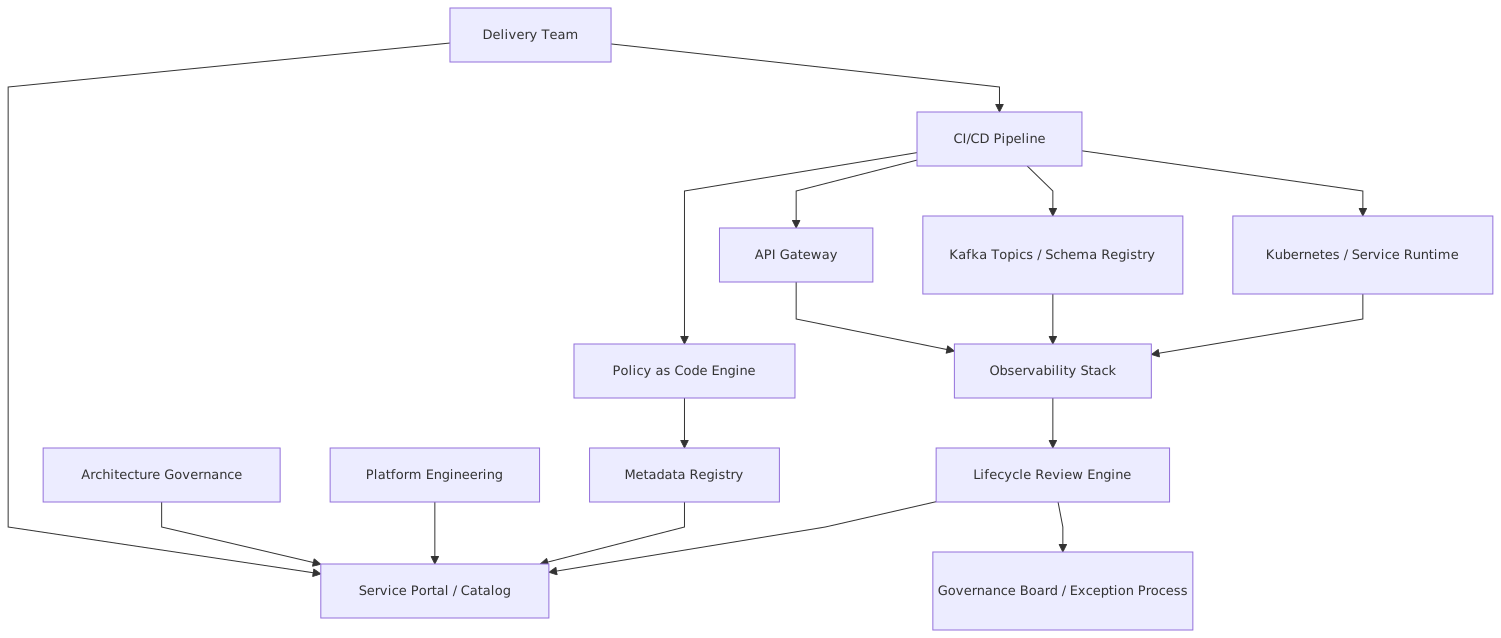
This is not a call for a giant centralized architecture machine. Quite the opposite. The architecture should make it easier for teams to comply than to improvise.
Migration Strategy
No enterprise starts with clean lifecycle governance. They inherit a mixed estate of monoliths, services, batch interfaces, file transfers, shared databases, and hand-built APIs. So the migration strategy matters as much as the target state.
The right approach is progressive strangler migration, but not just for application functionality. You also need to strangle unmanaged governance.
Step 1: inventory before intervention
You cannot govern what you cannot see. Start by creating a basic service and interface inventory:
- existing services and APIs
- Kafka topics and schema owners
- runtime locations
- ownership gaps
- consumer maps
- criticality and data classification
Do not wait for perfection. A rough inventory that is 80% right is more useful than a perfect catalog that arrives a year late.
Step 2: establish a minimum viable lifecycle
Define a thin lifecycle first. Usually:
- proposed
- active
- deprecated
- retired
Then add richer states like certified or approved once the process has traction. Many enterprises make the mistake of launching a cathedral of governance nobody can use.
Step 3: wrap new services first
Governance is easiest to apply to net-new services. Require registration, domain classification, ownership metadata, and contract publication as part of service creation templates. This gives you a compliant frontier even while the legacy estate remains patchy.
Step 4: strangle the legacy integration surface
As monolith capabilities are extracted, route new consumers to governed APIs or events rather than legacy interfaces. Over time, the legacy estate becomes a shrinking island with explicit retirement plans.
Step 5: introduce reconciliation capabilities
This is the bit many teams skip.
In distributed microservice estates, especially with Kafka, governance must include reconciliation patterns. Events will be delayed, duplicated, dropped, or consumed inconsistently. Deprecation will expose forgotten consumers. Read models will drift. Batch systems will remain in the background longer than anyone expects.
So each critical service domain needs a reconciliation strategy:
- replayable event streams where practical
- authoritative snapshots or query APIs
- compensating jobs
- dead-letter handling with ownership
- periodic consistency checks for critical entities
- state repair workflows
A microservice architecture without reconciliation is a fair-weather architecture. It works beautifully until weather arrives.
Step 6: enforce retirement as a first-class activity
Most enterprises are good at creating services and terrible at killing them. Build retirement into governance from the start:
- identify active consumers
- provide successor service or event contract
- publish deprecation deadlines
- monitor usage decline
- remove traffic and credentials
- archive compliance records
- decommission infrastructure and topics
If retirement is not governed, your architecture accumulates ghosts.
Migration view

The pattern here is familiar: isolate, extract, govern, reconcile, retire.
Enterprise Example
Consider a large insurer modernizing its policy administration landscape. The estate began with a monolithic core system, dozens of nightly batch jobs, regional integration variations, and a new digital channel program building microservices around quotes, policy issuance, billing, and claims notifications.
At first, the microservice effort looked successful. Teams used Kafka for event distribution, Kubernetes for runtime, and API gateways for partner access. But after two years, the insurer had around 140 services and a very ordinary kind of chaos.
Three “customer” services existed, each shaped by a different product line. Kafka topics like policy-updated, policychange, and policy_txn carried overlapping facts with conflicting semantics. Some services emitted domain events, others emitted after-save notifications from internal tables. Two deprecated quote APIs still served traffic from broker portals nobody remembered. Incident response during a premium billing outage took six hours because nobody could map which consumers relied on a changed event schema.
The insurer’s architecture group did something wise: they stopped talking first about technology standards and started with domain semantics.
They identified bounded contexts for Customer Profile, Policy Administration, Billing, Claims Intake, and Broker Distribution. Service owners had to map each service to a capability and context. Duplicate capabilities were surfaced. Event taxonomies were rewritten around business language rather than table updates. A service catalog became mandatory through platform templates. Kafka topic creation required ownership, schema registration, retention settings, and classification as domain event, integration event, or technical event.
They also introduced lifecycle gates:
- no production deployment without registered owner and on-call support
- no external API without published versioning and deprecation policy
- no Kafka topic without schema governance and consumer visibility
- no service marked active without SLOs and traces
- no deprecation without measured consumer migration plan
The most valuable addition was reconciliation. Billing and policy systems could not guarantee perfect event delivery across all legacy boundaries, so the insurer built periodic reconciliation jobs and repair workflows for premium statements and policy status. That decision looked boring compared with shiny streaming demos. It saved them repeatedly.
Within eighteen months, they retired 27 services, merged several overlapping customer capabilities, and reduced incident triage time materially because ownership and dependency data were finally trustworthy.
That is what good governance looks like in the wild. Not elegance for its own sake. Fewer surprises.
Operational Considerations
Lifecycle governance lives or dies operationally.
Observability tied to lifecycle state
An active service should have baseline metrics, logs, traces, error budgets, dashboards, and alerts. A deprecated service should additionally expose consumer usage and traffic decay. A retired service should disappear from operational rotation and cost monitoring, except for archived evidence.
Dependency intelligence
You need real dependency maps, not guessed ones. For synchronous paths, use tracing and API gateway data. For Kafka, track producers, consumer groups, lag, and schema usage. This is crucial for deprecation and incident response.
Policy exception management
Some services will need exceptions. Legacy systems may not support all standards. That is fine. What matters is that exceptions are explicit, time-bound, and owned. Hidden noncompliance is poison.
Cost governance
Idle services, oversized clusters, stale topics, and duplicate capabilities create real cost. Lifecycle governance should feed FinOps. Retirement is one of the most underrated cost optimization tools in enterprise architecture.
Security and compliance integration
Data classification, secrets rotation, access policies, audit trails, and retention requirements should attach to the service lifecycle. Governance should not bolt these on afterward.
Human ownership
A service without a named owner is not a service. It is an operational hazard. Team ownership, escalation paths, support windows, and product accountability are all part of lifecycle governance.
Tradeoffs
There is no free lunch here.
More control means more process
Even automated governance creates friction. Teams will spend time capturing metadata, publishing contracts, and passing readiness checks. That is the price of operating at scale.
Standardization can suppress useful variation
If governance becomes too rigid, teams stop making sensible local optimizations. The art is to standardize what improves coherence — metadata, lifecycle states, contract discipline, operational baselines — while allowing implementation freedom inside those boundaries.
Catalog accuracy is hard
A service catalog becomes shelfware quickly unless integrated into delivery and runtime systems. Manual updates are a losing battle.
Event governance slows informal integration
That is not always bad. Informal integration is often just future pain arriving early. Still, strict schema review can frustrate teams if the process is clumsy.
Reconciliation adds complexity
Periodic repair flows, snapshots, replay, and exception handling all add design overhead. But pretending distributed systems do not need reconciliation is not simplicity. It is denial.
Failure Modes
This topic is full of traps.
Governance as committee theater
If lifecycle governance is mostly meetings and PowerPoint, teams will route around it. Governance must be embodied in platforms, pipelines, and runtime controls.
Over-centralization
A central group that approves every service design detail becomes the bottleneck microservices were meant to avoid. Govern outcomes and critical constraints, not every implementation choice.
Lifecycle without retirement
Many organizations define service creation and operation well enough but never enforce deprecation and removal. The estate bloats. Cognitive load rises. Costs spread quietly.
Domain-free governance
If you govern services as technical units rather than bounded contexts, duplication and semantic conflict become inevitable. Domain-driven design is not decoration here. It is the map.
Kafka without semantic discipline
Teams often treat Kafka as a universal integration solvent. Then topics proliferate, schemas drift, replay becomes dangerous, and no one agrees what events mean. Event governance is not optional in serious enterprise estates.
Missing reconciliation
A service ecosystem that assumes event delivery is enough will eventually lose data consistency in ways that matter to the business. Financial balances, policy states, claims statuses, and customer preferences all need repair paths.
Stale ownership metadata
The most common operational lie in microservices is the named owner who left six months ago. Ownership must be synchronized with organizational reality.
When Not To Use
Not every system needs this level of lifecycle governance.
If you have a small product with a handful of services, one or two teams, limited regulatory pressure, and low integration complexity, heavy governance will likely slow you down more than it helps. A simple service inventory, basic ownership tagging, and modest API standards are enough.
Likewise, if your domain is not genuinely decomposed into bounded contexts and most change remains tightly coupled, a modular monolith may be a better architecture. It is easier to govern one well-structured application than fifty accidental microservices.
And if your platform engineering capability is weak, be careful. Lifecycle governance without automation becomes paperwork. Paperwork breeds resentment, and resentful teams do not build clean systems.
So there is a clear warning here: do not adopt elaborate service lifecycle governance just because “microservices at scale” sounds modern. Use it when the estate, risk profile, and organizational complexity justify it.
Related Patterns
Several patterns sit close to service lifecycle governance.
Bounded Context Mapping
This is the foundation. Without explicit context boundaries and domain language, service governance has no semantic anchor.
Strangler Fig Pattern
Ideal for both functionality migration and governance migration. New capabilities are introduced under managed lifecycle rules while legacy interfaces are gradually enclosed and retired.
Consumer-Driven Contracts
Useful for API and event compatibility, especially where many downstream consumers depend on independent service evolution.
Backstage or Service Catalog Patterns
Developer portals and service catalogs make governance visible and self-service. They are not the governance model, but they are often the front door.
Policy as Code
Essential for making lifecycle standards executable inside delivery pipelines and infrastructure workflows.
Saga and Compensating Transaction Patterns
Relevant where lifecycle governance intersects with long-running business processes and failure recovery.
Reconciliation and Repair Patterns
Critical in event-driven systems. They provide a practical answer to eventual consistency drift, message loss, late arrival, and state divergence.
Summary
Microservices do not just need governance. They need governance that respects how services actually live and die.
The right mental model is not “approval process.” It is lifecycle stewardship. A service is born in a domain, grows through delivery, proves itself operationally, evolves through changing contracts, and should one day retire cleanly. Governance is the architecture that makes those transitions safe, visible, and economical.
The strongest implementations share a few traits:
- they anchor services in bounded contexts and business capabilities
- they treat APIs and Kafka events as governed contracts, not incidental outputs
- they automate policy through platform workflows
- they include runtime feedback, not just design-time review
- they plan for reconciliation because distributed systems drift
- they make deprecation and retirement as real as creation and release
This is one of those architectural disciplines that seems optional early and unavoidable later. Enterprises that ignore it eventually get the same lesson from production incidents, compliance pressure, platform cost, or plain operational confusion.
A microservice estate without lifecycle governance is a city without zoning, maps, or demolition crews. It can grow impressively for a while. Then one day everyone wonders why nothing is easy to find, nothing is easy to change, and the old buildings never seem to come down.
That is the moment governance stops sounding bureaucratic and starts sounding like common sense.
Frequently Asked Questions
What is a service mesh?
A service mesh is an infrastructure layer managing service-to-service communication. It provides mutual TLS, load balancing, circuit breaking, retries, and observability without each service implementing these capabilities. Istio and Linkerd are common implementations.
How do you document microservices architecture for governance?
Use ArchiMate Application Cooperation diagrams for the service landscape, UML Component diagrams for internal structure, UML Sequence diagrams for key flows, and UML Deployment diagrams for Kubernetes topology. All views can coexist in Sparx EA with full traceability.
What is the difference between choreography and orchestration in microservices?
Choreography has services react to events independently — no central coordinator. Orchestration uses a central workflow engine that calls services in sequence. Choreography scales better but is harder to debug; orchestration is easier to reason about but creates a central coupling point.