⏱ 21 min read
Most microservices don’t fail because teams picked the wrong framework. They fail because nobody agreed on what “alive” means.
A service is deployed. It passes health checks. It emits metrics. The dashboard is green. And yet the business says it is not ready, operations says it is unstable, security says it is non-compliant, and downstream consumers say they still cannot trust it. That is the quiet architectural problem underneath a great deal of “modernization”: we treat services as binaries—up or down, built or not built, legacy or modern—when the enterprise reality is a progression of maturity, trust, ownership, and contractual certainty.
That progression deserves a first-class model.
A service maturity lifecycle is not merely a release checklist wearing better clothes. It is an architectural language for expressing how a service moves from idea to experiment, from experimental to operational, from operational to strategic platform capability, and eventually toward retirement. If we do not model those states explicitly, the organization invents them informally. Informal lifecycle states are where technical debt breeds, governance becomes political, and migration programs become folklore.
This is especially true in event-driven microservices environments. A service that publishes Kafka events before its domain semantics are stable can poison a whole ecosystem. A service that is technically “running” but still reconciles nightly from a legacy master is not truly autonomous. A service that owns writes but not reads, or emits events but cannot replay them safely, is somewhere in between. Architecture lives in those in-between places.
The useful question is not “Do we have microservices?” The useful question is: what lifecycle state is each service in, what commitments does that state permit, and how do we migrate safely between states?
That is what this article addresses.
Context
Microservices architecture promised independent deployability, bounded contexts, and faster change. In practice, enterprises inherited a more complicated landscape:
- legacy systems that still hold the system of record
- domain boundaries that are only half-understood
- Kafka topics that outlive the services that created them
- platform teams pushing standards faster than product teams can absorb them
- compliance and operational controls arriving after the first dozen services are already in production
In that setting, the naive service catalog becomes useless. A list of services tells you very little. The architect needs to know:
- Which services are just façades over a monolith?
- Which have true domain ownership?
- Which are authoritative for writes?
- Which are still dependent on nightly reconciliation?
- Which can be consumed by other teams with confidence?
- Which are candidates for decommissioning?
These are lifecycle questions, not implementation questions.
Domain-driven design helps here because it gives us a language of bounded contexts, ownership, invariants, and ubiquitous language. A service should not be judged mature because it is containerized. It should be judged mature because its domain semantics are clear, its ownership is real, and its contracts are stable enough that other bounded contexts can depend on it.
That distinction matters. You can have a beautifully engineered service that is still immature because its domain model is a thin translation layer over legacy tables. You can also have a relatively simple service that is highly mature because it owns a coherent business capability, exposes stable contracts, and can survive failures without corrupting domain truth.
The enterprise needs a lifecycle model to make those differences visible.
Problem
Without explicit lifecycle states, organizations make several predictable mistakes.
First, they confuse deployment status with business readiness. A service is declared “live” because traffic reached it, even though support processes, backfill routines, reconciliation controls, and data stewardship are all still unfinished.
Second, they confuse technical decoupling with domain autonomy. A team extracts a service from the monolith, wraps it with an API, and claims victory. But the service still depends on shared data, central release coordination, and undocumented business rules embedded in a batch job somewhere else.
Third, they create event streams too early. Kafka makes publication easy, but easy publication is not the same as meaningful domain events. If the service lifecycle state is immature, the event vocabulary will likely be unstable. Downstream consumers will then code against accidental semantics and lock in a bad model. event-driven architecture patterns
Fourth, they cannot govern migration sensibly. Every service is discussed as if it deserves the same controls, resilience standards, and onboarding treatment. That is wasteful. A pilot service in a low-risk bounded context should not carry the same obligations as a core ledger service. On the other hand, a core customer identity service absolutely should not be treated like an experiment.
Fifth, retirement becomes chaotic. Services linger because there is no recognized terminal state between “still exists” and “deleted.” Enterprises become museums of half-decommissioned APIs and Kafka topics.
This is not a tooling problem. It is a semantic gap.
Forces
A good architecture article should admit that the world is not clean. Real enterprises are messy because the forces are real.
1. Domain clarity versus delivery pressure
DDD asks for careful boundary discovery. Delivery asks for shipping this quarter. The result is often a premature service boundary around an unclear domain. That boundary then calcifies through APIs and events.
2. Autonomy versus consistency
Teams want local control. The business wants coherent outcomes. In a distributed system, those goals collide around data ownership, transactional boundaries, and reconciliation.
3. Standardization versus context sensitivity
Platform teams want one maturity model, one golden path, one runtime standard. But a payment authorization service is not the same kind of beast as a marketing preferences service.
4. Event-driven responsiveness versus semantic stability
Kafka encourages asynchronous integration and decoupled scaling. But once events are consumed by multiple downstream teams, semantic mistakes become expensive. Publishing “CustomerUpdated” before deciding what “customer” means is a classic self-inflicted wound.
5. Migration speed versus operational safety
A strangler migration can reduce risk incrementally, but incremental change creates long-lived coexistence: duplicate data, reconciliation jobs, split traffic, dual writes, and occasional confusion about who is authoritative.
6. Governance versus team ownership
Central architecture wants visibility and control. Product teams want room to move. Lifecycle states are useful precisely because they provide a common language without pretending every service must look the same.
Solution
The solution is to model a service lifecycle state machine explicitly. Not a project status. Not a ticket board. A real architectural model with semantic meaning, technical obligations, and migration criteria.
A practical lifecycle often looks like this:
- Concept
- Incubating
- Operational
- Trusted
- Strategic
- Sunsetting
- Retired
Different organizations may rename these, but the shape matters more than the labels.
Concept
The capability is being identified, domain boundaries are being explored, and ownership is not yet fully settled. This state is about bounded context discovery, not production promises.
Typical signals:
- event storming or domain modeling underway
- API sketches exist but no published commitments
- source of truth still unclear
- no external consumers should depend on it
Incubating
The service exists, may handle low-risk traffic, and begins to implement a domain model. But semantics, operational readiness, and ownership boundaries are still stabilizing.
Typical signals:
- initial API or events available
- legacy remains authoritative for some or all records
- reconciliation is required
- schema and event contracts may still evolve quickly
- use is limited to controlled consumers
This is where many services spend far too long.
Operational
The service runs in production with support processes, observability, and on-call expectations in place. It is useful. It is not yet universally trusted.
Typical signals:
- SLOs are defined
- operational dashboards and runbooks exist
- data ownership is established for at least part of the domain
- rollback, replay, and recovery procedures are understood
- event contracts are versioned
Trusted
The service becomes a credible dependency for other bounded contexts. It has stable contracts, known failure behavior, and enough domain integrity that others can build on it.
Typical signals:
- ownership of domain invariants is clear
- external teams can consume APIs/events with confidence
- backward compatibility policy exists
- reconciliation exceptions are rare and measurable
- platform/security/compliance obligations are fully met
Strategic
The service is not merely healthy; it is a strategic enterprise capability. It may be a core domain service or a foundational shared domain platform. Its evolution is managed carefully because many capabilities now rely on it.
Typical signals:
- critical path in business operations
- broad internal adoption
- high reliability and resilience requirements
- product and architecture roadmaps explicitly depend on it
- formal stewardship of schema and event evolution
Sunsetting
The service still exists, but the architectural direction has changed. New consumers should not adopt it; migration plans are underway.
Typical signals:
- deprecation notices published
- topic or API replacement identified
- traffic and dependency burn-down tracked
- archival and retention strategy defined
Retired
No active production role remains. Contracts are withdrawn, data is archived according to policy, and infrastructure is decommissioned.
That progression turns vague opinions into operational architecture.
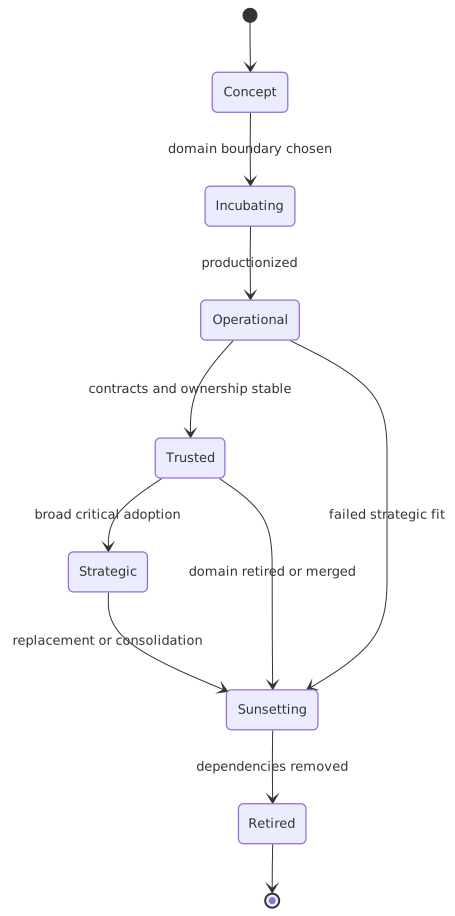
The important point is not that every service must reach Strategic. Most should not. A mature enterprise architecture accepts that many services are local, modest, and good enough. The lifecycle is there to clarify commitment, not to create prestige tiers.
Architecture
A lifecycle model becomes real when it influences architecture decisions.
Lifecycle metadata belongs in the service catalog
Each service should carry machine-readable lifecycle metadata:
- current lifecycle state
- owning team
- bounded context
- authoritative data scope
- upstream system of record, if any
- downstream criticality
- API contract status
- event contract status
- reconciliation model
- deprecation target and date, if applicable
This turns the service catalog from a phone book into an architectural control plane.
Domain semantics must be explicit
This is where DDD matters. Lifecycle maturity is tightly linked to semantic maturity.
For example, consider a “Customer Service.” That phrase is usually too broad to be useful. In a large enterprise, customer identity, legal party, marketing profile, billing account, and support contact preferences often belong to different bounded contexts. A service claiming to own “Customer” is likely lying, or at least oversimplifying.
A service should be considered more mature when it can answer these questions clearly:
- What domain concept does it own?
- What invariants does it enforce?
- What language does it use in APIs and events?
- What semantics are local versus shared?
- What does “authoritative” mean in this context?
If the service can only say “we mirror the CRM customer record,” it is not yet semantically mature. It may still be useful. But let us call things by their proper names.
Event contracts should reflect lifecycle state
Kafka is a powerful ally when used with restraint. In early states, event publication should be limited and clearly marked as unstable. In later states, events become enterprise contracts.
A practical rule:
- Incubating services may publish integration events to a narrow set of consumers, often under explicit versioning or internal-only policies.
- Operational services may publish broader events, but only with replay, schema management, and recovery practices in place.
- Trusted/Strategic services may publish canonical domain events suitable for wider reuse, with formal compatibility governance.
This is not bureaucracy. It is hygiene. A bad event taxonomy spreads faster than a bad API because event consumers are often invisible until too late.
Reconciliation is part of the architecture, not an embarrassing secret
During migration, many services are not yet the sole system of record. They coexist with legacy stores, batch interfaces, or parallel write paths. That means reconciliation is inevitable.
Architects often treat reconciliation as a temporary nuisance. In reality, it is one of the defining concerns of lifecycle maturity.
A service is less mature if:
- it cannot detect divergence
- it relies on manual spreadsheet comparisons
- replay is unsafe or undefined
- no one can say which side wins in a mismatch
A service is more mature if:
- reconciliation rules are explicit
- idempotency is built in
- mismatch thresholds are monitored
- compensating actions are automated
- ownership of discrepancy resolution is assigned
In event-driven systems, reconciliation often combines:
- Kafka event replay
- periodic snapshots
- reference data validation
- outbox patterns
- dead-letter handling
- compensating commands
Architecturally, that is not scaffolding. That is the bridge between states.

Control obligations should vary by state
Not every service needs every control from day one. But the obligations should be clear.
For example:
The tradeoff is obvious: too little control too early creates chaos, too much control too early kills momentum. The lifecycle lets you tune governance to risk. EA governance checklist
Migration Strategy
A lifecycle model is most valuable during migration because migration is where enterprises are most tempted to lie to themselves.
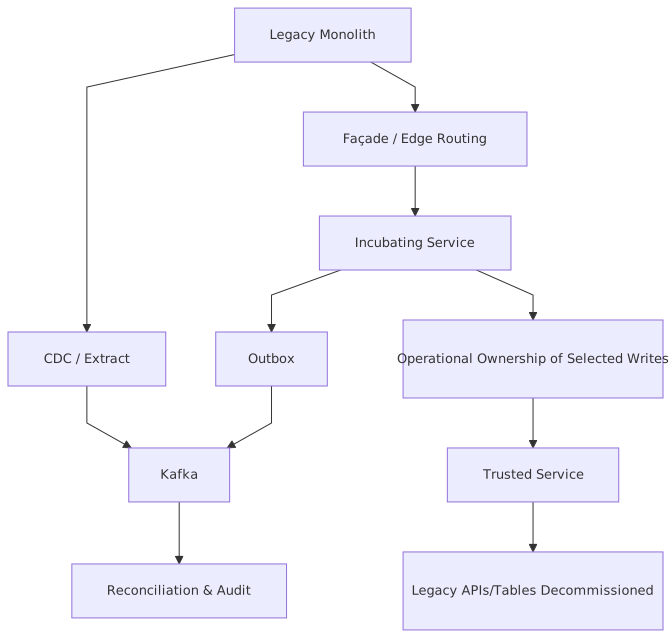
The right pattern here is usually a progressive strangler migration. Not a big bang. Not a purity crusade. Progressive, observable replacement.
Step 1: Discover the bounded context before extracting the service
Do not extract technical layers; extract business capabilities. If the legacy module is “customer,” but the domain actually contains identity, segmentation, consents, preferences, and account relationships, split the thinking before you split the code.
This is classic DDD work:
- event storming
- process mapping
- invariant analysis
- identifying aggregate boundaries
- clarifying upstream and downstream contexts
If you skip this, you do not get microservices. You get distributed confusion. microservices architecture diagrams
Step 2: Introduce a façade and route selected use cases
The strangler begins at the edge. Route a narrow slice of traffic through a new interface while the legacy system still performs most of the work.
This usually places the service in Incubating state:
- low-risk operations first
- feature toggles and controlled routing
- no broad event publication yet
- legacy remains authoritative
Step 3: Establish data capture and reconciliation
Before moving ownership, build the plumbing to compare outcomes:
- change data capture from legacy
- outbox pattern from the new service
- Kafka topics for domain or integration events
- reconciliation jobs and exception workflows
This is where many migration programs become adults. Teams realize the hard part is not forwarding requests. The hard part is proving semantic and data consistency under failure.
Step 4: Move write authority for a narrow invariant set
Do not transfer ownership of the whole domain at once. Move a specific set of writes where invariants can be enforced locally.
For example:
- marketing preference updates move first
- legal identity changes remain in legacy
- read models are built from combined data during coexistence
Now the service starts earning the right to become Operational.
Step 5: Publish stable events after semantics settle
Once the service truly owns a domain action, publish events that reflect business meaning, not technical side effects. “PreferenceUpdated” is better than “CustomerRowChanged.” One describes the domain; the other leaks the database.
Event versioning, schema registry policies, replay testing, and consumer onboarding become necessary here.
Step 6: Expand ownership and retire shadow dependencies
Over time:
- direct legacy reads are reduced
- consumers are shifted to the new service or its events
- reconciliation volumes shrink
- support ownership transfers
- deprecation of old APIs/topics begins
This is the movement from Operational toward Trusted.
Step 7: Decommission with evidence, not optimism
A service is not replacing legacy because the project says so. It is replacing legacy when:
- traffic has migrated
- reconciliation exceptions are controlled
- authoritative ownership is explicit
- downstream dependencies are cataloged and moved
- operational support has stabilized
- old stores and interfaces can be shut down safely
That is the architecture test. PowerPoint is not evidence.
Enterprise Example
Consider a global insurer modernizing its policy administration landscape. The old world consists of a core policy platform, regional CRM variants, nightly batch feeds into finance, and dozens of downstream reporting extracts. Leadership announces a microservices strategy. Naturally, the first proposed service is called “Customer Service.”
This is usually where architecture goes to die.
A better approach starts by recognizing that “customer” is not one thing. In the insurer’s domain, there are at least four distinct bounded contexts:
- Party Identity: legal person or organization identity
- Contact Preferences: communications channels and consent
- Broker Relationship: intermediary associations and servicing rights
- Policy Holder View: contextual representation inside policy administration
The firm begins with Contact Preferences, because it has cleaner boundaries, lower regulatory risk than legal identity, and high business value due to digital engagement initiatives.
Lifecycle progression
Concept
The team models consent semantics. It discovers that “opt-in” means different things for marketing, servicing, and regulatory communications. Good. Better to find that in a workshop than in production.
Incubating
A new Contact Preferences service is introduced behind the customer portal. Preference updates are accepted there, but nightly reconciliation compares the service database, Kafka events, and the old CRM preference tables. Only digital channel preferences are migrated at first.
Operational
The service becomes the write authority for digital marketing preferences in two regions. It has on-call support, dashboards for reconciliation mismatches, and an exception workflow for region-specific consent edge cases.
Trusted
The claims platform and campaign platform now consume PreferenceChanged events from Kafka. Contracts are versioned through schema registry. The old CRM no longer serves as the operational source for these preferences.
Strategic
Over time, the service becomes the enterprise consent capability, integrated with customer channels, broker tooling, and data privacy workflows. It still is not “Customer Service,” and that restraint is one reason it succeeds.
What made the migration work?
- The bounded context was narrow and meaningful.
- Lifecycle state was explicit and visible.
- Kafka was used after semantics were clarified, not before.
- Reconciliation was designed as a core capability.
- Legacy coexistence was treated as a serious architectural phase, not a temporary inconvenience.
- The team resisted the urge to create a giant shared customer service.
That is a real enterprise lesson: small honest services age better than grand ambiguous ones.
Operational Considerations
A maturity lifecycle has to show up in operations, or it is just architecture theater.
Observability by state
Different states need different evidence.
For Incubating services:
- request success/failure
- reconciliation mismatch rate
- event publication failures
- schema validation issues
For Operational and above:
- SLO attainment
- latency distributions
- consumer lag on Kafka topics
- replay duration
- dead-letter trends
- audit completeness
- dependency health
Runbooks and support models
A Trusted service without a runbook is not trusted. A Strategic service without disaster recovery testing is a liability wearing a crown.
The operational model should mature along with the service:
- who gets paged
- what failures are tolerated
- how replay is performed
- who approves schema changes
- who resolves reconciliation discrepancies
- how deprecation is communicated
Data governance and audit
Lifecycle maturity often correlates with stronger evidence trails:
- event lineage
- schema evolution records
- access control reviews
- data retention and archival policies
- service ownership history
- deprecation notices
In regulated industries, the audit story is part of maturity, not an afterthought.
Tradeoffs
Architecture is mostly the management of regret. A service lifecycle model is no exception.
Benefit: clearer governance
You can apply the right controls at the right time.
Cost: more visible bureaucracy
Teams may fear being “stuck” in a lower state. If handled poorly, the model turns into a status hierarchy.
Benefit: safer migration
You can distinguish transitional coexistence from real domain autonomy.
Cost: slower declarations of success
Programs that want quick wins may dislike honest maturity labels.
Benefit: better event discipline
Kafka topics become managed contracts rather than enthusiastic emissions.
Cost: more upfront semantic work
Teams must actually discuss domain meaning, invariants, and ownership. This is work. Necessary work, but still work.
Benefit: explicit retirement
Sunsetting becomes a managed phase rather than a forgotten note in a backlog.
Cost: catalog maintenance
Lifecycle metadata must stay current. Stale catalogs are worse than no catalogs because they create false confidence.
Failure Modes
The lifecycle model itself can fail in familiar ways.
1. States become ceremonial
The catalog says “Trusted,” but the service still depends on manual restarts and undocumented reconciliation. This is badge inflation.
2. Technical maturity is mistaken for domain maturity
A service with excellent CI/CD and observability may still have weak domain boundaries and unstable semantics.
3. Incubating becomes permanent
This is common. Services linger in transitional architecture for years: dual writes, legacy dependencies, no real authority. At that point the service is not incubating; it is stalled.
4. Kafka topics are published too early
The enterprise starts consuming events whose semantics are not stable. Every downstream consumer then becomes an anchor on future design.
5. Reconciliation is under-designed
Teams assume mismatches will be rare. They are wrong. Then the organization discovers too late that nobody knows which side is correct or how to repair divergence at scale.
6. Sunsetting is announced without migration support
New consumers stop adopting the service, but existing consumers are left with no replacement path, no compatibility plan, and no target dates they can trust.
7. Strategic services become accidental monoliths
A highly adopted service starts absorbing unrelated capabilities because it is “already strategic.” That is how shared services become bloated platforms with fuzzy ownership.
When Not To Use
Not every environment needs a formal service maturity lifecycle.
Do not use this model when:
The system is small and owned by one team
A lightweight internal application with a handful of services probably does not need seven explicit lifecycle states.
Domain boundaries are intentionally temporary
In very early product discovery, heavy lifecycle formalization can freeze experimentation.
The architecture is not actually service-oriented
If the organization still operates a modular monolith, forcing service lifecycle governance is premature. Focus first on module boundaries and domain ownership. ArchiMate for governance
There is no organizational appetite to maintain the model
A lifecycle framework that nobody updates becomes decoration.
Teams will weaponize the states politically
If “Strategic” turns into prestige and budget competition, the model can do more harm than good. States must indicate commitment and risk, not social rank.
In short: use this where service sprawl, migration complexity, and cross-team dependency are real problems. Do not use it as architecture cosplay.
Related Patterns
Several patterns complement the service maturity lifecycle.
Bounded Context
The foundation. Lifecycle maturity depends on clear domain boundaries.
Strangler Fig Pattern
The migration backbone for moving from legacy systems to autonomous services progressively.
Anti-Corruption Layer
Essential when legacy semantics are messy and should not leak into the target bounded context.
Outbox Pattern
Useful for reliable event publication, especially during Operational and Trusted stages.
Event Sourcing
Sometimes appropriate for high-audit domains, but not required. Use only where replay and historical intent truly matter.
Saga / Process Manager
Helpful when business workflows cross multiple services and lifecycle maturity requires clear compensating behavior.
Consumer-Driven Contracts
Important when services become Trusted and broader consumers depend on stable APIs or events.
Data Mesh and Domain Data Products
Related but different. A mature service may expose data products, but service lifecycle is about operational and semantic maturity, not only analytical sharing.
Summary
A microservices estate without lifecycle states is like a city with roads but no signs. You can move, but not safely, and not with much confidence.
The key idea is simple: a service is not just deployed or undeployed, modern or legacy. It progresses through states of semantic clarity, operational robustness, ownership, and trust. Those states should be explicit. They should influence governance, migration, event publication, reconciliation, and retirement.
Domain-driven design gives the lifecycle its backbone. Without bounded contexts and ownership of invariants, maturity is mostly theater. Progressive strangler migration gives it its path. Reconciliation gives it its realism. Kafka, used carefully, gives it a scalable integration fabric—but only after semantics deserve to travel that far.
If I were reducing the whole argument to one line, it would be this:
A mature service is not the one with the newest stack; it is the one the enterprise can depend on without guessing what it means.
That is the standard worth designing for.
Frequently Asked Questions
What is a service mesh?
A service mesh is an infrastructure layer managing service-to-service communication. It provides mutual TLS, load balancing, circuit breaking, retries, and observability without each service implementing these capabilities. Istio and Linkerd are common implementations.
How do you document microservices architecture for governance?
Use ArchiMate Application Cooperation diagrams for the service landscape, UML Component diagrams for internal structure, UML Sequence diagrams for key flows, and UML Deployment diagrams for Kubernetes topology. All views can coexist in Sparx EA with full traceability.
What is the difference between choreography and orchestration in microservices?
Choreography has services react to events independently — no central coordinator. Orchestration uses a central workflow engine that calls services in sequence. Choreography scales better but is harder to debug; orchestration is easier to reason about but creates a central coupling point.