⏱ 21 min read
Identity is one of those ideas that looks obvious until a distributed system gets hold of it.
In a monolith, identity feels tame. A customer has a customer_id. An order has an order_id. The database sits like an overprotective librarian, making sure nobody checks out the same book twice. Then we split the system into microservices, add Kafka, sprinkle in asynchronous workflows, let teams move at their own pace, and suddenly identity stops being a column and becomes an architectural fault line.
This is where many microservice programs quietly bleed. Not with dramatic outages at first, but with small erosions of meaning. One service thinks “customer” means a billing account. Another means a legal entity. A third means a user profile. IDs get copied, translated, wrapped, re-keyed, synchronized, and eventually misunderstood. What started as technical decomposition turns into semantic drift. The system still compiles. The business stops trusting it.
That is the real problem with service identity in microservices. It is not just about generating unique identifiers. It is about protecting meaning while allowing autonomy. microservices architecture diagrams
If you get identity right, services can evolve independently, events can be reconciled, acquisitions can be integrated, legacy systems can be strangled gradually, and audit trails remain believable under pressure. Get it wrong and your architecture becomes a maze of brittle cross-reference tables, accidental coupling, duplicate entities, and impossible investigations.
So this article takes a hard line: identity in microservices is a domain design problem first, an integration problem second, and only then a technical implementation detail. UUIDs are cheap. Meaning is expensive.
Context
Microservices promise bounded autonomy. Domain-driven design gives us bounded contexts to make that autonomy safe. But the moment data moves across service boundaries, identity comes with it, and that is where many designs reveal whether they were carved from domain thinking or assembled from database habits.
Inside a bounded context, an identity can be local and precise. The Order service knows what an Order is. It can mint order IDs however it likes, preserve invariants, and model its own lifecycle. No issue there.
The trouble begins when another service needs to refer to that order. Perhaps Billing issues an invoice. Fulfillment allocates stock. Customer Care opens a case. Analytics builds a timeline. Fraud scores the transaction. Suddenly the same real-world thing appears in many contexts, each with different responsibilities and different language.
This is why the phrase “single source of truth” is both useful and dangerous. Useful because some system often is authoritative for some aspect of identity. Dangerous because people stretch it too far and imagine one universal ID and one universal model for the whole enterprise. That usually ends badly. Large organizations do not have a single customer, product, or account concept. They have several, all legitimate, each rooted in a different domain.
A retailer is a good example. The e-commerce platform identifies a customer as a shopper account. The CRM identifies them as a contact or household. Finance identifies them as a billable party. Loyalty identifies them as a membership holder. Fraud may identify them through a device graph. These are not implementation accidents. They are different business views.
Microservices make this unavoidable because they force us to stop hiding semantic differences behind a shared schema. That is healthy. But once you accept that identities are contextual, you need patterns for how those identities are created, mapped, propagated, and reconciled.
Problem
The central problem is simple to state and hard to solve:
How do microservices maintain local autonomy over identity while still coordinating references to the same business reality across distributed systems?
The naive answers are all familiar:
- Use one enterprise-wide ID everywhere.
- Share the same customer table across services.
- Replicate all IDs to all services.
- Let every service invent its own IDs and “sort it out” later.
- Make the API gateway translate everything.
- Put a master data service in the middle of every call.
Each of these works for a while. Each eventually charges interest.
A universal ID sounds elegant until teams discover they do not agree on what the entity actually is. Shared tables create lockstep change and turn microservices into a distributed monolith. Full replication spreads stale or misunderstood identities everywhere. Post-hoc reconciliation becomes an expensive archaeology project. Gateway translation centralizes logic that belongs in the domain. Master identity services often become bottlenecks, both operationally and organizationally.
The practical challenge is not uniqueness. Modern platforms can generate unique IDs all day long. The challenge is semantic identity: deciding what an ID means, who owns that meaning, where translation belongs, and how mismatches are repaired over time.
You feel this challenge most sharply in event-driven systems. Kafka makes it easy to publish events with identifiers. It does not make it easy to ensure every subscriber interprets those identifiers correctly. In fact, Kafka can amplify identity mistakes beautifully. A bad event schema with ambiguous keys can spread confusion to dozens of consumers in minutes. event-driven architecture patterns
And then there is migration. Most enterprises are not designing on a clean whiteboard. They have SAP, mainframes, CRM packages, old customer masters, regional ERPs, and a heroic spreadsheet somewhere in operations. Identity strategy in microservices is rarely greenfield. It is usually a negotiation with history.
Forces
Several forces pull the architecture in different directions.
1. Domain autonomy versus enterprise consistency
DDD teaches us that each bounded context should control its own model. That includes identity. But the enterprise still needs consistent references across workflows, analytics, compliance, and reporting.
That tension never goes away. Good architecture does not eliminate it; it manages it deliberately.
2. Local IDs are easy, global meaning is hard
A service can create a local primary key in one line of code. But making that identity understandable across systems requires contracts, translation, and governance. This is where architecture lives. EA governance checklist
3. Legacy systems already own important identities
In a large enterprise, the “golden” identifier may be in a system you are trying to retire. Or there may be three golden identifiers, depending on who you ask. Any microservice identity pattern must survive coexistence with legacy.
4. Asynchronous messaging introduces delay and uncertainty
With Kafka or other event platforms, identity propagation is eventual. New entities appear in one service before another service has learned the mapping. Reads become probabilistic unless you design for lag, duplication, and out-of-order delivery.
5. Reconciliation is inevitable
No matter how disciplined the design, mismatches happen. Duplicate customer profiles, missing mappings, replayed events, merged identities after acquisition, and corrected master data are facts of life. Reconciliation is not an exception path. It is part of the architecture.
6. Security and privacy matter
Identity data often overlaps with personal data, legal entity data, or credentials. The identifier itself may be harmless, but the lookup graph around it may not be. Architects who casually replicate all identity references across domains often create privacy and compliance headaches.
7. Operability counts more than elegance
A theoretically pure identity model that nobody can debug at 2 a.m. is not architecture. It is decoration. Teams need traceability: where this ID came from, what it maps to, when it changed, and why.
Solution
The pattern I recommend is this:
Let each bounded context own its local identity. Use explicit reference identities and mapping mechanisms across contexts. Introduce a dedicated identity translation capability only where the domain genuinely requires cross-context correlation.
This is not a call for an enterprise-wide canonical everything. It is a call for disciplined identity boundaries.
There are a few core patterns inside that statement.
Local Context Identity
Each service owns the identifiers for its own aggregates. Order owns orderId. Billing owns invoiceId. Loyalty owns memberId. These are not just keys; they are part of the service’s domain boundary.
Do not let other services dictate internal identifiers if you want real autonomy.
External Reference Identity
When a service needs to refer to an entity from another context, it stores an external reference, not ownership of the foreign entity. That reference should be named explicitly in the language of the consuming service.
For example, Billing may store commerceOrderRef, not pretend the Order aggregate belongs to Billing. The name matters. It reminds everyone that this is a reference crossing a boundary.
Identity Mapping
Where multiple identities correspond to the same business concept across contexts, maintain mappings explicitly. Sometimes this belongs in a dedicated identity resolution service. Sometimes in a domain service that already has that responsibility, such as customer profile or party management. Sometimes just in the integrating service itself.
The rule is simple: put mapping where the business meaning of equivalence is understood.
If “customer” equivalence depends on legal entity rules, consent, geography, or household logic, then this is not plumbing. It is domain logic.
Event-Carried References
In Kafka-based microservices, events should carry both the local aggregate identity and, where relevant, stable reference IDs used by downstream consumers. But do this with care. Do not turn events into dumping grounds for every known identifier. Include the identities necessary to preserve workflow continuity and traceability.
Reconciliation Workflow
Because mappings can be incomplete, delayed, or corrected, design reconciliation as a first-class process. Missing identity resolution should not automatically mean system failure. Sometimes it means parking a workflow, raising a resolution task, and replaying once the mapping is repaired.
That may sound inelegant. It is in fact one of the marks of a mature enterprise architecture.
Architecture
A practical service identity architecture in microservices typically has four layers of concern:
- Local aggregate identity inside each service
- Cross-context references in APIs and events
- Identity mapping or resolution where semantic equivalence matters
- Operational lineage and reconciliation
Here is a simple reference view.
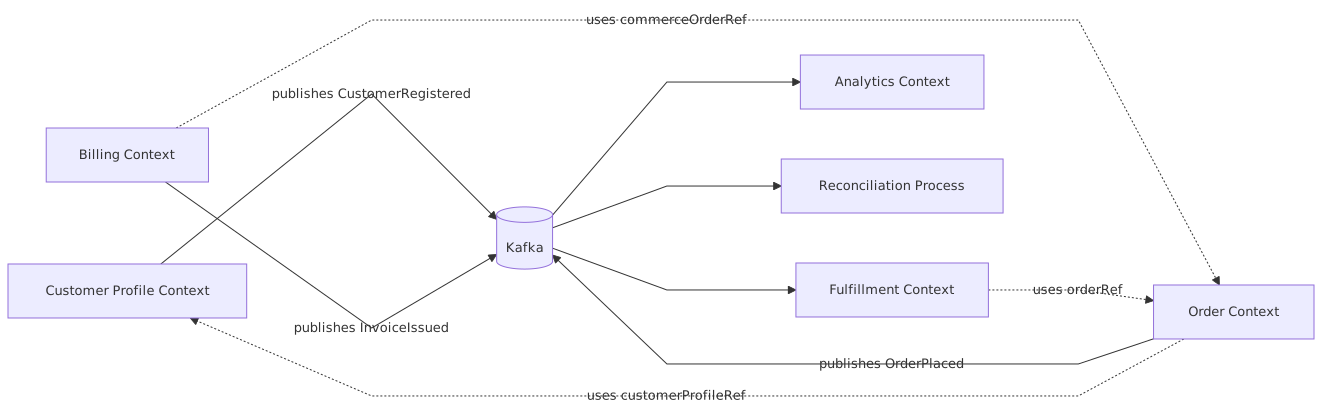
This diagram hides an important truth: the arrows are not simply technical integration lines. They are statements about meaning. commerceOrderRef is not the same thing as invoiceId, and it should not be forced into sameness just because both happen to describe related business activity.
Identity layers in the service contract
A well-formed API or event often includes:
- The local aggregate ID
- One or more external references to upstream or correlated entities
- A correlation ID for technical tracing
- Optionally a business key if it is stable and meaningful
For example:
orderId: local to Order contextcustomerProfileRef: external reference to Customer Profile contextcheckoutSessionId: workflow referenceeventId: technical event identitycorrelationId: observability trace across distributed execution
These serve different purposes. Confusing them is a common source of bugs.
Business keys versus surrogate keys
Architects love to debate this like theologians. The right answer is contextual.
Use surrogate identifiers for aggregate identity when business keys are mutable, composite, sensitive, or overloaded. Use business keys as secondary identities when they carry real domain value and users operate with them. An invoice number seen by a customer matters. A random UUID usually does not.
Do not force one identifier to satisfy all roles.
Identity resolution service: use sparingly
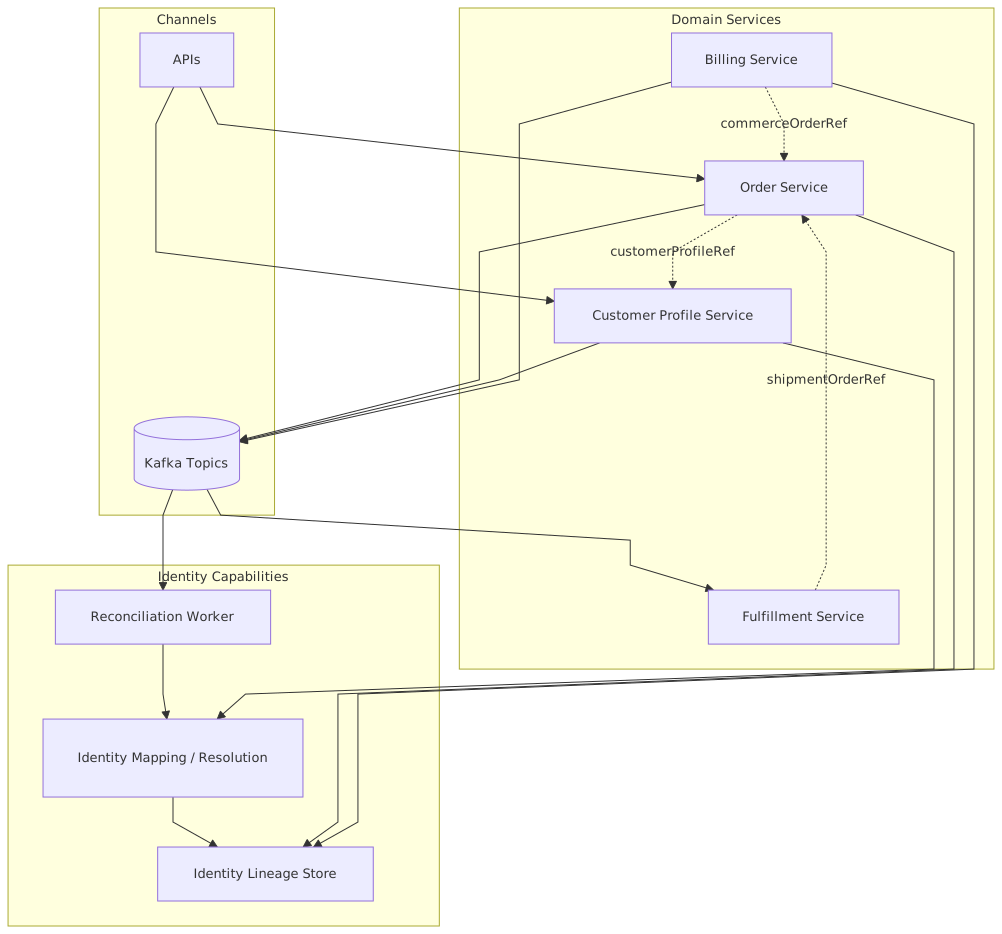
There are cases where a dedicated identity resolution service makes sense, especially in customer, party, product, or asset domains where many systems must correlate variants of the same entity.
But this service must not become a magic oracle for all joins in the enterprise. If every service calls it synchronously to function, you have just rebuilt a central dependency with better branding.
Use identity resolution primarily for:
- onboarding and matching,
- merge and split decisions,
- lookup for asynchronous processing,
- reconciliation,
- survivorship or mastered reference views.
Avoid making it the mandatory runtime hop for all core service behavior.
Here is a more detailed view.
Domain semantics are not optional
The worst identity architectures are technically clean and semantically lazy.
Take “customer.” In many enterprises, there are at least four plausible identities:
- a human user with login credentials,
- a consumer party,
- a legal account holder,
- a billing arrangement.
If your microservices simply pass customerId around without clarifying which one, you have built a future incident report.
DDD gives us the vocabulary to do better. Bounded contexts should define identity in their own ubiquitous language. If Order means “buyer account,” say so. If Billing means “responsible party,” say so. If CRM means “contact,” say so. Then map intentionally.
This is one of those places where architecture earns its keep. Naming is not cosmetics. Naming is control over misunderstanding.
Migration Strategy
No serious enterprise arrives at clean service identity patterns on day one. They migrate into them, usually from a shared database, a package-centric integration model, or a legacy master.
The right migration strategy is progressive strangler, not revolution.
Start by identifying the bounded context with the clearest claim to local identity ownership. Then expose that identity through APIs and events while preserving compatibility with legacy keys. In early stages, services often carry both:
- the new service-owned ID,
- and the legacy reference ID.
This is not a compromise to be ashamed of. It is a bridge.
A sensible migration sequence looks like this:
Step 1: Freeze semantics before changing technology
Before introducing a new ID, clarify what the entity means in the target bounded context. If you cannot define the semantics, do not generate a new identity yet. You will only create another layer of confusion.
Step 2: Introduce anti-corruption around legacy identifiers
Wrap legacy systems with an anti-corruption layer that exposes explicit references instead of leaking internal database keys all over the landscape.
Step 3: Publish events with dual identifiers
For a period, emit both the new context ID and the legacy ID. This allows downstream consumers to migrate gradually. It also gives reconciliation teams a way to cross-check.
Step 4: Build identity mapping and lineage
Do not wait until cutover to create mapping tables and lineage records. From the first migration step, record:
- source identifier,
- target identifier,
- mapping type,
- timestamp,
- confidence if matched probabilistically,
- merge/split history.
Step 5: Move consumers by bounded context, not by technology stack
Migrate based on business capability ownership. A service should adopt the new identity when it is ready to own the semantics, not merely because the platform team upgraded a library.
Step 6: Retire legacy references only after reconciliation stabilizes
Many programs drop old IDs too early and discover they cannot investigate discrepancies afterward. Keep legacy references until replay, audit, and operational reporting are proven.
Here is the migration shape.

Reconciliation during migration
Reconciliation deserves special attention because migration is where identity mistakes surface.
Suppose Kafka events arrive before a downstream mapping is loaded. Or a customer merge in the legacy master changes the preferred identifier after a service has already stored references. If the architecture assumes identity is static and perfectly propagated, workflows will fail in ugly ways.
A better approach is to design for:
- pending identity states,
- reprocessing of parked events,
- merge and split handling,
- compensating updates to dependent projections,
- human review where automated matching confidence is low.
This is not overengineering. This is what real enterprises need when twenty years of system history meets event-driven design.
Enterprise Example
Consider a multinational insurer modernizing claims, policy servicing, billing, and customer engagement.
The legacy landscape includes:
- a policy administration system with
policy_holder_no, - a CRM package with
contact_id, - a billing platform with
account_no, - a digital channel with
user_id, - and a Kafka backbone introduced during modernization.
At first, the program tried the usual move: define a single customerId and require every new microservice to use it. The result was predictable. Claims wanted claimant identity, not always the policy holder. Billing cared about payer responsibility. Digital cared about authenticated users. CRM tracked contacts, households, and brokers. The “universal customer” became a political artifact, not a usable domain model.
The program reset and took a better path.
A Party Profile bounded context was introduced to handle cross-system party correlation. Not to own all customer behavior, but to maintain identity mappings and mastered reference views where needed. Claims, Billing, and Digital each kept their own local IDs and semantics:
- Claims used
claimantRef - Billing used
responsiblePartyRef - Digital used
userAccountId - Policy used
policyHolderRef
Kafka events carried local IDs plus explicit references to related parties. For example, ClaimOpened included claimId, policyRef, and claimantRef. It did not pretend the claimant and policy holder were always the same person.
Reconciliation became critical when policies were transferred, parties merged, or brokers acted on behalf of customers. The Party Profile service maintained mappings such as:
contact_id -> partyRefpolicy_holder_no -> partyRefaccount_no -> partyRef
But runtime business processes did not synchronously depend on Party Profile for every operation. Services cached or stored relevant references at the time of workflow initiation. Party Profile was used for onboarding, lookup, merge events, and correction flows.
This architecture had real tradeoffs. It added mapping complexity. It required stronger event design and lineage tracing. But it reduced semantic confusion dramatically. Teams stopped arguing about what “customer” meant because they no longer had to force one term into every context.
And when auditors asked why a claim payment went to a specific party after a merger, the system could actually answer.
That is the standard. Not elegance on a slide. Explainability under pressure.
Operational Considerations
Identity architecture lives or dies in operations.
Traceability
Every important identity transition should be traceable:
- which system minted the ID,
- which external IDs were associated,
- what event established the mapping,
- whether the match was deterministic or probabilistic,
- what changed after a merge or correction.
If you cannot answer these questions quickly, support teams will fall back to database detective work.
Observability
Correlate business identity and technical tracing separately. OpenTelemetry trace IDs are useful, but they do not replace domain references. Dashboards should let operators search by order number, invoice number, customer reference, legacy ID, and event ID.
Kafka topic design
Kafka keys matter. If event ordering is important for an entity lifecycle, partition by the stable aggregate identity for that context. Do not casually switch between local IDs and external references as Kafka keys. That can break ordering assumptions and make replay inconsistent.
Idempotency
Identity mapping updates and event consumers must be idempotent. Duplicate delivery is not a theoretical concern in distributed systems. It is Tuesday.
Data retention and privacy
Identity lineage is operational gold, but it can also become a privacy minefield. Retain enough mapping and audit history to support legal and operational needs, but avoid replicating sensitive attributes where only references are required.
Merge and split events
Design explicit events for identity merge and split operations. Customer, party, and asset domains often need this. Downstream consumers must know whether to relink historical references, maintain snapshots, or preserve prior identity states for audit.
Tradeoffs
No identity pattern in microservices is free. Let us be honest about the price.
Benefit: strong service autonomy
Cost: more mapping and translation
Allowing each bounded context to own identity preserves domain integrity. The cost is explicit mapping logic, more careful event design, and more operational tooling.
Benefit: clearer semantics
Cost: more IDs in circulation
A mature enterprise architecture often has multiple legitimate identifiers for the same real-world party or object. This feels messy, but it reflects reality better than fake uniformity.
Benefit: safer migration
Cost: temporary dual-write and dual-reference complexity
Progressive strangler migration usually means carrying legacy and new references together for longer than teams would like. That is the cost of reducing cutover risk.
Benefit: better resilience
Cost: eventual consistency and reconciliation overhead
Asynchronous identity propagation improves decoupling but introduces lag, replay needs, and parked workflow handling.
The mistake is not having tradeoffs. The mistake is pretending you do not.
Failure Modes
Identity patterns fail in recognizable ways.
1. The universal ID fantasy
An enterprise invents one master identifier and declares victory. Teams then overload it with different meanings, or bypass it when it no longer fits. The architecture becomes dishonest.
2. Shared database identity coupling
Services “temporarily” use the same customer table or sequence. Temporary becomes permanent. Independent deployment becomes impossible. Semantic changes become hostage negotiations.
3. Ambiguous event schemas
Events contain customerId or accountId with no context, and consumers interpret them differently. Kafka spreads the misunderstanding faster than meetings can contain it.
4. Synchronous dependency on identity resolution
Every service call goes through a central identity mapper. Latency rises, outages fan out, and autonomy disappears.
5. No reconciliation design
The team assumes mappings are always complete and correct. Then duplicates, late events, or master data changes occur, and workflows either fail hard or silently corrupt projections.
6. Merge blindness
A business merges two identities, but downstream services are not informed or cannot process the correction. Reports drift, payments misroute, and audit explanations collapse.
7. Technical tracing without business lineage
Teams can trace a request through Jaeger but cannot explain which customer or order references were transformed along the way. Useful, but not enough.
When Not To Use
This style of identity architecture is not always necessary.
Do not reach for explicit multi-context identity mapping if:
- you have a small system with one clear domain model,
- one team owns the whole lifecycle,
- there is no meaningful semantic divergence,
- and no serious legacy coexistence.
A modular monolith often handles identity more simply and more safely than a premature microservices estate. If your “microservices” are just CRUD wrappers over the same entity model, introducing identity translation patterns will add complexity without earning autonomy.
Likewise, do not build a central identity resolution service just because the words sound enterprise-grade. If there is no real domain need for matching, merging, or mastering across contexts, keep identity local and references simple.
In short: if your system is not suffering from cross-context semantic differences, migration coexistence, or reconciliation needs, resist the urge to industrialize the problem.
Architecture is not about using the most elaborate pattern. It is about paying for complexity only when reality demands it.
Related Patterns
Several patterns naturally connect to service identity.
Bounded Context
The foundation. Identity meaning is contextual because business language is contextual.
Anti-Corruption Layer
Essential in migration. Prevents legacy identifiers and semantics from leaking unchecked into new services.
Published Language
Event schemas and API contracts should make identity semantics explicit and stable.
Saga
Long-running workflows need reliable references across services, often mixing local aggregate IDs and external references.
Event Sourcing
Useful where identity lineage and change history matter deeply, though not required for good identity design.
Master Data Management
Relevant for domains like party, product, or asset where enterprise correlation is itself a business capability. But MDM should support bounded contexts, not erase them.
Strangler Fig Pattern
The right migration shape for evolving identity from legacy systems into service-owned models without high-risk cutovers.
Summary
Service identity in microservices is not a matter of choosing UUID versus sequence, or REST versus Kafka. Those are implementation details. The real issue is preserving meaning while allowing systems to evolve independently.
The strongest pattern is straightforward, though not simplistic:
- let each bounded context own its local identity,
- use explicit external references across boundaries,
- introduce mapping where semantic equivalence must be managed,
- treat reconciliation as a first-class capability,
- and migrate progressively with lineage intact.
That approach respects domain-driven design, works in event-driven architectures, survives legacy coexistence, and gives operations a fighting chance when reality gets messy.
There is no magic universal identifier waiting to rescue a confused enterprise. There is only disciplined modeling, explicit contracts, and the humility to admit that different parts of the business see the world differently.
That is not a flaw in the architecture.
That is the reason architecture exists.
Frequently Asked Questions
What is a service mesh?
A service mesh is an infrastructure layer managing service-to-service communication. It provides mutual TLS, load balancing, circuit breaking, retries, and observability without each service implementing these capabilities. Istio and Linkerd are common implementations.
How do you document microservices architecture for governance?
Use ArchiMate Application Cooperation diagrams for the service landscape, UML Component diagrams for internal structure, UML Sequence diagrams for key flows, and UML Deployment diagrams for Kubernetes topology. All views can coexist in Sparx EA with full traceability.
What is the difference between choreography and orchestration in microservices?
Choreography has services react to events independently — no central coordinator. Orchestration uses a central workflow engine that calls services in sequence. Choreography scales better but is harder to debug; orchestration is easier to reason about but creates a central coupling point.