⏱ 20 min read
There’s a particular kind of outage that embarrasses everyone in the room.
Not the dramatic sort where a datacenter disappears into smoke and heroics. The really expensive outages are quieter. A payment rule changes. A promotion engine rolls out with one wrong assumption. A customer eligibility service starts returning subtly different answers than the old monolith. Nothing crashes immediately. Instead, the business begins to drift off course: wrong invoices, duplicate shipments, phantom refunds, broken partner feeds. By the time people notice, the blast radius is no longer technical. It’s contractual, operational, reputational.
That’s why deployment safety in microservices is not primarily about servers, pods, or pipelines. It’s about containing business risk while software changes shape underneath a living enterprise. microservices architecture diagrams
We have spent years learning how to deploy faster. CI/CD, immutable infrastructure, Kubernetes rollouts, feature flags, service meshes. Useful tools, all of them. But speed without containment is just efficient recklessness. In a microservices estate, the hard problem is not shipping one service. It is changing a socio-technical system made of bounded contexts, asynchronous workflows, stale caches, downstream consumers, and people who assume “deployed” means “safe”.
This is where deployment safety rings earn their keep.
Think of safety rings as concentric zones of confidence. A change does not leap from a developer laptop to all customers in one dramatic gesture. It moves ring by ring: from isolated technical verification, into domain-shaped internal traffic, into low-risk production cohorts, and finally to the whole business. At each ring, we ask a blunt question: what kind of failure can still happen here, and can we survive it?
That is the right question. Architects get into trouble when they ask only whether code is correct. In enterprise systems, correctness is a negotiation between code, data, timing, policy, and organizational tolerance.
This article lays out a practical architecture for deployment safety rings in microservices, with particular attention to domain-driven design, Kafka-style event backbones, progressive strangler migration, and the ugly but essential business of reconciliation. Because if your migration strategy assumes all systems agree instantly, you are not doing architecture. You are writing fan fiction. event-driven architecture patterns
Context
Microservices changed the deployment conversation by making independent release possible. In theory, each service can evolve on its own cadence, with isolated data, bounded responsibilities, and explicit contracts. In practice, enterprises rarely enjoy that clean picture.
Most production landscapes are mixed ecologies:
- a monolith or ERP still owns important transactions
- microservices sit around it, often built by different teams
- event streams distribute state changes asynchronously
- APIs expose synchronous reads and commands
- reporting, search, fraud, and customer support systems consume derivatives of the same business facts
- compliance teams care far more about traceability than elegance
In that world, deployment is not one thing. It is several different risks layered together:
- technical rollout risk
- semantic risk to domain rules
- integration risk across upstream and downstream dependencies
- data consistency risk
- operational risk under production load
- customer and financial risk if behavior changes in the wrong segment
A deployment safety ring model gives structure to these risks. It creates controlled exposure levels, each with distinct validation goals and rollback assumptions. The trick is to design the rings around domain semantics, not merely environments.
That distinction matters. “Test”, “staging”, and “production” are infrastructure labels. “Internal employees in one region on one product line” is a business ring. One tells you where software runs. The other tells you what harm a defect can do.
Architecturally, the second is far more useful.
Problem
Most deployment strategies fail for one of three reasons.
First, they trust technical verification too much. Unit tests pass. Contract tests pass. Synthetic probes are green. Yet the service still misbehaves because production traffic carries edge cases no one modeled: odd customer states, out-of-order events, legacy identifiers, partial partner data, retries from a mobile app three versions behind.
Second, they expand blast radius too quickly. Canary releases are often presented as the answer, but many so-called canaries are just tiny percentages of random traffic. Randomness is not enough. If 1% of requests still includes high-value commercial customers, regulated workflows, or financial clearing paths, you haven’t reduced business risk. You’ve just sampled it.
Third, teams treat migration and deployment as separate concerns. They are not. During a strangler migration, old and new systems coexist. Commands may hit one side while reads come from another. Events may be duplicated, delayed, or transformed. That means deployment safety is deeply tied to coexistence patterns, reconciliation strategy, and domain ownership boundaries.
Without a ring model, enterprises default to one of two bad habits:
- big bang confidence theatre: lots of pre-production process, then a full production cutover
- continuous rollout optimism: small technical releases with little understanding of domain-level consequence
Neither is good enough for systems that move money, inventory, entitlements, patient records, or customer promises.
Forces
Several competing forces shape the design.
1. Independence versus coordination
Microservices promise team autonomy. Deployment safety often demands coordinated rollout across producers, consumers, schema versions, and operational support. Too much coordination, and you recreate a distributed monolith. Too little, and you discover incompatibilities in production.
2. Speed versus semantic certainty
Fast release cycles are attractive. But business meaning changes more slowly than code. A new discount rule, cancellation policy, or eligibility algorithm can be syntactically correct and semantically disastrous. Safety rings slow exposure without forcing every release into a committee.
3. Eventual consistency versus business accountability
Kafka and event-driven microservices make systems scalable and decoupled. They also make truth plural for a while. One service believes an order is approved. Another still sees it pending. Safety rings must account for these temporal gaps, especially when old and new implementations coexist.
4. Fine-grained architecture versus coarse-grained risk
A defect in one microservice may affect a much larger business capability. For example, changing a “Pricing Adjustment Service” can alter checkout conversion, invoicing, tax reporting, and partner commission. The architecture is granular; the risk often isn’t.
5. Rollback fantasy versus forward-fix reality
In stateful distributed systems, rollback is often a comforting lie. If a service emitted events, updated data, triggered downstream side effects, or called external parties, simply redeploying the previous version does not restore the old world. Safety rings must assume some failures require reconciliation and compensating actions rather than classic rollback.
This is why I favor ring-based deployment thinking. It acknowledges that confidence is accumulated, not declared.
Solution
Deployment safety rings are a layered release model in which each ring increases exposure only after proving the change against the risks appropriate to that ring.
A sensible ring model for microservices usually looks something like this:
- Ring 0: isolated verification
Developer environments, ephemeral test systems, automated tests, schema compatibility checks, replay of representative events.
- Ring 1: production-like shadow or mirrored validation
Real production inputs are copied or replayed to the new service without affecting outcomes. Useful for semantic comparison and performance behavior.
- Ring 2: internal or low-risk domain cohort
Real production effect, but only for carefully chosen users, product lines, regions, or channels with manageable business impact.
- Ring 3: broader customer segment rollout
Wider production use, often by domain slices rather than random percentages.
- Ring 4: full production exposure
The new behavior becomes standard, with old path retained only as fallback or migration residue for a defined period.
The model is not new in spirit. Large platforms have long used rings, waves, and canaries. The enterprise twist is this: define rings by domain semantics and business recoverability.
That means ring membership should be based on things like:
- internal users before external users
- one legal entity before all entities
- one region before global
- one product family before all catalog items
- one fulfillment mode before all order types
- low-value transactions before high-value transactions
- read-only scenarios before state-mutating workflows
This is where domain-driven design matters. A bounded context exposes not just APIs and events, but business meaning. Your safety strategy should follow those seams.
If “Returns” is a bounded context with unique policy complexity, deploying it by random customer sample is usually worse than deploying first to one controlled return channel. If “Pricing” has distinct subdomains like list price, promotional price, and negotiated contract price, rollout rings should respect those distinctions.
Microservices are supposed to make change easier. Safety rings make that promise survivable.
Architecture
At the architectural level, deployment safety rings need five capabilities:
- routing control
- version compatibility
- observability by ring
- semantic comparison
- reconciliation support
Core components
A practical deployment safety architecture often includes:
- API gateway or service mesh routing for synchronous traffic steering
- Kafka topics with version-tolerant event contracts for asynchronous coexistence
- feature flags or policy engines to enable behavior by ring
- shadow execution path to compare old and new results
- domain telemetry that measures business outcomes, not just latency and errors
- reconciliation services/jobs to detect and repair divergence during migration
Here is a simplified ring architecture.
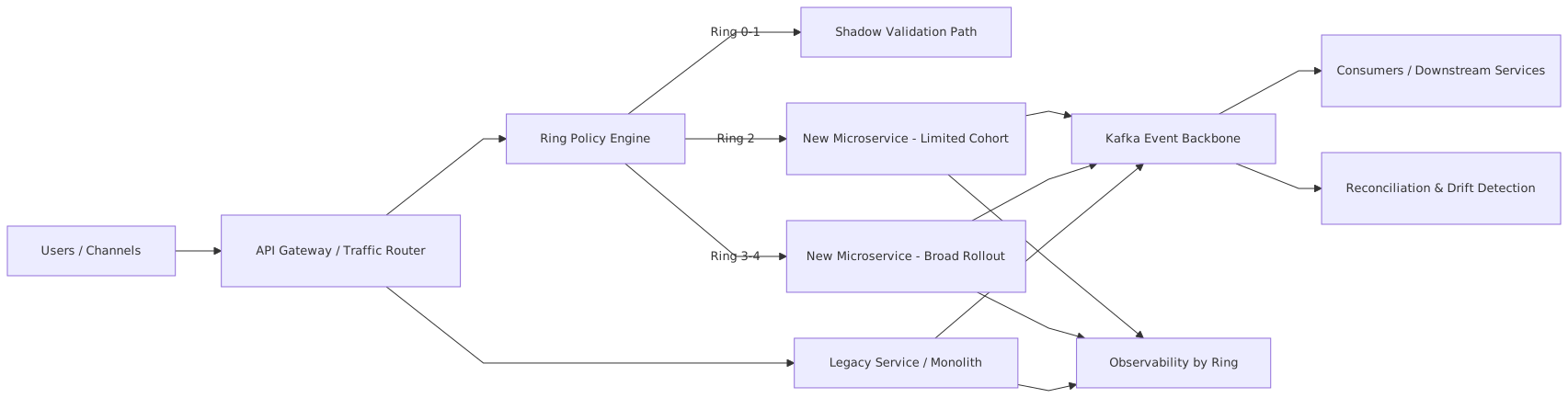
Notice two things.
First, the legacy path is still present. During migration, “new service” and “old service” are not enemies. They are cohabitants. The architecture must support dual running longer than anyone initially wants.
Second, observability is attached to each path. Not generic metrics. Ring-aware metrics. If you cannot answer, “How is Ring 2 performing for wholesale customers in Germany using negotiated pricing?” then your rollout is blind.
Ring-aware traffic shaping
For synchronous APIs, route by domain attributes:
- customer segment
- market or country
- channel type
- product line
- order type
- tenant
- internal versus external principal
Do not default to plain percentage rollout if business semantics matter. Random percentages are helpful for infrastructure changes. For domain changes, cohort-based routing is usually superior.
Event-driven safety with Kafka
Kafka complicates and improves deployment safety.
It improves things because event streams let you replay history into new services, shadow-consume production events, and compare derived state without immediately taking over production decisions.
It complicates things because multiple consumers may interpret the same event differently, and ordering or idempotency issues can surface only under production conditions.
A safe event-driven rollout usually includes:
- backward and forward compatible schemas
- consumer tolerance for unknown fields
- idempotent event handling
- dead-letter or quarantine strategy for malformed messages
- offset management for shadow consumers
- replay tooling for historical comparison
- explicit event ownership by bounded context
Here is a useful migration shape for asynchronous coexistence.
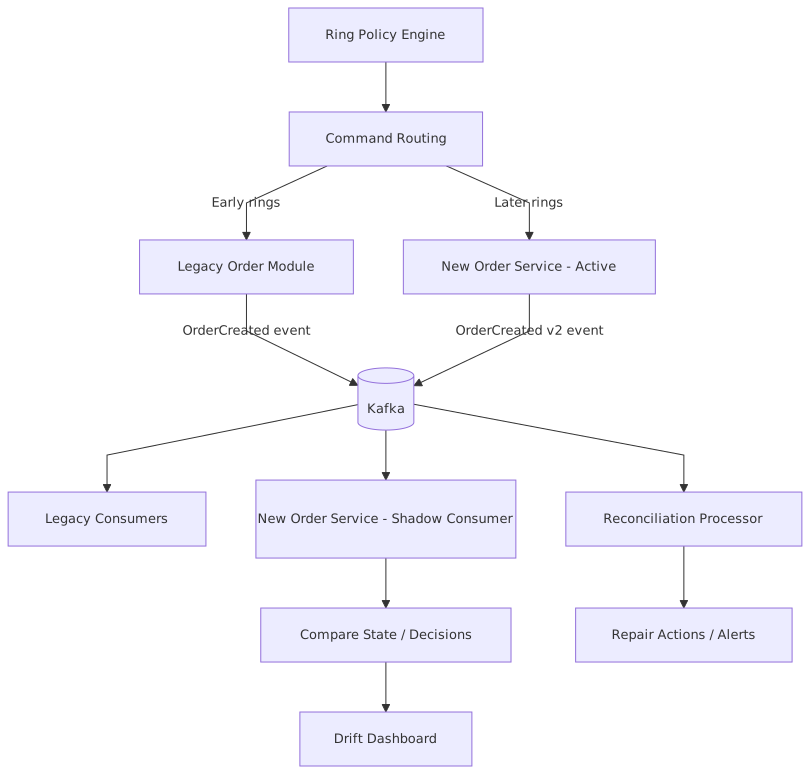
This pattern gives you a crucial capability: before the new service becomes authoritative, it can consume the same facts, build its own view, and prove semantic parity or explain intentional differences.
Domain semantics and bounded contexts
The single biggest mistake in deployment design is treating services as merely technical units.
If you are doing domain-driven design properly, each service should correspond to a bounded context or a coherent slice within one. Safety rings must therefore be chosen with domain language.
Take a retail enterprise. “Order” is too broad. It usually contains separate concerns:
- cart pricing
- order capture
- credit authorization
- fulfillment allocation
- shipment orchestration
- return initiation
- refund settlement
A deployment ring for “Order Service” is meaningless unless you know which part of the domain behavior changes. Rolling out allocation logic to one warehouse is very different from rolling out refund logic to one payment method.
Domain semantics determine:
- what is safe to sample
- what must be paired with reconciliation
- what requires dual writes avoidance
- what downstream consumers must be checked
- what constitutes business success in each ring
Architecture gets more honest when the domain language appears in the release plan.
Migration Strategy
Safety rings become indispensable during progressive strangler migration.
The strangler pattern is often drawn as a clean replacement story: route some traffic to the new service, expand gradually, retire the old system. Reality is messier. During migration, authority over data and behavior shifts unevenly. Some reads may come from the new model while critical writes still land in the monolith. Some events are produced twice. Some states must be backfilled. Some domain rules are “the same” until you find the old batch job that quietly corrected edge cases every night.
A good migration strategy uses safety rings to control this ambiguity.
Stage 1: Observe before you own
Start by creating a new service that can observe the domain through copied events, CDC streams, or mirrored commands. Let it build state and decisions in parallel. Do not trust synthetic data alone. Enterprises hide weirdness in production records.
The point here is not just load testing. It is semantic learning.
Stage 2: Compare and classify drift
Differences between old and new behavior will appear. Some are defects. Some are intentional policy changes. Some are data quality problems the monolith masked. You need an explicit drift classification process:
- expected difference
- defect in new service
- defect in old service
- data issue requiring cleanup
- timing issue due to eventual consistency
- non-deterministic rule requiring redesign
This is architecture work, not QA housekeeping.
Stage 3: Route a recoverable cohort
Move one cohort whose failures are survivable. Choose a ring where:
- support teams can intervene manually if needed
- financial exposure is bounded
- process complexity is lower
- customer communication paths are clear
If possible, begin with read paths or advisory decisions before command authority. For example:
- new recommendation or validation service used for internal users
- new pricing engine calculating in parallel before becoming system of record
- new fulfillment predictor informing but not controlling allocation
Stage 4: Establish reconciliation as a first-class capability
Reconciliation is not a temporary script. It is a migration subsystem.
Whenever old and new paths coexist, there will be divergence:
- missing events
- duplicate processing
- state transitions applied in different orders
- stale projections
- partial side effects after retries or timeouts
You need regular reconciliation between sources of truth and derived stores. This may involve:
- comparing entity snapshots
- replaying event histories
- checking aggregate invariants
- triggering repair workflows
- generating audit records for finance or compliance
The teams that skip this stage usually rediscover it under executive pressure.
Stage 5: Shift authority, then retire carefully
Once a new service proves itself ring by ring, shift command authority. But don’t rush to delete the old path. Keep the fallback and comparison capability long enough to survive month-end processing, unusual business cycles, and delayed downstream consumption.
Retirement should happen only after:
- ring metrics are stable
- reconciliation backlog is low and understood
- operational runbooks are updated
- support staff know failure handling
- reporting and compliance outputs are verified
Here is a simple ring-based strangler progression.

If that sounds slow, good. Enterprise migration should be fast where it can be and cautious where it must be.
Enterprise Example
Consider a global insurance company modernizing claims handling.
The legacy claims platform was a 20-year-old core system. It handled claim intake, fraud screening, policy validation, reserve calculation, adjuster assignment, and partner notifications. The company wanted to carve out a new Claims Intake microservice and later move fraud and reserve logic into separate bounded contexts. Kafka was already in place as the integration backbone.
On paper, intake looked simple: receive claim submission, validate policy, register claim, emit ClaimRegistered.
In reality, the intake process encoded years of policy quirks:
- country-specific regulatory fields
- partner-submitted claims with partial identity data
- catastrophe events that changed SLA and workflow
- duplicate claim suppression rules known only by operations
- internal claims entered by call center agents using privileged overrides
A naive team would have built the new service, passed tests, and rolled it out with a 5% canary. That would have been reckless. A random 5% sample would include regulated and catastrophe-related claims where failure costs were disproportionate.
Instead, they used safety rings based on domain cohorts.
Ring 1: shadow-consume production intake events and reconstruct claim registration decisions without changing outcomes.
Ring 2: internal call center claims in one small country where manual intervention was easy.
Ring 3: partner claims for a narrow product line with low claim value.
Ring 4: broader retail claims across several regions.
Ring 5: catastrophe and complex commercial claims only after separate validation.
They found several important drifts:
- the legacy platform tolerated malformed broker reference fields and auto-corrected them in a nightly batch
- duplicate detection was time-window based and depended on claim source channel
- policy validation responses arriving out of order caused occasional re-registration attempts
- one downstream reserving consumer assumed a field that was undocumented but always present in old events
None of those issues would have shown up in a clean lower environment.
The team used Kafka replay to test historical events against the new intake service. They added idempotency keys for claim submissions, preserved event compatibility, and built a reconciliation job that compared registered claims across old and new stores every hour. They also instrumented domain metrics:
- duplicate claim rate
- manual adjustment rate
- average registration latency by claim type
- partner rejection rate
- reserve creation lag
The migration took longer than management first hoped. It also avoided a regulatory incident. That is what good architecture looks like in the real world: less dramatic, more durable.
Operational Considerations
Safety rings are not merely a release pattern. They are an operating model.
Ring-specific observability
Measure technical and business signals per ring:
- error rate
- latency
- throughput
- consumer lag
- retry rate
- dead-letter volume
- business acceptance rate
- compensation rate
- duplicate or orphan record count
- support ticket volume
- revenue or settlement anomalies
Dashboards should answer whether the ring is healthy, not merely whether the service is up.
Control points
You need explicit mechanisms to pause expansion:
- feature flags
- routing rules
- topic consumer toggles
- saga initiation guards
- policy engine switches
A rollout without a pause button is not a rollout plan. It is wishful thinking.
Runbooks and support
Support teams need to know:
- how to identify ring membership for a request or entity
- how to reprocess messages safely
- how to trigger reconciliation
- when to fail back to the legacy path
- which cases require manual business intervention
Data lineage and auditability
During coexistence, it must be clear:
- which system was authoritative for a decision
- which event version was emitted
- which service processed which command
- whether the outcome was later corrected by reconciliation
This is especially important in financial services, healthcare, telecom, and regulated retail.
Tradeoffs
No honest architecture article should pretend this is free.
More control, more complexity
Safety rings add routing logic, telemetry dimensions, comparison tooling, and operational process. For a small system, this may feel heavy. That’s because it is.
Slower broad rollout
You trade immediate global deployment for staged exposure. Some organizations will perceive this as reduced agility. They are wrong in the long term, but they will still complain.
Temporary duplication
Shadow paths, reconciliation jobs, dual-read logic, and compatibility layers all add cost. Migration architectures are often inelegant. That is acceptable if they are temporary and purposeful.
Cognitive load
Teams must understand both business cohorts and technical deployment mechanics. This requires stronger collaboration between engineering, operations, and domain experts.
Not all changes deserve rings
A CSS tweak to an internal admin screen probably does not need a domain-shaped rollout hierarchy. Applying the pattern indiscriminately turns prudence into bureaucracy.
The architect’s job is not to maximize safety everywhere. It is to spend safety where failure is expensive.
Failure Modes
Safety rings fail in recognizable ways.
Ring definitions are technical, not business-oriented
If rings are “10%, 25%, 50%” without regard to domain impact, you have limited some load but not necessarily business risk.
Observability lacks semantic metrics
A rollout can look healthy on CPU, latency, and error rates while quietly corrupting invoices or rejecting legitimate claims.
Legacy and new paths diverge silently
Without drift comparison and reconciliation, dual running gives false confidence. Both systems continue, but no one notices disagreement until downstream damage accumulates.
Rollback assumptions are unrealistic
If side effects escaped the service boundary, rollback is incomplete. You need compensations, not just redeployment.
Teams expand rings under schedule pressure
The most common operational failure is managerial impatience disguised as pragmatism. “It looks fine so far” is not evidence.
Event contracts break consumers
A new producer emits semantically different events under a compatible schema. Syntactic compatibility is preserved, semantic compatibility is not. This is one of the nastier Kafka failure modes.
Reconciliation becomes a junk drawer
If reconciliation is treated as “we’ll fix data later,” it becomes institutionalized sloppiness. Reconciliation should detect and repair bounded classes of drift, not excuse poor design.
When Not To Use
Deployment safety rings are not mandatory for every microservice.
Do not use a heavy ring model when:
- the service is internal, low criticality, and easily reversible
- the change is purely infrastructural with no domain behavior change
- there are no meaningful cohorts to segment
- the system has low side-effect complexity
- the cost of delayed rollout outweighs the limited blast radius
- the architecture is so immature that basic observability and contract discipline are still missing
In those cases, a simpler canary or blue-green deployment may be enough.
Also, do not pretend to use safety rings if the organization lacks the discipline to operate them. A half-implemented ring model—without business metrics, without pause controls, without reconciliation—is worse than a simple honest deployment strategy. Complexity without containment is just pageantry.
Related Patterns
Deployment safety rings sit well with several other patterns:
- Strangler Fig Pattern: progressive replacement of monolith capabilities
- Branch by Abstraction: introduce indirection before switching implementations
- Canary Release: useful as one mechanism inside a ring, especially for infrastructure changes
- Blue-Green Deployment: strong for environment-level switching, weaker for domain-segmented risk control
- Feature Flags: critical for behavior gating and ring membership control
- Saga Pattern: relevant where distributed workflows need compensation
- Outbox Pattern: helps reliable event publication during migration
- Consumer-Driven Contracts: useful, but insufficient alone for semantic safety
- CQRS: can support shadow reads and side-by-side projections
- Anti-Corruption Layer: essential when new bounded contexts must coexist with a legacy model
The important point is that rings are not a substitute for these patterns. They are a release and risk containment model that coordinates them.
Summary
Deployment safety in microservices is too often discussed as a pipeline concern. It isn’t. It is a domain risk management problem expressed through architecture.
Safety rings work because they respect a simple truth: confidence should grow in concentric circles. Start where failure is cheap and visible. Move outward only when the new behavior proves itself against production reality. Define the rings by business meaning, not infrastructure convenience. Use Kafka and event replay to observe before you own. Build reconciliation because coexistence always leaks. Assume rollback is limited. Measure semantics, not just systems.
And above all, remember this: in enterprise architecture, the dangerous releases are rarely the loud ones. They are the quiet ones that change the business before anyone realizes the software has done so.
That is why safety rings matter. Not because they make deployment elegant, but because they keep change inside a boundary the business can survive.
Frequently Asked Questions
What is a service mesh?
A service mesh is an infrastructure layer managing service-to-service communication. It provides mutual TLS, load balancing, circuit breaking, retries, and observability without each service implementing these capabilities. Istio and Linkerd are common implementations.
How do you document microservices architecture for governance?
Use ArchiMate Application Cooperation diagrams for the service landscape, UML Component diagrams for internal structure, UML Sequence diagrams for key flows, and UML Deployment diagrams for Kubernetes topology. All views can coexist in Sparx EA with full traceability.
What is the difference between choreography and orchestration in microservices?
Choreography has services react to events independently — no central coordinator. Orchestration uses a central workflow engine that calls services in sequence. Choreography scales better but is harder to debug; orchestration is easier to reason about but creates a central coupling point.