⏱ 20 min read
Microservices fail in a surprisingly ordinary way. Not with a dramatic outage, not with a spectacular postmortem, but with slow conceptual decay. A team splits a system into services, gives each one a Dockerfile, a CI pipeline, and a Kafka topic, and declares victory. Six months later the services still talk too much, change together, break together, and confuse everyone. What was meant to be a set of business-aligned capabilities becomes a distributed monolith wearing cloud-native clothing. event-driven architecture patterns
That is the real problem of cohesion in microservices. It is not just about lines of code or package boundaries. It is about whether a service has a meaningful center of gravity. Whether its behavior belongs together in business terms. Whether the team owning it can explain, in one breath, why these responsibilities are in the same box and not in three others.
A cohesive microservice feels like a well-run shop: one purpose, clear inventory, obvious staff responsibilities. An incohesive one feels like a department store built by committee, where shoes are sold in electronics because a database table happened to fit there first.
This article looks at service cohesion metrics in microservices from an enterprise architecture perspective. Not vanity metrics, not dashboard theater, but practical ways to assess whether a service boundary reflects the domain. We will look at domain-driven design, migration strategy, Kafka-driven integration, reconciliation, operational realities, and the tradeoffs that matter in large organizations. We will also look at when cohesion metrics help, when they lie, and when microservices are simply the wrong answer. microservices architecture diagrams
Context
In a monolith, cohesion problems are often survivable. You can have a bloated module, a utility package that knows too much, or an order component that quietly manipulates customer records. The damage is real, but the runtime is still local. Calls are fast, transactions are shared, and debugging is at least physically nearby.
In microservices, low cohesion becomes expensive. Every misplaced responsibility now creates network traffic, versioning complexity, ownership ambiguity, and failure propagation. The old design smell becomes an operating model problem.
This is why service cohesion matters more in distributed systems than in modular monoliths. A bad service cut is not just ugly. It is operational debt with interest.
Most enterprises arrive here through one of three paths:
- Lift-and-shift decomposition
They break a monolith along technical layers rather than business capabilities. A “customer-service” becomes a thin API over customer tables, while order, billing, and support all still depend on it for reasons nobody can cleanly justify.
- Team topology drift
The service boundary follows org charts, not domain semantics. One team owns “everything checkout-ish,” another owns “everything account-ish,” and over time the seams reflect manager spans more than business truth.
- Event-driven optimism
Kafka is introduced, topics proliferate, and architects assume asynchronous communication automatically creates loose coupling. It does not. You can absolutely build a tightly coupled distributed system with excellent event streaming.
Cohesion is the question beneath these symptoms: do the behaviors, rules, state, and change patterns of this service truly belong together?
Problem
Teams usually ask the wrong question. They ask, “How small should a microservice be?” That is a seductive but mostly useless question. Smallness is not the goal. Cohesion is.
A tiny service with three endpoints can still be incohesive if it mixes pricing rules, customer identity checks, and shipment status formatting. A larger service can be entirely appropriate if it encapsulates a rich domain capability with strong internal consistency.
The hard part is that cohesion is partly qualitative. Architects sense it before they can measure it. They hear it in requirements conversations:
- “Every change to returns also needs a change in order management.”
- “This team owns customer preferences, but marketing and support keep adding logic.”
- “We have five services in the checkout flow, yet all of them deploy together.”
- “Nobody knows which service is the source of truth.”
These are not just delivery problems. They are boundary problems.
The distributed monolith often emerges because service design starts from data entities instead of domain behavior. Enterprises see tables like Customer, Order, Invoice, and Payment, then create services with the same names. That looks neat in a slide deck. It is often wrong in practice. A data entity is not a business capability. A bounded context is not a table with an API in front of it.
Domain-driven design gives us a better lens. A service should usually align to a bounded context or a meaningful subdomain capability, not merely a noun in the data model. The service boundary should preserve ubiquitous language, keep invariants where they belong, and avoid scattering one business process across many owners.
If a customer address change affects shipping eligibility, tax jurisdiction, fraud scoring, marketing segmentation, and support workflows, then “Customer Service” is probably too vague to be useful. The business meaning is smeared across contexts. That smearing is a cohesion problem.
Forces
Good architecture is mostly force management. Cohesion sits in the middle of several competing forces.
1. Domain integrity vs team autonomy
A service should encapsulate meaningful business rules. But teams also want independent delivery. Sometimes a single cohesive domain capability is too large for one team. Sometimes splitting it improves flow, but weakens semantic clarity.
This is the first uncomfortable truth: organizational scalability and domain cohesion do not always point in the same direction.
2. Local consistency vs distributed flexibility
High cohesion often means keeping tightly related state transitions together. That supports transactional integrity. But enterprises also want asynchronous integration, event streaming, and independent data stores. Pull too hard toward distribution and you fracture invariants.
3. Reuse vs ownership
Shared services are often sold as reuse. In reality they are frequently ownership sinkholes. A heavily reused “common customer service” may have low cohesion because it serves too many masters with conflicting semantics.
Shared utility is not the same as a shared domain.
4. Stable boundaries vs evolving understanding
Domains are not discovered once. They are learned. Cohesion metrics must support evolution, not fossilize today’s assumptions. A service that looks cohesive during initial decomposition may split later as the business matures.
5. Synchronous simplicity vs event-driven decoupling
Synchronous APIs are easy to reason about for immediate request-response needs. Kafka and event-driven architectures support decoupling, scale, and temporal independence. But event-driven systems can obscure cohesion failures by moving coupling from HTTP calls to topic choreography.
A chain of services all reacting to the same business event without clear ownership is still a design smell. It is just harder to see.
Solution
The useful approach is to treat cohesion as a composite assessment, not a single metric. There is no magic number that tells you a service boundary is right. What works is a small set of measures that combine runtime behavior, change behavior, and domain semantics.
I recommend evaluating service cohesion across five dimensions.
1. Semantic Cohesion
Do the capabilities in the service belong to the same bounded context? Can the team describe the service in domain language without hand-waving?
Questions to ask:
- Do its commands and events use a consistent ubiquitous language?
- Are its invariants conceptually related?
- Does it represent one business capability or a grab bag of adjacent concerns?
- When domain experts speak, do they naturally describe these behaviors together?
Semantic cohesion is the most important dimension because it keeps the architecture honest. A service that is operationally neat but semantically muddled will eventually rot.
2. Change Cohesion
How often do features in this service change together, and how often do they require changes elsewhere?
Useful signals:
- Commit correlation across services
- Joint release frequency
- Cross-service ticket coupling
- Number of features that require multi-team coordination
If every pricing change also requires changes in promotions and checkout orchestration, your boundaries likely cut through one business capability.
A memorable rule: services that always travel together should probably live together.
3. Interaction Cohesion
How much chat is required to complete one business action?
Useful measures:
- Average number of service calls per business transaction
- Number of synchronous dependencies in critical paths
- Event fan-out from a single command
- Round trips required to enforce one invariant
Some interaction is normal. Excessive interaction is often a symptom of low cohesion. If placing an order requires seven synchronous calls just to answer “is this valid?”, the boundary is probably wrong.
4. Data Cohesion
Does the service own data that fits its responsibility, or is it hoarding unrelated state?
Signals include:
- Number of external services reading its database indirectly or demanding replicas
- Cross-context joins reappearing in analytics and operational workflows
- Duplicate copies of the same concept with conflicting update rules
- Data model breadth relative to domain purpose
Data cohesion matters because data gravity is real. Services often become incohesive not because of endpoints, but because they accumulate state from neighboring contexts.
5. Operational Cohesion
Can the service be deployed, scaled, observed, and supported as a unit?
Measures include:
- Independent deployment success rate
- Runtime scaling profile consistency
- Incident ownership clarity
- Blast radius of failure
A service that contains features with radically different runtime profiles can still be semantically cohesive, but the operational cost may be unacceptable. Cohesion is not purely a domain story. It lives in production too.
Architecture
A pragmatic architecture uses these dimensions as a diagnostic model. It does not force every service into textbook purity. It asks: where are the seams causing pain, and are those seams aligned to the business?
Here is a simple conceptual view of service cohesion assessment.
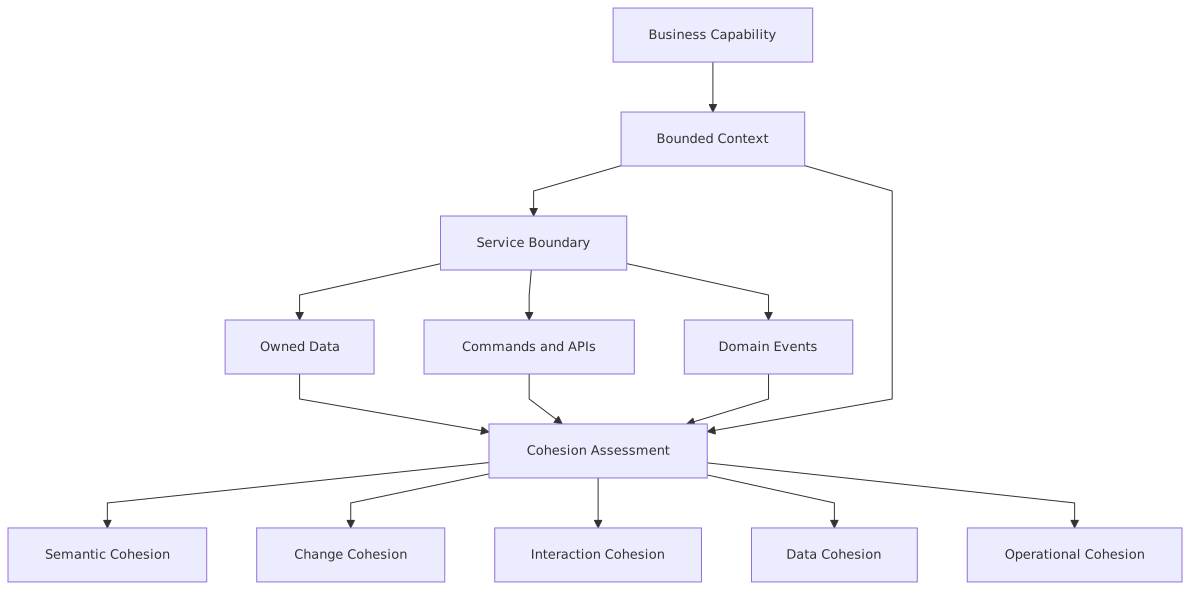
This is not a maturity model. It is a conversation tool. Architects should use it during service design reviews, post-incident analysis, and migration planning.
A cohesive microservice architecture usually has these characteristics:
- Each service maps to a meaningful business capability or bounded context.
- Commands and invariants are local where possible.
- Domain events communicate outcomes, not internal implementation noise.
- Kafka topics reflect business facts with durable meaning.
- Read models and replicas are created intentionally, not as accidental shadow ownership.
- Reconciliation processes exist where eventual consistency is accepted.
And this last point matters. In real enterprises, cohesion does not eliminate distributed inconsistency. It changes where you handle it. If a workflow spans order capture, inventory allocation, payment authorization, and fulfillment, some of those concerns should remain in distinct contexts. The answer is not to shove them all into one giant “commerce service.” The answer is to keep each context cohesive and make reconciliation explicit.
That means designing for:
- idempotent consumers
- compensating actions
- replay-safe event handling
- audit trails
- business reconciliation dashboards
The architect’s job is not to abolish inconsistency. It is to decide where consistency is mandatory and where reconciliation is acceptable.
Here is a typical enterprise pattern for cohesive event-driven collaboration.
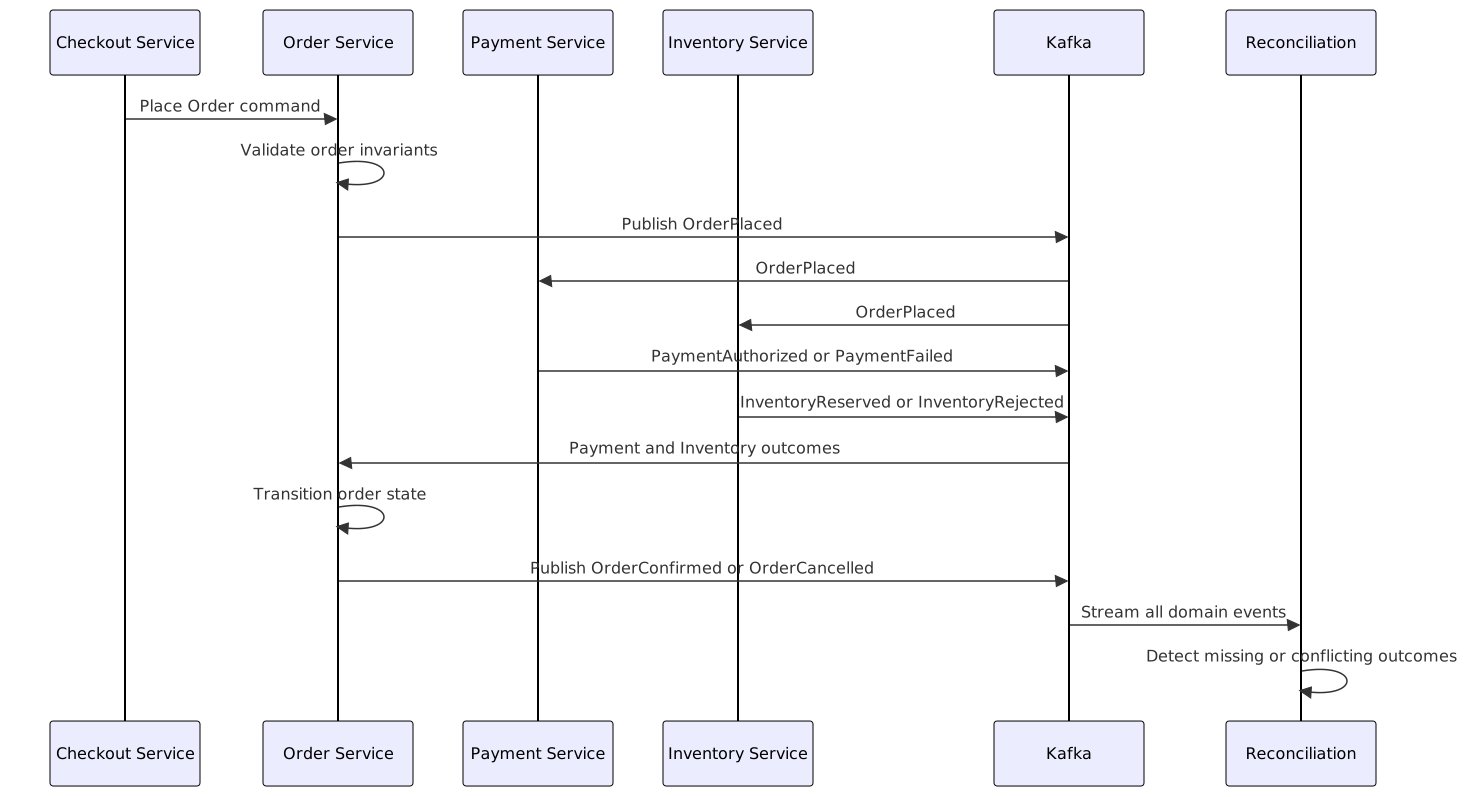
Notice what this sequence does not do. It does not pretend synchronous orchestration is always superior. It also does not pretend Kafka magically solves everything. The order service remains cohesive because it owns order lifecycle semantics. Payment owns payment rules. Inventory owns stock reservation. Reconciliation handles drift across the edges.
That is what healthy cohesion looks like in distributed systems: clear ownership inside the service, explicit coordination outside it.
Migration Strategy
Most enterprises do not get to redesign from scratch. They inherit a monolith, political compromises, shared databases, and several years of accidental architecture. So the practical question is not “What is the ideal target?” It is “How do we move without wrecking the business?”
The right answer is usually a progressive strangler migration.
Start by identifying seams not in the codebase, but in the domain. Which business capabilities have relatively self-contained language, rules, and change patterns? Which pain points reveal a boundary mismatch? Which capabilities suffer because changes require too much coordination?
Then move in stages.
Stage 1: Measure before splitting
Do not carve out services because a team wants modern technology. Measure:
- change coupling across modules
- production call graphs
- deployment coordination patterns
- incident ownership confusion
- data access hotspots
This tells you where cohesion is low today.
Stage 2: Extract one cohesive capability
Pick a capability with:
- clear business semantics
- high internal change correlation
- manageable integration surface
- low need for distributed transactions at first
This is often something like pricing, catalog publication, claims intake, or identity verification. It is less often “customer,” because customer data tends to span multiple contexts.
Stage 3: Establish source-of-truth ownership
Before moving code, decide what the extracted service owns:
- write authority
- event publication responsibility
- canonical business rules
- reconciliation obligations
Without this, migration produces duplicate ownership and endless confusion.
Stage 4: Introduce anti-corruption and event publication
Put an anti-corruption layer around the old model. Publish domain events with business meaning. Avoid leaking monolith internals into new services. This is where Kafka helps: not as a buzzword, but as a durable integration backbone for domain events and downstream read models.
Stage 5: Run parallel with reconciliation
During migration, the old and new worlds will disagree. Plan for it. Create reconciliation jobs, exception queues, and business review processes. Progressive migration without reconciliation is just optimism in a suit.
Stage 6: Cut over by business behavior, not just API traffic
A successful strangler pattern retires business responsibility from the monolith in slices. It is not enough to route HTTP calls to a new service if critical rules still live in old code or if batch jobs still mutate the same state.
Here is a migration view.
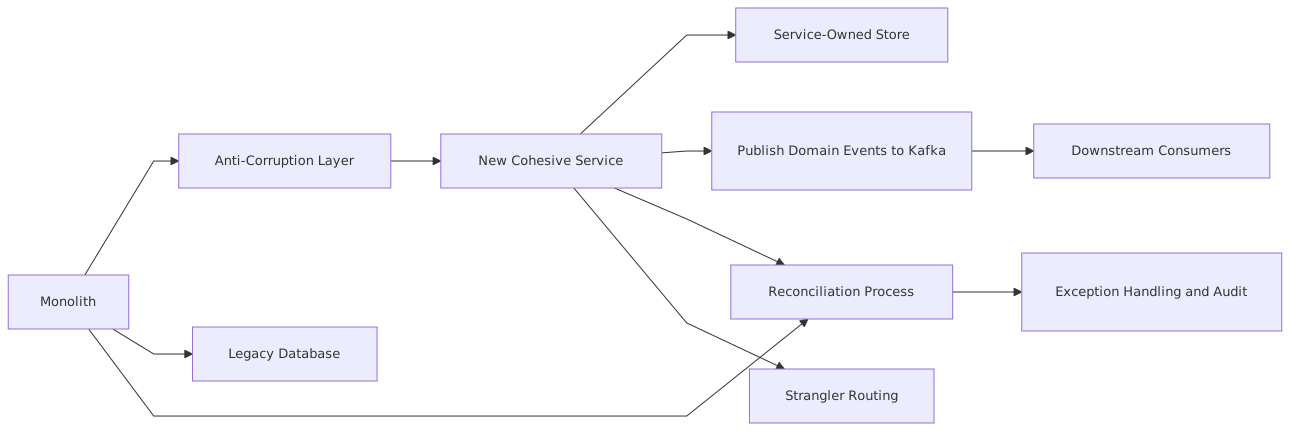
The trap here is over-extraction. Teams often split too early and discover they moved one tangled domain into five unstable services. Migration should increase clarity, not merely increase service count.
Enterprise Example
Consider a large insurer modernizing its policy administration platform.
The legacy core had one giant policy module that handled quote generation, policy issuance, endorsements, billing triggers, document production, and agent notifications. The company’s first decomposition attempt produced services called Policy, Billing, Customer, Document, and Notification. It looked reasonable. It was a mess.
Why? Because the “Policy Service” still contained quoting rules, endorsement calculations, and underwriting exceptions, while Billing needed policy semantics to generate installment schedules, and Document needed policy semantics to produce regulated artifacts. Every change to a product rule triggered changes in three or four services.
The service boundaries reflected technical nouns, not business capabilities.
A second pass used domain-driven design more seriously. The architecture team identified bounded contexts around:
- Quotation
- Policy Lifecycle
- Billing
- Document Composition
- Producer/Agent Interaction
This was not just relabeling. They explicitly mapped ubiquitous language and invariants:
- Quotation owned premium calculation options and quote validity.
- Policy Lifecycle owned issued policy state transitions and endorsements.
- Billing owned receivable schedules and payment allocation.
- Document Composition owned regulated template assembly, not policy rules.
- Producer Interaction owned channel workflows and notifications.
Kafka was introduced to carry durable business events such as QuoteCreated, PolicyIssued, EndorsementApplied, and InstallmentGenerated. The team resisted publishing low-level internal events. That discipline mattered. Downstream services subscribed to business facts, not implementation twitching.
They also built reconciliation because eventual consistency was unavoidable. If PolicyIssued reached billing but a downstream transformation failed, the reconciliation process detected a policy with no generated receivable schedule within a defined SLA. That exception entered a business operations queue.
The result was not perfect decoupling. Some policy changes still touched billing assumptions. But change cohesion improved dramatically. Product rule changes mostly affected quotation and policy lifecycle. Billing could evolve payment methods independently. Incident ownership became clearer. The architecture stopped pretending there was one universal meaning of “policy data.”
That is what better cohesion looks like in enterprise life: fewer semantic arguments, fewer coordinated releases, and fewer 2 a.m. calls where three teams insist the bug belongs to someone else.
Operational Considerations
Cohesion shows up in production long before it appears in architecture governance documents. EA governance checklist
Observability
A cohesive service should produce telemetry that reflects one business capability. Traces, logs, and metrics should tell a coherent story. If one service dashboard mixes cart abandonment, tax lookup latency, inventory reserve failures, and loyalty point accrual, the service is probably doing too much.
Scaling
Different workload profiles often reveal low cohesion. If part of a service needs CPU-heavy rule evaluation while another part is I/O-bound and bursty, scaling them together can be wasteful. Sometimes this is the operational evidence that a semantic split is justified. Sometimes it is not. Architects should resist using infrastructure inconvenience as the only decomposition driver, but they should not ignore it either.
Data governance
In regulated enterprises, cohesion affects auditability. If PII, payment data, and operational support notes all cluster in one service because “customer needed everything,” access control and retention become chaotic. Strong service boundaries often support cleaner governance models. ArchiMate for governance
Event versioning
Kafka-based architectures need discipline. Topic ownership should align to service ownership. Events should be versioned with care, and schemas should preserve business meaning. Incohesive services tend to emit unstable event contracts because they serve too many concerns. That instability spreads downstream like mold.
Reconciliation operations
Reconciliation is not a side note. It is a first-class operating capability in event-driven microservices. Enterprises need:
- timeout detection
- missing event detection
- duplicate event handling
- compensating workflow triggers
- human review tooling
If you choose eventual consistency, you are choosing reconciliation. Say it plainly.
Tradeoffs
There is no free lunch here.
Finer-grained services improve some kinds of agility
They can enable independent deployment, more focused ownership, and localized change. But they also increase coordination overhead, contract management, and operational complexity.
Coarser-grained services preserve invariants more easily
They reduce network chatter and simplify local transactions. But they can become too broad, too politically contested, and too difficult for one team to evolve cleanly.
Event-driven integration reduces temporal coupling
Consumers can react asynchronously and build local models. But now observability, debugging, ordering guarantees, and reconciliation get harder.
Shared domain services can reduce duplication
But they can also become semantic battlegrounds, where every department wants slightly different behavior from the same concept.
The practical tradeoff is not monolith versus microservices. It is where to place semantic responsibility so that business change remains affordable.
That is the real economic question of cohesion.
Failure Modes
Architects should be skeptical of neat diagrams. Most cohesion initiatives fail in familiar ways.
1. Entity-based decomposition
Teams create services around nouns from the ER model. The result is APIs over tables, not services around business capabilities.
2. Topic explosion with no domain clarity
Kafka becomes a dumping ground for “events,” many of which are just technical state changes with no business meaning. Consumers bind to noise, and coupling grows in the shadows.
3. False autonomy
Teams claim independent ownership, but every release still requires cross-team coordination. This is low change cohesion wearing a product operating model costume.
4. Split invariants
Business rules that must be atomic get scattered across services. Now reliability depends on retries and hope. Hope is not a consistency model.
5. Reconciliation denial
The architecture assumes asynchronous processing will “eventually settle.” But there is no process to detect when it does not. Missing business outcomes accumulate silently until finance, compliance, or customer support notices.
6. Measuring only technical signals
Call counts and commit patterns are useful, but without domain semantics they mislead. Some domains naturally interact heavily. High interaction does not automatically mean low cohesion if the business responsibilities are still well bounded.
When Not To Use
Not every system needs microservice cohesion metrics, because not every system should be microservices in the first place.
Do not overinvest in this approach when:
The domain is small and stable
A modular monolith may be the better design. If one team owns the system, releases are straightforward, and business rules are tightly integrated, distribution may buy you little.
The organization cannot support service ownership
If teams are not stable, production support is centralized, and operational maturity is low, microservices will create ceremony without autonomy.
The boundaries are still highly uncertain
When a business capability is still being discovered, splitting too early can freeze bad assumptions. A modular monolith often gives better learning economics.
Strong consistency dominates
If core workflows require strict transactional integrity across several tightly related behaviors, forcing them into separate services can create more risk than value.
Metrics become governance theater
If cohesion scoring becomes a checkbox exercise for architecture review boards, it will produce compliance theater, not better design.
A decent test is this: if the business cannot articulate distinct capabilities with distinct ownership and change patterns, do not force a microservice boundary just because the platform team has a Kubernetes cluster.
Related Patterns
Several patterns naturally connect to service cohesion.
Bounded Context
This is the anchor pattern. Cohesion is strongest when services align to bounded contexts with clear language and rules.
Strangler Fig
Ideal for progressively extracting cohesive capabilities from a monolith while preserving business continuity.
Anti-Corruption Layer
Essential during migration to prevent legacy concepts from infecting new service models.
Saga
Useful for coordinating multi-service workflows where no single local transaction can cover the whole business process. Use carefully. Sagas can expose bad boundaries as much as they can manage them.
CQRS
Helpful when write-side cohesion is clear but read-side needs span multiple contexts. Read models can reduce pressure to merge services simply for query convenience.
Event Sourcing
Sometimes useful in domains with rich state transitions and audit needs. But do not use it as a cohesion substitute. A bad boundary with event sourcing is still a bad boundary, just with more storage.
Modular Monolith
Worth mentioning because it is often the right precursor. Strong internal module cohesion often predicts healthier later service extraction.
Summary
Service cohesion in microservices is not a beauty contest. It is a test of whether your architecture respects the domain strongly enough to survive distribution.
The best services are not the smallest. They are the ones with a clear semantic center. Their rules belong together. Their data has a rightful home. Their changes do not drag half the estate along. Their incidents have obvious owners. Their events mean something in business language. Their inconsistencies are reconciled intentionally, not discovered by accident.
If you remember one line, remember this: microservices should divide operational independence without dividing business meaning.
Use cohesion metrics as a practical lens:
- semantic cohesion to test bounded context integrity
- change cohesion to find hidden coupling
- interaction cohesion to expose chatty boundaries
- data cohesion to reveal ownership confusion
- operational cohesion to keep production sane
Then migrate progressively. Use strangler patterns. Introduce Kafka where asynchronous domain events genuinely help. Build reconciliation because reality will not stay perfectly synchronized for your convenience. Let domain-driven design steer the cuts, not the shape of your tables or the enthusiasm of your platform team.
A coherent service architecture does not eliminate complexity. It puts complexity where it can be understood, owned, and changed. In enterprise systems, that is as close to elegance as we usually get.
Frequently Asked Questions
What is a service mesh?
A service mesh is an infrastructure layer managing service-to-service communication. It provides mutual TLS, load balancing, circuit breaking, retries, and observability without each service implementing these capabilities. Istio and Linkerd are common implementations.
How do you document microservices architecture for governance?
Use ArchiMate Application Cooperation diagrams for the service landscape, UML Component diagrams for internal structure, UML Sequence diagrams for key flows, and UML Deployment diagrams for Kubernetes topology. All views can coexist in Sparx EA with full traceability.
What is the difference between choreography and orchestration in microservices?
Choreography has services react to events independently — no central coordinator. Orchestration uses a central workflow engine that calls services in sequence. Choreography scales better but is harder to debug; orchestration is easier to reason about but creates a central coupling point.