⏱ 21 min read
Microservice estates rarely fail because teams chose the wrong serialization format. They fail because nobody can see where the system is actually sweating.
That is the uncomfortable truth.
On the whiteboard, every service looks neat: bounded contexts are carefully named, event streams are elegantly routed, and arrows flow in ways that make architects feel clever. In production, something else happens. A handful of services become traffic magnets. One catalog service gets called by everything. One pricing service sits in the middle of every order path. One customer-profile component turns into a dependency that every team is afraid to touch. The architecture still looks distributed, but operationally it has started to collapse toward a few gravitational centers.
Those centers are hotspots.
And if you don’t detect them early, your microservices landscape turns into a city built around a few overloaded roundabouts. Every road leads through them. Every outage spreads through them. Every change request is delayed because somebody whispers, “be careful, half the company depends on that service.” microservices architecture diagrams
Hotspot detection is not merely a performance trick. It is architecture work. It is domain work. It is organizational work. A hotspot diagram, done properly, is one of the clearest ways to expose where your supposed autonomy has quietly decayed into coupling, contention, and fear.
This article lays out how to detect service hotspots in a microservices environment, why they appear, how to reason about them with domain-driven design, and how to migrate away from them without replacing one form of chaos with another. We will cover telemetry, event-driven patterns, Kafka where it helps, reconciliation where it is unavoidable, and the very real tradeoffs that get lost in simplistic “just split the service” advice. event-driven architecture patterns
Context
Microservices promise independent deployability, local ownership, and scaling aligned to business capability. That promise is real. But it comes with a trap: decomposition alone does not guarantee healthy boundaries.
In many enterprises, services are carved up early around teams, systems, or existing APIs rather than around stable domain semantics. The result is a distributed system that looks modular but behaves like a shared monolith. Calls bounce across service boundaries for data that should have been local. Synchronous chains become longer. Shared reference services emerge. Event streams are introduced, but not always in a way that reduces coupling. Sometimes they just move coupling from HTTP to Kafka.
A hotspot diagram helps reveal this reality. It is a visual map of where demand, dependency, change frequency, and operational risk accumulate. Good hotspot detection blends runtime signals with domain understanding:
- request volume
- fan-in and fan-out
- latency concentration
- retry amplification
- deployment frequency
- incident frequency
- data ownership confusion
- reconciliation workload
- business criticality
The point is not to paint a red box around “the busy service.” The point is to identify architectural pressure points: the services whose design, placement, data model, or interaction style creates disproportionate system-wide consequences.
This is where architecture becomes less about component diagrams and more about reading the political economy of a software landscape.
Problem
The visible symptom is usually load.
A service receives too many requests, has too many consumers, or becomes the main source of latency in a user journey. Teams first treat this as an infrastructure issue. They add autoscaling, bigger nodes, caching, maybe a read replica. Sometimes that works for a while.
Then the deeper symptoms appear:
- many teams must coordinate to change one service
- incidents in one area spread across multiple business journeys
- retries from downstream consumers multiply load
- deployment windows become tense
- versioning becomes painful
- local data is insufficient, so synchronous calls proliferate
- event consumers build fragile assumptions around one producer
- domain boundaries blur
At that point, the hotspot is no longer just “hot.” It is centralizing power. It becomes a distributed monolith nucleus.
There are two common mistakes here.
The first is to ignore the hotspot because it seems unavoidable: “of course all services need customer data” or “pricing is naturally central.” Sometimes that is true. Often it is lazy architecture dressed up as inevitability.
The second mistake is the opposite: to reflexively split the service into smaller services. That can make things worse. If the domain is not properly understood, decomposition simply creates more network hops, more eventual consistency pain, and more reconciliation processes. A bad boundary, once distributed, becomes expensive.
So the real problem is not “how do I reduce traffic to service X?” It is:
How do I determine whether a hotspot reflects valid domain centrality or accidental architectural gravity, and what should I do about it?
That is a much better question.
Forces
Service hotspot detection sits at the intersection of several forces, and they pull against each other.
1. Domain centrality vs accidental coupling
Some capabilities are naturally central. Identity, payment authorization, product pricing, fraud scoring—these often sit on critical paths. But centrality in the business domain does not automatically justify centrality in runtime dependencies. The architecture must distinguish true business authority from unnecessary technical dependence.
In domain-driven design terms, a bounded context may be authoritative without being synchronously consulted for every transaction.
2. Consistency vs autonomy
The fastest way to avoid stale data is to call the source service directly. The fastest way to destroy autonomy is also to call the source service directly.
This tension drives much of hotspot formation. Teams want correctness, so they rely on synchronous lookups. Over time, local models atrophy and all roads lead to the source. Eventually, the source becomes both overloaded and feared.
3. Reuse vs ownership
Enterprises love shared capabilities. They also suffer from them. A service that offers “reusable” data or logic often becomes an integration convenience for many teams, but every reuse decision increases fan-in. Shared services can save effort early while quietly accumulating systemic drag.
4. Operational scale vs cognitive scale
A hotspot may be technically scalable with enough hardware, partitioning, and caching. That does not solve the cognitive hotspot: too many teams depend on one contract, one roadmap, one deployment calendar. Throughput can be fixed while organizational bottlenecks remain.
5. Event-driven decoupling vs reconciliation burden
Kafka and event streaming can relieve synchronous hotspots by pushing data outward. But this shifts complexity into event contracts, out-of-order delivery, duplicate handling, stale views, and reconciliation. You have not removed complexity. You have moved it into a different room.
That is fine, if you know why.
Solution
The practical solution is to treat hotspot detection as a continuous architectural capability, not a one-off performance analysis.
You need three things:
- A hotspot model
- A hotspot diagram
- A response playbook
A hotspot model
A useful hotspot model combines runtime and design-time signals. I like to score services across several dimensions:
- Traffic intensity: requests per second, messages per second, concurrent sessions
- Dependency fan-in: number of callers or consumers
- Critical path presence: percentage of key business flows traversing the service
- Latency contribution: share of end-to-end latency
- Retry amplification: amount of downstream retry traffic generated
- Change sensitivity: number of teams impacted by a contract change
- Incident concentration: role in sev1/sev2 incidents
- Data authority pressure: degree to which others depend on it as source of truth
- Reconciliation demand: how often downstream views must be corrected from its data
This matters because a hotspot is multidimensional. A low-latency service with enormous fan-in can still be your biggest architectural risk. A service with moderate traffic but high change sensitivity can be more dangerous than a heavily loaded but isolated component.
A hotspot diagram
The diagram should show not only service relationships but concentration. Node size can represent throughput, color can represent risk or incident frequency, and edge thickness can represent call volume or event flow. If you can layer in business journeys—order placement, claims processing, customer onboarding—you move from technical observability to enterprise architecture.
Here is a simplified example.
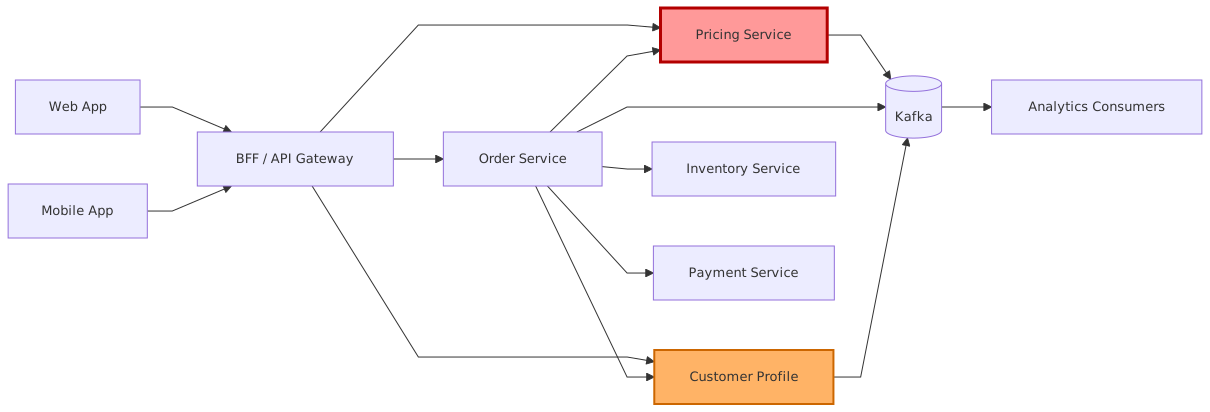
In a real hotspot diagram, Pricing would likely show high fan-in, and Customer Profile might show broad dependence across many journeys. The architecture question is not “how do I draw this nicely?” It is “why are these services the center of gravity?”
A response playbook
Once a hotspot is identified, you need a disciplined response. Broadly, the options are:
- accept it as a legitimate central authority and engineer it accordingly
- reduce synchronous dependence through replication or event-carried state transfer
- split domain responsibilities if the bounded context is too broad
- move computations closer to where decisions are made
- introduce caches or materialized views
- separate write authority from read distribution
- add reconciliation processes for eventual consistency
- change the consuming interactions, not just the hotspot
This is where domain-driven design earns its keep. Hotspots are often a signal that your bounded contexts are wrong, your aggregates are too chatty, or your consumers are treating another context’s internal model as if it were their own.
Architecture
A robust hotspot detection architecture typically has two layers: detection and mitigation.
Detection layer
The detection layer gathers:
- distributed tracing
- service mesh telemetry or API gateway metrics
- Kafka topic metrics and consumer lag
- deployment and incident data
- domain flow mapping
- contract ownership metadata
You want to correlate technical flow with business flow. A service processing 20,000 requests per minute may not be a hotspot if it sits off the critical path and is operationally stable. Another service with only 500 requests per minute may be a severe hotspot if every high-value transaction waits on it and six teams coordinate every change.
Mitigation layer
Mitigation usually combines a few patterns:
- CQRS-style read models for high-read scenarios
- event-driven propagation via Kafka for broad data distribution
- local domain caches with explicit freshness semantics
- anti-corruption layers where one context consumes another’s events
- reconciliation jobs to repair inevitable drift
- saga/process manager orchestration where long-running business flows should not hinge on one synchronous service
The architecture often ends up looking something like this.
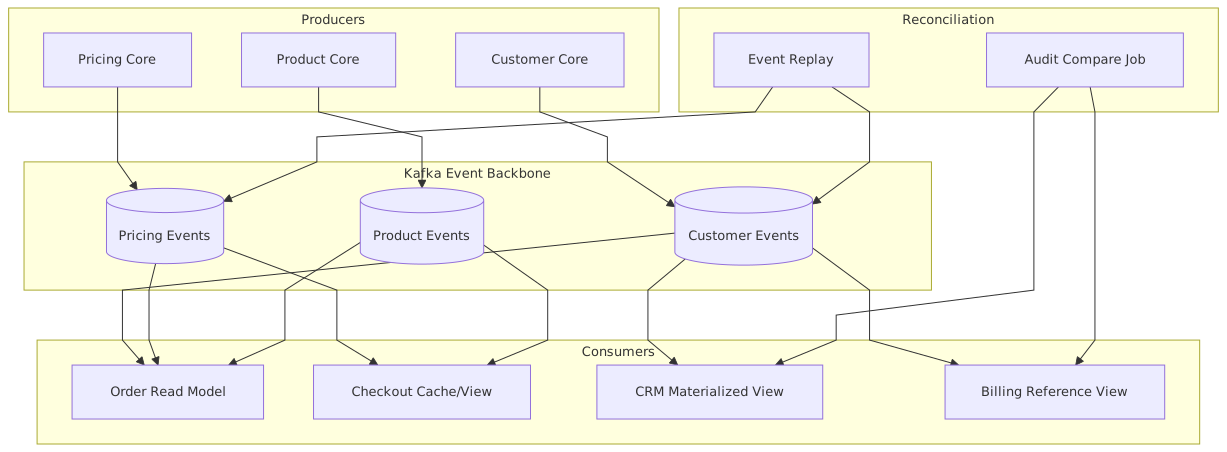
This is the shape of a common answer to hotspot pressure: keep write authority in a bounded context, distribute relevant facts as events, and let consumers maintain fit-for-purpose views.
But this only works if event semantics are sound. “CustomerUpdated” is usually too vague. Downstream consumers need language that reflects actual domain facts and lifecycle significance. Domain events are not change logs with better branding.
Domain semantics matter
This is the part many teams skip. They stream records and call it architecture.
If your hotspot is Customer Profile, then ask: what do consumers actually need?
- legal identity?
- communication preferences?
- shipping addresses?
- loyalty tier?
- KYC status?
- segmentation?
- account standing?
These are not the same thing. Treating them as one giant “customer service” is often the architectural sin that creates the hotspot in the first place. In DDD terms, you probably have multiple subdomains packed into one overburdened bounded context. Consumers then call that service for everything because it owns too much.
Likewise with pricing. “Pricing” can mean base price publication, promotion eligibility, personalized offer calculation, tax treatment, discount policy, or quote generation. Those have different consistency needs, different change rates, and different ownership models.
Hotspot detection should therefore trigger semantic investigation, not just traffic optimization.
A hotspot is often a symptom of domain compression.
Migration Strategy
The safest migration away from a hotspot is usually progressive strangler migration, not big-bang decomposition.
A hotspot service often sits in too many business flows to replace directly. If you rip it out all at once, you will discover every hidden dependency the hard way—at 2 a.m., in production, during month-end processing.
Instead, migrate in slices.
Step 1: classify the hotspot
Decide whether the hotspot is:
- authoritative and valid
- over-centralized but semantically coherent
- semantically overloaded
- an accidental integration hub
- a read hotspot, a write hotspot, or both
This choice matters. A read hotspot is often solved with replicated views. A write hotspot may require aggregate redesign, command partitioning, or business policy refactoring.
Step 2: identify dependency cohorts
Not all consumers use the hotspot for the same reason. Group them:
- transactional callers
- read-only enrichment consumers
- reporting consumers
- operational back-office users
- event listeners
- cross-domain policy checks
You can then move one cohort at a time.
Step 3: publish a stable event stream
If Kafka is part of the platform, this is often the inflection point. The hotspot service starts publishing domain events with versioned contracts and clear semantics. Consumers begin building local read models instead of making synchronous lookups.
The trick is to avoid pretending this is free. Event adoption requires idempotency, consumer offset governance, replay strategy, and schema evolution discipline. EA governance checklist
Step 4: introduce local views and anti-corruption layers
Consumers should not swallow the producer’s model whole. They should translate what they receive into their own bounded context language. That reduces the chance that a hotspot simply reappears as semantic dependence on a Kafka topic.
Step 5: run parallel with reconciliation
This is non-negotiable in enterprises. During migration, old and new paths coexist. Some consumers still call synchronously. Others rely on event-fed projections. Data drift will happen.
So build reconciliation deliberately:
- compare source and projection counts
- detect missing events
- replay from retained topics
- run periodic full-state verification where needed
- define acceptable freshness windows
Reconciliation is not a sign of failure. In distributed systems, it is a sign of adulthood.
Step 6: move critical paths carefully
Only after local views prove reliable should you remove synchronous dependencies from high-value user journeys. This is where strangler migration becomes visible: edge routes, consumer paths, and business capabilities peel away from the hotspot over time.

Step 7: shrink the hotspot’s responsibility
The final move is not “turn off the service.” It is usually to narrow it to a clearer authority boundary: perhaps only writes, perhaps only a subset of policies, perhaps only a core registry while operational views live elsewhere.
That is a good ending. Healthy services are not those with low traffic. They are those with clear authority and manageable dependency surfaces.
Enterprise Example
Consider a global retailer with separate teams for e-commerce, store operations, fulfillment, loyalty, and customer care.
They started with a customer-profile microservice. Reasonable enough. It stored account details, addresses, consent flags, loyalty status, fraud markers, communication preferences, and some segmentation attributes. Over four years it became the universal answer to any question involving a person.
Every channel used it:
- web checkout for addresses and account state
- mobile app for profile rendering
- store systems for loyalty lookup
- CRM tools for service interactions
- fraud screening for identity data
- marketing systems for preference checks
- order management for customer validation
On paper, this looked like a shared core domain service. In reality, it had become a hotspot in three dimensions.
First, runtime hotspot: huge fan-in, frequent bursts, and retry storms during incidents.
Second, change hotspot: every schema change triggered alignment meetings across half a dozen teams.
Third, semantic hotspot: unrelated concerns had been packed into one bounded context. Loyalty and consent evolved on very different business timelines, but they were trapped together.
The retailer measured the service and found that only a small subset of calls truly required synchronous authority. Most consumers needed reference data that could tolerate seconds or minutes of staleness. Store operations could live with slight lag on segmentation. CRM could use materialized views. Checkout needed authoritative address validation for a narrow set of steps, not for every page render.
So they changed the architecture.
They kept a slimmed customer core as authority for account identity and consent writes. They published customer lifecycle and preference events onto Kafka. Loyalty moved into its own bounded context. CRM and service tooling built local customer views. Checkout maintained a tightly scoped cache for customer reference data, with a fallback to synchronous authority only when performing sensitive actions. A nightly reconciliation process compared source-of-truth records with downstream projections and replayed missing events from retained topics.
What happened?
Latency on the main order path dropped because checkout no longer made repeated profile calls. Incident blast radius shrank. Teams released more independently. Not perfectly—nothing ever is—but enough that the architecture started acting like a federation again rather than a dependency monarchy.
The most important lesson was not technical. It was semantic. The organization had confused “all these things relate to a customer” with “one service should own all of them.” That confusion is how hotspots are born.
Operational Considerations
Hotspot detection only matters if operations can act on it.
Instrument business journeys, not just endpoints
Tracing a single request is useful. Tracing a business transaction is better. You want to know which services dominate checkout completion, claims adjudication, invoice production, or payment settlement. Hotspots become clearer when tied to value streams.
Watch retry amplification
One sick service can generate a storm if ten consumers retry aggressively. Often the hotspot is not the original load but the multiplied load caused by poor client behavior, mismatched timeouts, and circuit breakers configured by folklore.
Measure freshness, not just availability
If you replace synchronous calls with Kafka-fed read models, then “up” is not enough. You need lag metrics, projection staleness, replay health, and reconciliation error rates. A stale but green dashboard is a lie.
Handle schema evolution seriously
Event-led mitigation fails when producers casually change payloads or meanings. Use versioned schemas, compatibility rules, and consumer contract discipline. In large enterprises, schema governance is architecture, not bureaucracy. ArchiMate for governance
Partition with domain sense
Kafka partitioning and scaling strategies should align to business identifiers where possible: customer ID, order ID, account ID. Random partitioning may improve spread while destroying ordering assumptions needed by downstream models.
Keep ownership visible
A hotspot often persists because no one is truly accountable for reducing it. Publish ownership maps. Show who owns the service, the events, the contracts, and the reconciliation processes.
Tradeoffs
There is no free lunch here. Anyone promising one is selling slides.
Synchronous authority is simpler to reason about
A direct call gives the latest answer, at least in theory. It is easier for teams to understand than eventual consistency. Replacing calls with local views improves resilience and autonomy but adds complexity in propagation, staleness management, and data repair.
Event distribution reduces load but increases platform dependence
Kafka can absorb broad dissemination beautifully. It can also become a central nervous system that teams misuse or depend on too casually. You may solve one hotspot while creating another around topic governance, consumer lag, or platform operations.
Splitting a service can lower fan-in but raise interaction cost
A broad hotspot service may deserve decomposition. But every split introduces new contracts, potential orchestration, and more data synchronization. Sometimes a better move is not to split authority, but to split access patterns.
Reconciliation is expensive
It adds code, jobs, dashboards, support playbooks, and operational burden. Still worth it in many enterprises. But let’s be honest: reconciliation is architecture’s tax for choosing asynchronous autonomy.
Caches hide problems
Caching reduces read pressure quickly. It also masks unclear ownership and lets consumers continue depending on a central model. A cache is a tactical move; it is rarely the whole answer.
Failure Modes
Hotspot detection and mitigation can go badly wrong.
1. Mistaking popularity for pathology
A service with high throughput is not automatically unhealthy. If the domain genuinely requires central authority and the service is operationally robust, forcing decentralization may create more problems than it solves.
2. Publishing bad events
Teams often emit low-quality technical events like “record updated” with no business semantics. Consumers then reverse-engineer meaning, coupling tightly to the producer’s internals. The hotspot moves from API calls to event interpretation.
3. Creating stale business decisions
A local read model is fine for rendering a screen. It may be dangerous for a credit decision or regulatory consent check. Freshness requirements differ by use case. Treating all reads alike is reckless.
4. Ignoring replay and repair
If your Kafka-based mitigation has no replay strategy, no idempotency, and no reconciliation path, then one outage or schema bug can leave downstream models permanently wrong.
5. Migrating too much at once
Strangler migration works because it limits blast radius. If every consumer shifts from synchronous reads to event-fed views in one quarter, your reconciliation burden and operational uncertainty will spike.
6. Keeping the old hotspot semantics intact
Sometimes teams add events, caches, and replicas but never narrow the hotspot’s responsibility. The service remains semantically overloaded, and new consumers continue to attach. The pressure returns.
When Not To Use
Hotspot detection as a formal architectural practice is useful in most medium-to-large microservice estates. But there are times not to lean into it.
Don’t overinvest in very small systems
If you have eight services, one product team, and modest traffic, you probably do not need elaborate hotspot scoring and diagram governance. Keep your eyes open, but don’t build a platform religion around a simple topology.
Don’t decentralize regulated or strongly consistent decisions without cause
Some domains genuinely require immediate authoritative checks: funds availability, final payment authorization, legal consent enforcement in certain contexts. If the business consequence of stale data is severe, reducing synchronous dependence may be the wrong call.
Don’t use hotspot decomposition as a substitute for domain understanding
If the organization has not done the hard work of bounded contexts, aggregate boundaries, and domain language, then splitting hotspots is just mechanical refactoring. It will produce more moving parts, not a better system.
Don’t force event-driven propagation where consumers barely exist
If only one or two consumers need the data and the throughput is low, events may be unnecessary ceremony. Architecture should earn its complexity.
Related Patterns
Several patterns commonly intersect with hotspot detection.
- Bounded Context: the first lens for deciding whether a hotspot reflects valid authority or muddled semantics.
- CQRS: separates read scaling from write authority, often useful for read hotspots.
- Event-Carried State Transfer: reduces synchronous dependence by pushing data to consumers.
- Saga / Process Manager: coordinates long-running workflows without central synchronous orchestration at every step.
- Strangler Fig Pattern: ideal for progressively moving traffic and responsibility away from hotspot services.
- Anti-Corruption Layer: protects consumers from importing another bounded context’s model directly.
- Materialized View: local projection for high-read scenarios.
- Bulkhead and Circuit Breaker: limit blast radius when hotspots fail.
- Outbox Pattern: makes event publication from authoritative services more reliable.
- Reconciliation Batch / Audit Repair: critical companion pattern for eventual consistency in enterprise environments.
These patterns work best together, not in isolation. Architecture is a composition game.
Summary
Microservice hotspots are where architecture tells the truth.
They reveal where teams have centralized authority without meaning to, where domain boundaries are blurred, where synchronous convenience has outgrown its usefulness, and where incidents spread because too many things lean on too little structure. A hotspot diagram makes this visible, but the real value comes from interpretation.
Use domain-driven design to decide whether the hotspot is justified or accidental. Use telemetry to measure not only load but dependency, latency, incident concentration, and change friction. Use progressive strangler migration to move carefully, not heroically. Use Kafka and event-driven views where they reduce unhealthy dependence, but pair them with schema discipline, replay strategy, and reconciliation. And always remember that not every busy service is a bad service.
The aim is not to make every node equally quiet. That is fantasy.
The aim is to build a system where central business authority is explicit, dependency surfaces are intentional, and no single service quietly becomes the place where everyone else’s autonomy goes to die.
Frequently Asked Questions
What is a service mesh?
A service mesh is an infrastructure layer managing service-to-service communication. It provides mutual TLS, load balancing, circuit breaking, retries, and observability without each service implementing these capabilities. Istio and Linkerd are common implementations.
How do you document microservices architecture for governance?
Use ArchiMate Application Cooperation diagrams for the service landscape, UML Component diagrams for internal structure, UML Sequence diagrams for key flows, and UML Deployment diagrams for Kubernetes topology. All views can coexist in Sparx EA with full traceability.
What is the difference between choreography and orchestration in microservices?
Choreography has services react to events independently — no central coordinator. Orchestration uses a central workflow engine that calls services in sequence. Choreography scales better but is harder to debug; orchestration is easier to reason about but creates a central coupling point.