⏱ 20 min read
Microservices rarely fail because the first architecture was stupid. They fail because the architecture was once sensible, then life happened.
A team makes a clean decision in year one: each service owns its data, events flow through Kafka, APIs stay narrow, domains stay decoupled. It looks crisp on the whiteboard. Then a regulatory deadline lands. A strategic customer wants a custom workflow. One team needs a faster report, another needs a shared reference table, and suddenly “just this once” becomes a design principle. Six quarters later the system still wears the clothes of microservices, but it behaves like a distributed monolith with better marketing. microservices architecture diagrams
That is decision drift.
Architecture decision drift is what happens when the logic behind earlier choices fades, while the system keeps accumulating exceptions, shortcuts, and local optimizations. The code still runs. The diagrams still look respectable. But the original boundaries no longer match the business, operating costs climb, reconciliation jobs multiply, and teams spend more time negotiating contracts than shipping change.
This is not a moral failure. It is what enterprise systems do under pressure. The mistake is pretending drift is rare, or that a few architecture review boards will prevent it. Drift is normal. Good architecture does not eliminate it. Good architecture makes it visible, survivable, and reversible.
This article explores how decision drift appears in microservices systems, why domain-driven design is the best lens for understanding it, how Kafka and event-driven patterns both help and hurt, and how to migrate progressively using a strangler approach rather than a heroic rewrite. We will also cover tradeoffs, failure modes, reconciliation, and when not to solve this problem with yet another architecture initiative. event-driven architecture patterns
Context
Microservices changed the conversation from “how do we build one correct system?” to “how do we let many teams change safely at the same time?” That shift mattered. It moved architecture from a static design exercise into an operating model.
But decentralization has a price. Every local decision can be rational and still move the whole estate in the wrong direction.
A product service decides to cache customer tier because the customer service is slow. Billing adds a direct database replica because event delivery lags. Order management publishes generic OrderUpdated events because the team wants flexibility. Analytics consumes those events and builds logic around fields never intended as contracts. Compliance introduces a manual override process outside the main flow. Nothing here is absurd. In fact, each step probably came with a good reason and a tense meeting.
The trouble starts when architecture becomes archaeology. Nobody remembers why a service boundary exists. Nobody can explain whether “Customer” means legal entity, buyer account, household, or CRM record. Teams can recite APIs but not domain semantics. At that point, the system is still decomposed physically, but not intellectually.
This is why decision drift is fundamentally a domain problem before it becomes a platform problem.
Domain-driven design gives us a sharper vocabulary. Bounded contexts are not just boxes on a diagram. They are semantic commitments. They define what a term means, what invariants matter, and which team has the authority to change them. When those commitments erode, the architecture drifts even if the deployment topology stays exactly the same.
Microservices amplify this because the cost of semantic confusion grows with every asynchronous integration, every event topic, every compensating workflow, and every reporting extract.
Problem
Most architecture decisions have a half-life.
The initial service decomposition reflects the business understanding at a point in time. Then the business changes. More often, the business understanding changes. The distinction matters. Sometimes the world is different. Sometimes we simply realize our model was wrong.
A common pattern looks like this:
- teams decompose around technical capabilities rather than business capabilities
- shared concepts such as customer, account, order, product, price, and entitlement get duplicated
- event streams become integration bandages
- synchronous and asynchronous contracts evolve independently
- local deadlines override domain integrity
- nobody revisits old decisions because the system is “too busy”
Over time, this creates four visible symptoms.
First, semantic leakage. A service starts depending on internal meanings from another service. Consumers infer state transitions from event payload quirks. Reporting logic relies on fields that were never meant to be canonical.
Second, integration creep. A bounded context that should expose a stable language starts exporting implementation detail. Instead of anti-corruption layers, teams add convenience endpoints, shared libraries, and replicated tables.
Third, reconciliation becomes permanent. Reconciliation should be a safety mechanism for distributed systems. In drifted systems it becomes the main business process. Every night jobs compare invoices to orders, orders to shipments, entitlements to subscriptions, subscriptions to customer records.
Fourth, change friction rises. The architecture still claims independent deployability, but every meaningful change now requires three teams, six topics, and a release note nobody reads.
The result is painful but familiar: distributed coordination without distributed clarity.
Forces
Architecture drift is produced by real forces, not negligence. If you do not name the forces, you will end up blaming the teams. That is lazy architecture.
1. Business change outruns model change
Enterprises do not stand still. New channels, acquisitions, regulations, pricing models, and partner ecosystems constantly reshape the domain. The original service boundaries often encode yesterday’s business.
For example, a retailer may start with a neat split between Catalog, Pricing, Orders, Payments, and Fulfillment. Then marketplace selling appears, introducing seller-specific assortment, negotiated pricing, tax responsibilities, and split settlement. The word “Order” no longer means what it used to. If the architecture does not follow the semantic shift, drift begins.
2. Team topology hardens architecture
Conway’s Law is undefeated. Teams keep services alive long after the domain case has vanished because service ownership aligns to budget lines, vendor arrangements, or management structures. The org chart becomes the architecture’s fossil record.
3. Local optimization beats global coherence
A microservice estate rewards local autonomy. Teams optimize for their throughput, their SLOs, their deadlines. That is healthy until local decisions externalize complexity onto everyone else.
Caching foreign state is the classic example. It improves latency today and creates authority ambiguity tomorrow.
4. Event-driven systems lower integration friction
Kafka is excellent at moving facts around. It is not excellent at preserving meaning by itself.
When publishing to Kafka is cheap, teams emit broad, generic events. Consumers multiply. Topic schemas become accidental enterprise contracts. Soon a service cannot change an internal field because five unknown consumers have built logic around it. Events that should represent business facts become snapshots, diffs, or overloaded integration messages.
5. Enterprise controls create side channels
Audit, compliance, finance, and operational support often need override paths. If those paths are not modeled explicitly in the domain, they emerge as side tables, manual scripts, or admin APIs. Those side channels are often where drift becomes institutionalized.
6. Legacy gravity never leaves
In brownfield enterprises, microservices coexist with ERP, CRM, data warehouses, MDM tools, and custom batch platforms. The architecture is never a fresh field. It is a city built over older cities. Decision drift often appears at the seam where modern service boundaries collide with long-lived system-of-record realities.
Solution
The cure for decision drift is not stricter governance alone. It is disciplined re-alignment around domain semantics, decision visibility, and intentional migration. EA governance checklist
My opinionated version is this:
- Treat architecture decisions as temporal, not permanent.
- Use bounded contexts as semantic contracts, not just service boundaries.
- Track drift explicitly through decision timelines.
- Design reconciliation as a first-class capability, not an embarrassment.
- Migrate progressively with strangler patterns and anti-corruption layers.
- Refactor event streams the same way you refactor APIs: deliberately, with ownership.
Architecture is less like city planning and more like river management. You do not stop the water. You shape the channels, watch where the banks erode, and reinforce the places that matter.
A practical approach starts with three questions:
- What business meaning does each service actually own?
- Where do invariants truly belong today?
- Which integrations exist because of the domain, and which exist because of old decisions nobody challenged?
If you cannot answer those, do not start with platform modernization. Start with domain mapping.
Architecture
The most useful way to reason about drifted microservices is to separate four concerns:
- domain authority
- interaction style
- state propagation
- reconciliation
These are often collapsed into one messy implementation story. They should not be.
Domain authority
Every important concept needs a clear authority. Not a “main source” with caveats. An authority.
For instance, in an insurance platform:
- Policy owns coverage terms and policy lifecycle
- Billing owns invoicing and payment schedules
- Claims owns adjudication and claim state
- Customer owns party identity and contact preferences
If Billing stores policy fields for invoicing, that is fine. If Billing decides what policy state means, that is drift.
DDD helps here because bounded contexts let the same word exist with different meanings. “Customer” in CRM may be a marketing profile. “Customer” in Billing may be a bill-to party. “Customer” in Identity may be an authenticated principal. Trying to force one enterprise-wide “Customer service” is how many organizations create semantic chaos with excellent uptime.
Interaction style
Not every dependency should be asynchronous. Not every fact deserves a topic.
Use synchronous APIs where a request needs current authority and tolerates coupling. Use Kafka or other event streams where publishing business facts enables independent processing. Use commands sparingly across contexts; they often hide coordination.
A healthy rule: publish events for facts you own, not for state you are trying to share because another service is inconvenient to call.
State propagation
Replicated state is not wrong. Undisciplined replicated state is wrong.
Read models, local caches, search indexes, and denormalized projections are all legitimate. But each copy must declare:
- source of truth
- freshness expectation
- update mechanism
- reconciliation policy
- failure behavior
Without this, teams slowly turn projections into shadow systems of record.
Reconciliation
In distributed systems, some divergence is normal. Reconciliation is how you detect and repair when asynchronous truth falls out of line.
The mistake is treating reconciliation as a back-office batch detail. In enterprise systems, it is part of the architecture. It needs ownership, data lineage, observability, and business policies. What happens if shipment says delivered but billing says pending? Which state wins? Is this a compensating action, a support queue, or an auditable exception?
Those are domain questions wearing operational clothes.
Here is a simple decision timeline showing how drift accumulates over time.
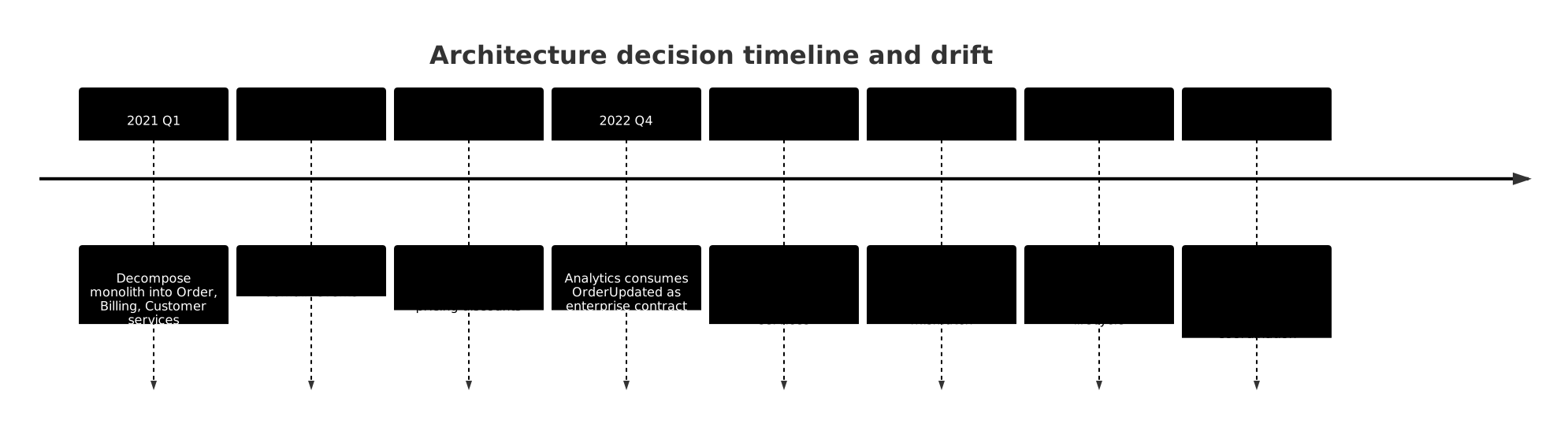
This is the pattern in miniature: sound decisions, then expedient exceptions, then systemic coupling.
A target architecture should make semantic authority and data movement explicit.
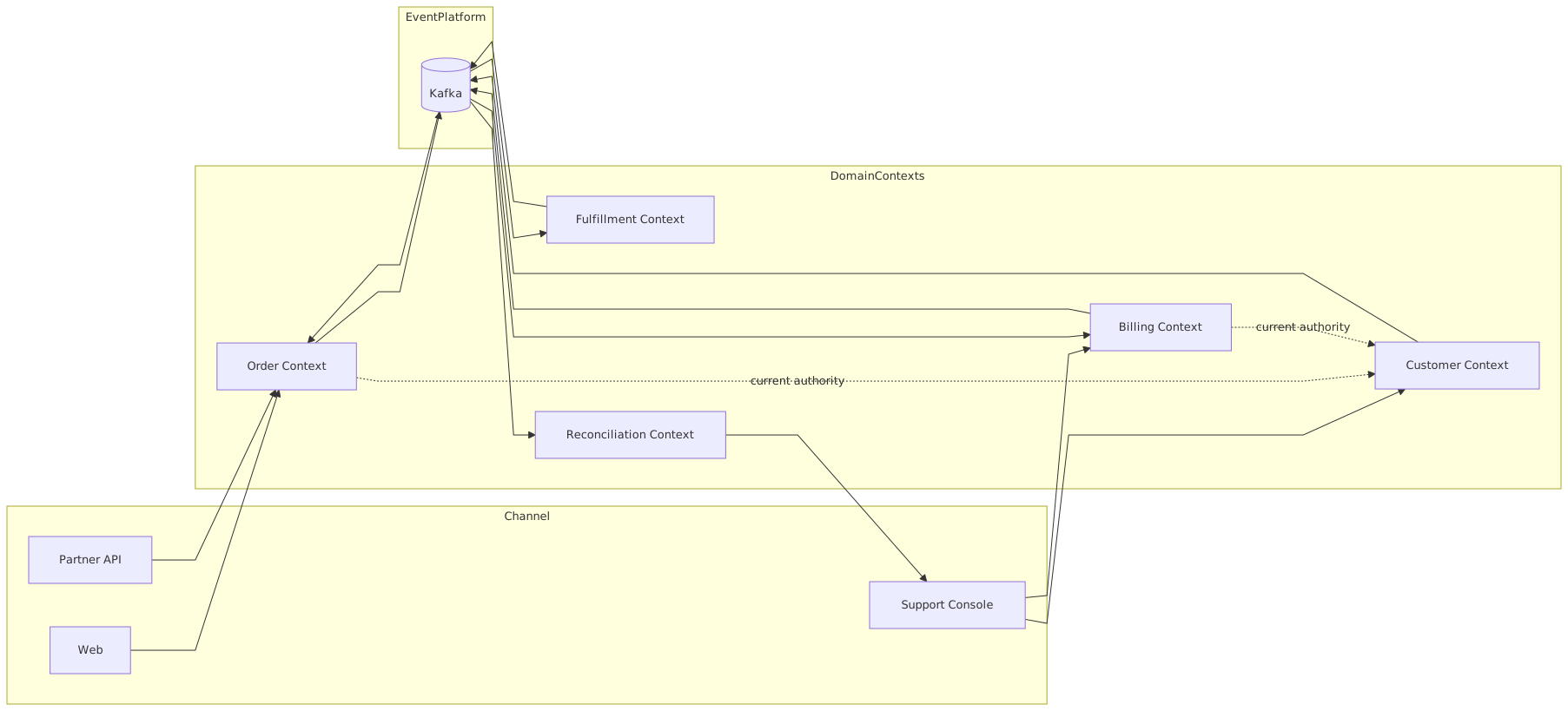
There are two important points in this picture.
First, Reconciliation is its own capability, not an invisible script folder. That does not mean every enterprise needs a separate service called Reconciliation. It means the capability must be explicit somewhere.
Second, current authority is different from propagated state. Order may call Customer for current regulated preferences or customer status, while also consuming customer events to maintain a local read model. Those are different needs and should not be muddled.
Migration Strategy
You do not repair decision drift with a rewrite. Rewrites are where architecture regret goes to become budget variance.
Use a progressive strangler migration.
The goal is not to “modernize microservices.” The goal is to restore semantic integrity with controlled risk.
Step 1: Build a decision and dependency map
Start by cataloging:
- service boundaries
- domain concepts owned per service
- key events and consumers
- replicated data stores
- reconciliation jobs
- manual workarounds
- known ownership disputes
Then annotate where the current architecture disagrees with current business semantics.
This step is half architecture, half anthropology.
Step 2: Re-map bounded contexts
Run event storming or domain mapping sessions with people who actually know the business: operations leads, product managers, compliance experts, support staff, and key engineers. Most drift reveals itself when two teams use the same noun differently.
Do not ask, “What services do we have?”
Ask, “What meanings do we have, and who decides them?”
Step 3: Introduce anti-corruption layers
Where services currently consume polluted or overloaded contracts, insert anti-corruption layers. Translate external representations into local language. This protects the receiving context while you untangle upstream design.
This is especially vital in Kafka-based estates. If consumers ingest raw upstream event models directly into domain logic, drift spreads like mold.
Step 4: Split generic events into domain facts
If you have topics like CustomerUpdated, OrderUpdated, or ProductChanged, inspect them closely. These are often vague wrappers around internal state transitions.
Refactor toward business-meaningful facts:
OrderPlacedPaymentAuthorizedInvoiceIssuedShipmentDeliveredCustomerCreditStatusChanged
Not every change needs publication. Publish what matters to other contexts.
Step 5: Make reconciliation explicit
Before changing flows, define reconciliation rules:
- what records should align
- acceptable time windows
- authority in case of conflict
- compensation actions
- support escalation path
- audit trail requirements
Many migrations fail because they improve elegance but weaken operational repair.
Step 6: Strangle by capability, not by technology layer
Choose one capability with high business pain and clear semantics. Examples:
- entitlement calculation
- invoice generation
- order fulfillment orchestration
- customer identity resolution
Build the new bounded context beside the old one. Route new traffic or selected flows to it. Publish canonical events from the new model. Gradually reduce dependency on the old context.
Step 7: Retire old contracts aggressively
This is where many enterprises lose nerve. They add better events, better APIs, better read models, then keep all legacy contracts forever. That is not migration. That is sediment.
A contract retirement plan needs dates, owners, usage telemetry, and executive backing.
Here is a progressive strangler sketch.
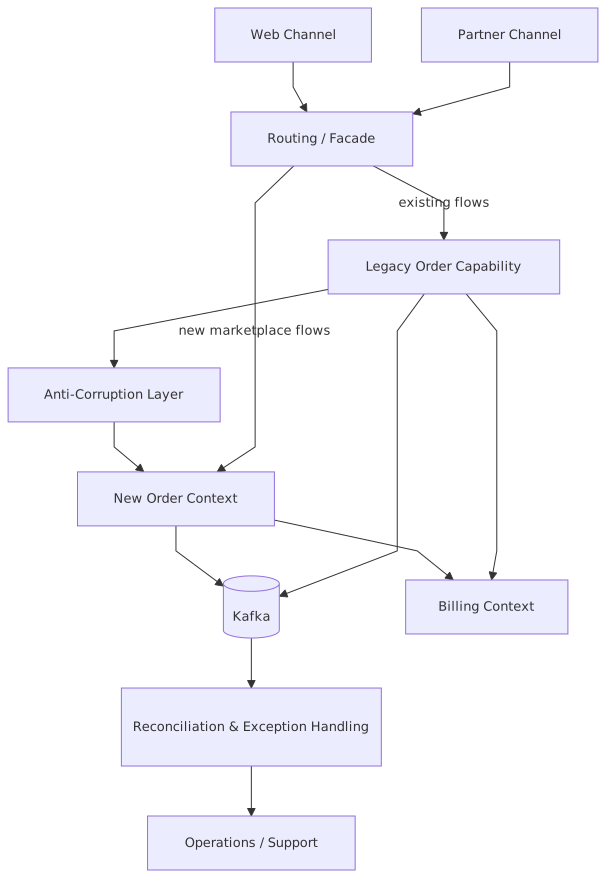
The architecture deliberately supports a period where both old and new flows coexist. That coexistence is not a failure. It is the cost of safe change.
Enterprise Example
Consider a global subscription business selling software, support packages, and consumption-based add-ons across direct and partner channels.
The company started with a monolith. It then split into microservices: Customer, Subscription, Billing, Entitlement, Pricing, and Order. Kafka connected them. For a while, this worked.
Then reality showed up.
Partners needed delayed activation. Enterprise customers wanted parent-child billing hierarchies. Sales required negotiated price protections. Finance introduced invoice adjustments. Support needed emergency entitlement overrides. A new usage-based product blurred the line between subscription and metering.
The architecture drifted in predictable ways.
- Subscription began storing copied billing hierarchy data.
- Billing maintained its own entitlement snapshots for invoice validation.
- Entitlement consumed
SubscriptionUpdatedevents and inferred lifecycle changes from optional fields. - Order published a generic
OrderChangedtopic used by half the estate. - Support created direct database scripts for emergency overrides.
- Finance relied on daily reconciliation between invoices, subscriptions, and entitlements.
The system was still “microservices-based.” It was also semantically confused.
The remediation began not with code but with context mapping.
The enterprise realized:
- Subscription owns commercial agreement lifecycle
- Entitlement owns product access rights and activation state
- Billing owns financial obligations and invoice state
- Order owns sales transaction capture, not the long-lived agreement
- Customer in partner channels is not the same concept as bill-to account
That sounds obvious after the fact. It never is during the mess.
They then took three migration steps.
First, they replaced SubscriptionUpdated with explicit business events such as SubscriptionActivated, SubscriptionRenewed, SubscriptionCanceled, and BillingAccountReassigned. Entitlement no longer inferred meaning from snapshots.
Second, they created an entitlement anti-corruption layer to translate commercial lifecycle into access-right language. This prevented Billing and Subscription terms from bleeding into entitlement rules.
Third, they established a reconciliation service for entitlement-versus-billing exceptions with clear authority rules. Billing did not deactivate access directly. It emitted financial state; Entitlement applied policy according to domain rules and grace periods.
The result was not fewer services. It was cleaner semantics, fewer hidden dependencies, and far less support drama. That is the real win in enterprise architecture: not prettier diagrams, but fewer 2 a.m. calls where three departments argue about which system is right.
Operational Considerations
Architecture drift becomes expensive in operations long before it becomes visible in portfolio reviews.
Observability must include semantic health
Most teams monitor latency, throughput, consumer lag, and error rates. Good. But drift often hides in semantic indicators:
- percentage of events requiring compensation
- reconciliation exception volume
- stale read-model age
- number of manual overrides per domain
- contract versions in live use
- cross-context schema break risk
If a business process only succeeds because nightly reconciliation closes the gap, that should be on an executive dashboard.
Kafka requires governance without central paralysis
Kafka is a force multiplier. It can create a healthy event backbone or an enterprise rumor mill.
Use:
- topic ownership
- schema versioning
- retention policies by business need
- event classification: domain event vs integration event vs audit event
- consumer registration and dependency visibility
- deprecation policy for topics and fields
Do not let “event-driven” become shorthand for “nobody knows who depends on what.”
Idempotency and replay are non-negotiable
As soon as you rely on asynchronous propagation and reconciliation, replay becomes part of normal operations. Consumers must tolerate duplicate delivery. Rebuilding projections must be safe. If replay corrupts business state, your event architecture is decorative.
Manual intervention must be modeled
Support consoles, finance adjustments, compliance holds, and operational overrides should feed the same domain pathways where possible. If they bypass them, at least publish auditable facts. Hidden human workflows are one of the biggest accelerants of decision drift.
Tradeoffs
There is no drift-free architecture. There are only tradeoffs you choose consciously versus tradeoffs you inherit accidentally.
More explicit domain boundaries mean more translation
Bounded contexts reduce semantic pollution, but they increase translation work. Anti-corruption layers, event mapping, and context-specific models all cost time. That cost is worth paying when the domain is complex and the organization large. It is wasteful in small, stable domains.
Reconciliation improves resilience but accepts temporary inconsistency
When you design for asynchronous autonomy, you accept periods where systems disagree. Reconciliation is the price of scale and decoupling. If the business cannot tolerate that even briefly, use stronger coordination or keep the capability together.
Event refactoring improves clarity but disrupts consumers
Replacing generic topics with explicit domain events is healthy, but migration can be messy. Some consumers rely on ambiguous fields precisely because they gave freedom. Clearer contracts often force hidden assumptions into the open. Expect politics.
Strangler migrations reduce risk but prolong complexity
Coexistence periods are operationally awkward. Running old and new flows side by side costs money and attention. But this is usually cheaper than a big-bang cutover and much safer for revenue-critical domains.
Failure Modes
Most architecture programs fail in familiar ways.
1. Service reshuffling without domain clarity
Teams redraw service boundaries but never resolve semantic ownership. They move code, keep the same confusion, and call it modernization.
2. Central canonical model fantasy
An enterprise tries to solve drift by defining one universal model for customer, order, product, or account. This usually flattens meaningful distinctions between bounded contexts and creates endless committee design.
3. Event overload
Everything becomes an event. Teams publish snapshots, internal state changes, and UI-level deltas. Kafka fills with noise. Consumers write defensive parsers. Nobody trusts the stream.
4. Reconciliation as an afterthought
Migration introduces asynchronous flows but no explicit reconciliation rules. Exceptions pile up in support queues, and confidence in the new architecture collapses.
5. Contract retirement never happens
Legacy APIs and topics survive forever because nobody has mandate to break old dependencies. The new architecture gets layered on top of the old one until both are mandatory.
6. Governance becomes theater
Architecture boards demand diagrams, standards, and review documents but do not track actual drift indicators or operational pain. Governance then measures compliance to templates rather than coherence of the estate. ArchiMate for governance
When Not To Use
Not every system needs a drift-management playbook this heavy.
Do not lean hard into this approach when:
- the domain is simple and stable
- one team owns the whole capability
- consistency requirements are strong and immediate
- event-driven integration would add more moving parts than value
- the main problem is poor engineering discipline, not domain misalignment
If you are running a small internal workflow app with one team and a modest change rate, a modular monolith will often beat a fleet of microservices plus Kafka plus reconciliation logic. That is not architectural conservatism. That is adult judgment.
Likewise, if the business process requires strict transactional consistency across closely related concepts, splitting them too early can create artificial complexity. Distributed systems are expensive ways to avoid honest conversations about cohesion.
Related Patterns
Several architecture patterns are especially relevant to managing decision drift.
Bounded Context
The core DDD tool for preserving semantic integrity. If the meaning of core terms differs, separate the contexts even if the entities look similar.
Context Map
Useful for making relationships visible: partnership, customer-supplier, conformist, anti-corruption layer, open host service. Decision drift often hides in undocumented context relationships.
Anti-Corruption Layer
Essential when one context must consume another without adopting its language. Particularly valuable in legacy modernization and Kafka consumer isolation.
Strangler Fig Pattern
The safest migration pattern for replacing drifted capabilities progressively. Build new behavior around and beside the old until the old can be retired.
Event Sourcing and CQRS
Sometimes useful, sometimes worshipped too quickly. They can help when domain history and replay are central concerns. They are not a default answer to drift. Event sourcing preserves history; it does not magically preserve meaning.
Saga / Process Manager
Helpful for long-running cross-context workflows. Dangerous when used to coordinate what should really be one cohesive domain boundary.
Data Mesh and Domain Data Products
Relevant for analytics-facing estates, but only if operational bounded contexts remain clear. Data products do not replace transactional domain ownership.
Summary
Architecture decision drift in microservices systems is not a niche technical issue. It is the normal result of time, pressure, and changing business understanding.
The architecture starts as a set of decisions. It becomes a set of habits. Some habits are healthy. Others survive long after their reason died.
The way through is not more dogma about microservices. It is sharper domain thinking, explicit decision timelines, controlled migration, and operational honesty about reconciliation and failure. Domain-driven design matters here because drift is, at heart, semantic erosion. Kafka matters because event streams can either preserve business facts cleanly or spread ambiguity at industrial scale. Strangler migration matters because enterprises cannot stop the machine to rebuild the engine.
If you remember one thing, remember this: a microservice boundary is only as good as the business meaning it protects.
And if you remember two things, remember the second one too: when reconciliation becomes your real process model, your architecture is telling you the truth. Listen to it.
The key is not replacing everything at once, but progressively earning trust while moving meaning, ownership, and behavior into the new platform.
Frequently Asked Questions
What is a service mesh?
A service mesh is an infrastructure layer managing service-to-service communication. It provides mutual TLS, load balancing, circuit breaking, retries, and observability without each service implementing these capabilities. Istio and Linkerd are common implementations.
How do you document microservices architecture for governance?
Use ArchiMate Application Cooperation diagrams for the service landscape, UML Component diagrams for internal structure, UML Sequence diagrams for key flows, and UML Deployment diagrams for Kubernetes topology. All views can coexist in Sparx EA with full traceability.
What is the difference between choreography and orchestration in microservices?
Choreography has services react to events independently — no central coordinator. Orchestration uses a central workflow engine that calls services in sequence. Choreography scales better but is harder to debug; orchestration is easier to reason about but creates a central coupling point.