⏱ 19 min read
Microservice testing usually fails for a boring reason: we test code, but we ship topology.
That is the quiet scandal at the heart of many “modern” delivery programs. Teams write neat unit tests, a respectable layer of contract tests, a few end-to-end scripts, and then act surprised when the system still behaves badly in production. But production isn’t just code paths. It’s dependency paths. It’s network shape, message timing, fan-out, retry storms, stale reads, split ownership, cross-domain assumptions, and the ugly geometry of how services actually collaborate under load. A microservice estate is less like a set of classes and more like a city at rush hour. If you only test the engines, you miss the traffic. microservices architecture diagrams
Topology-aware testing starts from that uncomfortable truth. It treats the architecture itself as a thing to test: not merely whether one service fulfills its API contract, but whether the arrangement of services, brokers, databases, caches, sidecars, and gateways behaves as intended for a domain workflow. This matters even more when Kafka, event-driven integration, and asynchronous processing are involved, because behavior is no longer a tidy request-response chain. It is a living graph with delays, reorderings, duplicates, dead letters, compensations, and reconciliation loops. event-driven architecture patterns
This is not a call to replace unit testing or contract testing. Those remain table stakes. It is a call to stop pretending they are enough.
In enterprise systems, the important bugs live in the seams. And topology is one giant seam.
Context
Microservices promised independent deployability, bounded context autonomy, and faster change. In many organizations they delivered some of that. They also delivered new failure surfaces. A monolith hides complexity inside code. Microservices externalize it into the network. The old coupling was procedural. The new coupling is topological.
This is where domain-driven design helps. DDD is not just a modeling exercise for whiteboards and workshops. It gives us the vocabulary to decide what should be tested together and what should be tested apart. A bounded context is not simply a deployment boundary. It is a semantic boundary: a place where terms mean specific things and rules are consistent. Testing that ignores these semantic boundaries often creates two bad outcomes at once: false confidence and brittle suites.
Suppose “customer” exists in Sales, Billing, and Risk. That does not mean those contexts share the same meaning. Sales may care about lead conversion and account hierarchy. Billing cares about payment responsibility and invoicing preferences. Risk cares about fraud indicators and exposure. If tests treat “customer” as one universal entity moving cleanly across services, they encode a lie. And lies in tests are expensive because they age into architecture.
Topology-aware testing asks: for this domain capability, what parts of the runtime topology are semantically relevant? Which interactions are critical? Where does eventual consistency matter? What downstream systems affect truth, timing, or user-visible outcomes? It is testing with a map, not just a checklist.
Problem
Traditional microservice testing strategies have a blind spot. They focus on local correctness while under-testing distributed correctness.
A team might have:
- strong unit test coverage
- consumer-driven contracts between APIs
- isolated integration tests with stubs
- a small set of end-to-end tests through the UI
On paper this looks mature. In practice, three things still go wrong.
First, stubs flatten reality. A stubbed downstream service does not exhibit queue lag, partial failure, duplicate event delivery, schema drift, race conditions, or read-model staleness. It behaves like a loyal actor reading from a script. Production is more like improvisational theater with packet loss.
Second, end-to-end tests are too blunt. They test whole-system workflows, but they are expensive, slow, flaky, and hard to diagnose. They tell you something is wrong somewhere. That is not enough when change is continuous and blast radius matters.
Third, contract tests validate interface shape more than behavioral topology. They tell you payload A is accepted and payload B is returned, but not whether the service graph around that call still preserves business invariants under realistic sequencing and timing.
So organizations drift into a trap. They have many tests, yet poor confidence. Releases slow down. Incident reviews keep discovering “we didn’t test that interaction.” Teams then add more end-to-end tests, which worsens cycle time and still misses topology-specific failure modes.
The root issue is simple: architecture decisions change what should be tested. Once you split a domain workflow across services and asynchronous channels, the topology becomes part of the behavior.
Forces
Several competing forces shape this problem.
Independent delivery versus system behavior
We want teams to deploy independently. We also need confidence that a change in one service does not destabilize a larger workflow. The more independently services evolve, the more their interactions need explicit validation.
Bounded context autonomy versus enterprise coherence
DDD encourages strong bounded contexts. Good. But the enterprise still has cross-context journeys: order-to-cash, claims processing, onboarding, fulfillment. Those journeys are where executive pain lives. Testing must respect context boundaries while still validating end-to-end business outcomes.
Asynchrony versus determinism
Kafka and event-driven architecture improve decoupling and throughput. They also remove the comforting determinism of synchronous chains. Message order may vary. Consumers may lag. Side effects may happen later. Tests must cope with time as a first-class variable.
Speed versus fidelity
A perfect production clone is slow and expensive. Lightweight test doubles are fast and cheap. Topology-aware testing is about choosing the smallest realistic slice of the topology needed to validate a domain behavior.
Local ownership versus shared platform concerns
A service team owns its code. But resilience libraries, service mesh policies, broker configuration, retry behavior, dead-letter handling, and observability infrastructure often belong to platform teams. Many production issues emerge at that shared layer. If your testing strategy excludes those concerns, you are testing a fiction.
Solution
The core idea is straightforward: define test topologies around domain flows, not around technical layers alone.
A topology-aware test is an executable scenario that includes the subset of services, data stores, message channels, and infrastructure behavior required to validate a meaningful business invariant. It is broader than a unit test, narrower than a full end-to-end test, and explicitly shaped by the runtime graph.
That graph should be chosen intentionally.
For each critical domain workflow, identify:
- the bounded contexts involved
- the authoritative sources of truth
- the integration style between contexts: sync API, async event, batch, file, or human task
- timing assumptions
- reconciliation rules
- compensations and fallback behavior
- observable outcomes that matter to the business
Then build test slices that exercise those interactions with realistic conditions.
A good topology-aware strategy typically uses four layers:
- Local tests for service logic and aggregate behavior
- Contract tests for API and event compatibility
- Topology tests for domain workflow slices across relevant services and channels
- Sparse end-to-end tests for only the highest-value user journeys
This is not a pyramid in the simplistic sense. It is more like a portfolio. You invest heavily where risk lives.
Here is a conceptual view:
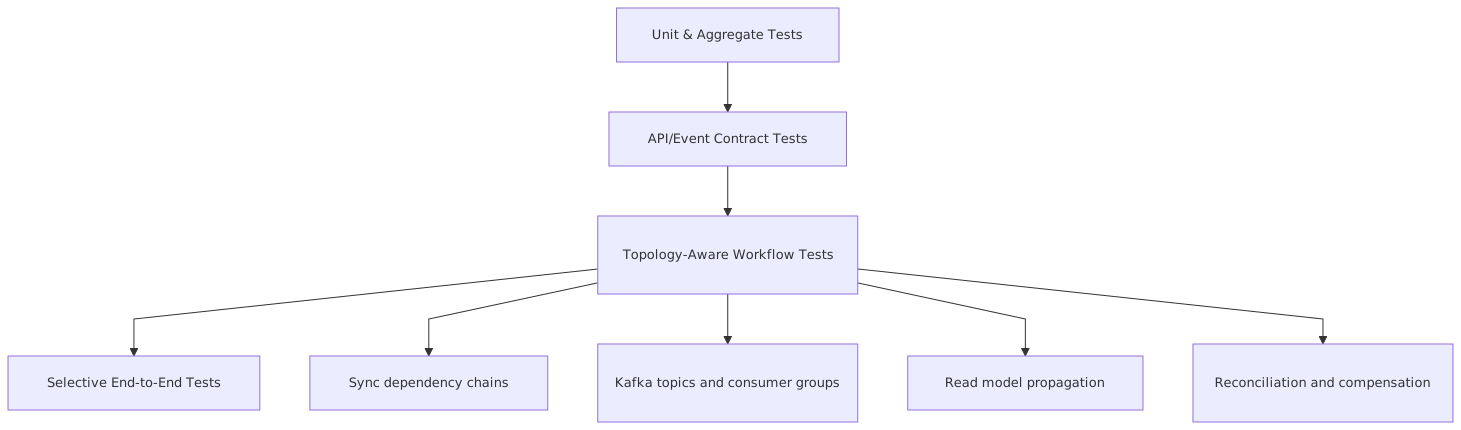
Notice what sits in the middle: workflow tests shaped by topology. That is where most enterprise bugs actually happen.
What makes a topology-aware test different
It encodes not just expected responses but architectural assumptions:
- this service depends on those two services plus one Kafka topic
- this state becomes visible in the query model within 5 seconds
- duplicate events do not create duplicate invoices
- if Risk rejects an order after reservation, Billing never invoices
- if one consumer falls behind, reconciliation eventually restores consistency
These are architecture assertions. We should write them down as tests because architecture diagrams alone do not fail the build.
Architecture
Let’s make this concrete with a common enterprise pattern: order processing.
An Order context accepts orders. Inventory reserves stock. Payment authorizes funds. Fulfillment creates shipments. Billing issues invoices. Some interactions are synchronous, some asynchronous. Kafka carries domain events. Read models support operations dashboards. Reconciliation corrects drift.
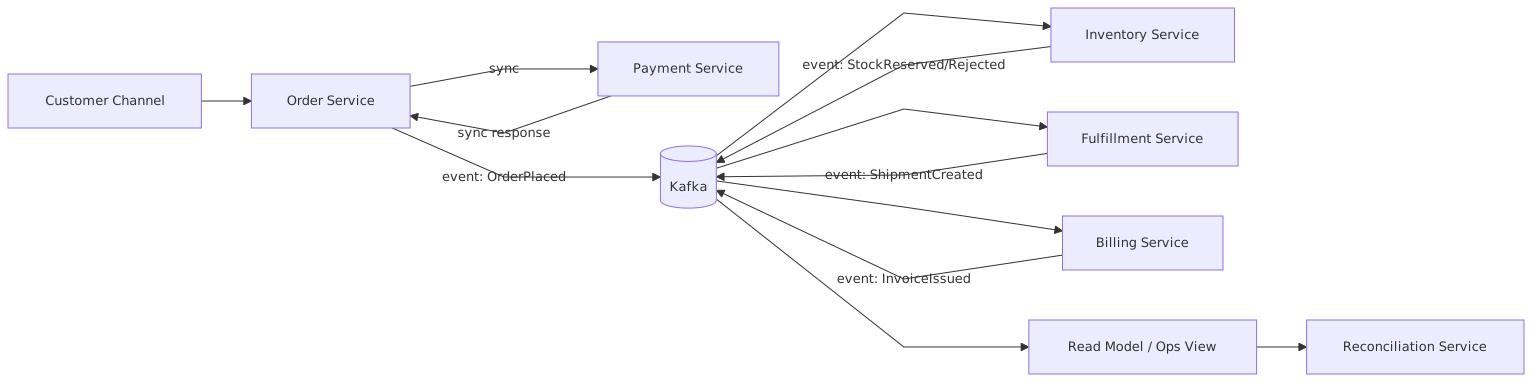
This topology creates several distinct testing concerns.
Synchronous command path
Order submission may synchronously call Payment for authorization. That needs local integration and contract testing. Fine.
Asynchronous propagation path
Inventory, Fulfillment, and Billing react to events. Here topology matters:
- Are events partitioned by order ID?
- Can Billing issue an invoice before Inventory confirms reservation?
- What if Fulfillment sees
OrderPlacedbefore Payment later fails? - What happens when one consumer is down and catches up later?
These are not code-only questions. They are properties of the service graph and messaging design.
Read models and operational truth
Operations dashboards often read from denormalized projections. Users treat them as truth. Architects know better. Read models lag. They are truth-shaped, not truth itself. Tests should validate the user-visible consistency envelope: how stale can the dashboard be, and what compensating information is shown while it catches up?
Reconciliation
A mature distributed architecture always includes reconciliation. Not because the design is weak, but because distributed systems are honest. Messages fail. Consumers skip offsets. downstream APIs time out after performing side effects. Reconciliation is the broom after the parade.
Topology-aware tests should include it. If a Billing event is dropped, does reconciliation eventually generate the missing invoice or raise an exception queue item? If Inventory reserved stock but Fulfillment never created a shipment, can the system detect and repair the gap?
This is where many testing strategies become naive. They only test the happy event path. Enterprises live in the unhappy path.
Domain semantics matter more than service count
One of the worst habits in microservice programs is using technical decomposition to drive testing. Teams test “Service A to Service B” as if service boundaries themselves define the business risk. They don’t. Domain semantics do.
Take “order confirmed.” In one bounded context, it means payment authorized. In another, it means stock reserved. In a third, it means customer notification sent. If topology-aware tests do not pin these terms to specific contexts, you get semantic leakage: one service emits an event another interprets differently, and everybody passes their local tests while the enterprise process fails.
This is classic DDD territory. Tests should be named after domain outcomes:
order_is_accepted_but_not_fulfillable_when_payment_authorized_and_stock_rejectedinvoice_is_not_issued_before_shipment_for_physical_goodssubscription_activation_tolerates_duplicate_payment_authorization_events
Those names are ugly in a beautiful way. They reveal the model.
Migration Strategy
No enterprise starts with topology-aware testing neatly in place. Most arrive here after a few expensive incidents and a test estate that grew by sedimentation. So migration matters.
The sensible path is a progressive strangler approach.
Do not rewrite the test strategy wholesale. That is architecture cosplay. Instead, identify critical business journeys and progressively surround them with topology-aware slices while decommissioning low-value end-to-end scripts.
Step 1: Map the current topology
Create a dependency graph for a small number of important workflows:
- order-to-cash
- claim submission to adjudication
- account onboarding
- payment dispute handling
Mark sync calls, async events, data ownership, and read models. Then mark where incidents have historically occurred. That incident overlay is gold. It tells you where testing should get smarter.
Step 2: Classify interactions by semantic criticality
Not every edge in the graph needs the same fidelity. Ask:
- Does this edge affect money, compliance, customer commitments, or inventory?
- Is this interaction eventually consistent?
- Does it involve schema evolution risk?
- Is there compensation or only reconciliation?
- Has it failed in production before?
Build topology tests only where the answers justify the effort.
Step 3: Introduce executable workflow slices
For each high-value workflow, stand up the minimum set of real components needed:
- the initiating service
- the message broker or realistic broker substitute
- the key downstream consumers
- relevant data stores or production-like persistence behavior
- observability hooks for assertions
Keep external third parties virtualized where possible, but simulate realistic timing and fault behaviors.
Step 4: Add reconciliation scenarios
This is often skipped. Don’t skip it. Explicitly test lost events, duplicate events, and delayed consumers. Then run reconciliation and assert final business state.
Step 5: Retire brittle broad tests
As topology-aware coverage improves, remove low-signal UI-driven and full-stack tests that duplicate the same workflow with poorer diagnostics.
A migration view often looks like this:
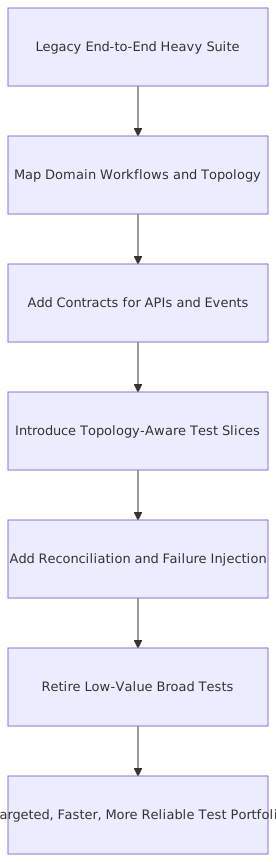
This is the strangler fig pattern applied to test architecture. You grow the new discipline around the old until the old can be cut away.
Enterprise Example
Consider a global insurer modernizing claims processing.
The original platform was a large claims monolith with nightly batch integrations into fraud, payments, document management, and customer communications. The modernization program introduced microservices around bounded contexts: Claim Intake, Coverage, Fraud Assessment, Payment, Document, and Notification. Kafka became the event backbone. Everyone declared victory early.
Then production happened.
A claim submitted through Intake emitted ClaimRegistered. Coverage validated eligibility. Fraud scored risk asynchronously. Payment created reserve amounts. Notification told the customer the claim was “in progress.” Under load, Fraud lagged behind several minutes. Payment occasionally created reserves before fraud holds were applied. A reconciliation batch corrected some cases overnight, but customer communications had already gone out. The business impact was not merely technical. It was operational embarrassment and compliance concern.
The teams had solid unit tests and a forest of API contract tests. They also had six giant end-to-end suites through the portal UI. None of those tests captured the actual timing shape of the architecture.
The fix was not “add more tests.” The fix was to test the topology.
They defined three topology-aware scenarios around the domain semantics of a claim:
- low-risk straight-through processing
- high-risk claim requiring fraud hold before payment reserve
- fraud service lag with eventual reconciliation
Each scenario used real Kafka topics in an ephemeral environment, real consumer groups, and production-like persistence. Fraud could be deliberately slowed. Duplicate events could be injected. Payment reserve creation and customer notification were asserted as temporal business outcomes, not just service responses.
What changed?
- They discovered one consumer was keyed by policy ID while another was keyed by claim ID, causing ordering anomalies.
- They found that Notification listened to
ClaimRegisteredrather than a semantically saferClaimAcceptedForProcessing. - They exposed that reconciliation corrected reserve records but did not retract customer messages.
None of these were “bugs” in the narrow coding sense. They were topology and semantics bugs.
After six months, release confidence improved and the giant UI suites were cut by more than half. More importantly, incident reviews shifted. Teams stopped saying “we didn’t test that path” and started saying “that workflow slice needs a new topology assertion.” That is architectural maturity.
Operational Considerations
Topology-aware testing is not just a design technique. It has real platform implications.
Ephemeral environments
You need environments that can stand up a meaningful topology quickly. Not the whole enterprise, just the right slice. Kubernetes helps, but only if environment assembly is automated and realistic. If every test environment becomes a snowflake, the cure is worse than the disease.
Test data with domain meaning
Randomized payloads are fine for fuzzing. They are poor substitutes for domain-rich scenarios. Use canonical examples that reflect business rules:
- expired policy
- split shipment
- partial payment
- duplicate claim attachment
- cross-border tax handling
Data should tell a story. If it doesn’t, your failures will be hard to interpret.
Kafka-specific concerns
If Kafka is part of the architecture, test what Kafka actually introduces:
- partitioning keys
- consumer group rebalancing
- duplicate delivery
- out-of-order processing across partitions
- poison messages and dead-letter handling
- schema evolution with backward and forward compatibility
A surprising number of teams “test Kafka” by replacing it with an in-memory queue in CI. That gives you speed, but it hides key topology behaviors. Use the in-memory substitute for local development if you must, but topology tests should hit a real broker.
Observability as a test tool
Logs are not enough. Topology-aware testing needs trace correlation, event IDs, causation IDs, business keys, and measurable lag. A topology test should be able to assert:
- event published at T1
- consumed by Inventory at T2
- visible in read model at T3
- reconciled at T4 if fault injected
If you cannot observe the flow, you cannot test the topology with confidence.
Cost discipline
Not every pull request should run every topology slice. Be deliberate:
- small, critical slices in PR validation
- broader suites on merge or nightly
- failure injection and reconciliation tests on scheduled cadence
- production synthetic probes for the most important business capabilities
Architecture is compromise made visible. So is test architecture.
Tradeoffs
This style of testing is powerful, but it is not free.
The biggest cost is complexity. Topology-aware tests require environment automation, event fixtures, temporal assertions, and better observability. They demand more architectural thinking from teams. Some teams will resist because it feels less straightforward than mock-based integration tests.
The second cost is ownership friction. A topology slice often crosses team boundaries. Who owns the test? In my view, the initiating domain team should usually own the workflow assertion, with downstream teams contributing contracts and failure semantics. Shared ownership sounds noble and usually means nobody updates the test.
The third cost is slower execution compared with local tests. That is acceptable if the suite is targeted. It becomes a disaster if teams try to recreate the whole production estate for every build.
And there is a subtle tradeoff around design. Good topology tests can expose bad service boundaries. This is healthy, but politically inconvenient. If a domain workflow can only be tested by assembling eight services and four topics, you may not have microservices. You may have a distributed monolith with better branding.
Failure Modes
Architecture patterns fail in recognizable ways. Topology-aware testing is no exception.
1. Testing everything together
Teams get excited and build giant integrated environments that are merely slower versions of end-to-end tests. The fix is to define workflow slices by bounded context relevance, not by ambition.
2. Ignoring domain semantics
If tests are organized around transport mechanics rather than business meaning, they become fragile and shallow. “Topic A to Service B” is weaker than “fraud hold blocks reserve creation.”
3. Over-mocking infrastructure behavior
If retries, broker ordering, lag, and rebalancing are all mocked away, topology testing collapses back into conventional integration testing.
4. No reconciliation coverage
This is the classic enterprise mistake. The happy path works, but data drift accumulates and only finance notices. Reconciliation is a feature. Test it as such.
5. Poor observability
When assertions rely on sleep statements and polling loops without traceability, tests become flaky. Flaky tests are architecture debt with a CI badge.
6. Treating timing as fixed
Distributed systems rarely respect your favorite timeout. Assert windows, eventual outcomes, and compensating states rather than brittle exact timing unless timing is itself the requirement.
When Not To Use
This pattern is not universal.
Do not use topology-aware testing heavily if you have a small, simple system with low-value integrations and short synchronous call chains. A modular monolith with clear boundaries may get better results from rich in-process integration tests. In fact, many organizations should stay there longer.
Do not over-invest if the domain does not justify it. If a workflow is operationally trivial, has no compliance or financial impact, and can tolerate occasional manual correction, broad topology slices may be overkill.
Do not use it as a substitute for good service design. If your architecture requires topology-aware tests everywhere just to feel safe, that may be evidence of poor bounded context boundaries, excessive chatty interactions, or careless event semantics.
And do not confuse topology-aware testing with “testing in production.” Production verification has its place through canaries, synthetic monitoring, and observability. But if architecture assumptions are only being validated after release, you are not being brave. You are being late.
Related Patterns
Several adjacent patterns fit naturally here.
Consumer-driven contracts remain essential for API and event compatibility. They are necessary, not sufficient.
Saga orchestration and choreography influence what topology needs testing. Orchestration centralizes flow control, which may simplify assertions. Choreography distributes it, which increases the importance of semantic event testing.
Outbox pattern helps make event publication reliable. Topology-aware tests should validate downstream effects of outbox-driven delivery, including duplicates and replay.
CQRS introduces read-model lag and projection correctness, both prime candidates for topology testing.
Strangler fig migration is the natural migration approach when replacing monolith journeys with distributed flows. Test slices should strangle along with the runtime.
Reconciliation processing is the unsung partner of event-driven systems. Where there is eventual consistency, there should be eventual verification.
Summary
Microservices are not just a code organization technique. They are a runtime topology. Testing that ignores this ends up validating the least interesting part of the system.
Topology-aware testing closes that gap. It uses domain-driven design to identify meaningful workflow slices, then tests the actual interaction shape of the architecture: synchronous dependencies, Kafka-driven events, read-model propagation, compensations, and reconciliation. It gives architects and teams a better instrument panel than bloated end-to-end suites or endless mocks.
The point is not to test more. It is to test where architecture creates risk.
That means naming tests in domain language. It means validating semantic outcomes across bounded contexts. It means accepting that eventual consistency needs explicit coverage. It means including failure and repair, not just success. And it means migrating gradually, using a strangler approach to replace low-value broad tests with smaller, sharper, topology-aware slices.
The practical payoff is substantial: faster feedback than giant end-to-end suites, better realism than isolated service tests, and far more confidence in the workflows the business actually cares about.
A microservice system is a map of promises between bounded contexts. Topology-aware testing is how you verify those promises when the roads are busy, the weather is bad, and one bridge is out. That is the moment architecture becomes real.
Frequently Asked Questions
What is a service mesh?
A service mesh is an infrastructure layer managing service-to-service communication. It provides mutual TLS, load balancing, circuit breaking, retries, and observability without each service implementing these capabilities. Istio and Linkerd are common implementations.
How do you document microservices architecture for governance?
Use ArchiMate Application Cooperation diagrams for the service landscape, UML Component diagrams for internal structure, UML Sequence diagrams for key flows, and UML Deployment diagrams for Kubernetes topology. All views can coexist in Sparx EA with full traceability.
What is the difference between choreography and orchestration in microservices?
Choreography has services react to events independently — no central coordinator. Orchestration uses a central workflow engine that calls services in sequence. Choreography scales better but is harder to debug; orchestration is easier to reason about but creates a central coupling point.