⏱ 19 min read
Every large enterprise says it wants microservices. What it often has is a distributed argument about meaning. microservices architecture diagrams
The hard part is rarely Docker, Kubernetes, Kafka, or which framework won the architecture beauty contest this quarter. The hard part is language. More specifically, it is what happens when one system says “customer,” another says “party,” a third says “account holder,” and all three are absolutely certain they mean the same thing—right up until money moves, a regulator asks questions, or an order disappears into a reconciliation queue.
That is where data model anti-corruption matters.
In Domain-Driven Design, the anti-corruption layer is not a polite adapter. It is a customs checkpoint at the border between bounded contexts. It inspects meaning, not just shape. It stops foreign assumptions from leaking into a domain that is trying to remain coherent. In a microservices estate, especially one evolving from a large legacy platform, this pattern is less optional than many teams hope. Without it, you do not get independently evolving services. You get a semantic hairball spread across APIs, events, ETL jobs, and “temporary” mapping logic hidden in code no one wants to touch.
This article goes deep on data model anti-corruption in DDD microservices: why it matters, how to design the translation boundary, how to migrate progressively using a strangler approach, where Kafka fits, how reconciliation should work, and where this pattern becomes overengineering. The goal is not elegance for its own sake. The goal is preserving domain semantics while the enterprise changes around them. event-driven architecture patterns
Context
Most enterprises do not start with clean bounded contexts. They start with a core platform that grew over twenty years through mergers, regulation, channel expansion, and heroic delivery under pressure. The result is usually a shared data model pretending to be universal.
It never is.
A canonical customer table may contain retail customers, commercial entities, guarantors, leads, dormant records, prospects, deceased individuals, sanctioned entities, and “temporary placeholders” inserted by batch jobs. On paper, it is one master model. In reality, it is a political treaty encoded in columns.
When teams begin decomposing such an estate into microservices, the temptation is obvious: reuse the existing schema, expose it through APIs, and move on. It feels efficient. It avoids painful conversations. It also imports the old confusion wholesale into the new architecture.
DDD pushes in the opposite direction. A service should model its own domain in the language of its bounded context. An underwriting service should not think in terms of CRM contact records. A billing service should not expose the internal lifecycle states of order management. A fraud service should not inherit accounting’s definition of finality. If they do, every service becomes a remote-controlled extension of the old system.
This is why anti-corruption is so central in real migrations. It gives each new service the right to interpret legacy data on its own terms, and the discipline to keep that interpretation explicit.
The anti-corruption layer is the seam where translation happens:
- shape translation: fields, structures, payload formats
- semantic translation: meaning, lifecycle, invariants
- behavioral translation: workflows, commands, events, error conditions
- temporal translation: sync vs async, snapshots vs streams, eventual consistency
A good anti-corruption layer does not merely map legacy_status = "A" to active = true. It encodes what “active” means inside the receiving domain, what exceptions exist, and what to do when the upstream source sends impossible combinations.
That difference is the whole game.
Problem
The core problem is not integration. It is semantic contamination.
When a service consumes another system’s data model directly, it starts making decisions based on concepts it does not own. Soon its code, tests, events, reports, and database all become dependent on foreign semantics. At that point, the service is independent only in deployment diagrams.
A few common symptoms appear quickly.
First, domain leakage. The target microservice begins exposing fields that only make sense because they existed in the source system. Teams say things like, “we don’t really use this attribute, but downstream consumers need it.” That is not a domain model; that is a forwarding address.
Second, false equivalence. Enterprises love one-to-one mappings that are not one-to-one. A “customer” in sales is not always a “customer” in billing. A “product” in catalog is not always a “product” in fulfillment. A “transaction” in payments is not a “transaction” in the general ledger. Calling them by the same name does not make them semantically aligned.
Third, migration paralysis. If new services are tightly coupled to the old data model, the legacy platform remains the center of gravity. Every schema change becomes cross-team negotiation. Every modernization step drags hidden dependencies behind it.
Fourth, operational drift. Once multiple services interpret a shared record differently, discrepancies emerge. Counts do not match. States diverge. Kafka consumers replay old events into new models and produce contradictory outcomes. Reconciliation becomes a permanent operating function.
This is why anti-corruption should be treated as architecture, not plumbing. It exists to preserve the integrity of a model in the face of a stronger, older, messier neighbor.
Forces
There are several competing forces here, and architecture is mostly about handling collisions between them.
1. Local domain purity vs enterprise interoperability
DDD tells us to protect bounded contexts. Enterprises tell us systems must still talk. The anti-corruption layer is the compromise: integrate aggressively, model locally.
2. Speed of delivery vs semantic safety
Direct schema reuse is fast in the first sprint and expensive for the next five years. A translation layer slows the first release because someone has to define language, mappings, and invariants. That is exactly why many teams skip it. They pay later in coupling.
3. Event-driven decoupling vs event semantic drift
Kafka can decouple producers and consumers physically. It does not decouple them semantically by magic. If upstream events carry legacy concepts, downstream services can still be corrupted through the event stream. An anti-corruption layer may sit on event ingestion just as much as on APIs.
4. Shared truth vs contextual truth
Enterprises often ask for “one version of the truth.” In operational domains, that is usually the wrong aspiration. Better is “multiple trustworthy contextual truths with explicit translation.” Finance, sales, service, and risk can all be right within their contexts while still reconciling across boundaries.
5. Immediate consistency vs resilience and autonomy
Many anti-corruption layers are asynchronous because synchronous translation chains create brittle runtime dependencies. But eventual consistency introduces delays, stale views, duplicate events, replay concerns, and reconciliation work. There is no free lunch here.
6. Migration pragmatism vs ideal target design
A greenfield bounded context can be beautifully designed. A migration context often cannot. It must absorb ugly upstream data, partial records, out-of-order events, and operational exceptions. The architecture has to survive reality before it can become elegant.
Solution
The solution is to place an explicit anti-corruption layer between bounded contexts and make it responsible for translating foreign models into local ones.
That sounds obvious. The trick is understanding what “translating” really means.
A data model anti-corruption layer should do at least five things:
- Map foreign structures to local aggregates, entities, and value objects
- Interpret upstream states into local lifecycle semantics
- Enforce local invariants before data crosses the boundary
- Record correlation and provenance for reconciliation
- Shield local consumers from source-system churn
The local service should never treat upstream payloads as if they were native domain objects. The anti-corruption layer should convert them into local commands, local events, or local persistence representations.
In practice, this often leads to a pipeline that looks like this:

A few opinions, strongly held:
- Do not let upstream DTOs bleed into your service internals.
- Do not name local classes after legacy tables unless you enjoy permanent architectural debt.
- Do not pretend a field map is enough when lifecycle meaning differs.
- Do not publish rewrapped legacy events as “domain events” from your new service. That is cargo-cult event-driven architecture.
A proper anti-corruption layer often includes:
- translators
- assemblers
- policy rules
- schema adapters
- idempotency controls
- correlation identifiers
- dead-letter handling
- reconciliation support
Sometimes it lives in-process with the service. Sometimes it is a separate integration service. Sometimes it is split: thin ingress adapters plus local domain translators. The choice depends on scale, reuse, and ownership.
But the principle remains the same: foreign models stop at the border.
Architecture
The cleanest architecture is one where the anti-corruption layer is close enough to the target bounded context to understand its language, but isolated enough to absorb source complexity.
A common pattern in enterprise estates is this:
- Legacy system publishes database changes, batch extracts, or Kafka events
- An ingress adapter normalizes transport concerns
- A translation component converts source concepts into local domain commands/events
- The target microservice persists only local models
- A reconciliation component checks source-to-target completeness and semantic consistency
Here is a more detailed view.
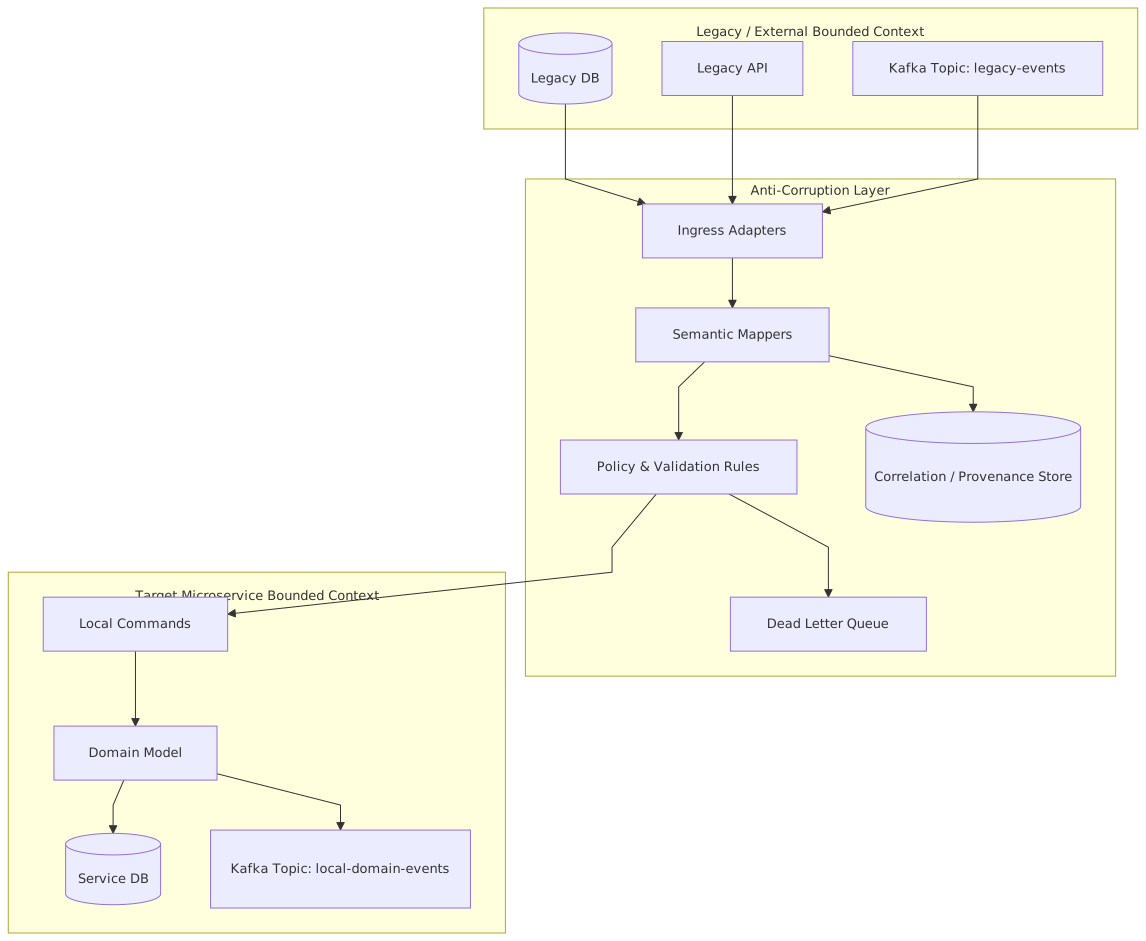
Translation is about semantics, not syntax
Suppose the upstream CRM emits an event:
A lending service may not care about partyType as CRM defines it. It may instead need a local concept of Borrower, with subtypes such as IndividualBorrower and BusinessBorrower, and a notion of EligibleForCreditAssessment. That eligibility may depend on risk policy, sanctions screening, legal form, and onboarding completeness—not on CRM’s status code.
So the anti-corruption layer might translate one upstream record into:
- a local
RegisterBorrowercommand - a local value object
LegalEntityClassification - a domain policy evaluation
- maybe no action at all if the upstream record is not relevant
That is anti-corruption. It is interpretation under domain rules.
The local model should be narrower than the source model
One of the biggest design mistakes is trying to preserve every field from the source in the target. That usually means the target has not discovered its true boundaries.
A bounded context should carry only what it needs to perform its own responsibilities. Extra fields are not harmless. They create accidental dependencies and broaden the change surface.
Correlation matters
You will need to answer uncomfortable questions:
- Which source records have been translated?
- Which target aggregates came from which source entities?
- Which source version produced this local state?
- What events were skipped, retried, or quarantined?
That requires a mapping registry or correlation store. Not glamorous. Absolutely necessary.
Kafka fits, but it does not replace design
Kafka is excellent for event distribution, backpressure handling, replay, and decoupled consumption. It is not a semantic model. If a legacy event topic is just a stream of table mutations, consumers still need anti-corruption before those changes become meaningful in a local domain.
A robust pattern is:
- consume legacy topic
- translate into local command or local integration event
- apply idempotent domain handling
- emit true local domain events only after local state changes successfully
That prevents “legacy event laundering,” where bad upstream semantics are republished with modern event names.
Migration Strategy
This pattern shines during progressive strangler migration.
Most enterprises cannot replace a core system in one move. They carve out slices of capability over time: customer onboarding, pricing, order orchestration, billing, claims, servicing. Each extracted service must coexist with the old platform for months or years. During that coexistence, data translation is not a side issue. It is the migration.
The practical migration sequence often looks like this:
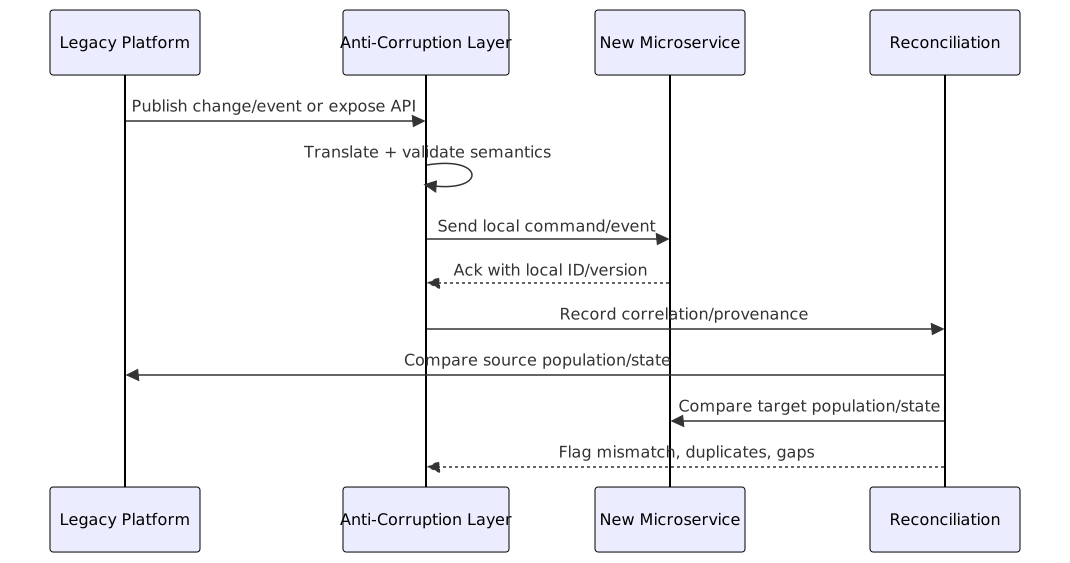
Step 1: Read from legacy, model locally
Start by letting the new service consume legacy data but persist its own model. This creates a read-side or operational model that reflects local semantics. It proves the mappings before the service becomes authoritative.
Step 2: Reconcile relentlessly
Before cutover, you need dual-run comparison:
- record counts by segment
- lifecycle state distributions
- key financial or operational totals
- completeness of mandatory relationships
- lag and replay characteristics
- exception categories
Reconciliation is often dismissed as an afterthought. In enterprise migration, it is a first-class capability. If you cannot explain differences, you are not ready to move authority.
Step 3: Strangle by capability, not by table
Do not migrate “the customer table.” Migrate a capability such as onboarding identity verification, address servicing, or account notification preferences. Data should move in service of a capability boundary.
This is DDD thinking applied to migration. The target bounded context should emerge from business responsibility, not schema decomposition.
Step 4: Introduce reverse anti-corruption if needed
During coexistence, the legacy system may still depend on outputs from the new service. That means translation in both directions. Be careful here. Many migrations fail because write-back turns into hidden dual ownership. Define system of record boundaries with brutal clarity.
Step 5: Move ownership deliberately
Eventually the new service becomes the source of truth for its domain. At that point:
- stop mirroring unnecessary legacy fields
- reduce translation scope
- publish local events as the enterprise contract for that capability
- keep legacy adapters only for consumers not yet migrated
This is the strangler pattern with semantics, not just routing.
Enterprise Example
Consider a global insurer modernizing policy servicing.
The legacy policy administration platform has a massive relational schema centered on PARTY, POLICY, INSURED_OBJECT, and TRANSACTION. It supports multiple countries, product lines, brokers, endorsements, renewals, reinstatements, and claims references. Everything is technically connected. Nothing is conceptually clean.
The insurer wants to introduce a dedicated Customer Communication Preferences service to manage consent, channel choices, suppression rules, and regulatory contact restrictions across web, call center, and broker channels.
A naive design would expose the legacy PARTY model directly to the new service. That would be a mistake.
Why? Because the communication domain does not actually care about PARTY in its full legacy meaning. It cares about reachable contact identities, legal consent subjects, preferred channels, contactability windows, and jurisdiction-specific restrictions. One PARTY may represent multiple communication subjects. One household may share channels. A broker contact is not the same as a policyholder contact. Deceased status may suppress all outreach in one country but not all operational messages in another. Suddenly the “same customer” story collapses.
So the architecture team creates an anti-corruption layer between the policy admin platform and the new preferences service.
The ACL:
- consumes party and policy events from Kafka CDC topics
- looks up product, jurisdiction, and role context
- derives local
ContactSubjectaggregates - maps party roles into communication roles such as
PolicyholderContact,BrokerContact,ClaimantContact - validates legal basis and suppression policies
- records source-to-target correlation for each derived subject
The preferences service stores only local concepts:
ContactSubjectCommunicationChannelConsentDecisionSuppressionRuleJurisdictionProfile
It publishes local domain events like:
ConsentCapturedChannelPreferenceChangedContactSuppressedContactSubjectMerged
Notice what did not happen: the team did not build a microservice that is a thin REST facade over PARTY.
During migration, they run both systems in parallel. A reconciliation job compares:
- number of contactable policyholders by country
- active suppression counts
- email/SMS channel eligibility
- opted-out populations
- unresolved identity matches
They discover a failure mode early: the legacy system emits broker updates without stable contact identifiers in some countries. The ACL quarantines these and routes them for data quality correction rather than creating polluted local records. That one design choice prevents a long tail of compliance defects.
This is what anti-corruption looks like in enterprise practice: boring where it should be, opinionated where it must be, and deeply tied to business meaning.
Operational Considerations
This pattern lives or dies in operations.
Idempotency
Kafka consumers replay. APIs retry. batch files reappear. Your translators must be idempotent. Correlation keys and source version tracking are non-negotiable.
Ordering
Upstream events may arrive out of order. If translation depends on sequence, design for buffering, version comparison, or compensating updates. Assuming perfect ordering is one of those architectural lies that survives until production.
Dead-letter strategy
Not every failed translation should go straight to a dead-letter queue and stay there forever. Classify failures:
- transient transport errors
- schema evolution mismatches
- missing reference data
- semantic violations
- source data quality defects
Each needs a different response path.
Observability
You need visibility into:
- translation throughput and lag
- success/failure rates by source type
- reconciliation drift
- duplicate suppression
- semantic exception categories
- version skew between source and target models
A dashboard that shows only consumer lag is not enough. You want semantic health, not just pipeline health.
Schema evolution
Legacy producers will change. Sometimes with documentation. Often without. Protect the ACL with tolerant readers, versioned translators, and contract tests. But remember: even “compatible” schema changes can be semantically breaking.
Reconciliation as an operating capability
Do not treat reconciliation as migration-only machinery. Keep it. In event-driven enterprises, divergence is normal. Reconciliation tells you whether the architecture is still telling the truth.
Tradeoffs
Let’s be honest: anti-corruption layers are not free.
Benefits
- protects bounded context integrity
- reduces semantic coupling
- supports progressive strangler migration
- isolates legacy churn
- enables local domain evolution
- improves auditability and reconciliation
Costs
- more moving parts
- delayed initial delivery
- duplicated data and logic
- more operational complexity
- need for stronger domain understanding
- potential performance overhead in translation paths
There is also an organizational tradeoff. A real anti-corruption layer forces teams to confront meaning. That means workshops, context mapping, naming debates, event reviews, and awkward questions about ownership. Some organizations would rather build another adapter than have those conversations. They pay for that preference later.
Another tradeoff is duplication. You will sometimes duplicate fields or reference data across services. Purists complain. In DDD microservices, selective duplication in service of autonomy is usually the correct choice.
Failure Modes
This pattern is useful partly because so many teams get it wrong.
1. Field mapping without semantic mapping
The team creates a transformation layer that renames attributes and converts formats but never defines domain meaning. The result is decorative anti-corruption.
2. Generic enterprise canonical model in the middle
Someone decides the solution is a universal canonical schema between all systems. This often becomes a lowest-common-denominator swamp that satisfies nobody and corrupts everybody more slowly.
3. ACL becomes a new shared monolith
If one central integration team owns all translations for all domains, the anti-corruption layer can become the old ESB with better branding. Domain-specific translation should remain close to domain ownership.
4. Dual writes and hidden shared ownership
During migration, both old and new systems update overlapping data without clear authority. Reconciliation explodes. Auditors appear. Nobody sleeps.
5. Republishing legacy semantics as local domain events
A service consumes upstream events, changes some names, and republishes them as if they were its own. Downstream teams believe they are consuming stable domain contracts. They are really consuming legacy leakage.
6. Ignoring data quality defects
If source data is inconsistent, the ACL must surface and manage that reality. Quietly passing through bad records simply moves the corruption downstream.
7. No exit strategy
The ACL remains forever because nobody narrows its scope as migration progresses. Temporary compatibility logic becomes permanent architecture.
When Not To Use
Anti-corruption is powerful, but not universal.
Do not use a heavy anti-corruption layer when:
- the systems are inside the same bounded context and share the same language
- the source model is already the right domain model for the service
- you are building a simple CRUD application, not independently evolving domain services
- the integration is low-risk, short-lived, and not worth the complexity
- latency constraints make rich translation impractical and semantics are genuinely aligned
Also, if your organization is not willing to define bounded contexts properly, an anti-corruption layer will not save you. It will just hide confusion behind code.
Sometimes a thin adapter is enough. Sometimes a published language between cooperating contexts works better. Sometimes a shared kernel is acceptable. The anti-corruption layer is for cases where semantic mismatch is real and dangerous. Use it where the border matters.
Related Patterns
This pattern sits in a family of DDD and integration ideas.
Bounded Context
The anti-corruption layer exists because bounded contexts have different meanings. No bounded context thinking, no reasoned anti-corruption.
Context Mapping
You need to understand upstream/downstream relationships, conformist pressures, and partnership boundaries before designing translation.
Strangler Fig Pattern
The migration approach here is often a strangler: route capability gradually to the new service while legacy continues operating.
Published Language
When contexts can agree on explicit contracts, translation may become simpler and more stable.
Open Host Service
A source system may provide APIs or events that are designed for external consumption. Even then, semantic translation may still be needed.
Event Sourcing and CQRS
Useful in some target services, especially where local domain events matter. But do not combine them automatically with ACLs unless the domain justifies the added complexity.
Saga / Process Manager
Relevant when translated commands trigger long-running business processes across services.
Reconciliation Pattern
Not always named as a formal pattern, but in enterprise landscapes it deserves to be. Independent models require explicit drift detection and repair.
Summary
Data model anti-corruption in DDD microservices is one of those patterns that sounds optional in a slide deck and becomes essential in production.
Its purpose is simple: protect local meaning. But that simplicity hides serious architectural work. You must define domain semantics, translate states and identities, enforce local invariants, reconcile divergence, and support migration without dragging old assumptions into new services.
The anti-corruption layer is not just an adapter. It is a semantic firewall.
In progressive strangler migrations, especially around Kafka-driven estates and legacy core platforms, this firewall becomes the mechanism that lets new bounded contexts form without being absorbed back into the old model. It gives teams room to evolve. It gives architects a path to modernize without pretending the enterprise can stop and rewrite itself.
The tradeoff is complexity. More components. More mapping logic. More operational machinery. That complexity is justified only when semantic mismatch is material. But when it is, not building the layer does not remove complexity. It merely distributes it, invisibly, across every service that follows.
And that is the real anti-pattern: not corruption itself, but corruption with no border control.
If you want microservices that are genuinely domain-driven, the translation boundary is not incidental. It is where autonomy begins.
Frequently Asked Questions
What is a service mesh?
A service mesh is an infrastructure layer managing service-to-service communication. It provides mutual TLS, load balancing, circuit breaking, retries, and observability without each service implementing these capabilities. Istio and Linkerd are common implementations.
How do you document microservices architecture for governance?
Use ArchiMate Application Cooperation diagrams for the service landscape, UML Component diagrams for internal structure, UML Sequence diagrams for key flows, and UML Deployment diagrams for Kubernetes topology. All views can coexist in Sparx EA with full traceability.
What is the difference between choreography and orchestration in microservices?
Choreography has services react to events independently — no central coordinator. Orchestration uses a central workflow engine that calls services in sequence. Choreography scales better but is harder to debug; orchestration is easier to reason about but creates a central coupling point.