⏱ 21 min read
Most distributed systems don’t collapse because a single service is slow. They collapse because nobody admitted the shape of the conversation.
That’s the quiet scandal in many microservice estates. Teams split a once-coherent application into neat little services, each with a bounded context, a tidy API, and its own release cadence. Then the user asks a perfectly reasonable question — “show me the customer with their orders, shipment status, credit exposure, and support cases” — and suddenly the architecture behaves like a committee trapped in a lift. Everyone has a piece of the answer. Nobody owns the whole story.
This is where API aggregation trees become useful. Not fashionable. Useful. They are a deliberate way of composing distributed data and behavior into a response structure that matches how the business thinks, not how the network happens to be wired.
The key word is tree.
A lot of aggregation discussions stay hand-wavy. People talk about API gateways, backend-for-frontend layers, orchestration, GraphQL, Kafka views, and “composite endpoints” as if they were interchangeable. They are not. An aggregation tree makes the response composition explicit: a root business concept, child dependencies, nested fetches, enrichment steps, fallbacks, and reconciliation points. It gives shape to what is otherwise an accidental mess of chained HTTP calls and timeouts.
A tree is not the whole architecture, but it is often the missing diagram.
And in enterprise systems, missing diagrams become expensive decisions.
Context
Microservices changed where complexity lives. The old monolith concentrated complexity in one deployable unit. Microservices distribute it across service boundaries, ownership lines, operational tooling, and eventually, meeting invitations. microservices architecture diagrams
That trade can be worth it. Domain-driven design gave us a better lens for decomposition: align services to bounded contexts, protect domain semantics, and let teams evolve independently. Order Management should not need the same release cycle as Billing. Customer Profile should not be held hostage by Warehouse planning. This is sensible architecture.
But once you decompose along domain boundaries, you also fragment read models. The business user still expects a unified view. An e-commerce customer page, a claims dashboard, a patient summary, a relationship manager cockpit — these are not single bounded contexts. They are business compositions.
That’s the tension.
- Write-side decomposition wants clean ownership.
- Read-side experience wants synthesis.
- Distributed systems reality punishes naive synthesis.
API aggregation trees sit in that tension. They are not a silver bullet. They are a disciplined response to an unavoidable problem: many user journeys need a coherent answer stitched from multiple services.
In a healthy architecture, that stitching should reflect business meaning. If the root of your response is a Customer in the CRM sense, that matters. If “customer” in Billing means invoiced party and in Support means ticket owner, your tree cannot pretend these are identical. Aggregation without domain semantics becomes a lie with low latency.
That point is worth underlining. In microservices, composition is not just technical assembly. It is semantic assembly.
Problem
The classic failure pattern looks familiar.
An organization breaks a monolith into services:
- Customer Service
- Order Service
- Payment Service
- Shipment Service
- Support Case Service
Each service is independently deployable. Each has its own datastore. Kafka broadcasts events. Everyone feels modern. event-driven architecture patterns
Then the digital channel team needs a “customer 360” page. They start from the frontend or API gateway and call five services. The Order Service call then triggers Shipment Service calls per order. Payment summaries come from another endpoint. Support cases are fetched separately. Soon the request graph looks less like architecture and more like ivy crawling over a wall.
Latency grows multiplicatively. Partial failures become normal. Retries create storms. Teams argue about who owns response shape. Caching papers over some pain but introduces staleness. The frontend now knows too much about service topology. The gateway becomes an orchestration engine by accident.
This is not microservices failing. This is composition being left to chance.
There are really three problems tangled together:
- Topology leakage
Consumers must understand internal service structure to answer a business question.
- Semantic drift
Different services use similar words with different meanings, and aggregation glosses over it.
- Operational fragility
Fan-out calls, inconsistent timeout policies, duplicated retries, and nested dependencies create failure cascades.
An API aggregation tree addresses these by making response composition a first-class architectural concern.
Forces
Good architecture is usually a negotiation between forces that refuse to disappear.
1. Business wants cohesive views
Users don’t think in services. They think in journeys, tasks, and decisions. A fraud analyst wants a case packet. A banker wants client exposure. A supply-chain planner wants order, inventory, ETA, and supplier risk in one place.
2. Domains want autonomy
Bounded contexts should remain independent enough to evolve safely. Aggregation must not become a backdoor that re-couples all domains into one giant pseudo-monolith.
3. Network calls are expensive in aggregate
One service call is cheap. Ten service calls, each with retries, auth checks, TLS setup, serialization, and variable latency, are not. Add mobile clients and global regions and the bill arrives quickly.
4. Data freshness is uneven
Some fields must be live: payment authorization, inventory availability, case lock status. Others can be eventually consistent: loyalty status, historical counts, recommendation summaries. A single response often blends both.
5. Domain semantics are messy
“Account,” “customer,” “policy,” “case,” and “order” often mean different things across contexts. Aggregating them requires translation, not mere joining.
6. Enterprises need controlled migration
Nobody gets to rebuild everything. The real constraint is coexistence: monolith plus services, synchronous APIs plus Kafka events, old schemas plus new canonical references.
7. Ownership matters
Somebody must own the assembled business experience. If no team owns the composed response, everyone contributes and nobody is accountable.
Those forces are why simplistic advice fails. “Just use GraphQL.” “Just use an API gateway.” “Just denormalize into a read model.” Sometimes. Not always. Architecture deserves better than slogans.
Solution
An API aggregation tree is a structured composition model in which a business-facing root resource is assembled from subordinate domain resources through a governed hierarchy of retrieval, enrichment, and reconciliation.
That sounds formal, but the practical idea is straightforward:
- Pick a business root
- Define the child data dependencies
- Separate authoritative ownership from presentation assembly
- Decide which branches are fetched live, read from materialized views, or filled asynchronously
- Make failure handling explicit per branch
- Keep domain translation visible, not hidden in glue code
The tree gives you a way to reason about the shape of a composite response.
For example, a customer dashboard might have this conceptual tree:
- Customer Summary
- Profile
- Active Orders
- Shipment Status
- Payment State
- Support Cases
- Credit Exposure
- Recommendations
Not every branch is equal.
- Profile may come directly from Customer context.
- Orders may come from Order context.
- Shipment status may be live for active orders only.
- Credit exposure may be served from a periodically reconciled projection.
- Recommendations may come from a Kafka-fed feature store and tolerate staleness.
That is the architecture: not just what data is included, but the retrieval semantics of each branch.
The crucial design rule
The aggregator owns composition, not domain truth.
This is where many implementations go wrong. They start by “just assembling responses” and end up embedding business rules that should live in domain services. The aggregator may normalize, translate, and reconcile data for consumption. It should not become the hidden place where credit policy, fulfillment invariants, or claims adjudication logic quietly migrates.
If you let that happen, your aggregation layer becomes a distributed big ball of mud with excellent documentation.
Aggregation tree at a high level
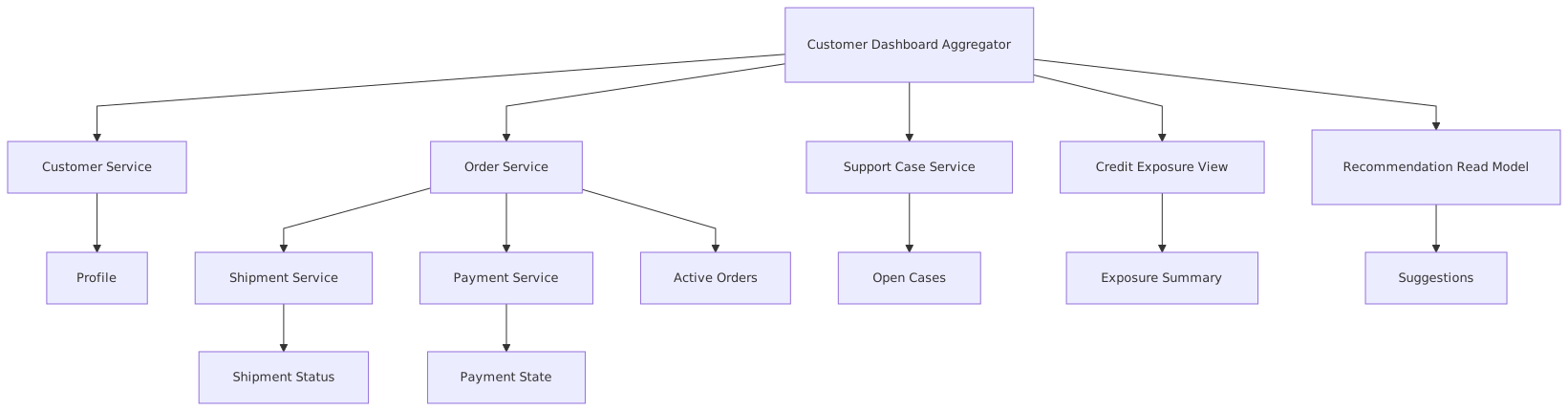
This diagram matters because it shows the truth everyone eventually discovers in logs: one business API often hides a dependency graph. Better to design it deliberately.
Architecture
There are several ways to implement aggregation trees. The right one depends on response latency goals, consistency needs, and domain ownership.
1. Dedicated aggregation service
This is my default preference in enterprise systems when the composition is meaningful enough to deserve ownership.
A dedicated aggregation service:
- exposes business-facing composite endpoints
- orchestrates downstream calls or projections
- translates identifiers and semantics
- enforces response contracts for a channel or journey
- contains branch-specific timeout, fallback, and degradation policy
This is not just a “fat gateway.” It is an application service aligned to a business composition. If it serves web only, it may be a BFF. If it serves multiple consumers, it may be a domain composition API.
The difference is intent.
2. Gateway-level aggregation
Useful for lightweight composition, auth-aware edge concerns, and simple endpoint bundling. Dangerous when it starts absorbing real business semantics. API gateways should route, protect, mediate, and sometimes compose. They should not become your secret enterprise integration platform.
3. Query federation
GraphQL and similar federation tools can model a tree naturally. They are strong when clients need flexible traversal. But they don’t eliminate backend complexity; they often make it easier to expose it. Federation can be elegant, but only if resolver design, caching, ownership, and failure behavior are tightly managed.
4. Materialized read models
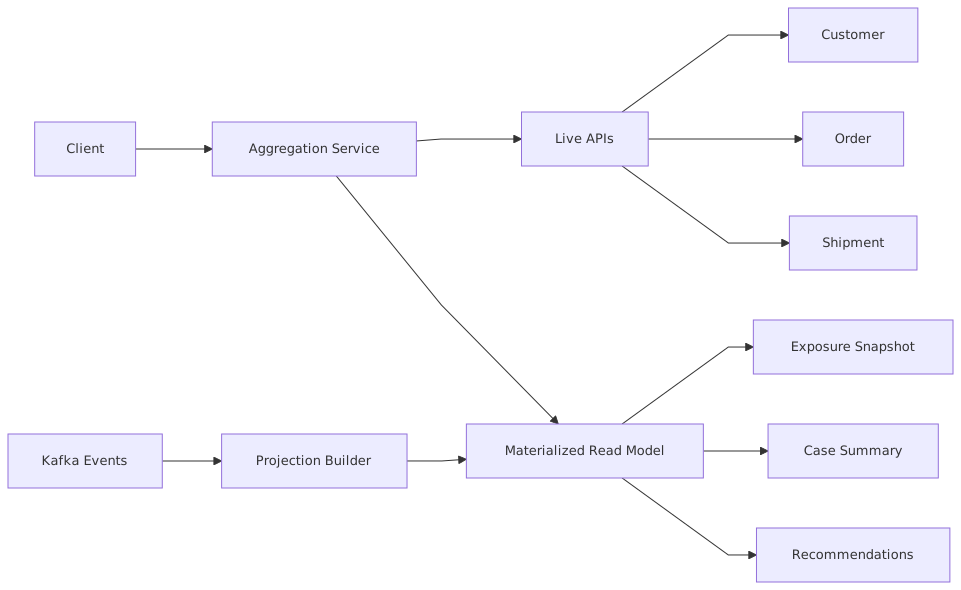
For high-fan-out or high-volume reads, precomputed views are often the better answer. Kafka is especially relevant here. Domain events can feed a projection that assembles portions of the tree in advance. The API then fetches a mostly ready structure with a few live enrichments for volatile fields.
That hybrid is common in serious systems.
Hybrid tree pattern
The strongest production designs usually blend synchronous and asynchronous branches:
- root fetched live
- stable subtrees from materialized projections
- volatile leaves enriched synchronously
- non-critical leaves omitted or deferred under pressure
That is architecture behaving like an adult.
Domain semantics in the tree
This is where domain-driven design becomes essential.
Suppose your root is “Customer Overview.” Sounds innocent. But which customer identity anchors the tree?
- CRM customer ID?
- Billing party ID?
- Legal entity?
- Household?
- Logged-in user profile?
If you don’t settle that, you’ll build a tree on semantic quicksand.
A good aggregation tree names its root and branches using explicit domain language. It also carries mapping rules where contexts differ. For instance:
customerIdin CRM maps topartyIdin Billing- household-level support cases may need roll-up
- order ownership may differ for marketplace scenarios
- shipment status may reflect fulfillment unit, not order header
Those are not implementation details. They are the design.
Reconciliation inside the tree
Reconciliation is inevitable whenever branches come from systems with different update rhythms or identity models.
Examples:
- Order says “paid,” payment branch says “pending settlement”
- Shipment branch has two packages, order branch still shows one fulfillment line
- Support case references a customer merged yesterday, profile branch still has old identifiers
The aggregator should not “fix” source-of-truth conflicts by inventing new truth. But it must decide how conflicting branches appear in a business response.
That means defining reconciliation policy:
- prefer authoritative branch for displayed status
- annotate response with data freshness
- expose confidence or source metadata
- suppress contradictory leaves when harmful
- trigger async correction workflow where appropriate
An honest system is often better than a falsely consistent one.
Migration Strategy
In enterprises, greenfield purity is fantasy. You will likely start with a monolith, add services around it, and live through a long middle period where old and new both matter.
This is where API aggregation trees shine: they give you a controlled seam for progressive strangler migration.
The pattern is simple in principle.
- Keep the consumer contract stable.
- Introduce an aggregation layer in front of existing APIs or monolith endpoints.
- Gradually replace branches of the tree with calls to new services or projections.
- Reconcile differences behind the aggregation boundary.
- Retire old branches one by one.
This is much safer than making every client understand migration status.
Progressive branch strangling
Imagine a legacy customer portal backed by a monolith. You introduce microservices for Orders and Support first. Instead of making the portal call both monolith and new services directly, place an aggregator in front:
- root profile still comes from monolith
- orders branch now from new Order Service
- support branch now from Support Case Service
- payment branch still from monolith
- shipment branch temporarily joined through legacy adapter
Consumers see one response. Internally, the tree is slowly re-wired.
That gives you several benefits:
- client contracts remain stable
- migration risk is localized
- observability can compare old vs new branches
- reconciliation logic absorbs semantic differences during transition
Migration tree example

Reconciliation during migration
Migration exposes semantic mismatches brutally.
A legacy monolith often stores denormalized, overloaded concepts. New microservices sharpen boundaries. During transition, identifiers may not line up, statuses may be calculated differently, and timing may drift.
You need explicit reconciliation strategies:
- dual-read and compare on selected traffic
- shadow branches that do not affect response yet
- discrepancy metrics by field and branch
- anti-corruption layers for legacy concepts
- compensating enrichment where new domains are not fully populated
A common mistake is to treat migration as plumbing. It isn’t. It is a semantic negotiation between old and new models.
Kafka in migration
Kafka helps when direct synchronous replacement is too risky.
You can use event streams to build transitional read models:
- consume legacy change events
- consume new domain events
- project both into a shared aggregation view
- compare or merge selectively
- cut over branch reads without changing consumers
This is particularly effective for heavy read paths where live fan-out would be too expensive.
But do not romanticize it. Event-driven migration creates its own hard problems:
- replay correctness
- event schema evolution
- ordering assumptions
- duplicate handling
- backfill consistency
- lag visibility
Kafka is powerful because it preserves history. It is dangerous for the same reason.
Enterprise Example
Consider a global insurer building a broker portal.
The broker wants a “client account view” showing:
- client profile
- active policies
- unpaid invoices
- recent claims
- risk alerts
- servicing tasks
On paper, this sounds like one screen. In reality, it spans half the enterprise:
- CRM for party and broker relationships
- Policy Administration for active coverage
- Billing for invoices and delinquency
- Claims platform for claim summaries
- Risk engine for alert scoring
- Workflow platform for open servicing tasks
Different vendors. Different data models. Some modern APIs. Some old SOAP services with the personality of a locked filing cabinet.
The first attempt usually comes from the UI team: call everything directly. It works in lower environments and dies in production.
A better design is a Broker Client Aggregation Service with a tree rooted at BrokerClientOverview.
Domain decisions that matter
This insurer discovered that “client” meant three things:
- legal policy holder
- billing account owner
- broker-serviced relationship node
Those were not the same. So the aggregation service anchored on a broker client relationship ID, then mapped branches to their native identifiers:
- CRM owned the relationship root
- Policy service resolved policies by insured party
- Billing resolved invoices by account owner
- Claims resolved by claimant or policy depending on branch purpose
This mapping was not hidden. It was modeled explicitly. That one decision prevented years of confusion.
Technical implementation
- Live calls for policy and workflow tasks
- Kafka-fed materialized view for claim summaries and risk alerts
- Billing branch from a legacy adapter with aggressive timeout and fallback
- Partial response contract with freshness metadata
- Correlation ID propagated across all branch fetches
- Branch-level SLOs and circuit breakers
Why not one giant read model?
Because some branches needed authoritative freshness. Unpaid invoice status and servicing task ownership changed too frequently. Claim summaries and risk alerts tolerated minutes of lag. So they used a hybrid tree, not a single precomputed document.
Migration path
The insurer still had a monolithic policy admin platform. They strangled around it:
- started with a legacy facade for policy branch
- introduced event publication from policy changes
- built a policy summary projection
- shifted non-critical policy fields to the projection
- retained live calls for endorsement-sensitive fields
- eventually replaced the facade with a dedicated policy API
That’s how sensible migration looks: branch by branch, semantics preserved, risk contained.
Operational Considerations
Aggregation trees are conceptually clean and operationally treacherous if unmanaged.
Latency budgeting
You must budget latency per branch, not only per endpoint. If the whole response has a 500 ms target, a tree with six live branches cannot leave everyone free to take 400 ms.
Set branch budgets:
- profile: 80 ms
- orders: 120 ms
- shipments: 100 ms
- cases: 80 ms
- exposure: 50 ms from projection
- recommendations: 40 ms optional
Then decide execution policy:
- parallel where safe
- sequential only when branch identity depends on parent resolution
- hedged calls for flaky dependencies if justified
- cancellation of low-priority branches when root already breaches budget
Caching
Caching helps, but careless caching makes systems feel haunted.
Use it with intent:
- cache stable branches, not the whole response blindly
- align TTL to business tolerance
- invalidate by domain event when possible
- keep per-branch freshness metadata
- avoid mixing identity-sensitive and public cache semantics
A cached composite can easily become semantically inconsistent. Better to cache branch fragments with known ownership.
Observability
If you operate aggregation without branch-level telemetry, you are driving at night with the dashboard unplugged.
Track:
- branch latency distribution
- fan-out count per request
- timeout and fallback rate by branch
- stale-read ratio for projected data
- reconciliation discrepancy metrics
- topological hot spots, such as N+1 downstream patterns
Distributed tracing is essential. So are business traces. Knowing Shipment Service is slow matters; knowing “customer overview with active orders > 10 causes latency spikes” matters more.
Security and data minimization
Aggregation tends to pull more data than consumers need. That is a governance smell. EA governance checklist
The aggregation service should:
- enforce consumer-specific field access
- avoid over-fetching sensitive downstream data
- apply masking or redaction per branch
- propagate authorization context properly
- log access decisions for regulated fields
A customer 360 endpoint is often one bad access-control decision away from an audit finding.
Versioning
Composite contracts evolve awkwardly because downstream branches evolve independently.
Prefer additive change. Hide downstream churn. Keep response semantics stable. The whole point of the aggregator is to absorb internal movement so clients don’t live on tectonic fault lines.
Tradeoffs
Aggregation trees are a trade, not a free lunch.
What you gain
- consumer simplicity
- controlled domain composition
- migration seam for strangler delivery
- explicit failure handling
- clearer ownership of business-facing views
- reduced topology leakage
What you pay
- extra service layer and operational complexity
- potential duplication of query logic
- risk of semantic drift in the aggregator
- harder testing across multiple dependencies
- possibility of creating a central bottleneck
That last one is important. If every meaningful read goes through one mega-aggregator, congratulations: you have reinvented a distributed monolith at the edge.
The trick is granularity. Build aggregation services around coherent business experiences, not around the entire enterprise.
Failure Modes
Architecture patterns are best judged by how they fail.
1. The accidental orchestration monster
The aggregator starts with read composition and gradually absorbs business decisions, validation, sequencing, and write coordination. Now it owns too much and knows too much.
Symptom: downstream services become dumb record stores.
2. Tree explosion
Each new screen adds one more branch until the response resembles an overgrown Christmas tree. Fan-out rises, dependencies multiply, and no branch can fail safely.
Symptom: latency and timeout problems scale faster than traffic.
3. Semantic flattening
Different domain meanings are merged into one convenient but false model. “Status” becomes a single field even though order, payment, and shipment statuses are distinct concepts.
Symptom: business users stop trusting the screen.
4. Reconciliation denial
Conflicts between branches are ignored or silently overwritten. The system returns a neat answer that is operationally untrue.
Symptom: support teams invent spreadsheet workarounds.
5. Eventual consistency surprise
Projection-backed branches lag in ways the business did not agree to. A customer pays an invoice and still sees delinquency for ten minutes.
Symptom: angry calls, followed by a technical explanation nobody wanted.
6. Gateway abuse
The API gateway becomes the aggregation engine, migration adapter, transformation layer, and policy brain. It turns into a critical bottleneck with poor local testability.
Symptom: every change requires edge-team coordination.
Failure modes are not reasons to avoid the pattern. They are reasons to use it with discipline.
When Not To Use
This pattern is useful, but not universal.
Do not use API aggregation trees when:
A single bounded context can answer the question
If one service truly owns the data and semantics, adding aggregation is ceremonial architecture.
The composition is trivial and stable
A simple gateway composition may be enough. Don’t build a whole aggregation service for a two-call bundle with no semantic translation.
Clients need arbitrary graph traversal
If consumers genuinely need flexible querying across many entities, a federated query approach may fit better — provided you manage resolver performance and ownership well.
The read path can be fully projection-driven
For analytic or dashboard-heavy use cases with relaxed freshness requirements, a materialized read model may outperform live tree orchestration.
The organization cannot sustain ownership
An aggregation tree needs a team willing to own contract design, reconciliation, branch SLOs, and migration logic. Without that, it becomes abandoned middleware.
Writes dominate the interaction
If the real problem is distributed transaction or command coordination, aggregation is the wrong pattern. You may need saga orchestration, process managers, or a redesign of service boundaries.
A good architect knows not just where to use a pattern, but where to leave it on the shelf.
Related Patterns
API aggregation trees live among several neighboring patterns. They overlap, but they are not identical.
Backend for Frontend
A BFF tailors APIs to a specific client experience. An aggregation tree is often implemented in a BFF, but the tree idea is about composition structure and branch semantics, not just client specialization.
API Gateway Aggregation
A lighter-weight form suited to edge composition. Fine for simple cases. Dangerous as domain complexity grows.
CQRS Read Models
Materialized views are excellent for stable, query-heavy branches. They often complement aggregation trees, especially with Kafka-fed projections.
GraphQL Federation
Natural fit for tree-shaped queries. Strong for client flexibility. Needs careful resolver economics and ownership boundaries.
Saga / Process Manager
Related only in that both deal with distributed concerns. Sagas coordinate state-changing workflows. Aggregation trees compose read-side views.
Strangler Fig Pattern
Essential for migration. The aggregator can serve as the stable façade while internal branches move from monolith to services progressively.
Anti-Corruption Layer
Critical during migration or when crossing bounded contexts with mismatched semantics. Many aggregation branches need ACL behavior, whether teams admit it or not.
Summary
API aggregation trees are one of those patterns that become obvious only after you’ve suffered without them.
Microservices separate domains well, but users still ask integrated questions. The answer is not to abandon bounded contexts, nor to let every client discover your service topology the hard way. The answer is to treat composition as a first-class architectural problem.
A good aggregation tree starts with business meaning. It chooses a clear root. It respects bounded contexts. It makes branch retrieval semantics explicit. It distinguishes live data from projected data. It plans for reconciliation instead of pretending inconsistency won’t happen. And during migration, it provides a stable seam for strangling the monolith branch by branch.
Used well, it gives enterprises a practical shape for composite APIs. Used badly, it becomes an orchestration swamp.
That’s the real trade.
If you remember one thing, remember this: in distributed systems, the shape of the answer is part of the architecture. Ignore that shape and the network will design it for you — badly, expensively, and in production.
A tree is not magic. But it is honest. And honesty is a fine place to start.
Frequently Asked Questions
What is a service mesh?
A service mesh is an infrastructure layer managing service-to-service communication. It provides mutual TLS, load balancing, circuit breaking, retries, and observability without each service implementing these capabilities. Istio and Linkerd are common implementations.
How do you document microservices architecture for governance?
Use ArchiMate Application Cooperation diagrams for the service landscape, UML Component diagrams for internal structure, UML Sequence diagrams for key flows, and UML Deployment diagrams for Kubernetes topology. All views can coexist in Sparx EA with full traceability.
What is the difference between choreography and orchestration in microservices?
Choreography has services react to events independently — no central coordinator. Orchestration uses a central workflow engine that calls services in sequence. Choreography scales better but is harder to debug; orchestration is easier to reason about but creates a central coupling point.