⏱ 21 min read
Microservices rarely fail because teams chose the wrong transport protocol. They fail because we scatter volatility across the estate like glitter in a carpet. Every change, every dependency, every ambiguous business rule ends up smeared across services, databases, pipelines, and support teams. Then we call the result “distributed architecture” as if distance were a design principle.
It isn’t.
If you’ve spent time in a large enterprise, you know the real enemy is not scale by itself. It is unstable change moving faster than the organization can absorb it. One part of the business changes weekly because pricing is experimental. Another changes quarterly because finance closes books under strict controls. A third should barely change at all because identity and regulatory reporting are governed to death. Yet in many microservice landscapes, these wildly different rates of change are wired together as though they belong to the same tempo. The outcome is predictable: fragile releases, endless regression testing, event storms, and Kafka topics that become archaeological sites of half-understood intent. event-driven architecture patterns
This is where service stability zones matter.
A stability zone is not a platform feature. It is a way of structuring a microservice ecosystem around business volatility, domain semantics, and operational blast radius. In plain English: group services according to how likely they are to change, how dangerous those changes are, and how much coupling they should tolerate. Put the twitchy parts of the business in one zone, the slow-moving crown jewels in another, and design the seams between them with discipline.
The idea sounds obvious. In practice, it is radical. Most organizations partition by team chart, cloud account, or technical layer. Stability zones partition by change physics. That is a better predictor of pain.
This article lays out the pattern in depth: the context that makes it useful, the forces that push teams into it, the architecture, migration strategy, operational consequences, tradeoffs, and the failure modes that show up when good intent meets enterprise reality. I’ll also use a realistic enterprise example to show how this plays out beyond whiteboard theater.
Context
Microservices emerged to solve a real problem: large systems become hard to change when every release requires synchronized coordination. Breaking a monolith into services promised independent deployability, localized ownership, and better alignment with bounded contexts. Sometimes that promise is fulfilled. Often it is replaced with a new tax: distributed ambiguity.
The mistake is subtle. Teams carve services around nouns—Customer, Order, Product, Payment—and stop there. That is domain-driven design with the brakes on. Good DDD does not just ask, “What are the business capabilities?” It also asks, “Where does the language change? Where are the rules contested? Which concepts are stable, and which are under constant experimentation?” Those are different questions, and they matter more over time.
In a mature enterprise, not all domains are equal in their behavior:
- Core record domains tend to be stable, highly governed, and intolerant of semantic drift.
- Decisioning domains such as pricing, eligibility, fraud scoring, and promotions are volatile and often under active tuning.
- Experience-facing composition domains change with channels, journeys, and UX experiments.
- Integration and reconciliation domains absorb mess from legacy systems, partner feeds, timing gaps, and eventual consistency.
Treating all of these with the same service granularity and interaction style is architectural laziness. Stability zones create a more deliberate structure.
Problem
A typical microservice estate degrades in familiar ways.
First, teams push unstable business logic deep into foundational services. A customer service that should represent customer identity and core profile starts accumulating onboarding experiments, consent variants, segmentation rules, and cross-sell flags. Now every product team depends on a “customer” concept that no longer means one thing.
Second, synchronous dependencies spread outward. A checkout flow calls pricing, promotions, inventory, fraud, tax, customer, entitlements, shipment options, and payment orchestration in real time. Any one of them can wobble and poison the customer journey. Latency climbs. Retries multiply. Circuit breakers become decorative.
Third, events are introduced as a cure-all. Kafka appears, topics bloom, and teams announce they have solved coupling. In reality they may simply have made coupling asynchronous and harder to observe. Events without semantic discipline become gossip. Multiple services infer state from partial facts, then spend their lives reconciling with one another.
Fourth, migration from legacy systems gets trapped in the middle. Teams peel off front-end features but keep core workflows dependent on the old transaction backbone. They end up with dual writes, inconsistent identifiers, and a reconciliation backlog that quietly becomes the real system.
The underlying problem is that the architecture does not distinguish between stable and unstable business semantics. Everything is connected as though change is uniformly distributed. It never is.
Forces
Several forces pull against one another here, and any useful architecture has to acknowledge them rather than pretend they can be optimized away.
1. Business volatility is uneven
Promotions may change twice a day. Ledger rules should not. Product catalog structure may evolve weekly in retail, while employee identity in HR barely changes except under policy revision. This unevenness should shape service boundaries.
2. Semantics decay under shared reuse
A service used by ten teams drifts toward the least common denominator or, worse, accumulates every exception. Shared services become semantic junk drawers. The more central the service, the more conservative its meaning must be.
3. Synchronous calls amplify instability
Real-time request chains are the architectural equivalent of daisy-chaining extension cords in a storm. They work until they don’t, and then everything catches fire at once.
4. Event-driven designs need reconciliation, not faith
Kafka is excellent for decoupling time and load, but it does not erase inconsistency. It creates a new responsibility: understanding and healing the gaps between local truths.
5. Migration is constrained by legacy gravity
You do not get to redesign the enterprise from scratch. Mainframes still settle money. ERP still owns procurement truth. CRM still emits customer identifiers nobody fully trusts. A viable pattern must support gradual migration, not require a ceremonial rewrite.
6. Teams mirror architecture
Conway always gets paid. If one team owns both highly volatile customer acquisition experiments and the regulated system of record, they will either slow the experiments or destabilize the record. Usually both.
Solution
Service stability zones organize microservices into zones based on the stability of their domain semantics and operational tolerance for change. The point is not to create rigid layers. The point is to isolate change where it belongs and make crossings explicit.
A practical model usually has three zones:
- Stable Core Zone
Services with durable semantics, strong governance, and high correctness requirements. This includes systems of record, identity, ledgers, order commitments, entitlements, compliance facts. They change slowly and carefully. EA governance checklist
- Adaptive Decision Zone
Services where business rules change frequently: pricing, promotions, fraud strategies, eligibility, recommendations, routing, experimentation. This zone is intentionally flexible and often event-driven.
- Volatile Experience Zone
Channel-facing composition, orchestration, BFFs, journey services, personalization surfaces, campaign-specific APIs. This zone changes fastest and should have the least authority over durable truth.
A fourth zone often exists in real enterprises whether people admit it or not:
- Reconciliation and Integration Zone
Anti-corruption layers, legacy adapters, CDC processors, topic normalization, identity resolution, discrepancy handling, replay, repair, and back-office correction workflows. If your estate spans legacy and microservices, this zone is not optional. microservices architecture diagrams
The key principle is simple: the more stable the semantics, the less traffic in exceptions the service should carry. Stable zones publish durable facts. Adaptive zones consume those facts and produce decisions. Volatile zones compose experiences without owning core truth.
Here is a conceptual view.

This diagram is intentionally plain. The important thing is not the arrows. It is the asymmetry of authority.
- The Stable Core Zone owns canonical commitments and durable facts.
- The Adaptive Decision Zone owns transient interpretations and decisions.
- The Volatile Experience Zone owns presentation-oriented composition and customer journey behavior.
- The Reconciliation Zone owns translation, healing, and coexistence with imperfect reality.
That separation has enormous consequences.
Architecture
Let’s make this more concrete.
Stable Core Zone
This zone is where domain-driven design should be at its most disciplined. Bounded contexts here must be semantically sharp. “Order” means a committed commercial object, not a half-built basket, not a quote, not a recommendation artifact. “Customer” means the enterprise identity or party record, not every marketing profile shape that ever touched a form.
These services should prefer:
- strong ownership of data
- explicit contracts
- conservative change management
- idempotent command handling
- clear event publication of durable business facts
- minimal dependence on volatile upstream services
This zone is not where you put every reusable utility. It is where you put what the business cannot afford to be fuzzy about.
Examples:
- Customer Identity Record
- Account Ledger
- Order Commitment
- Contract Registry
- Entitlement Registry
- Invoice and Settlement
Adaptive Decision Zone
Here lives the business logic that changes because the business is still learning. Pricing algorithms, fraud rules, offers, eligibility policies, routing logic, recommendation models, case prioritization—these are not records. They are decisions derived from facts, context, and strategies.
This zone should prefer:
- event consumption from stable facts
- model versioning
- configuration and policy management
- temporal awareness
- auditability of decision outcomes
- graceful degradation under missing context
A crucial design point: decision services should not mutate stable truth casually. They should issue commands or recommendations to stable services when required, but not become shadow systems of record.
Volatile Experience Zone
This is where channels move quickly. Web, mobile, call center, partner APIs, onboarding flows, customer journey orchestration. These services care about responsiveness, composition, A/B testing, content variants, and interaction patterns. They should remain thin in business authority.
A classic error is letting this zone own durable business state because “the mobile team moves faster.” Fast-moving teams are exactly the wrong place to park semantics that need institutional memory.
Reconciliation and Integration Zone
This zone deserves more respect than it usually gets. In enterprises, eventual consistency is not just a timing pattern. It is a working condition. Systems miss events. Legacy interfaces replay stale files. Partner feeds conflict with internal records. IDs fork. Human operators correct data after the fact. If your architecture lacks a home for discrepancy detection and repair, you have merely outsourced complexity to production support.
This zone often contains:
- anti-corruption layers around legacy systems
- change data capture processors
- event enrichment and normalization
- identity resolution
- replay and backfill pipelines
- discrepancy detectors
- repair workflows
- exception dashboards
That is not architectural shame. That is architecture facing adulthood.
Domain semantics and service boundaries
The heart of stability zones is semantic discipline.
In DDD terms, each zone may contain multiple bounded contexts, but the same noun should not mean a different thing every time it crosses a zone without explicit translation. This is where many microservice programs quietly rot. Teams say “customer event,” but one means “identity registered,” another means “marketing lead updated,” and a third means “authenticated digital profile touched.” Then downstream consumers stitch together Franken-truth.
A useful heuristic:
- Stable Core publishes facts
- Adaptive Zone publishes decisions
- Volatile Zone publishes interactions
- Reconciliation Zone publishes corrections and discrepancy states
That distinction is more important than whether you use REST, gRPC, or Kafka.
For example:
CustomerRegisteredis a stable fact.OfferEligibilityCalculatedis a decision.CheckoutStartedis an interaction.CustomerIdentityMergedorOrderReconciledis a correction.
When event streams mix those semantics indiscriminately, consumers become accidental philosophers. They infer reality from implication. That is fragile.
Kafka and event-driven collaboration
Kafka fits naturally into stability zones, but only if you use it as a semantic backbone, not a dumping ground.
A robust pattern looks like this:
- Stable Core publishes domain facts to durable topics.
- Adaptive services consume facts, compute decisions, and publish decision events.
- Experience services consume both when needed, often via read-optimized views.
- Reconciliation services monitor streams, detect missing transitions, and trigger repair workflows.
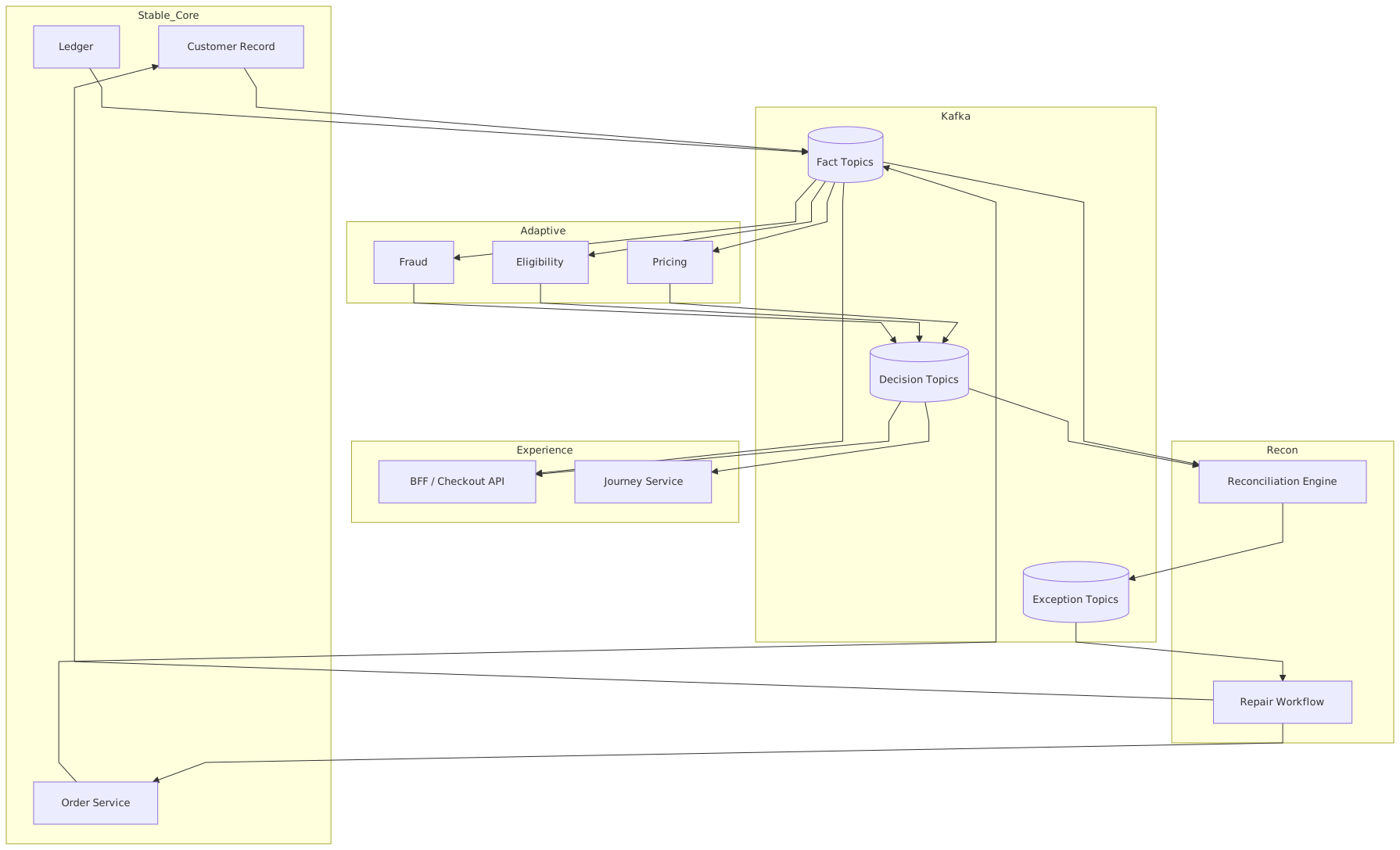
The pattern works because authority remains clear. Kafka distributes information; it does not dissolve ownership.
A few hard-won opinions:
- Don’t let every service subscribe to every topic “just in case.”
- Don’t publish low-level CRUD events and call them domain events.
- Don’t assume event ordering globally.
- Don’t skip replay strategy. You will need it.
- Don’t confuse eventual consistency with eventual correctness. Correctness needs reconciliation.
Migration Strategy
This pattern is most valuable during migration, because migration is where architectural wishful thinking is most expensive.
The right move is usually a progressive strangler approach. Not a heroic rewrite. Not a synchronized cutover. A strangler aligned to stability zones.
Start by identifying legacy capabilities by stability:
- Which functions are stable records and must remain authoritative for now?
- Which are policy-heavy and can be peeled out safely?
- Which are channel workflows that can be rebuilt without changing underlying commitments?
Then migrate in this order:
1. Extract volatile experience first
Build new experience services or BFFs in front of the legacy core. This gives immediate delivery flexibility while keeping system-of-record authority intact. It is the lowest-risk place to create separation.
2. Isolate adaptive decisioning next
Move pricing, eligibility, recommendations, routing, fraud policies, and similar logic out of legacy code paths. Feed them with facts from legacy via CDC, events, or anti-corruption APIs. This is where business agility usually pays for the migration.
3. Preserve stable core authority until semantics are clear
Do not rip out the ledger, identity master, or order commitment because a modernization roadmap says “Phase 2.” Replace stable core services only when their domain boundaries are well understood and downstream dependencies have been untangled.
4. Invest early in reconciliation
The strangler pattern without reconciliation is theater. During coexistence you will have parallel representations, delayed updates, replays, duplicate identifiers, stale caches, and human corrections. Build discrepancy detection and repair from day one.
A migration view often looks like this:

This sequence matters. Many programs try to replace the stable core first because it feels architecturally pure. It is also where failure is most expensive. The better path is to peel off volatility first, where learning is fastest and coupling can be reduced incrementally.
Enterprise Example
Consider a multinational retailer modernizing order management and customer commerce.
The legacy estate includes:
- an ERP that owns product and inventory truth
- a mainframe-based order system
- a CRM that holds customer records
- a promotions engine embedded in e-commerce software
- several country websites and mobile apps
- Kafka introduced recently for integration events
The organization initially split into microservices around nouns: Customer, Order, Product, Promotion, Basket, Payment, Shipment. It looked modern. It behaved terribly.
Why? Because the “Customer” service ended up holding identity, channel preferences, loyalty behavior, guest checkout profiles, marketing consent snapshots, and fraud flags. The “Order” service held both basket interactions and committed orders. Promotions changed constantly and required releases in order and basket services. Checkout became a synchronous gauntlet of calls across pricing, customer, stock, tax, and fulfillment. During holiday peaks, a slowdown in promotions cascaded into order failures. Kafka topics helped move some data around, but event meanings varied by country site.
The company reorganized around stability zones.
Stable Core Zone
- Customer Identity Record
- Order Commitment Service
- Inventory Reservation
- Payment Capture Record
- Settlement and Refund Ledger
Adaptive Decision Zone
- Promotions Decision Service
- Pricing Decision Service
- Fraud Decisioning
- Fulfillment Routing
- Eligibility for loyalty and benefits
Volatile Experience Zone
- Web BFF
- Mobile BFF
- Checkout Journey Service
- Customer Service Agent API
- Market-specific composition services
Reconciliation and Integration Zone
- ERP anti-corruption adapters
- CRM identity merge processor
- event normalization pipelines
- order discrepancy detector
- replay and repair tooling
A few decisions changed everything.
First, baskets were reclassified as volatile interaction state, not orders. That sounds minor. It wasn’t. It stopped teams from polluting the order model with half-finished shopping behavior.
Second, promotions became decision outputs, not persistent order truth. The order service records the applied commercial commitment, but it does not own the logic that generated every possible offer. Promotions could now evolve rapidly without destabilizing order semantics.
Third, customer identity was separated from customer engagement profiles. Identity moved into stable core; engagement attributes stayed in adaptive and experience contexts. That ended years of confusion over what “customer update” actually meant.
Fourth, Kafka topics were reorganized around semantic categories:
- fact topics for committed domain events
- decision topics for calculated outcomes
- exception topics for reconciliation
The migration ran progressively. New checkout journeys were built in the experience zone first. Promotions and fraud came out next. The legacy order mainframe remained authoritative for committed orders during coexistence. CDC fed fact streams into Kafka; reconciliation services compared committed orders, reservations, captures, and shipments. Only after these seams stabilized did the enterprise begin carving out a new order commitment service for selected markets.
The benefits were not magical. They were practical:
- fewer coordinated releases
- lower checkout blast radius
- clearer event semantics
- faster promotions changes
- easier incident triage
- less contamination of core records by experiment logic
That is what good architecture looks like in enterprises: not elegance alone, but reduced organizational friction.
Operational Considerations
Stability zones influence operations as much as design.
Different SLOs by zone
Not every service deserves the same reliability target. Stable Core services often need stricter correctness and availability guarantees. Adaptive services may tolerate temporary degradation if defaults or last-known-good decisions exist. Experience services need responsiveness but should degrade gracefully rather than fail hard.
Observability by semantic flow
Traditional tracing helps, but it is not enough. You need observability that follows business state transitions:
- order committed but payment not captured
- customer merged but downstream profile not updated
- eligibility decision expired before checkout completed
These are semantic failures, not just technical ones.
Replay and backfill
If you use Kafka, replay is not an edge case. It is an operating model. Design consumers to be idempotent. Preserve event versioning. Keep repair pipelines out of ad hoc scripts written during incidents.
Reconciliation as first-class ops
There should be explicit ownership for discrepancy queues, correction SLAs, and human-in-the-loop resolution. Enterprises often hide this in support teams. That is a mistake. Reconciliation is architecture with operators attached.
Data product discipline
Read models and analytical projections should align to zone semantics. A stable-core fact stream feeding downstream marts is healthy. A dozen channel teams deriving their own customer truth from clickstreams is how governance nightmares begin. ArchiMate for governance
Tradeoffs
This pattern is not free.
The biggest cost is added architectural intentionality. You must decide what is stable, what is adaptive, and what is merely experiential. That sounds obvious until senior stakeholders discover their favorite “core” domain is actually a mess of local exceptions.
You also introduce more explicit seams:
- more contracts
- more event taxonomies
- more anti-corruption logic
- more reconciliation workflows
Some teams will complain this slows them down. For small systems, they may be right.
Another tradeoff is duplication of data views. That is often necessary. Experience zones may maintain journey-centric projections that should never be mistaken for canonical records. Decision zones may cache facts for performance. Stable Core may remain intentionally normalized and conservative. This is healthy duplication if semantics stay clear.
Finally, there is a political tradeoff. Stability zones expose domain confusion. They force hard conversations about authority, meaning, and ownership. Architecture can survive technical debt for a long time. It struggles more with unresolved semantic debt.
Failure Modes
This pattern fails in very recognizable ways.
1. Everything gets labeled “core”
Teams protect their turf by declaring their service mission-critical and stable. If every domain is core, the model collapses. Core must mean durable semantics and low tolerance for ambiguity, not just business importance.
2. Experience services become shadow systems of record
BFFs or journey services start persisting business commitments because it is expedient. Months later, nobody knows whether the order is “real” in checkout, orchestration, or the order service.
3. Decision services leak into canonical truth
Eligibility or pricing services start storing persistent entitlements or commercial commitments without coordinating with stable core. This creates split authority.
4. Kafka topics become semantic soup
Events are emitted from internal state changes rather than domain meaning. Consumers reverse-engineer intent. Reconciliation becomes impossible because the source facts are muddy.
5. Reconciliation is postponed
This is the classic one. Teams say they will “handle edge cases later.” In migration, edge cases are the project. Postpone reconciliation and production will invent it for you.
6. Legacy anti-corruption layers become permanent sludge
The ACL is supposed to protect the new model from legacy semantics. If left unmanaged, it becomes a new monolith in disguise. Keep it explicit, constrained, and temporary where possible.
When Not To Use
Do not use stability zones everywhere.
If you are building a small product with a handful of services, one team, and limited compliance pressure, this pattern may be overkill. You probably need clearer bounded contexts and fewer moving parts, not a zoned architecture.
Do not use it if your business domain is genuinely simple and stable. A modest modular monolith may be better. In fact, many organizations would improve their systems by replacing a sloppy microservice sprawl with a disciplined monolith plus a few well-chosen integrations.
Do not use stability zones as a bureaucratic layer over poor domain modeling. If you cannot explain what your business facts are, what your decisions are, and what your interactions are, zones will just give you more boxes and no clarity.
And do not use it to justify permanent fragmentation of a domain that should be unified. Sometimes a noisy service is not “adaptive”; it is simply badly designed.
Related Patterns
Several patterns sit naturally alongside stability zones.
Bounded Contexts
This is foundational. Stability zones do not replace DDD bounded contexts; they organize them by volatility and operational behavior.
Strangler Fig
Essential for migration. Stability zones provide a smarter sequence for what to strangle first.
Anti-Corruption Layer
Critical between legacy semantics and newly clarified domain models. Particularly important in the reconciliation zone.
Event-Carried State Transfer
Useful, but dangerous without semantic discipline. Best used for fact propagation and derived views, not as an excuse to avoid ownership.
Saga / Process Manager
Helpful in adaptive or experience zones for coordinating long-running workflows. Less suitable as a substitute for stable commitment models.
CQRS
Often useful where volatile reads and stable writes differ sharply, especially across experience and decision zones.
Outbox Pattern
Almost mandatory for reliable fact publication from stable core services.
Reconciliation Workflow
Not discussed enough in fashionable architecture circles, but indispensable in enterprise systems with eventual consistency and coexistence.
Summary
Service stability zones are a practical response to a simple truth: not all business change deserves equal proximity to your core systems. Some parts of the domain should move quickly. Some should move carefully. Some should mostly translate, reconcile, and keep the whole estate honest.
That is not just a deployment concern. It is a domain concern.
The pattern works because it aligns architecture with the actual behavior of the business:
- Stable Core protects durable truth.
- Adaptive Decision absorbs frequent rule change.
- Volatile Experience enables fast channel evolution.
- Reconciliation and Integration makes coexistence survivable.
Used well, stability zones reduce blast radius, clarify semantics, improve migration sequencing, and make Kafka-based collaboration far more meaningful. Used badly, they become another taxonomy pasted over confused services.
If there is one line worth keeping, it is this: architect around the rate and meaning of change, not just the shape of nouns.
That is where microservices stop being a diagram and start becoming a system an enterprise can live with.
Frequently Asked Questions
What is a service mesh?
A service mesh is an infrastructure layer managing service-to-service communication. It provides mutual TLS, load balancing, circuit breaking, retries, and observability without each service implementing these capabilities. Istio and Linkerd are common implementations.
How do you document microservices architecture for governance?
Use ArchiMate Application Cooperation diagrams for the service landscape, UML Component diagrams for internal structure, UML Sequence diagrams for key flows, and UML Deployment diagrams for Kubernetes topology. All views can coexist in Sparx EA with full traceability.
What is the difference between choreography and orchestration in microservices?
Choreography has services react to events independently — no central coordinator. Orchestration uses a central workflow engine that calls services in sequence. Choreography scales better but is harder to debug; orchestration is easier to reason about but creates a central coupling point.