⏱ 20 min read
Most API programs do not fail because engineers can’t build endpoints. They fail because the organization cannot agree on what state an API is in, what that state means, and what behavior is allowed next.
That sounds bureaucratic. It isn’t. It is operational survival.
An API is not just a technical artifact. It is a product boundary, a policy object, a contract, a risk surface, and—if you run a large enterprise—a promise with a legal tail. Teams often say they have “API governance,” but what they really have is a publishing checklist and a style guide. That is governance theater. Real governance begins when lifecycle states are explicit, enforceable, and tied to business semantics. EA governance checklist
The lifecycle of an API is the backbone of API governance. Get it right and teams can move quickly without breaking trust. Get it wrong and you get zombie APIs, accidental production contracts, broken consumers, duplicate capabilities, and endless arguments over whether “beta” means safe enough for partners or only safe enough for internal experiments. ArchiMate for governance
This article takes an architectural view of API lifecycle states: what they are, why they matter, how to model them, and how to implement them in real enterprises. We’ll look at domain-driven design, event-driven reconciliation, progressive strangler migration, Kafka-backed propagation, failure modes, and the tradeoffs that make governance feel annoyingly human. Because it is. event-driven architecture patterns
Context
In a small company, an API lifecycle is often informal.
A team builds a service. They publish an OpenAPI spec. Someone posts the docs. A few consumers appear. Versions multiply. At some point there is a deprecation email, usually ignored until a major outage forces migration. This works for a while because people know each other, architecture is tribal, and the cost of ambiguity is low.
Then the enterprise arrives.
Now there are platform teams, product domains, external partners, regulated data, audit obligations, internal chargeback, service catalogs, service meshes, developer portals, and governance boards trying not to become bottlenecks. APIs are no longer just integration points. They are operating assets.
At this scale, “is this API ready?” is no longer a subjective question. It has to be answered with policy-backed semantics:
- Can internal consumers use it?
- Can external consumers onboard?
- Is production traffic allowed?
- Are SLAs in force?
- Is breaking change allowed?
- Must security review be complete?
- Is deprecation notice active?
- Is retirement blocked by active consumers?
- Is the catalog authoritative, or is the gateway?
These are lifecycle questions.
And if you think this is just metadata, watch what happens when one banking team says an API is “deprecated” because a replacement exists, while another team hears “deprecated” as “still fine for the next three years.” The word is the same. The semantics are not. Architecture lives or dies on semantics.
Problem
Most organizations define lifecycle states too loosely.
You see the usual labels:
- Draft
- Development
- Test
- Beta
- Production
- Deprecated
- Retired
That list is familiar and mostly useless.
The issue is not the names. The issue is that the states are rarely tied to:
- domain meaning
- transition rules
- technical controls
- operational obligations
- consumer communication
- retirement evidence
As a result, lifecycle states become decorative tags in a developer portal rather than control points in architecture governance.
Worse, API lifecycle is often conflated with software delivery lifecycle. They are related, but not identical.
A service may be deployed to production while its API remains “private experimental.” Another API may be fully “published and supported” even though the backing implementation is in the middle of a strangler migration from a monolith to microservices. Infrastructure state, deployment state, and contract state are different things. Mixing them creates chaos. microservices architecture diagrams
The architectural problem is this:
How do we design API lifecycle states so they reflect business semantics, support governance without crippling delivery, and remain enforceable across distributed systems?
That is not a tooling question. It is a model question first.
Forces
Every serious architecture problem is a tug-of-war. API lifecycle governance is no different.
1. Speed vs control
Delivery teams want autonomy. Governance teams want safety. Both are right.
If lifecycle transitions require a committee for every move, teams route around governance. If there is no control, your API estate turns into a landfill. Architecture is often the art of deciding where friction belongs.
2. Contract semantics vs implementation reality
An API contract may look stable while the implementation behind it is being carved out of a monolith. Or the implementation may be stable while the contract itself is under redesign. The lifecycle of the API product is not always the lifecycle of the codebase.
3. Internal consumers vs external consumers
Internal APIs tolerate ambiguity longer than partner APIs. External APIs carry legal expectations, onboarding cost, support obligations, and reputational risk. One state model may not be enough unless semantics are carefully layered.
4. Federated domains vs enterprise standardization
Domain-driven design tells us domains should own their capabilities and language. Enterprise governance tells us some things must be standardized. The trick is not to flatten domains, but to standardize the lifecycle vocabulary and controls around them.
5. Synchronous control vs eventual consistency
In modern enterprises, the API catalog, gateway, service mesh, CI/CD platform, security tooling, and event backbone are separate systems. Lifecycle state changes propagate asynchronously. That means reconciliation is not optional. If your portal says “retired” while the gateway still routes production traffic, your governance model is fiction.
6. Product truth vs platform truth
Is the source of truth the API product team, the gateway, the service repository, or the contract registry? Pick badly and you create constant drift. Pick well and you still need reconciliation because reality leaks.
Solution
The right answer is to treat API lifecycle as a governed domain model, not as a loose status field.
A good lifecycle model does four things:
- Defines domain semantics for each lifecycle state.
- Specifies allowed transitions and required evidence.
- Links states to controls and policies.
- Supports asynchronous propagation and reconciliation across platforms.
This is where domain-driven design is genuinely useful. Not as a slogan, but as discipline.
The domain here is not “API management” in a generic sense. It is API product governance. The bounded context includes concepts like API Product, Version, Lifecycle State, Consumer, Publication Channel, Policy Profile, Deprecation Notice, Retirement Evidence, and Exception.
Within that bounded context, a lifecycle state is not merely descriptive. It changes what actions are legal.
For example:
- Draft: visible only to producers; no consumer onboarding; breaking changes unrestricted.
- Trial: limited approved consumers; no enterprise SLA; telemetry mandatory.
- Active: onboarding open to intended audience; compatibility rules enforced; support model active.
- Deprecated: new onboarding restricted; sunset date required; replacement API referenced.
- Retired: traffic blocked; contract archived; audit record preserved.
That is governance with teeth.
A practical state model for most enterprises looks something like this:
- Concept – identified capability, not yet consumable
- Design – contract under development, review in progress
- Build – implementation underway, non-authoritative environments
- Trial – consumable by controlled audience, limited commitments
- Active – approved for intended production consumption
- Deprecated – still functioning, but migration expected
- Sunset – shutdown scheduled and communicated, onboarding closed
- Retired – no supported traffic, contract closed
You do not have to use these exact names. You do have to define them with painful clarity.
Lifecycle diagram
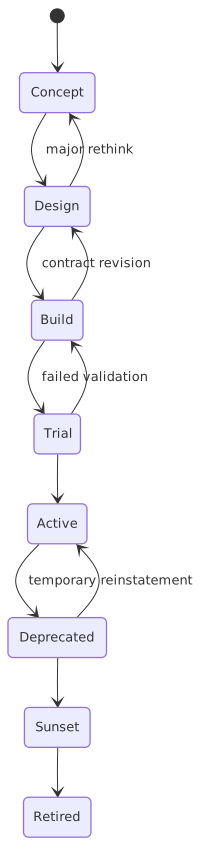
This model works because it reflects both product maturity and governance posture. It is not just SDLC painted onto APIs.
Architecture
The architecture for API lifecycle governance should be boring in the right places and opinionated in the right places.
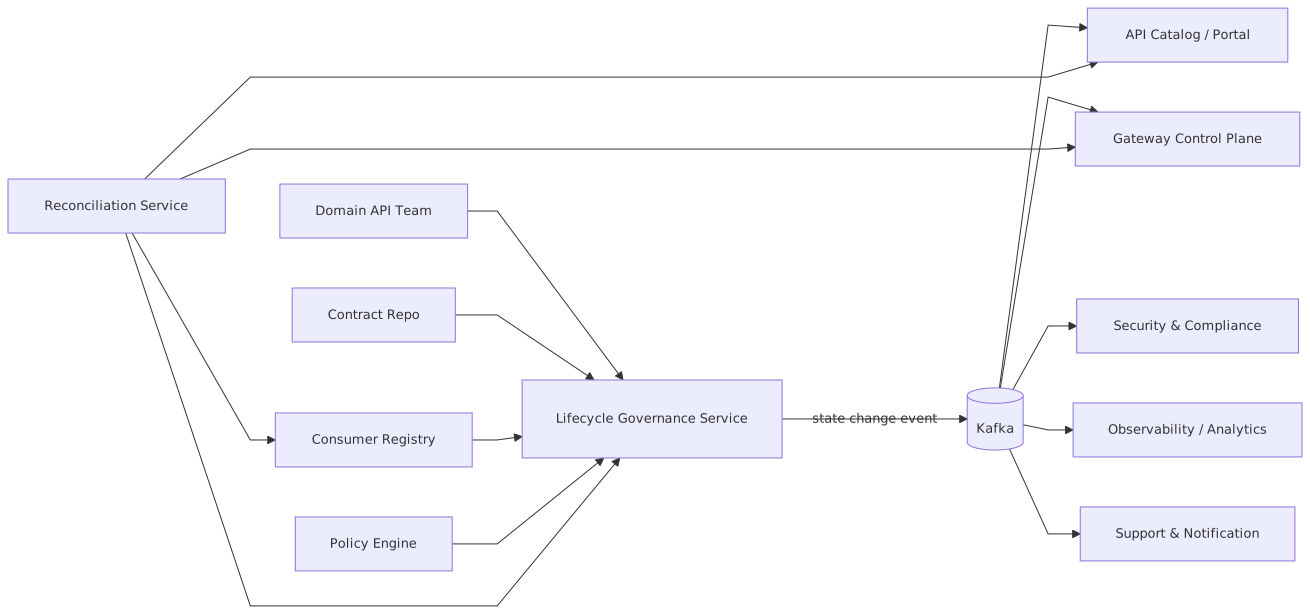
The core pattern is this:
- A central lifecycle service or governance capability owns the canonical state model.
- Domain teams own the API product and request transitions.
- Policy engines and delivery tooling enforce transition rules.
- State changes are emitted as events.
- Downstream systems reconcile to the canonical state.
The moment you run this across a large enterprise, you are in distributed systems territory. Which means eventually consistent governance. Many organizations pretend otherwise. They shouldn’t.
Core capabilities
A robust architecture usually includes:
- API registry/catalog for discoverability and metadata
- Contract repository for OpenAPI/AsyncAPI/GraphQL schemas
- Lifecycle governance service for state transitions and evidence
- Policy engine for validation, exceptions, and approvals
- Gateway or ingress control plane for exposure rules
- CI/CD integration for release checks
- Consumer registry for who is using what
- Event backbone such as Kafka for propagation
- Reconciliation jobs for drift detection
- Audit store for compliance and traceability
The canonical mistake is to let the gateway become the lifecycle system of record. Gateways know traffic and routing. They do not know enough about product semantics, consumer intent, legal commitments, or migration dependencies. The gateway is an actuator, not the business brain.
Domain semantics matter
In domain-driven design terms, “API lifecycle” belongs in a bounded context that mediates between platform concerns and domain ownership.
The business domains still own the meaning of the API itself—Customer Profile, Payment Authorization, Shipment Tracking, Claims Submission. Governance should not rewrite domain language. But it should define the semantics of publication and support around those domain contracts.
This distinction matters. If you blur it, governance starts meddling in domain design and teams rebel, rightly. If you separate it cleanly, governance sets the traffic laws without driving the car.
Event-driven propagation
Kafka is useful here because lifecycle transitions have many consumers:
- developer portal
- gateway management
- analytics
- security scanners
- support systems
- internal billing
- documentation pipelines
A lifecycle transition like API_VERSION_DEPRECATED should be emitted as an immutable domain event with key metadata:
- API identifier
- version
- previous state
- new state
- effective timestamp
- actor
- justification
- sunset date
- replacement reference
- policy profile
These events feed downstream actions, but they also create an audit trail and support reconciliation.
Architecture diagram
Reconciliation is not a side feature
This deserves blunt language: if your lifecycle architecture does not include reconciliation, it is incomplete.
Distributed governance systems drift. Consumers appear through side channels. Gateway routes linger. Documentation is outdated. A contract marked retired still receives traffic because some old batch job calls it once a month from a forgotten subnet in a country nobody remembers approving.
Reconciliation addresses this by comparing:
- canonical lifecycle state
- actual gateway exposure
- observed traffic
- registered consumers
- published docs
- support status
- deployment endpoints
Then it raises discrepancies:
- Active in catalog, missing gateway route
- Retired in governance, traffic still observed
- Deprecated without replacement reference
- Sunset passed, but active consumers remain
- Trial API exposed to external audience
This is governance becoming operationally real.
Migration Strategy
API lifecycle governance is rarely introduced into a greenfield estate. More often, it is applied to a mess already in motion. That means migration strategy matters as much as target design.
The right approach is progressive strangler migration.
Do not attempt a heroic enterprise-wide relabeling exercise with a giant committee and a 200-column spreadsheet. It will produce a presentation deck and very little else.
Instead:
1. Establish the canonical lifecycle model
Define a small, enterprise-approved set of states and transition rules. Keep the first model simpler than you want. Precision beats comprehensiveness.
2. Classify the existing estate coarsely
Map every API to one of a few initial states based on evidence:
- traffic present?
- external consumers?
- support commitment?
- deprecation notice sent?
- gateway route active?
Do not wait for perfect metadata. Use what you can prove.
3. Introduce a governance facade
Place a lifecycle governance service in front of existing tools. It becomes the canonical source for lifecycle state, even if underlying gateways and portals still retain their own local statuses temporarily.
4. Strangle local lifecycle logic
Gradually remove state semantics from portals, wikis, gateway tags, and spreadsheets. Replace with event-fed views from the canonical service.
5. Add enforcement incrementally
Start with visibility. Then warnings. Then hard gates.
For instance:
- phase 1: show deprecated banner in portal
- phase 2: block new consumer onboarding to deprecated APIs
- phase 3: require sunset date before deprecation
- phase 4: automatically disable routing post-sunset with approved exceptions
6. Reconcile continuously
Legacy estates are full of unknown consumers. You cannot retire what you cannot see. Use traffic analytics, API keys, service mesh telemetry, and Kafka-based event subscriptions to discover actual usage and compare it to declared usage.
Strangler migration view
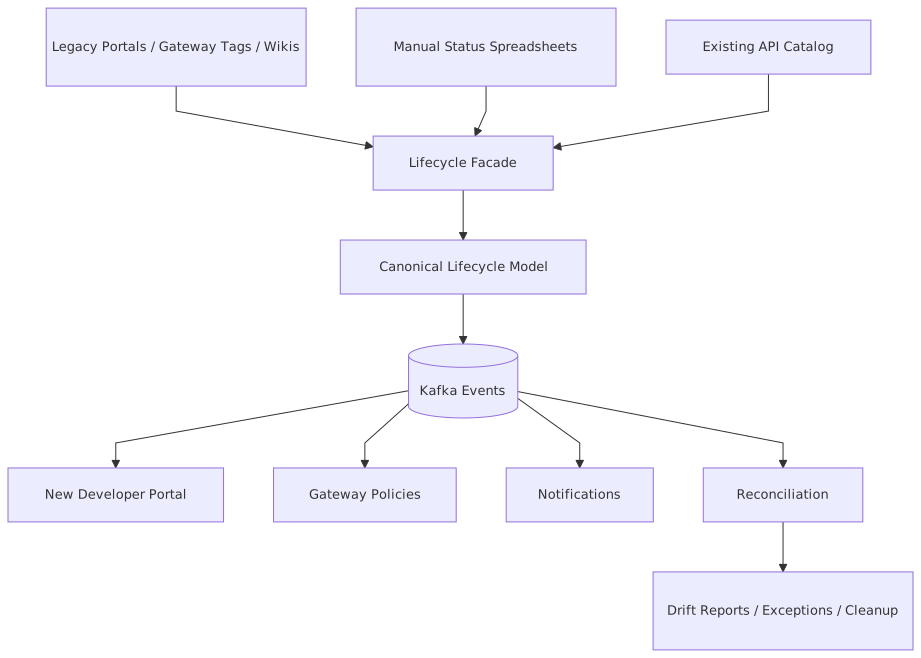
Progressive migration reasoning
This matters for a simple reason: lifecycle state is not just data migration. It is behavior migration.
When you move from a world of implicit understanding to explicit lifecycle states, you are changing:
- decision rights
- onboarding controls
- breaking-change rules
- support obligations
- retirement mechanics
That means migration needs socialization, not just integration.
You also need dual running for a while. During this period:
- legacy systems keep serving traffic
- the canonical lifecycle service emits states
- reconciliation identifies mismatches
- exceptions are documented
- policy enforcement ramps up gradually
The strangler pattern works because it accepts enterprise reality: you cannot stop the city to redesign the traffic lights.
Enterprise Example
Consider a large retail bank modernizing its integration estate.
The bank has:
- 1,200+ APIs
- multiple lines of business
- internal consumers across mobile, branch, fraud, and finance
- partner APIs for merchants and fintechs
- a monolithic customer platform being decomposed into microservices
- Kafka as the central event backbone
For years, “production API” meant whatever had traffic through the gateway.
This was disastrous.
Some APIs had external partners but no formal owner. Others were labeled “beta” for four years because nobody wanted to commit to SLAs. A supposedly retired customer address API was still called nightly by anti-money-laundering workflows. And because the customer domain was being split out of the monolith, teams assumed lifecycle cleanup should wait until the migration finished.
That was exactly backwards.
The architecture team introduced a lifecycle governance bounded context centered on the concept of API Product Version. They defined these states:
- Design
- Trial
- Active
- Deprecated
- Sunset
- Retired
Notably, they did not use “Development” or “Production” as lifecycle states. Those were deployment concerns. This avoided one of the oldest mistakes in enterprise architecture: naming states after environments.
Each state had explicit semantics.
For example, Trial meant:
- limited approved consumers only
- no external partner onboarding without exception
- observability baseline required
- breaking changes allowed with direct notification
- no enterprise SLA
- PII exposure prohibited unless security exception approved
Active meant:
- production consumption allowed for intended audience
- compatibility policy enforced
- support ownership assigned
- operational SLOs registered
- schema review complete
- consumer registration mandatory
The bank implemented a lifecycle service that emitted Kafka events on every transition. These events updated:
- the internal developer portal
- Apigee gateway policies
- support routing in ServiceNow
- deprecation notifications
- a reconciliation store that combined declared consumers with observed traffic
This last piece changed everything.
When the team marked the old Customer Address API as Deprecated, the reconciliation process detected unregistered traffic from three internal consumers and one batch platform. The API could not move to Sunset until those consumers were identified and migration plans established. This blocked a politically convenient retirement, but prevented a production incident. Governance did its job by making reality hard to ignore.
At the same time, the bank was strangling the monolithic customer platform. New microservices exposed a consolidated Customer Profile API. Rather than flip consumers all at once, the old API remained Active for existing consumers but was closed to new onboarding. The replacement API entered Trial, then Active. Once telemetry showed migration progress and Kafka-fed consumer records aligned with gateway analytics, the old API moved to Deprecated.
That is proper migration governance. Not a deprecation email. A managed transition with evidence.
Operational Considerations
Lifecycle governance sounds strategic until the pager goes off. Then the operational details matter.
Observability
Every lifecycle state should imply telemetry expectations.
A Trial API without detailed usage metrics is reckless. A Deprecated API without consumer-level traffic visibility is a trap. A Retired API still receiving requests should raise alerts, even if traffic is blocked.
Track at least:
- request volume by consumer
- error rates
- latency
- schema/version usage
- auth context
- onboarding funnel
- deprecated endpoint traffic
- blocked post-sunset calls
Consumer identification
You cannot govern what you cannot attribute.
If APIs are shared internally with anonymous service accounts or reused API keys, retirement becomes guesswork. Consumer registration and identity propagation are not administrative overhead; they are prerequisites for safe lifecycle management.
Exception handling
Enterprises run on exceptions. Pretending otherwise leads to shadow systems.
A sunset policy may say traffic is blocked after 90 days. Then a regulator, a strategic partner, or a fiscal-year freeze says not yet. Fine. Model exceptions explicitly:
- approved by
- scope
- expiry date
- reason
- compensating controls
An exception without expiry is just policy surrender.
Documentation synchronization
The portal, docs, gateway, and support systems must reflect the same lifecycle truth. If developers see “Active” in the portal while support says “Deprecated,” you lose trust fast. This is why event propagation and reconciliation matter.
Security and data governance
Lifecycle states often need to carry security implications:
- Trial APIs may be restricted from sensitive data classes
- Active external APIs may require penetration testing and threat modeling
- Deprecated APIs may require increased monitoring due to reduced change investment
- Retired APIs must ensure credentials, routes, and secrets are actually revoked
Retirement is not deleting docs. It is closing an attack surface.
Tradeoffs
There is no perfect lifecycle model. Only useful ones with known costs.
Rich state model vs simple state model
A detailed model captures nuance, but complexity breeds inconsistent interpretation. A simple model is easier to enforce, but may force awkward exceptions.
My bias: start with fewer states and stronger semantics.
Central control vs domain autonomy
A central lifecycle service improves consistency. It can also become a bottleneck or political weapon. Domain ownership must remain with product teams for API meaning and evolution. Governance should control state semantics, not domain design.
Synchronous enforcement vs asynchronous propagation
Synchronous checks provide certainty at transition time. Asynchronous propagation scales better across tools and domains. Most enterprises need both: synchronous validation before transition, asynchronous events for downstream application.
Hard retirement vs soft deprecation
Hard shutdown creates urgency and reduces long-tail cost. It also breaks forgotten consumers. Soft deprecation is kinder but often endless. Use evidence and deadlines, not hope.
Tool-driven governance vs model-driven governance
Buying an API management suite does not solve lifecycle governance. Tools help. The model matters more. If the semantics are vague, expensive software just automates confusion.
Failure Modes
This is where architecture earns its keep: not in the happy path, but in the ways things go wrong.
1. Lifecycle states become cosmetic
If no policy or automation is attached to states, teams stop caring. “Deprecated” becomes a sad color in the portal.
2. State definitions are ambiguous
If Active means “safe for internal production” to one team and “approved for partners” to another, governance creates more confusion than clarity.
3. Gateway and catalog drift
The catalog says retired. The gateway still routes traffic. Security thinks the surface is gone. Attackers disagree.
4. Unknown consumers block retirement
This is common in enterprises with poor identity hygiene. A service cannot be retired because no one knows who is really using it.
5. Migration dependencies are ignored
Teams mark legacy APIs deprecated before replacement APIs have equivalent semantics, throughput, or operational readiness. Consumers are then forced into bad migrations.
6. Lifecycle tied too tightly to deployment environments
An API isn’t “Active” because code is in production. It’s Active because the organization is willing to support and govern its use. These are not the same thing.
7. No reconciliation loop
Without reconciliation, eventual consistency becomes permanent inconsistency.
8. Governance overreaches
If every lifecycle move requires architecture board approval, teams route around the process by exposing “internal-only” APIs that mysteriously become critical integration points six months later.
When Not To Use
Not every environment needs a formal lifecycle governance architecture.
Do not over-engineer this when:
- you have a very small API estate with tightly co-located teams
- APIs are purely ephemeral prototypes
- there are no external consumers, compliance obligations, or long-lived contracts
- consumer identity and gateway controls are minimal
- the cost of manual coordination is lower than platform investment
Also, don’t use a heavy state model for event schemas or internal technical interfaces that are not managed as API products. Everything does not need a governance ceremony.
This is especially important in microservices programs. Teams sometimes govern every internal service-to-service interface as if it were a partner API. That creates process debt and slows decomposition. Use product thinking: govern the interfaces whose lifecycle carries enterprise consequence.
Related Patterns
API lifecycle governance intersects with several architecture patterns.
Domain-Driven Design
Use bounded contexts to separate API product governance from business domain ownership. Shared semantics for lifecycle; local semantics for domain capabilities.
Strangler Fig Pattern
Ideal for introducing canonical lifecycle governance into an existing API estate and for replacing legacy APIs progressively.
Event-Driven Architecture
Lifecycle transitions are valuable domain events. Kafka is particularly useful for fan-out, auditability, and downstream automation.
Reconciliation Pattern
Essential in distributed control planes. Compare declared state with observed state and resolve drift.
Consumer-Driven Contracts
Helpful, but not sufficient. These address compatibility between providers and consumers. Lifecycle governance addresses publication, support, and retirement semantics across the estate.
Policy as Code
A strong fit for enforcing transition rules, required evidence, and exception workflows in CI/CD and governance platforms.
Summary
API lifecycle states are not labels for documentation pages. They are the operating grammar of API governance.
A mature enterprise treats lifecycle as a domain model with explicit semantics, controlled transitions, policy enforcement, event propagation, and reconciliation. This is where domain-driven design helps: define the bounded context, use precise language, and separate contract governance from implementation noise.
The practical architecture is straightforward:
- one canonical lifecycle model
- domain teams own API products
- policy-backed transitions
- Kafka events to distribute state changes
- reconciliation to detect drift
- progressive strangler migration to modernize safely
The tradeoffs are real. Too little governance and your API estate decays into ambiguity. Too much governance and teams tunnel underneath it. The goal is not maximal control. The goal is trustworthy movement.
That is the heart of lifecycle governance.
An API should not become Active because someone feels optimistic. It should become Active because the organization is prepared to stand behind it. And it should not become Retired because a document says so. It should become Retired because the enterprise has done the hard work of proving the contract is truly gone.
That is what architecture looks like when it respects both software and reality.
Frequently Asked Questions
What is API-first design?
API-first means designing the API contract before writing implementation code. The API becomes the source of truth for how services interact, enabling parallel development, better governance, and stable consumer contracts even as implementations evolve.
When should you use gRPC instead of REST?
Use gRPC for internal service-to-service communication where you need high throughput, strict typing, bidirectional streaming, or low latency. Use REST for public APIs, browser clients, or when broad tooling compatibility matters more than performance.
How do you govern APIs at enterprise scale?
Enterprise API governance requires a portal/catalogue, design standards (naming, versioning, error handling), runtime controls (gateway policies, rate limiting, observability), and ownership accountability. Automated linting and compliance checking is essential beyond ~20 APIs.