⏱ 21 min read
Most API problems do not begin with bad technology. They begin with politeness.
A team wants to help everyone, so it exposes one large service interface. Sales can use it. Operations can use it. Mobile can use it. Finance can use it. Partners can use it. The API becomes a kind of corporate buffet: broad, accommodating, and increasingly indigestible. Every new consumer adds one more field, one more query parameter, one more “small exception.” Before long, the service is no longer expressing a domain. It is negotiating treaties between departments.
That is where interface segregation matters.
People often talk about the Interface Segregation Principle as a class design concern from object-oriented programming: clients should not be forced to depend on methods they do not use. True enough. But in enterprise systems, the more interesting version lives at the service boundary. A microservice API should not force unrelated consumers to depend on capabilities, data shapes, workflows, or lifecycle rules that belong to other parts of the domain. If it does, coupling spreads in quiet ways. Release cycles tangle. Schemas bloat. Authorization becomes inconsistent. Performance tuning becomes political. And the service becomes “critical” mostly because too many things are trapped inside it.
In microservices, interface segregation is not a matter of tidiness. It is a matter of preserving domain semantics.
The trap is especially common in organizations moving from monoliths to distributed systems. Teams split deployment units but keep a monolithic API mindset. They carve the backend into services, then put one thick “customer,” “order,” or “account” API in front of everything. It feels convenient. It also recreates the same coupling, now with network latency and partial failure added for free.
A better approach is to split interfaces around domain intent, consumer need, and operational reality. Not every consumer needs the same abstraction. Not every workflow belongs in the same contract. Not every service should expose the full inner model of the business. A useful API is not a complete mirror of data. It is a purposeful language.
That is the heart of this article: how to apply interface segregation to microservices APIs in a way that respects domain-driven design, supports progressive strangler migration, works with Kafka and asynchronous integration where appropriate, and does not dissolve into dogma. event-driven architecture patterns
Context
Microservices are often introduced to improve team autonomy, release speed, and alignment between software and business capabilities. The promise is simple: smaller services, clearer ownership, independent evolution. The reality is messier. If service boundaries are clean but API boundaries are not, the system still behaves like a distributed monolith.
The symptom usually appears in one of three forms.
First, there is the god API. One service exposes endpoints for reads, writes, searches, lifecycle transitions, administrative overrides, reporting views, and partner integrations. Different consumers use different fragments of it, but all are tied to the same versioning, availability profile, and governance process.
Second, there is the shared canonical contract. An enterprise creates one “enterprise customer model” or “global order schema” and tries to make every service and every consumer conform to it. This sounds disciplined. In practice, it turns semantic nuance into committee work. Different bounded contexts use the same terms with different meanings, and the schema becomes either painfully generic or dangerously misleading.
Third, there is the experience leakage problem. Internal workflow concerns bleed into public APIs, or backend storage structure bleeds into consumer contracts. Consumers end up knowing too much about internal state machines, reconciliation rules, event timing, or database identifiers. Once that happens, changing internals becomes expensive because consumers have accidentally become co-designers.
Interface segregation is the corrective. But it only works when it is driven by domain understanding, not by arbitrary endpoint slicing.
Problem
A broad API feels efficient at first. One place to integrate. One contract to document. One security model to apply. One team to call.
Then the bill arrives.
Different consumers pull the interface in different directions. A mobile app wants lightweight reads and coarse operations. An internal operations console wants fine-grained mutation and diagnostic visibility. Finance wants stable reporting views and reconciliation hooks. A partner API wants hard backward compatibility and externalized identifiers. A machine-learning pipeline wants event streams, not chatty request-response calls.
Trying to satisfy all of them through one interface creates several forms of coupling:
- Behavioral coupling: consumers depend on operations they should not even know exist.
- Data coupling: fields are added for one client and accidentally relied on by others.
- Release coupling: one consumer’s urgent change forces testing across every integration.
- Security coupling: the authorization model becomes a patchwork because different roles need different slices of capability.
- Performance coupling: one read-heavy use case drives cache design that harms write consistency, or vice versa.
- Semantic coupling: one context’s definition of a concept infects another.
This is where domain-driven design earns its keep. In DDD, the same word can legitimately mean different things in different bounded contexts. “Customer” in billing is not the same thing as “customer” in fulfillment. “Order” in sales capture is not the same thing as “order” in warehouse execution. A segregated interface honors those distinctions. A unified interface tends to flatten them.
The result of ignoring this is familiar: an API that is technically stable and conceptually incoherent.
Forces
Good architecture happens in tension. Interface segregation is not free, and pretending otherwise leads to cargo cults. The real design sits among competing forces.
Domain clarity versus consumer convenience
A single broad API is convenient for integration teams at the start. But convenience at the edge often comes at the expense of conceptual coherence in the core. If every consumer gets one universal interface, the service team becomes a broker of conflicting meanings.
Autonomy versus consistency
Different interfaces allow independent evolution. They also raise the risk of duplication, drift, and inconsistent policy enforcement. The point is not to avoid duplication at all costs. The point is to duplicate with intent where contexts differ, and centralize only what is truly shared.
Synchronous simplicity versus asynchronous truth
Many organizations default to REST because it is easy to explain. But some consumers do not want request-response APIs at all. They want events, feeds, or materialized views. Kafka often becomes relevant here: not as a silver bullet, but as a way to separate state change propagation from transactional command handling. A segregated architecture may include command APIs, query APIs, and event interfaces side by side.
Team topology
If one team owns all consumers and the domain is immature, a broad API may survive for a while. In large enterprises, though, consumer groups are usually separate teams with separate delivery cadences. Shared interfaces then become organizational choke points.
Governance and compliance
Financial, healthcare, and regulated environments put pressure on auditability, access control, lineage, and reconciliation. These concerns often justify segregated interfaces because operational support users, auditors, and external partners need different access patterns and different guarantees.
Migration economics
Most enterprises cannot stop the world and redesign. They need a progressive strangler migration. That means coexistence: old and new interfaces, adapters, anti-corruption layers, event duplication, and reconciliation processes. Segregation must be phased, not declared.
Solution
The practical solution is this: design multiple fit-for-purpose APIs and interface channels around bounded contexts, use cases, and consumer classes, rather than exposing one broad surface area for all purposes.
This usually means separating at least some combination of:
- command interfaces from query interfaces
- external partner contracts from internal operational contracts
- domain APIs from reporting or search APIs
- transactional APIs from event subscriptions
- context-specific representations from enterprise-wide identifiers and reference data
The goal is not to create many services for the sake of it. The goal is to reduce the blast radius of change and align contracts with domain language.
A useful rule of thumb: if two consumers care about the same noun but different verbs, different latency expectations, different consistency requirements, or different business meanings, they probably should not share the same interface.
Consider “Order”:
- A checkout frontend needs
PlaceOrder,GetOrderStatus, maybeCancelBeforeFulfillment. - A warehouse system needs
ReserveInventory,ReleaseReservation,PickReadyOrders, shipment milestones. - Finance needs invoiceable events, tax snapshots, and reconciliation reports.
- Customer support needs override operations and a timeline view.
- A data platform wants immutable events.
Calling all of that “the Order API” is how enterprise systems become museums of compromise.
A better design might keep one Order Management domain service internally while exposing separate interfaces:
- customer order command API
- order status query API
- warehouse integration API
- finance event stream
- support operations API
Same business capability, segregated contracts.
API split diagram
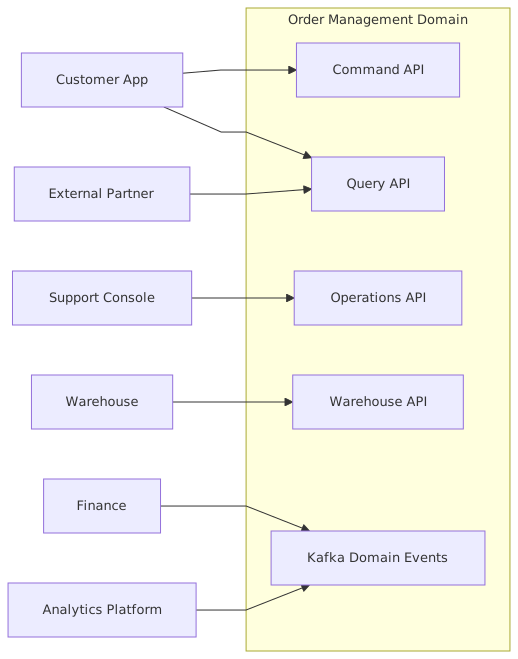
The key point is subtle but vital: interface segregation does not necessarily require service proliferation. You can have one bounded context with multiple interfaces. Or multiple services behind one consumer-facing experience. The split is about contracts and coupling, not merely deployment units.
Architecture
A robust architecture for interface segregation in microservices usually layers the interfaces by intent. microservices architecture diagrams
1. Domain command interfaces
These handle business actions that change state: place order, approve refund, assign shipment, suspend account. They should speak in domain language and enforce invariants. They are not generic CRUD wrappers unless the domain itself is truly CRUD, which is rarer than people admit.
Commands should be narrow, explicit, and stable in meaning. “ApproveClaim” is better than “UpdateClaimStatus.” The latter invites invalid transitions and leaks state-machine internals.
2. Query interfaces
Read models deserve their own treatment. Many consumers need denormalized, optimized, or purpose-specific views. They should not be forced through the same model used to enforce write-side rules. Segregated query APIs can return shapes tuned for mobile, dashboards, or partner needs without polluting the command model.
This is where CQRS thinking is often useful, though not mandatory. You do not need ideological CQRS. You need the simple idea that write semantics and read semantics are often different.
3. Event interfaces
Some consumers should not call APIs at all. They should subscribe to domain events. Kafka is well suited when downstream systems need scalable fan-out, replay, decoupled timing, and durable integration. Events let consumers build their own local views and reduce synchronous dependency chains.
But events are not commands in disguise. They are statements of fact: OrderPlaced, PaymentAuthorized, ShipmentDispatched. If you publish vague integration events such as OrderUpdated, you have simply reinvented a remote database notification.
4. Operational and support interfaces
Production systems need interfaces for support tooling, repair operations, replay, reconciliation, and exceptional workflows. These are often dangerous if mixed into customer-facing APIs. Keep them separate, with stronger controls, explicit audit trails, and sometimes separate network exposure.
5. External-facing contracts
Partners and public consumers require additional discipline. They need long-lived compatibility, clear deprecation policy, and stable identifiers. Internal APIs often evolve too quickly for this. An external contract should usually sit behind an anti-corruption or facade layer, even if the same bounded context powers it.
Segregated interface architecture
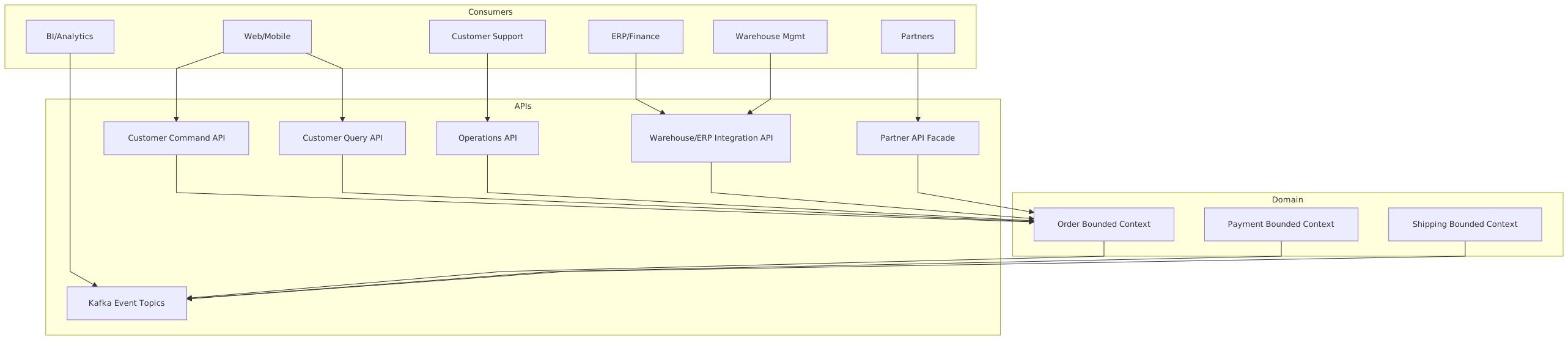
This architecture supports different consumers without forcing them into the same dependency shape. It also makes domain semantics explicit. The warehouse integration API can represent fulfillment concepts without forcing a customer app to understand pick waves or inventory holds. Finance can consume settlement events without calling support-only endpoints.
That is real segregation: not technical partitioning for its own sake, but semantic containment.
Migration Strategy
Nobody gets to start clean. Enterprises inherit broad interfaces and overgrown service contracts. The only realistic path is progressive migration, usually by strangling the old API over time.
Start with consumer and capability mapping
Do not split an API by endpoint count. Split it by dependency patterns and domain intent.
Map:
- who consumes which operations
- which fields are used by which consumers
- latency and availability expectations
- consistency requirements
- security and audit needs
- domain language differences
This often reveals that one “general API” is actually four or five unrelated contracts wearing the same URL.
Introduce façade routing first
Put an API gateway or façade in front of the broad service if one does not already exist. Not because gateways are magical, but because you need a place to route, observe, and gradually redirect consumers.
Then begin extracting fit-for-purpose interfaces behind it. At first, they may still call the legacy backend. That is fine. Migration architecture is allowed to be ugly if it is directional.
Create anti-corruption layers
Legacy APIs often encode semantics badly: overloaded fields, mixed workflows, hidden side effects. New interfaces should not inherit these flaws. Use an anti-corruption layer to translate between the old contract and the new domain model. This is one of the few places where duplication is not only acceptable but healthy.
Split reads before writes when possible
Query segregation is often the safest first move. Build new read models, search endpoints, or reporting views without disturbing transactional behavior. This gives immediate value and reduces pressure on the broad API.
Then carve out commands with clear invariants
Commands are harder because they touch consistency and state transition rules. Move one workflow at a time: order placement, cancellation, refund approval, claim submission. Make sure ownership of invariants is clear.
Use Kafka for propagation, not wishful consistency
As contexts and interfaces split, downstream consumers may need state they used to fetch synchronously. Publish domain events so they can build local read models. But do not promise instant consistency unless you can deliver it. Say what the timing is. Design reconciliation for lag and missed messages.
Reconciliation is not a failure of architecture
This point matters in enterprise systems. Once you use asynchronous propagation, things will drift: messages are delayed, consumers fail, transformations change, external systems reject records. A mature design includes reconciliation processes:
- periodic comparison between source-of-truth and downstream projections
- replay from Kafka or event logs
- idempotent consumers
- repair tooling and exception queues
- domain-level discrepancy reporting
Architects who dismiss reconciliation are usually designing for slides, not operations.
Progressive strangler migration diagram
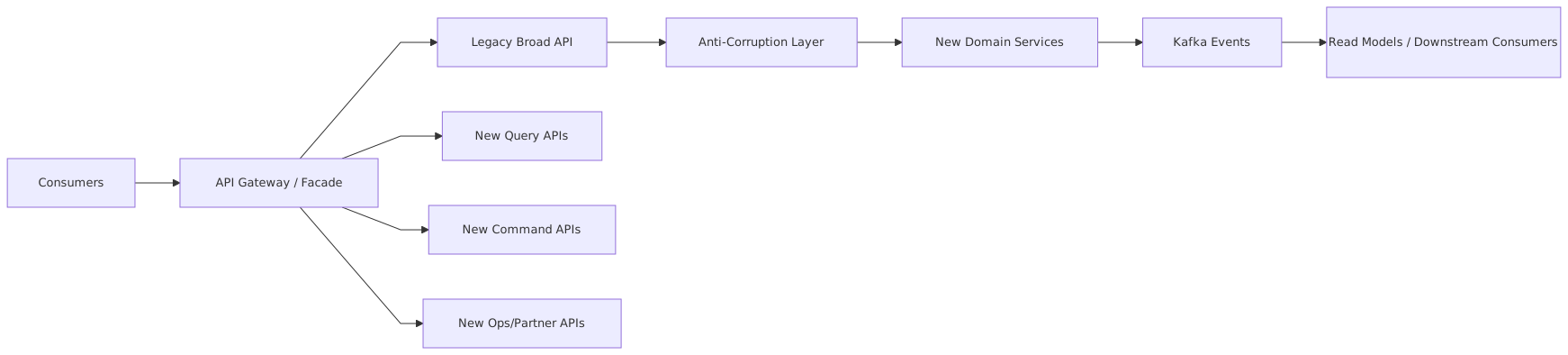
The old interface shrinks over time. The new interfaces grow around real use cases. Eventually, the legacy API becomes a thin compatibility shell or disappears entirely.
Enterprise Example
Consider a global insurer modernizing its policy administration platform.
The legacy system exposed a single Policy API. It handled quote retrieval, policy issue, endorsement, cancellation, billing inquiries, document access, agent operations, customer self-service, and reporting extraction. It had over 200 endpoints, dozens of optional fields, and years of compatibility baggage. Every channel depended on it: agent portal, customer app, billing engine, claims intake, call center desktop, compliance reporting, and third-party brokers.
On paper, it was “the single source of truth.”
In practice, it was a battlefield.
The customer app wanted fast, stable read APIs for policy summary and coverage details. The call center needed repair operations and visibility into processing history. Brokers needed a partner-safe contract with curated fields and contractual versioning. Billing needed policy lifecycle events, not chatty polling. Compliance needed traceable snapshots and reconciliation extracts. Claims intake needed only a small subset of policy validation rules.
The architecture team first tried a common enterprise policy schema. It failed. “Policy status,” “effective date,” and “insured party” meant subtly different things across underwriting, billing, and claims. The canonical model became both vague and contentious.
The turnaround came when the team reframed the problem in DDD terms.
They identified bounded contexts:
- policy administration
- billing
- claims
- document services
- broker distribution
Then they segregated interfaces:
- Customer Policy Query API for self-service and mobile
- Policy Command API for issue, endorse, renew, cancel
- Broker Partner API with stronger compatibility guarantees
- Operations API for call center interventions and audit-rich support actions
- Kafka policy lifecycle events for billing, analytics, and compliance pipelines
They did not split everything into tiny services overnight. In fact, policy administration remained one substantial bounded context for quite a while. But the interfaces changed shape.
The benefits were concrete.
Mobile performance improved because query responses were denormalized and cacheable. Billing stopped polling and moved to event-driven updates. The call center got explicit operational actions instead of reusing customer workflows with hidden flags. Partner changes no longer triggered regression tests across internal support tools. Most importantly, semantic arguments became local. The broker API no longer had to represent internal underwriting states that partners should never see.
There was a cost. Reconciliation became a first-class concern. Kafka consumers occasionally missed updates due to deployment issues or schema evolution mistakes. A nightly reconciliation compared policy snapshots against billing projections and broker extracts. Exception queues and replay tooling were added. This was not glamorous work. It was the work that made the architecture real.
That is the enterprise lesson: interface segregation pays off when the business is broad, the consumers are diverse, and semantics vary by context. But it only succeeds if you also invest in translation, observability, and repair.
Operational Considerations
Segregated APIs improve changeability, but they increase the number of moving parts. Operations must keep up.
Observability by interface class
Do not monitor all APIs the same way. Customer commands, read views, partner integrations, and event streams have different service level objectives. Measure:
- command success and business rule rejection rates
- read latency and cache hit ratios
- event publication lag and consumer lag
- reconciliation discrepancy counts
- partner contract version usage
- operational override frequency
A single aggregate availability metric will hide the trouble.
Authorization and policy separation
Segregated interfaces simplify access control if you let them. Customer APIs should not carry support-only permissions. Operations APIs should require stronger audit logging and narrower network exposure. Partner APIs should have explicit tenancy and throttling controls. Security architecture often improves simply because the contracts stop pretending all users are the same.
Schema governance
If using Kafka, govern event schemas carefully. The point of interface segregation is not to replace one giant REST contract with one giant event contract. Publish bounded, meaningful events. Version them deliberately. Test compatibility. Avoid event payloads that expose internal persistence models.
Idempotency and retries
Commands crossing a network will be retried. Consumers of event streams will reprocess messages. Design for idempotency where business operations demand it. Otherwise, segregation just moves duplicate execution into more places.
Supportability
Provide repair paths:
- event replay
- dead-letter handling
- projection rebuilds
- compensating actions
- manual reconciliation workflows
If the architecture has no operational tools, the operations team will build spreadsheets. They always do.
Tradeoffs
Interface segregation is one of those ideas that sounds universally good right up until someone has to run it.
The upside is substantial:
- lower consumer coupling
- clearer domain semantics
- better team autonomy
- more targeted performance optimization
- cleaner security boundaries
- less accidental exposure of internal workflows
But there are real costs:
- more contracts to design and govern
- more documentation
- more versioning decisions
- more test matrices
- more infrastructure for eventing, read models, and monitoring
- possible duplication of data representations
- increased need for reconciliation and support tooling
There is also a political tradeoff. Broad APIs let organizations avoid hard conversations about ownership and meaning. Segregation forces those conversations. That is healthy, but it is not always welcome.
One opinionated point: some duplication across interfaces is not a smell. It is often the price of clarity. If a partner API and an internal operations API both have a concept of policy summary but need different fields, lifecycles, and guarantees, keeping them separate is sane. Reusing one shape to avoid duplication can create much deeper coupling.
Failure Modes
Most bad implementations of interface segregation fail in predictable ways.
Splitting by technical layer, not by domain
Teams create /internal, /external, and /mobile APIs without clarifying business semantics. The contracts still mirror the same confused model. This is just cosmetic segregation.
Service explosion
Every endpoint becomes a microservice. Governance overhead surges. Cross-service orchestration grows. Nobody knows where invariants live. You did not solve coupling; you atomized it. EA governance checklist
Event abuse
Organizations replace APIs with Kafka for everything, including request-response style interactions. They publish vague “updated” events and call it decoupled. It is not decoupled if every consumer still needs to know too much.
Leaky facades
A new query or partner API simply proxies the old broad backend one-to-one. The external shape changes, but semantics, latency, and failure behavior remain inherited from the legacy design. This usually postpones the problem rather than solving it.
Missing reconciliation
Asynchronous consumers drift and nobody notices until finance totals differ or customers see stale status. If there is no replay and no discrepancy detection, the architecture will eventually fail in production, then be blamed on microservices in general.
Over-segregation of a simple domain
Some domains are genuinely small and cohesive. Splitting them too early creates accidental complexity. If all consumers truly share the same semantics and lifecycle, one well-designed API may be enough.
When Not To Use
Do not apply aggressive interface segregation just because the phrase sounds architectural.
It may be the wrong move when:
- the domain is small, stable, and genuinely uniform
- there are only one or two closely related consumers
- one team owns producer and consumers with synchronized release cycles
- the system is early-stage and the domain language is still forming
- operational maturity is low and event-driven reconciliation would be a liability
- regulatory or contractual simplicity favors one narrowly scoped external contract
A startup with one product team and one customer-facing app probably does not need separate command, query, partner, and operations APIs on day one. A medium-sized internal platform serving one tightly aligned consumer group may be better off with one concise, well-bounded interface. The smell is not “one API.” The smell is “one API serving conflicting meanings.”
Architecture is not improved by more boxes. It is improved by better boundaries.
Related Patterns
Several patterns sit naturally beside interface segregation for microservices APIs.
Bounded Context
This is the anchor. Interface segregation without bounded context thinking becomes ad hoc endpoint reshuffling. A contract should reflect a specific model and language, not a corporate compromise vocabulary.
CQRS
Useful when reads and writes differ in shape, scale, or consistency needs. Not mandatory, but often a natural companion to segregated APIs.
API Gateway / Facade
Helpful in migration and consumer routing. Also useful for hiding internal service topology. But do not let the gateway become a new monolith of business logic.
Anti-Corruption Layer
Essential when legacy interfaces use poor domain language or external systems impose alien semantics.
Strangler Fig Pattern
The right migration strategy for broad enterprise APIs. Replace behavior incrementally while preserving business continuity.
Event-Driven Architecture
A complement, not a replacement. Use Kafka or similar platforms when downstream consumers benefit from decoupled propagation, replay, and fan-out.
Backend for Frontend
A specialized form of interface segregation for user experiences. Different frontends deserve tailored contracts. Just do not confuse UI tailoring with domain modeling.
Summary
Interface segregation for microservices APIs is not a tidy refactoring trick. It is a way to stop one service contract from becoming the accidental constitution of the enterprise.
When an API serves too many consumers with too many meanings, it stops expressing the domain and starts absorbing organizational confusion. That is the real danger. Not ugliness. Not a few extra endpoints. Semantic collapse.
The remedy is to design interfaces around bounded contexts, business intent, and consumer needs. Separate commands from queries where it helps. Keep partner, operational, and customer-facing contracts distinct when their guarantees differ. Use Kafka for asynchronous propagation where consumers should react to facts rather than call synchronously. Accept reconciliation as part of life, not as a design embarrassment. Migrate progressively with strangler techniques and anti-corruption layers.
And be honest about the tradeoffs. More interfaces mean more governance, more monitoring, and more operational discipline. Sometimes one concise API is enough. Sometimes splitting too early is just architecture cosplay. ArchiMate for governance
But in the enterprise, where the same noun usually hides three departments and five agendas, interface segregation is often the difference between a service that evolves and one that merely accumulates.
A broad API feels generous. A segregated API feels opinionated.
In serious systems, opinionated usually ages better.
Frequently Asked Questions
What is a service mesh?
A service mesh is an infrastructure layer managing service-to-service communication. It provides mutual TLS, load balancing, circuit breaking, retries, and observability without each service implementing these capabilities. Istio and Linkerd are common implementations.
How do you document microservices architecture for governance?
Use ArchiMate Application Cooperation diagrams for the service landscape, UML Component diagrams for internal structure, UML Sequence diagrams for key flows, and UML Deployment diagrams for Kubernetes topology. All views can coexist in Sparx EA with full traceability.
What is the difference between choreography and orchestration in microservices?
Choreography has services react to events independently — no central coordinator. Orchestration uses a central workflow engine that calls services in sequence. Choreography scales better but is harder to debug; orchestration is easier to reason about but creates a central coupling point.