⏱ 19 min read
Most distributed systems fail long before the first packet crosses the network.
They fail in the naming.
A team draws ten boxes, calls them microservices, puts Kafka between them, and feels modern. The slides look clean. The cloud bill grows with dignity. Deployment pipelines multiply. Yet six months later, every real business change still needs five teams, three coordinated releases, and one emergency call no one admits was predictable. The architecture is distributed, but the thinking is still monolithic. The old monolith did not die. It escaped. It now lives inside the spaces between services.
That is the hidden monolith.
This pattern matters because many enterprises do not really decompose by business capability. They decompose by technical layers, by database tables, by channels, by legacy team boundaries, or by whatever was easiest to carve out during a rushed modernization program. The result is not microservices architecture in the domain-driven sense. It is a monolith stretched over the network: operationally expensive, cognitively fragmented, and brutally coupled in all the places that matter. microservices architecture diagrams
If you have ever seen an “Order Service” that cannot place an order without synchronous calls to Pricing, Inventory, Customer Profile, Promotions, Payment Orchestration, Fraud, and Shipping Eligibility, you have seen it. If a single checkout change requires edits across seven repositories and agreement on one Kafka event nobody fully owns, you are living it. The hidden monolith diagram usually looks beautiful. The runtime behavior usually does not. event-driven architecture patterns
This article examines that architecture honestly: what it is, why it appears, how to recognize it, how to migrate away from it, and when to avoid microservices altogether. I will argue something unfashionably simple: microservices only work when service boundaries reflect domain semantics, decision ownership, and independent change. Without that, you have not achieved decomposition. You have just outsourced your monolith’s internal method calls to HTTP and asynchronous retries.
Context
Enterprises rarely move from a well-factored modular monolith to elegant microservices in one clean leap. They move from large legacy estates: ERP customizations, line-of-business applications, homegrown workflow engines, mainframe-backed systems, and integration layers that know too much. Then comes the modernization mandate. Sometimes it is digital transformation. Sometimes cloud migration. Sometimes a merger. Often it is all three with a board deadline attached. cloud architecture guide
In those environments, microservices become both a technical approach and a political tool. Teams want autonomy. Platforms want standardization. Leadership wants faster delivery. Architects want bounded contexts. Operations wants fewer 2 a.m. incidents. Compliance wants audit trails. Data teams want streaming. Everyone is right, and that is the problem.
The temptation is to split early and split visibly. Create many services. Put an API gateway in front. Introduce Kafka for event-driven architecture. Add Kubernetes because scale is a future requirement. Publish a capability map. Then discover that the core business process still behaves like a single transactional application, only now every dependency is remote.
This is where domain-driven design becomes less a design preference and more a survival mechanism. DDD reminds us that the system should reflect the business model, not the org chart or the data model. A bounded context is not a namespace. It is a consistency boundary around a language, a set of decisions, and a model with meaning. Get that wrong, and distributed architecture will amplify your mistakes.
Problem
The hidden monolith emerges when services look independent on a diagram but remain tightly coupled through process logic, shared data expectations, and coordinated change.
The common symptoms are easy to spot once you know the smell:
- End-to-end business operations require chained synchronous calls across many services.
- Teams cannot deploy independently because contracts and workflows change together.
- A central database schema still effectively defines the domain, even if physically split.
- Kafka topics carry low-level CRUD events rather than business facts.
- One service is “master” of almost everything, while others act as thin wrappers.
- Failure in one downstream service blocks an entire user journey.
- Reconciliation becomes a permanent operating model rather than an exception path.
This is not merely a performance issue. It is a modeling issue.
Imagine a retail enterprise that “decomposes” commerce into Product Service, Price Service, Stock Service, Basket Service, Order Service, Discount Service, Tax Service, Payment Service, and Shipment Service. Sounds sensible. But if the business still thinks in terms of a single coherent checkout transaction, and if no service can make meaningful decisions without asking five others, then each service owns data but not the business capability. The capability is smeared across the mesh. Nobody owns “Place Order” as a first-class domain outcome. Everyone owns a piece of the pain.
That is the hidden monolith’s signature: distributed implementation, centralized business truth.
Forces
This pattern does not appear because architects are foolish. It appears because several legitimate forces pull in conflicting directions.
1. Team autonomy versus process integrity
Microservices promise independent teams and isolated deployment. But core business processes—claims handling, loan origination, order fulfillment, policy issuance—often span many concepts. The naive split gives teams ownership of components, while the business still needs coherent outcomes. You gain local autonomy and lose end-to-end flow.
2. Data ownership versus transactional consistency
A proper microservices architecture avoids a shared database. Good. But once each service owns its data, consistency becomes a business design question. If your domain requires immediate atomic outcomes, decomposition is expensive. If your domain can tolerate eventual consistency with explicit reconciliation, decomposition is feasible. Many teams pretend they can tolerate eventual consistency without actually designing for it.
3. Reuse versus coupling
Enterprises love shared services. Pricing, customer profile, tax, authentication, product catalog—why not centralize them? Because centralization often creates high-fan-in dependencies that turn one team into a release bottleneck. Reuse sounds efficient until every critical process waits behind the same service.
4. Reporting and analytics pressure
Operational data wants clean ownership; enterprise reporting wants a single version of truth. This often drives hidden coupling. Teams start publishing events not because the domain needs them, but because downstream reporting systems demand data replication. Soon event contracts become integration handcuffs.
5. Legacy migration pressure
During migration, strangling a monolith demands coexistence. Old and new systems must agree enough to keep the business running. That often introduces temporary duplication, anti-corruption layers, and reconciliation jobs. Temporary structures become permanent more often than anyone likes to admit.
6. Organizational boundaries
Conway’s Law is undefeated. If identity, billing, fulfillment, and CRM are run by separate departments with different budgets and vendors, the architecture will mirror that. Sometimes the hidden monolith is not hidden at all. It is just institutionalized.
Solution
The answer is not “fewer microservices” or “more Kafka.” It is sharper boundaries.
A healthy architecture treats microservices as bounded contexts, not as decomposed classes. A service should own a meaningful business capability, its model, and the decisions within that model. It should not need constant permission from neighboring services to complete its primary work.
This usually leads to a few opinionated design moves:
- Model around domain semantics, not technical nouns.
- Keep synchronous dependencies narrow and deliberate.
- Move from request choreography to outcome ownership.
- Publish business events, not table-change notifications.
- Accept eventual consistency where the domain allows it, and design reconciliation explicitly.
- Prefer a modular monolith when the domain is still tightly coupled or not well understood.
A hidden monolith becomes visible when you redraw the system around decision points instead of infrastructure. Ask:
- Who decides whether an order is accepted?
- Who owns the truth of available inventory?
- Who defines payment authorization versus payment settlement?
- Who resolves pricing disputes?
- Which outcomes must be immediate, and which can be reconciled later?
These questions force domain semantics to the surface. And that is where architecture gets real.
Hidden monolith versus bounded decomposition
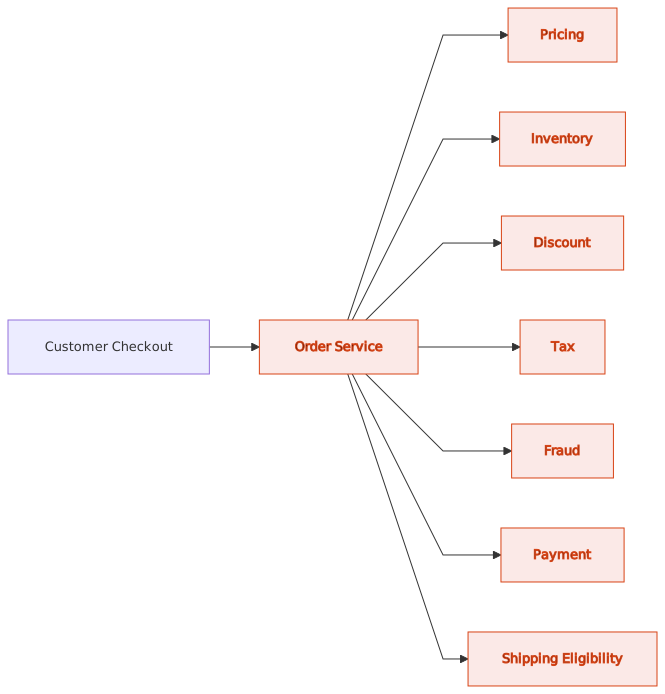
At first glance, these are separate services. In practice, Order Service is just an orchestration shell around a single distributed transaction. It owns very little. It depends on everything. This is not decomposition. This is a remote procedure call graph in business clothing.
A stronger model gives one service or bounded context ownership of the outcome and treats supporting information as inputs, policies, or asynchronously updated facts.

Here the Order context owns order acceptance as a business concept. Inventory owns stock reservation. Payment owns authorization. Events are business events. The flow is still distributed, but the semantics are clear. Each context owns decisions in its language.
That distinction matters more than the transport protocol.
Architecture
A useful way to think about the monolith-inside-microservices architecture is as a mismatch between visible topology and semantic topology.
Visible topology is what you put on a slide: APIs, queues, topics, services, databases, clusters.
Semantic topology is where decisions really live: which model has authority, where invariants are enforced, and how business meaning flows.
The hidden monolith appears when semantic topology remains centralized while visible topology is fragmented.
Core architectural characteristics
1. Distributed execution, centralized business transaction
Even when there are many services, one end-to-end workflow behaves like a giant transaction. The business expects all-or-nothing behavior, but the implementation cannot guarantee it without complex compensation. This leads to awkward timeout handling, orchestration engines, and support procedures disguised as architecture.
2. Service boundaries shaped by data entities
Customer service. Product service. Order line service. Address service.
These names are suspicious. They often reflect database decomposition rather than bounded contexts. Entities are useful, but businesses do not operate on nouns alone. They operate on capabilities: underwriting, fulfillment, claims adjudication, subscription lifecycle, settlement, entitlement. A service boundary built around a passive entity often lacks real autonomy.
3. Event streams with no semantic discipline
Kafka is powerful, but it is also a mirror. It reflects the quality of your domain thinking. If topics contain CustomerUpdated, AddressChanged, OrderLineInserted, or snapshots of mutable records, you have built asynchronous coupling. If they carry OrderAccepted, PaymentAuthorized, InventoryReserved, ClaimRejectedForPolicyLapse, you are getting closer to domain events.
4. Reconciliation as architectural necessity
In a hidden monolith, reconciliation becomes constant because no context truly owns the final state. One service thinks payment succeeded, another thinks stock expired, another thinks shipping was booked, and the customer sees “processing.” Reconciliation is not a sign of failure by itself; in distributed systems it is often necessary. The issue is whether reconciliation is a deliberate business mechanism or a daily tax on bad boundaries.
A more robust reference architecture
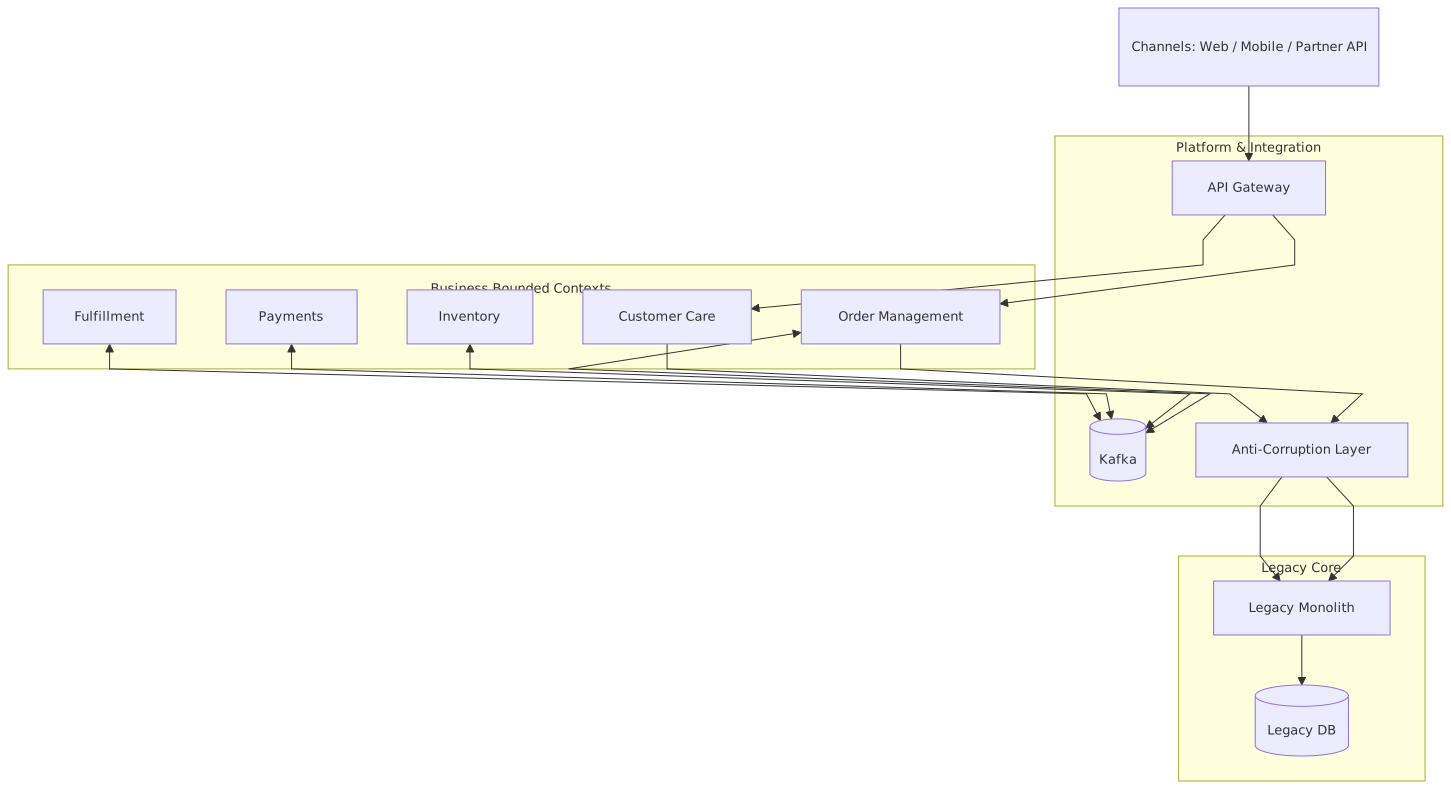
This architecture has a practical stance:
- bounded contexts for real business capabilities
- Kafka as an event backbone where asynchronous collaboration is appropriate
- an anti-corruption layer protecting new domain language from the legacy model
- progressive strangler migration rather than big-bang replacement
The crucial detail is not the boxes. It is that each context has its own model and does not leak legacy semantics into the rest of the platform.
Migration Strategy
A progressive strangler migration is the sane path for most enterprises. Big-bang rewrites are where confidence goes to die.
But strangling a monolith does not mean peeling off random services one by one. It means identifying seams in the business, isolating a bounded context, redirecting behavior, and reconciling state while trust is earned.
Step 1: Find business seams, not just technical seams
Good first candidates have these traits:
- clear domain boundary
- high change rate
- painful coupling in the current monolith
- manageable integration surface
- measurable business value
For example, “Promotions” in retail can be a good candidate if it has volatile rules and independent policy logic. “Customer” is often a bad first cut because customer data is usually entangled with every channel and compliance process in the enterprise.
Step 2: Establish an anti-corruption layer
The anti-corruption layer is not glamorous, but it is one of the few honest tools in migration architecture. Its job is to translate between the old model and the new one so that the new bounded context does not inherit the monolith’s conceptual debt.
Without it, teams copy legacy field names, status codes, and process assumptions straight into new services. Then the migration “succeeds” while preserving the old model’s flaws in a more expensive runtime.
Step 3: Redirect one business outcome
Do not migrate all reads and writes at once. Redirect one outcome. For example:
- new order acceptance
- stock reservation
- payment authorization
- claims triage
This creates a controlled operational slice. The old monolith may still serve surrounding processes, but one decision now belongs to the new context.
Step 4: Introduce events with business meaning
If Kafka is involved, start with events that represent completed business facts, not internal state churn. This is where many migration programs go off the rails. They publish every state transition because it is easy. Downstream services then couple to implementation details. Publish less, but publish meaningfully.
Step 5: Reconcile aggressively during coexistence
There is no dignified migration without reconciliation. During coexistence, data divergence is normal. What matters is how you detect, classify, and resolve it.
Reconciliation should include:
- idempotent commands and consumers
- replayable event streams where possible
- periodic comparison of authoritative state
- business exception queues
- support tooling for manual correction
- observability tied to business identifiers, not only technical traces
Architects often underspecify reconciliation because it sounds operational rather than strategic. That is a mistake. In enterprise migration, reconciliation is architecture.
Step 6: Retire old responsibilities deliberately
The strangler pattern fails when new services are added but old logic is never removed. Then you do not have decomposition; you have duplication with suspense. Make retirement explicit: switch traffic, decommission paths, archive old code, and remove backflow dependencies.
Enterprise Example
Consider a global insurer modernizing its claims platform.
The original claims system was a twenty-year-old monolith integrated with policy administration, payment disbursement, document management, fraud analytics, and customer service. Leadership wanted microservices, Kafka, and cloud deployment. The first attempt split the system into Claim Service, Policy Service, Customer Service, Document Service, Payment Service, Fraud Service, and Workflow Service.
On paper, it looked textbook.
In production, opening a claim required synchronous checks across policy coverage, customer identity, prior claims, fraud score, and payment preferences. The “Claim Service” owned almost none of the actual decisioning. Workflow logic was spread across services and BPM tooling. Event topics mirrored database updates. Support teams had no clear answer to a simple question: who decided this claim was accepted for processing?
The result was a hidden monolith with excellent dashboards.
The second iteration took a different path. The enterprise re-modeled around bounded contexts:
- Claim Intake owned first notice of loss and claim acceptance.
- Coverage Decisioning owned interpretation of policy applicability.
- Fraud Assessment owned risk evaluation.
- Claim Settlement owned approval and payment initiation.
- Customer Support owned case visibility and manual intervention.
A Kafka backbone remained, but event contracts changed. Instead of publishing generic updates, services emitted domain events such as ClaimRegistered, CoverageConfirmed, CoverageDenied, FraudReviewRequested, SettlementApproved, and PaymentInitiated.
During migration, Claim Intake used an anti-corruption layer to invoke parts of the legacy policy administration system. Reconciliation jobs compared claim status across old and new models daily. For six months, some claims were dual-tracked for audit confidence. Painful? Yes. Necessary? Absolutely.
What improved was not only deployment autonomy. It was business clarity. Claims handlers could finally see where a claim was stuck and which context owned the next decision. Teams could change fraud scoring without redeploying intake. Coverage logic became explicit instead of hidden in process glue. This is what good architecture does: it reduces ambiguity where money and risk meet.
Operational Considerations
Microservices are often sold as a design style. In enterprise reality, they are an operating model.
If you are living with a hidden monolith, operations becomes your early warning system.
Observability must follow business flows
Technical traces are useful, but they are not enough. You need correlation by business key: order ID, claim ID, policy ID, payment reference. Otherwise, a distributed workflow becomes a forensic exercise.
Track:
- process completion time
- waiting states between contexts
- event lag by topic and consumer group
- reconciliation backlog
- compensation rates
- manual intervention counts
- semantic errors, not just HTTP 500s
If the order pipeline is green but accepted orders are not shipping, your architecture is failing in a way infrastructure dashboards will not reveal.
Kafka requires contract discipline
Kafka can decouple time, but it does not decouple meaning. Treat event schemas as products. Version them carefully. Prefer immutable business facts. Avoid using topics as a shared integration junk drawer.
A practical rule: if consumers break because you changed an internal persistence representation, your events were never domain events.
Reconciliation is a first-class capability
Do not hide reconciliation in batch scripts under someone’s desk. Build it as part of the platform:
- dead-letter handling with operator workflows
- replay controls
- duplicate detection
- state comparison jobs
- exception dashboards
- business approval paths for correction
This is especially important in financial services, retail fulfillment, telecommunications, and healthcare, where eventual consistency has real customer and regulatory consequences.
Security and compliance cut across contexts
Distributed architecture widens the attack surface. It also complicates audit. Security boundaries should align with domain boundaries where possible, but compliance evidence often needs an end-to-end view. That means audit trails across services, immutable event retention where required, and careful handling of personally identifiable information in events and logs.
Platform maturity matters
A team that cannot reliably run ten services in production should not start with fifty. Container orchestration, CI/CD, secrets management, contract testing, schema evolution, and SRE discipline are not optional extras. Without them, microservices are all tax and no yield.
Tradeoffs
There is no clean victory here. Good architecture is usually a choice about which pain you prefer.
What you gain
- clearer ownership of business capabilities
- independent evolution where bounded contexts are real
- better scaling of teams and change
- resilience through isolation when failures are contained
- explicit handling of eventual consistency
- improved fit for event-driven integration and streaming analytics
What you pay
- more operational complexity
- harder debugging and distributed tracing
- consistency challenges
- schema and contract governance overhead
- longer path to initial stability during migration
- need for stronger domain modeling discipline
A modular monolith, by contrast, often gives simpler operations, easier transactions, and lower cognitive load. That is why I am skeptical of premature microservices. If your domain is still evolving quickly and team boundaries are not stable, a modular monolith can be the more mature choice. The best microservices programs often begin by building a better monolith first.
Failure Modes
The hidden monolith fails in predictable ways.
1. Orchestration service becomes the new god object
A central workflow service starts coordinating every business process. Soon it knows all states, all dependencies, all exception paths. You have rebuilt the monolith as process glue.
2. Shared reference services become bottlenecks
Customer, pricing, product, identity—these become overloaded enterprise utilities with dozens of consumers and no freedom to evolve. Every change turns political.
3. Event soup
Kafka topics multiply, semantics decay, and consumers subscribe to everything “just in case.” There is no clear ownership, only distributed anxiety.
4. Reconciliation backlog becomes business debt
Mismatches accumulate faster than teams can resolve them. Eventually customer service becomes the integration layer.
5. False autonomy
Teams own repositories but not outcomes. They can deploy code independently, but not deliver business changes independently. This is autonomy theater.
6. Latency chain collapse
A customer-facing transaction depends on too many synchronous calls. One slowdown ripples across the chain. Timeouts trigger retries. Retries amplify load. A graceful architecture becomes a storm system.
When Not To Use
You should not use this style—or at least not the full microservices treatment—when the domain is tightly coupled, transactional integrity is paramount, and team scale does not justify distribution.
More concretely, avoid it when:
- a modular monolith can meet your delivery needs
- the business process demands strong atomic consistency across most operations
- the domain language is still unsettled
- teams are small and highly collaborative
- platform operations are immature
- the main driver is fashion, procurement signaling, or slideware
If your application is effectively one cohesive decision engine with a single team and straightforward scaling needs, splitting it into services is vandalism dressed as architecture.
Likewise, if your organization has not yet learned to model bounded contexts, microservices will only industrialize confusion. DDD is not mandatory for all software, but for serious microservices it is close to mandatory. Without a shared language and explicit boundaries, the network will punish you.
Related Patterns
Several patterns sit close to this discussion.
Modular Monolith
Often the right starting point. Strong internal modules, one deployment unit, clear domain boundaries, fewer operational burdens. A good modular monolith is not a failed microservices architecture. It is usually a prerequisite for one.
Strangler Fig Pattern
Essential for progressive migration. Replace behavior incrementally, route traffic gradually, and retire the legacy system piece by piece.
Anti-Corruption Layer
Crucial when introducing new bounded contexts beside a legacy model. It protects the new language from contamination.
Saga
Useful for coordinating long-running distributed business transactions. But use carefully. A saga can make consistency explicit, or it can become a storybook of architectural regret if every simple process needs one.
Event Sourcing and CQRS
Sometimes valuable for domains where event history and auditability matter. But they are not antidotes to poor boundaries. If your model is wrong, event sourcing will preserve the wrongness with perfect fidelity.
Data Mesh and Domain Data Products
Relevant when operational bounded contexts feed analytical domains. But analytical ownership should not drive operational coupling. Keep the distinction clear.
Summary
The monolith inside microservices architecture is not a contradiction. It is a warning.
You can have dozens of services, Kafka everywhere, cloud-native deployment, and still be running one giant application in semantic disguise. The hidden monolith appears when business decisions remain centralized, service boundaries ignore domain semantics, and end-to-end change still demands coordinated motion across the whole estate. cloud architecture patterns
The cure is not blind decomposition. It is disciplined decomposition.
Start with bounded contexts. Model business capabilities, not tables. Use progressive strangler migration. Introduce anti-corruption layers. Publish business events, not persistence noise. Design reconciliation as a first-class concern. Accept tradeoffs honestly. And know when a modular monolith is the more sophisticated answer.
A distributed system should distribute responsibility, not just runtime.
That is the line worth remembering.
Frequently Asked Questions
What is a service mesh?
A service mesh is an infrastructure layer managing service-to-service communication. It provides mutual TLS, load balancing, circuit breaking, retries, and observability without each service implementing these capabilities. Istio and Linkerd are common implementations.
How do you document microservices architecture for governance?
Use ArchiMate Application Cooperation diagrams for the service landscape, UML Component diagrams for internal structure, UML Sequence diagrams for key flows, and UML Deployment diagrams for Kubernetes topology. All views can coexist in Sparx EA with full traceability.
What is the difference between choreography and orchestration in microservices?
Choreography has services react to events independently — no central coordinator. Orchestration uses a central workflow engine that calls services in sequence. Choreography scales better but is harder to debug; orchestration is easier to reason about but creates a central coupling point.